Licence Creative Commom
CC
RBCDH
1 Federal University of Santa Catarina, Graduate Program in Physical Education. Laboratory of Biomechanics. Florianópolis, SC. Brazil
Received: 03 October 2014 Accepted: 28 January 2015
Bilateral asymmetry of knee and ankle
isokinetic torque in soccer players u20
category
Assimetria bilateral no torque isocinético do joelho e
tornozelo em jogadores de futebol da categoria sub 20
José Raphael Leandro Costa Silva1 Daniele Detanico1
Juliano Dal Pupo1 Cintia de la Rocha Freitas1
Abstract– Bilateral asymmetries and muscle imbalances are associated with increased risk
for lower limb injuries and still seem to imply in athletes performance. his study aimed to analyze bilateral asymmetry of soccer players in age category below 20 years old (peak torque and conventional and functional reason in extensor/lexors of knee and inverter/ eversion of ankle) and to compare these variables between defending, midield and at-tacker players. he study included 22 athletes in age category below 20, which underwent a ive maximal isokinetic testing with repetitions at 180°/s for knee and 120°/s for ankle, both concentric and eccentric actions. T test for dependent data was used to compare values of torque between dominant and non-dominant limbs and one-way ANOVA was used to compare neuromuscular variables between players of diferent positions, both at p <0.05. No signiicant diferences were observed in any neuromuscular variable (peak torque and functional and conventional ratio) between dominant and non-dominant sides (p> 0.05). It was found that defensive players had eccentric torque values of extensors knee higher than midield players (p <0.05). Defensive players exhibit greater eccentric torque of knee extensor muscles compared to midield players. It can be concluded that the analyzed soccer players did not present bilateral asymmetries in lexor/extensor knee muscles neither in inverter/eversion ankle muscles.
Key words: Asymmetry index; Injury; Muscle imbalance; Soccer.
Muscle asymmetry in soccer players Costa Silva et al.
INTRODUCTION
Soccer is a sport in which the energy supply is predominantly aerobic, considering the total efort time. However, it has intermittent character-istics, allowing performing high-intensity actions such as sprints with constant accelerations, decelerations, jumps and kicks, requiring high energy demand from anaerobic systems1. In view of these characteristics, neuromuscular properties such as ability to produce force and power in the lower limbs is considered an important determinant for the performance of soccer players2-4.
During a soccer game, players oten perform diferent actions, many of which are unilateral such as kicks, passes and movements to change the running direction in order to achieve greater success in carrying out these actions12. It has been reported that the performance of continuous and prolonged acyclic actions with asymmetrical motor pattern may cause force deicit between two segments (bilateral asymmetry) or among agonists
/ antagonists muscle groups of the same segment (muscle imbalance)5,6.
Fousekis et al.6 reported that muscular asymmetry may be related or be dependent on age or training time of athletes and playing positions. Young players tend to be more asymmetric than more experienced players due to more balanced use of forces of the lower limbs by the latter, which may be a preventive neuromuscular strategy in relation to the process of specialized training5,6. Some results suggest that the position or function performed in the ield can also promote asymmetries in muscle function between lower limbs, which could impair performance during game actions11. Silva
et al.4 observed diferences in muscle power of lower limbs among soccer
players, according to their position in the ield3, in which defenders were more powerful than midielders, probably due to the higher number of high-intensive tasks such as jumps and short-distance sprints4. However, it is not clear whether there is diference in knee and ankle muscle torque and levels of asymmetry among players of diferent positions.
An important aspect to be highlighted is that bilateral force asymme-tries and imbalances in power capacity between agonist and antagonist muscles have been associated with increased risk for muscle injuries in the lower limbs6,7. Among these, hamstring muscle strains7 and injuries in the knee ligaments5,6 are the most reported in soccer players7,5,6. his type of injury commonly occurs in team sports athletes during the performance of maximum sprints, more speciically, during the inal phase of the free leg swinging in step cycle, time at which hamstrings eccentrically act to slow down the leg and control knee extension11,12. According to Small et al13, power imbalance between hamstrings and quadriceps is the main risk factor for muscle injuries14.
In this context, this study aimed to: i) analyze bilateral asymmetry of soccer players U20 category, considering concentric and eccentric peak
torque (PT) and conventional and functional ratioof knee extensors /
lexors and ankle eversor / inversor muscles; ii) compare isokinetic torque variables among players of diferent positions (defenders, midielders and forwarders). hus, it was hypothesized that young athletes would show bilateral asymmetries and that there are diferences in isokinetic PT ac-cording to the position in the match.
METHODOLOGICAL PROCEDURES
Subjects
Twenty-two soccer players U20 category aged 18-20 years participated in this cross-sectional study, with practice time 8.0 ± 1.3 years, body mass 74.0 ± 7.1 kg, height 177 8 ± 6.5 cm and fat percentage 10.7 ± 1.9%, belonging to a professional soccer club in the city of Florianópolis, SC. Brazil. Athletes trained on average ive times per week for approximately 90 minutes. he following inclusion criteria were used: 1) to train at least 5 times a week; 2) not be injured at the time of collection; 3) to sign the informed consent form. Goalkeepers were excluded from the sample due to their training speciicity and function performed in the ield. he sample selection was non-probabilistic and intentional type, with volunteer participation. Sample size was calculated based on the efect size = 0.5 (moderate efect) and p = 0.05, set at minimum power of 80% of the statistical analysis.
Subjects were informed about the research objectives and methods before starting the data collection procedures and then signed the informed consent form, which presented the agreement with conducting evaluations. his study was approved by the Ethics Committee for Research with Human Beings of the local university under protocol No: 724427.
Data collection procedures
Soccer players were evaluated in two stages. Initially, anthropometric meas-urements were performed and then the knee and ankle isokinetic torque evaluation of dominant (DOM) and nondominant limbs (NON-DOM). Dominant limb was considered as that that the athlete reported having a preference to make technical movements such as control or passes.
Knee isokinetic torque evaluation
Muscle asymmetry in soccer players Costa Silva et al.
the malleolus medialis of the tibia. he motion range was maintained at 90° of lexion from the full knee active extension. Athletes were evaluated by an experienced researcher who, through verbal command, encouraged them throughout the test for maximum force performance.
he protocol applied for the knee isokinetic torque measurement was performed as follows: to familiarize in the angular velocity of 180°/s, three submaximal voluntary contractions in the concentric / eccentric mode (CON / EXC) of knee extensors were performed. Ater 120 seconds, ive maximal voluntary contractions in CON / EXC mode of the same muscle group were performed, which were considered for analysis. he same procedures were followed for the isokinetic torque assessment in the eccentric / concentric mode (EXC / CON) of knee lexors. he protocols were performed in both legs, always starting with DOM. In both protocols (CON / EXC and EXC / CON), peak torque (PT) was considered as the highest value obtained in ive replicates using the Biodex System sotware 4. he conventional ratio was calculated using the ratio between PTCON of lexors and PTCON of extensors. he functional ratio was calculated by the ratio between PTEXC of lexors and PTCON of extensors.
In addition to PT, the asymmetry index (AI) between dominant and
nondominant limbs was calculated, as proposed by Kobayashi et al13:
AI = {(PTdom-PTndom) / (+ PTdom PTndom)} × 100 (%)
Ankle Isokinetic torque evaluation
Athletes remained sat with chair backrest kept at 70
º, knee
po-sitioned between 30
ºand 45
º, ixation support at the calf height
and ankle with 35
ºof plantar lexion. he dynamometer shat was
aligned with the lateral malleolus, according to manufactures’
recommendations. he motion range was maintained at 55
ºfrom
maximum active eversion.
For isokinetic torque measurement, a protocol similar to that described for the knee joint was used, with three submaximal voluntary contractions for familiarization, followed by 5 maximal voluntary contractions in CON / EXC (ankle inverters) and EXC / CON (ankle everters) modes, angular velocity of 120°/s and rest interval of 120 seconds between them.
he selected angular velocities (180ºŸs-1 for knees and 120ºŸs-1 for ankles) have been widely used to evaluate muscle strength in soccer play-ers6,8,12,14, as they favor the force-velocity relation of muscles and provide more applicable information on muscle power. Eccentric contractions can better simulate the joint stabilization function held during the various actions of the soccer game15.
PTCON of ankle eversors and PTCON of ankle inversors and the functional ratio was calculated using the ratio between PTEXC of ankle eversors and PTCON of ankle inversors.
Statistical analysis
Data was presented using descriptive statistics (mean and standard de-viation). Data and residue normality was tested using the Shapiro-Wilk test. he t test for dependent data was used to compare the torque values between dominant and nondominant limbs and analysis of variance (one-way ANOVA) with post hoc Tukey to compare neuromuscular parameters (peak torque, muscle ratios and asymmetry index) among players of dif-ferent positions (defenders, midielders and forwarders). Signiicance level set at 5% was adopted for all tests and the sotware used for analysis was SPSS Statistics 17.0.
RESULTS
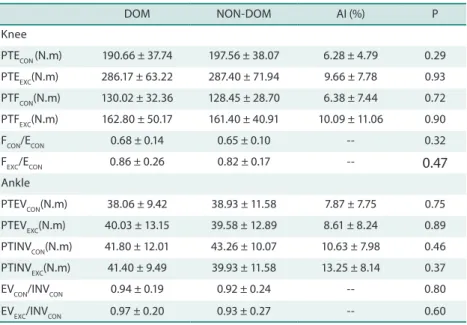
Table 1 shows the isokinetic torque values of knee extensor and lexor and ankle inversor and eversor muscles in concentric and eccentric muscle ac-tion of dominant and nondominant limbs. No signiicant diferences were found in knee and ankle peak torque between lower limbs.
Table 1. Isokinetic torque parameters of knee extensor/lexor and ankle inversor/eversor muscles in concentric and eccentric muscle action in the dominant (DOM) and nondominant limb (NON-DOM) and asymmetry indexes (% AI) between segments.
DOM NON-DOM AI (%) P
Knee
PTECON (N.m) 190.66 ± 37.74 197.56 ± 38.07 6.28 ± 4.79 0.29
PTEEXC(N.m) 286.17 ± 63.22 287.40 ± 71.94 9.66 ± 7.78 0.93
PTFCON(N.m) 130.02 ± 32.36 128.45 ± 28.70 6.38 ± 7.44 0.72
PTFEXC(N.m) 162.80 ± 50.17 161.40 ± 40.91 10.09 ± 11.06 0.90
FCON/ECON 0.68 ± 0.14 0.65 ± 0.10 -- 0.32
FEXC/ECON 0.86 ± 0.26 0.82 ± 0.17 -- 0.47
Ankle
PTEVCON(N.m) 38.06 ± 9.42 38.93 ± 11.58 7.87 ± 7.75 0.75
PTEVEXC(N.m) 40.03 ± 13.15 39.58 ± 12.89 8.61 ± 8.24 0.89
PTINVCON(N.m) 41.80 ± 12.01 43.26 ± 10.07 10.63 ± 7.98 0.46
PTINVEXC(N.m) 41.40 ± 9.49 39.93 ± 11.58 13.25 ± 8.14 0.37
EVCON/INVCON 0.94 ± 0.19 0.92 ± 0.24 -- 0.80
EVEXC/INVCON 0.97 ± 0.20 0.93 ± 0.27 -- 0.60
Muscle asymmetry in soccer players Costa Silva et al.
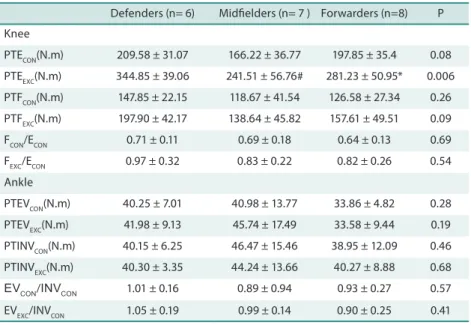
Table 2 shows the torque parameters in the knee extensor and lexor and ankle inversor and eversor muscles in concentric and eccentric muscle action on the dominant limb of defenders, midielders and forwarders. here was a signiicant diference only in eccentric PT of extensor muscles (PTEEXC), and defenders showed higher values than midielders, but showed no diference from forwarders.
Table 2. Isokinetic torque parameters of knee extensor/lexor and ankle inversor/eversor muscles of the dominate limb of defenders, midielders and forwarders.
Defenders (n= 6) Midielders (n= 7 ) Forwarders (n=8) P
Knee
PTECON(N.m) 209.58 ± 31.07 166.22 ± 36.77 197.85 ± 35.4 0.08
PTEEXC(N.m) 344.85 ± 39.06 241.51 ± 56.76# 281.23 ± 50.95* 0.006
PTFCON(N.m) 147.85 ± 22.15 118.67 ± 41.54 126.58 ± 27.34 0.26
PTFEXC(N.m) 197.90 ± 42.17 138.64 ± 45.82 157.61 ± 49.51 0.09
FCON/ECON 0.71 ± 0.11 0.69 ± 0.18 0.64 ± 0.13 0.69
FEXC/ECON 0.97 ± 0.32 0.83 ± 0.22 0.82 ± 0.26 0.54
Ankle
PTEVCON(N.m) 40.25 ± 7.01 40.98 ± 13.77 33.86 ± 4.82 0.28
PTEVEXC(N.m) 41.98 ± 9.13 45.74 ± 17.49 33.58 ± 9.44 0.19
PTINVCON(N.m) 40.15 ± 6.25 46.47 ± 15.46 38.95 ± 12.09 0.46
PTINVEXC(N.m) 40.30 ± 3.35 44.24 ± 13.66 40.27 ± 8.88 0.68
EVCON/INVCON 1.01 ± 0.16 0.89 ± 0.94 0.93 ± 0.27 0.57
EVEXC/INVCON 1.05 ± 0.19 0.99 ± 0.14 0.90 ± 0.25 0.41
PTECON: Concentric PT of knee extensors; PTEEXC: Eccentric PT of knee extensors; PTFCON: Concentric PT of knee lexors; PTFEXC: Eccentric PT lexors of knee lexors; FCON/ECON:knee conventional ratio; FEXC / ECON knee functional ratio; PTEVCON: concentric PT of ankle eversors; PTEVEXC: eccentric PT of ankle eversors; PTINVCON: Concentric PT of ankle inversors; PTINVEXC: Eccentric PT of ankle inversors; EVCON / INVCON: ankle conventional ratio; EVEXC / INVCON: ankle functional ratio. * Signiicantly diferent from defenders and midielders. # Signiicantly diferent from defenders.
DISCUSSION
he irst aim of this study was to analyze the bilateral asymmetry of soccer players U20 category (peak torque and conventional and functional ratio of knee extensors / lexors and ankle inversors / eversors). According to results, there was no diference in torque variables between dominant and nondominant limbs, as well as in conventional and functional ratios, thus rejecting the hypothesis of this study. It had been hypothesized inding force asymmetries, as soccer players almost never use both limbs with the same emphasis, focusing on the dominant limb17. Analyzing the AI values, it was observed that they are within normality standards suggested in literature (less than 15%)6,8-10. his result may have been inluenced by the methodology used in the training of these athletes, who are encouraged to perform technical movements with both limbs, avoiding the exclusive use of the dominant limb.
non-dominant limb tends to present higher values in the eccentric torque of lexors, which is in agreement with results found in this investigation. hese diferences are possibly related to the diferent muscle functions between dominant and nondominant limbs during the match actions, which exert, for example, in the kick moment, eccentric force of the knee extensors, while applies concentric force of this muscle group in the contralateral limb. hese characteristics may lead to diferences in overloads received by muscle groups during training / matches12. he superiority of the PT
EXC of knee lexors in the dominant limb was observed in other studies14,16,18, which could be justiied by the speciic actions of this muscle group, such as when making passes, there is a concentric contraction of knee extensor and eccentric contraction of lexor muscles in the dominant limb. his action promotes distinct adaptations in lexor muscles as to develop greater capacity to produce eccentric force, as this contraction plays a key role in protection and stabilization of the knee joint, thus avoiding the anterior tibial translation in relation to the femur, especially in end angles of knee extension during intense contractions of extensor muscles19.
Even though our study found no bilateral asymmetry, literature has reported that bilateral force asymmetry, particularly eccentric force (>15%) and agonist / antagonist muscle imbalances are considered risk factors for injuries9. It has been reported that asymmetries seem to be related with age and practice time in sport. According to Fousekis et al6, older players have lower force asymmetry and higher force indexes compared to young athletes, as these athletes possibly use in a more balanced manner forces as a neuromuscular preventive strategy against excessive fatigue and injury. In the same study, Fousekis et al.6 indicated that less experienced athletes had higher prevalence of force asymmetries, probably due to their reduced capacity to deal with pre-existing asymmetries from the incomplete
de-velopment of neuromuscular pattern6.
It has been reported that for the ankle, muscle imbalance between in-versor and ein-versor torque can be a risk factor for injuries in this joint20-22. Sprains are the most reported due to inversion ankle, afecting the lateral ligaments of the knee joint22, and functional ratio values near 1.0 seem to be a pattern to the ankle joint, regardless of physical activity performed23. In prospective study investigating ankle injury risk factors, it was identiied that functional ratio smaller than 1.0 would be an important indicator of ankle sprain22. However, it is essential to observe that the eccentric PT of inversors muscles must present values above the concentric PT of eversors, since studies report that the weakness of inversors muscles makes the ankle chronically unstable24,25 and therefore susceptible to injuries.
Muscle asymmetry in soccer players Costa Silva et al.
be justiied due to the performance of similar speciic actions between defenders and forwarders, mainly composed of short and intense
move-ments like sprints and jumps, demanding great efort of knee extensors9.
Another point to be considered is that the technical training of defenders and forwarders is also similar, but midielders are submitted to more speciic training routine and with more prolonged actions9.
Conventional and functional ratios showed no diferences among position of players in the match. Defenders have balance of both muscle groups near the ideal considered in literature (PTFCON/PTECON = 0.60 – 0.70; PTFEXC/PTECON ≥ 1.0)10,16. Midielders and forwarders have conventional ratio values for knee close to ideal, 0.69 and 0.64, respectively, but the functional ratio values are within standards for these muscle groups9. hese indings can be justiied because the eccentric PT values of knee lexors are lower than the concentric PT values of knee extensors. hese values are close to those found in other studies8,17,19; thus, for these athletes, training aimed at increasing eccentric force capacity of lexors would be relevant, as it would promote an increase in functional knee ratio, which could promote a reduction in this injury risk factor. An interesting point was highlighted by Crosier et al.9, who found that soccer players with functional ratio higher than 1.4 had never sufered hamstring injury. hese indings show the importance of functional ratio values greater than 1, because this way, hamstrings would be better able to withstand the powerful actions of eccentric contraction in times of high-intensity leg displacement9. During a soccer match, a decrease in eccentric PT of hamstrings resulting from fatigue was observed, which could decrease this ratio, especially at the inal moments of the match7,26. To the ankle joint, values observed were close to 1. hus, it is suggested that these values could be a balancing standard for athletes with no history of instability or injury in the ankle joint23.
CONCLUSION
We concluded that soccer players analyzed in thus study showed no bilateral asymmetries in knee lexor / extensor as well as in ankle inversor / eversor muscles. Analyzing the variables among players of diferent positions, we concluded that defenders have higher eccentric torque in knee extensors compared to midielders, with no diference from forwarders. Finally, further studies should be carried out with a larger sample size in order to identify a proile of muscular asymmetry in soccer players of diferent ages, verifying possible adjustments according to training speciicity.
REFERENCES
1. Coelho DB, Pimenta EM, Veneroso CE, Morandi RF, Pacheco DAS, et al. Assess-ment of acute physiological demand for soccer. Rev Bras Cineantropom Desem-penho Hum 2013;15(6):667-76.
2009;15(4):861-70.
4. Silva JF, Detanico D, Floriano LF, Dittrich N, Nascimento PC, Santos SG, et al. Levels of muscle power in soccer and futsal athletes of diferent categories and positions. Motr 2012;8(1):14-22.
5. Masuda K, Kikuhara N, Demura S, Katsuta S, Yamanaka K. Relationship between muscle strength in various isokinetic movements and kick performance among soccer players. J Sports Med Phys Fitness 2005;45(1):44-52.
6. Lehance C, Binet J, Bury T, Croisier JL. Muscular strength, functional performances and injury risk in professional and junior elite soccer players. Scand J Med Sci Sports 2009;19(2):243-51.
7. Fousekis K, Tsepis E, Poulmedis P, Athanasopolus S, Vagenas G. Intrinsic risk factors of non-contact quadriceps and hamstring strains in soccer: a prospective study of 100 professional players. Br J Sports Med 2011;45(9):709-14.
8. Fousekis K, Tsepis E, Vagenas G. Lower limb strength in professional soccer players: proile, asymmetry, and training age. J Sports Sci Med 2010;9(3):364-73
9. Carvalho P, Cabri J. Isokinetic muscle strength in the thigh soccer player. Revi Port Fisioter Desp 2007;1(2):4-13
10. Brito J, Figueiredo P, Fernandes L, Seabra A, Soares JM, Krustrup P, et al. Isoki-netic strength efects of FIFA’s “he 11+” injury prevention training programme. Isokinetics and Exercise Science 2010;18(1):211-5.
11. Novacheck TF. he biomechanics of running – review paper. Gait and Posture 1998 (7):77-95.
12. Pinniger G, Steele J, Groeller H. Does fatigue induced by repeated dynamic eforts afect hamstring muscle function? Med Sci Sports Exerc 2000 32(3):647-53.
13. Small K, McNaughton L, Greig M, Lovel R. he efects of multidirectional soccer-spe-ciic fatigue on markers of hamstring injury risk. J Sci Med Sport 2010;13(1):120-125.
14. Croisier JL, Ganteaume S, Binet J, Genty M, Ferret JM. Strength Imbalances and Prevention of Hamstring Injuryin Professional Soccer Players. Am J Sports Med 2008; 36(8):1469-75.
15. Teixeira J, Carvalho P, Moreira C, Santos R. Isokinetic Assessment of Muscle Imbal-ances and Bilateral Diferences between Knee Extensores and Flexores’ Strength in Basketball, Footbal, Handball and Volleyball Athletes. Int J Sports Sci 2014;4(1):1-6.
16. Arnason A, Andersen T, Holme I, Engebretsen L, Bahr R. Prevention of hamstring strains in elite soccer: an intervention study. Scand J Med Sci Sports 2008;18(1):40-8.
17. Kobayashi Y, Kubo J, Matsubayashi T, Matsuo A, Kobayashi K, Ishii N. Relationship between bilateral diferences in single-leg jumps and asymmetry in isokinetic knee strength. J Appl Biomech 2013;29(1):61-7.
18. Baumhauer JF, Alosa DM, Renstrom AFH, Trevino S, Beynnon B. A prospective study of ankle injury risk factors. Am J Sports Med 1995;23(5):564-570.
19. Alonso AC, Greve JMD, Macedo O, Pereira CAM, Souza PCM. Isokinetic evalu-ation of ankle eversion and inverters: a comparative study between soccer players and sedentary normal. Rev Bras Fisioter 2003;7(3):195-9.
20. Zakas A. Bilateral isokinetic peak torque of quadriceps and hamstring muscles in professional soccer players with dominance on one or both two sides. J Sport Med Phys Fitness 2006;46(1):28‐35.
21. Daneshjoo A, Rahnama N, Mokhtar AH, Yusof A. Bilateral and unilateral asym-metries of isokinetic strength and lexibility in male young professional soccer players. J Hum Kinet 2013;28(36):45-53.
22. Iga J, George K, Lees A, Reilly T. Cross-sectional investigation of indices of isoki-netic leg strength in youth soccer players and untrained individuals. Scand J Med Sci Sports 2009;19(5):714-9.
Muscle asymmetry in soccer players Costa Silva et al.
Corresponding author
José Raphael Leandro da Costa Silva. Universidade Federal de Santa Catarina.
Campus Universitário.
Laboratório de Biomecânica – CDS/ UFSC
E-mail: [email protected]
24. Weber FS, Silva BGC, Radaelli R, Paiva C, Pinto RS. Isokinetic assessment in pro-fessional soccer players and performance comparison according to their diferent positions in the ield. Rev Bras Med Esporte 2010;16(4):264-8.
25. Magalhães J, Oliveira J, Ascensão A, Soares JMC. Isokinetic strength assessment in athletes of diferent sports, ages, gender and positional roles. Rev Port Cien Desp 2001;1(2):13-21.
26. Valderrabano V, Barg A, Paul J, Pagenstert G, Wiewiorski M. Foot and ankle in-juries in professional soccer players. Sport Orthop Traumatol 2014;30(2):98-105.
27. Engebretsen AH, Myklebust G, Holme I, Engebretsen L, Bahr R. Intrinsic risk factors for acute ankle injuries among male soccer players: a prospective cohort study. Scand J Med Sci Sports 2010;20(3):403-10.
28. Munn DJ, Beard KM, Refshauge RY, Lee RY. Eccentric muscle strength in functional ankle instability. Med Sci Sports Exerc 2003;35(2):245-50.
29. Hartsell HD, Spaulding SJ. Eccentric/concentric ratios at selected velocities for the invertor and evertor muscles of thechronically unstable ankle. Br J Sports Med 1999; 33(4):255-8.