
0103 - 5053 $6.00+0.00
A
r
ti
c
le
* e-mail: [email protected]
A Study of the Elemental Reactions Involved in the Initiation of the Polymerization of
Tetrahydrofuran Induced by the Photosensitization of a Triphenylsulphonium Salt by Perylene
Miguel G. Neumann *,a and Maira R. Rodriguesb
a
Instituto de Química de São Carlos, Universidade de São Paulo, CP 780, 13560-970 São Carlos - SP, Brazil
b
Universidade do Vale do Paraíba, Av. Shishima Hifumi, 2991, Urbanova, 12244-000 São José dos Campos - SP, Brazil
A fotopolimerização de THF foi estudada na presença de sal de trifenilsulfônio e perileno. O mecanismo envolve uma transferência de elétron do estado singlete excitado do perileno para os íons trifenilsulfônio, levando à formação de cátions radicais, que reagem com o tetrahidrofurano. O rendimento aparente de cátions radicais calculado do mecanismo proposto tem o mesmo comportamento geral que as velocidades de polimerização medidas experimentalmente.
The photopolymerization of THF was studied in the presence of a triphenylsulphonium salt and perylene. The mechanism involves an electron transfer from the excited singlet state of perylene to triphenylsulphonium ions, resulting in perylene cation radicals that react with tetrahydrofuran. The calculated apparent yield of cation radicals follows the same general trend than the measured polymerization rates.
Keywords: Photopolymerization, perylene sensitization, THF polymerization
Introduction
There is growing interest in polymerizations initiated by external stimulation, such as photoirradiation or high-energy radiation,1 and much effort has been devoted to develop systems that may initiate the polymerization processes through cationic2,3,4 and radical mechanisms.5,6 Cationic polymerization is widely applicable for both vinyl and ring-opening polymerizations giving place to many studies of both academic and industrial interests.7 Thermally stable onium salts, such as diaryliodonium and triarylsulphonium salts, in the presence of low nucleophilic complex metal halide anions are well established photoinitiators for cationic polymerization by direct irradiation8 and photosensitization.9,10
Sensitization by energy- or electron-transfer is often used to overcome the unfavourable absorption properties of these compounds. The addition of sensitizers leads to complex mechanisms involving intermediates of various types. To understand those mechanisms, studies of the elemental reactions and the product distributions are needed. Photosensitized cationic polymerizations with compounds absorbing at longer wavelengths attract
particular interest since the triggering of the initiation may be extended beyond the UV region.4
The ring-opening polymerizations of several oxirane monomers have been studied quite frequently and have been known for a long time. Direct and photosensitized11 irradiation of onium salts12,13 can generate strong Brønsted acids that will begin the polymerization processes. On the other hand, perylene has already been used as sensitizer14 for the polymerization of this type of compounds, whereas the initiation of the polymerization of THF has been obtained using various systems.15
yield of cation radicals was calculated using data obtained for the elemental reactions. Similar mechanistic studies were already reported for the cationic photopolymerization of THF by sulphonium salts sensitized by thioxanthone16 and phenothiazine.17
Experimental
Chemicals
Perylene (Pery, Aldrich, 99%) was purified by recrystallization from toluene before use and triphenyl-sulphonium hexafluoroarsenate (Johnson Matthey Co.) was used as received. The monomer tetrahydrofuran (THF, Fluka GC grade) and the solvent dichloromethane (Mallinckrodt, HPLC) were dried over CaCl2.
Photopolymerization procedure
The light-induced polymerization of THF in the presence of the photoinitiator system (Pery - S+) was conducted in a dilatometer.16,17 The solution was thoroughly deoxygenated by bubbling oxygen-free nitrogen. The dilatometer was constructed by attaching two capillaries (internal diameter 0.18 cm) to a cylindrical reaction vessel (internal diameter 2.2 cm, volume 8 mL), which was placed in a constant temperature bath (30.00 ± 0.01 oC) in front of the irradiation source. The reaction cell was placed in front of a monochromatic light source (405 or 366 nm) selected with a monochromator from the output of a 200 W Hg(Xe) lamp in an Oriel Universal Arc Lamp source.
The polymerization rates (Rp) were calculated using
[THF] .
F.t f h
Rp = (mol L-1 s-1) (1)
where h is the contraction in volume in the capillary (measured with a cathetometer) at time t; f is the volume fraction of monomer THF in the solution; F is the volume contraction related to the densities of polymer and
monomer in solution [F = (d
p-dm)/dp], and [THF]
corresponds to the monomer molar concentration. The rates of all photoinitiated polymerizations were corrected for the changes in the incident light intensity. Conversion percentages were calculated by multiplying the polymerization rates by the irradiation time and dividing by the monomer concentration (12.34 mol L-1).
After irradiation, the polymers (poly-THF) were precipitated by addition of NH4OH in methanol, washed, filtered, dried in a dissecator and characterized by gel permeation chromatography.
Photochemical measurements
The fluorescence decays and lifetimes were measured using the single-photon timing technique on a CD-900 Edinburgh spectrometer, operating with a nanosecond hydrogen-filled flash lamp pulsing at 25-30 kHz, at room temperature (25 ± 1 °C). The excitation wavelength was 436 nm and the emission was monitored at 469 nm.
Static fluorescence quenching experiments were carried out at room temperature using a Hitachi F-4500 spectrofluorimeter. Pery was excited at 430 nm and the emission was determined at the maximum of the emission peak. Absorption spectra were measured on a Hitachi U-2000 spectrophotometer.
Photolysis of Pery oxygen-free solutions at 355 nm was performed using the third harmonic of a Nd-YAG laser (Spectron) pulsed at 1 Hz. The FMHW of the pulses was 20 ns with an energy of ~80 mJ.
Actinometry was performed using ferrioxalate/ phenanthroline salt. The quantum efficiency of this actinometer is ~1.0 at wavelengths below 405 nm.18
The concentration of the sensitizer, Pery in dichloro-methane, was kept around 2.0×10⁻⁴ mol L-1, in order to obtain a reasonable absorption at the excitation wavelength.
Results and Discussion
In order to establish the mechanism that leads to the photopolymerization of THF in the presence of Pery and S+, it is necessary to evaluate all the possible elemental reactions that may happen in the system. Therefore, interactions between the three components of the system were studied in the ground and excited states. Evidence for the formation of complexes and exciplexes, quenching of the excited states, as well as the behaviour of the Pery cation radical were investigated. No chemistry or any other evidence of the participation of the triplet state of the sensitizer was found.
Ground state interactions
These changes suggest the formation of a ground-state complex between both species present in the solution.
Singlet state processes
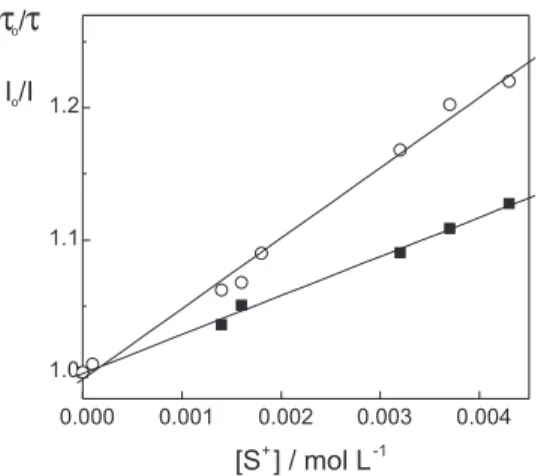
The lifetimes of the singlet excited state of Pery in the absence and presence of S+ and THF were obtained from the fluorescence decays. The lifetime of 1Pery was found to be 6.63 ns, in good agreement with the previously reported value of 6 ns.19 The Stern-Volmer plots for the quenching of the singlet excited state of Pery by S+ were obtained from both the changes in the emission intensity and the fluorescence lifetimes, as shown in Figure 2. Similar linear plots were also obtained for the quenching by THF. As the plot for the total quenching is linear, the static and dynamic contributions to the quenching process could be evaluated using equation 2
K
SV≅ Kc + Dk
q.τ0 (2)
where K
C corresponds to the ground state complexation
constant and Dk
qτ0 is the dynamic quenching contribution. The calculated values are listed in Table 1.
The values of the complexation constant show that approximately 45% and 95% of the quenching of 1Pery by
S+ or THF are due to the formation of ground state
complexes, respectively
Pery + Q [Pery…Q] (3)
where Q represents a molecule of S+ or THF.
No chemistry involving the triplet state was detected in this study, as expected for polynuclear aromatic hydrocarbons which normally present low intersystem crossing quantum yields.20
Perylene cation radical
Perylene solutions containing different concentrations of S+ were photolysed using the 335-nm laser emission. A decrease in the absorption wavelengths corresponding to the ground state of Pery (370-450 nm) were observed after photolysis, simultaneous to a growth in the absorption in the 450-530 nm region (Figure 3). The solutions acquired a yellowish colour with a bluish fluorescence. This fluorescence, as well as the new absorption are assigned to the Pery cation radical (Pery+•), according to previous reports on this species.21 This cation radical is formed by the electron transfer quenching of the excited singlet sensitizer, i.e.
1Pery + S+→1[Pery…S+] →1[Pery+•…S•]
↓ (4)
Pery+• + S•
where 1[Pery…S+] is an excited encounter complex, which may lead to the exciplex 1[Pery+•…S•] after electron transfer. This complex can eventually dissociate to generate the cation radical Pery+• and the radical S•. Exciplexes of this type have been described quite frequently for similar systems.3,9
Figure 1. Differential spectrum of the mixture of Pery (2.0×10⁻⁴ mol L-1) and S+ (1.0×10⁻⁴ mol L-1) in dichloromethane.
Table 1. Stern-Volmer constants, quenching rate constants of 1Pery (k
q) by S
+ and THF, and ground state complexation constants K
C
Quencher Ksv (L mol-1) k
q (L mol
-1 s-1) DK sv (L mol
-1) Dk q (L mol
-1 s-1) K C (L mol
-1)
S+ 53.3 8.04×10⁹ 29.5 4.45×10⁹ 23.8
THF 11.4 1.72×10⁹ 0.62 9.3 ×10⁷ 10.8
After stopping the irradiation the absorption corresponding to the cation radical decreases following a second-order decay. Under the conditions of that experiment this species decays with a lifetime of ca. 1.2 h (Figure 4). Concurrently, an increase in the 370-450 nm region is observed, corresponding to the recovery of the ground state absorption of perylene.
On the other hand, no changes in the absorption spectrum of Pery or any other reactions are observed when the sensitizer is photolysed in the presence of the monomer THF.
Photopolymerization studies
The THF photopolymerization was studied at 405 nm. Figure 5 shows the linear plots obtained for the monomer conversion percentage versus irradiation time in the presence of the photoinitiating system (Pery 2.0×10⁻⁴ mol L-1 – S+). The variation of the instantaneous polymerization rate (Rp
i)
with irradiation time can be observed in Figure 6. All curves reach a maximum that depends on the concentration of S+.
After this point the monomer conversion proceeds at constant rate. The photopolymerization rates, shown in Table 2, were obtained from the slopes of converted THF versus irradiation time.
The polymerization quantum yields (Φm) were
determined from the slopes of the plots of converted THF versus absorbed energy. The corresponding results are collected in Table 2, together with the maximum conversion percentages and the molecular weights (Mn).
This data is related to polymers with sufficiently high molecular mass to be retained in the precipitation process, so that they can actually be considered as lower limits for the quantum yields and conversion percentages and higher limit for the Mn. As can be seen, in spite of a relatively high polymerization quantum yield, the amount of consumed Pery is rather low due to the large deactivation rate of the sensitizer.
Figure 5. Conversion percentage of the photopolymerization of THF in the presence of different concentrations of sulfonium salt S+ (from bottom to top 1.4×10⁻⁴, 1.8×10⁻⁴, 2.4×10⁻⁴, 2.85×10⁻⁴, and 4.0×10⁻⁴ mol L-1).
Figure 6. Instantaneous THF polymerization rate photoinitiated by the Pery-S+ system as a function of irradiation time ([S+] = 1.4×10⁻⁴, 1.8×10⁻⁴, 2.4×10⁻⁴, 2.85×10⁻⁴, and 4.0×10⁻⁴ mol L-1, from bottom to top).
Figure 3. Changes in the absorption spectrum of Pery (2×10⁻⁴ mol L-1) resulting from photolysis at 355 nm in the presence of S+.
Polymerization mechanism
A mechanism consistent with the results of the photophysical and photochemical behaviour of Pery in the presence of the monomer THF and the initiator S+ is shown in Scheme 1, where Peryo, 1Pery and Pery+• indicate the fundamental, excited singlet and cation radical of Pery, respectively. The associations [Pery…S+]
o,
1[Pery+•…S•],
[Pery…THF]o and 1[Pery…THF] correspond to the ground state complexes formed between Pery and S+ or THF, and to the exciplexes formed between the excited singlet state of Pery and S+ or THF.
From the analysis of the constants in Table 1 it can be seen that Pery complexes are formed in the ground state with THF and with S+. On the other hand, free Pery, when excited will be quenched by both species above, going through exciplexes with the same conformation that the singlet excited complexes. The difference is that only the 1[Pery+•…S•] complex will promote electron transfer to
form the cation radical, whereas the excited Pery-THF complex will only decay physically to its ground state. This observation is confirmed by the photolysis of the sensitizer in the presence of the monomer THF, when no changes were observed in the absorption spectrum of Pery.
The ∆G calculated for the electron transfer from the excited singlet of Pery to S+ is -83 kJ mol-1.22 This confirms that the Pery+• formation process is thermodynamically favourable, as also proved by the UV-Vis absorption spectroscopy studies after photolysis.
Scheme 2, illustrates the aromatic nucleophilic initiation (step 1) and electron and proton transfer reactions (steps 2 and 3). These reactions are similar to
those described for the reaction between Pery+• and
cyclohexene oxide, in which the binding of the monomer to Pery was also observed.23 The propagation (reaction 4) proceeds by the usual nucleophilic reaction of THF on the
α-carbon of the oxonium cation.24
After the formation of the cation radical of perylene Pery+• only a fraction of the sensitizer is regenerated (the rest will be bound to the polymer, as proved by the presence of perylene groups in the UV spectrum of the polymer), whereas the sulphonium radicals that are not involved in the electron back-transfer are decomposed forming diphenylsulphide and phenyl radicals.24,17 The presence of larger concentrations of sulphonium salt will result in the formation of additional initiating species due to the photolysis of both the ground
state complex [Pery…S+]
o and the non-complexed sensitizer, therefore increasing the polymerization rate.
Table 2. THF polymerization in dichloromethane photoinitiated by the Pery 2.0×10⁻⁴ mol L-1 – S+ system, in N
2 atmosphere at 30 oC (I
a= 3.38× 10⁻⁶ Einstein s-1 L-1)
[S+] / mol L-1 R P 10
-4 / (mol L-1 s-1) Φ
m Pery Consumed (%) Mn Conversion percentage
1.4×10⁻⁴ 0.70 46.8 2.8 120000 2.6
1.8×10⁻⁴ 0.90 67.4 3.7 130000 2.9
2.4×10⁻⁴ 1.2 88.5 4.2 150000 3.4
2.85×10⁻⁴ 1.4 105 4.7 160000 3.8
4.0×10⁻⁴ 1.8 124 4.7 190000 4.6
From the mechanism shown in Scheme 1, the yield of active cation radicals (ΦCR) can be deduced to be25
r ] [S 1 ] [S 1 1 + + ´ b = F + + SV SV CR K
K (5)
where 1K
SV is the Stern-Volmer constant for the quenching
of the excited singlet of Pery by S+ and β is the fraction of cation radicals that effectively lead to polymerization. There is no contribution to the polymerization process coming from the quenching of the excited species by THF, so that these quenching reactions can be disregarded in equation 5. The factor r (= 2.57) represents the ratio between the static quenching rates by the monomer and the sulphonium salt, and accounts for the excited Pery singlets that effectively lead to the initiation of polymerization.5,17 Its value is calculated from the experimental quenching rate constants shown in Table 1.
[M] r , , ´ = + S q M q k k (6)
The apparent yield of cation radicals (ϕCR) defined as
β CR CR
F
j = (7)
is calculated with equation 5 and is plotted in Figure 7 together with the polymerization rates (Rp) as a function of the sulphonium salt concentration. The plot shows that the cation radical yields calculated with the equations above using the values for the elemental reactions, follow the same general trend as the measured polymerization rates. A rather good correspondence can be observed between the experimental and the calculated points.
Conclusions
The use of Pery combined with a triphenylsulphonium salt initiates the cationic photopolymerization of THF by the formation of a cation radical (Pery+•). The formation of this species is thermodynamically possible and was evidenced by the products obtained after photolysis. Both THF and S+ form ground state complexes with Pery, leading to the quenching of the singlet excited state. Only the chemical quenching by S+ will produce the Pery+• radical cation.
The polymerization rate increases with the concen-tration of S+ and the use of relatively larger concentrations of S+ than of Pery renders the photoinitiation more efficient. The reactions responsible for the decrease of the polymerization efficiency are the physical quenching of excited Pery by THF and S+ , and the electron back-transfer reaction between Pery+• and S•.
An expression for the yield of cation radicals was deduced from the proposed mechanism for the photo-polymerization process and could be calculated with the help of the rate data obtained for the elemental reactions involved in the process. The dependence of this yield with the concentration of S+ is similar to that of the photopoly-merization rates.
Acknowledgements
The authors thank FAPESP (Fundação de Amparo à Pesquisa do Estado de São Paulo) for financial support. M.R.R. also thanks the same agency for a Post-Doctoral Fellowship.
References
1. Fouassier, J.-P.; Photoinitiation, Photopolymerization and Photocuring. Fundamentals and Applications; Hanser / Gardner Publications, Inc.: Cincinnati, 1995, ch. 4. 2. Toba, Y.; Saito, M.; Usui, Y.; Macromolecules1999, 32, 3209;
Zhu, Q. Q.; Schnabel, W.; Polymer1996, 37, 4129. 3. Hizal, G.; Yagci, Y.; Schnabel, W.; Polymer1994, 35, 2428. 4. Dossow, D.; Zhu, Q. Q.; Hizal, G.; Yagci; Y.; Schnabel, W.;
Polymer1996, 37, 2821.
5. Neumann, M. G.; Rodrigues, M. R.; Polymer1998, 39, 1657. 6. Rodrigues, M. R.; Catalina, F.; Neumann, M. G.; J. Photochem. Photobiol. A: Chem.1999, 127, 147; Encinas, M. V.; Rufs, A. M.; Neumann, M. G.; Previtali, C. M.; Polymer1996, 37, 1395; Encinas, M. V.; Previtali, C. M.; Gehlen; M. H.; Neumann, M. G.; J. Photochem. Photobiol. A: Chem. 1996, 94, 237; Neumann, M. G.; Gehlen, M. H.; Encinas, M. V.; Allen, N. S.; Corrales, T.; Peinado; C.; Catalina, F.; J. Chem. Soc. Faraday
Trans.1997, 93, 1517; Costela, A.; García-Moreno, I.; García, O.; Sastre, R.; J. Photochem. Photobiol. A: Chem.1200, 131, 133; Rodrigues, M. R.; Catalina, F.; Neumann, M. G.; J. Photochem. Photobiol. A: Chem.1999, 124, 29; Gehlen, M. H.; Buchviser, S. F.; Rodrigues, M. R.; Neumann, M. G.; Quim. Nova1998, 21, 794.
7. Smid, J.; Fish, D.; Encyclopedia of Polymer Science and Engi-neering, Wiley: New York, 1988, v.2, p.729.
8. Sasaki, H.; Kuriyama, A.; Kakuchi, T.; Pure Appl. Chem. 1995,
A32, 1699; Mikhael, M. G.; Padias, A. B.; Hall Jr., H. K.;
Macromolecules1995, 28, 5951; Yagci, Y.; Ledwith, A.; J. Polym. Sci. Part A: Polym. Chem.1988, 26, 1911.
9. Manivannan, G.; Fouassier, J.-P.; J. Polym. Sci. Part A: Polym. Chem. 1991, 29, 1113.
10. Fouassier, J.-P.; Burr, D.; Crivello, J. V.; J. Photochem. Photobiol. A: Chem. 1989, 49, 317.
11. Crivello, J. V.; Lam, J. H. W.; J. Polym. Sci. Part A: Polym. Chem. 1978, 16, 2441.
12. Crivello, J. V.; Löhden, G.; J. Polym. Sci. Part A: Polym. Chem. 1996, 34, 1013; Crivello, J. V.; Lai, Y.-L.; J. Polym. Sci. Part A: Polym. Chem. 1995, 33, 653; Crivello, J. V.; Lam, J. H. W.;
J. Polym. Sci. Part A: Polym. Chem. 1979, 17, 977. 13. Crivello, J. V.; Lam, J. H. W.; J. Polym. Sci. Part A: Polym.
Chem. 1978, 17, 2877.
14. Crivello, J. V.; Jo, K. D.; J. Polym. Sci. Part A: Polym. Chem.
1993, 31, 2143; Manivannan, G.; Fouassier, J.-P.; Crivello, J. V.; J. Polym. Sci. Part A: Polym. Chem. 1992, 30, 1999. 15. Yagci, Y.; Borbely, J.; Schnabel, W.; Eur. Polym. J. 1989, 25,
129; Mah, S.; Hwang, H.; Shin, J.-H.; J. Appl. Polym. Sci.
1999, 74, 2637.
16. Rodrigues, M. R.; Neumann, M. G.; Macromol. Chem. Phys.
2001, 202, 2776.
17. Rodrigues, M. R.; Neumann, M. G.; J. Polym. Sci. Part A: Polym. Chem. 2001, 39, 46.
18. Fouassier, J.-P.; Photoinitiation, Photopolymerization and Photocuring. Fundamentals and Applications, Hanser / Gardner Publications, Inc.: Cincinnati, 1995, ch. 2; Allen, N. S.; Catalina, F.; Mateo, J. L.; Sastre, R.; Green, P. N.; Green, W, A.; J. Photochem. Photobiol. A: Chem.1988, 44, 171. 19. Burke, N. A. D.; Templin, M. J.; Guillet, E.; J. Photochem.
Photobiol. A: Chem. 1996, 100, 93.
20. Wayne, R. P.; Principles and Applications of Photochemistry, Oxford University Press: Oxford, 1988.
21. Dabestani, R.; Reszka, K. J.; Sigman, M. E.; J. Photochem. Photobiol. A: Chem. 1998, 117, 223.
22. Yagci, Y.; Reetz, I.; Prog. Polym. Sci.1998, 23, 1485. 23. Crivello, J. V.; Lee, J. L.; Macromolecules1981, 14, 1141. 24. Dreyfus, P.; Dreyfus, M. P. In Ring-Opening Polymerization;
Frisch, K. C.; Reegen, S.L., eds., Marcel Decker: New York, 1969, ch. 2.
25. Corrales, T.; Peinado, C.; Catalina, F.; Neumann, M. G.; Allen, N. A.; Rufs, A. M.; Encinas, M. V.; Polymer2000, 41, 9103.
Received: March 3, 2002
Published on the web: November 29, 2002
![Figure 6. Instantaneous THF polymerization rate photoinitiated by the Pery-S + system as a function of irradiation time ([S + ] = 1.4×10 -4 , 1.8×10 -4 , 2.4×10 -4 , 2.85×10 -4 , and 4.0×10 -4 mol L -1 , from bottom to top).](https://thumb-eu.123doks.com/thumbv2/123dok_br/18989712.460183/4.892.524.780.519.745/figure-instantaneous-thf-polymerization-photoinitiated-pery-function-irradiation.webp)

