ABSTRACT
ORIGINAL AR
TICLE
Lucia Libanez Bessa Campelo Braga Marcellus Henrique Loiola Ponte de Souza
Alzira Maria de Castro Barbosa Felipe Magalhães Furtado Paula Andréa Maia Campelo Antônio Haroldo de Araújo Filho
Diagnosis of spontaneous bacterial
peritonitis in cirrhotic patients in
northeastern Brazil by use of rapid
urine-screening test
Hospital Universitário Walter Cantídio, Universidade Federal do Ceará,
Ceará, Brazil
INTRODUCTION
Spontaneous bacterial peritonitis (SBP) is a frequent and severe complication of cir-rhotic patients with ascites. The prevalence of SBP among unselected hospitalized cir-rhotic patients with ascites ranges between 10% and 30%.1-5 Although antibiotic ther-apy produces a good response, the mortality rate due to SBP remains high: approximately 30%-50%.6-9 Improved survival in SBP episodes might be obtained through rapid diagnosis and treatment.
The polymorphonuclear (PMN) leu-kocyte count in the ascitic fl uid has proven to be a very useful and sensitive method for diagnosing SBP.10–15 SBP is highly likely when the PMN cell count in the ascitic fl uid reaches a cutoff of 250/mm3 .10 Once this cut-off has been reached, antibiotic therapy must be started immediately, without waiting for a culture from the ascitic fl uid. However, total and PMN leukocyte counts from the ascitic fl uid are not always available everywhere, or it may be impossible to obtain them in emer-gency situations.
Reagent strip testing for leukocyte esterase has been found to be a sensitive and accurate predictor for the presence of PMN in body fl uids such as urine,16–18 cerebrospinal fl uid, seminal and peritoneal fl uid.19 This test is based on the esterase activity of granulocytes present in the biological fl uid, which reacts with a chemical compound on the reagent strip to cause a color change in the azo dye (purple).
It has been proposed that reagent strip testing for leukocyte esterase could be uti-lized to reduce the time between performing paracentesis and obtaining a presumptive diagnosis of SBP from a few hours to a few seconds. Moreover, such strips would be avail-able everywhere, and could be a useful tool for diagnosing SBP, especially in developing countries. Therefore, it seems very important
to validate the use of such reagent strips in a country like Brazil, and especially in the northeast of this country.
OBJECTIVE
The aim of this prospective study was to evaluate the accuracy of reagent strips for rap-idly diagnosing SBP in cirrhotic patients with ascites in the university hospital in Fortaleza, State of Ceará, Brazil.
PATIENTS AND METHODS
Patients Patients
This study was carried out in Hospital Universitário Walter Cantídio between March and August 2004 and it was approved by the Ethics Committee of Hospital Universitário Walter Cantídio, Universidade Federal do Ceará. Forty-two consecutive unselected cir-rhotic patients (32 males, 10 females, mean age 51.7 years) were included and a total of 100 paracenteses were performed. The diagnosis of cirrhosis was established by histological criteria or by clinical criteria (splenomegaly, ascites and/or esophageal varices) and ultrasonography fi ndings. All these patients had evidence of ad-vanced liver disease: 23 patients (54.7%) were in Child-Pugh class B and 19 patients (45.3%) in Child-Pugh class C. The cirrhosis was related to alcoholism in 27 patients (64.2%), and to chronic hepatitis B or C in six patients (14.2%). The characteristics of the study population are summarized in Table 1.
The diagnosis of SBP was defi ned as a PMN count in the ascitic fl uid greater than 250/mm3, in the absence of a contiguous source of intra-abdominal infection, with or without a positive culture,10 and after exclud-ing other causes of elevated PMN in ascitic fl uid such as tuberculosis, peritoneal carci-nomatosis or pancreatitis. Antibiotic therapy was started empirically in all cirrhotic patients
CONTEXT AND OBJECTIVE: Spontaneous bacte-rial peritonitis (SBP) is a frequent and severe complication of cirrhotic patients with ascites. It has been proposed that the reagent strip for leukocyte esterase designed for the testing of urine (Combur test® UX) could be a useful tool
for diagnosing SPB. The aim of this study was to assess the sensitivity and specifi city of urine test strips for diagnosing SBP in cirrhotic patients with ascites.
DESIGN AND SETTING:Prospective study, at a university hospital in northeastern Brazil.
METHODS: Forty-two unselected consecutive cirrhotic patients (32 males; mean age: 51.7 ± years) were included, and a total of 100 para-centeses were performed. All ascitic fl uid samples were analyzed using the reagent strip and cytol-ogy, neutrophils, lymphocyte count, appropriate biochemical tests and culturing. The strips were considered positive if the color became purple on a colorimetric scale.
RESULTS: Nine patients were diagnosed with SBP using cytology (> 250 neutrophils/mm3),
and the strips were positive for all these nine patients with SBP. In one sample, the strip was positive but the neutrophil count was less than 250 cells/mm3. For 86 samples, both the strips
and cytology were negative. At the threshold of 250 neutrophils/mm3 in ascitic fl uid, the
sensitivity, specifi city, positive predictive value and negative predictive value for the strips were respectively 100%, 98.9%, 92.3% and 100%.
CONCLUSION: The Combur test® UX urine
screening test is a very sensitive and specifi c method for diagnosing SBP in cirrhotic patients with ascites.
KEY WORDS: Cirrhosis. Ascites. Diagnosis. Peritonitis. Reagent strips. Urinalysis.
142
kocyte count were collected in tubes contain-ing ethylenediaminetetraacetic acid (EDTA) anticoagulant. Cytological examinations and differential cell counts were performed using a conventional optical microscope.
Culturing of ascitic fl uid was performed by inoculating 5 ml of ascitic fl uid into 3 ml of BHI (brain heart infusion), and into Mac-Conkey agar and chocolate agar.
Combur Test Combur Test®
Immediately after the paracentesis, the ascitic fl uid was tested by using a reagent strip for leukocyte esterase designed for the testing of urine (Combur Test® UX; Roche Diagnostics GmbH, D-68298 Mannheim, Germany). The procedure utilized was the same as described by the manufacturer for urine. Briefl y, the sample of fresh ascitic fl uid was collected in a clean, dry container. All reagent areas were immersed in the ascitic fl uid and the strip was removed immediately. The strip was read by the physician who carried out the paracentesis (who was unaware of the results from the cytological and bacteriologi-cal tests). The color of the leukocyte reagent area was then compared with the color chart on the bottle, and the result was scored on a colorimetric four-grade scale (0-3). The cor-relation between PMN and the four-grade scale suggested by the manufacturer was as follows: grade 0: 0 PMN/mm3; grade 1: 25 PMN/mm3; grade 2: 75 PMN/ mm3; grade 3: 500 PMN/mm3. The reagent strip was con-sidered positive if the color turned to purple, i.e. if the grade was 2 or 3. We considered the strip positive when it showed grade 2 or 3 on the basis of previous studies that demonstrated that the sensitivity of the test improved with
this cutoff.20,21 Since SPB is an infectious disease with high mortality, it is important to have a test with high sensitivity.
Statistical analysis Statistical analysis
Quantitative variable are expressed as the mean ± standard deviation (SD). The sensitiv-ity, specifi csensitiv-ity, positive predictive value and negative predictive value were determined.
RESULTS One hundred paracenteses were performed on 42 cirrhotic patients from March 2004 to August 2004 in our primary referral hospital.
Sixty-fi ve paracenteses were performed routinely in an outpatient setting to investigate refractory ascites, and 35 during classical hos-pitalization. Paracenteses were systematically performed on 27 asymptomatic inpatients to investigate new onset of ascites and to confi rm symptoms suggestive of peritoneal infection in the other eight inpatients. The number of paracenteses per patient ranged from one to eight, with an average of two.
During the study period, SPB was di-agnosed in nine patients by cytology (> 250 neutrophils/mm3); however, only three of these nine ascitic fl uid cultures grew. The test with the strips (Combur Test® UX) was positive (colo-rimetric scale 2 or 3) for all nine patients with SBP (Table 2). The paracentesis was repeated after 48 hours on antibiotics, for four patients with SBP. In three cases, the neutrophil count remained above 250/mm3 and the strips were also positive: in these cases, the antibiotics were changed. In the other case, the neutrophil count was below 250/mm3 and the strip was negative. In fi ve patients with SBP, it was not possible to collect ascitic fl uid after 48 hours on antibiot-ics, because one patient died, two patients no longer had any ascitic fl uid, and two patients abandoned the treatment.
In one sample, the test with the strip was positive but the PMN count was below 250/mm3. In this case, the ascitic fl uid cul ture was also negative. In the other 86 samples of ascitic fl uid, the neutrophil counts were below 250/mm3 and the strip tests were nega-tive in all cases.
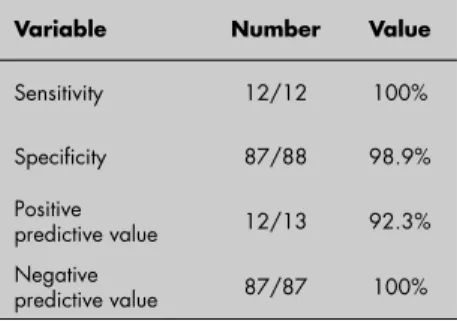
At the threshold of 250 PMN/mm3 in ascitic fl uid, the sensitivity, specifi city, positive predictive value and negative predictive value were respectively 100%, 98.9%, 92.3% 100%, as shown in Table 3.
DISCUSSION This prospective study confi rmed the high accuracy of reagent strips for the diagnosing of SBP in cirrhotic patients with ascites. Our
Table 1. Characteristics of 42 patients with cirrhosis who underwent 100 paracenteses
Characteristics Mean ± SD or number (%)
Female sex 10 (23.8%) Age (mean ± SD) 51.7 Child-Pugh classifi cation
A 0 (0%)
B 23 (54.8%)
C 19 (45.2%)
Etiology
Viral hepatitis 6 (14.3%) Alcohol abuse 27 (64.3%) Alcohol + viral hepatitis 1 (2.4%) Others 8 (19.0%) SD = standard deviation.
Table 2. Details regarding of spontaneous bacterial peritonitis detected by cytology and strip test in nine cirrhotic patients
Patient outpatientIn or Strip result cell count (cell/mmPolymorphonuclear 3) culture resultAscitic fl uid
1 Inpatient 2 300 0
2 Inpatient 2 504 0
3 Inpatient 3 28560 Escherichia coli
4 Inpatient 2 553 0
5 Inpatient 3 5133 Pseudomonas aeruginosa
6 Inpatient 2 260 0
7 Inpatient 3 5004 Escherichia coli
8 Outpatient 2 2592 0
9 Inpatient 2 1675 0
with an ascitic fl uid PMN cell count greater than 250/mm3 and consisted of 5-10 days of ceftriaxone (2 g/day).10 One follow-up paracentesis was performed after two days of antibiotic therapy to determine the PMN count in the ascitic fl uid.
Paracentesis Paracentesis
Paracentesis was performed under aseptic conditions in the cirrhotic patients at the time of admission to hospital, or routinely in an outpatient setting, to investigate ascites. Three samples of ascitic fl uid were obtained from each patient. Ascitic fl uid was classically processed including investigation of cytology, PMN leukocytes, lymphocyte count and appropriate biochemical tests. The ascitic samples for PMN leukocytes and total
143
Table 3. Sensitivity, specifi city, positive and negative predictive value for the diagnosis of spontaneous bacterial peritonitis in 42 cirrhotic patients (100 paracenteses) by using the Combur Test® UX reagent strip
Variable Number Value
Sensitivity 12/12 100%
Specifi city 87/88 98.9% Positive
predictive value 12/13 92.3% Negative
predictive value 87/87 100%
results showed that a grade 2 or 3 result from the Combur test® UX reagent strip had highly positive predictive value (92.3%), with a specifi city of 98% for the SBP diagnosis. On the other hand, in patients with a reagent strip result of grade 0 or 1, a diagnosis of ascitic fl uid infection could confi dently be ruled out because the negative predictive value was 100%. Our results are consistent with previ-ous reports. Vanbiervliet et al. showed that the Multistix 8SG rapid urine screening test had 100% sensitivity and specifi city for SBP diagnosis.22 More recently, Castellote et al. demonstrated that another urine screening test (Aution sticks) also had high sensitivity (96%) and specifi city (89%) for detecting SBP in cir-rhotic patients with ascites.20 In another study, Théovenot et al. tested the reagent Combur-2 test® LN, and showed a sensitivity of 89% and a specifi city of 100%.21
In the present study, one false positive result was found. Despite the fact that a false positive result could indicate antibi-otic therapy for a patient without SBP, this therapy would be discontinued if the PMN count were below 250 cell/mm3. Consider-ing the high mortality from SBP episodes, a method with high sensitivity is essential for the management of these patients.
The reagent strips are easy to use, do not require expertise, are rapid, can be performed everywhere, and have high sensitivity and specifi city for diagnosing of SBP, thereby al-lowing antibiotic therapy to immediately start. Another noteworthy point is the low cost of
hospitals in our country have limited labora-tory facilities, or are unable to perform PMN counts in ascitic fl uid at night or over the weekend. Considering the mortality from SBP, this test will help to improve the man-agement of SBP.
CONCLUSIONS
In summary, this is the first study us-ing this low-cost method for diagnosus-ing SBP in northeastern Brazil. Our results are comparable with those reported previ-ously, thus demonstrating that this accurate method could be used everywhere, thereby reducing the time from paracentesis to a presumptive diagnosis of SBP from a few hours to a few seconds.
these strips (R$ 0.15 per strip). This new di-agnostic method is also useful for determining the effectiveness of the antibiotic therapy. In fact, there were three SBP episodes in which we observed that the PMN count remained above 250/mm3 after 48 hours of ceftriaxone therapy, and these positive results were always confi rmed by the PMN cell count.
The incidence of SBP in our study was 10.4%, which was lower than previously reported.10 This difference can be explained by the greater number of outpatients in our study (82%).
In the present study, only three positive cultures were observed among the nine cases of SBP (33%). It is possible that this low rate was due to suboptimal culturing methods and techniques. However, like what was found in this study, low rates of positive SBP cultures have been reported in other studies, with pro-portion ranging from 39% to 59%,12,23-25 and these fi ndings probably refl ect earlier diagnosis of the infection. All three patients for whom the cultures were positive were inpatients and had advanced liver disease, and in one of them
Pseudomonas aeruginosa was isolated, a germ that is resistant to ceftriaxone. The source of the SBP seems to have to the therapy planning, since nosocomial organisms are usually more resistant to antibiotics than those acquired in the community. Therefore, it is worthwhile culturing ascitic fl uid in inpatients with ad-vanced diseases.
The simplicity and low cost of this test is an important point in our results. Many
REFERENCES
1. Rimola A. Infections in liver disease. In: McIntyre N, Ben-hamou JP, Bircher J, Rizetto M, Rodes J, editors. Oxford Textbook of Clinical Hepatology. Oxford: Oxford University Press; 1991. p. 1272–84.
2. Garcia-Tsao G. Spontaneous bacterial peritonitis. Gastroen-terol Clin North Am. 1992;21(1):257-75.
3. Caly WR, Strauss E. A prospective study of bacterial infections in patients with cirrhosis. J Hepatol. 1993;18(3):353-8. 4. Pinzello G, Simonetti R, Camma C, Dino O, Miazzo G,
Pagliano L. Spontaneous bacterial peritonitis: an update. Gastroenterol Int. 1993;6:54-60.
5. Bac DJ, Siersema PD, Mulder PGH, DeMarie S, Wilson JHP. Spontaneous bacterial peritonitis: outcome and predictive factors. Eur J Gastroenterol Hepatol. 1993;5:635-40.
6. Llovet JM, Planas R, Morillas R, et al. Short-term prognosis of cirrhotics with spontaneous bacterial peritonitis: multivariate study. Am J Gastroenterol. 1993;88(3):388-92. 7. Runyon BA, McHutchison JG, Antillon MR, Akriviadis EA,
Montano AA. Short-course versus long-course antibiotic treatment of spontaneous bacterial peritonitis. A random-ized controlled study of 100 patients. Gastroenterology. 1991;100(6):1737-42.
8. Toledo C, Salmeron JM, Rimola A, et al. Spontaneous bacterial peritonitis in cirrhosis: predictive factors of infection resolution and survival in patients treated with cefotaxime. Hepatology. 1993;17(2):251-7.
9. Thuluvath PJ, Morss S, Thompson R. Spontaneous bacterial peritonitis--in-hospital mortality, predictors of survival, and
health care costs from 1988 to 1998. Am J Gastroenterol. 2001;96(4):1232-6.
10. Rimola A, Garcia-Tsao G, Navasa M, et al. Diagnosis, treat-ment and prophylaxis of spontaneous bacterial peritonitis: a consensus document. International Ascites Club. J Hepatol. 2000;32(1):142-53.
11. Rimola A, Salmeron JM, Clemente G, et al. Two different dosages of cefotaxime in the treatment of spontaneous bacterial peritonitis in cirrhosis: results of a prospective, randomized, multicenter study. Hepatology. 1995;21(3):674-9. 12. Navasa M, Follo A, Llovet JM, et al. Randomized,
com-parative study of oral ofloxacin versus intravenous cefo-taxime in spontaneous bacterial peritonitis. Gastroenterology. 1996;111(4):1011-7.
144
13. Runyon BA, Hoefs JC. Culture-negative neutrocytic ascites: a variant of spontaneous bacterial peritonitis. Hepatology. 1984;4(6):1209-11.
14. Terg R, Levi D, Lopez P, et al. Analysis of clinical course and prognosis of culture-positive spontaneous bacterial peritonitis and neutrocytic ascites. Evidence of the same disease. Dig Dis Sci. 1992;37(10):1499-504.
15. Runyon BA, Canawati HN, Akriviadis EA. Optimiza-tion of ascitic fl uid culture technique. Gastroenterology. 1988;95(5):1351-5.
16. Lejeune B, Baron R, Guillois B, Mayeux D. Evaluation of a screening test for detecting urinary tract infection in newborns and infants. J Clin Pathol. 1991;44(12):1029-30. 17. Kutter D, Figueiredo G, Klemmer L. Chemical detection of
leukocytes in urine by means of a new multiple test strip. J Clin Chem Clin Biochem. 1987;25(2):91-4.
18. Hiscoke C, Yoxall H, Greig D, Lightfoot NF. Validation of a method for the rapid diagnosis of urinary tract infec-tion suitable for use in general practice. Br J Gen Pract. 1990;40(339):403-5.
19. López Parades A, Valera Mortón C, Ródenas García V, Pe-dromingo Marino A, Martínez Hernández P. Estudio de la zona de leucocitos de la tira reactiva Multistix-10-SG en líquidos cefalorraquídeo, seminal y peritoneal. [The leukocyte zone on Multistix-10-SG reactive strips for cerebrospinal, seminal and peritoneal fl uids]. Med Clin (Barc). 1988;90(9):362-5. 20. Castellote J, Lopez C, Gornals J, et al. Rapid diagnosis of
spontaneous bacterial peritonitis by use of reagent strips. Hepatology. 2003;37(4):893-6.
21. Thevenot T, Cadranel JF, Nguyen-Khac E, et al. Diagnosis of spontaneous bacterial peritonitis in cirrhotic patients by use of two reagent strips. Eur J Gastroenterol Hepatol. 2004;16(6):579-83.
22. Vanbiervliet G, Rakotoarisoa C, Filippi J, et al. Diagnostic accuracy of a rapid urine-screening test (Multistix8SG) in cirrhotic patients with spontaneous bacterial peritonitis. Eur J Gastroenterol Hepatol. 2002;14(11):1257-60. 23. Fernandez J, Navasa M, Gomez J, et al. Bacterial infections
in cirrhosis: epidemiological changes with invasive procedures and norfl oxacin prophylaxis. Hepatology. 2002;35(1):140-8.
24. Rimola A, Salmeron JM, Clemente G, et al. Two different dosages of cefotaxime in the treatment of spontaneous bacterial peritonitis in cirrhosis: results of a prospective, randomized, multicenter study. Hepatology. 1995;21(3):674-9. 25. Navasa M, Follo A, Filella X, et al. Tumor necrosis factor and
interleukin-6 in spontaneous bacterial peritonitis in cirrhosis: relationship with the development of renal impairment and mortality. Hepatology. 1998;27(5):1227-32.
Sources of funding: Not declared Confl ict of interest: Not declared Date of fi rst submission: March 30, 2005 Last received: May 12, 2006
Accepted: May 12, 2006
RESUMO
Diagnóstico de peritonite bacteriana espontânea em pacientes cirróticos com o uso fi ta reagente para urinanálise no nordeste do Brasil
CONTEXTO E OBJETIVO: Peritonite bacteriana espontânea (PBE) é uma freqüente e grave complicação em pacientes cirróticos com ascite. Vem sendo proposto o uso de fi tas reagente para esterase leucocitária, utilizadas para diagnóstico de infecção urinária, como instrumento para diagnosticar PBE. O objetivo deste estudo é avaliar a sensibilidade e a especifi cidade da fi ta reagente Combur Test® UX no diagnóstico de PBE
em pacientes cirróticos com ascite.
TIPO DE ESTUDO E LOCAL: Estudo prospectivo, realizado no Hospital Universitário Walter Cantídio, Fortaleza, Ceará, Brasil.
MÉTODOS: Quarenta e dois pacientes consecutivos, não selecionados (32 homens, com média de idade de 51,7 ± anos) foram incluídos e um total de 100 paracenteses foram realizadas. O líquido ascítico foi avali-ado pela fi ta reagente (Combur Test® UX), citologia, contagem de neutrófi los, linfócitos, testes bioquímicos
e cultura. As fi tas reagentes foram consideradas positivas se havia mudança na cor para roxo na escala colorimétrica fornecida pelo fabricante.
RESULTADOS: Foram diagnosticados nove pacientes com PBE pela citologia (> 250 neutrófi los/mm3), estando a
fi ta Combur Test® UX positiva em todos os nove pacientes. Em uma amostra o teste da fi ta foi positivo, embora
a contagem de neutrófi los fosse < 250 células/mm3. Nas outras 86 amostras ambos os testes foram negativos.
Tendo-se como ponto de corte 250 PMN/mm3 no líquido ascítico, a sensibilidade, a especifi cidade, o valor
preditivo positivo e o valor preditivo negativo foram respectivamente 100%, 98,9%, 92,3% e 100%.
CONCLUSÕES: Combur Test® UX (fi ta reagente para urinanálise) é um método sensível e específi co para o
diagnóstico de PBE em pacientes cirróticos com ascite.
PALAVRAS-CHAVE: Cirrose. Ascite. Diagnóstico. Peritonite. Fitas reagente. Urinálise.
AUTHOR INFORMATION
Lucia Libanez Bessa Campelo Braga, MD, PhD. Professor of Internal Medicine, Universidade Federal do Ceará, Ceará, Brazil.
Marcellus Henrique Loiola Ponte de Souza, MD, PhD. Professor in the Department of Pharmacology, Uni-versidade Federal do Ceará, Ceará, Brazil. Alzira Maria de Castro Barbosa, MD.
Gastroenter-ologist at Hospital Universitário Walter Cantídio, Ceará, Brazil.
Felipe Magalhães Furtado. Medical student at Univer-sidade Federal do Ceará, Ceará, Brazil.
Paula Andréa Maia Campelo. Medical student at Universidade Federal do Ceará, Ceará, Brazil. Antônio Haroldo de Araújo Filho, MD. Fellow in
Gastroenterology, Hospital Universitário Walter Cantídio, Ceará, Brazil.
Address for correspondence: Lúcia Libanez Bessa Campelo Braga
Unidade de Pesquisa Clínica — Hospital Universitário Walter Cantídio – Departamento de Medicina Interna da Universidade Federal do Ceará
Rua Professor Costa Mendes, 1.608 Rodolfo Teófi lo
Fortaleza (CE) — Brasil – CEP 60436-170 Tel. (+55 85) 3409-8052
Fax (+55 85) 281-5212 E-mail: [email protected]
Copyright © 2006, Associação Paulista de Medicina