REVISTA
BRASILEIRA
DE
ANESTESIOLOGIA
PublicaçãoOficialdaSociedadeBrasileiradeAnestesiologia www.sba.com.brSCIENTIFIC
ARTICLE
The
effect
of
passive
exposure
to
tobacco
smoke
on
perioperative
respiratory
complications
and
the
duration
of
recovery
夽
Esen
Simsek
a,∗,
Yucel
Karaman
b,
Mustafa
Gonullu
b,
Zeki
Tekgul
b,
Meltem
Cakmak
baC¸anakkaleStateHospital,DepartmentofAnesthesiologyandReanimation,C¸anakkale,Turkey
bTepecikTeachingandResearchHospital,DepartmentofAnesthesiologyandReanimation, ˙Izmir,Turkey
Received5December2014;accepted10March2015 Availableonline23January2016
KEYWORDS
Tobaccosmoke; Passivesmoking; Airwaycomplication
Abstract
Background: Theincidenceofperioperativerespiratorycomplicationsandpostoperativecare unitrecoverytimeinvestigatedinpatientswithpassivetobaccosmokeexposureaccordingto thedegreeofexposure.
Methods:Total270patientsranginginagefrom18to60yearswiththeASAphysicalstatusIor IIexposedandnotexposedtopassivetobaccosmokereceivedgeneralanesthesiaforvarious electivesurgicaloperationsevaluatedforthestudy.Patientsdividedintotwogroupsasexposed andnon-exposedtopassivetobaccosmoke,thoseexposedtopassivesmokearealsodividedinto twogroupsaccordingtothedegreeofexposure.Patientstakentothepostoperativecareunit (PACU)attheendoftheoperationandmonitorizeduntilModifiedAldrete’sScoresbecame9and more.Respiratorycomplicationsevaluatedandrecordedinintraoperativeandpostoperative period.
Results:Atotalof251patientswereenrolled;63(25.1%)patientshadairwaycomplications, 11(4.4%)hadcomplicationsintraoperativelyand52(20.7%)patientshadcomplications post-operatively. Therehasbeenfound significantrelationwithpassivetobacco smokeexposure andhighincidencesofperioperativeandpostoperativerespiratorycomplications.Theriskof cough,desaturationandhypersecretioncomplicationswerefoundtobeincreaseddepending onthedegreeofexposure.Therewassignificantrelationbetweenthedegreeofpassivesmoke exposureandthedurationofPACUstay.
Conclusion:Passivetobaccosmokeexposedgeneralanesthesiareceivingpatientsalsoregarding tothe degreeofexposure havinghigh ratesofperioperativerespiratory complicationsand prolongationofPACUstayswhencomparedwithunexposedpatients.
©2015SociedadeBrasileiradeAnestesiologia.PublishedbyElsevierEditoraLtda.Thisisan openaccessarticleundertheCCBY-NC-NDlicense( http://creativecommons.org/licenses/by-nc-nd/4.0/).
夽
StudyheldinTepecikTeachingandResearchHospital,DepartmentofAnesthesiologyandReanimation, ˙Izmir,Turkey.
∗Correspondingauthor.
E-mail:[email protected](E.Simsek).
http://dx.doi.org/10.1016/j.bjane.2015.03.003
PALAVRAS-CHAVE
Fumac¸adetabaco; Fumantepassivo; Complicac¸ão respiratória
Oefeitodaexposic¸ãopassivaàfumac¸adetabacoemcomplicac¸õesrespiratórias noperioperatórioeadurac¸ãodarecuperac¸ão
Resumo
Justificativa: Aincidênciadecomplicac¸õesrespiratóriasnoperioperatórioeotempoemsala derecuperac¸ãopós-anestesianopós-operatórioempacientescomexposic¸ãopassivaàfumac¸a detabacoforamavaliadosdeacordocomograudeexposic¸ão.
Métodos: Nototal,270pacientescomidadesentre18-60anos,estadofísicoASAIouII, pas-sivamente expostos enão-expostos àfumac¸ade tabaco,submetidos àanestesia geralpara vários procedimentoscirúrgicoseletivos,foramavaliadaspara oestudo.Ospacientesforam divididos emdoisgrupos:passivamenteexpostosenão expostosàfumac¸adetabaco. Aque-lescomexposic¸ãopassivaàfumac¸atambémforamdivididosemdoisgruposdeacordocomo graudeexposic¸ão.Ospacientesencaminhadosàsaladerecuperac¸ãopós-anestesia(SRPA)ao finaldacirurgiaforammonitoradosatéatingirem9oumaisnoescoremodificadodeAldrete. As complicac¸ões respiratórias foram avaliadas e registradas nos períodos intraoperatório e pós-operatório.
Resultados: Foramincluídos251pacientes,dosquais63(25,1%)apresentaramcomplicac¸ões respiratórias, 11 (4,4%)complicac¸ões no intraoperatórioe 52(20,7%) complicac¸ões no pós-operatório. Houve relac¸ão significativaentre a exposic¸ão passiva à fumac¸a de tabaco e a alta incidênciadecomplicac¸õesrespiratóriasnoperioperatório epós-operatório.Oriscode complicac¸ãocomo tosse,dessaturac¸ãoehipersecrec¸ãoaumentoudeacordocomograude exposic¸ão.Houverelac¸ãosignificativaentreograudeexposic¸ãopassivaàfumac¸aeotempo depermanênciaemSRPA.
Conclusão:Ospacientescomexposic¸ãopassivaàfumac¸adetabacoapresentaramaltastaxas decomplicac¸õesrespiratóriasnoperioperatórioeprolongamentodapermanênciaemSRPA,em comparac¸ãocomospacientesnãoexpostos.
©2015SociedadeBrasileiradeAnestesiologia.PublicadoporElsevierEditoraLtda.Este ´eum artigo OpenAccess sobumalicenc¸aCCBY-NC-ND( http://creativecommons.org/licenses/by-nc-nd/4.0/).
Introduction
Passivesmokingistheinhalationofsmokebypersonsother
than the intended active smoker. It occurs when tobacco
smoke permeatesany environment, causing itsinhalation
bypeoplewithinthatenvironment.
Turkey’ssmokingrateofthepopulationovertheageof
15 in 2006 was 33.4%, while this rate for the year 2012
isdecreased to27.1%.Nearly2million 200thousand
peo-ple quit smoking and passive exposure to tobacco smoke
decreasedby60%,alsodespitebeingnotprohibited,
smok-ingathomedecreasedby35%whencomparedto2008.
Active and passive exposure to tobacco smoke is one
of the main morbidity andmortality cause.
Epidemiologi-calandclinical studies shown thatthe activeandpassive
smokingcauses cardiovascular,cerebrovascular, lung,
gas-trointestinaltractandcancerdiseases.1,2
Therearestudiesshowingthatactiveandpassive
smok-ers mayexperienceperioperative airway complicationsin
generalanesthesiabecauseoftheairwaychangeswhichis
causedbycontinuoussmokeexposure.3---14Passiveexposure
tocigarettesmokeisbeingassociatedwithincreased
post-operative mortality due tothe respiratory complications,
prolonged postoperative follow-up period and prolonged
anestheticrequirements.9,10
In this study, we aimed to research whether is there
a significant differences in the incidence of respiratory
complicationsduringpreoperativeandpostoperativeperiod
and the duration of recovery in patients who exposed
passively to tobacco smoke compared with unexposed
patients.
Material
and
methods
StudyplannedasaprospectiveandapprovedbytheTepecik
Teaching and Research Hospital, LocalEthics Committee.
270 adult patients ranging in age from 18 to 60 years
withthe American Society of Anesthesiologists (ASA) I or
IIscore whoreceivedgeneral anesthesiafor various
elec-tivesurgicaloperationsbetweenthedates01/09/2011and
31/08/2012 were included to the study. Patients in ASA
III-IV physical status, having chronic respiratory disease
or having acute upper or lower respiratory tract
infec-tionwithin2 weeks,whohas severesystemicdiseaseand
active smokers or quitted smokers within 5 years are all
excludedfromthestudy.Althoughincludedinthestudy,19
patientswhoaredetectedinpreoperativeperiodforupper
respiratory tract infections were also excluded from the
study.
Theremaining251patientsdividedintostudyandcontrol
groups.156patientswhoareexposed topassivecigarette
smokewereinstudygroupanda95patientswhoare
unex-posedtosmokewere incontrol group.96 patients ofthe
smokenamedasGroup1and60patientsofthestudygroup
whoarepassivelyexposedtomorethan10cigarettesmoke
namedasGroup2.
The patient’s history was important to determine the
state of exposure. Passive exposure defined as
involun-taryinhalationofsmokebyanon-smokerbecauseofliving
or working witha smoker. And thevictims were notable
to change their environment. Degree of exposure
deter-mined with the number of cigarettes passively smoked
according tothe patient’s history. Patientsexposed to10
or less cigarettes per day grouped as Group 1. If there
was exposure to smoke more than 10 cigarettes we put
thepatientsin Group2.Ourmain aimby dividingpassive
smokersinto two groups were toinvestigate the
respira-torycomplicationsifitschangingbythedegreeofpassive
smoking.
Twenty gauge intravenous cannula inserted and i.v.
2mgmidazolam (Dormicum, Roche)administeredfor
pre-medication before patient taken to the operation room.
Electrocardiogram, noninvasive arterial blood pressure
(Nikbu),peripheral oxygensaturation(SpO2)andend-tidal
CO2 (EtCO2) monitorizations wereperformed in operating
room.Theanesthesiamethodadministeredtopatientswas
determinedby the primer anesthesiologist of the patient
and those clinicians were not informed before about the
patients status which is related with the study. Airway
control performed by mask, laryngeal mask airway (LMA)
or endotracheal intubation depending on the operation.
Anesthesia was induced with propofol (Propofol,
Frese-niusKabi)2---2.5mgkg−1,remifentanil(Ultiva,GlaxoSmith
Kline) 1g/kg−1 and intubation provided with0.1mgkg−1
vecuronium(Norcuron,ScheringPlough).Afterintubation,
mechanicalventilationparameterswassetat50%oxygen-air
mixturewithaninspiredoxygenconcentrationof50%(FiO2),
6---7mLkg−1oftidalvolumeand12---14breathsmin−1setfor
respiratoryfrequencytoobtainend-tidalCO2concentration
levelsat30---35mmHg.Maintenanceofanesthesiaprovided
withsevoflurane 1---2% (Sevorane, Abbott), 0.05---2gkg−1
remifentanilinfusionandintermittent0.05mgkg−1
vecuro-niumbolusesinintubatedpatients.Paracetamol1g15min
--- IV administrated for postoperative analgesia near to
the end of surgery. At the end of the operation, all
patients who underwentintubation were extubated after
thedecurarizationwithatropine(0.02mg/kg)and
neostig-mine(0.05mg/kg). Laryngospasm(failuretoventilatethe
patient,needofcontinuouspositivepressureventilationto
maintain ventilation and requirement of additional doses
ofmusclerelaxants), bronchospasm(wheezing,expiratory
wheezing, airwaypeakpressure increase), breathholding
(more than 15s), desaturation (oxygen saturation below
95%),hypersecretion(accordingtotheincreaseofquantity
anddensityofsecretionsandmorethan2timesthe
neces-sityoforal ornasalaspiration)andcough(morethan15s)
areall acceptedasairwaycomplicationsduringthe
intra-operative andpostoperative period.In case of morethan
oneofthesecomplicationsseen,thanonlythemostsevere
orsignificant complication werenoted.ModifiedAldrete’s
Score (MAS) wasused for determining when patients can
be safely discharged from the postanesthesia care unit
(PACU).MASevaluatedeach5mininPACUstayandpatients
discharged from pacu to post-surgical ward when MAS
was9.
Statisticalanalysis
Statistical analysisofthe datawasperformedby the
pro-gram,SPSS(StatisticalPackageforSocialSciences)Version
15.00inEgeUniversity FacultyofMedicineDepartmentof
Biostatistics. Mann Whitney U test was used for
compar-ison of inter-group differences for abnormally distributed
parametersandusedtodeterminethegroupwhichisleading
todifferences.The‘‘Chi-Squaretest’’and‘‘Fisher’sExact
Chi-square test’’ wasused for thecomparison of
qualita-tivedata.Resultsevaluatedat95%confidenceintervaland
p<0.05forsignificance.
Results
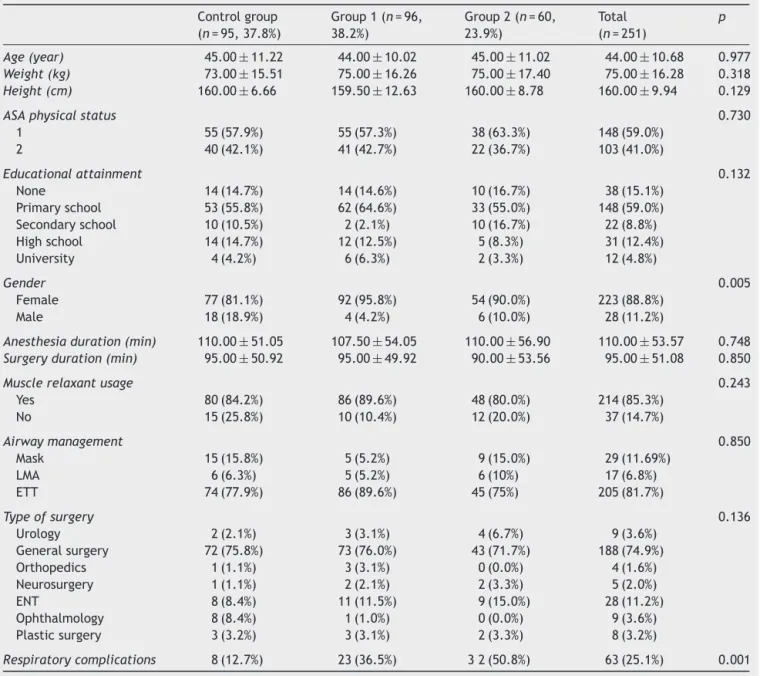
When the demographic data of 251 patients participated
in the study wereevaluated for age, weight,height,ASA
andeducationalattainmenttherewerenostatistically
sig-nificant differences between the groups (p>0.05). In the
distributionbygender,malegenderinallgroupswasless,
andthisdifferencethanfoundtobestatisticallysignificant
(p=0.005).When groups comparedaccording tothe
dura-tionof anesthesia, duration of surgery,chosen anesthesia
method for airway management, use of muscle relaxants
andoperationtype,theresultswerestatisticallysimilarin
allgroups(p>0.05)(Table1).
Respiratorycomplicationsobservedin63of251(25.1%)
patients.The distributionofcomplicatedpatientswas, 23
(23.9%) inGroup 1,32 (53.8%)in Group 2and 8(8.4%) in
control group. Differencesof respiratory complications in
groupsfoundstatisticallysignificant(p<0.01)(Table1).
Elevencases(4.4%)ofrespiratorycomplicationsoccurred
inintraoperativeperiodand52cases(20.7%)ofrespiratory
complicationsoccurredinpostoperativeperiod.
Intraoper-ative complications occurred in 11patients, 5 in Group 1
and6inGroup2wereallintobaccosmokeexposedgroups
andcomparedtothecontrolgroupstatisticallysignificant
differencewasfound(p<0.05).
Postoperative pulmonary complications observed in 52
patientsand44wereintobaccosmokeexposedgroups(18
inGroup1;26inGroup2)whileonly8patientswereinthe
controlgroupthatpresentstatisticallysignificantdifference
(p=0.005)(Table2).
Laryngospasmdevelopedin8(3.2%)patients,6hadthis
complicationinpostoperativeperiodand2hadthis
compli-cation inintraoperative period.These patientsunderwent
positivepressureventilationandtherewasnoneedfor
addi-tionaldoses of musclerelaxants. Bronchospasm onlyseen
intraoperativelyandin2(0.8%)patients.9(3.6%)patients
showedbreath-holdingand7(2.8%)patientsshowed
desat-uration in thepostoperative period.Jaw thrustmaneuver
was performed in 1 desaturated patient and intubation
wasnot required.Hypersecretion documentedin 2 (0.8%)
patientsinintraoperativeperiodandin43(17.1%)patients
in postoperative period. Intraoperative cough
complica-tiondevelopedin1(0.4%)patientandpostoperativecough
developedin23(9.2%)patients.
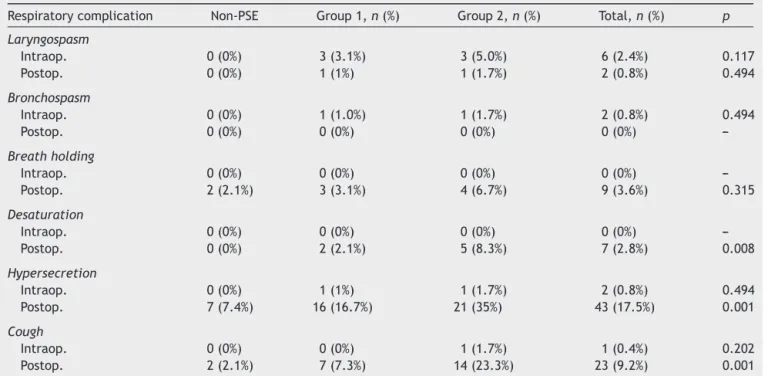
Whenrespiratory complications evaluatedaccordingto
the groups there was no statistically significant
differ-enceintraoperativelyorpostoperativelybetweenthegroups
for the documentedcomplicationsaslaryngospasm,
Table1 Thedemographicandsurgicalcharacteristicsofpatients.
Controlgroup (n=95,37.8%)
Group1(n=96, 38.2%)
Group2(n=60, 23.9%)
Total (n=251)
p
Age(year) 45.00±11.22 44.00±10.02 45.00±11.02 44.00±10.68 0.977
Weight(kg) 73.00±15.51 75.00±16.26 75.00±17.40 75.00±16.28 0.318
Height(cm) 160.00±6.66 159.50±12.63 160.00±8.78 160.00±9.94 0.129
ASAphysicalstatus 0.730
1 55(57.9%) 55(57.3%) 38(63.3%) 148(59.0%) 2 40(42.1%) 41(42.7%) 22(36.7%) 103(41.0%)
Educationalattainment 0.132 None 14(14.7%) 14(14.6%) 10(16.7%) 38(15.1%)
Primaryschool 53(55.8%) 62(64.6%) 33(55.0%) 148(59.0%) Secondaryschool 10(10.5%) 2(2.1%) 10(16.7%) 22(8.8%) Highschool 14(14.7%) 12(12.5%) 5(8.3%) 31(12.4%) University 4(4.2%) 6(6.3%) 2(3.3%) 12(4.8%)
Gender 0.005
Female 77(81.1%) 92(95.8%) 54(90.0%) 223(88.8%) Male 18(18.9%) 4(4.2%) 6(10.0%) 28(11.2%)
Anesthesiaduration(min) 110.00±51.05 107.50±54.05 110.00±56.90 110.00±53.57 0.748
Surgeryduration(min) 95.00±50.92 95.00±49.92 90.00±53.56 95.00±51.08 0.850
Musclerelaxantusage 0.243 Yes 80(84.2%) 86(89.6%) 48(80.0%) 214(85.3%)
No 15(25.8%) 10(10.4%) 12(20.0%) 37(14.7%)
Airwaymanagement 0.850
Mask 15(15.8%) 5(5.2%) 9(15.0%) 29(11.69%)
LMA 6(6.3%) 5(5.2%) 6(10%) 17(6.8%)
ETT 74(77.9%) 86(89.6%) 45(75%) 205(81.7%)
Typeofsurgery 0.136
Urology 2(2.1%) 3(3.1%) 4(6.7%) 9(3.6%) Generalsurgery 72(75.8%) 73(76.0%) 43(71.7%) 188(74.9%) Orthopedics 1(1.1%) 3(3.1%) 0(0.0%) 4(1.6%) Neurosurgery 1(1.1%) 2(2.1%) 2(3.3%) 5(2.0%) ENT 8(8.4%) 11(11.5%) 9(15.0%) 28(11.2%) Ophthalmology 8(8.4%) 1(1.0%) 0(0.0%) 9(3.6%) Plasticsurgery 3(3.2%) 3(3.1%) 2(3.3%) 8(3.2%)
Respiratorycomplications 8(12.7%) 23(36.5%) 32(50.8%) 63(25.1%) 0.001
LMA,laryngealmaskairway;ETT,endotrachealtube;ENT;ear,nose,throat. Valuesgivenasmeans±SD,thenumberofpatientsgivenasnandpercent(%).
Therewasnostatisticallysignificantdifferencein intra-operativeperiodforthecomplicationsdesaturation, hyper-secretion and cough. Although documented desaturation, hypersecretionandcoughcomplicationsseeninsignificantly
higherratesinpatientsexposedtotobaccosmoke(p<0.05). Desaturationdevelopedinpostoperativeperiodin2patients forGroup1andin5patientsforGroup2andtherewasno patientdevelopeddesaturationincontrolgroup.Withthese
Table2 Thedistributionofintraoperativeandpostoperativerespiratorycomplicationsdependingonthepassiveexposureto tobaccosmokeinthecontrolandstudygroups.
Respiratorycomplications Studygroups Controlgroup (n=95)
Total (n=251)
p
Group1(n=96) Group2(n=60) Total(n=156)
Intraoperative 5(5.2%) 6(10.0%) 11(7.0%) 0(0%) 11(4.4%) 0.005 Postoperative 18(18.7%) 26(43.3%) 44(28.2%) 8(8.4%) 52(20.7%) 0.001 Total 23(23.9%) 32(53.3%) 55(35.2%) 8(8.4%) 63(25.1%) 0.001
Table3 Distributionofrespiratorycomplicationsbetweenthegroups.
Respiratorycomplication Non-PSE Group1,n(%) Group2,n(%) Total,n(%) p Laryngospasm
Intraop. 0(0%) 3(3.1%) 3(5.0%) 6(2.4%) 0.117
Postop. 0(0%) 1(1%) 1(1.7%) 2(0.8%) 0.494
Bronchospasm
Intraop. 0(0%) 1(1.0%) 1(1.7%) 2(0.8%) 0.494
Postop. 0(0%) 0(0%) 0(0%) 0(0%)
---Breathholding
Intraop. 0(0%) 0(0%) 0(0%) 0(0%)
---Postop. 2(2.1%) 3(3.1%) 4(6.7%) 9(3.6%) 0.315
Desaturation
Intraop. 0(0%) 0(0%) 0(0%) 0(0%)
---Postop. 0(0%) 2(2.1%) 5(8.3%) 7(2.8%) 0.008
Hypersecretion
Intraop. 0(0%) 1(1%) 1(1.7%) 2(0.8%) 0.494
Postop. 7(7.4%) 16(16.7%) 21(35%) 43(17.5%) 0.001
Cough
Intraop. 0(0%) 0(0%) 1(1.7%) 1(0.4%) 0.202
Postop. 2(2.1%) 7(7.3%) 14(23.3%) 23(9.2%) 0.001
Intraop.,intraoperativeperiod;Postop.,postoperativeperiod;PSE,passivesmokingexposure.
Table4 ModifiedAldrete’sScoreinPACUentryandthedurationofrecovery.
Controlgroup Group1 Group2 Total p
MAS 6±1.8 7±1.47 6±1.28 6±1.60 0.013
MAS≥9time(min) 30±8.86 30±8.50 35±9.21 30±8.97 0.005
MAS,ModifiedAldrete’sScore;PACU,postanesthesiacareunit. Valuesgivenasmeans±SD.
results,postoperativedesaturationwassignificantlyhigher (p=0.008)inpatientswithtobaccosmokeexposure.
Hypersecretioninpostoperativeperiodseenin7patients in control group. According to the degree of exposure, in Group 1 and 2 this complication seen in order 16 and 21 patients, and the results were statistically significant (p<0.01).
Cough complication seen in 2 patients in the control groupinpostoperativeperiod.Accordingtothedegree of smoke exposure, in order 7 and 14 patients in Group 1 and Group 2 had cough complication. Results were sta-tistically significant (p<0.01). We concluded that cough complications were more frequent in the postoperative periodintobaccosmokeexposedpatients(Table3).
TheMASaveragesatadmissiontothePACUwere6±1.8
incontrolgroup,7±1.47inGroup1and6±1.28inGroup
2.Therewasstatisticallysignificantdifferencebetweenthe
groups(p=0.005)(Table4).
PACUstay(MAS≥9)averagesfound30±8.86minin
con-trol group, 30±8.50min in Group 1 and 35±8.97min in
Group2.The longeststay wasinGroup2when compared
toother groups andtheresultwasstatistically significant
(p=0.013)(Table4).
Discussion
Nowadays passive smoking is one of the top topics
discussed withits medicalconsequences,legal and
socio-logical aspects.Long termexposure tosmokegiveriseto
changes in airways and this causes various complications
in the perioperative period in general anesthesia. In
these patients respiratory complications such as cough,
laryngospasm,bronchospasm,desaturation,hypersecretion
andbreath-holdingprevalencewassignificantlyhigherthan
non-smokers.3---15
Inastudy,researchersgroupedthepatientsaccordingto
thetobaccosmokeexposureintensity.Theystudiedon385
patients for perioperative complications and when
demo-graphic parameterssuch as weight, age, gender and ASA
comparedbetweenthegroupstheydidnotfindany
signifi-cantdifference.3Alsotherewasnosignificantdifferencein
ourstudyforthedemographicdataasage,weight,ASAand
educationalattainmentbetweenthegroups.Althoughmale
genderwassignificantlylessinallgroups(p<0.05).Thisis
because malesare more activesmokers.Also the passive
tobaccosmokeexposurevictimsareespeciallyfemaleand
A study reported that female are more sensitive to
tobaccosmokethanmale.16 Inourstudytheproportionof
respiratorycomplications bygender is 11(17.5%)patients
maleand52(82.5%)patientsfemale.Theseresultsdonot
showastatisticalsignificancebutcouldsupportthatfemale
gender sensitivitytotobaccosmokeleads tohigh ratesof
respiratorycomplications(p>0.05).
Differentstudiescomparedsurgicalcharacteristicslike;
durationofanesthesia,durationofsurgery,typeof
opera-tion,perioperativeanalgesia,musclerelaxantconsumption
and airway control methods between the groups and
they found similar results to our study.3,6 Respiratory
complicationsshowntobeincreasedinintubatedpatients
thanLMApreferredpatients.3,6,13Alsowedidnotfind
statis-ticallysignificantdifferenceforthestateddatainourstudy.
Theprocessofintubationismorelikelytobeinvasivethan
laryngeal maskairwayprocess andbecauseofthepassive
tobaccosmokeexposuremakingtheairwaysmoresensitive
tostimuli respiratory complications expectedto be more
due tosuch invasive processes. We couldnot find
signifi-cantresultsbecausetherewerenotenoughpatientsairway
managedwithLMAtocomparewithintubation.
A study reported that respiratory complication rate
was 86.2% in passive tobacco smoke exposure group and
13.8%inthecontrolgroupalsootherstudiesfoundsimilar
results.3Anotherstudyinvolving9297casesshowthat
pas-sivetobaccoexposureisbecomingariskfactorforincreased
perioperative respiratory complications.7 However, in a
studyCOHb,PaO2,PaCO2valuesevaluatedduringthe
anes-thesia andpost-surgicalcomplicationsin 150patients and
didnotfoundanysignificant differencesbetweentobacco
smoke exposureand non-exposure group.17 The incidence
ofrespiratorycomplicationsfoundtobeincreasedwiththe
degreeofexposureinourstudy(p<0.05).Passivesmokers
exposedmorethan10cigarettesperdayexperience
signif-icantlymuchmoreperioperativerespiratorycomplications
thanpatientswhoareexposedtolessorfewcigarettesand
thisshowsalsothedegreeofpassivesmokeexposureisvery
important.
There are studies showing that those exposed to
tobacco smoke both in intraoperative and postoperative
period has significantly increased incidence of
respira-torycomplications alsodifferentstudies reportthatthese
complications are becoming more likely in postoperative
period.3,10 In our study there is found any intraoperative
complicationsinnon-exposedgroupofpatientsbuttotal11
patientshadcomplicationsinbothofpassivesmokersgroup.
Postoperative respiratory complications seen in only 8
patientsinnon-exposed(control)groupand44patientsin
bothexposed groupsandtheresultsof ourstudy are
con-sistent withother studies. Those smoke exposedpatients
have high incidences of intraoperative and postoperative
complications. Neverthelesswhile the degree ofexposure
tocigarettesmokeincreasestheincidenceofpostoperative
complicationsisincreasingmore.
Theincreasedincidenceofintraoperativelaryngospasm
and bronchospasm has been shown in many studies in
tobacco smoke exposed patients. Laryngospasm risk is
increasedinsmokeexposedpatients.6Astudyrevealedthat
laryngospasm incidence is becoming 4.9 times more with
tobaccosmokeexposure.9
Pediatricpatientsexposedtotobaccosmokeare10times
morepronetodeveloplaryngospasmaftertheextubation.14
In our study, intraoperative laryngospasm not seen in
unexposedpatients. Laryngospasm rate was 3.2% in total
in patients with smoke exposure. In a study that made
withpediatric patients reportedlaryngospasm rates were
higher and this should be considered that the incidence
of laryngospasm is higher in pediatric patients in normal
conditions.14Inourstudy,therewasnosignificantdifference
between the intraoperative desaturation and
hypersecre-tioncomplicationincidences.Incontrastdependingonthe
degreeofexposuretotobaccosmoketheincidenceofthese
complicationsfoundtobesignificantlyincreasedinthe
post-operativeperiod(p<0.05).
Respiratory complications such as breath holding and
coughing reportedtobe observed morefrequently in the
postoperativeperiodintobaccosmokeexposedpatients.6,10
Tobaccosmokecausesgobletcellmetaplasiainthe
respira-torytractand excessivemucusproduction in tracheaand
proximal small airways. The secretions accumulated
dur-ingtheoperationleadstohypersecretionanddesaturation
problemsinintraoperativeandin especiallypostoperative
period.Theincidenceofthesecomplicationsincreasingwith
thedegreeoftobaccosmokeexposureasdifferentstudies
stated.3,6,12Inourstudyinpostoperativeperiodtherewasno
significantincreaseinbreathholdingcomplicationbutcough
complicationwassignificantlyincreasedwiththedegreeof
tobaccosmokeexposure(p<0.05).
InourstudyMASfoundtobesignificantlyhigherinPACU
entry for the smoke exposed patients according to the
degreeofexposure(p<0.05).Wesuggestthattheincreased
incidenceofintraoperativecomplicationsinthesepatients
plays important role for the prolongation of recovery
times.
TherearealsoseveralstudiesshowingthatthePACUstay
couldbe prolonged in patients according totheir degree
ofexposuretotobaccosmoke.Inastudy,prolongedPACU
staysreportedforsmokeexposedpatients,buttheycould
notfindanysignificantresults.3Anotherstudyreportedthat
passivesmokeexposureisindirectlyassociatedwiththe
Pro-longationof PACU.9 In our study we found that thePACU
stay prolonged with the increase of the exposure degree
tothetobaccosmoke(p<0.05).The longeststaysinPACU
wereinGroup2whichisthemosttobaccosmokeexposed
groupofthestudy.Thissituationcouldbeexplainedwiththe
needofhighanestheticdrugsmaintenancedosescausedby
theincreasedmetabolicratesandincreasedpostoperative
respiratory complications in patients changing in severity
correlatedwiththedegreeofsmokeexposure.
Weaknessesof ourstudycouldbethelackof the
mea-surement of the cotinine levels to assess the degree of
passiveexposure.Insteadoftakingpatient’spassivetobacco
smokeexposurehistory,measurement ofthecotinine
lev-elsasamajormetaboliteof nicotinefoundin hair,urine,
blood,salivaisstillacontroversialsubject.Thereare
stud-iesreflectingthatthe passive exposuretotobaccosmoke
isnotassociatedwiththepatient’shistory,18howeverthere
arealsostudiesshowingthatthehistorytakingaboutpassive
tobaccosmokeexposureisapracticalandreliablemethod.9
Anotherstudy reportedthat thepatienthistoryofpassive
Cotinine levels, is affected from the prolongation of
evaluation time of passive smoke exposure and levels of
cotininedecreasesover time.Sothesubjectis
controver-sialandbeinganexpensive,timecostinganduncomfortable
method. We avoided assessment of preoperative cotinine
levelsinblood,urine,andsaliva.
Passiveexposuretotobaccosmokeis amajorcauseof
morbidity and mortality. Passive smoke exposed patients
receivinggeneralanesthesiaareinincreasedriskof
respi-ratory complications as active smokers. In conclusion,
passivetobaccosmokeexposedgeneralanesthesia
receiv-ingpatientsalsoregardingtothedegreeofexposurehaving
high rates of perioperative respiratory complications and
prolongationofPACUstayswhencomparedwithunexposed
patients.
Conflicts
of
interest
Theauthorsdeclarenoconflictsofinterest.
References
1.FieldingJE.Smoking:healtheffectsandcontrol.NEnglJMed. 1985;313:491---8.
2.Giantz SA, Parmley WW. Passive smoking and heart dis-ease:epidemiology,physiologyand biochemistry.Circulation. 1991;83:1---12.
3.SeyidovTH,ElemenL,SolakM,etal.Passivesmokeexposure isassociatedwithperioperativeadverseeffectsinchildren.J ClinAnesth.2011;23:47---52.
4.Rodrigo C. The effects of cigarette smoking on anesthesia. AnesthProg.2001;47:143---50.
5.KoopCE.Adverseanesthesiaeventsinchildrenexposedto envi-ronmentaltobaccosmoke:exposuretoenvironmentaltobacco smokeand theriskofadverse respiratoryeventsin children receivinggeneralanesthesia.Anesthesiology.1998;88:1141---2.
6.SkolnickET,VomvolakisMA,BuckKA,etal.Exposureto envi-ronmentaltobaccosmokeandtheriskofadverse respiratory eventsinchildrenreceivinggeneralanesthesia.Anesthesiology. 1998;88:1144.
7.SternbergBS,BodaK,ChambersNA,etal.Riskassessmentfor respiratorycomplicationsinpaediatricanaesthesia:a prospec-tivecohortstudy.Lancet.2010;376:773---83.
8.O’RourkeJM,KalishLA,McDanielS,etal.Theeffectsof expo-sureto environmentaltobacco smokeonpulmonaryfunction inchildrenundergoinganesthesia forminorsurgery.Paediatr Anaesth.2006;16:560---7.
9.Jones DT, Bhattacharyya N. Passive smoke exposure as a risk factor for airway complications duringoutpatient pedi-atric procedures. Otolaryngol Head Neck Surg. 2006;135: 12---6.
10.Drongowski RA, Lee D, Reynolds PI, et al. Increased respi-ratory symptoms following surgery in children exposed to environmental tobacco smoke. Paediatr Anaesth. 2003;13: 304---10.
11.Dennis A, CurranJ, Sherriff J, et al. Effects ofpassive and active smoking on induction of anaesthesia. Br J Anaesth. 1994;73:450---2.
12.LyonsB,FrizelleH,KirbyF,etal.Theeffectofpassivesmoking ontheincidenceofairwaycomplicationsinchildrenundergoing generalanaesthesia.Anaesthesia.1996;51:324---6.
13.MamieC, Habre W, Delhumeau C,et al. Incidence and risk factors of perioperative respiratory adverse events in chil-drenundergoing electivesurgery.PaediatrAnaesth.2004;14: 218---24.
14.LakshmipathyN,BokeschPM,CowenDE,etal.Environmental tobaccosmoke:ariskfactorforpediatriclaryngospasm.Anesth Analg.1996;82:724---7.
15.Paul S, Myles M, George A, et al. Risk of respiratory complications and wound infection in patients undergoing ambulatorysurgerysmokersversusnonsmokers.Anesthesiology. 2002;97:842---7.
16.PaolettiP,FornaiE,Maggiorelli F,etal.Importanceof base-line cotinine plasma values in smoking cessation: results froma double-blind studywithnicotine patch.EurRespirJ. 1996;9:643---51.
17.TütüncüA, Dilmen O, Utku T, et al. The effects ofpassive smokingon COHb, PaO2 and PaCO2 levelsand postoperative
respiratorycomplicationsinchildrenundergoinggeneral anes-thesiaTurk.ArchPed.2012;47:204---9.