SOCIEDADE BRASILEIRA DE ORTOPEDIA E TRAUMATOLOGIA
w w w . r b o . o r g . b r
Original
Article
Osteosynthesis
of
mallet
finger
using
plate
and
screws:
evaluation
of
25
patients
夽
Fábio
Sano
Imoto
∗,
Thiago
Araujo
Leão,
Rogério
Sano
Imoto,
Eiffel
Tsuyoshi
Dobashi,
Carlos
Eduardo
Pereira
de
Mello,
Natan
Madeira
Arnoni
HospitalIfor,SãoBernardodoCampo,SP,Brazil
a
r
t
i
c
l
e
i
n
f
o
Articlehistory:
Received25June2015 Accepted11September2015 Availableonline26April2016
Keywords:
Distalinterphalangealjoint Fingerphalanges
Fracturesbone Malletfinger Osteosynthesis
a
b
s
t
r
a
c
t
Objectives:Toevaluatetheresultsfromsurgicaltreatmentofpatientswithmalletfinger injuryusingahookplateandscrew.
Methods:Twenty-fivepatients(19malesandsixfemales)betweentheagesof20and35years wereanalyzedbetweenMay2008andDecember2012.Theywereevaluatedinaccordance withCrawford’scriteriaandthemeanfollow-upwas18months.
Results:Theresultsfrom10patients(40%)wereexcellentandfrom15(60%),good. Twenty-onepatients(84%)reportednopain,18monthsaftertheoperation.Therewasnolimitation torangeofmotionin14cases(56%),limitationofextensioninseven(28%)andlimitation offlexioninfour(16%).
Conclusion:Surgicaltreatmentbymeansofopenreductionandinternalfixationusinga hookplateandscrewprovedtobeanexcellentoptionfortreatingmalletfingerfractures andwasconsideredtobeasafeandeffectivemethod.
©2015SociedadeBrasileiradeOrtopediaeTraumatologia.PublishedbyElsevierEditora Ltda.ThisisanopenaccessarticleundertheCCBY-NC-NDlicense(http:// creativecommons.org/licenses/by-nc-nd/4.0/).
Osteossíntese
do
dedo
em
martelo
com
placa
e
parafuso:
avaliac¸ão
de
25
pacientes
Palavras-chave:
Articulac¸ãointerfalangeanadistal Falangesdosdedosdamão Fraturasósseas
Dedoemmartelo Osteossínteses
r
e
s
u
m
o
Objetivo:Avaliarosresultadosdotratamentocirúrgicodepacientescomlesãodededoem martelocomousodeplaca-ganchoeparafuso.
Métodos:Foramanalisados25pacientesentre20e35anos,19dosexomasculinoeseisdo feminino,demaiode2008adezembrode2012.Ospacientesforamsubmetidosàavaliac¸ão deacordocomoscritériosdeCrawfordeoacompanhamentomédiofoide18meses.
Resultados:Osresultadosobtidosforamexcelentesem10pacientes(40%)ebonsem15(60%); 21pacientes(84%)nãoreferiramdorno18◦mêsdepós-operatório.Foiverificadaausência delimitac¸ãodaamplitudedemovimentoem14casos(56%),limitac¸ãodaextensãoemsete (28%)elimitac¸ãodaflexãoemquatro(16%).
夽
StudyconductedattheHospitalIfor,SãoBernardodoCampo,SP,Brazil. ∗ Correspondingauthor.
E-mail:[email protected](F.S.Imoto). http://dx.doi.org/10.1016/j.rboe.2015.09.013
Conclusão: Otratamentocirúrgicocomreduc¸ãoabertaefixac¸ãointernacomplaca-gancho eparafusodemonstrouserumaótimaopc¸ãodetratamentonasfraturasemmarteloeé consideradoummétodoseguroeeficaz.
©2015SociedadeBrasileiradeOrtopediaeTraumatologia.PublicadoporElsevier EditoraLtda.Este ´eumartigoOpenAccesssobumalicenc¸aCCBY-NC-ND(http:// creativecommons.org/licenses/by-nc-nd/4.0/).
Introduction
Themalletfingerdeformitywithboneinvolvementis deter-minedbyanintra-articularfractureofthedorsal lipofthe distalphalanx,inwhichthetraumaticmechanismisanaxial load on the extended distalinterphalangeal (DIP) joint, as occurs,forexample,insportinjuries.1
The fracture may involve a large area of the articular surface and may sometimes also beassociated with volar subluxationofthe distalphalanx. Insuchcases,surgeryis usuallyindicated,duetotheinabilitytoachieveormaintain anappropriatereductionwithoutdirectlyaddressingthe frac-turefocus.2
Thetreatmentoptionsforthistypeofinjurymayinvolve indirect fracture reduction withstabilization that could be achieved by immobilization or even by surgical fixation withKirschnerwires,percutaneouspins,absorbabledevices, screws and other methods. Although the results of con-servativetreatmentwith immobilizationsplintsapparently leadstogoodresults,anargumentamongthosewhodefend this methodis therisk ofcomplications involvingsurgical techniques,suchasinfection,naildeformity, osteomyelitis, hypertrophic scar, synthesis material migration, recurrent subluxation,and bone fragmentfracture inthe attempt of osteosynthesis,amongothers.3
Some authors defend surgical therapy, especially when thereisinvolvementofmore than one-thirdofthe articu-larsurface ofthe distalphalanxor DIP joint subluxation.4 Theneed foranatomical reductionis alsofundamental in these cases. Also with regard to surgical treatment, there areseveraltechniquesanddevicesthataimtofacilitatethe implementationofosteosynthesisandalsodeterminebetter futureoutcomes. Amongthe articlesthat demonstratethe efficacyofsurgicalintervention,someuseddirectorindirect reduction,whichdifferencesarerelatedtothestabilization systemsfortheseinjuries.TheliteraturedescribesKirschner wiresfixationinvariousconfigurations,5,6pull-outsuturewith transarticularfixation,2tensionband,7hookplates,sutures, andminiscrews.8
This study aimed to demonstrate the results of surgi-caltreatmentofmalletfingerusinghook-plateandscrews, assessingitseffectiveness.
Material
and
methods
ThisstudywasapprovedbytheResearchEthicsCommittee undertheNo.CEP-786.101.Thestudyconsistedofareviewof 25patientswhounderwentsurgicaltreatmentbetweenMay
4%
8%
16%
20%
12% 24%
12%
4%
Lesions frequency according to the finger affected
2nd RD
2nd LD
3rd RD
3rd LD
4th RD
4th LD
5th RD
5th LD
Fig.1–Distributionoffrequencyofoccurrenceofinjuries, consideringtheaffectedfinger.
2008andDecember2012.Ofthese,19weremaleandsixwere female,agedbetween20and35years.
Ofthe25patients,17(68%)hadtheinjuryinthedominant hand,whileeight(32%)haditinthenon-dominanthand.
Sixpatients(24%)hadinvolvementofthefourthleftdigit (LD);fivepatients(20%),ofthethirdLD;fourpatients(16%),of thethirdrightdigit(RD);threepatients(12%),ofthefourthRD; threepatients(12%),ofthefifthRD;twopatients(8%),ofthe secondLD;onepatient(4%),ofthesecondRD;andonepatient (4%)ofthefifthLD,asshowninFig.1.
Theinclusioncriteriacomprisedpatientsofbothgenders withhistoryofacutetraumaticinjuryinthe15previousdays andwithoutsurgicalintervention;withoutpreviousinjuryin theaffectedfinger;withoutpreviousorcurrentinflammatory disease,suchasrheumatoidarthritis,ordegenerativedisease ofthe fingers; and signingthe Freeand InformedConsent Form.OnlythosecategorizedastypeC2accordingtothe Alber-toniclassification9wereincluded.
Surgical treatment was indicated for patients with an avulsedbonecomponentcorresponding toone-thirdofthe articularsurfaceofthedistalphalanx,evidencedonafinger lateralviewradiograph(Fig.2)orwhenvolarsubluxationofthe distalphalanxwasobservedduringphysicalexamination.
Fig.2–X-rayinlateralviewshowingthefractureofthe distalphalanx.
Patientswereplacedinthesupinepositionandsubmitted toaxillarytrunknerveblock.Aftertheusualpreparatorysteps totheinjuredfinger,atourniquet(Penrosedrain)wasplaced tocontrollocalbleedingduringtheprocedure.
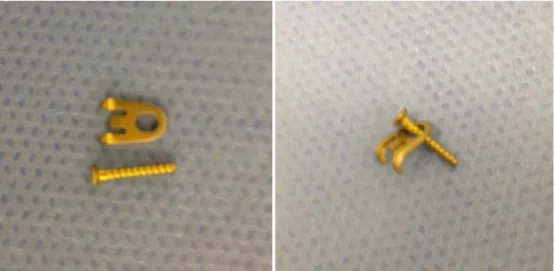
A dorsal H-shaped incision was performed atthe base topographyofthedistalphalanxoftheaffected finger, fol-lowedbysofttissuedissectionwhenthedistalportionofthe extensortendonandthefocusofthedistalphalanxfracture wereidentified.Thefracturesitewasthenprepared,followed byreductionindirectview.Osteosynthesiswasachievedwith theaidofaspecialprefabricatedplate,developedand man-ufacturedforthetreatment ofthis typeofinjury,which is characterized by the presence of hooks at one end (hook plate;Fig.3).Thefixationwasperformedwitha1.2-or 1.5-mmminifragmentcortexscrew,accordingtothethicknessof thecompromisedphalanx.AdditionalstabilizationoftheDIF jointwasmadebyplacingatransarticular1-mm Kirschner wire.Intraoperativecontrolwasperformedwitharadioscopy device,followedbyradiographicexamination.
Aftercleaningthewoundwith0.9%salinesolution, releas-ingthetourniquet,andensuringlocalhemostaticcontrol,the suturewas performedand adressing was placed.A metal splintwasusedinthepostoperativeperiod.
Table1–Crawfordcriteria(1984)toassessmalletfinger.
Classification Characteristics
Excellent Nopain;fullflexionandextensionoftheDIP joint
Good Nopain;0◦–10◦extensiondeficit,fullflexion oftheDIPjoint
Fair Nopain;10◦–25◦extensiondeficit,lossof
somedegreeofflexion
Poor Persistentpain;>25◦extensiondeficit
Patientsweredischargedonthedayaftertheintervention. Patients werefollowed-up weekly; immobilization,stitches, and the transarticular Kirschnerwirewere removed inthe secondweekofthepostoperativeperiod.Thereafter,patients wereinstructedtobegintheprocessofrehabilitationunder the supervision of physiotherapists who followed a pre-establishedprotocol.Paincontrolwasrecommended;range ofmotiongainwasinitiatedfourweeksaftersurgery.
PlainX-raysofthefingersintheanteroposteriorandlateral viewsweremadeweeklytomonitorthefractureconsolidation process(Fig.4).
At sixweeks post-operative, patients were subjected to anassessmentoftheirdegreeofsatisfactionwiththe treat-ment inaccordance tothecriteriaproposedbyCrawford.10 Thefunctionalscoreofthismethodcomparesthelossof flex-ionandextensionoftheDIPjointmeasuredindegreesusing a fingergoniometer, comparing it tothe normal contralat-eralside.Todeterminethelevelofsatisfaction,complications duringtreatmentandtheimpairmentoflaboractivitiesare considered.
Crawford10devisedaclassificationinwhichtheresultscan beclassifiedintofourcategories,throughtheanalysisof pre-determined parameters(painandmobilityoftheDIPjoint) relatedtoworkactivitiesandthedegreeofsatisfactionofthe individual(Table1).
After18monthsoffollow-up,anevaluationofthepainon the operatedfingerwasconductedand rangeoffunctional motionforflexionandextensionoftheDIPjointwas mea-suredwiththeaidofanappropriatedevice.
Fig.4– PostoperativeX-rayinanteroposteriorandlateralviewsshowingthefracturehealingprocess.
Results
Inthepresentstudy,10patients(40%)hadexcellentand15 (60%)hadgoodresultsinthesixthpostoperativeweek accord-ingtotheCrawfordclassification.
After18monthsofsurgery, the presenceofpain inthe injuredsite wasassessed.Itwasobservedthat 21patients (84%)hadnopaincomplaintsandfour(16%)reported symp-tomsofmildintensity.
ThedatainFig.5showthat14patients(56%)hadnorange ofmotionlimitationoftheDIPjoint18monthsaftersurgery; seven(28%)hadlimitedextension;andfour(16%)hadlimited flexion.Functionalmotionlimitationdidnotexceeded10◦for
flexionand5◦forextension(Fig.6).
Discussion
Malletfingerisaninjurycausedbyavulsionoftheterminal partoftheextensortendon,whichisinsertedintothebaseof thedistalphalanx,andwhichinturnmaybeassociatedwith afractureandleadtoflexiondeformityoftheDIPjoint.1This
Range of motion limitation
56%
28%
16%
Limited extension Limited flexion No limitation
Fig.5–Distributionofpatientsinpercentages,considering therangeofextensionorflexionoftheDIPjoint.
studyassessedtheresultsofsurgicaltreatmentforinjuries classifiedastypeC2intheAlbertoniclassification,9inwhich overone-thirdofthearticularsurfacewouldbeinvolved.
Despite the many studies in the orthopedic literature since1956featuringtheterm“malletfinger”inthePubMed database,thelevelofevidenceofpublicationsaddressingthis themeisnotidealtodefine thebesttherapeuticoptionfor thiscondition.2Relativetothistheme,in2014Gruberetal.11 publishedanarticle thatprospectivelycomparedona ran-domized study the effectiveness ofthe use ofa nocturnal orthosisversusnon-use.However,notevenintheCochrane Librarydatabasewecouldretrievestudiesthathadcompared thedifferentmethodsofsurgicaltreatment.
Regardlessofthetherapeuticmethod,itisknownthatan inappropriatechoiceoftreatmentwillleadtopoorresultsdue to finger deformities,symptomatic secondary degenerative osteoarthritis,andfunctionaldeficiencies.12Todecreasethe riskoftheseproblems,theorthopedicsurgeonshouldselect thebestmethodoftreatmentavailableandapplyitproperly. Someauthorsarguethatnon-surgicaltreatmentisamong thetherapeuticoptions,andsupportthethesisthatafailureto obtainananatomicalreductionwouldnotleadtoasignificant functionalloss,asfingermobilitydependsmoreonthe prox-imalinterphalangealjoint.Localanatomicaldamage,evenif significant,wouldalsonotbeconsideredaproblem,giventhe potentialforremodelingoffracturesinthatregion.13
Fig.6–Functionallimitationofthefifthfingerinthelatepostoperativeperiod.
authorsconsiderthatanatomicalreductionandstable inter-nalfixationareessentialtopreventthesecomplications.Other studies,suchasthosebyLubahn,13corroboratethispremise andadvocateinfavorofsurgicaltreatment.
Over time, various surgical techniques have been described,withorwithoutopenreduction,featuringvarious methods and devices used for stabilization of fractures. Kirschnerwireshavebeenoftenusedininternalfixationof fractures, and various configurations have been described, suchastheintramedullary,interfragmentary,“umbrella han-dle”,and combined techniques. Tensionbands withwires, fixation with screws, absorbable pins, plates and screws, amongothershavealsobeenused.2,5–8
Damronet al.,2 when assessing tension bands, demon-stratedthattheirassociationwithsutureshowed unaccept-ableratesoffailureandattributedthistotheinabilityofthis synthesistocontroltheenergydissipatedinthefracturesite. As described in the study by Kronlage and Faust,8 six casesoffixationwithscrewshadconsiderableprominenceof thesynthesismaterialwhenassessedbyplainradiography ofthe operatedfinger.However,their patientshadnopain complaintsandremainedasymptomaticandwithout postop-erativecomplications.Thisshows thatthetechniqueswith directreduction have good results. Someauthors, such as Hamasetal.,5claimthatadequateopenreductionprevents lossofmotionandtheonsetofdegenerativediseases. How-ever, suchcomplications can alsoberelated to the degree ofdamageoftheinvolvedtissues.Theshapeoftheheadof thetractionscrewcould influencetheprotuberanceofthis device;asecondapproachmightbenecessarytoremovethe implant.8Anotherimportantfactthatshouldbementioned when consideringbonestabilization throughscrews isthe
potentialforfragmentationofthebonesegmentthatneedsto bestabilized.Ifadequateandgoodqualityinstrumentsarenot usedandiftheprinciplesofosteosynthesisarenotfollowed, thepossibilityoffailureandcomplicationsincreasesgreatly. ItisnoteworthythatYamanakaandSasaki14didnotobserve bonefragmentfracturesduringsurgery,achieving anatomi-calreductioninalltheirpatients. Theirfindingsmatch the intraoperativedataobservedinthepresentstudy.
Wecanfindsomestudieswherehookplateswereusedand basedonthefollowingarguments:theyallowforanatomical reduction;avoidtheuseofimplantsthroughasmalldorsal fragmentandreducetheriskoffracture and/or fragmenta-tion; use a superior biomechanical principle, which is the tensionband;allowforastablefixationandthereforeearly mobilization;andtheybringcomfort,confidence,and accep-tancetotheoperatedpatient.3Thesecharacteristicswerealso observedbytheauthorsofthepresentstudy.
Theinterest in runningthis research wasbased on the small numberofstudiesintheliteraturethatassessedthe effectivenessoftheuseofhookplates.Therefore,thisstudy aimedtoevaluateitsefficiencyandbenefitsofsurgical treat-mentofmalletfingerfracture.Regardingtheanalysisofdata, thepresentresultsweresimilartothoseobservedinthe liter-ature.
In our study, presence of pain at the 18th postopera-tivemonthwasobservedin16%ofcases.Despiteadequate reduction on radiographic imaging, this finding may be justifiedbyearlysecondarydegenerativeosteoarthritis, neu-romas,regionalneuropathy,chondrolysis,andpresenceofthe implant,amongothers.
Theinjurysitewasqualitativelyanalyzedinthepresent study,anditwasobservedthat68%ofpatientshadinjuryin thedominanthand.InthestudiesbyBadiaandRiano17and byLucchinaetal.,18allinjurieswereinthedominanthand.
Conclusions
Consideringthefactspresented,itwasobservedthatthereis noconsensusonthebesttreatmentmethodformalletfinger. Thelevelofevidenceofstudiesthataddressthisissueisstill notideal,and theconclusionsonthis subjectneedfurther evidence.Therefore,tosettlethisissue, studieswithbetter methodologicalqualityareneeded.
Thesurgicaltreatmentwithopenreductionandinternal fixationwithhookplateandscrewissafeandeffective,and wasproventobeaexcellenttreatmentoptioninmallet frac-tures.
Conflicts
of
interest
Theauthorsdeclarenoconflictsofinterest.
r
e
f
e
r
e
n
c
e
s
1. McCueFC3rd,MeisterK.Commonsportshandinjuries:an overviewofetiology,managementandprevention.Sports Med.1993;15(4):281–9.
2. DamronTA,EngberWD,LangeRH,McCabeR,DamronLA, UlmM,etal.Biomechanicalanalysisofmalletfingerfracture fixationtechniques.JHandSurgAm.1993;18(4):600–7.
3.TeohLC,LeeJY.Malletfractures:anovelapproachtointernal fixationusingahookplate.JHandSurgEur.2007;32(1): 24–30.
4.DoyleJR.Extensortendons-acuteinjuries.In:GreenDP, HotchkissRN,PedersonWC,editors.Operativehandsurgery. 4ed.NewYork:ChurchillLivingstone;1998.p.1950–87. 5.HamasRS,HorrellED,PierretGP.Treatmentofmalletfinger
duetointra-articularfractureofthedistalphalanx.JHand SurgeryAm.1978;3(4):361–3.
6.StarkHH.Troublesomefractureanddislocationsofthehand. InstrCourseLect.1970;19:130–9.
7.BischoffR,BuechlerU,DeRocheR,JupiterJ.Clinicalresultsof tensionbandfixationofavulsionfracturesofthehand.J HandSurgAm.1994;19(6):1019–26.
8.KronlageSC,FaustD.Openreductionandscrewfixationof malletfractures.JHandSurgBr.2004;29(2):135–8.
9.AlbertoniWM.Malletfinger:classification.RevHospSão PauloEscPaulMed.1989;1(3):133–6.
10.CrawfordGP.Themoldedpolythenesplintformalletfinger deformities.JHandSurgAm.1984;9(2):231–7.
11.GruberJS,BotAG,RingD.Aprospectiverandomized controlledtrialcomparingnightsplintingwithnosplinting aftertreatmentofmalletfinger.Hand(NY).2014;9(2): 145–50.
12.GabermanSF,DiaoE,PeimerCA.Malletfinger:resultsofearly versusdelayedclosedtreatment.JHandSurgAm.
1994;19(5):850–2.
13.LubahnJD.Malletfingerfractures:acomparisonofopenand closedtechnique.JHandSurgAm.1989;14Pt2(2):394–6. 14.YamanakaK,SasakiT.Treatmentofmalletfracturesusing
compressionfixationpins.JHandSurgBr.1999;24(3): 358–60.
15.KingHJ,ShinJS,KangES.Complicationsofoperative treatmentformalletfracturesofthedistalphalanx.JHand SurgBr.2001;26(1):28–31.
16.SternPJ,KastrupJJ.Complicationsandprognosisoftreatment ofmalletfinger.JHandSurgAm.1988;13(3):329–34.
17.BadiaA,RianoF.Asimplefixationmethodforunstablebony malletfinger.JHandSurgAm.2004;29(6):1051–5.