Article
Printed in Brazil - ©2014 Sociedade Brasileira de Química0103 - 5053 $6.00+0.00A
*e-mail: [email protected]
Conformational Analysis of 2,2’-arylmethylene
bis(3-hydroxy-5,5-dimethyl-2-cyclohexene-1-one) by NMR and Molecular Modeling
Marcelle de S. Ferreira and José D. Figueroa-Villar*
Medicinal Chemistry Group, Department of Chemistry, Military Institute of Engineering, Praça General Tiburcio 80, 22290-270 Rio de Janeiro-RJ, Brazil
2,2’-arilmetileno bis(3-hidróxi-5,5’-dimetil-2-ciclo-hexano-1-onas) com grupos para e orto
no anel benzeno foram preparados e estudados por ressonância magnética nuclear (NMR) e modelagem molecular para determinar modificações conformacionais. Os resultados teóricos e experimentais mostraram que a interconversão conformacional nessas moléculas acontece por rotação do anel benzeno e leve movimentação dos anéis de dimedona, levando a variação do comprimento das ligações de hidrogênio intramoleculares. A presença de um na posição orto
do anel benzeno modifica a interconversão conformacional, levando ao desaparecimento de uma ligação de hidrogênio intramolecular e sobreposição de diversos sinais de RMN. A correlação dos valores de σp com deslocamentos químicos, ângulos e cargas atômicas confirma que as propriedades eletrônicas dos grupos R-para estão envolvidas nas mudanças conformacionais e
variação dos deslocamentos químicos. Esses resultados serão aplicados para o estudo da interação desses compostos com biomoléculas e no seu uso como materiais de partida no planejamento e síntese de novos agentes bioativos.
2,2’-arylmethylene bis(3-hydroxy-5,5-dimethyl-2-cyclohexene-1-ones) with para and ortho-R
groups on the benzene ring were prepared and studied by nuclear magnetic resonance (NMR) and molecular modeling to determine their conformational exchanges. Experimental and calculated results indicated conformational interconversions in these compounds by rotation of benzene ring and slow movement of dimedone rings, leading to intramolecular hydrogen bond length variation. The presence of one R group at the ortho position on the benzene ring modifies conformational
exchange, leading to disappearance of one intramolecular hydrogen bond and superposition of diverse NMR signals. The correlation of σp values with chemical shifts, angles and atomic charges confirms that para-R groups electronic properties are involved in conformational exchange and
chemical shift variance. These results will be used to study the interaction of these compounds with bio-molecules and their use as starting materials for design and synthesis of new bioactive agents.
Keywords: 2,2’-arylmethylene bis(3-hydroxy-5,5-dimethyl-2-cyclohexene-1-one), NMR, molecular modeling, intermolecular hydrogen bond, structure conformation
Introduction
2,2’-arylmethylene bis(3-hydroxy-5,5-dimethyl-2-cyclohexene-1-ones) are important substances used as precursors for synthesis of heterocyclic compounds,1 as
xanthenes2-11 and acridinediones.12-16 These compounds
present interesting biological activity as antioxidants,17
tyrosinase inhibition,18 significant activity with enzyme
lipoxygenase,17 action against important disorders of
asthma and inflammatory processes,19 including antiviral
and antibacterial activities.20
These compounds are prepared from aromatic aldehydes via Knoevenagel condensation and Michael additions with 5,5-dimethyl-1,3-cyclohexanedione (dimedone, 1) under different conditions. In the literature, there are several reported procedures for the synthesis of 2,2’-arylmethylene bis (3-hydroxy-5,5-dimethyl-2-cyclohexene-1-ones) using catalysts, such as polyvinyl pyrrolidone (PVP) stabilized nickel nanoparticles,1 triethylbenzylammonium chloride
(TEBA),2 KF/Al
2O3,3 HClO4–SiO2,5 EDDA,7 sodium
docecyl sulfate (SDS),9 SmCl
3,10 tetraethyl ammonium
bromide,17 piperidine,18,21 polyethylene glycol 400
(PEG-400),22 molecular iodine,23 L-histidine in ionic
ammonium bromide (CTMAB),27 zirconium oxychloride/
sodium amide (ZrOCl2/NaNH2)28 and CaCl2.29 Other
reported synthetic methods for these compounds include imine in methanol at 70 ºC,4 aqueous medium at room
temperature6,30 or with refluxing,9 microwave-irradiation,11
with DMF at 80 ºC,31 as well as using acyclic nitrones
in CH2Cl2 at 80 ºC32 or aqueous media under ultrasound
catalyzed by urea.33
T h e s e c o m p o u n d s w e r e s t u d i e d b y x - r a y crystallography,34-37 nuclear magnetic resonance
(NMR)and molecular modeling,37 affording important
information about structure and conformation, including the presence of intramolecular hydrogen bonds.37 One of
the most important works on 2,2’-[(phenyl)methylene] bis(3-hydroxy-5,5-dimethyl-2-cyclohexene-1-one) by NMR was reported by Forsén et al. in 1969,38 describing
that this compound exists as dienolic tautomer, which information was obtained only by 1H NMR chemical
shifts using temperature effects, coupling constants, signal intensity and bandwidths, including intramolecular nuclear Overhauser and van der Waals deshielding effects, affording very important results.38 They also determined
the conformation of alkyl groups on 2,2’-[(alkyl) methylene] bis(3-hydroxy-5,5-dimethyl-2-cyclohexene-1-ones) using coupling constants and chemical shifts.38
However, conformational exchanges and other structural information of 2,2’-arylmethylene bis(3-hydroxy-5,5-dimethyl-2-cyclohexene-1-ones) were not previously investigated, despite being important points for understanding pharmacological properties and their use as starting materials for design and synthesis of new bioactive agents. Considering the influence of benzene ring R groups on conformational characteristic and three-dimensional structure of 2,2’-arylmethylene bis(3-hydroxy-5,5-dimethyl-2-cyclohexene-1-ones), this work reports their advanced structure and conformational analysis by NMR and molecular modeling.
Experimental Section
General
Solvents and reagents were obtained from commercial sources (Sigma-Aldrich, Acrós Organics). Melting points were determined on a Fisher-Johns apparatus. The infrared spectra (IR) were measured using a Shimadzu 21 spectrometer, with samples prepared in tablets of anhydrous potassium bromide (KBr). The thin layer chromatography analyses were conducted using Merck silica gel 60 F254
aluminum sheets.
NMR
The 1H and 13C NMR spectra were obtained using a
Varian 600 MHz NMR spectrometer. The samples were analyzed using CDCl3 as solvent and temperature of 20 and
50 oC, with control of ±0.1 oC. All samples were prepared
with 20 mg of the respective compound and 600 µL of solvent. The 1H and 13C NMR spectra were obtained with
32 and 1024 scans, respectively. The obtained spectra to confirm the unquestionable chemical shift assignments, as well as determination of structural conformation were gCOSY, gHSQC, gHMBC and NOESY-1D or ROESY-1D.
Molecular modeling
All studied structures were calculated using the B3LYP method and 6-311+G(d,p) basis set from the Spartan’06 program.39 The natural atomic charges (Q
NPA), were selected
for correlation studies. Potential energy surfaces were calculated at B3LYP/6-311+G(d,p) level, to study the conformational versatility of the compounds studied. The conformational variations were performed by rotation of the benzene ring, rotation of the dimedone rings, movement of the methyl and methylene groups of the dimedone rings, as well as hydrogen bond oscillation on Side A and Side B. The percentage of molecules on each conformation was calculated by DeltaG using 6-311G(d,p). All molecular modeling results are included on the Supplementary Information.
General Procedure for the preparation of compounds 3a-g
In a 250 mL becker were added 1.68 g (12 mmol) of 5,5-dimethyl-1,3-cyclohexanedione (dimedone) in 100 mL of distilled water, followed by addition of 6 mmol of the respective aldehyde dissolved in 30 mL of ethanol 95% and stirring for 30 min. The precipitated product was filtered and washed with distilled water, followed by recrystallization in ethanol.
2,2’-[(4-dimethylaminophenyl)methylene] bis(3-hydroxy-5,5-dimethyl-2-cyclohexene-1-one) (3a)
Yellow solid; 94% yield; m.p. 191-193 ºC (lit. 193-194 ºC);23 IR (KBr) ν/cm-1 3439, 2959, 2874, 1591,
1443, 1370, 1312, 1258, 1163, 910, 812, 594, 482; 1H NMR
(600 MHz, CDCl3) d 11.95 (s, 1H, OH), 11.57 (bs, 0.3H,
OH), 6.95 (d, 2H, J 8.4, Ph-H), 6.67 (d, 2H, J 8.4, Ph-H),
5.48 (s, 1H, CH), 2.91 (s, 6H, CH3), 2.45 (d, 2H, J 17.4,
Hα-CHβ ), 2.40 (d, 2H, J 13.8, Hα-CHβ), 2.38 (d, 2H, J 13.8,
HαC-Hβ), 2.32 (d, 2H, J 17.4, Hα-CHβ), 1.24 (s, 6H, CH3),
189.46, 148.95, 127.68, 125.79, 116.15, 112.88, 47.29, 46.66, 40.91, 32.04, 31.57, 29.91, 27.54.
2,2’-[(4-methoxyphenyl)methylene] bis(3-hydroxy-5,5-dimethyl-2-cyclohexene-1-one)(3b)
White solid; 83% yield; m.p. 143-145 ºC (lit. 146-148 ºC);10 IR (KBr) ν/cm-1 3447, 3015, 2959, 1603,
1508, 1458, 1368, 1304, 1246, 1178, 1165, 1034, 918, 829, 661, 580, 490; 1H NMR (600 MHz, CDCl
3) d 11.93 (s, 1H,
OH), 11.58 (bs, 0.3H, OH), 7.01 (d, 2H, J 8.4, Ph-H), 6.82
(d, 2H, J 8.4, Ph-H), 5.48 (s, 1H, CH), 3.78 (s, 3H, CH3),
2.46 (d, 2H, J 18.0, Hα-CHβ), 2.40 (d, 2H, J 16.2, Hα-CHβ),
2.38 (d, 2H, J 16.2, HαC-Hβ), 2.32 (d, 2H, J 18.0, HαC-Hβ),
1.23 (s, 6H, CH3), 1.11 (s, 6H, CH3); 13C NMR (150 MHz,
CDCl3) d 190.61, 189.56, 157.79, 130.02, 127.99, 116.00,
113.85, 54.41, 47.27, 46.69, 32.23, 31.59, 29.88, 27.57.
2,2’-[(phenyl)methylene] bis(3-hydroxy-5,5-dimethyl-2- cyclohexene-1-one)(3c)
White solid; 85% yield; m.p.193-195 ºC (lit. 194-195 ºC);17 IR (KBr) ν/cm-1 3421, 2960, 2872, 1595,
1491, 1447, 1375, 1300, 1250, 1167, 843, 777, 694, 581, 496; 1H NMR (600 MHz, CDCl
3) d 11.91 (s, 1H, OH),
11.57 (bs, 0.3H, OH), 7.28 (t, 2H, J 7.8, Ph-H), 7.18 (t, 1H, J 7.2, Ph-H), 7.11 (d, 2H, J 8.4, Ph-H), 5.55 (s, 1H, CH),
2.49 (d, 2H, J 18.0, Hα-CHβ), 2.40 (d, 2H, J 15.6, Hα-CHβ),
2.38 (d, 2H, J 15.6, HαC-Hβ), 2.34 (d, 2H, J 18.0, HαC-Hβ),
1.25 (s, 6H, CH3), 1.11 (s, 6H, CH3); 13C NMR (150 MHz,
CDCl3) d 190.67, 189.60, 138.28, 128.42, 126.99, 126.05,
115.81, 47.28, 46.67, 32.96, 31.63, 29.86, 27.62.
2,2’-[(4-chlorophenyl)methylene] bis(3-hydroxy-5,5-dimethyl-2-cyclohexene-1-one)(3d)
White solid; 80% yield; m.p. 140-141 ºC (lit. 140-142 ºC);7
IR (KBr) ν/cm-1 3441, 2956, 2872, 1593, 1490, 1400, 1375,
1304, 1253, 1153, 889, 835, 683, 588, 499; 1H NMR (600
MHz, CDCl3) d 11.87 (s, 1H, OH), 11.57 (bs, 0.3H, OH),
7.24 (d, 2H, J 8.4, Ph-H), 7.02 (d, 2H, J 8.4, Ph-H), 5.48 (s,
1H, CH), 2.46 (d, 2H, J 17.4, Hα-CHβ), 2.41 (d, 2H, J 10.2,
Hα-CHβ), 2.38 (d, 2H, J 10.2, HαC-Hβ), 2.32 (d, 2H, J 17.4,
HαC-Hβ), 1.22 (s, 6H, CH3), 1.11 (s, 6H, CH3); 13C NMR
(150MHz, CDCl3) d 190.84, 189.63, 136.91, 131.80, 128.56,
128.41, 115.55, 47.25, 46.64, 32.62 , 31.63, 29.80, 27.63.
2,2’-[(4-nitrophenyl)methylene] bis(3-hydroxy-5,5-dimethyl-2-cyclohexene-1-one)(3e)
White solid; 96% yield; m.p. 192-194 ºC (lit. 191-193 ºC);6 IR (KBr) ν/cm-1 3437, 2957, 2868, 1589,
1510, 1458, 1375, 1342, 1252, 1167, 1153, 1044, 851, 733, 588, 492; 1H NMR (600 MHz, CDCl
3) d 11.80 (s, 1H,
OH), 11.55 (bs, 1H, OH), 8.14 (d, 2H, J 8.4, Ph-H), 7.25
(d, 2H, J 8.4, Ph-H), 5.55 (s, 1H, CH), 2.50 (d, 2H, J 17.4,
Hα-CHβ), 2.43 (d, 2H, J 16.2, Hα-CHβ), 2.41 (d, 2H, J 17.4,
HαC-Hβ), 2.34 (d, 2H, J 16.2, HαC-Hβ), 1.24 (s, 6H, CH3),
1.12 (s, 6H, CH3); 13C NMR (150 MHz, CDCl3) d 191.14,
189.78, 146.73, 146.34, 127.85, 123.72, 115.12, 47.20, 46.61, 33.47, 31.68, 29.50, 27.68.
2,2’-methylene bis(3-hydroxy-5,5-dimethylcyclohex-2-en-1-one) (3f)
White solid; 80% yield; m.p. 192-194 ºC (lit. 190-192 ºC);9 IR (KBr) ν/cm-1 2967, 2933, 2873, 1606,
1578, 1419, 1368, 1150, 1085, 870, 827, 758; 1H NMR
(600 MHz, CDCl3) d11.58 (s, 2H, OH), 3.16 (s, 2H, CH2),
2.30 (d, 4H, J 16.2, CH2), 2.28 (d, 4H, J 16.2, CH2), 1.05 (s,
12H, CH3); 13C NMR (150 MHz, CDCl3) d 189.76, 113.67,
46.18, 31.98, 29.73, 27.27, 16.14.
2,2’-[(2,4-dinitrophenyl)methylene] bis(3-hydroxy-5,5-dimethyl-2-cyclohexene-1-one)(3g)
White solid; 92% yield; m.p. 175-177 ºC (lit. 172-173 ºC);29 IR (KBr) ν/cm-1 3254, 3119, 2926, 1718,
1612, 1531, 1465, 1387, 1352, 1238, 1072, 986, 835, 789;
1H NMR (600 MHz, CDCl
3) d 11.49 (s, 2H, OH), 8.40 (d,
1H, J 2.4, Ph-H), 8.34 (d, 1H, J 2.4, Ph-H), 7.46 (d, 1H, J 2.4, Ph-H), 6.06 (s, 1H, CH), 2.60-2.20 (m, 8H, CH2),
1.20-0.80 (m, 12H, CH3); 13C NMR (150 MHz, CDCl3) d
191.54, 189.95, 149.56, 146.37, 140.15, 131.13, 125.81, 119.94, 114.20, 46.96, 46.52, 32.24, 30.94, 28.78, 28.21.
Results and Discussion
Synthesis
The selected compounds for synthesis and analysis in this work were 2,2’-arylmethylene bis(3-hydroxy-5,5-dimethyl-2-cyclohexene-1-ones) (3a-e) with para substitution on the
benzene ring. The basic idea was determination of their detailed structure and conformation, as well as the effect of R groups on these topics. Using literature information we prepared these compounds using water as solvent. Accordingly, the synthesis of 2,2’-arylmethylene bis(3-hydroxy-5,5-dimethyl-2-cyclohexene-1-ones) (3a-e) was performed mixing a water solution of 5,5-dimethyl-1,3-cyclohexanedione (dimedone, 1) with the selected aromatic aldehydes (2) dissolved in ethanol, followed by stirring at room temperature for 30 min (Figure 1). This procedure leads to product precipitation with good yields and purity of 90 to 98%, followed by recrystallization in ethanol, leading to global yields of 80 to 96%.
properties of R groups at the aromatic ring, compounds 2,2’-methylene bis(3-hydroxy-5,5-dimethylcyclohex-2-en-1-one) (3f) and 2,2’-[(2,4-dinitrophenyl)methylene] bis(3-hydroxy-5,5-dimethyl-2-cyclohexene-1-one) (3g) were also prepared using the same synthetic procedure. These compounds were used to compare with 3a-e to determine the effect by presence of benzene ring and
ortho-R substituents on the conformations.
Conformational analysis of methylene bis(3-hydroxy-5,5-dimethyl-2-cyclohexene-1-ones) by NMR
To determine the structure conformation of all compounds, with emphasis on 2,2’-arylmethylene bis(3-hydroxy-5,5-dimethyl-2-cyclohexene-1-one) with
para-substituted benzene ring (3a-e), we used NMR and molecular modeling.
The first step was obtention of unquestionable 1H and 13C signal assignment for all products (Supplementary
Information), which were subjected to 1H, 13C, HSQC,
COSY, HMBC and NOESY experiments. The correct and
unquestionable chemical shift assignment is fundamental for NMR interactions study of these molecules with enzymes, nucleic acids or receptors,40,41 as well as complete
determination of their structure conformation.
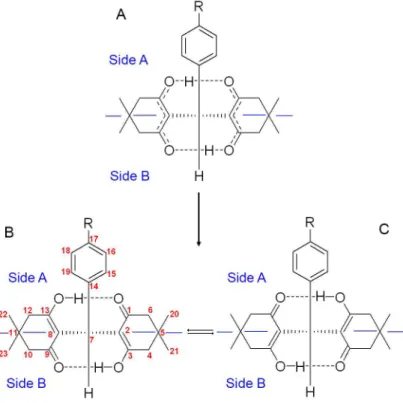
To facilitate the conformational description of these compounds we named the molecular region containing the benzene ring as Side A, and the opposite region as Side B, as shown in Figure 2. We consider that the basic structure of these compounds corresponds to structure A, which is a combination of structures B and C.
The 13C NMR spectra of compounds 3a-e show only one
sp3 CH signal, corresponding to C7 (32.04 to 33.47 ppm),
indicating the enolization of the two dimedone rings (Figure 2). The gHMBC spectra displayed all OH---O hydrogens (11.95 to 11.49 ppm) correlating with C3 and C13 (189.46 to 189.78 ppm) and with C4 and C12 (46.61 to 46.69 ppm), which are directly bounded to C3 and C13, confirming the enolization on compounds 3a-e.
When one OH hydrogen is forming hydrogen bonding with another electronegative atom usually displays a very high chemical shift, which could be broad or narrow. If the
Figure 1. Synthesis of methylene bis(3-hydroxy-5,5-dimethyl-2-cyclohexene-1-ones) (3a -g).
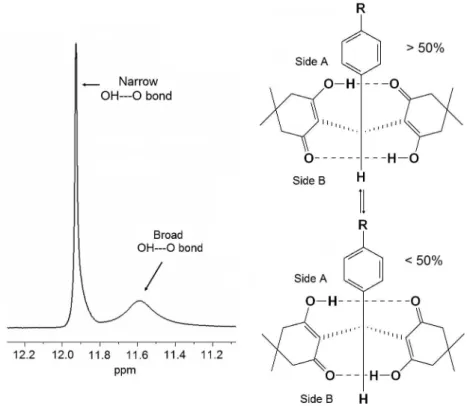
hydrogen bond is intramolecular and very permanent its NMR signal is narrow. On the other hand, if the hydrogen bond displays greater oscillation, its signal becomes broader. The 1H NMR data of compounds 3a-e show two
different OH signals, one narrow (11.80 to 11.95 ppm) and one broad (11.55 to 11.58 ppm). The narrow signal indicates that the respective OH group is part of a strong intramolecular hydrogen bond, while the other one, which is broad, could only be participating on lever hydrogen bond. Forsén et al. (1969) determined the existence of the
two intramolecular hydrogen bonds on these compounds, including their difference on line width and chemical shift, but did not confirm that the moderate hydrogen bond was able to modify it length or participate on intermolecular interactions.38 The OH---O variations that we suggest on
these molecules agree with the IUPAC rules.42 The position
of these intramolecular hydrogen bonds was also reported by Sigalov et al. (2010), who assigned the signal of the
OH---O bond closer to the benzene ring as the strong chemical shift (narrow).37 In order to confirm that the
hydrogen bond difference depended on the position of the benzene ring we compared the NMR data of compound 3f with 3a-e. This compound does not contain a benzene ring and shows a single OH---O signal which integration corresponds to two hydrogens, confirming that presence of the benzene ring on compounds 3a-e leads to hydrogen bond differentiation. If all OH groups were involved on similar strength of intramolecular hydrogen bonds, they would display basically the same type of line widths, which is not the case for 3a-e. The broad OH---O signal is due to longer hydrogen bond strength, a condition that leads to more movement.
In order to determine if the strong hydrogen bond (11.95 to 11.80 ppm) of compounds 3a-e is fixed on Side A, as indicated in the literature,37,38 we executed NOE
experiments (NOESY and NOESY-1D). If the permanent position of this hydrogen bond is on Side A its signal would not display NOE interaction with H7, which is located on Side B. Also, if the broad OH---O bond were fixed on Side B its signal would be the only one displaying NOE interaction with H7. However, experimental NMR data shows that both OH signals display similar NOE interaction with H7, indicating that these hydrogen bond chemical shifts exchange their position between Side A and Side B. These results were obtained by NOESY spectrum (example in Supplementary Information).
The NOE interaction of both OH---O signals with H7 indicates that their bond strength exchanges between Side A and Side B. If the hydrogen bond distance oscillations were very fast it would lead to a single hydrogen signal, which is not the case, because the oscillation is slow, leading to two
different OH---O signals on compounds 3a-e. The NOESY spectrum (Supplementary Information) also shows NOE correlation of the narrow OH---O signal (11.93 ppm) with the ortho-hydrogens of the benzene ring of 3b (7.01 ppm), Therefore, the movement of the dimedone rings leading to hydrogen bond length oscillation, as shown in Figure 3, must be slow.
The suggested molecular exchange of Figure 3, besides explaining the interaction of both OH---O hydrogens signals with H7, indicates that broadening of one hydrogen bond signal is due to its elongation.
Despite the existence of this conformational exchange, the presence of the benzene ring on Side A leads the shorter hydrogen bond to stay more time on Side A of compounds 3a-e. Therefore, the benzene ring could also display some effects on hydrogen bond length in function of the benzene ring oscillation, a process that is basically the same for compounds 3a-e, because their benzene rings are para
-substituted and must display very similar rotation type. However, if the R groups were present at other positions on the benzene ring, the oscillation would be different, leading to modification of the dimedone rings movement. To confirm that suggestion it was analyzed compound 2,2’-[(2,4-dinitrophenyl)methylene] bis(3-hydroxy-5,5-dimethyl-2-cyclohexene-1-one) (3g) by NMR, because it contains a benzene ring with two nitro groups (ortho
and para), and its conformation must be different from
that of compounds 3a-f. The obtained 3g NMR spectra is completely different from the literature reported data,28
shows a single OH signal at 11.50 ppm (Supplementary Information), being different from the OH---O signals of compounds 3a-e. The only hydrogen bond signal of 3g is much broader than the one of Side A and more narrow than the one of Side B of compounds 3a-e. This result indicates that the two dimedone rings of hs 3g oscillate very fast, leading to a single OH signal, which integration corresponds to one hydrogen, indicating that other expected intramolecular hydrogen bond disappeared or became extremely weak (very broad). The NOE experiment of 3g shows that the detected OH signal is not interacting by dipolar coupling with H7, indicating that it is mainly located permanently on Side A and suffering strong oscillation. These results suggest that the intramolecular OH---O bond does not exists on Side B, while the only observed OH signal is most located on Side A and forming a relatively weak intramolecular hydrogen bond.
In parallel, the NMR spectra of 3g shows that its CH3 and CH2 signals were broad and superimposed, very
nitro group at the ortho position with the dimedone rings.
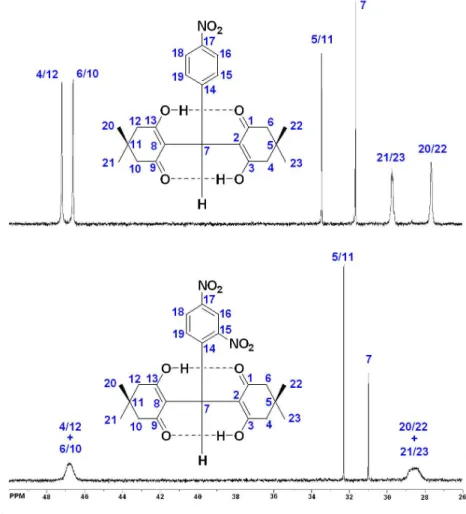
Another important point was the comparison of the sp3 13C NMR spectra of 3e and 3g, as shown in Figure 4. The
spectrum of 3e displays its methyl groups signals relatively broad as compared with the other carbons, a process that is in agreement with the dimedone rings conformational exchange. Interestingly, the 13C NMR spectrum of 3g
displays much signal broadening on CH2 (C4, C6, C10
and C12) and CH3 (C20, C21, C22 and C23), confirming
its strong molecular conformational exchange. Also, the C=O (C1/C9) and O-C=C (C3/C13) signals, which are not shown in Figure 4, display broadening for 3g but not for 3e. These results were obtained with NMR at 20 oC, indicating
that the 3g dimedone rings are very much mobile at this temperature than for 3e.
The same NMR spectra comparison between 3e and 3g was also obtained at 50 oC. The NMR spectra at 20 oC of
3g showed a single OH signal and when the temperature was changed to 50 oC several other signals superimposed.
The carbon and hydrogen methyl groups became narrow single signals at 50 oC, indicating that the conformation
exchange was much faster at that temperature. The same variation was observed for the methylene groups, which lead to the single 2.39 ppm (H) and 46.88 ppm (C) signals (Supplementary Information). However, the C1/C9 and C3/C13 signals of 3g at 50 oC became much broad, with the C3/C13 signal disappearing or superimposing with C1/C9 (190.76 ppm). On the other hand, the increase of
temperature on 3e did not lead to any hydrogen or carbon NMR signal disappearance or superposition. These results confirm that 2,2’-arylmethylene bis(3-hydroxy-5,5-dimethyl-2-cyclohexene-1-ones) exchange conformation, with more emphasis on compounds with R groups at the
ortho position of the benzene ring.
This information leads to three-dimensional structure determination of these compounds, which also indicates that the 3a-e conformational exchange occurs via intramolecular hydrogen bond distance variation by slow movement of the dimedone rings. In order to support the conformational structure information obtained by NMR of these compounds the next step was the application of molecular modeling.
Conformational analysis of methylene bis(3-hydroxy-5,5-dimethyl-2-cyclohexene-1-one) by molecular modeling
In this work, molecular modeling was executed using density functional theory with the B3LYP method and 6-311+G(d,p) basis set. Calculations with other different basis sets lead to very similar results, and 6-311+G(d,p) was selected because it provided the results in appropriate time. Some calculated bond and dihedral angles from the most stable conformation of each compound are in the Supplementary Information.
Initially we studied the energy variation due to the rotation of the benzene ring and one dimedone ring. The
Figure 4. Comparison of 13C NMR CH
2 and CH3 signals from 3e and 3g at 20 oC.
conformational variation of 3e is shown as example in Figure 5.
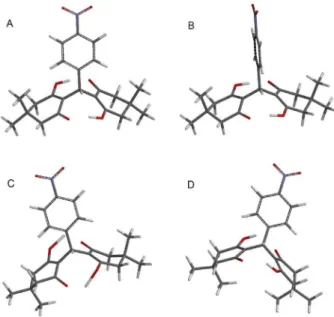
Benzene ring rotational simulation (Figure 5A) indicates conformation A (Figure 6A) as the most stable conformation with dihedral angle close to 90o, in which the
benzene ring is perpendicular to the C7-H7 bond (relative energy 0.00 kJ mol-1), while the highest conformational
Figure 5. Rotation graphics of p-nitrophenyl ring (A) and dimedone ring (B) from 3e.
energy by benzene ring rotation (conformation B, Figure 6B, dihedral angle 0o or 180o) displays the benzene
ring parallel to the C7-H7 bond (16.23 kJ mol-1). These
energy value (4.5 kJ mol-1), 17 kJ mol-1 was considered to
allow moderate benzene ring rotation at the temperatures on which the NMR experiments were executed (20 to 50 oC). The calculation of the number of conformers of
compound 3e at 20 oC (Figure 6A) by DeltaG, shows that the number of molecules with the highest conformation energy corresponds to 2.0%, while the lowest energy conformer is 32.5%. These results indicate that rotation of the benzene ring at room temperature is not very effective but may occurs at higher temperatures.
On the other hand, the energy variation by rotation of one dimedone ring is about 97 kJ mol-1 (Figure 5B),
indicating that this type of conformational exchange is not available at normal temperatures. Therefore, the other type of potential conformational exchange of these compounds is the moderate oscillation of the dimedone rings with major mobility of the methylene and methyl groups. The molecular modeling calculation indicated three different stable conformations, as shown on Figure 6 (A, C and D), where conformation A is the most stable (0.00 kJ mol-1),
C is with medium stability (1.50 kJ mol-1) and D is the
less stable of the three (2.44 kJ mol-1). Because the energy
difference between these three conformations is low, it is clear that the dimedone ring oscillation is occurring all the time on these compounds. These dimedone rings movement, despite being occurring all time, its effect on intramolecular hydrogen bond length variation seems small.
Rotation of dimedone rings is much more difficult because the number of molecules with 62 kJ mol-1 energy
conformation is 0.9% while the number of molecules from lowest energy conformation (0.0 kJ mol-1) is 50.7%.
The conformation of 97 kJ mol-1 displays basically zero
percent of molecules (0.5%), confirming that rotation of the dimedone rings is not efficient, being much less possible than the benzene ring rotation.
In Figure 6, the most stable conformations (A and C) display a distance of 2.27 and 2.45 Å between H15/H19 and
α-methyl groups. These results completely agree with the experimental NOE NMR experiments, confirming dipolar coupling between the ortho-hydrogens of the benzene ring
and α-methyl groups. It is clear that the three conformations A, C and D are present on these molecules, but the NOE results indicate that conformations A and C must be the two most abundant ones. These experimental results were confirmed by the DeltaG conformational energy calculation where conformations A and C are 32.5% and 29.1%, while conformation D is less that 10%.
The molecular modeling of compounds 3a-e confirms the presence of two intramolecular hydrogen bonds, in which the shortest one is localized on Side A. These calculations also indicate that the hydrogen bond length from Sides A and B are similar but not identical (Table 1). The length of the two OH---O bonds of compound 3f is the same, while bond distance difference of compounds 3a-e varies from 0.05 to 0.06 Å, confirming the effect of the benzene ring presence, in agreement with the NMR results.
Bolte et al. reported that, in solid state, the position
of the narrow hydrogen bond signal is on Side A, as determined by x-ray crystallography.34 However, the
conformation of 2,2’-arylmethylene bis(3-hydroxy-5,5-dimethyl-2-cyclohexene-1-one) in solution and solid state should be relatively different, because in solid state mobility and conformational exchange is usually restricted.
As mentioned before, molecular modeling confirms the difference between the OH---O hydrogen bond length of Side A and Side B for compounds 3a-e, despite being relatively similar. This calculation agrees with the NMR
Table 1. Hydrogen bond lengths of compounds 3a-g by B3LYP 6-311+G(d,p) and chemical shift difference (∆δOH---O).
Prod. OH---O Bond / Å ∆OH---O / Å ∆δOH---O / ppm Side A Side B
3a 1.63 1.68 0.05 0.38
3b 1.63 1.69 0.06 0.35
3c 1.63 1.68 0.05 0.34
3d 1.63 1.69 0.06 0.30
3e 1.63 1.69 0.06 0.25
3f 1.69 1.69 0.00 0.00
3g 1.61 1.73 0.12
data of these compounds, which shows that the two hydrogen OH---O signals of compounds 3a-e are different by line broadening and chemical shift, with the narrow one forming a strong hydrogen bond and the broad one a weak one. Because the NOE experiments indicated the OH---O bond chemical shift exchanging position between Side A and Side B, it was necessary to perform molecular modeling of the OH---O bond oscillation to confirm that variance. To determine the possibility of intramolecular hydrogen bond motilities it was calculated the conformational exchange, as shown in Figure 7 using 3e as example. That procedure was carried out with the hydrogen bond length exchange from 1.50 to 2.00 Å in Sides A and B. When bond length variation was executed on Side A, the Side B OH---O bond length varied from 1.68 to 1.69 Å (difference of 0.01 Å). The same calculation on Side B leads Side A OH---O bond length variation from 1.64 to 1.65 Å (difference 0.01 Å). The comparison between these data indicates that the short OH---O bond is basically permanent on Side A. However, the low conformation energy difference (9.4 and 6.7 kJ mol-1)
indicates that the bond length can oscillate, especially with bond length exchanges from 1.60 to 1.80 Å, a process that includes energy exchanges less than 2.0 kJ mol-1.
In general, it is observed that compounds 3a-e display differences between Side A and Side B, with the major differences on OH---O bond length (Table 1) and angle differences between C1C2C7 and C7C8C13 (Side A) as well as C3C2C7 and C7C8C9 (Side B) (Supplementary Information). The differences between C1C2C7 and C7C8C13 (Side A) vary from 4.52 to 5.45 degrees, being very similar to the difference between C3C2C7 and C7C8C9 of Side B (4.85 to 5.72 degrees). These results indicate that small structural data differences between
Side A and Side B are sufficient to differentiate their intramolecular OH---O bonds.
Calculating the population on each conformation from oscillation of the intramolecular hydrogen bond of Side A shows a percentage of molecules at high energy (2.04 kJ mol-1) of 8.8% and 1.9% at 9.40 kJ mol-1 and 18.0%
at the lowest energy (0.00 kJ mol-1). The same calculation
from Side B shows 4.7% molecules at 3.91 kJ mol-1
and 2.7% at 6.70 kJ mol-1, while at the lowest energy
(0.00 kJ mol-1) it is 18.4%. These results indicate that the
two hydrogen bonds oscillate very similar.
The study of conformational effect of ortho-R group on
the benzene ring was performed by molecular modeling of compound 3g, showing that its most stable conformation possess a OH---O bond distance of 1.61 Å on Side A and 1.73 Å on Side B, leading to a difference (∆H---OA-B) of
0.12 Å. This bond length difference is about two times greater than for compounds 3a-e, indicating that 3g posses a single stronger OH---O bond, which is located on Side A, as expected. The other OH group of 3g must oscillate strongly, a process that leads to non observation of its signal by NMR. These results confirm that 3g displays major conformational exchange than compounds 3a-e, as previously indicated by the NMR experimental results.
Effect of para-R groups on chemical shift and structure conformation
The electronic property of R groups at the para position
of the benzene ring is defined with the Hammett constants,
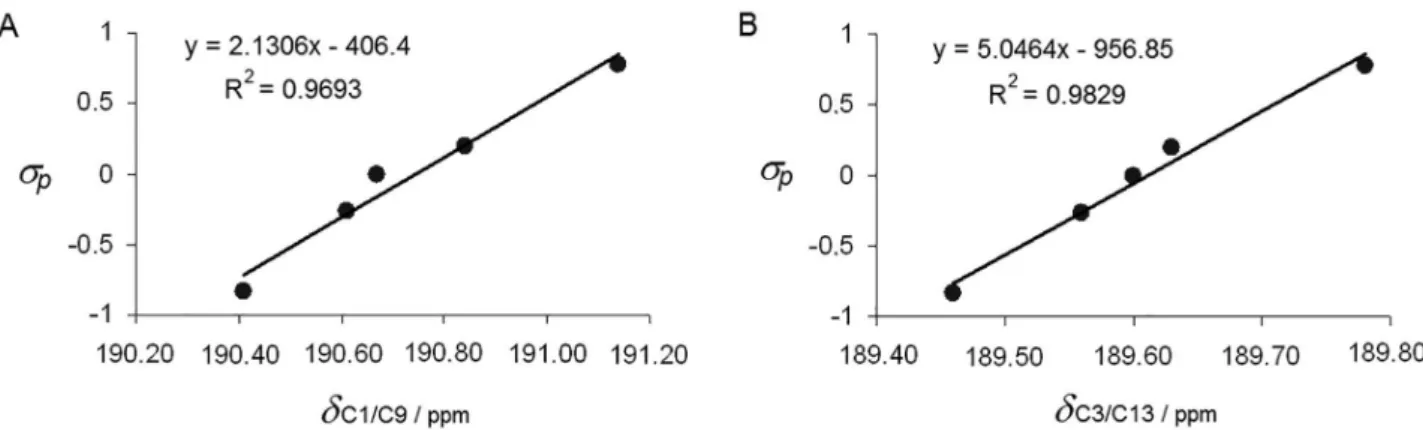
σp, which effect on the structure of 3a-g was studied by its correlation with experimental (NMR) and molecular modeling data. The first case was obtaining graphics of
δC3/C13 and δC1/C9 with σp (Figure 8) confirming good correlation
(R2 0.9693 and 0.9829). To explain these results is necessary
that the benzene ring, despite not being directly attached to the sp2 oxygenated carbons of the dimedone rings (C3/C13
and C1/C9), interacts with them via C7 and C8. Because the correlation of σp with δC7 and δC2/C8 afford R2 respectively
0.8498 and 0.9675 (Supplementary Information), it is clear that the benzene ring electronic properties directly affect the bounded sp3 carbon (C7), which is connected to the
sp2 carbons C2/C8, leading to transference of σ
peffects to C3/C13 and C1/C9, affecting their chemical shifts.
Molecular modeling results were also used to compare the electronic properties and position of benzene ring R groups with the structure and conformation of compounds 3a-g. It was observed that bond length and angle differences between Side A and Side B occur by the presence of the benzene ring on Side A. Comparison of the observed Side A and Side B differences between compounds 3a-e indicates that they are very similar, but these small differences must be defined by the type of para-R group present on the
benzene ring of each compound. This result suggests that these differences could be controlled either by electronic properties or size of the R groups. However, because the
para-R groups are relatively far away from the dimedone
rings, it is clear that only the electronic properties of para-R
groups are responsible for these differences. The ∆δOH---O
data (Table 1) correlates well with para-R σpvalues, as shown in Figure 9 (R2 = 0.9467), confirming that the most
important R factor affecting the intramolecular hydrogen bonds of compounds 3a-e is σp.
The correlation of σp with δOH Side A displays R2 = 0.9120,
while with δOH Side B leads to R2 = 0.4996, indicating that
the effect of the para-R groups is only effective on Side A.
Because the electronic effects are conducted by bond connections, this result confirms that Side B displays more conformational exchange. For example, the major movement on Side B leads to a weaker intramolecular hydrogen bond (broad signal), which does not conduct well electronic effects, different from Side A (narrow
signal). Formation of hydrogen bong with one oxygen certainly affects its electronic density, leading to electronic effect. It is clear that weak hydrogen bonds lead to much lower electronic effects to the bonded atom because their interaction is weaker.
The natural atomic charge (QNPA) of carbons involved
on connection with the phenyl group (Supplementary Information), indicate basic continuous atomic charges variation of C7, C2/C8 and C1/C9 by the para-R groups
electronic properties of compounds 3a-e.
The correlation of atomic charges with NMR chemical shifts gives good R2 values for C1, C2, C7 and C9 (0.8860
to 0.9743), as well as with σp (0.8765 to 0.9727), indicate again the electronic influence of the para-R groups on
carbons C1, C2, C7 and C9. In general terms, these results confirm our conclusion that para-R groups electronically
affect carbons C7, C2/C8, C3/C13 and C1/C9.
Three-dimensional structure of 2,2’-arylmethylene bis(3-hydroxy-5,5-dimethyl-2-cyclohexene-1-ones)
The 1H NMR spectra of 3a-e contain two different
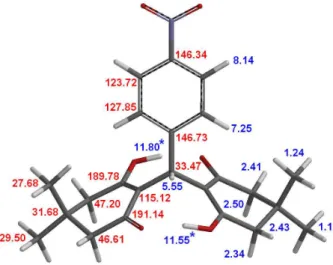
methyl signals, 1.22 to 1.25 ppm and 1.10 to 1.12 ppm. The NOE experiments display dipolar coupling between the benzene ring ortho-hydrogens (H16 and H19) with
the 1.22 to 1.25 ppm methyl signals, but not with the other
Figure 9. σp correlation of para-R groups with the chemical shift
difference between the two intramolecular hydrogen bonds of compounds 3a-e.
ones. Considering the phenyl ring of these compounds at the α-position, the methyl groups of chemical shift 1.22 to 1.25 ppm are α-methyl groups, and the other (1.10 to 1.12 ppm) are the β-methyl groups. The NOE results between the α- and β-methyl groups with the CH2 hydrogens also
confirm that the signals 2.41 and 2.43 ppm are respectively
α-H10 and α-H12, while 2.50 ppm is β-H10 and 2.34 ppm is β-H12. Therefore, using molecular modeling and RMN results, with emphasis on NOESY, HSQC and HMBC, it was possible obtaining the definitive signal assignment and three-dimensional conformation of all compounds. One example is the most stable three-dimensional structure of compounds 3e, as shown for compound 3e in Figure 10.
Conclusion
The NMR study of 2,2’-arylmethylene bis(3-hydroxy-5,5-dimethyl-2-cyclohexene-1-one) confirms their conformational variation, a process that is affected by characteristics of the benzene ring bounded to C7 and temperature exchange. The major conformational exchange of compounds 3a-e, with a benzene ring with R or H groups at the para position, corresponds to rotation of this ring,
maintaining two intramolecular hydrogen bonds. The two intramolecular hydrogen bonds are different by the effect of the presence of the benzene ring, one being more strong that the other. However, these hydrogen bonds exchange their chemical shift by movement of the dimedone rings, a process that is confirmed by the dipolar coupling of both OH---O hydrogens with H7. In any case, the shorter hydrogen bond is close to the benzene ring most of the time. On the other hand, compound 3g, which posses R group at the ortho position of the benzene ring, displays a major
conformational exchange, including benzene ring rotation
Figure 10. Three-dimensional structure assignment of compound 3e (signals marked with * exchange position).
and major dimedone rings oscillation, leading to a single intramolecular hydrogen bond not being strong.
The molecular modeling analysis of compounds 3a-e and the NOESY experiments confirm that their main conformation corresponds to position of the ortho
-hydrogen atoms of the benzene ring very close to the two
α-methyl groups of dimedone rings.
The good correlation between σp of the benzene ring para-R groups with the chemical shifts of carbons
C1/C9 (R2 = 0.9693) and C3/C13 (R2 = 0.9829), and with ∆δOH---O (R2 = 0.9467), confirms that electronic properties
of the para-R groups are the important factor leading
to structure differences. These results confirm that the R groups electronic properties, even not being directly conjugated with the atoms C1/C9, C3/C13 and OH, modify their electronic charges and chemical shifts.
The obtained conformational information of 2,2’-arylmethylene bis(3-hydroxy-5,5-dimethyl-2-cyclohexene-1-one) is very important to understand their properties and capacity of interaction with bio-molecules, as well as their application for design and synthesis of new drugs. This information is necessary to improve the biological activity of these compounds and analogues, especially as new tyrosinase inhibitors used for treatment of skin cancer.
Acknowledgments
We thanks CNPq, CAPES, FAPERJ and INBEB for the financial support.
Supplementary Information
Supplementary data are available free of charge at http:// jbcs.sbq.org.br as PDF file.
References
1. Khurana, J. M.; Vij, K.; J. Chem. Sci. 2012, 124, 907. 2. Shi, D. Q.; Chen, J.; Zhuang, Q. Y.; Wang, X. S.; Hu, H. W.;
Chin. Chem. Lett. 2003, 14, 1242.
3. Jin, T.-S.; Wang, A.-Q.; Ma, H.; Zhang, J.-S.; Li, T.-S.; Indian J. Chem. 2006, 45B, 470.
4. Rong, L.; Li, X.; Wang, H.; Shi, D.; Tu, S.; Zhuang, Q.; Synth. Commun. 2006, 36, 2345.
5. Kantevari, S.; Bantu, R.; Nagarapu, L.; J. Mol. Catal. A: Chem. 2007, 269, 53.
6. Bayat, M.; Imanieh, H.; Hossieni, S. H.; Chin. Chem. Lett. 2009, 27, 2203.
7. Jung, D. H.; Lee, Y. R.; Kim, S. H.; Lyoo, W. S.; Bull. Korean Chem. Soc. 2009, 30, 1989.
8. Kumar, D.; Sandhu, J. S.; Synth. Commun. 2010, 40, 510. 9. Qin, X,-Y.; Jin, T,-S.; Zhang, J,-S.; Li, T,-S.; Asian J. Chem.
2010, 22, 1173.
10. Ilangovan, A.; Malayappasamy, S.; Muralidharan, S.; Maruthamuthu, S.; Chem. Cent. J. 2011, 5, 1.
11. Saha, M.; Dey, J.; Ismail, K.; Pal, A. K.; Lett. Org. Chem. 2011, 8, 554.
12. Shanmugasundaram, P.; Murugan, P.; Ramakrishnan, V. T.; Srividya, N.; Ramamurthy, P.; Heteroat. Chem. 1996, 7, 17. 13. Nikolaeva, T. G.; Shchekotikhin, Y. M.; Ponomarev, A. S.;
Kriven’ko, A. P.; Chem. Heterocycl. Compd. 2000, 36, 403. 14. Kolos, N. N.; Yurchenko, E. N.; Orlov, V. D.; Shishkina, S. V.;
Shishkin, O. V.; Chem. Heterocycl. Compd. 2004, 40, 1550. 15. Josephrajan, T.; Ramakrishnan, V. T.; Kathiravan, G.;
Muthumary, J.; Arkivoc 2005, xi, 124.
16. Ashry, E. S. H. E.; Awad, L. F.; Ibrahim, E. S. I.; Bdeewy, O. K. H.; Arkivoc 2006, ii, 178.
17. Maharvi, G. M.; Ali, S.; Riaz, N.; Afza, N.; Malik, A.; Ashraf, M.; Iqbal, L.; Lateef, M.; J. Enzyme Inhib. Med. Chem. 2008, 23, 62.
18. Khan, K. M.; Maharvi, G. M.; Khan, M. T. H.; Shaikh, A. J.; Perveen, S.; Begum, S.; Choudhary, M. I.; Bioorg. Med. Chem. 2006, 14, 344.
19. Ali, S.; Maharvi, G. M.; Riaz, N.; Afza, N.; Malik, A.; Rehman, A. U.; Lateef, M.; Iqbal, L.; West Ind. Med. J. 2009, 58, 92.
20. Lambert, R. W.; Martin, J. A.; Merrett, J. H.; Parkes, K. E. B.; Thomas, J. G.; PCT Int. Appl., WO 9706178 Chem. Abstr. 1997, 126, 212377y.
21. Cagulada, A. M.; Lynch, D. E.; Hamilton, D. G.; Cryst. Growth Des. 2009, 9, 825.
22. Nemati, F.; Kiani, H.; Chin. J. Chem. 2011, 29, 2407. 23. Kidwai, M.; Bansal, V.; Mothsra, P.; Saxena, S.; Somvanshi,
R. K.; Dey, S.; Singh, T. P.; J. Mol. Catal. A: Chem. 2007, 268, 76.
24. Zhang, Y.; Shang, Z.; Chin.J. Chem. 2010, 28, 1184. 25. Zhang, Y.; Sun, C.; Liang, J.; Shang, Z.; Chin. J. Chem. 2010,
28, 2255.
26. Saha, M.; Pal, A. K.; Nandi, S.; RSC Adv. 2012, 2, 6397. 27. Ren, Z.; Cao, W.; Tong, W.; Jing, X.; Synth. Commun. 2002,
32, 1947.
28. Heravi, M. R. P.; Piri, S.; J. C h e m . 2 0 1 3, doi: 10.1155/2013/652805.
29. I l a n g ova n , A . ; M u r a l i d h a r a n , S . ; S a k t h ive l , P. ; Malayappasamy, S.; Karuppusamy, S.; Kaushik, M. P.; Tetrahedron Lett. 2013, 53, 491.
30. Bayat, M.; Imanieh, H.; Hossieni, S. H.; Chin. Chem. Lett. 2009, 20, 656.
31. Kaupp, G.; Naimi-Jamal, M. R.; Schmeyers, J.; Tetrahedron 2003, 59, 3753.
32. Lasri, J.; Gajewski, G.; Silva, M. F. C. G.; Kuznetsov, M. L.; Fernandes, R. R.; Pombeiro, A. J. L.; Tetrahedron 2012, 68, 7019.
33. Li, J.-T.; Li, Y.-W.; Song, Y.-L.; Chen, G.-F.; Ultrason. Sonochem. 2012, 19, 1.
34. Bolte, M.; Scholtyssik, M.; Acta Crystallogr. C1997, C53, 1869.
35. Bolte, M.; Degen, A.; Rühl, S.; Acta Crystallogr. C 2001, C57, 446.
36. Low, J. N.; Cobo, J.; Cruz, S.; Quiroga, J.; Glidewell, C.; Acta Crystallogr. C 2003, C59, 666.
37. Sigalov, M.; Vainer, R.; Khodorkovsky, V.; J. Mol. Struct. 2010, 977, 230.
38. Forsén, S.; Frankle, W. E.; Laszlo, P.; Lubochinsky, J.; J. Magn. Reson. 1969, 1, 327.
39. Shao, Y.; Molnar, L. F.; Jung, Y.; Kussmann, J.; Ochsenfeld, C.; Brown, S. T.; Gilbert, A. T. B.; Slipchenko, L. V.; Levchenko, S. V.; O’Neill, D. P.; DiStasio, J. R. A.; Lochan, R. C.; Wang, T.; Beran, G. J. O.; Besley, N. A.; Herbert, J. M.; Lin, C. Y.; Van Voorhis, T.; Chien, S. H.; Sodt, A.; Steele, R. P.; Rassolov, V. A.; Maslen, P. E.; Korambath, P. P.; Adamson, R. D.; Austin, B.; Baker, J.; Byrd, E. F. C.; Dachsel, H.; Doerksen, R. J.; Dreuw, A.; Dunietz, B. D.; Dutoi, A. D.; Furlani, T. R.; Gwaltney, S. R.; Heyden, A.; Hirata, S.; Hsu, C.-P.; Kedziora, G.; Khalliulin, R. Z.; Klunzinger, P.; Lee, A. M.; Lee, M. S.; Liang, W. Z.; Lotan, I.; Nair, N.; Peters, B.; Proynov, E. I.; Pieniazek, P. A.; Rhee, Y. M.; Ritchie, J.; Rosta, E.; Sherrill, C. D.; Simmonett, A. C.; Subotnik, J. E.; Woodcock III, H. L.; Zhang, W.; Bell, A. T.; Chakraborty, A. K.; Chipman, D. M.; Keil, F. J.; Warshel, A.; Hehre, W. J.; Schaefer, H. F.; Kong, J.; Krylov, A. I.; Gill, P. M. W.; Head-Gordon, M.; Phys. Chem. Chem. Phys. 2006, 8, 3172.
40. Ross, B.; Tran, T.; Bhattacharya, P.; Watterson, D. M.; Sailasuta, N.; Curr. Top. Med. Chem. 2011, 11, 93.
41. Figueroa-Villar, J. D.; Tinoco, L. W.; Curr. Top. Med. Chem. 2009, 9, 811.
42. Novakovskaya, Y. D.; Struct. Chem. 2012,23, 1253.
Submitted: December 4, 2013