Abst ract
Submitted: June 23, 2016 Accepted: October 02, 2016
Effect s of grape seed ext ract on
periodont al disease: an experim ent al
st udy in rat s
Nat ural com pounds capable of m odulat ing t he host response have received considerable at t ent ion, and herbal product s are suggest ed as adj unct ive agent s in periodont al disease t reat m ent . Obj ect ive: This st udy aim ed t o dem onst rat e t he effect of grape seed ext ract ( GSE) on periodont it is. Mat erial and Met hods: Ligat ure induced periodont it is was creat ed in 40 rat s and t hey w ere assigned t o four equal groups. One group was fed laborat ory diet ( group A) while t hree groups received GSE addit ionally. Silk ligat ures w ere
SODFHGDURXQGWKHFHUYLFDODUHDRIWKHPDQGLEXODU¿UVWPRODUVIRUIRXUZHHNV
t o induce periodont it is. The GSE groups were reallocat ed regarding GSE consum pt ion as: for t wo weeks before ligat ion ( group B; t ot ally eight weeks) , from ligat ion t o t w o w eeks aft er rem oval of t he ligat ure ( group C; t ot ally six w eeks) , and for t w o w eeks from ligat ure rem oval ( group D; t ot ally t w o w eeks) . Sect ions were assessed hist ologically and im m unohist ochem ically.
,QÀDPPDWRU\FHOOQXPEHU,&1FRQQHFWLYHWLVVXHDWWDFKPHQWOHYHO&$/ RVWHRFODVWGHQVLW\2',/DQG7*)ǃVWDLQLQJVLQJLQJLYDOHSLWKHOLXP
( GE) , connect ive t issue ( GC) , and per iodont al ligam ent ( PL) w er e used as t he st udy param et ers. Result s: Low er I CN, higher CAL, and low er OD w ere observed in t he GSE groups ( p< 0.05) . I L- 10 was m ore int ensive in t he GSE groups and in t he GEs ( p< 0.05) . Group B show ed t he highest I L-10 for PL ( p< 0.05) . TGF- ß was higher in t he GEs of all groups ( p< 0.017) .
&RQFOXVLRQV7KHUHVXOWVVXJJHVWDQWLLQÀDPPDWRU\DFWLYLWLHVRI*6(EXW IXUWKHULQYHVWLJDWLRQVDUHQHHGHGIRUFODUL¿FDWLRQRIWKHVHDFWLYLWLHV
K e y w o r d s : Gr a p e se e d e x t r a ct . Pe r i o d o n t a l d i se a se s. Ch r o n i c
SHULRGRQWLWLV,/7*)ǃ
Feyza Otan ÖZDEN1
1
1
Bülent AYAS2
3
http://dx.doi.org/10.1590/1678-77572016-0298
1 2
Turkey.
3Giresun University, Faculty of Medicine, Department of Histology and Embriology, Giresun, Turkey.
Corresponding address: Feyza Otan Özden Department of Periodontology
I nt roduct ion
I n r e s p o n s e t o p e r i o d o n t o p a t h o g e n i c
m icr oor g an ism s, p r o- in f lam m at or y cy t ok in es ar e V\QWKHVL]HGWRLQGXFHDQGPDLQWDLQWKHLQÀDPPDWRU\ r esp on se in p er iod on t al d isease. Con com it an t ly, DQWLLQÀDPPDWRU\F\WRNLQHVDUHUHOHDVHGWROLPLWWKH GXUDWLRQDQGH[WHQWRIWKHSHULRGRQWDOLQÀDPPDWRU\ p r o c e s s . Ma i n t a i n i n g a b a l a n c e b e t w e e n p r o -LQÀDPPDWRU\DQGDQWLLQÀDPPDWRU\F\WRNLQHVLVRQH of t he m anifest at ions of self- regulat ion in t he body8. I n
cert ain individuals, an im proper im m une response m ay OHDGWRRYHUSURGXFWLRQRILQÀDPPDWRU\PHGLDWRUV13. 7KXV DQ LPEDODQFH EHWZHHQ SURLQÀDPPDWRU\ DQG DQWLLQÀDPPDWRU\ UHVSRQVH UHVXOWV LQ SHULRGRQWDO b r eak d o w n2 4. D i f f er en ces i n t h e i n d i v i d u al h o st
r e sp o n se s h a v e l e d r e se a r ch e r s t o i n v e st i g a t e
m iscellaneous host m odulat ing t herapies t hat m ay
slow down t he progression and severit y of periodont al
disease, and, also, m ay be pr ot ect ive against t he
disease10. Nat ural com pounds capable of m odulat ing
t he host response have received considerable at t ent ion
for t his purpose, and herbal product s are suggest ed as
adj unct ive agent s in periodont al disease t reat m ent4,11.
Grape seed ext ract ( GSE) has been proposed as
a pr om isin g im m u n om odu lat or agen t , par t icu lar ly
due t o it s pr oant hocyanidin ( PA) cont ent , and is a
nat urally occuring polyphenolic com pound obt ained
from seeds of Vit is vinifera, w hich possesses a w ide
r an ge of biological act iv it ies su ch as an t iox idan t , DQWLFDUFLQRJHQLFDQGDQWLLQÀDPPDWRU\HIIHFWV2,18,22,29. GSE m ay st r ongly inhibit ost eoclast differ ent iat ion,
r e d u ce o st e o cl a st a ct i v i t y, a n d st i m u l a t e b o n e
for m at ion t hr ough it s posit ive act ion on ost eoblast GLIIHUHQWLDWLRQ DQG WKXV PD\ EH EHQH¿FLDO IRU WKH t r eat m en t of in f lam m at ion associat ed w it h b on e
dest r uct ion23 *6( JHQHUDWHV LWV DQWLLQÀDPPDWRU\
effect by calibrat ing t he delicat e balance bet w een SURLQÀDPPDWRU\ DQG DQWLLQÀDPPDWRU\ F\WRNLQHV t hrough regulat ing t heir release and gene expression1.
How ever, t here are lim it ed dat a on t he effect s of GSE
on healt hy and diseased periodont al t issues. GSE was
dem onst rat ed t o prot ect against collagen breakdown16,
and had a bact eriost at ic effect on t he anaerobes t hat PD\VLJQL¿FDQWO\GHFUHDVHWKHPDWXUDWLRQRIGHQWDO ELR¿OPDQGWKHUHIRUHPD\EHXVHGLQWKHSUHYHQWLRQ of periodont al disease7. Furt her st udies are needed t o
part icularly show t he m echanism s of GSE int eract ions LQSHULRGRQWDOLQÀDPPDWRU\SURFHVV
,QWHUOHXNLQ,/LVDQDQWLLQÀDPPDWRU\F\WRNLQH t hat is pr oduced by m acr ophages, T cells, B cells,
m ast cells, and kerat inocy t es for a m aj or funct ion
of supr essing cy t ok ine and chem ok ine pr oduct ion
fr om m acr ophages5. I L- 10 m ediat es t he cont r ol of
periodont al disease progression21 and m odulat es t he SHULRGRQWDO LQÀDPPDWRU\ UHVSRQVH26. Transfor m ing JURZWK IDFWRUEHWD 7*)ǃ UHSUHVHQWV D IDPLO\ RI polypept ide grow t h fact ors and plays an im port ant UROHLQWLVVXHUHJHQHUDWLRQUHPRGHOLQJDQG¿EURVLV19, ZKLFKKDVDQWLLQÀDPPDWRU\HIIHFWVGXHWRLWVUROHV in t he suppression of collagenase product ion and in
t he enhancem ent of t he t issue inhibit or s of m at r ix
m et allopr ot einases6 *LQJLYDO FUHYLFXODU ÀXLG *&) OHYHO RI 7*)ǃ KDV EHHQ IRXQG WR EH KLJKHU DIWHU SHULRGRQWDO WUHDWPHQW DV D PDUNHU RI LQÀDPPDWRU\ r esolut ion and healing pr ocess15. Since t he r ole of
t hese cyt okines are w ell- docum ent ed in periodont it is, WKH HIIHFW RI *6( LQ SHULRGRQWDO LQÀDPPDWLRQ ZDV w ort h st udying.
6LQFHWKHPLFURELDOGHQWDOELR¿OPDFFXPXODWLRQLV t he prim ary et iologic fact or for periodont al disease,
GSE m ay b e u sef u l in t h e p r esen ce of m icr ob ial GHQWDOELR¿OPLQGXFHGSHULRGRQWDOLQÀDPPDWLRQGXH WRLWVDQWLLQÀDPPDWRU\DFWLRQ7KHSXUSRVHRIWKLV st udy is t o invest igat e t he effect s of GSE applicat ion
on per iodont ium befor e and aft er ligat ur e induced
ex per im en t al per iodon t it is, u sin g h ist ological an d
im m unohist ochem ical analyses.
Mat erial and Met hods
All ex per im ent al pr ocedur es w er e appr ov ed by
t he Anim al Et hics Com m it t ee and w er e per for m ed
acco r d i n g t o t h e m an d at o r y r eg u l at i o n s o f t h i s
Com m it t e. For t y m ale Sp r ag u e Daw ley r at s w it h
average w eight of 150- 200 g w ere used in t he st udy.
They w ere housed in an air- condit ioned room at
23-25° C, exposed t o a 24- h- light dark cycle of equal t im e,
and fed st andart laborat ory diet and wat er ad libit um.
Periodont it is induct ion and GSE applicat ion
Ligat ure induced experim ent al periodont it is w erecreat ed in all anim als. A 4/ 0 silk sut ure was placed
in subm arginal posit ion around t he right m andibular
1st m olar t eet h an d k ept t h er e for fou r w eek s t o
induce periodont it is12. GSE was obt ained from Berkem
SA, Gar don n e, Fran ce, an d su pplied in a for m of
st andardised ext ract including + 90% oligom eric PAs.
w eigh t an d sy st em ically adm in ist er ed v ia gavage
feeding once a day. The dose of GSE was calibrat ed
as 200 m g/ kg BW according t o a previous st udy28 and
due t o it s proved ant ioxidant , DQWLLQÀDPPDWRU\ and
ant iapopt ot ic effect w it h t he st at ed dosage3,27.
Groups
Anim als w ere random ly divided int o four groups
( groups A, B, C, and D) wit h 10 rat s in each one. Group
A was used as a posit ive cont rol group and t he anim als
w er e fed only st andar d laborat or y diet / wat er unt il
t w o m ore w eeks follow ing ligat ure rem oval ( t ot ally
six w eeks) . Group B included t he rat s t hat received
GSE for t w o w eeks before periodont it is induct ion and
cont inued for six w eeks ( for a period of eight w eeks) .
Group C included t he rat s t hat received GSE from t he
day of periodont it is induct ion and cont inued for six
w eeks ( for a period of six w eeks) . Group D included
t he rat s t hat r eceiv ed GSE aft er ligat ur e r em oval
and cont inued for t w o w eek s ( for a per iod of t w o
weeks) . Regarding t he experim ent al periods, rat s were VDFUL¿FHGYLDRYHUGRVHRIDQHVWKHWLFVROXWLRQLQMHFWLRQ The m andibles w ere rem oved, separat ed from m uscle
an d sof t t issu es, an d t h e r igh t m an dibu lar sides
w er e used for hist ological and im m unohist ological
assessm ent s. Designat ion of t he experim ent al groups
is show n in Figure 1.
Th e r ig h t m an d ib le w as f ir st f ix ed in n eu t r al EXIIHUHGIRUPDOLQDQGGHFDOFL¿HGZLWKIRUPLFDFLG VROXWLRQ)ROORZHGE\GHFDOFL¿FDWLRQWKHULJKWPDQGLEOH ZDVHPEHGGHGLQWRSDUDI¿QDQGPWKLFNVHFWLRQV w er e m ade in a bucco- lingual dir ect ion t hr oughout WKH¿UVWPRODUWRRWK(DFKt h sect ion was sam pled in a syst em ic random sam pling- m anner and st ained
wit h hem at oxylin eosin. Eight sect ions obt ained in t his
way w ere used for hist om orphom et rical assessm ent s
t h at w er e per f or m ed by a cam er a- at t ach ed ligh t
m icr oscop e. Mesial sit e of t h e f ir st m olar t oot h
was select ed for t he assessm ent s in each sect ion. ,QÀDPPDWRU\ FHOO QXPEHU ,&1 FRQQHFWLYH WLVVXH at t achm ent level ( CAL) , and ost eoclast densit y ( OD)
was used as t he param et ers of hist om orphom et rical
m easurem ent s. I CN was calculat ed in four different DUHDVRI[P2 under t he j unct ional epit helium . &$/ ZDV PHDVXUHG DV WKH P GLVWDQFH EHWZHHQ alveolar crest and connect ive t issue border beneat h
t he j unct ional epit helium14. OD was count ed as t he DYHUDJH QXPEHUV RI IRXU DUHDV LQ [ P2 t hroughout t he m esial alveolar bone.
I m m unohist ochem ical analysis
)RU HDFK WRRWK VHFWLRQV LQ P WKLFN w er e t ak en ov er p o l y - L- l y si n e co at ed sl i d es f o r
i m m u n o h i st o ch e m i ca l a n a l y si s. Se ct i o n s w e r e
d ep ar af f i n i zed w i t h x y l en e, r eh y d r at ed t h r o u g h
alcohol, and washed w it h dist illed wat er. For ant igenic
unm asking, t hey were exposed t o m icrowave radiat ion
in a cit r at e bu f f er ( pH: 6 . 0 ) . Sect ion s w er e t h en
washed w it h dist illed wat er, incubat ed in % 3 H2O2,
washed wit h phosphat e- buffered saline ( PBS; Ph: 7.2) ,
and incubat ed w it h prot ein blocking solut ion for 10
m inut es respect ively ( Super Block, SensiTek HRP Ant
i-Polyvalent Lab Pack, Scyt ek Laborat ories, Logan, Ut ah, 86$,/DQG7*)ǃZHUHXVHGDVWKHSDUDPHWHUVRI im m unohist ochem ical assessm ent s. Prim ary ant ibodies
against I L- 10 ( 0. 1 m g, rabbit polyclonal ant ibody, $EELRWHF6DQ'LHJR&$86$DQG7*)ǃ$QWL7*)ǃ ant ibody, Abcam , Cam bridge, UK) w ere incubat ed for
60 m inut es at room t em perat ure. Aft er washing w it h
PBS, sect ions w ere exposed t o biot inylat ed secondary
ant ibody ( Biot inylat ed Link Ant ibody, SensiTek HRP
Ant i- Polyvalent Lab Pack, Scyt ek Laborat ories, Logan,
Ut ah, USA) for 20 m inut es. The sect ions w ere t hen
w ashed w it h PBS, k ept in st r ept av idin- conj ugat ed
peroxidase solut ion ( St rept avidin/ HRP Label, SensiTek
HRP Ant i- Polyvalent Lab Pack, Scyt ek Laborat ories,
Logan , Ut ah , USA) f or 2 0 m in u t es, an d ex posed
t o diam in oben zidin e ( DAB: 3 , 3 ’- diam in oben zidin e
t et r ah y d r o ch lor id e, DBS, Pleasan t on , CA, USA)
for color dev elopm en t . Follow ed by w ash in g w it h
PBS, sect ion s w er e cou n t er st ain ed w it h May er ’s
hem at oxylin, dehydrat ed, and coat ed w it h Ent ellan®.
Gingival epit helium ( GE) , gingival connect ive t issue
( GC) , and at 2/ 3 coronal part of m esial periodont al
l i g am en t ( PL) w er e ev al u at ed f or t h ei r st ai n i n g SUR¿OHV RI ,/ DQG 7*)ǃ )RU WKH GHWHUPLQDWLRQ of st aining int ensit y levels, im m unoreact ions against DQWLERGLHVZHUHTXDQWL¿HGE\VFRULQJEHWZHHQDV 0 ( no im m unoreact ivit y) , 1 ( light im m unoreact ivit y) ,
2 ( m o d er a t e i m m u n o r ea ct i v i t y ) , a n d 3 ( st r o n g
im m unoreact ivit y)25. Two blinded exam iners separat ely
perform ed t his scoring via light m icroscopy at x100 REMHFWLYH PDJQL¿FDWLRQ DQG WKH\ GHWHUPLQHG WKH average scores of 10 different areas in GE, GC, and
PL for each sect ion. The HScore value was calculat ed
for each t issue by adding percent age of t he cells t hat
st ained at each st aining int ensit y, and m ult iplying it by WKHZHLJKWHGLQWHQVLW\RIVWDLQLQJ+6FRUH ƶ3LL i: int ensit y scores and Pi: percent age of t he cells)25.
Finally, t he average HScore value of t w o exam iners
was used as one value in t he calculat ions.
St at ist ical analysis
Dat a analyses w ere perform ed using a st at ist ical
soft ware program ( SPSS Version 16.0, SPSS, Chicago,
I L, USA) . Power analysis showed a m inim um allocat ion
of 1 0 r at s in each gr ou p t o obt ain t h e st at ist ical VLJQL¿FDQFHDWSOHYHOZLWKDSRZHURI7KH
Shapiro- Wilk t est was used t o det erm ine w het her t he
dat a w ere norm ally dist ribut ed. Com parisons of t he KLVWRPRUSKRPHWULFDOSUR¿OHVRIWKHVWXG\JURXSVZHUH analy zed using t he Kr usk al- Wallis t est . Differ ences
bet w een t he gr oups for t he im m unohist ochem ical
param et ers in norm al dist ribut ion w ere evaluat ed by
One- way ANOVA t est and hom ogenit y of variances
was calculat ed by Levene t est , and t he result s w ere
expressed as m ean± st andard deviat ion values. Post
hoc Tukey t est was perform ed t o det erm ine m ult iple
com parisons am ong t he com part m ent s of t he groups,
and int ragroup com parisons of GE, GC, and PL w ere
m ade by repeat ed m easures analysis of variance (post
hocSDLUHGVDPSOHWHVW6WDWLVWLFDOVLJQL¿FDQFHOHYHO
was accept ed as p< 0.05/ 3= 0.017 for post hoc paired
sam ple t est and as p< 0.05 for t he ot her t est s.
Result s
Hist om orphom et rical assessm ent s
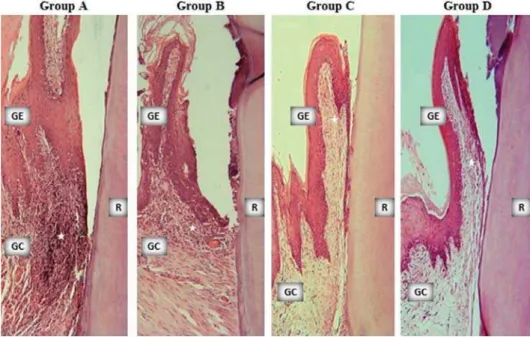
I CN, CAL, and OD w ere show n in Table 1. All t he JURXSVVKRZHGVLJQVRISHULRGRQWDOLQÀDPPDWLRQDQG t issue dest r uct ion in differ ent degr ees ( Figur e 2) .
How ever, I CN was low er in groups B, C, and D t han in
group A; CAL was higher in groups B, C, and D t han
in group A; and OD was low er in groups B, C, and D
t han in group A ( p< 0.05) .
I nt ergroup com parisons of I L- 10 and TGF- ß
st ainings
,/VWDLQLQJSUR¿OHVDQGLQWHUJURXSFRPSDULVRQV a s HSco r e s w e r e g i v e n i n Ta b l e 2 . Mo r e I L- 1 0
accum ulat ion was det erm ined in t he GEs of groups B,
Groups ICN CAL OD
Median (min-max)
Median (min-max)
Median (min-max)
A 9.83 525.00 0.06
(4.5-14.66) (50-1050) (0.03-0.12)
B 6.99 825.00 0.04
(6.00-19.83) (425-1075) (0.02-0.06)
C 5.83 875.00 0.04
(2.16-19.50) (410-1450) (0.03-0.05)
D 6.5 825.00 0.03
(4.83-20.83) (490-1025) (0.02-0.04)
p¥ 0.032 * 0.012 * 0.039 *
¥: Kruskal Wallis test
Table
1-μm; OD: Osteoclast Density)
( Table 2, Figure 3) . I L- 10 st ainings in GCs were sim ilar
for all t he groups ( p> 0.05) ( Table 2, Figure 3) . Group
B show ed t he m ost int ensive I L- 10 st aining for PL S 7*) VWDLQLQJ SUR¿OHV DQG LQWHUJURXS com parisons as HScores w ere given in Table 3. There ZHUHQRVWDWLVWLFDOO\VLJQL¿FDQWGLIIHUHQFHVDPRQJVW t he st ainings of all t he groups for GE, GC, and PL
( Figure 4) .
st ainings
I nt ragroup com parisons were sum m arized in Table
4. I L- 10 st aining did not show any differences bet ween
GE- GC and GE- PL in group A ( p> 0.017) , but it was
higher in GC t han t hat of PL in t his group ( p< 0.017) .
TGF- ß st ainings w ere sim ilar in all t he com part m ent s
of g r ou p A ( p > 0 . 0 1 7 ) . I L- 1 0 st ain in g w as m or e
int ensive in GE com pared w it h GC and PL in group
Groups GE GC PL p§
F
A 157.21±37.64a,b,c 144.86±15.42 131.03±11.94d 0.000007*
361.972 B 240.80±33.06a 183.72±29.13 195.56±40.11d,e,f 0.0000*
p=0.000 418.716
C 227.84±36.59b 137.61±49.05 133.77±42.88e 0.00001*
p=0.002 183.40
D 222.48±43.22c 155.38±38.39 138.86±41.25f 0.0000*
p¥ 0.0004 0.081 0.002
F 8.687 2.512 6.863
¥: One-way ANOVA test §: Post hoc Tukey test
groups
Table 2- HScore values with the inter- and intra-group comparisons of IL-10 staining. Data were expressed as as mean±standart deviation (GE: Gingival epithelium; GC: Gingival Connective Tissue; PL: Periodontal Ligament)
Figure 2-
B ( p< 0.017) , and it was sim ilar in t he GC and PL of
t his group ( p> 0.017) . TGF- ß was higher in t he GE of
group B t han t hat of t he PL in t his group ( p< 0.017) .
I L- 10 st aining of GE was m ore int ensive t han GC and
PL for groups C and D ( p< 0.017) , but it was sim ilar
for t he GCs and PLs of t hese groups ( p> 0.017) . TGF- ß
st ainings of groups C and D w ere higher in GEs t han
t hose in PLs ( p< 0.017) , and t hey w ere sim ilar for t he
GEs- GCs and GCs- PLs of t hese groups ( p> 0.017) .
Discussion
Th e p r e se n t i n v e st i g a t i o n w a s d e si g n e d t o
dem onst rat e t he pot ent ial of oral GSE adm inist rat ion
as a prevent ive or t herapeut ic agent for periodont al GLVHDVH:HLQYHVWLJDWHGDQWLLQÀDPPDWRU\HIIHFWVRI GSE on periodont al t issues by hist om orphom et rical
a n d i m m u n o h i st o ch em i ca l m ea n s. Ou r f i n d i n g s
proposed t hat GSE int ake m ight have alt ered local
Groups GE GC PL pb
F
A 217.83±42.95 183.37±55.73 155.66±55.93
68.752 B 211.76±57.15 158.76±62.79 132.84±27.93 0.000186*
96.556 C 207.45±45.46 159.42±46.45 141.36±31.92 0.000017*
151.948 D 209.89±43.38 156.01±48.41 126.24±34.56 0.000001*
861.700
Pa 0.981 0.764 0.513
F 0.058 0.386 0.791
One Way ANOVA test
b: Post hocTUKEY test
*: Statistical differences amongst GE, GC, and PL in the groups
Table 3-
GC: Gingival Connective Tissue; PL: Periodontal Ligament)
Figure
LQÀDPPDWRU\UHVSRQVHVGXULQJWKHSHULRGRQWDOGLVHDVH process.
O u r h i s t o m o r p h o m e t r i c a l f i n d i n g s s h o w e d SHULRGRQWDO LQÀDPPDWLRQ DQG GHVWUXFWLRQ LQ DOO WKH JURXSVLQGLIIHUHQWVHYHULWLHVE\PHDQVRILQÀDPPDWRU\ FHOOLQ¿OWUDWLRQFRQQHFWLYHWLVVXHDWWDFKPHQWORVVDQG ost eoclast ic act ivit y. The GSE usages t hat init iat ed
prior t o ligat ure placem ent ( group B) , on t he day of
ligat ure placem ent ( group C) , and on t he day of ligat ure
and bone healing, w hich was also associat ed w it h a ORZHUGHJUHHRILQÀDPPDWLRQWKDQWKHQHJDWLYHFRQWURO JURXSJURXS$7KHVH¿QGLQJVPD\EHVXSSRUWHGE\ t he result s of som e st udies in w hich GSE decreased
r eact iv e ox y g en e an d n it r og en sp ecies, in h ib it ed
m yeloper ox idase and ly sosom al enzy m es act iv it ies
in experim ent al periodont it is9, dow nregulat ed m at rix PHWDOORSURWHLQDVHVLQLQÀDPHGSHULRGRQWDOWLVVXHV16,
Figure
4-diaminobenzidine). Arrows indicate the stained cells. GE: gingival epithelium, GC: gingival connective tissue, PL: periodontal ligament
Groups Paired areas IL-10 TGF-ß
( p, ta) ( p, ta)
GE-GC 0.406, 0.908 0.291, 1.179
A GE-PL 0.115, 1.904 0.045, 2.651
GC-PL 0.003, 5.491b 0.159, 1.655
GE-GC 0.003, 4.490b 0.184, 1.540
B GE-PL 0.005, 4.051b 0.005, 4.709b
GC-PL 0.328, -1.052 0.076, 2.227 GE-GC 0.001, 5.285b 0.025, 2.958
C GE-PL 0.000, 17.080b 0.005, 4.266b
GC-PL 0.670, 0.448 0.034, 2.739 GE-GC 0.010, 3.580b 0.061, 2.404
D GE-PL 0.000, 7.874b 0.002, 5.722b
GC-PL 0.182, 1.480 0.092, 2.077
Paired Samples test
b
and inhibit ed ost eoclast different iat ion and reduced
ost eoclast act ivit y in m ice w hen applied as 100 m g/
kg for 18 days23. Alt hough t he doses, m et hods, and
per iods of GSE applicat ion ar e dissim ilar in t hese VWXGLHVDOOWKHLU¿QGLQJVVKRZSRVLWLYHHIIHFWVRI*6( on bone form at ion and/ or healing. Our OD result s are
also in agreem ent wit h t his phenom enon as suggest ing
an inhibit ory im pact of GSE on ost eoclast ic act ivit y.
Go v i n d a r a j , e t a l .9 ( 2 0 1 0 ) w e r e t h e f i r st t o
dem onst rat e t he ant i- oxidant effect of proant hocyanidin
in an ex p er im en t al p er iod on t it is m od el t h at w as
in d u ced b y in j ect in g E. coli en d ot ox in . Th e sam e
st u dy con sist ed of dif f er en t ex per im en t al per iods
( t he longest was 30 days) and different dosages of
pr oant hocyanidin ( t he highest was 40 m g/ kg BW) . 'LIIHUHQWO\RXUVWXG\VKRZHGWKHDQWLLQÀDPPDWRU\ ef f ect o f GSE i n l i g a t u r e- i n d u ced ex p er i m en t a l
periodont it is for a longer durat ion ( t he longest was
eight w eek s) w it hout any side- effect s of a higher
dosage ( 200 m g/ kg BW) .
Th e GSE h as b een r ep or t ed t o h av e an an t i-LQÀDPPDWRU\FDSDFLW\GXHWRLWVHIIHFWRQR[LGDWLYH st r ess, and t her efor e, it has been suggest ed as a UHPHG\ LQ WKH SUHYHQWLRQ RI VHYHUDO LQÀDPPDWRU\ d i se a se s1 1. Pr o a n t h o cy a n i d i n s f r o m g r a p e se e d LQKLELWHG WXPRXU QHFURVLV IDFWRU 71)Į DQG ,/ ǃ IRUPDWLRQV LQ WKH H[XGDWH IURP HGHPD SDZV RI UDWV WKXV VXJJHVWLQJ LWV DQWLLQÀDPPDWRU\ UROH DV D VXSSUHVVRU RI SURLQÀDPPDWRU\ F\WRNLQHV18. The pr esen t st u dy r esu lt s ar e in agr eem en t w it h t h is ¿QGLQJEHFDXVHZHKDYHGHWHUPLQHGWKHLQFUHDVHG product ion of I L- 10 due t o GSE int ake. I n a recent VWXG\ WKH DQWLLQÀDPPDWRU\ DFWLYLW\ RI *6( RUDOO\ ad m in ist er ed as 2 5 , 5 0 , an d 1 0 0 m g / k g d oses)
was explained w it h t he decrease in Th1 and Th 17A
levels and increase in Th2 released cyt okines at t he LQÀDPPDWLRQVLWH1. This st udy also dem onst rat ed t hat GSE increased t he m RNA expressions of I L- 10 and 7*) ZKLOH UHGXFLQJ WKH ,/ DQG 71)Į OHYHOV1. Therefore, it m ay be proposed t hat GSE dem onst rat es
it s an t i- in f lam m at or y ef f icacy v ia r eg u lat in g t h e UHOHDVHVRISURDQGDQWLLQÀDPPDWRU\F\WRNLQHV
Ou r im m u n oh ist och em ical f in d in g s su g g est ed D SRVVLEOH DQWLLQÀDPPDWRU\ HIIHFW RI *6( $V WKH t ot al GE area, m ore int ensive I L- 10 st ainings w ere
dem onst rat ed in all t he GSE groups com pared w it h
t he non- GSE group. Group B, w hich was designed as
t he prophylact ic group, had also t he m ost abundant
I L- 10 cy t ok ine st aining in PL and in GC, alt hough
t h e last on e w as n ot fou n d st at ist ically differ en t .
Tw o w eek s of GSE in t ak e p r ior t o ex p er im en t al
periodont it is in group B m ight have creat ed such a
difference in GE, GC, and PL due t o it s prevent ive
effect on periodont it is. There was no prevent ive or DQWLLQÀDPPDWRU\HIIHFWVDIWHUWKHGLVHDVHZDVFUHDWHG and no effect t o decrease t he dest ruct ion ( groups C
and D) in GE, GC, and PL. I L- 10 expression in t he HDUO\SKDVHVRILQÀDPPDWLRQLVFRRUGLQDWHGZLWKRWKHU JHQHV¶H[SUHVVLRQWKDWKDVSRWHQWSURLQÀDPPDWRU\ and chem oat t ract ant pr oper t ies, but t he funct ions
of I L- 10 converge int o a congruent at t em pt at lat er LQÀDPPDWRU\ VWDJHV IRU OLPLWLQJ WKH GDPDJHV RI LQÀDPPDWLRQ20. The st age- dependent propert y of t his cyt okine m ay explain t he differences am ongst t he GSE
groups in t he present ed st udy. The adm inist rat ion of
GSE beginning t w o w eeks before ligat ure placem ent
( gr oup B) pr esent ed t he best r esult s of I L- 10 and
t he levels w ere higher in all com part m ent s of group
B. Alt hough I L- 10 was dem onst rat ed t o be higher in
t he GEs of ot her GSE groups ( groups C and D) , t he GLIIHUHQFHVZHUHQRWVLJQL¿FDQWLQWKHFRQQHFWLYHWLVVXH and t he periodont al ligam ent when com pared wit h t he
post ive cont rol group ( group A) . This m eans t hat t he DQWLLQÀDPPDWRU\HIIHFWRI*6(PD\EHOLPLWHGZLWK t he applicat ion t im e.
,Q WKH SUHVHQW VWXG\ WKHUH ZHUH QR VLJQL¿FDQW differences in t he TGF- ß level am ongst t he groups.
How ever, int ragroup com parisons show ed st at ist ical
differ ences in t he select ed r egions. I n all t he GSE
gr oups, TGF- ß st aining w as m or e int ensiv e in GE
com par ed w it h PL. This m ay be ex plained by t he IDFW WKDW JLQJLYDO ¿EUREODVWV KDG DOPRVW D WZRIROG LQFUHDVH LQ WKH DPRXQW RI 7*)ǃ ZKHQ FRPSDUHG ZLWK SHULRGRQWDO OLJDPHQW ¿EUREODVWV2 1. Th er e ar e QRDYDLODEOHGDWDDERXWWKHHIIHFWRI*6(RQ7*)ǃ in gingival t issues. But it has been show n t hat GSE LQKLELWVDUVHQLFUHODWHGOLYHUGDPDJHE\7*)ǃ6PDG act ivat ion and suppression of NADPH oxidase17.
Ther e is a gr ow ing int er est in her bal r em edies
a s a d j u n ct i v e a n t i - i n f l a m m a t o r y a g e n t s i n t h e
prevent ion of periodont al disease, part icularly for t he
individuals prone t o disease. This st udy evaluat ed t he
int eract ion bet w een grape seed ex t ract ( GSE) and
diseased periodont ium in experim ent al peridont it is. +LVWRSDWKRORJLFDO¿QGLQJVVKRZHGLPSURYHPHQWVLQWKH LQKLELWLRQRISHULRGRQWDOLQÀDPPDWLRQDQGGHVWUXFWLRQ IROORZLQJ*6(LQWDNH,QQPXQRKLVWRFKHPLFDO¿QGLQJV dem onst rat ed m ore int ensive I L- 10 st ainings in t he
*6( JURXSV ZLWKRXW VLJQL¿FDQW GLIIHUHQFHV LQ WKH TGF- ß levels.
Conclusion
,QFRQFOXVLRQDOWKRXJKRXU¿QGLQJVVXJJHVWDQDQWL LQÀDPPDWRU\DFWLYLW\RI*6(IXUWKHULQYHVWLJDWLRQVDUH st ill needed t o clarify possible m echanism s and det ails RIWKLVDFWLYLW\LQWKHSHULRGRQWDOLQÀDPPDWRU\SURFHVV
Acknow ledgem ent s
7KHDXWKRUVUHFHLYHGQR¿QDQFLDOVXSSRUWIRUWKH research, aut horship, and/ or publicat ion of t his art icle.
Grape seed ext ract was provided free of charge by
Berkem SA, Gardonne, France.
References
1- Ahm ad SF, Zoheir KM, Abdel- Ham ied HE, At t ia SM, Bakheet SA,
Ashour AE, et al. Grape seed proant hocyanidin ext ract prot ect s against
FDUUDJHHQDQLQGXFHGOXQJLQÀDPPDWLRQLQPLFHWKURXJKUHGXFWLRQRI SURLQÀDPPDWRU\PDUNHUVDQGFKHPRNLQHH[SUHVVLRQV,QÀDPPDWLRQ
2014; 37: 500- 11.
2 - Bay d ar NG, Sag d i c O, Ozk an G, Cet i n S. Det er m i n at i on of ant ibact erial effect s and t ot al phenolic cont ent s of grape (Vit is vinifera
L.) seed ext ract s. I nt J Food Sci Tech. 2006; 41: 799- 804.
3 - B o g h d a d y N A . A n t i o x i d a n t a n d a n t i a p o p t o t i c e f f e c t s o f
pr oan t h ocyan idin an d gin k go biloba ex t r act again st dox or u bicin -induced cardiac inj ury in rat s. Cell Biochem Funct . 2013; 31: 344- 51.
4- Chapple I L, Milward MR, Ling- Mount ford N, West on P, Cart er K, Askey K, et al. Adj unct ive daily supplem ent at ion w it h encapsulat ed fruit ,
veget able and berry j uice powder concent rat es and clinical periodont al out com es: a double- blind RCT. J Clin Periodont ol. 2012; 39: 62- 72.
5- Cont i P, Kem puraj D, Kandere K, Gioacchino MD, Barbacane RC,
&DVWHOODQL0/HWDO,/DQLQÀDPPDWRU\LQKLELWRU\F\WRNLQHEXW
not always. I m m unol Let t . 2003; 86: 123- 9.
6- Dereka XE, Markopoulou CE, Vrot sos I A. Role of grow t h fact ors on
periodont al repair. Grow t h Fact ors. 2006; 24: 260- 7.
7- Furiga A, Lonvaud- Funel A, Badet C. I n vit r o st udy of ant ioxidant
capacit y and ant ibact erial act ivit y on oral anaerobes of a grape seed ext ract . Food Chem . 2009; 113: 1037- 40.
8- Garlet GP, Mart ins W Jr, Fonseca BA, Ferreira BR, Silva JS. Mat rix m et alloprot einases, t heir physiological inhibit ors and ost eoclast fact ors
DUHGLIIHUHQWLDOO\UHJXODWHGE\WKHF\WRNLQHSUR¿OHLQKXPDQSHULRGRQWDO
disease. J Clin Periodont ol. 2004; 31: 671- 9.
9 - Gov in d ar aj J, Em m ed i P, Deep alak sh m i, Raj ar am V, Pr ak ash G, Pu v an ak r ish n an R. Pr ot ect iv e ef f ect of p r oan t h ocy an id in s on
endot oxin induced exper im ent al per iodont it is in rat s. I ndian J Exp Biol. 2010; 48: 133- 42.
10- Gulat i M, Anand V, Govila V, Jain N. Host m odulat ion t herapy: an in dispen sable par t of per ioceu t ics. J I n dian Soc Per iodon t ol.
2014; 18: 282- 8.
proant hocynidins against oxidat ive st ress induced by lipopolysaccharides
of periodont opat hogens. J Periodont ol. 2006; 77: 1371- 9.
12- I rie K, Tom ofuj i T, Tam aki N, Sanbe T, Ekuni D, Azum a T, et al.
(IIHFWVRIHWKDQROFRQVXPSWLRQRQSHULRGRQWDOLQÀDPPDWLRQLQUDWV-Dent Res. 2008; 87: 456- 60.
13- Kir kw ood KL, Cir elli JA, Roger s JE, Giannobile WV. Novel host r esp on se t h er ap eu t ic ap p r oach es t o t r eat p er iod on t al d iseases.
Periodont ol 2000. 2007; 47: 294- 315.
14- Fischer RG, Klinge B. Clinical and hist ological evaluat ion of ligat
ure-induced periodont al breakdown in dom est ic ferret s im m unosuppressed by cyclosporin- A. J Clin Periodont ol. 1994; 21: 240- 9.
.XUX/*ULI¿WKV*63HWULH$2OVHQ,&KDQJHVLQWUDQVIRUPLQJ JURZWKIDFWRUEHWDLQJLQJLYDOFUHYLFXODUÀXLGIROORZLQJSHULRGRQWDO
surgery. J Clin Periodont ol. 2004; 31: 527- 33.
16- La VD, Ber ger on C, Gafner S, Gr enier D. Grape seed ex t ract
suppresses lipopolysaccharide- induced m at rix m et alloprot einase ( MMP) secret ion by m acrophages and inhibit s hum an MMP- 1 and - 9 act ivit ies.
J Periodont ol. 2009; 80: 1875- 82.
17- Li J, Li J, Li S, He B, Mi Y, Cao H, et al. Am eliorat ive effect of grape
seed proant hocyanidin ext ract on t hioacet am ide- induced m ouse hepat ic
¿EURVLV7R[LFRO/HWW
/L :* =KDQJ ;< :X <- 7LDQ ; $QWLLQÀDPPDWRU\ HIIHFW DQG
m echanism of proant hocyanidins from grape seeds. Act a Pharm acol
Sin. 2001; 22: 1117- 20.
0DUHN$%URG]LFNL-/LEHUHN$.RU]RQ07*)ǃWUDQVIRUPLQJ JURZWKIDFWRUǃLQFKURQLFLQÀDPPDWRU\FRQGLWLRQV±DQHZGLDJQRVWLF
and prognost ic m arker? Medl Sci Monit . 2002; 8: 145- 51.
20- Mocellin S, Panelli MC, Wang E, Nagorsen D, Marincola FM. The dual role of I L- 10. Trends I m m unol. 2003; 24: 36- 43.
21- Morandini AC, Sipert CR, Ram os-Junior ES, Brozoski DT, Sant os
&) 3HULRGRQWDO OLJDPHQW DQG JLQJLYDO ¿EUREODVWV SDUWLFLSDWH LQ WKH SURGXFWLRQ RI 7*)ǃ LQWHUOHXNLQ ,/ DQG ,/ %UD] 2UDO 5HV
2011; 25: 157- 62.
22- Nut t all SL, Kendall MJ, Bom bardelli E, Morazzoni P. An evaluat ion of t he ant iox idant act iv it y of a st andar dized grape seed ex t ract ,
Leucoselect . J Clin Pharm Ther. 1998; 23: 385- 9.
23- Park JS, Park MK, Oh HJ, Woo YJ, Lim MA, Lee JH, et al.
Grape-seed proant hocyanidin ext ract as suppressors of bone dest ruct ion in
LQÀDPPDWRU\DXWRLPPXQHDUWKULWLV3/R62QHH
24- Preshaw PM. Host response m odulat ion in periodont ics. Periodont ol
2000. 2008; 48: 92- 110.
25- Tanriover G, Dem ir N, Pest ereli E, Dem ir R, Kayisli UA.
PTEN-m e d i a t e d Ak t a ct i v a t i o n i n h u PTEN-m a n n e o co r t e x d u r i n g p r e n a t a l developm ent . Hist ochem Cell Biol. 2005; 123: 393- 406.
26- Trindade SC, Olczak T, Gom es- Filho I S, Moura- Cost a LF, Cerqueira
(0*DOGLQR1HWD0HWDO,QGXFWLRQRILQWHUOHXNLQ,/ǃ,/,/
and im m unoglobulin G by Porphyrom onas gingivalis Hm uY in hum ans. J Periodont al Res. 2012; 47: 27- 32.
27- Wang YH, Yang XL, Wang L, Cui MX, Cai YQ, Li XL, et al. Effect s of proant hocyanidins from grape seed on t reat m ent of recurrent ulcerat ive
colit is in rat s. Can J Physiol Pharm acol. 2010; 88: 888- 98.
28- Yam akoshi J, Sait o M, Kat aoka S, Kikuchi M. Safet y evaluat ion of
proant hocyanidin- rich ext ract from grape seeds. Food Chem Toxicol. 2002; 40: 599- 607.
29- Zhang XY, Bai DC, Wu YJ, Li,WG, Liu NF. Proant hocyanidin from grape seeds enhances ant i- t um or effect of doxorubicinbot h in vit ro