Article
Printed in Brazil - ©2011 Sociedade Brasileira de Química0103 - 5053 $6.00+0.00
A
*e-mail: [email protected]
Theoretical Substituent Electrophilicities
Marcos Caroli Rezende*,a and Daniela Millánb
aFacultad de Química y Biología, Universidad de Santiago, Av. Bernardo O’Higgins 3363, Santiago, Chile
bFacultad de Química, Pontificia Universidad Católica de Chile, Av. Vicuña Mackenna 4860, Santiago, Chile
Uma equação de tipo Hammett, relacionando as eletrofilicidades teóricas globais e de substituinte, foi derivada para etilenos e ácidos benzóicos substituídos, permitindo o cálculo de constantes eletrofílicas para substituintes σω. As constantes teóricas foram correlacionadas com
parâmetros cinéticos ou termodinâmicos para vários processos químicos da literatura. Embora formalmente semelhantes às constantes de Hammett, as constantes eletrofílicas para substituintes são obtidas a partir de postulados teóricos inteiramente distintos. As semelhanças e diferenças entre os dois conjuntos de constantes são discutidas e racionalizadas em termos da definição do poder eletrofílico de uma espécie química.
A Hammett-like equation, relating theoretical global and substituent electrophilicities, is derived for substituted ethylenes and benzoic acids, allowing the calculation of electrophilic substituent constants σω. Correlations are given between the theoretical σω constants and kinetic or
thermodynamic parameters of various chemical processes from the literature. Though electrophilic substituent constants are formally similar to the Hammett constants, they are derived from entirely different theoretical postulates. The similarities and differences between the two sets of constants are discussed and rationalized in terms of the definition of the electrophilic power of a chemical species.
Keywords: substituent electrophilicity, electrophilicity index, Hammett equation, sigma constants
Introduction
Empirical linear-free-energy relationships have been invaluable in the investigation of structural properties and reactivities of organic compounds in solution. Among them, the Hammett relationship has been permanently utilized in the interpretation of reaction mechanisms, and in the rationalization of the influence of substituents on the fate of a wide variety of reactions. The fact that the constants derived from these equations were empirical led to efforts to look for correlations between them and other theoretically derived parameters, which might be obtained from quantum-chemical calculations. Several indices derived from density functional theory (DFT) have been increasingly employed in the interpretation of organic reactivity. They include parameters like chemical potential, hardness, softness and electrophilicity indices.
Efforts to associate substituent effects with such indices have yielded variable results. The group electronegativity,
hardness and softness of 30 organic groups were calculated within the framework of density functional theory, with satisfactory results in comparison with experimental data.1
A Hammett-like equation was reported for the chemical hardness or the HOMO-LUMO (highest occupied molecular orbital and lowest unoccupied molecular orbital, respectively) gap of a number of molecules, leading to the proposal of hardness substituent constants, similar to the Hammett’s σ values.2
The reactivity and stability of particular classes of compounds were explained in terms of local and global density functional theory-based reactivity descriptors.3
Intrinsic electronic contributions to the Hammett’s
σp constants were described for a series of 42 functional
groups, yielding constants σe(ω), based on electrophilicity
indices.4 A reasonably linear dependence between
Hammett’s σp constants and the electrophilicities of a series
of substituted benzoic acids was reported by Elango et al.5
one example of what has been recently termed philicity descriptors. Recalling the original approach by Hammett, the prediction of pKa values has been suggested using group philicities.7
A more systematic study in the same line has been published recently, in which correlations were sought
between the acidity of meta- and para-substituted
aromatic acids and DFT-derived indices.8 Theoretical
descriptors included free-energy deprotonation energies, electronegativies (χ), hardness (η) and electrophilicity-based charge-transfer (ECT) indices and correlations were often poor.
In a study of a set of substituted ethylenes, Domingo et al.4
obtained a good correlation between Hammett’s σp
constants and the logarithm of their calculated global electrophilicities (ω), allowing them to define what they termed “the intrinsic electronic contributions to the Hammett substituent constants”.
In the present communication, we applied the same method to a set of substituted benzoic acids, showing that the results described by the authors constitute a particular case of a more general behavior, with a much wider scope. In consequence, a Hammett-like equation was here defined as an equation that relates the global electrophilicity of substituted benzoic acids with their substituent electrophilicities. The treatment allowed us to define a set of electrophilic substituent constants (σω) that
are shown to apply to various systems.
Methodology
All calculations were performed with the Gaussian03 package.9 The structures of all substituted benzoic acids
were optimized employing the hybrid B3LYP/6-31G* or, for the purpose of comparison, the semiempirical AM1 method. The chemical potential µ ≈ (εH + εL)/2 and
molecular hardness η ≈εH − εL for each structure were
obtained from the HOMO and LUMO energies, εH and εL,
respectively. The global electrophilicities (ω) were calculated with the aid of the relationship ω = µ2/2η. The
electrophilic substituent constants (σω) were derived from
the global electrophilicities of the substituted benzoic acids as σω = log (ωX/ωH), where the subscripts refer to
substituents X and H, respectively.
Results and Discussion
The global electrophilicity index (ω) measures the stabilization in energy when a molecule acquires an additional electronic charge from the environment. The index is given by the following simple equation 1 in terms
of the electronic chemical potential (µ) and the chemical hardness (η).
ω = µ2/2η (1)
Both quantities are obtained from one-electron energies of the frontier molecular orbital HOMO and LUMO,
εH and εL, as µ≈(εH + εL)/2 and η≈ (εH − εL), respectively. 10
The electrophilicity index takes into account both the propensity of the molecule to acquire an additional electronic charge, and the resistance of the system to exchange charge with the environment.
Protocol for the derivation of the constant
Our analysis started from a comparison of the experimental
σ values tabulated by Hansch et al.11 and the global
electrophilicity index (ω), evaluated for a set of substituted benzoic acids. The protocol adopted by Domingo et al.4 was
closely followed by us for substituted ethylenes, arriving, however, at conclusions of a much wider scope.
Twenty three representative meta- and para-substituents commonly present in organic compounds (Table 1) were selected. Our list included aliphatic and aromatic, charged and uncharged substituents, with σ values ranging from –0.83, for strong electron-donors such as NMe2,
to +1.00, for strong electron-withdrawing groups, such as Me2S
+. The ω values for the corresponding substituted
benzoic acids were calculated at the HF/6-31G* level of theory, using the Gaussian03 package.9
The linear correlation between the calculated ω values for all substituted acids and the corresponding σ constants was rather poor (R2 = 0.52). Nevertheless, it was practically
the same as that reported by Domingo et al.4 (R2 = 0.53)
for a similar plot of their set of 42 substituted ethylenes. The authors obtained a better correlation (R2 = 0.84) when,
instead of looking for a linear dependence of σp on ω, they
employed a logarithmic relationship.4 In our case, the same
procedure also improved our correlation (R2 = 0.74), when
a dependence of σ on log ω was assumed.
After selecting only 20 functional groups from their set of substituted ethylenes, Domingo et al.4 proposed
equation 2, with an excellent correlation (R2 = 0.99, n = 20).
σe(ω) = 1.43 log ω – 0.20 (2)
Equation 2 allowed the definition of a set of electrophilic constants σe(ω), which the authors described as “the
intrinsic electronic contribution to Hammett’s constants”.4
their log ω values, was that such a good correlation was an indication that a Hammett-like relationship should exist for the global electrophilicity (ω) of any family of substituted compounds.
Equation 3 for substituted ethylenes or benzoic acids may be indeed written as,
log (ω/ωH) = ρωσω (3)
where all global electrophilicities of a family of substituted compounds are expressed in terms of a constant substituent contribution σω and a parameter ρω that should vary with the
analyzed system. It is easy to see that simple manipulation of equation 3 leads to equation 2, if ωH = 0.73 eV4 and
ρω = 0.7.
Following the historical choice of Hammett of substituted benzoic acids as the basis of his original σ
values, ρω = 1 was arbitrarily assumed for our set, and
values for the σω substituent constants are immediately obtained from equation 3. These values are given in
Table 1, as σωp and σ
ω
m for the para- and meta-substituent
electrophilicity constants.
A plot of the σe(ω) values, reported by Domingo et al. 4
for substituted ethylenes, vs. the σωp obtained in this work is
shown in Figure 1. The obtained straight line corresponds to the relationship σe(ω) = 1.97 σωp, allowing the calculation
of σωp values for other substituents from the reported σ e(ω)
values.4 The linear correlation is very good (R2 = 0.97).
The slope of the observed linear plot gives the value of ρω
for that family of compounds, assuming the family of substituted benzoic acids as a reference. The value of ρω
measures how susceptible is the global electrophilicity of a given family of substituted compounds to the substituent electrophilicity.
The slope of 1.97 in the plot of Figure 1 indicates that the global electrophilicities of substituted ethylenes depend more heavily on the substituent electrophilicities than those of the corresponding substituted benzoic acids.
The good correlation obtained for the electrophilic σ
values of Figure 1 is not accidental, and is not due to the
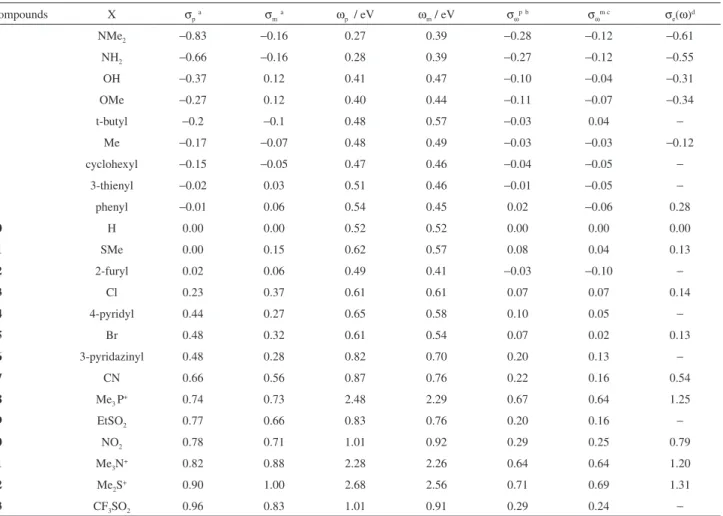
Table 1. Hammett’s σp and σm constants (global electrophilicities ωp and ωm for para- and meta-substituted benzoic acids X-C6H4-COOH, respectively) and calculated substituent electrophilic constants σωp and σωm
Compounds X σpa σma ωp / eV ωm / eV σωpb σωm c σe(ω)d
1 NMe2 −0.83 −0.16 0.27 0.39 −0.28 −0.12 −0.61
2 NH2 −0.66 −0.16 0.28 0.39 −0.27 −0.12 −0.55
3 OH −0.37 0.12 0.41 0.47 −0.10 −0.04 −0.31
4 OMe −0.27 0.12 0.40 0.44 −0.11 −0.07 −0.34
5 t-butyl −0.2 −0.1 0.48 0.57 −0.03 0.04 −
6 Me −0.17 −0.07 0.48 0.49 −0.03 −0.03 −0.12
7 cyclohexyl −0.15 −0.05 0.47 0.46 −0.04 −0.05 −
8 3-thienyl −0.02 0.03 0.51 0.46 −0.01 −0.05 −
9 phenyl −0.01 0.06 0.54 0.45 0.02 −0.06 0.28
10 H 0.00 0.00 0.52 0.52 0.00 0.00 0.00
11 SMe 0.00 0.15 0.62 0.57 0.08 0.04 0.13
12 2-furyl 0.02 0.06 0.49 0.41 −0.03 −0.10 −
13 Cl 0.23 0.37 0.61 0.61 0.07 0.07 0.14
14 4-pyridyl 0.44 0.27 0.65 0.58 0.10 0.05 −
15 Br 0.48 0.32 0.61 0.54 0.07 0.02 0.13
16 3-pyridazinyl 0.48 0.28 0.82 0.70 0.20 0.13 −
17 CN 0.66 0.56 0.87 0.76 0.22 0.16 0.54
18 Me3 P+ 0.74 0.73 2.48 2.29 0.67 0.64 1.25
19 EtSO2 0.77 0.66 0.83 0.76 0.20 0.16 −
20 NO2 0.78 0.71 1.01 0.92 0.29 0.25 0.79
21 Me3N+ 0.82 0.88 2.28 2.26 0.64 0.64 1.20
22 Me2S+ 0.90 1.00 2.68 2.56 0.71 0.69 1.31
23 CF3SO2 0.96 0.83 1.01 0.91 0.29 0.24 −
aValues from reference 10; bcalculated as log (ω
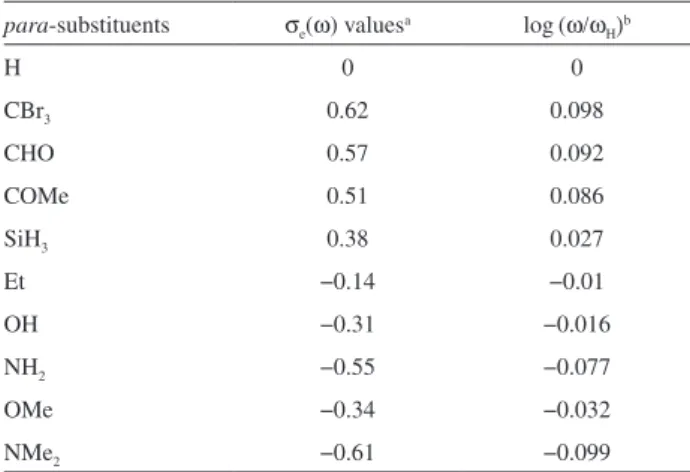
particular level of calculation employed. Table 2 lists the global electrophilicities of a number of substituted benzoic acids, which were calculated with the aid of equation 1, but at a lower level of theory, the semiempirical AM1 method. Many of the substituents of Table 2 were not included in Table 1, and were chosen so, as to span a reasonably wide range of the σe(ω) values reported in the literature,4 which
were calculated with the B3LYP/6-31G* method.
A comparison of the values calculated with the B3LYP/6-31G* method of Table 1 with those with the AM1 of Table 2 shows that, although the electrophilic σ constants differ in their absolute values, substituent trends are conserved. In spite of the different methods employed and the different families of substituted electrophiles, a
reasonably good correlation (R2 = 0.95) is still obtained
between log (ω/ωH) (calculated with the AM1 method) and
σe(ω) (calculated with the hybrid DFT method) as can be
seen in Figure 2 (where the data of Table 2 are plotted).
Thus, the original definition of the σe(ω) parameter, by
Domingo et al.,4 as “the intrinsic electronic contribution to
the Hammett substituent constant“ is not entirely correct. This contribution should be constant, independent of the system under consideration, which is not the case. Values for the σω constant obtained in this work are very different from those previously reported, yet they are as “intrinsic” as the latter.
The most important is not their absolute values, but the fact (shown in Figure 1) that they are proportional, and that this proportionality is measured in terms of a Hammett-like
ρω factor that is characteristic of the system under study. So, the above definition must be correct, and the
σωp parameter must not be regarded as an electronic
contribution to Hammett’s σp, but as an electrophilic
substituent constant in its own right. Positive values of
σω correspond to substituents that are more electrophilic
than H, negative values to substituents that act as nucleophilic groups, or as electron-donors. These trends parallel those of the experimentally derived Hammett’s
σ constants. Interestingly, the electrophilic constants obtained from substituted benzoic acids allow a distinction to be made between the electrophilicities of meta- and para-substituents. Inspection of Table 1 shows that the substituent contribution to the global electrophilicity of benzoic acids is generally larger for para-substituents than for the meta-analogs.
Figure 1. Plot of the electrophilicity index σe(ω) calculated from substituted ethylenes4vs. σ
ωp values (this work) (correlation R2 = 0.97).
Figure 2. Plot of the logarithm of the global electrophilicity ratios of substituted benzoic acids (calculated by the AM1 method) vs. the electrophilicity index σe(ω),4 calculated from substituted ethylenes with the B3LYP/6-31G* level.
Table 2. Values of the electrophilicity index σe(ω) for various substituents and of the logarithm of electrophilicity ratios of substituted benzoic acids log (ω/ωH) calculated with the AM1 method
para-substituents σe(ω) valuesa log (ω/ωH)b
H 0 0
CBr3 0.62 0.098
CHO 0.57 0.092
COMe 0.51 0.086
SiH3 0.38 0.027
Et −0.14 −0.01
OH −0.31 −0.016
NH2 −0.55 −0.077
OMe −0.34 −0.032
NMe2 −0.61 −0.099
Our contention that a Hammett-like relationship between global and substituent electrophilicities should exist for a large variety of systems may be verified by comparison with data from the literature. If the electrophilic
σωvalues are constants that are characteristic of the group
and its position in a substituted system, they should yield good correlations in various Hammett-like plots.
Applications to data from the literature
Correlation with basicity and acidity values
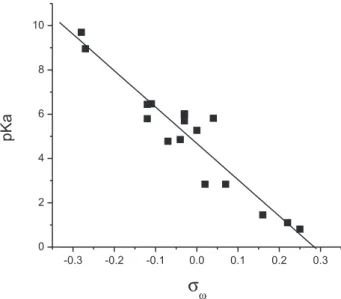
Although the electrophilic constants σω (unlike the original Hammett’s σ values) were derived from purely theoretical considerations, a first test of their validity would be the existence of good correlations with the basicity or the acidity of organic compounds. The dependence of the basicity of 15 substituted pyridines12,13 on the electrophilicity of their
substituents is illustrated in Figure 3. A good correlation between the pKa values of the protonated pyridines vs. σωand
a ρω value of –16.0 indicate that the basicity of pyridines decreases significantly with the substituent electrophilicity.
Figure 4 is a plot of the pKa of protonated pyridine N-oxides14,15 vs. σ
ωvalues. The smaller ρωvalue of –9.6
reflects the decreased importance of the substituent electrophilicity to the basicity of this system, when compared with that of pyridines.
A plot of the pKa of 28 mono- and di-substituted phenols16 vs. σ
ωvalues is shown in Figure 5. A reasonable
linearity is obtained, with a ρωvalue of –5.0. Note that the
two data points that correspond to charged substituents (3- and 4-Me3N+) fall significantly off the regression
straight line. The electrophilic contribution of these substituents to the acidity of the series of phenols is overestimated, according to the plot. As discussed below (Figure 8), the contribution of charged substituents to the global electrophilicity of benzoic acids is exaggerated, when compared to their contribution to the acidity of the same compounds, estimated by Hammett’s σ values.
Correlation with an experimental electrophilicity parameter
Equation 4 was proposed by Mayr and Patz17 to
describe the variation of the reaction rates k for a variety of nucleophile/electrophile pairs.
Figure 3. Plot of pKa values of 3- and 4-substituted pyridinium in water vs. the corresponding substituent electrophilic σωvalues (correlation
R2 = 0.89). pKa values were obtained from references 12 and 13.
Figure 4. Plot of pKa values of protonated pyridine N-oxides vs. the corresponding substituent electrophilic σω values (correlation R2 = 0.96).
pKa values were obtained from reference 14 and 15.
Figure 5. Plot of the pKa values of 3- and 4- mono- and di-substituted phenols vs. the corresponding substituent electrophilic σω values
log k (20 oC) = s (N + E) (4)
where N and E are parameters that are characteristic of a particular nucleophile or electrophile, respectively. For a series of analogous electrophiles reacting with the same nucleophile, the s and N parameters are constant and equation 4 assumes the familiar form of Hammett’s relationship. Accordingly, a linear relationship would be anticipated here between the experimental electrophilicity value E and the electrophilic constants σω.
A plot of the electrophilicity parameter E of
diarylcarbenium ions18 vs. the sum of the σ
ω
p values of the
corresponding substituents is shown in Figure 6.
A good correlation is obtained between experimentally and theoretically derived electrophilicity parameters, showing that contributions by the latter are additive.
It is interesting to note that good linear correlations between Mayr’s electrophilicity parameter E and theoretical global electrophilicities (ω) for seven diarylcarbenium ions have been recently reported.19 Correlation coefficients of
R2 = 0.95 and 0.89 were obtained, when the theoretical
electrophilicities were calculated with an HF or a B3LYP method, respectively.
This result is in apparent contradiction with the linear dependence of E on σωp for the same family of compounds,
shown in Figure 6. In fact, if E bears a linear relationship with ω, then, according to equation 3, log E, and not E, should correlate linearly with σωp.
An explanation for this apparent contradiction lies on the fact that Chamorro et al.19 employed for their correlations
a set of diarylcarbenium ions with strongly nucleophilic alkylamino substituents, and corresponding E values in the range of –10.4 to –5.53. Deviations from linearity in plots of E vs. ω should not be apparent when a small range of E values is considered. In the case of Figure 6, a wider range of experimental electrophilicities were employed, from –7.02 to + 6.02. A good linear correlation in this case, with a range of substituents that include, besides the strongly nucleophilic NMe2, other less nucleophilic (OMe, Me) and
even a slightly electrophilic substituent (Cl), validates equation 3 and its extension to experimental data.
Correlation with the oxidation potential of an organometallic complex
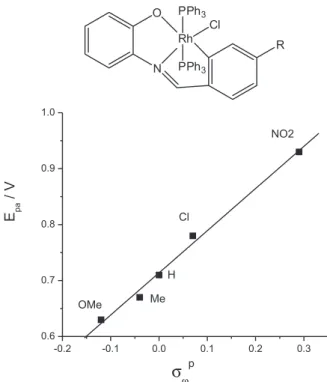
A final example from a rather different type of process is the electrochemical oxidation of Rh(III) to Rh(IV) in the complexes below, where the nature of substituent R was expected to affect this potential, through the coordinated benzaldimine ligand.20 Figure 7 is a plot of the oxidation
potential of Rh(III) to Rh(IV) vs. σωp values for five
derivatives, which included, besides the unsubstituted parent compound, nucleophilic (OMe, Me) and electrophilic (Cl, NO2) substituents. The obtained ρωvalue of 0.76 indicates
that the ease of metal oxidation decreases with the increased electrophilicity of the R substituent.
Figure 6. Plot of the electrophilicity E of diarylcarbenium ions ArAr’CH+vs. the sum of the corresponding σ
ωp values (correlation
R2 = 0.97). The electrophilicities E were obtained from reference 18.
Figure 7. Plot of the oxidation potential of Rh(III) to Rh(IV) in a substituted benzaldimine complex vs. the electrophilic σωp value of
The above examples suffice to demonstrate the wide scope of equation 3 and the use of the electrophilic σω
constants derived from it.
Finally, the question is to ask ourselves how far the parallel behavior of Hammett’s σ and the electrophilic σω
constants go.
Correlation with Hammett’s σ constants
Figure 8 is a plot of the former vs. the latter constants, for the 46 substituents listed in Table 1. It is seen that the correlation between the two sets is rather good (R2 = 0.88),
if only uncharged substituents are considered. The charged substituents (Me3P+, Me3N+, Me2S+) constitute a subset for
which electrophilicities are overestimated, if compared
with their corresponding Hammett’s σ values. This
observation reinforces the remarks made above for the plot of Figure 5, and the anomalous behavior of the data points corresponding to the charged Me3N
+ group.
In view of the good correlation between Hammett’s
σ and our theoretical σωvalues, the linear plots shown in
Figures 3-7 should not be a surprise. The poorer correlation between σω and the pKa values of phenols (Figure 5)
reflects the known failure of Hammett’s σ constants to reproduce the exalted conjugation between π-accepting
substituents and the phenoxide charge. In this sense, the good correlation between E and Σσω of Figure 6 is a bit surprising, because of the failure of σ values to describe through-conjugation in arylcarbenium ions. A possible explanation for this may be the fact that the vast majority of the data points in Figure 6 correspond to strong electron-donating substituents, thus covering a rather limited range of σωvalues.
An intriguing point, however, is the fact that the set of theoretically-derived electrophilic constants σω exhibit such a good correlation with the empirically obtained σ
values. But it is possible to stress the differences between the theoretical approach that led to the definition of electrophilic substituent constants and the empirical nature of the Hammett equation. The σω constant reflects
a group contribution to the global electrophilicity of a substituted benzoic acid. Nothing is said about the acid deprotonation or the stabilization of a particular center of the molecule. Nevertheless, the σω constants of Table 1 not
only reflect the electrophilicity of a particular substituent, but also its position relative to the carboxylic acid group: para- and meta- values for the same substituent are generally different.
A possible explanation for this may be sought in the original concept of the global electrophilicity of a molecule. Its electrophilicity index is associated with the energy gained by the molecule immersed in a sea of free electron gas, after an amount of charge flows from the sea to the system.21 In the case of substituted benzoic acids, this
charge-transfer corresponds to the first step of the two-step hypothetical process depicted by Scheme 1.
The whole process is a gas-phase dissociation of substituted benzoic acids, and its free-energy should well correlate with Hammett’s σ. The second step is relatively insensitive to the nature of X, as it is a homolytic loss of a hydrogen radical. In consequence, the effect of substituent X on the deprotonation is fully reflected in the first step of the process. Thus, the electrophilic σω and Hammett’s σ
constants well correlate because they are derived from similar processes, where negative charge is locally built on the carbonyl oxygen.
The Scheme 1 also helps to understand why positively charged substituents fall off the straight line of Figure 8. For
Figure 8. Plot of electrophilic σω vs. Hammett’s σ constants for all
meta- and para-substituents of Table 1 (correlation R2 = 0.88). The points above the straight line correspond to positively charged substituents (Me3N+, Me3P+, Me2S+)
neutral substituents, the carboxylic carbon atom is the most electrophilic center of the molecule, and charge will flow to the system to generate a ketyl radical anion, as shown in the Scheme 1. For positively charged substituents this is no longer true, and charge will flow to the more electrophilic substituent, in a different reduction process to that shown in the Scheme 1. For these substituents, the electrophilic
σωand Hammett’s σ constants no longer refer to the same process, and do not correlate.
Conclusions
The above results showed that there is a Hammett-like relationship between the global and substituent electrophilicities for substituted ethylenes and benzoic acids. This relationship is quite general, and allows the definition of substituent electrophilic σω constants. Such
theoretically-derived constants may be used in the analysis of various systems, relating the contribution of substituent electrophilicities to a variety of chemical processes. In fact, good correlations have been obtained by various groups, between the global electrophilicities of a family of substituted compounds and some constant related with their reactivity. Examples include linear relationships involving global or group electrophilicities in a variety of processes, such as the reactivity of benzhydryl carbocations,19,22 in
the Baeyer-Villiger reaction of aldehydes and ketones,23
in the hydride affinities of quinones,24 in the reaction
of aryl benzoates with cyanide,25 or of α,β-unsaturated
carbonyl compounds with glutathione.26 These examples
only add to the ones presented in the present work. In all cases, however, the authors have arrived at particular relationships, failing to recognize that such cases are particular examples of a general behavior. Our purpose in this work was to emphasize the existence of this general Hammett-like behavior involving global and substituent electrophilicities. Like the Hammett equation, such a general relationship will very probably find applications in the future for an ever-increasing number of chemical processes.
Due to the existence of this general Hammett-like behavior, electrophilic σωvalues of uncharged substituents in general correlate well with normal Hammett’s σ values. This observation has also been made by other authors, but in general no effort has been made to search for an explanation to it. We suggest that it follows from their derivation from similar chemical processes. When this does not happen, as is the case with positively charged substituents, much larger σω values are obtained than what might be predicted
from their Hammett’s σ values.
Acknowledgements
Support from Fondo Nacional de Desarrollo Científico y Tecnólogico (Fondecyt) (project 1100022) is gratefully acknowledged.
References
1. De Proft, F.; Langenaeker, W.; Geerlings, P.; J. Phys. Chem. 1993, 97, 1826
2. Kneissler, J.; Zhou, Zh.; Int. J. Quantum Chem. 1994, 49, 309. 3. Roy, R. K.; Choho, K.; De Proft, F.; Geerlings, P.; J. Phys. Org.
Chem. 1999, 12, 503.
4. Domingo, L. R.; Pérez, P.; Contreras, R; J. Org. Chem.2003,
68, 6060.
5. Elango, M.; Parthasarathi, R.; Narayanan, G. K.; Sabeelullah, A. M. D.; Sarkar, U.; Venkatasubramanian, N. S.; Subramanian, V.; Chattaraj, P. K.; J. Chem. Sci. 2005, 117, 61.
6. Chattaraj, P. K.; Sarkar, U.; Roy, D. R.; Chem. Rev. 2006, 106, 2065. 7. Parthasarathi, R.; Padmanabhan, J.; Elango, M.; Chitra, K.;
Subramanian, V.; Chattaraj, P. K.; J. Phys. Chem. A2006, 110, 6540.
8. Gupta, K.; Giri, S.; Chattaraj, P. K.; New J. Chem. 2008, 32, 1945.
9. Frisch, M. J.; Trucks, G. W.; Schlegel, H. B.; Scuseria, G. E.; Robb, M. A.; Cheeseman, J. R.; Montgomery, Jr., J. A.; Vreven, T.; Kudin, K. N.; Burant, J. C.; Millam, J. M.; Iyengar, S. S.; Tomasi, J.; Barone, V.; Mennucci, B.; Cossi, M.; Scalmani, G.; Rega, N.; Petersson, G. A.; Nakatsuji, H.; Hada, M.; Ehara, M.; Toyota, K.; Fukuda, R.; Hasegawa, J.; Ishida, M.; Nakajima, T.; Honda, Y.; Cammi, R.; Pomelli, C.; Ochterski, J. W.; Ayala, P. Y.; Morokuma, K.; Voth, G. A.; Salvador, P.; Dannenberg, J. J.; Zakrzewski, V. G.; Dapprich, S.; Daniels, A. D.; Strain, M. C.; Farkas, O.; Malick,D. K; Rabuck, A. D.; Raghavachari, K.; Foresman, J. B.; Ortiz, J. V.; Cui, Q.; Baboul, A. G.; Clifford, S.; Cioslowski, J.; Stefanov, B. B.;. Liu, G.; Liashenko, A.; Piskorz, P.; Komaromi, I.; Martin, R. L.; Fox, D. J.; Keith, T.; Al-Laham, M. A.; Peng, C. Y.; Nanayakkara, A.; Challacombe, M.; Gill, P. M. W.; Johnson, B.; Chen, W.; Wong, M. W.; Gonzalez, C.; Pople, J. A.; Gaussian 03, Revision C.02, Gaussian, Inc., Wallingford, CT, 2004.
10. Parr, R. G.; Pearson, R. G.; J. Am. Chem. Soc.1983, 105, 7512. 11. Hansch, C.; Leo, A.; Taft, R. W.; Chem. Rev. 1991, 91, 165 12. Güven, A.; Int. J. Mol. Sci.2005, 6, 257.
13. Watson, C. T.; Cai, S.; Shokhirev, N. V.; Walker, F. A.; Inorg. Chem.2005, 44, 7468.
14. Jaffé, H. H.; Doak, G. O.; J. Am. Chem. Soc. 1955, 77, 4441. 15. Gardner, J. N.; Katritzky, A. R.; J. Chem. Soc. 1957, 4375. 16. Serjeant, E. P.; Dempsey, B.; Ionisation Constants of Organic
17. Mayr, H.; Patz, M.; Angew.Chem., Int. Ed. Engl. 1994, 33, 938. 18. Mayr, H.; Bug, T.; Gotta, M. F.; Hering, N.; Irrgang, B.;
Janker, B.; Kempf, B.; Loos, R.; Ofial, A. R.; Remennikov, G.; Schimmel, H.; J. Am. Chem. Soc. 2001, 123, 9500.
19. Chamorro, E.; Duque-Noreña, M.; Pérez, P.; J. Mol. Struct. (THEOCHEM)2009, 901, 145.
20. Basu, S.; Dutta, S.; Drew, M. G. B.; Bhattacharya, S.;
J. Organomet. Chem.2006, 691, 3581.
21. Parr, R. G.; Szentpály, L. V.; Liu, S.; J. Am. Chem. Soc. 1999,
121, 1922.
22. Campodónico, P. R.; Pérez, C.; Aliaga, M.; Gazitúa, M.; Contreras, R.; Chem. Phys. Lett. 2007, 447, 375.
23. Meneses, L.; Araya, A.; Pilaquinga, F.; Fuentealba, P.; Chem. Phys. Letters2008, 460, 27.
24. Campodónico, P. R.; Aizman, A.; Contreras, R.; Chem. Phys. Lett.2009, 471, 168.
25. Campodónico, P. R.; Ormazábal-Toledo, R.; Aizman, A.; Contreras, R.; Chem. Phys. Lett. 2010, 498, 221.
26. Wondrousch, D.; Böhme, A.; Thaens, D.; Ost, N.; Schüürmann, G.; J. Phys. Chem. Lett.2010, 1, 1605.
Submitted: March 4, 2011