Departamento de Marketing, Operações e Gestão Geral
PERCEIVED DETERMINANTS OF THE MANAGERIAL
EFFECTIVENESS OF PERFORMANCE MEASUREMENT
IN MUNICIPALITIES
João Carlos Veloso Gonçalves Ralha
Tese submetida como requisito parcial para obtenção do grau de
Doutor em Gestão Empresarial Aplicada
Orientador:
Prof.ª Doutora Carmen Lages, Professora Auxiliar, ISCTE-IUL
RESUMO
O aumento do desempenho organizacional através de maior eficiência e eficácia na alocação dos recursos públicos é essencial para os Municípios, um dos mais relevantes instrumentos para o desenvolvimento económico, social e cultural no âmbito da administração pública. A medição do desempenho é um dos mais importantes instrumentos de gestão ao serviço dos gestores dos municípios para tomarem as melhores decisões de modo a melhorar o desempenho organizacional. Utilizamos a “stakeholder theory” , a “resource based view” e a teoria da aprendizagem organizacional para entendermos o impacto relativo do apoio dos interessados internos, dos recursos intangíveis e da formação técnica na eficácia gestionária da medição do desempenho, no contexto dos Municípios.
Entrevistas exploratórias suportaram o desenvolvimento do questionário. Os dados foram recolhidos através de um questionário eletrónico dirigido a eleitos e dirigentes de municípios portugueses a partir do qual obtivemos uma amostra de 152 questionários. A análise dos dados foi efetuada com base no método “Partial Least Squares - Path
Modeling”, uma técnica de modelação por equações estruturais, baseada na análise da
variância.
Os principais resultados revelam que o apoio dos interessados é o maior determinante da eficácia gestionária da medição do desempenho, que os recursos intangíveis têm um efeito menor e que a formação técnica não tem qualquer efeito significativo.
São descritas as implicações e sugeridas recomendações para os eleitos e para os dirigentes dos municípios bem como para a agência do governo que tem a responsabilidade pelos municípios.
Palavras-chave: eficácia gestionária, apoio dos interessados, medição do desempenho, PLS-PM, municípios,
JEL: M10, M19
ABSTRACT
The quest for better performance through greater efficiency and effectiveness in the allocation of public resources is essential for municipalities as it is one of the public administration’s most important instruments for economic, social and cultural development. Performance measurement is a key management tool as it allows managers in municipalities to take the best decisions in order to improve performance. This research uses stakeholder theory, the resource based view and organizational learning theory with the aim of understanding the relative impact of support from internal stakeholders (stakeholders’ support), intangible resources and technical training in the managerial effectiveness of performance measurement in municipalities.
The survey instrument was drawn up with the support of results from exploratory interviews. Data was collected by an online questionnaire addressed to elected officials and managers in Portuguese municipalities. A sample of 152 questionnaires was gathered. Data was analyzed using Partial Least Squares Path Modeling, a variance-based structural equation modeling technique.
The main results reveal that stakeholders’ support is the major determinant of the managerial effectiveness of performance measurement, while intangible resources have a minor effect and technical training has no significant effect.
Implications are drawn from these results and recommendations made for elected officials and managers in municipalities as well as the government agency which deals with them.
Keywords: managerial effectiveness, stakeholders’ support, performance measurement, PLS-PM, municipalities.
EXECUTIVE SUMMARY
This DBA thesis follows the management consulting work I have undertaken in Portuguese municipalities since 2006 following the implementation of SIADAP (Public Administration Performance Measurement System), a framework designed to improve central, regional and local administration performance by means of performance measurement. The aim of the research was to understand what determines the managerial effectiveness of performance measurement and their relative effects.
At a time when public administration is under increased pressure to use taxpayers’ scarce resources efficiently, adopting management tools such as performance measurement to transform the bureaucratic style of public administration is both difficult and challenging for most elected officials, managers and workers.
Building on the literature, we adapted four empirically tested constructs to develop a conceptual model in an attempt to understand the possible benefits of using performance measurement. My perspective furthers existing research, as stakeholder theory and the resource based view of the organization, seldom used in a public administration context, as well as organizational learning theory are integrated in one model. As such, this research tested a model that verified the impact of stakeholders’ support, intangible resources and technical training on managerial effectiveness of performance measurement.
The mixed methodology started with exploratory in-depth interviews followed by a pre-test of the questionnaire. By means of an electronic survey addressed to elected officials and managers in municipalities, we gathered 152 questionnaires which were analyzed and tested by means of the partial least squares path modeling (PLS-PM), a variance-based structural equation modeling technique.
The findings support the hypotheses that stakeholders’ support and intangible resources, e.g. organizational structure, organizational culture, and the skills of managers and workers, have a significant effect on the effectiveness of performance measurement. Surprisingly, technical training had no significant effect. This latter finding is important at both theoretical and managerial levels. Some studies found that, under certain circumstances, human resources training has no impact on performance (Bontis et al, 2002). This is relevant at the managerial level because the Portuguese municipalities
spent many millions of Euros of EU funds on human resources training. If this massive expenditure has no impact whatsoever on performance, as suggested by this study, further research is required to shed light on the root causes of this situation.
Another important finding is that elected officials and managers have a positive perception of the effects of performance measurement in municipalities.
Theoretical and managerial contributions are proposed as well as recommendations for elected officials, managers and the government agency that deals with municipalities. I believe that the development of a training plan in public management specifically for elected officials is the most important recommendation. In light of my practical experience, it is the elected officials, and not their managers, who take the key management decisions that will affect the economic and financial sustainability of municipalities. Thus, they require management knowledge that enables them to take better informed decisions.
Another key recommendation is that elected officials, managers and employees should focus on improving performance rather than on performance appraisal.
I hope that this research helps extend knowledge about the mechanisms that can guide municipalities to a better future through improved performance.
ACKNOWLEDGEMENTS
I am grateful to the many people who have helped me in countless ways to complete this research.
First and foremost, my thanks go to my supervisor, Professor Carmen Lages, who has always supported me both academically and psychologically over these last four years. She gave me the courage to go on when I doubted my ability to conclude this work and always knew how to give the right support. Carmen, I thank you from the bottom of my heart. I am also grateful to Professor Luís Bernardino for his enthusiastic backing, to Professor Sérgio Santos for his questions, remarks and encouragement in the initial stages of the research and to Professor Catarina Marques for her help with the statistics in the final stages and her enthusiasm and willingness to help me come what may. I am in debt to the specialists in performance measurement that gave up their time for interviews, to DGAL and Paulo Mauritti who gave me access to important data about municipalities and allowed me to mention DGAL support in the survey, to ATAM and its President Francisco Alveirinho, and to all the mayors, aldermen, and managers in municipalities who answered my questionnaire.
I am grateful to some exceptional people who, for many reasons, were very important to me in this endeavour: Conceição Canavilhas, José Figueiredo Faria, António Cruz, Ana Teresa Machado, José Vidal Oliveira and Alexandra Machás.
I thank my DBA colleagues, Miguel Pimentel, Nuno Correia, Rui Ribeiro, António Fraga and Carlos Costa for their support in various stages of my research and trust they will also complete their journey successfully.
Finally, I am grateful to my family, my wife Luísa, my dear Luisinha, who was always with me, my mother that supported me especially in the final part of the research and my brother who always had some word of encouragement.
TABLE OF CONTENTS
RESUMO ... I ABSTRACT ... II EXECUTIVE SUMMARY ... III ACKNOWLEDGEMENTS ... V TABLE OF CONTENTS ... VI INDEX ... VII LIST OF TABLES ... X LIST OF FIGURES ... XII LIST OF APPENDICES ... XII LIST OF ABBREVIATIONS ... XIII
INDEX
CHAPTER 1 – INTRODUCTION ... 1
1.1. Motivations for the research ... 2
1.2. Research questions ... 6
1.3. The study context: Portuguese municipalities ... 7
1.4. Expected research contribution ... 8
1.4.1. Expected theoretical contribution... 8
1.4.2. Expected managerial contribution ... 9
1.5. Structure of the thesis ... 10
CHAPTER 2 - LITERATURE REVIEW ... 12
2.1. Performance ... 13
2.2. Performance measurement and public administration ... 15
2.3. The managerial effectiveness of performance measurement ... 16
2.4. Stakeholders’ support ... 18
2.5. Intangible resources ... 20
2.6. Technical training ... 22
2.6.1. Organizational Learning Theory ... 23
CHAPTER 3 – CONCEPTUAL FRAMEWORK AND HYPOTHESES ... 26
3.1. Conceptual framework ... 26
3.2. Research hypotheses ... 27
3.2.1. The influence of stakeholders´ support on the managerial effectiveness of performance measurement ... 27
3.2.2. The secondary source of managerial effectiveness of performance measurement ... 28
3.2.3. The mediating effects of intangible resources and technical training on the managerial effectiveness of performance measurement. ... 29
3.2.4. The moderating effect of the type of respondent ... 30
CHAPTER 4 – METHODOLOGY ... 34
4.1. Research approach ... 34
4.2. Research context: Portuguese Municipalities ... 35
4.3. Development of primary research instruments ... 36
4.3.1. Unit of analysis... 36
4.4. Measures ... 38
4.5. Data collection procedures ... 41
4.5.1. Sampling procedure and survey administration ... 41
4.5.2. Data cleaning ... 43
4.5.3. Non response bias... 44
4.5.4. Common method bias... 44
4.6. Data analysis ... 45
4.6.1. PLS Path Modeling (PLS-PM) ... 45
4.6.2. PLS-PM reflective measurement model assessment ... 46
4.6.3. PLS-PM structural model assessment ... 48
4.6.4. Testing mediation ... 49 4.6.5. Testing moderation ... 50 4.7. Conclusion ... 51 CHAPTER 5 – FINDINGS ... 52 5.1. Sample profile ... 52 5.2. Analysis of results ... 55 5.3. Measurement Model ... 58
5.4. Structural model assessment and hypotheses testing ... 62
5.4.1. Main effects model analysis ... 64
5.4.2. Effect sizes ... 66
5.4.3. Model’s capability to predict latent variables ... 67
5.4.4. Goodness of Fit index (GoF ) ... 68
5.4.5. The mediating effects ... 68
5.4.6. Testing moderation ... 69
5.5. Main findings ... 74
CHAPTER 6 – CONCLUSIONS ... 75
6.1. Theoretical contribution ... 77
6.2. Managerial contribution and final recommendations ... 78
6.3. Research limitations ... 79
6.4. Directions for future research ... 80
6.5. Main Conclusions ... 81
LIST OF TABLES
CHAPTER 1 – INTRODUCTION ... 1
CHAPTER 2 - LITERATURE REVIEW ... 12
Table 2.1 – Main studies used in literature review ... 25
CHAPTER 3 – CONCEPTUAL FRAMEWORK AND HYPOTHESES ... 26
Table 3.1 – Summary of research hypotheses ... 31
CHAPTER 4 – METHODOLOGY ... 34
Table 4.1. – Research philosophies and approaches ... 34
Table 4.2 – Types of Municipality ... 35
Table 4.3 – Constructs, items, scales and sources ... 40
Table 4.4 – Characterization variables ... 41
Table 4.5 – Municipalities sample and total Portugal... 42
Table 4.6 – Number of Municipalities with responses ... 43
Table 4.7 – Assessing reflective measurement and structural models ... 48
CHAPTER 5 – FINDINGS ... 52
Table 5.1 – Age of respondents ... 52
Table 5.2 –Respondents’ gender ... 53
Table 5.3 – Role in Municipality ... 53
Table 5.4 – Education ... 53
Table 5.5 – Municipality size (number of employees) ... 54
Table 5.6 – Starting year with SIADAP ... 54
Table 5.7 – Training in Public Management ... 55
Table 5.8 – Assessment on SIADAP ... 55
Table 5.9 – Summary statistics of manifest variables ... 56
Table 5.10 – Outer model weights ... 57
Table 5.11 – Communalities and redundancies of manifest variables... 58
Table 5.12 – Composite reliability... 59
Table 5.13 – Item reliability: standardized loadings of manifest variables ... 60
Table 5.14 – Convergent reliability: AVE for latent variables ... 60
Table 5.15 – Discriminant validity of latent variables ... 61
Table 5.16 – Cross – loadings ... 62
Table 5.18 – Effect sizes ... 67
Table 5.19 – Model’s capability to predict ... 67
Table 5.20 – GoF index results ... 68
Table 5.21 – Testing mediating effects ... 69
Table 5.22 – Permutation test - differences of path coefficients between group 1 (elected officials) and group 2 (managers) ... 70
Table 5.23 – Differences of model quality indexes between groups 1 (elected officials) and group 2 (managers) ... 73
Table 5.24 – Multi-group t test – Path coefficients differences groups 1 (elected officials) and group 2 (managers) ... 73
Table 5.25 – Hypotheses testing ... 74
CHAPTER 6 – CONCLUSIONS ... 75
BIBLIOGRAPHY ... 82
LIST OF FIGURES
CHAPTER 1 – INTRODUCTION ... 1
Figure 1.1 – Thesis structure ... 11
CHAPTER 2 - LITERATURE REVIEW ... 12
CHAPTER 3 – CONCEPTUAL FRAMEWORK AND HYPOTHESES ... 26
Figure 3.1 – Conceptual Model and hypotheses – Main effects ... 32
Figure 3.2 – Conceptual Model and hypotheses – Mediating effects ... 32
Figure 3.3 – Path diagram of the proposed model ... 33
CHAPTER 4 – METHODOLOGY ... 34
CHAPTER 5 – FINDINGS ... 52
Figure 5.1 – Structural model of the main effects model ... 63
Figure 5.2 – Multi-group analysis – group 1: elected officials (n=41) ... 70
Figure 5.3 – Multi-group analysis – group 2: managers (n=97) ... 71
CHAPTER 6 – CONCLUSIONS ... 75
BIBLIOGRAPHY ... 82
APPENDICES ... 92
LIST OF APPENDICES APPENDIX 1 - Guide for pre-test interviews ... 92
APPENDIX 2 - Pre-test questionnaire... 96
APPENDIX 3 - Final online questionnaire ... 101
APPENDIX 4 - e-mails asking for participation... 109
APPENDIX 5 - Data cleaning ... 113
APPENDIX 6 – Common method bias – exploratory factor analysis ... 115
APPENDIX 7 – Histograms and normality test ... 117
LIST OF ABBREVIATIONS ATAM: Associação dos Técnicos Administrativos Municipais
BSC: Balanced Scorecard
CEO: Chief Executive Officer
DBA: Doctor of Business Administration
DGAL: Direção-Geral das Autarquias Locais
ECB: European Central Bank
EU: European Union
GPS: Global Positioning System
IMF: International Monetary Fund
ISCTE-IUL: Instituto Universitário de Lisboa
KPI: Key Performance Indicator
MBO: Management by Objectives
MCS: Management Control Systems
NPM: New Public Management
PDCA: Plan-Do-Check-Act
PLS: Partial Least Squares
PLS-PM: Partial Least Squares - Path Modeling
POPH: Programa Operacional Potencial Humano
RBV: Resource-based view
SEM: Structural equation modeling
SIADAP: Sistema Integrado de Gestão e Avaliação do Desempenho na Administração
Latent variables abbreviations:
Efe: Managerial effectiveness of performance measurement
Res: Intangible resources
Sup: Stakeholders´ support
CHAPTER 1 – INTRODUCTION
Performance improvement is becoming increasingly critical for public organizations (Behn, 2003; Yang and Hsieh 2007). Performance measurement is a management process aimed at contributing to that improvement. Previous research has identified several determinants for the successful implementation of performance measurement systems in public organizations, (Berman and Wang 2000; Rodgers and Hunter 1991; Rodgers and Hunter 1992; Sotirakou and Zeppou 2006). However, because the successful implementation of performance measurement systems is context-dependent, many of those findings are difficult to apply to different public organizations. As a practitioner who helps to implement performance measurement systems in Portuguese municipalities, I felt I could contribute to research by gathering empirical evidence about what has an impact on improving the performance of municipalities.
This thesis studied the relative impact of three determinants (stakeholders’ support, intangible resources and technical training) on the managerial effectiveness of performance measurement.
The managerial effectiveness of performance measurement is measured through outcomes such as enhanced efficiency on use of resources, cost efficiency, staff evaluation and priority setting (Yang and Hsieh, 2007).
The goal of performance measurement in government is to establish a system that can measure results of actions through the use of performance indicators in order to improve management and democratic governance (Hatry, 2002; Ho, 2006; Moynihan, 2006; Wholey, 1999).
The model demonstrates that stakeholders’ support and intangible resources have a direct positive impact on the effectiveness of performance measurement.
The first section of this first chapter discusses the research questions and objectives. The second describes the researcher’s personal and professional motives for this work. The third addresses the context of the study, the Portuguese municipalities, followed by the
expected contributions to theory and management practice. The final section presents the structure of the thesis.
1.1. Motivations for the research
The motivations for this thesis are both professional and academic.
In the early years of my professional life, back in 1981, I worked at a plastics processing factory where I were responsible for preparing and presenting a monthly management report with key performance indicators (KPI) covering several functional areas such as production, sales, human resources, economic and financial areas.
There was an annual plan against which these monthly indicators were compared. It could be considered a sort of management by objectives (MBO) system, because it lacked some organizational prerequisites described in the literature (Jun, 1976) such as for example “self-management and decentralization”. When I started to work in my own company in 1985, I continued to use planning and KPIs for management control purposes.
In 1991 I joined an English management consultancy firm whose most important service was productivity improvement, mainly in production facilities. Although several tools were used to increase productivity, the management control system (MCS) was fundamental. It was an approach based on the PDCA concept (Plan-Do-Check-Act). A production target was set, based on the best result achieved in the past. Then the actual results were collected and checked against the target at regular intervals. Any relevant deviation from the target was analyzed to understand its root causes in order to eliminate or prevent them. A new iteration was done until the process could be considered under control, i.e. the deviations were limited to a certain predefined range. This concept was applied in both the operations area (production, maintenance, tool changes) and others such as sales or inventory control.
I continued to apply productivity improvement techniques in my consultancy work in different types of private organizations for several years, with the support of some different frameworks like MCS, Total Quality, Toyota Production System and Performance Measurement Systems.
Since 2004 I have been involved in consultancy work in public administration for the implementation of a management tool called “SIADAP” or “public sector performance measurement system”. Municipalities have been legally required to apply SIADAP annually since 2006; however some did not use it for a number of years.
The SIADAP toolkit is an adaptation of the Balanced Scorecard (BSC) framework (Kaplan and Norton, 1992) and involves Management by Objectives (MBO).
The SIADAP set of tools was designed to improve performance (i.e. increase citizen satisfaction, increase efficiency, reduce costs, increase civil servants’ skills ), at all levels of public sector organizations and it is the basis for the annual performance appraisal of public organizations and their civil servants. It is a legal obligation to which every local government must comply. It strives to address political concerns to provide customers with a better service, along with more effective and efficient use of public resources.
There are several acts that define the rules and regulations that drive this process, the first of which is the Act nº 10/2004 published March 2004 that established SIADAP. Later, this was replaced by Act nº 66-B/2007 published December 2007 which only became compulsory for municipalities from 2010 onwards.
As a result of my knowledge of the Public Administration, in which I have undertaken management consulting projects since 1996, I am convinced that implementing performance measurement linked to individual performance appraisal, could be a lever for the necessary and desirable changes to increase the effectiveness and efficiency of municipalities.
I applied for the Doctor of Business Administration (DBA) course at ISCTE-IUL because I wanted to know the state of the art in terms of academic knowledge and develop a scientific approach that could deepen my insights from practical experience. My own professional and personal experience as a practitioner had made the many difficulties in implementing performance measurement systems in public administration organizations clear. In conclusion, I wanted to research the determinants of a better usage of resources in order to facilitate effective performance measurement. For the purposes of this research, I will follow Lebas and Euske’s (2007: 127) definition of performance as “the
sum of all the processes that will lead managers to taking appropriate actions in the present that will create a performing organization in the future (i.e. one that is effective and efficient)”.
These motivations are personal in that I want to learn more about performance measurement, but also professional due to the fact that I intend to use the knowledge gained to improve my consultancy work not only in the public administration but also with profit and not for profit organizations.
Following similar experiences in different countries in the past decades, since June 2004, performance measurement has been introduced in Portugal as a mandatory process in public administration. The pressure on public administration organizations to reach higher levels of performance and accountability has grown. Determinants for performance improvement in public organizations and implementation methodologies have been investigated by various researchers (Brown 2005; Murray and Dollery 2005; Poister and Streib, 1995;Pollanen 2005; Rodgers and Hunter 1992; Sotirakou and Zeppou 2006).
Previous research has identified several prerequisites for implementing, enabling and facilitating performance measurement systems, (de Waal 2003; Rodgers and Hunter 1992; Sotirakou and Zeppou 2006). Empirical models have been developed in order to understand relations between different variables such as organizational support, stakeholder participation and the managerial effectiveness of government performance measurement (Yang and Hsieh 2007).
Despite all research efforts, what determines the successful implementation of performance measurement systems remain unclear and the models developed have not yet provided an answer valid for all countries and types of organization. This knowledge gap further motivated this research project.
One of the most important determinants of the effectiveness of performance measurement in public administration is stakeholders’ support. A definition of stakeholders was proposed by Freeman (1984:5) as: “any group or individual that is affected or can affect
the achievement of an organization’s objectives”. Literature on performance measurement
2000, Franklin, 2002; Gianakis and Stone 1997; Joyce 1993; Melkers and Willoughby, 2005; Mikesell 1995).
The resource-based view of the firm (Wernerfelt, 1984) later developed by other authors (Hall, 1992; Grant, 1996a; Grant, 1996b) is a theoretical foundation that aims to explain the differences in an organization’s performance. The implementation of a process like performance measurement seldom requires tangible resources (such as equipment or machines) but always requires intangible resources e.g. the organization culture, people’s skills (Hall, 2002), knowledge about information systems and organizational capabilities (Grant, 1996a; Grant, 1996b).
Some theoretical arguments suggest that intangible resources are more likely to support performance than tangible resources (Amit and Schoemaker, 1993; Barney, 2001b; Hitt et al., 2001; Teece, 1998). Human capital is paramount in service industries like public administration, given its people intensive nature. Knowledge-related resources and other intangibles are considered to be the most important performance drivers in services industries (Bharadwaj et al., 1993; Canals, 2000; Hitt et al., 2001; Swartz et al., 1992). As such, this thesis intends to research the effects of intangible resources (such as the organizational structure, skills of managers and workers, know-how on information systems) on the effectiveness of performance measurement.
Implementing performance measurement, implies that elected officials, managers and workers need to develop new practical knowledge (e.g. what is an objective, how are output or outcome measures defined) and, in a context of public administration, to know the new regulations to be followed (Berman and Wang, 2000; Fountain et al., 2003; Hatry, 1999; Liner et al., 2001; Newcomer et al., 2002). As such, this thesis will research the effects of technical training on the effectiveness of performance measurement. From experience, I have evidence that technical training depends upon of both stakeholders’ support and intangible resources (i.e. the organization culture, the competencies of managers). I will also research the technical training mediating role, between stakeholders’ support and intangible resources and the effectiveness of performance measurement.
1.2. Research questions
My research aims to understand the determinants that can lead to effective performance measurement.
The main research questions are:
1) What are the main determinants of the managerial effectiveness of performance measurement?
Based on the literature review and on my personal experience, I studied support from stakeholders, intangible resources and technical training as the latent variables as they presented themselves as the most important.
2) What is the relative impact of stakeholders’ support, intangible resources and technical training on the managerial effectiveness of performance measurement?
By means of an empirical model, I test the effects of stakeholders’ support, intangible resources and technical training on the managerial effectiveness of performance measurement.
3) Do intangible resources have a mediating role between stakeholders´ support and the effectiveness of performance measurement?
4) Does technical training have a mediating role between stakeholders ´ support and between intangible resources and the managerial effectiveness of performance measurement?
There are several definitions for mediating variables: a variable in a chain whereby an independent variable causes the mediator which in turn causes the outcome variable, (Sobel, 1990); a variable that occurs in a causal pathway from an independent variable to a dependent variable, it causes variation in the dependent variable and is itself caused to vary by the independent variable (Last, 1988). I research the mediating roles of intangible resources and technical training, to have a better understanding of their relative impacts on the managerial effectiveness of performance measurement.
5) Do the different type of respondents, elected officials and managers, have a moderating role on the model relationships?
Moderation occurs when the relationship between two variables depends on a third variable. The third variable is referred to as the moderator variable or the moderator. The effect of a moderator variable is characterized as an interaction; i.e, a qualitative (e.g., role, education) or quantitative (e.g., dimension of a firm) variable that affects the direction and/or strength of the relation between independent or predictor variable and dependent or criterion variables (Baron and Kenny, 1986; Cohen et al., 2003)
1.3. The study context: Portuguese municipalities
Since 2006, I have been involved in the implementation of performance measurement in several municipalities using SIADAP. Municipalities are dynamic organizations due, among other reasons, to the fact that their customers have a dual role, i.e. citizens who on one hand receive the services they provide and on the other cast their votes in elections. Municipalities also compete with each other for customers, i.e. new investment projects, which bring more economic activity as well as more people to live in the municipality.
Comparing with central administration (i.e. public organizations directly ruled by central Government) senior management in municipalities have much more incentives to improve their management standards because they are under direct pressure from citizens and other competing municipalities.
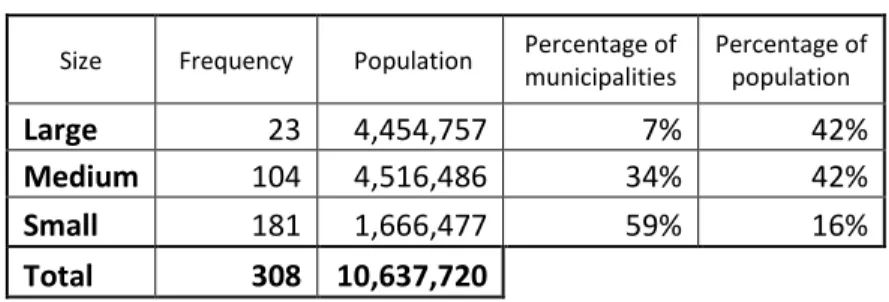
In 2009, there were a total of 308 municipalities of varying sizes (in terms of population or budget) in Portugal. Portuguese municipalities can be grouped into three segments: “Large” with a total population of over 100,000 inhabitants, “Medium”, with more than 20,000 inhabitants and less or equal to 100,000 inhabitants, and “Small” with 20,000 inhabitants or less (Carvalho et al., 2009). There are 181 “Small”, 104 “Medium” and 23 “Large” municipalities in Portugal.
Currently, municipalities are some of the biggest economic organizations in their territory and are as well, in most cases, the biggest employer. While elected officials serve a four-year term, the managers in Municipalities are appointed for three four-years.
1.4. Expected research contribution 1.4.1. Expected theoretical contribution
I attempt to contribute to the literature in five ways. First, I propose a model that brings the resource-based view (RBV) theory to the public administration context in the study of performance measurement.
Second, I aim to study the support that internal stakeholders, elected officials, managers and workers give to a management change process in Portuguese municipalities, which is an environment where in most cases elected officials and managers are not highly skilled in management. To my best knowledge this has not yet been done.
Third, I research the relative impact of technical training in a management change process furthering previous research from other authors such as Yang and Hsieh (2007). Political leaders in Portugal consider training to be a key factor for the development of the country. The political agenda of the XIX Portuguese Government included the word training (“formação”) 31 times in relation to different areas of activity (Programa do XIX
Governo Constitucional, 2011)
Fourth, I advance theory by testing hypotheses about the determinants of the managerial effectiveness of performance measurement, in the context of Portuguese municipalities.
Finally, I contribute methodologically by using measures from different respondents at different levels, elected officials and managers, in the same municipalities, in order to prevent the possibility of common method bias (Podsakoff et al., 2003). To the best of my knowledge, almost all previous studies on performance measurement effectiveness used single respondents.
1.4.2. Expected managerial contribution
The research aims to offer insights into the determinants of effective performance measurement for elected officials and managers working in municipalities as well as for political decision makers in Parliament and Government.
Portugal is facing one of the worst economic crises in the last 100 years, due in part to the fact that productivity levels are low in comparison with our EU partners. The lack of economic growth over the last decade is also indicative of poor resource allocation. The significant public debt that caused the then Government to ask for financial support from EU, IMF and ECB in April 2011, also reveals low levels of accountability in the
investment of public money.
The lack of information on resources, how they are being allocated and the results thereof could be a contributory factor. Performance measurement systems, which are based on information, can help improve economic results and show better ways of allocating resources and improving accountability.
My purpose is to contribute to improving the quality of management in municipalities by building a model which will shed light on the relative impact of different key determinants of the managerial effectiveness of performance measurement.
1.5. Structure of the thesis
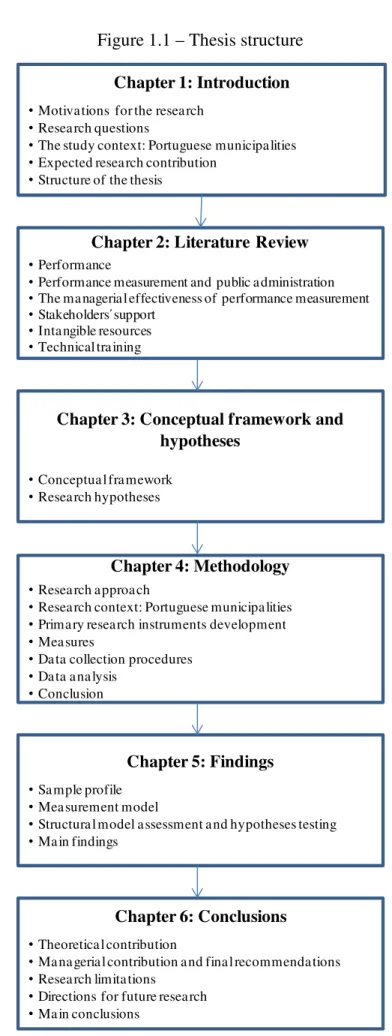
This thesis has six chapters as depicted in figure 1.1.
In the first chapter I introduce the subject of the thesis and outline the researcher’s motivations given that he is a practitioner and brings his field experience to the subject and the research problem and questions. Then I present the context of the study with a brief description of the Portuguese municipalities. In the final section I present the expected contributions to theory and practice.
Chapter 2 presents a literature review of the main constructs of the research: the effectiveness of performance measurement, stakeholders’ support, intangible resources and technical training. I review the theoretical foundations for this research using the stakeholder theory, resource-based view and the organizational learning theory. I identify the major gaps in literature that this research intends to fill.
In chapter 3 I build and explain the hypotheses leading to the proposed conceptual framework. Stakeholders’ support is directly related to intangible resources, technical training and the effectiveness of performance measurement and indirectly to the effectiveness of performance measurement through intangible resources and technical training. Intangible resources are directly related with technical training and the effectiveness of performance measurement and indirectly to the effectiveness of performance measurement through technical training. Technical training is related with the effectiveness of performance measurement.
In chapter 4 I describe the methodology used to test the hypotheses set in chapter 3. I explain and discuss the steps that were developed concerning research philosophies and approaches, the survey instrument, sampling, pretest, administration and data collection.
Chapter 5 presents the findings and discusses the extent to which the proposed hypotheses are confirmed or not. The discussion is supported by the literature.
Finally, in Chapter 6 I analyze the contributions to theory and practice and the implications for elected officials and managers in municipalities and politicians in Parliament and Government and suggest future avenues of research.
Figure 1.1 – Thesis structure Chapter 1: Introduction • Motivations for the research
• Research questions
• The study context: Portuguese municipalities • Expected research contribution
• Structure of the thesis
Chapter 2: Literature Review • Performance
• Performance measurement and public administration • The managerial effectiveness of performance measurement • Stakeholders´support
• Intangible resources • Technical training
Chapter 3: Conceptual framework and hypotheses
• Conceptual framework • Research hypotheses
Chapter 4: Methodology • Research approach
• Research context: Portuguese municipalities • Primary research instruments development • Measures
• Data collection procedures • Data analysis
• Conclusion
Chapter 5: Findings • Sample profile
• Measurement model
• Structural model assessment and hypotheses testing • Main findings
Chapter 6: Conclusions • Theoretical contribution
• Managerial contribution and final recommendations • Research limitations
• Directions for future research • Main conclusions
CHAPTER 2 - LITERATURE REVIEW
The goal of this chapter is to present the management literature related to the understanding of the key determinants that can make performance measurement effective.
The first section is about performance. I review the concept and its possible different definitions. I choose a position from the different possible definitions.
The second section is about the origins and the evolution of the utilization of performance measurement in the context of public administration.
The third section is dedicated to the managerial effectiveness of performance measurement construct. I present the concept and review the literature on the relationships between this construct and its determinants.
The fourth section is about stakeholders’ support. After defining the term, I present its typology and then review the literature on its role in the effectiveness of performance measurement. Finally I discuss the Stakeholder theory that supports the inclusion of stakeholders’ support.
The fifth section is about the intangible resources construct. Here I review the literature to address the influence of intangible resources on performance. The Resource-based view is reviewed as the supporting theory, extended to the context of public administration.
In the sixth section I present the technical training construct, I review the literature and address the possible mediating effects of intangible resources and technical training between stakeholders’ support and intangible resources and the effectiveness of performance measurement. Lastly, I look at Organizational Learning theory as the support theory for the importance of technical training to the managerial effectiveness of performance measurement.
2.1. Performance
Performance is a commonly used term in a broad scope of activities and organizations. Lebas and Euske (2007:126) provide a table of nine possible meanings of performance: “1. measurable by either a number or an expression that allows communication (e.g.
performance in management is a multi-person concept);
2. to accomplish something with a specific intention (e.g. create value); 3. the result of an action (the value created, however measured);
4. the ability to accomplish or the potential for creating a result (e.g. customer satisfaction, seen as a measure of the potential of the organization for future sales); 5. the comparison of a result with some benchmark or reference selected or imposed, either internally or externally;
6. a surprising result compared to expectations; 7. acting out, in psychology;
8. a show, in the “performing arts”, that includes both the acting or actions and the result of the actions as well the observation of the performers by outsiders;
9. a judgment by comparison.”
Performance is not easy to define. The more I read the literature about business performance, the more I understand that there is no consensus on its definition. Performance covers all the functional areas of a firm and therefore it is treated differently by researchers from distinct functional backgrounds such as marketing, human resources, finance and operations, for example (Neely, 2007). Another point for discussion is that there are multiple adequate units of analysis for performance measurement: the corporate level of the firm, the division, the cost center, the activity (Meyer, 2007).
However, a significant part of the literature agrees on some points such as the business performance definition. It is consensual that the performance level of a firm is a function of the efficiency (i.e. the economic utilization of its resources) and the effectiveness (i.e. level of achievement of their goals and objectives) of their activities. It was suggested that performance means the efficiency and effectiveness of past actions (Neely, Gregory and Platts, 1995); a performance indicator is a metric used to quantify the efficiency and/or the effectiveness of an action; and a performance measurement system is a metric system used to quantify the efficiency and/or the effectiveness of past actions by means of
collection, analysis, study and deployment of information in order to take the right decisions that will foster action in order to improve future firm performance (Neely, 1998).
In the context of public administration, performance measurement can be defined as the utilization of quantitative indicators to periodically measure the results and efficiency of public programs that citizens, customers, or stakeholders expect (Broom et al., 1998; Hatry 1999).
As such, and for the purposes of this research, I adopt Lebas and Euske’s proposition that defines performance as “the sum of all the processes that will lead managers to taking
appropriate actions in the present that will create a performing organization in the future (i.e. one that is effective and efficient)” (Lebas and Euske 2007: 127).
Much work has been done about what type of measures should be used to measure performance, whether financial and/or non-financial measurements (Eccles, 1991; Kaplan and Norton, 1992). Financial measures have predominated and it is true that they are still preferred by the analysts on the stock markets (i.e. dividend yield, earnings per share, earnings growth, sales growth, return on equity), and thus the ones that CEO´s are always concerned about. Of course, financial measures are the end of the line and could be considered the results of the preceding activities. But financial measures are about past performance not about the potential for future performance unlike non financial measures, i.e. market share, customer satisfaction levels, customer retention or loyalty, customer service levels (e.g. defect rates, response time, deliveries on time) or employee satisfaction.
As a result of the knowledge I gleaned from working in performance improvement projects in firms and public administration, I agree that the above definition is valid for both private and public organizations and that financial and non financial metrics should be used when measuring performance. Indeed, SIADAP uses the concepts of effectiveness and efficiency as parameters for setting and evaluating goals in organizational units in municipalities.
2.2. Performance measurement and public administration
Performance measurement in public administration has become an essential part of the reform programs in governments, driven by increasing pressure from elected officials and citizens who demand higher levels of accountability, responsiveness, and quality (Barzelay, 2001; Kettl, 2005; Moynihan, 2006 ).
Public Administrations in developed countries have been subject to pressure since the 1970´s to increase their effectiveness and efficiency, to reduce the cost burden for taxpayers whilst simultaneously improving the quality of service and customer satisfaction levels. An evolution from the bureaucratic system of administration which did not care about customer satisfaction, and against the “public officials who were inefficient
and ineffective, and who were more concerned with their own needs than those of their
service users” (Osborne and McLaughlin, 2002:8).
This has led to changes in the way Public Administrations are managed. In the United States, MBO – Management by Objectives - was introduced in local government in the early 1970´s and in a number of federal agencies in 1974, following an initiative of President Richard Nixon (Jun, 1976).
Several reforms have since been made in North American countries (USA and Canada) Australasia (Australia, New Zealand) and Western European Countries like the UK, The Netherlands, Germany, and Switzerland (McLaughlin, Osborne and Ferlie, 2008). One of the dominant paradigms for these reforms is best known by the term NPM – New Public Management.
The source for NPM was a seminal paper based on the UK experience (Hood 1991). The classic NPM formulation (Osborne and McLaughlin, 2002:9) “comprised seven
doctrines:
• Hands-on and entrepreneurial management as opposed to the traditional
bureaucratic focus of the public administrator;
• Explicit standards and measures of performance; • An emphasis on output controls;
• The importance of disaggregation and decentralization of public services; • A shift to the promotion of competition in the provision of public services; • A stress on private sector styles of management and their superiority; • The promotion of discipline and parsimony in resource allocation.”
The improvements that several management tools used by the private sector could bring when used in the public sector organizations were implicit in these doctrines.
Although not written by academics, another contribution to the NPM paradigm was the best-seller “Reinventing Government” (Osborne and Gaebler, 1993) whose doctrines were expressed as slogans, such as “funding outcomes, not inputs” in chapter 5 - “Results-Oriented Government” or “meeting the needs of the customer, not the bureaucracy” in chapter 6 - “Customer-driven government”. This book influenced the priorities in the US Federal Government during the first Clinton Administration (Barzelay 2002).
Some authors consider the New Zealand reforms in the 1980s part of the intellectual foundations for the NPM. The Treasury’s public management reform in New Zealand, called the New Institutional Economics (NIE), had three key theoretical components: public choice theory, transactions-cost economics and the economic theory of agency (Boston 1991). Based on these principles the “contractualist model” was developed suggesting that the ministers were purchasers of outputs provided by government departments (Schick 1996).
2.3. The managerial effectiveness of performance measurement
In the last decades there has been great interest in using performance measurement to improve performance (Ammons, 1996; Greiner, 1996; Harris, 1995; Holzer, 1998; Keehley et al., 1997; Walters, 1998).
Performance measurement is not an end in itself, but is intended as a means to obtain more informed and better decisions (Julnes and Holzer, 2001). The question is: why measure performance in public administration? Other than the fact that it is mandatory in Portugal for municipalities to measure their performance in terms of effectiveness,
efficiency and quality of services provided to citizens, what other explanations are there for it? Are there pertinent goals for measuring performance besides complying with the law?
Behn (2003:588) offers an answer by giving eight managerial purposes that public managers may have to measure performance:
1. Evaluate: How well is my public agency performing?
2. Control: How can I ensure that my subordinates are doing the right thing?
3. Budget: On what programs, people, or projects should my agency spend the public’s money?
4. Motivate: How can I motivate line staff, middle managers, non profit and for-profit collaborators, stakeholders, and citizens to do the things necessary to improve performance?
5. Promote: How can I convince political superiors, legislators, stakeholders, journalists, and citizens that my agency is doing a good job?
6. Celebrate: What accomplishments are worthy of the important organizational ritual of celebrating success?
7. Learn: Why is what working or not working?
8. Improve: What exactly should who do differently to improve performance?
Another question is: how can we improve performance? In order to improve performance public organizations would benefit from implementing performance measurement systems, but that can be a difficult challenge. Having such a system in place does not guarantee that performance will improve or that any of the other eight purposes defined by Behn (2003) will be achieved.
And that brings us to the concept of managerial effectiveness of performance measurement. Managerial effectiveness could be defined as the effects that performance measurement can have on managerial variables such as staff evaluation, priority setting, cost-efficiency and strategic planning (Behn 2003; Berman and Wang 2000; Poister and Streib 1999, Yang and Hsieh, 2007).
My research intends to identify the perceived main determinants of effective performance measurement by means of the literature review and using my experience in various
projects implementing performance measurement. The three main constructs identified are described in the next sections.
2.4. Stakeholders’ support
The definition of stakeholders proposed by Freeman (1984:5) is: “ any group or
individual that is affected or can affect the achievement of an organization’s objectives”.
According to this definition a large group of people either internal or external to the firm would be stakeholders. Later, Freeman (2002:39) proposed a new, more precise definition: “Stakeholders are those groups who have a stake in or claim in a firm.
Specifically I include suppliers, customers, employees, stockholders and the local
community, as well as management in its role as agent for these groups”. This definition
is also applicable in a public sector organization, although the “stockholders” are not the same as in a private corporation. I can argue that “stockholders” in a public organization are the citizens. One point of interest for this research is that Stakeholder theory does not imply that all stakeholders should be involved in all processes or decisions (Donaldson, 1995). This is also valid in public administration.
The various types of a municipality’s stakeholders could include the following: the internal stakeholders e.g. elected officials, managers, middle managers, personnel, and the external stakeholders, e.g. customers, citizens. Some authors consider elected officials as external stakeholders (Yang and Hsieh 2007) because they do not have a direct managerial role in some cases. For the purposes of this thesis, I will consider that elected officials are internal stakeholders, together with managers and employees, because they are also involved in the process of performance measurement either directly as participants or indirectly through its effects. Elected officials are viewed as important consumers and stakeholders of performance measurement (Ho, 2006). Berman and Wang (2000:409) refer that “Support from elected officials is often important in innovation, and
it is especially crucial to performance measurement because it is, in part, undertaken to provide elected officials with improved information”. On the other hand, if elected
officials perceive that the effects of performance measurement can cause them problems in elections, for example due to dissatisfaction of workers with their individual evaluations, they might tend to give the system less support. I was confronted with this lack of support in one of the performance measurement projects I was involved in.
The political and the management dimensions could sometimes be conflicting on what concerns elected officials, and as they consider themselves above all as politicians this dimension normally prevails in their decisions.
In municipalities elected officials are often, simultaneously, the first level managers. Their support is therefore critical because it legitimates reforms and new performance expectations, and helps ensure funding for new efforts. It has been recognized that the uncertainty of support from elected officials is an obstacle to the success of performance measurement (Berman and Wang, 2000).
When top management are strongly committed to introducing performance measurement, it appears to produce larger effects on productivity (Argyris, 1973; Hollmann, 1976; Ivancevich et al. 1976). Strong support and active participation from top management when implementing performance measurement, produces better results in productivity, when compared with situations of low commitment or no participation (Rodgers and Hunter, 1991).
My own professional experience confirms that without top management commitment and support, performance measurement initiatives are doomed to failure. I have been called as a consultant to help implement performance measurement systems in municipalities where it had previously failed. In all cases, elected officials gave the process no real support.
The best form of support from elected officials is their participation in performance measurement from the outset, starting with the definition of goals and objectives at the strategic level because it improves the conditions for the performance measurement and for the following use of performance information (Berman and Wang, 2000; Ho, 2006; Melkers and Willoughby, 2005; Yang and Hsieh, 2007; Wang and Berman, 2000). Junes and Holzer (2001:702) confirmed: “Our empirical findings also support the view that
continued success of performance measurement depends on the continued support of elected officials”.
Support and participation from managers in municipalities is probably hard to assess and measure as noted previously by Ammons (1995:41): “detailed investigation often casts
doubt on the number of such systems being claimed and on rhetoric declaring dedication
to the performance measurement enterprise”. My professional experience has
consistently confirmed the importance of managers’ support and participation in the performance measurement effort. However, sometimes support is stated, but does not exist in reality.
Involving internal stakeholders, such as managers and staff in the performance measurement efforts can lead to a greater understanding of the reasons for undertaking the effort and the frequently unduly feared consequences (Julnes and Holzer 2001), thus increasing their support for the process.
Employee participation and support is also a factor that influences the quality of the results of performance measurement. In order to be effective, performance measurement systems should meet standards of validity, functionality, and legitimacy. The principle underlying the legitimacy concept is that effective measures cannot be forced from the top of the organization down. Measures must be previously understood and accepted by subordinate level employees (Bouckaert, 1993). The Portuguese law on implementing performance measurement in public administration follows this legitimacy concept stating that, on setting objectives, the negotiation between manager and employee is the rule and the manager can only impose the objectives on the employee in case of disagreement. This is a good strategy to increase employees’ commitment and support.
Internal stakeholders’ support should be the starting point for effective performance measurement, but it is not the only determinant. The appropriate resources are also required to support the process. Intangible resources are the most relevant of these.
2.5. Intangible resources
Several studies have been conducted in the field of strategic management on the reasons a firm acquires and sustains competitive advantages and superior performance. The Resource Based View (RBV) is one of the theories that seek to explain why some companies perform better than others.
RBV analyzes the firm from the resources perspective. “…firm resources include all
etc. controlled by a firm that enable the firm to conceive of and implement strategies that improve its efficiency and effectiveness" Barney (1991:101).
Resources are anything that can be considered a strength or weakness of a firm (Wernerfelt, 1984). Resources can be any tangible possessions like land, machinery or capital, or intangible possessions like brand names, patents, in-house knowledge of technology, skilled personnel, trade contacts and efficient procedures (Wernerfelt, 1984). Firms are thought of as having different sets of resources which will remain heterogeneous over time and whose characteristics of value, rareness, imitability and substitutability, will allow the implementation of unique strategies that will achieve sustained competitive advantage (Barney, 1991).
“What a firm wants is to create a situation where its own resource position directly or
indirectly makes it more difficult for others to catch up” (Wernerflet, 1984:173).
Resources allow a competitive advantage to be sustained in order to obtain a better performance.
Based on the resource based view, I can conclude that any organization that defines a strategy in order to improve its efficiency and effectiveness, be it a firm, government agency, municipality, not-for-profit organization or non-governmental organization, should consider their resources as the implementation potential of the chosen strategies.
In addition to resources, capabilities also allow the long-term strategy of firms to be implemented and consequently they are a primary source for the firm’s profits (Grant, 1991). A capability is defined as the organizational capacities to deploy the resources (Amit and Schoemaker, 1993) or the organizational capacity that resources have to perform some task or activity (Grant, 1991).
Capabilities or “distinctive competencies” can also be found in functional areas: general management, financial management, marketing and selling, market research, product R&D, engineering, production, distribution, legal affairs, and personnel (Hrebiniak, 1980). “McDonald's possesses outstanding functional capabilities within product
operations management. However, critical to McDonald's success is the integration of these functional capabilities to create McDonald's remarkable consistency of products and services in thousands of restaurants spread across most of the globe” (Grant,
1991:122).
Capabilities provide the foundations for a sustainable competitive advantage and stem from both tangible and intangible resources. Intangible resources cover a wide range of items from public knowledge such as scientific works, to contracts, trade secrets, intellectual rights of patents, trademarks, copyright and registered design and to resources that are people-dependent like know-how, networks; organizational culture, and the reputation of products and of the company (Hall, 1992).
The intangible resources of a company sometimes enable financial performance, more than tangible resources. The difference between the share value of a public company and its book value is an indication of that effect (Hall, 1992). For the purposes of this thesis, I use the concept of intangible resources based on Hall (1992), described above, which includes both capabilities and other intangible assets such as organizational culture and managers’ and workers’ know-how.
Performance measurement is a process that demands those involved to have specific knowledge about management concepts and tools such as the concepts of efficiency, effectiveness and performance measurement and the knowledge to understand, define and monitor objectives, key performance indicators and targets. This can only be guaranteed by adding management knowledge through technical training.
2.6. Technical training
Inadequate technical ability to collect and analyze performance data is one of the most important obstacles in the implementation of performance measurement (Radin, 1998; Theurer, 1998).
The knowledge or know-how question is ever present when we deal with implementing new processes which to some extent means changing the way people work. Changing
processes imply different ways of doing the work, acquiring new knowledge, learning the new competencies that are needed. That is the case of performance measurement.
Technical training becomes critical in procedures embedded in performance measurement such as the definition of objectives, the definition of output or outcome indicators, setting benchmarks, determining the frequency of control, defining indicators reporting and information feedback. Training is also needed if there are regulations to comply with, like quotas in personnel assessment (Berman and Wang, 2000; Fountain et al., 2003; Hatry, 1999; Liner et al., 2001; Newcomer et al., 2002 ).
Itami and Roehl (1987) have argued that a characteristic of all successful organizations is the recognition that there is a learning process which runs parallel to all operations, and that all activities present the potential to both enhance, or degrade, the know-how and reputation features of the intangible resources.
Technical knowledge about how to implement performance measurement is critical to its success (Weidner and Noss-Reavely, 1996; Wilkins, 1996). Technical knowledge can be acquired through training or access to adequate information on performance measurement (Julnes and Holzer, 2001).
Training provides managers with suitable information about the transition towards results-based management and therefore reduces uncertainty, fear, and cynicism (Reichers, Wanous, and Austin, 1997). Liner et al., (2001:78) state that “On-the-job
training is essential, but more formal training and occasional technical assistance usually are also needed to enable personnel to implement successful governing-for-results practices”. Technical training is a form of organizational learning.
2.6.1. Organizational Learning Theory
In a continuously changing environment, learning becomes critical. An organization's capacity to learn may be its main sustainable competitive advantage (De Geus, 1988; Stata, 1989).
Organizational learning means the process of improving actions through better knowledge and understanding (Fiol and Lyles, 1985). At its most basic definition, organizational learning is the development of new knowledge or insights that have the potential to influence behaviour (Slater and Narver, 1995). A learning organization is the one which learns powerfully and collectively and is continually transforming itself to better collect, manage, and use knowledge for success (Marquardt, 1996). They are organizations where people continually expand their capacity to create the results they truly desire, where new and expansive patterns of thinking are nurtured, where collective aspirations are set free and where people are continually learning how to learn together (Senge, 1990).
Organizational learning theory argues that that there is a relation between learning and performance “as successful organizations are described as having capabilities for
learning” (Levinthal and March, 1993: 96). There is empirical evidence about the positive
relationship between learning and business performance (Bontis et al., 2002), although some authors suggest that learning does not necessarily imply that those changes will directly improve performance because it is a process of change in cognition and behaviour, (Crossan et al., 1995).
Despite evidence that learning contributes to performance, the aim of this thesis is to research the impact of learning on performance under the effect of stakeholders’ support and what impact intangible resources have on the conditions to develop the learning process. Organizational learning theory is used to support the development of the theoretical model.
The following table 2.1 includes the main studies used in the literature review. All are about performance and their determinants. They were instrumental in defining the above mentioned constructs. For example, the Galbreath and Galvin (2008) study was the source which gave rise to the definition of intangible resources presented by Hall (1992). The major source for this study came from Yang and Hsieh (2007). It was the base for the constructs of managerial effectiveness of performance measurement and technical training.