Surgical-orthodontic treatment of Class III malocclusion
with agenesis of lateral incisor and unerupted canine
Bruno Boaventura Vieira1, Ana Carolina Meng Sanguino1, Marilia Rodrigues Moreira1,
Elizabeth Norie Morizono2, Mírian Aiko Nakane Matsumoto3
Introduction:Orthodontic-surgical treatment was performed in patient with skeletal Class III malocclusion due to exceeding mandibular growth. Patient also presented upper and lower dental protrusion, overjet of -3.0 mm, overbite of -1.0 mm, congenital absence of tooth #22, teeth #13 and supernumerary impaction, tooth #12 with conoid shape and partly erupted in supraversion, prolonged retention of tooth #53, tendency to vertical growth of the face and facial asym-metry. The discrepancy on the upper arch was -2.0 mm and -5.0 mm on the lower arch. Methods: The pre-surgical orthodontic treatment was performed with extractions of the teeth #35 and #45. On the upper arch, teeth #53, #12 and supernumerary were extracted to accomplish the traction of the impacted canine. The spaces of the lower extractions were closed with mesialization of posterior segment. Ater aligning and leveling the teeth, extractions spaces closure and correct positioning of teeth on the bone bases, the correct intercuspation of the dental arch, with molars and canines in Angle’s Class I, coincident midline, normal overjet and overbite and ideal torques, were evaluated through study models. The patient was submitted to orthognathic surgery and then the post-surgical orthodontic treatment was inished. Re-sults: The Class III malocclusion was treated establishing occlusal and facial normal standards.
Keywords:Orthodontics. Angle Class III malocclusion. Oral surgery.
How to cite this article: Vieira BB, Sanguino ACM, Moreira MR, Morizono EN, Matsumoto MAN. Surgical-orthodontic treatment of Class III malocclusion with agenesis of lateral incisor and unerupted canine. Dental Press J Orthod. 2013 May-June;18(3):94-100.
» The patient displayed in this article previously approved the use of her facial and intraoral photographs.
1 Post-Graduation Student, FORP-USP.
Introdução:o presente trabalho apresenta um tratamento ortodôntico-cirúrgico realizado em paciente portadora de má oclusão de Classe III esquelética com crescimento mandibular, protrusão dentária superior e inferior, trespasse horizontal de -3,0mm, trespasse vertical de -1,0mm, ausência congênita do dente 22, dentes 13 e supranumerários inclusos, dente 12 com forma conoide e parcialmente irrompido em supraversão, retenção prolongada do dente 53, tendência ao cresci-mento vertical da face e assimetria facial. A discrepância na arcada superior era de -2,0mm, e na inferior era de -5,0mm.
Métodos: o tratamento ortodôntico pré-cirúrgico foi realizado com extrações dos dentes 35 e 45. Na arcada superior foram extraídos os dentes 53, 12 e supranumerário, para efetuar o tracionamento do canino incluso. Os espaços das extra-ções inferiores foram fechados com mesialização do segmento posterior. Após o alinhamento e nivelamento dos dentes, foram avaliados por meio de modelos de estudo o fechamento dos espaços das extrações e o posicionamento correto dos dentes nas bases ósseas, a intercuspidação correta das arcadas dentárias, com molares e caninos em Classe I de Angle, li-nhas medianas coincidentes, trespasse horizontal e trespasse vertical normais e torques ideais. A paciente foi encaminhada para realização de cirurgia ortognática e, em seguida, o tratamento ortodôntico pós-cirúrgico foi inalizado. Resultados:
a má oclusão de Classe III foi corrigida, estabelecendo padrões oclusais e faciais normais.
original article Vieira BB, Sanguino ACM, Moreira MR, Morizono EN, Matsumoto MAN
introduction
The Class III malocclusions are characterized by more anterior positioning of the mandible in rela-tion to the maxilla, considering that the discrepancy can be caused by the maxilla growth deficit, exces-sive mandibular prognathism or the combination
of both.5,8,9,16,17 In general, the facial aspect is very
compromised, motivating the patient to seek
treat-ment.4,13,19 Regarding etiology, factors such as
hered-ity and the environmental action are considered rel-evant. The treatment of the Class III malocclusion in adults is limited, requiring a multidisciplinary plan-ning that provides functional and esthetic benefits for the maxillomandibular complex. The options may be a compensatory treatment or combined treatment, consisted of orthodontic-surgical treatment that may require advancement of the maxilla, retraction of
the mandible or a combination of both.20 The main
objectives of the orthognathic surgery are to obtain normal occlusion and improve the facial esthetic, re-sulting on the balance of the soft tissues of the face, besides the obtainment of functional improvement on
mastication, phonation, breathing and occlusion,15,20
the reported case, also presents dental impaction, prolonged retention of deciduous tooth and presence
of supernumerary tooth, that are common
character-istics of orthodontic patients.2,10,12,14 For the success of
dental traction, achieving an ideal positioning of the crown and root, previous procedures as the extraction
of supernumerary teeth may be necessary.1,6,11,24,25
case report
Female Caucasian patient, 14 years and 8 months old, presenting Angle Class III malocclusion, skel-etal Class III pattern due to mandibular excessive growth, superior and inferior dental protrusion, overjet of -3 mm, overbite of -1 mm, congenital absence of tooth #22, teeth #13 and supernumerary impacted, tooth #12 with conoid shape and partly erupted in supraversion, prolonged retention of tooth #53, tendency to vertical growth of the face and facial asymmetry. Patient main complaint was the malposition of the teeth.
Facial and Functional analysis
Analysis showed facial asymmetry, with concave pro-ile, normal nasolabial angle, deiciency on the paranasal region, increased lower facial third, normal lip thickness with mentum prominence. On the functional analysis it was found: Nasal breathing, normal phonation, atypical
Figure 2 - Occlusal photographs and initial radiographs.
original article Vieira BB, Sanguino ACM, Moreira MR, Morizono EN, Matsumoto MAN
Figure 4 - Occlusal photographs and inal radiographs.
swallowing, normal pharyngeal and palatine tonsils, with upper and lower lips in normal function, mandibular clos-ing pattern with deviation to the right and ATM without any anomalies, however, presenting painful symptom-atology during intense mastication.
intraoral clinical examination
The patient presented good oral hygiene, periodon-tium with aspect of normality, absence of carious le-sions, dental anomaly of number, shape and size, labial and lingual frenum with normal insertions and Class III relation of molars. According to Angle’s classiication, the patient presented a Class III malocclusion, with su-perior and inferior midline deviation to the right.
interpretation oF cephalometric
mea-sures and analysis oF models
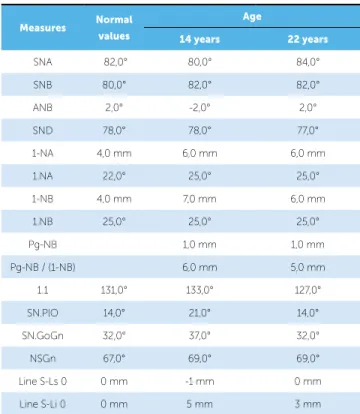
On the analysis of the skeletal pattern it was observed maxillary retrusion, mandibular protrusion, skeletal
cal growth of the face (NSGn = 69°, SN.GoGn = 37°) with dolichofacial morphological pattern, according to
Steiner’s measures.23,24 The measures of the dental
pat-tern showed protrusion and increase of axial inclina-tions of upper incisors (1-NA = 6 mm and 1.NA = 25°) and protruded lower incisors with normal axial incli-nations (1-NB = 7 mm and 1.NB = 25°). The occlusal plane was inclined in relation to cranial base. On the
model analysis,5,20 it was veriied that the discrepancy
on the upper arch was of -2 mm and -5.0 mm for the lower arch, upper arch contracted in relation to the lower and deep ogival palate. The upper midline, eval-uated on study models, was 1.5 mm deviated to the right and the lower 3.5 mm to the right side, conirm-ing the facial assessment.
pre-surgical orthodontic treatment
Figure 5 - Final extraoral and intraoral photographs.
Figure 6 - Observe the canines esthetics.
upper and lower teeth, cemented rings on irst molars of both arches and second lower molars.
It was initiated the alignment and levelling of the upper arch with stainless steel 0.014-in, 0.016-in, 0.018-in and 0.020-in archwires.
It was performed extraction of the teeth #53 (de-ciduous upper right canine), supernumerary and tooth #12 (lateral upper right incisor). On the same surgical
bone formation on the location where it would be performed the mandibular osteotomy.
The traction was done through a chain elastic and rubber type action line (GAC), connected to the ty-ing wire installed durty-ing the act of dental extractions.
original article Vieira BB, Sanguino ACM, Moreira MR, Morizono EN, Matsumoto MAN
On the lower arch 0.020-in, the partial distalization of the irst molars and canines, was performed to obtain the alignment of the incisors. Ater inishing the alignment and leveling, the spaces were closed with loss of anchor-age and mesialization of the irst and second molars.
With the complete closure of the spaces ideal lower rectangular archwire 0.019 x 0.025-in, coordinated with the opposite and with necessary torques was set. Ater alignment and levelling of both arches, clos-ing of spaces from extractions, correct positionclos-ing of teeth on the bone base with ideal torques for each tooth, it was obtained study models to evaluate, on the pre-surgical phase, the correct intercuspation (Class I of molars and canines with coincident midlines).
Interdental hooks were welded on the upper and lower arch 0.019 x 0.025-in, for metallic individual ty-ing wire. In this stage the patient was referred to com-bined orthognathic surgery of maxilla and mandible.
post-surgical orthodontic treatment
The post-surgical orthodontic treatment consisted in finishing the intercuspation and the occlusal func-tions, through the adjustment of torque, character-ization of upper canines in lateral incisors and use of intermaxillary elastics.
Functional adjustments of teeth #14 and #24 that substituted the upper canines were performed to ob-tain guides of disocclusion, Extractions of teeth #18 and #28 were also performed.
The upper and lower fixed appliances were re-moved and the retainers were installed, being in the upper arch a modified Hawley plate and, in the lower arch, lingual bar bonded to teeth #33 and #43 (Figs 5 and 6).
The patient was orientated to use upper retainer 24 hours a day, during a period of 12 months and after that the period of use should be overnight. The lower retainer should be kept for undetermined pe-riod. It was also recommended a speech treatment for adaptation to new muscle functions.
Final considerations
The objectives of the treatment were achieved with the association of the orthodontic-surgical treat-ment. Molar Class I relation and normal overjet and overbite were obtained. It was performed the traction of tooth #13, which, along with teeth #23, replaced lateral upper incisors. The Class III malocclusion was well corrected, establishing a normal occlusal, facial and functional patterns.
Table 1 - Table with initial and inal values of the Steiner analysis.
Measures Normal
values
Age
14 years 22 years
SNA 82,0° 80,0° 84,0°
SNB 80,0° 82,0° 82,0°
ANB 2,0° -2,0° 2,0°
SND 78,0° 78,0° 77,0°
1-NA 4,0 mm 6,0 mm 6,0 mm
1.NA 22,0° 25,0° 25,0°
1-NB 4,0 mm 7,0 mm 6,0 mm
1.NB 25,0° 25,0° 25,0°
Pg-NB 1,0 mm 1,0 mm
Pg-NB / (1-NB) 6,0 mm 5,0 mm
1.1 131,0° 133,0° 127,0°
SN.PlO 14,0° 21,0° 14,0°
SN.GoGn 32,0° 37,0° 32,0°
NSGn 67,0° 69,0° 69,0°
1. Almeida R, Fuziy A, Almeida MR, Almeida Pedrin RR, Henriques JFC, Insabralde CMB. Abordagem da impactação e/ou irrupção ectópica dos caninos permanentes: considerações gerais, diagnóstico e terapêutica. Rev Dental Press Ortod Ortop Facial. 2001;6(1):93-116.
2. Becker A, Bimstein E, Shteyer A. Interdisciplinary treatment of multiple unerupted supernumerary teeth. Am J Orthod. 1982;81(5):417-22. 3. Bishara SE. Impacted maxillary canines: a review. Am J Orthod Dentofacial
Orthop. 1992;101(2):159-71.
4. Bittencourt MAV. Má oclusão Classe III de Angle com discrepância antero-posterior acentuada. Rev Dental Press Ortod Ortop Facial. 2009;14(1):132-42. 5. Cao Y, Zhou Y, Li Z. Surgical-orthodontic treatment of Class III patients
with long face problems: a retrospective study. J Oral Maxillofac Surg. 2009;67(5):1032-8.
6. Cappellette M, Cappellette Jr M, Fernandes LCM, Oliveira AP, Yamamoto LH, Shido FT, et al. Caninos permanentes retidos por palatino: diagnóstico e terapêutica: uma sugestão técnica de tratamento. Rev Dental Press Ortod Ortop Facial. 2008;13(1):60-73.
7. Capelozza Filho L, Martins A, Mazzotini R, da Silva Filho OG. Efects of dental decompensation on the surgical treatment of mandibular prognathism. Int J Adult Orthodon Orthognath Surg. 1996;11(2):165-80.
8. Dale HC. Morphologic skeletal asymmetry, with a Class III skeletal discrepancy, treated without surgical intervention. World J Orthod. 2005;6(4):391-7.
9. Ellis E 3rd, McNamara JA Jr. Components of adult Class III malocclusion. J Oral Maxillofac Surg. 1984;42(5):295-305.
10. Fastlicht S. Treatment of impacted canines. Am J Orthod. 1954;40(12):891-905.
11. Frank CA, Long M. Periodontal concerns associated with the orthodontic treatment of impacted teeth. Am J Orthod Dentofacial Orthop. 2002;121(6):639-49.
12. Jacoby H. The etiology of maxillary canine impactions. Am J Orthod. 1983;84(2):125-32.
13. Kerr WJS, O’Donnell JM. Panel perception of facial attractiveness. Br J Orthod. 1990;42(4):299-304.
REFERENCES
14. Lewis PD. Preorthodontic surgery in the treatment of impacted canines. Am J Orthod. 1971;60(4):382-97.
15. Medeiros PJD, Quintão CCA, Menezes LM. Avaliação da estabilidade do peril facial após tratamento orto-cirúrgico. Ortod Gaúch. 1999;3(1):5-23. 16. Miloro M. Combined maxillary and mandibular surgery. In: Fonseca
RJ. Oral and maxillofacial surgery: orthognathic surgery. Philadelphia: Saunders; 2000. v. 2, p. 419-32.
17. Iino M, Ohtani N, Niitsu K, Horiuchi T, Nakamura Y, Fukuda M. Two-stage orthognathic treatment of severe Class III malocclusion: report of a case. Br J Oral Maxillofac Surg. 2004;42(2):170-2.
18. Mucha JN, Bolognese AM. Análise de modelos e ortodontia. Rev Bras Ortod. 1985;42(1-3):28-44.
19. Nicodemo D, Pereira MD, Ferreira LM. Efect of orthognatic surgery for class III correction on quality of life as measured by SF-36. Int J Oral Maxillofac Surg. 2008;37(2):131-4.
20. Pangrazio-Kulbersh V, Berger JL, Janisse FN, Bayirli B. Long-term stability of Class III treatment; rapid palatal expansion and protraction facemask vs LeFort I maxillary advancement osteotomy. Am J Orthod Dentofacial Orthop. 2007;131(1):7.e9-19.
21. Steiner CC. Cephalometrics for you and me. Am J Orthod. 1953;39(10):729-55.
22. Steiner CC. Cephalometrics in a clinical pratice. Angle Orthod. 1959;29(1):8-29.
23. Tavares HS, Gonçalves JR, Pinto AS, Rapoport A. Estudo cefalométrico das alterações no peril facial em pacientes Classe III dolicocefálicos submetidos à cirurgia ortognática bimaxilar. Rev Dental Press Ortod Ortop Facial. 2005;10(5):108-21.
24. Vilas Boas PC, Bernardes LAA, Pithon MM, Engel DP. Tracionamento ortodôntico de incisivos central e lateral superiores impactados: caso clínico. Rev Clin Ortod Dental Press. 2004;3(3):79-86.