RevBrasAnestesiol.2015;65(6):522---524
REVISTA
BRASILEIRA
DE
ANESTESIOLOGIA
OfficialPublicationoftheBrazilianSocietyofAnesthesiologywww.sba.com.br
CLINICAL
INFORMATION
Anesthetic
management
of
a
pediatric
patient
with
hypohidrotic
ectodermal
dysplasia
undergoing
emergency
surgery
Elif
Oral
Ahiskalioglu
a,∗,
Ali
Ahiskalioglu
b,
Binali
Firinci
c,
Aysenur
Dostbil
b,
Mehmet
Aksoy
baDepartmentofAnesthesiologyandReanimation,RegionalTrainingandResearchHospital,Erzurum,Turkey bDepartmentofAnesthesiologyandReanimation,AtaturkUniversitySchoolofMedicine,Erzurum,Turkey cDepartmentofPediatricSurgery,RegionalTrainingandResearchHospital,Erzurum,Turkey
Received16October2013;accepted31October2013 Availableonline11December2013
KEYWORDS
Ectodermaldysplasia; Regionalanesthesia; Acuteabdomen
Abstract Ectodermaldysplasiasarerareconditionswithatriadofhypotrichosis,anodontia andanhidrosis.Inliteraturereviewtherehavebeenonlyafewreportsofanesthetic manage-mentofpatientswithectodermaldysplasias. Hyperthermiaisavery seriousriskwhich may occurduetothedefectofsweatglands.The presentcaseinvolvesa10-year-oldchildwith ectodermaldysplasiawhopresentedwithanacuteabdomenandwasconsideredforan emer-gencysurgery.Ouraimwastodemonstrate thesuccessfulmanagementofthiscaseusinga combinationofgeneralandepiduralanesthesia.Itisimportantforanesthesiologisttohave informationaboutthissyndromeincaseofemergencyoperations,sinceitcanpreventserious complicationsandevensavelives.
©2013SociedadeBrasileiradeAnestesiologia.PublishedbyElsevier EditoraLtda.Allrights reserved.
PALAVRAS-CHAVE
Displasia ectodérmica; Anestesiaregional; Abdomeagudo
Manejoanestésicodepacientepediátricocomdisplasiaectodérmicahipoidrótica submetidoacirurgiadeemergência
Resumo As displasias ectodérmicas são condic¸ões raras, com uma tríade de hipotricose,
anodontiaeanidrose.Emrevisãodaliteraturaháapenasalgunsrelatosdemanejoanestésico depacientescomdisplasiasectodérmicas.Hipertermiaéumriscomuitosérioquepodeocorrer porcausadedefeitodasglândulassudoríparas.Opresentecasoenvolveumacrianc¸ade10anos comdisplasiaectodérmicaqueseapresentoucomabdomeagudoefoiconsideradaparauma cirurgiadeemergência.Nossoobjetivofoidemonstraromanejobem-sucedidodessecaso,com ousodeumacombinac¸ãodeanestesiageraleperidural.Éimportanteparaoanestesiologista
∗Correspondingauthor.
E-mail:[email protected](E.O.Ahiskalioglu).
0104-0014/$–seefrontmatter©2013SociedadeBrasileiradeAnestesiologia.PublishedbyElsevierEditoraLtda.Allrightsreserved.
Anestheticmanagementofhypohidroticectodermaldysplasia 523
obterinformac¸õessobreessasíndrome,emcasodeoperac¸õesdeemergência,poispodeevitar complicac¸õesgraveseatésalvarvidas.
©2013SociedadeBrasileira deAnestesiologia.PublicadoporElsevierEditoraLtda.Todosos direitosreservados.
Introduction
Hypohidrotic ectodermal dysplasia (HED) (Christ-Siemens-Tourainesyndrome)isanX-linkedconditionandisthemost commonformofectodermaldysplasia(ED).Inthistypeof syndrome,patientshavenosweatglandsortheyare signifi-cantlydecreased.HEDhascharacteristictriadofreduction in the amount of hair (hypotrichosis), absence of sweat glands(anhidrosis)andhypodontia.1
Patients with HED frequently suffer from pulmonary infections and hyperthermia in increased ambient temperatures.2
Case
report
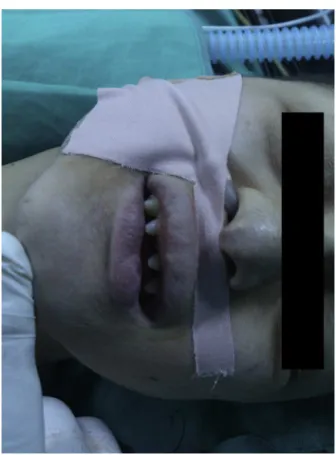
A 10-year-old boy with HED presented on our pediatric surgeryemergencydepartmentwitha12-hhistoryofnausea andvomitingassociatedwithright lowerquadrant abdom-inal pain. Abdominal examination revealed right lower quadranttendernesswithguardingandrebound.Childhas characteristictriadofHED(Figs.1and2).Laboratory test-ing revealed a mild leukocytosis of 13,400cells/mm3. All
other laboratory results showed normal values. Patient’s pastmedicalhistorywassignificantforHED.Patienthadno surgicalhistory.Thepatientwasdiagnosedwithappendicitis andemergencysurgerywasplanned.
Premedication included intravenous midazolam (0.15mg/kg).Thepatientwastransportedtotheoperating room and routine monitors were placed. Preanesthetic airway examination revealed Mallampati class-I in sitting and supine position. Although we didn’t suspect difficult airwayweprepareddifficultairwaycartwhichincluded dif-ferentsizesofendotrachealtubes,laryngealmaskairways, prosealLMAandfiberopticbronchoscope.
Afterpreoxygenationwith100%oxygen,anesthesiawas induced with propofol (3mg/kg) and fentanyl (2g/kg).
After ventilation, neuromuscular blockade was provided by rocuronium (1m/kg). Laryngeal view with the Macin-tosh laryngoscope was Cormack---Lehane grade-I and the patient’s trachea was intubated easily. At the beginning ofoperationbodytemperaturewas36.0◦C.Hisbody tem-perature remained36---36.5◦C duringthe operation. After intubation the patient was positioned in the left lateral position and the skin was prepared with polivinilpiroli-don iyot. An 18G epidural catheter was sited without difficultyatthelevelofthethirdandfourthlumbar inter-space using the loss of resistance technique a test dose of levobupivacaine 5mg was administered. 10mL of lev-obupivicaine 0.125% was infused into the epidural space. Anesthesia was maintained with propofol and epidural
Figure1 Teetharereducedandconicalinshape (anodontia).
524 E.O.Ahiskaliogluetal.
analgesia.The bodytemperature monitored continuously. Repeated dosing of the neuromuscular blockade was not necessary.
Appendicectomywasperformedinnormalcourse with-outanincidentwithin45min.Followingcompletionofthe surgical procedure, residual neuromuscular blockade was reversed with sugammadex100mg and the patient’s tra-cheaextubated. Patientwasdischargedfromthe hospital twodaysaftertheoperation.
Discussion
HEDisthemost frequentformofEDandararesyndrome with an incidence of approximately 1:100,000.3
Hyper-thermiadue toinadequatesweating,secondary topartial or complete absence of sweat glands, is common in the anhidroticformandresultsinapotentialforsuddendeath ininfancyduetohyperthermia.Thereportedmortalityrate isintheorderof10---54%.4
ProblemsforanesthesiainapersonwiththeHEDinclude potentially difficult tracheal intubation due to multiple missing teeth and hypoplasia of the maxilla. Respiratory functionneeds tobe assessedbecause ofrecurrent chest infectionsaswell.5
InPubMeddatabasesliteraturereviewtherehavebeen only afew reports of anestheticmanagement of patients withHED.
Hottaet al.emphasized airway hydration, preparation for difficult airway and following up body temperature in a case report which they mentioned management of anesthesia for ophthalmic surgery of a 10-year-old child that have HED.6 Also Sugi et al. reported a case
which they used epidural anesthesia for skin grafts and debridement in a 20-year-old male patient with HED.7
Docquier et al.8 add lumbar epidural analgesia to
propo-fol used intravenous anesthesia in an elective lower extremity orthopedic surgery case which was applied to an 8-year-old girl with multiminicore myopathy, and ED. They reported this combination provided a stable anes-thesia, without any complications and constituted an excellent analgesia during operation and post-operative period.
Untiltodayallreportedcaseswereaboutscheduled elec-tivesurgeries andtherefore they hadtimetoprepare. In our case, patient was diagnosed by a pediatric surgeon with an acute abdomen in ER and therefore was a sur-gical emergency situation and the patient wasdiagnosed with HED during the preanesthetic visit just before the
surgery.So,therewasnotenough timetoresearchorget moreinformationonHED.Surgicalprocedurewascompleted successfully without any complications via epidural anal-gesia combined with intravenous anesthesia. We believe thatregionalanesthesiatechniquescan bequiteuseful in these cases. ˙It is important to pay attention for airway humidificationanddifficultintubation.Intheoperation the-ater, difficult airway cart must prepared.No halogenated inhalation anesthetics and depolarizing muscle relaxants wereused.Bodytemperaturewasmonitoredthroughoutthe case.
Inconclusion,HEDisachallengeforanesthesiologistsand criticalcarephysiciansduringtheperioperativetime.The risk ofmalign hyperthermiatoanestheticdrugs shouldbe keptinmind.Allanesthetistsmustbeknowledgeableinthe case of having notime for preparation and making quick decisions for the most appropriate anesthesia method in emergencysurgicalinterventionssuchastraumaandacute abdomen.
Conflicts
of
interest
Theauthorsdeclarenoconflictsofinterest.
References
1.PinheiroMF-MN.Ectodermaldysplasias:a clinicalclassification andacausalreview.AmJMedGenet.1994;53:153---62.
2.IrvineAD.Towardsaunifiedclassificationoftheectodermal dys-plasias: opportunitiesoutweigh challenges. Am JMed Genet. 2009;149A:1970---2.
3.Palit AIA. What syndrome is this? Pediatr Dermatol. 2006;23:396---8.
4.Clarke APD, Brown R, Harper PS. Clinical aspects of X-linked hypohidrotic ectodermal dysplasia. Arch Dis Child. 1987;62:989---96.
5.GordonCPLS.Multicoremyopathy inapatientwithanhidrotic ectodermaldysplasia.CanJAnaesth.1992;39:966---8.
6.Hotta MKT,Umemura N, Takino Y, et al. Anesthetic manage-mentofapatientwithhypohidroticectodermaldysplasia.Masui. 2000;49:414---6.
7.Sugi YHK, Suzuki Y, Shono S, et al. Anesthetic management of a patient with hypohidrotic ectodermal dysplasia. Masui. 1999;48:414---6.