Master Thesis
Contingencies of Humble Leadership
Is humility the true charisma ?
Maastricht University International Business Universidade Nova de Lisboa Management
Thobias Lemmens i6072321
21835
Supervisor: Dr. Shuhua Sun
Co-supervisor: Prof. Dr. Miguel Pina e Cunha
Contents
1 INTRODUCTION ... 3
1.1 CLARIFYING THE HUMBLE LEADERSHIP DOMAIN ... 3
1.2 MOTIVATING THE RESEARCH ... 4
1.2.1 Specifying the research problem ... 4
1.2.2 Research motivation ... 5
1.2.3 Research gap ... 5
1.3 CONTRIBUTIONS ... 6
1.4 STRUCTURE ... 6
2 LITERATURE REVIEW ... 7
2.1 HUMBLE LEADERSHIP BEHAVIOR ... 7
2.2 UNCERTAINTY AVOIDANCE ... 9
2.2.1 Components of uncertainty avoidance ... 9
2.2.2 Individualizing uncertainty avoidance ... 10
2.3 LEADERSHIP OUTCOMES ... 11
2.3.1 Leader-member exchange (LMX) ... 11
2.3.2 Individual innovation ... 13
2.4 HIERARCHICAL RESEARCH ISSUES ... 14
2.5 HYPOTHESES DEVELOPMENT ... 15
2.5.1 Uncertainty avoidance and leadership outcomes ... 15
2.5.2 Influence of humble leadership ... 16
2.6 CONCEPTUAL MODEL ... 18
3 RESEARCH DESIGN ... 18
3.1 RESEARCH SETTING, PARTICIPANTS & PROCEDURE ... 18
3.2 MEASURES ... 20
3.2.1 Uncertainty avoidance ... 21
3.2.2 Humble leadership behavior ... 21
3.2.3 Individual innovation & LMX ... 21
3.2.4 Control variables ... 21
4 DATA ANALYSIS -‐ RESULTS ... 22
5 DISCUSSION ... 25
5.1 THEORETICAL CONTRIBUTIONS ... 27
5.2 MANAGERIAL IMPLICATIONS ... 29
5.3 LIMITATIONS AND SUGGESTIONS FOR FURTHER RESEARCH ... 30
5.4 CONCLUSION ... 32
6 APPENDICES ... 34
6.1 DESCRIPTIVES ... 34
6.2 ITEM SCALE RELIABILITY ... 35
6.2.1 Uncertainty avoidance ... 35
6.2.2 Humble leadership behavior ... 35
6.2.3 LMX ... 36
6.2.4 Individual innovation ... 36
6.3 OUTLIERS AND NORMALITY CONDITIONS ... 37
Preface & Acknowledgements
In writing and completing this master thesis I must admit that it has not all been plain sailing. For this reason I consider myself highly grateful as I have been able to count on certain knowledgeable persons who have supported me throughout this process.
First of all I would want to thank Dr. Shuhua Sun and Prof. Dr. Miguel Pina e Cunha for their willingness to be my supervisors. Dr. Shuhua Sun was able to guide me throughout the thesis process as he provided constructive feedback which elevated the level of my research. In addition, I would want to thank Prof. Dr. Miguel Pina e Cunha for his well-thought feedback which refined my research.
Second I would want to thank Nora Burre and Vincent Zhou for their calmness in uncertain times as well as for their support during our data collection. Special thanks as well to Bram Hoogers, Martin Wolowiec, and Vasco Matias for their valuable and thoughtful remarks in improving my master thesis.
Ultimately I would want to thank Michelle Van Houte, my parents, my brother and sister for supporting and encouraging me throughout this research.
Abstract
To what extent is humble leadership behavior capable of influencing desirable leadership outcomes? Taking an interactional approach, this research hypothesized that there is an interaction between uncertainty avoidance and humble leadership behavior in their influence on leader-member exchange (LMX) and individual innovation.
Cross-sectional data from 154 followers uncovers the negative interactive impact of uncertainty avoidance and humble leadership behavior on individual innovation. Additionally, this research confirms the strong positive relation between uncertainty avoidance and LMX. Overall, this two-level HLM-research is able to substantiate the importance of humble leadership in present business environment. Directions, limitations, practical and theoretical implications for humble leadership are discussed.
1
Introduction
1.1 Clarifying the humble leadership domain
Humility has been the subject of many discussions and theories for centuries. Mitchell (1988) for example has translated one part of the Tao Te Ching (basis for Taoism) which originates back to the 4th century B.C. (as cited in Morris, Brotheridge, & Urbanski, 2005):
All streams flow to the sea because it is lower than they are. Humility gives it its power. If you want to govern the people, you must place yourself below them.
If you want to lead the people, you must learn how to follow them…
In addition to these rather philosophical insights, the past couple of decades have provided sufficient evidence against charismatic and authoritarian leadership styles (Owens, Johnson, & Mitchell, 2013). Corporate leaders were glorified but at the same time, they got caught up in severe scandals (Owens & Hekman, 2012). Although the support in favor of humility in organizations seems pervasive, certain philosophers - as for instance Nietzsche (1974) - do not believe in the virtue of humility (as cited in Morris et al., 2005). In his opinion, all humility is worthy of contempt (Morris et al., 2005).
Nevertheless, this viewpoint is hardly supported by other scholars. Grant et al. (2011) believe that extraverted leadership can be associated with lower group performance. Furthermore, Vera & Rodriguez-Lopez (2004) believe that humility is – in all its essence - a virtue which ensures that true humble leaders are able to balance wisely between two extremes of arrogance and self-esteem in order to establish the most efficient organization.
Drawing back on the essence of humble leadership, it is discovered that humility comes from the Latin humilis, meaning “lowly, on the ground”, and from the word humus, meaning “earth”. Hence, one can say that this term literally means “to lead from the ground” or “to lead from the bottom-up” (Owens & Hekman, 2012, p. 787). In essence, a wise pundit once said: “Humility is like underwear; essential, but indecent if it shows.” (Vera & Rodriguez-Lopez, 2004, p. 3)
1.2 Motivating the research
1.2.1 Specifying the research problem
On the one hand, due to increased turbulence and dynamism in the market, employees might become more uncertainty avoidant because of safety concerns (Zhang & Zhou 2014). Furthermore, consensus has been reached on the adaptive behavior of highly uncertainty avoidant individuals. More specifically, Baker & Carson (2011) argue that individuals high on uncertainty avoidance, engage in adaptive behavior towards dynamic structures in order to reduce risk and increase safety. On the other hand, the credibility of present business leaders has been questioned due to numerous leadership scandals (Owens & Hekman, 2012). Consolidating these two thoughts, it can be assumed that present business leaders are faced with the challenge to develop a different leadership approach.
Therefore, based on the consolidation of the aforementioned notions, the question of the present research is whether humble leadership behavior is able to positively influence favorable organizational outcomes (individual innovation and leader-member exchange (LMX)) when working with highly uncertainty avoidant colleagues. More specifically, present business leaders might want to increase their credibility, strengthen their relation with the followers and secure the long-term success of the organization. Translating these courses of action into specific investigative questions, it is proposed to investigate:
• To what extent an individuals’ level of uncertainty avoidance influences the overall followers’ outcomes such as individual innovation and LMX.
• How humble leadership can contribute to positive followers’ outcomes such as individual innovation and LMX when working with highly uncertainty avoidant colleagues.
In essence, this research aims to advance the existing knowledge on the influence of humble leadership. More specifically, it investigates whether humble leadership is able to contribute sufficiently to the relation between highly uncertainty avoidance colleagues and favorable individual outcomes such as individual innovation and LMX.
1.2.2 Research motivation
The main motivation for this research is twofold. First, little knowledge is available on the actual influence of humility on its influence on favorable followers’ outcomes. More specifically, humble leadership behavior might convert or weaken negative relationships into less negative or even positive relations. Highly uncertainty avoidant individuals might feel more innovative when working together with a humble leader in comparison to less innovative behavior when there is no humility involved (Zhang & Zhou, 2014).
Secondly, it is interesting to investigate the immense potential of humble leadership in present business environment. Due to the existing vagueness and uncertainty surrounding humble leadership, individuals do not yet see the potential of humble leadership in an ever-changing and unpredictable business climate.
1.2.3 Research gap
Although consensus has been reached on the comprehensive definition of humble leadership, present knowledge seems to be more qualitative rather than quantitative (Owens & Hekman, 2012). For this reason, the current theoretical framework will be strengthened by the quantitative nature of this research. More specifically, this research will bridge the gap between the theoretical understanding of humble leadership (Owens et al., 2013) and the conditions under which humility is beneficial to produce desirable follower outcomes (Nielsen, Marrone, & Slay, 2010). In pinpointing these outcomes, this research focuses on individual innovation and LMX.
Another concern is based on the demographic background of humble leadership research. Most research on humble leadership has been executed in North America (Owens & Hekman, 2012) and China (Huang, Iun, Liu, & Gong, 2009). This research provides evidence from Belgium, Germany and the Netherlands which upheaves the cultural boundaries with regards to the positive influence of humble leadership behavior.
1.3 Contributions
This research aims to make three significant contributions to the literature. First, this research strengthens the current knowledge as this paper provides quantitative evidence which improves the rather qualitative nature of the existing literature (Owens & Hekman, 2012).
Second, this research adds to the existing cathedral of management effectiveness as it provides boundaries and contingencies which might strengthen or hamper the full effect of humble leadership. At this moment, one might believe that current research on humble leadership has merely attempted to understand and identify the concept of humble leadership. However, humble leadership does not operate in a vacuum. By delineating humble leadership and researching its most effective influences, individuals will be able to understand what outcomes humility produces, and – more importantly – how it influences overall leadership effectiveness (Nielsen et al., 2010).
Finally, while it is often assumed that humble leadership is highly effective in the context of employees with low uncertainty avoidance (Zhang & Zhou, 2014), this research extends present knowledge by showing that humble leadership can also be beneficial when working with highly uncertainty avoidance individuals.
1.4 Structure
First, the current literature on respectively humble leadership behavior, individual uncertainty avoidance, LMX and individual innovation is presented and reviewed. In sequence of this review, four hypotheses will be derived. Next, the conceptual model in which all of the above variables are connected is presented. Thirdly, the research design is discussed and the obtained results are presented. Lastly, a conclusion will be derived from the obtained results. Also, the research limitations as well as the managerial implications will be acknowledged and presented.
2
Literature review
2.1 Humble leadership behavior
Although the concept of humility has been known for thousands of years amongst scholars, a comprehensive conceptualization of humility with 13 dimensions was only constructed recently in 2004 (Vera & Rodriguez-Lopez). In addition, Lee & Ashton (2004) developed their Big-Five Personality traits to the Big-Six HEXACO Inventory including a new dimension labeled honesty-humility (as cited in Ou et al., 2014). In short, Morris et al. (2005) describe humility as the awareness of all that one is and all that one is not.
More recently, Owens et al. (2013) distinguish between three aspects of humility. It is believed to be an interpersonal characteristic that emerges in social contexts that connotes ”(1) a manifested willingness to view oneself accurately, (2) a displayed appreciation of others’ strengths and contributions (where supportiveness and guidance is a key-component), and (3) teachability” (Owens et al., 2013, p. 1518). In addition to this comprehensive definition, Vera & Rodriguez-Lopez (2004) argue that it is essential to develop humility at both individual and organizational level in order to embed humility in the entire organization. For this reason, leaders and followers should interact thoroughly to anchor humility in the organization. This embeddedness can be achieved by focusing on LMX in which the quality and depth of the dyadic relation is investigated.
Tangney (2009) contributes to the general understanding of humility as he suggests that one should continuously keep the fundamental difference between modesty and humility in mind (as cited in Davis et al., 2013). Other authors do not believe in this distinction. Van Dierendonck (2011) and Hare (1996) even believe modesty to be the manifestation of humble leadership. However, present humility researchers agree that one could feign modesty without truly being humble (Davis et al., 2013). They claim that even narcissistic leaders may find it beneficial to act modestly in highly visible situations (Davis et al., 2013). Other scholars stress the misconception of the lack of ambition assigned to humble leaders. Humble
leaders are definitely ambitious, but they possess a healthy and realistic ambition for the organization and its members (Vera & Rodriguez-Lopez, 2004).
Owens & Hekman (2012) identify more concerns as they acknowledge the lack of knowledge with regard to the contingencies and boundaries of humble leadership effectiveness. Fiedler was the first scholar in 1964 to establish the contingency model of leadership effectiveness in which leader and group accomplishments are predicted by analyzing the leader’s orientation towards success (as cited in Antonakis & Day, 2011). Even now, most initial studies remain experimental and solely focused on the leader’s side of the relation. Dansereau, Graen, and Haga (1975) share this concern as they strongly emphasize the importance of the followers’ acceptance to establish a successful leader. Additionally, Van Dierendonck (2011) argues that leaders who show humility will create a working environment where followers feel safe and trusted. Consecutively, one can posit that humility has a strong influence on the quality and strength of the relation between leader and followers, which ultimately leads to an increased effectiveness (Davis et al., 2013). By facilitating a down-to-earth and open business environment, employees will come up with and champion new ideas (Lambrechts, Bouwen, Grieten, Huybrechts, & Schein, 2011).
From a more aggregate viewpoint, humility can be believed to be vital for efficient leadership in short as well as in long term. Weick (2001) argues that the virtue of humble leadership is critical in generating favorable followers’ outcomes in present business environments (as cited in Owens & Hekman, 2012). In addition, LaBouff et al. (2012) conclude that humble persons are more helpful than less humble persons. On the long term, Morris et al. (2005) argue that – if a humble leader retires or leaves – the superior performance of the organization continues long past the tenure of that specific humble leader. This positive effect leads to the manifestation of humility as a competitive advantage, since
humility is a resource which is highly valuable, rare, irreplaceable and difficult to imitate when implemented correctly (Vera & Rodriguez-Lopez, 2004).
Although the majority of scholars agree on the perspective of humility as a classic and fundamental virtue in present business environment, Hume (1994) strongly doubts the true need for humility as he considers humble leadership to be too extreme for efficient leadership (as cited in Owens & Hekman, 2012). Crisp (2000) agrees as he believes in the “golden mean” with regards to effective leadership (as cited in Owens & Hekman, 2012)
In conclusion, although humble leadership is perceived to be fundamental for overall leader and organization effectiveness (Morris et al., 2005), comprehensive multi-level data do not seem pervasive in present research. More specifically, empirical knowledge on the contingencies and influences of humble leadership seems required.
2.2 Uncertainty avoidance
2.2.1 Components of uncertainty avoidance
Before gathering multi-level data, one should identify significant variables which might influence individual innovation and LMX. One dimension which tends to differ remarkably among followers is uncertainty avoidance (Culpepper & Watts, 1999).
When researching uncertainty avoidance, one cannot omit the ubiquitousness of cross-cultural leadership in studies (Dorfman et al., 1997). At the very macro-level of analysis, Hofstede (1984) identifies uncertainty avoidance as the extent to which members of a society feel uncomfortable with risk and ambiguity. On a more individual micro-level of analysis, Dorfman and Howell (1988) argue that highly uncertainty avoidance individuals avoid ambiguous situations by seeking rules and guidance (as cited in Zhang & Zhou, 2014)
To understand this definition correctly, one should continuously bear in mind the difference between risk aversion/avoidance and uncertainty avoidance. Risk avoidance refers to the question whether individuals are willing to take or avoid risk (Hartog, Ferrer-i-Carbonell, & Jonker, 2002). Uncertainty avoidance, however, does not necessarily lead to the
evasion of risk. Other outcomes might be the preference of structure, the strong identification and relation with their group, organization and leader and the decreased probability of implementing new and unpredictable ideas (Baker & Carson, 2011).
Although the findings of Hofstede (1984) are widely respected, Cross and Madson (1997) question the significance of macro-level data as they note that there might be considerable differences between countries which might blur the significance of these findings (as cited in Clugston, Howell, & Dorfman, 2000). In contrast, Al Kailani and Kumar (2011) were able to identify differences in terms of uncertainty avoidance in their sample consisting of USA, India and Jordan. Contrary to these geographically widespread countries, one might expect that the sample of this research (Belgium, Netherlands, Germany) will not produce such explicit and significant outcomes. Dwyer, Mesak, and Hsu (2005) argue that uncertainty avoidance differs between cultures but even more within cultures due to individual character traits (as cited in Baker & Carson, 2011). In addition, Triandis (1995) and other scholars measured a similar dimension and they found substantial differences across samples within the same culture (as cited in Clugston et al., 2000). Furthermore, Clugston et al. (2000) openly question the isomorphic nature of cross-cultural data measured at a macro level.
In short, one might expect subtle differences among cultures. However, one should consider if this variance across countries is adequate for hypothesis testing (Baker & Carson, 2011). For this reason, this research distantiates itself from macro-level research (Al Kailani & Kumar, 2011; Hofstede, 1984) and relies on the individual, psychological level classification of uncertainty avoidance (Clugston et al., 2000).
2.2.2 Individualizing uncertainty avoidance
Certain authors believe that, by specifying the scope of the level of analysis towards an individual/psychological level, the theoretical as well as practical value of research will steeply increase (Clugston et al., 2000). More explicitely, Bochner and Hesketh (1994) argue
that individualized measures must be used when uncertainty avoidance is an independent variable predicting any other individually measured dependent variable (as cited in Clugston et al., 2000). In addition, Culpepper and Watts (1999) propose that individualized knowledge is much more representative because one can then individually link uncertainty avoidance to favorable organizational outcomes such as individual innovation and LMX. Baker and Carson (2011) are researchers who also work with individual opinions to generate a more valuable and representative view on uncertainty avoidance. Owens and Hekman (2012) additionally denote that persons who admit their uncertainties contribute to a more down-to-earth environment of experimentation in which creative/innovative thinking is encouraged.
2.3 Leadership outcomes
When studying the impact of uncertainty avoidance and humble leadership behavior, it has to be established what the most comprehensive outcomes in leadership are (Liborius, 2014). As will be discussed in this section, individual innovation and LMX are selected as they are fundamental for the long as well as short term success of the organization, respectively (Hooper & Martin, 2008; Yuan & Woodman, 2010).
2.3.1 Leader-member exchange (LMX)
The definition of humble leadership states that humble leaders openly appreciate others’ strengths and contributions (Owens et al., 2013). Furthermore, these leaders strongly support and guide their followers in order to establish a healthy business environment. One measure which overlaps with and builds on these aspects can be referred to as LMX. The positive outcomes of LMX appear to be ubiquitous. Epitropaki and Martin (1999) are able to positively link LMX to certain short term goals as higher job satisfaction, increased well-being, higher leader satisfaction, increased organizational commitment and increased citizen behaviors (as cited in Hooper & Martin, 2008). It is interesting to note that Owens et al. (2013) also include these outcomes separately as a measure for humble leadership
effectiveness. Consecutively, it is intriguing to identify the strong predicting nature of LMX in present research (Hooper & Martin, 2008).
The origin of the LMX theory can be found in the Vertical Dyad Linkage (VDL) work presented by Dansereau, Graen and Haga (1975). LMX is a process in which a leader establishes different quality exchange relationships with followers (Liden, Wayne, & Stilwell, 1993). Hence, LMX differentiation refers to a set of interactive relationships in which the strength and level may vary across dyads between and within an organization (Henderson, Liden, Glibkowski, & Chaudhry, 2009; Liden, Wayne, & Stilwell, 1993).
However, due to its comprehensive nature, certain scholars do not fully believe in the success of LMX. They argue that LMX implements the leader-follower relation as a static tool in terms of social interaction and reciprocal influence patterns which can be perceived as a severe drawback (DeRue, 2011). Henderson et al. (2009) further discuss the negative aspects of LMX differentiation as they argue that this leadership style might not be readily accepted by the followers. These authors even state that LMX might lead to a diminished organization’s reputation (Henderson et al., 2009). Hooper and Martin (2008) agree as they state that LMX differentiation can lead to relational issues (dislike, distrust, disrespect) and poor team communication due to different relationships between leaders and subordinates.
Despite of these remarks, the positive outcomes of LMX still seem pervasive (Hooper & Martin, 2008). Olsson et al. (2012) further contribute increased creativeness to the positive outcomes of LMX as they used multi-level survey data from 137 leader-member dyads in academic and commercial R&D groups to link LMX and creative performance.
Considered on a more aggregate level, Gerstner and Day (1997) distinguish between LMX and other leadership styles because of its focus on the dyadic relationship as a multi-level analysis instead of the classical uni-multi-level research. More specifically, one fundamental premise of LMX theory is that a leader and a follower establish a unique dyad via social and
professional exchanges. Furthermore, these leaders and followers are also rooted in different groups and organizations (Olsson et al., 2012). Graen and Uhl-Bien (1995) emphasize the inclusion of the followers and the leader-follower dyadic relations in investigating effective leadership in order to capture the full value of these followers nested within one leader. In addition, these scholars argue that the use of one leader perspective reduces the predictive validity as well as the practical usefulness of the collected data (Graen & Uhl-Bien, 1995).
Although most scholars agree on this premise, multi-level research does not seem pervasive in present research (Olsson et al., 2012). Overall, Graen and Uhl-Bien (1995) state that more research on followers as well as on leadership relations is definitely needed.
2.3.2 Individual innovation
By establishing individual innovative behavior as a valid variable in generating long term favorable outcomes, Yuan and Woodman (2010) argue that the importance of innovation for long-term existence is widely accepted and respected. More fundamentally, Kanter (1983) believes that individual innovation behavior is the key to be successful in a dynamic business environment (as cited in Yuan & Woodman, 2010). Van de Ven (1986) contributes that an innovative idea without a champion will get nowhere, which implies that both leaders and followers are responsible for developing an innovative environment.
Although many scholars agree on the importance of innovation to secure a long-term existence, few scholars are able to assimilate and present a comprehensive definition of individual innovation. One prominent definition is presented by Parker and Collins (2010). This definition is based on the original ideas of Scott and Bruce (1994) as they believe individual innovation to comprise behaviors involved in the creation and implementation of ideas. This includes (1) the identification of an opportunity, (2) the generation of new ideas or approaches, as well as (3) the overall implementation of these new ideas (Scott & Bruce, 1994). In short, followers who are eager to learn and invent new techniques, technologies, and/or product ideas can be described as innovative (Parker & Collins, 2010). However, one
critique ought to be made as these scholars solely use self-assessments of behavior in their survey where social desirability bias might be in place (Blumberg, Cooper, & Schindler, 2011; Parker & Collins, 2010). In addition to the initial measures, certain authors consider individual innovation as a key to long-term existence of the organization as this measure facilitates a dynamic and flexible business environment in which innovative employees operate (Yuan & Woodman, 2010).
Although consensus has been reached on the importance of individual innovation in the long term, highly uncertainty avoidant colleagues might hamper this effect on individual innovation. The probability of implementing new and unpredictable ideas by these subordinates decreases due to their risk aversion, preference of structure and lack of guidance (Baker & Carson, 2011). However, Scott and Bruce (1994) argue that, in combination with supportive and appreciative behavior, the innovative behavior of uncertainty avoidance employees ought to increase. Janssen (2005) even argues that employees feel that their supervisors are the key actors to guide and support them in being innovative.
Liborius (2014) fully supports this line of reasoning as he concludes that for organizations operable in an uncertain environment, highly supportive, trustworthy leaders will improve the effectiveness of the organization. Followers will confide in these humble leaders and they will use their uncertainty avoidance to better grasp their organization’s surroundings, resulting in ideas that are truly creative, useful and novel.
2.4 Hierarchical research issues
As mentioned before, one weak aspect in the present knowledge on humble leadership, LMX and individual innovation is the uni-level nature of the input data. A strength of the present research is that it includes two levels of data. Klein et al. (1994) argue that the inclusion of different levels will increase the clarity, testability, creativity and comprehensiveness of organizational theories (as cited in Graen & Uhl-Bien, 1995). In addition, Liborius (2014)
concludes that differences in followers’ characteristics really matter for positive leadership outcomes.
This course of action is also in line with the findings of Bockner and Hesketh (1994) argueing that independent variables used in a study must be operationalized at the same level of analysis as the dependent variables (as cited in Baker & Carson, 2011). In the case of this study, the independent and dependent variables are operationalized at the follower level.
2.5 Hypotheses development
2.5.1 Uncertainty avoidance and leadership outcomes
First, one might expect that highly uncertainty avoidance followers will be tended to stay within one organization to benefit from a safe haven of structure. As mentioned before, the acknowledgement and acceptance of uncertainty avoidance facilitates an environment of learning dialogue and experimentation (Owens & Hekman, 2012). This positive atmosphere accommodates the highly uncertainty avoidance individuals to commit even more to the existing organization (Clugston et al., 2000).
Baker and Carson (2011) also argue that an individual’s level of uncertainty avoidance is positively associated with attachment as well as adaptive behavior towards a group or organization. This line of reasoning implies that uncertainty avoidance followers will strengthen the relation with their leader as well as their group in order to decrease their feelings of uncertainty avoidance. Certain authors even argue that the level of uncertainty avoidance is able to determine the strength of the relation between leader and follower (Henderson et al., 2009; Liden et al., 1993).
More specifically, highly uncertainty avoidant followers will favor strong relationships with their leader. In contrast, low uncertainty avoidance followers will favor a different relation with their leader resulting in a different individual approach between every follower. This need in relationship differentiation among the followers ought to result in a strong positive relation between uncertainty avoidance and LMX.
Second, Singh (2006) concludes that individuals low on uncertainty avoidance are likely to be more innovative (as cited in Baker & Carson, 2011). Altering this line of reasoning, individuals high on uncertainty avoidance are likely to be less innovative (generate, develop and favor new ideas and concepts). Hofstede (1984) concludes that uncertainty avoidant individuals believe that everything which is different and new ought to be dangerous and nondesirable (as cited in Al Kailani & Kumar, 2011).
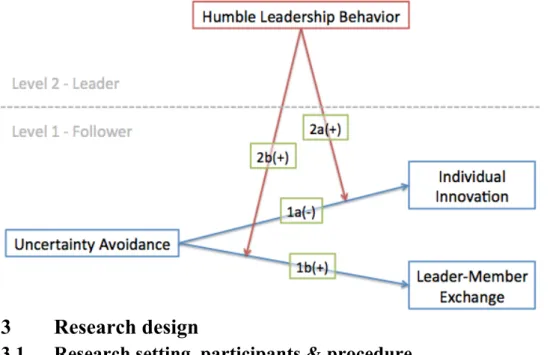
In consolidating these thoughts, one can establish the following hypotheses with regard to uncertainty avoidance, individual innovation and LMX. A visual representation of these hypotheses is depicted in Figure 1.
Hypothesis 1a: An individuals’ level of uncertainty avoidance has a negative effect on
the level of individual innovation.
Hypothesis 1b: An individuals’ level of uncertainty avoidance has a positive effect on
the level of LMX.
2.5.2 Influence of humble leadership
As mentioned before, uncertainty avoidance, individual innovation and LMX do not operate in a vacuum. Dorfman et al. (1997) for instance conclude that highly uncertainty avoidant individuals feel more valued when working with humble leaders as they feel appreciated and accepted. One might assume that highly uncertainty avoidant people feel better with humble leaders because of their supportive kindness. In his research, Liborius (2014) also argues that humility is an important factor in influencing leadership outcomes as for instance individual innovation and LMX.
More specifically, when analyzing the behavior of humble leadership, Owens and Hekman (2012) found that humble leaders facilitate an open environment in which highly uncertainty avoidant followers do not have to bottle up their uncertainties. Instead, humble leaders encourage an environment of experimentation and learning dialogue. This openness increases the acceptance of mistakes and encourages followers to think outside the box. This
line of reasoning is also supported by Zhang and Zhou (2014). In short, these scholars found that uncertainty avoidant followers will welcome guiding interventions from their supervisors (Zhang & Zhou, 2014). This positive tendency can be explained by their positive attitude to confide even more in that supervisor and consecutively generate ideas which are truly useful and novel (Zhang & Zhou, 2014)
Through the guidance and support of humble leaders, one might expect a stronger, more positive relation between uncertainty avoidance and LMX. Put in other words, one might expect the positive relation between to be strengthened even more. With regards to the moderating effect on individual innovation, one might expect that humble leadership behavior is able to mitigate the negative association between uncertainty avoidance people and their level of individual innovation. Therefore, this research predicts that:
Hypothesis 2a: Humble leadership behavior will moderate the relationship between
individual uncertainty avoidance and individual innovation, such that, when humble leadership behavior is high, there is a weaker (negative) relationship between uncertainty avoidance and individual innovation, and when humble leadership behavior is low, there is a stronger (negative) relationship between uncertainty avoidance and individual innovation.
Hypothesis 2b: Humble leadership behavior will moderate the relationship between
individual uncertainty avoidance and LMX, such that, when humble leadership behavior is high, there is stronger (positive) relationship between uncertainty avoidance and LMX, and when humble leadership is low, there is a weaker (positive) relationship between uncertainty avoidance and LMX.
2.6 Conceptual model
In consolidating these hypotheses, a holistic conceptual framework can be established:
Figure 1: Conceptual Model
3
Research design
3.1 Research setting, participants & procedure
For this quantitative research, data was collected from several for-profit organizations in Belgium, Germany and the Netherlands. More specifically, in total, 57 leader-follower dyads were identified with a total of 154 follower surveys (M = 3 followers per leader). The respondents for this research included different departments and sizes of organizations. The smallest leader-follower dyad contained two followers and the largest leader-follower dyad entailed seven followers. Most of the respondents (43,5%) were between 20-29 years old. More specific descriptive information can be found in the first appendix.
In order to establish a solid and reliable measure, a minimum of two followers per selected leader was selected. This decision is in line with the idea of triangulation in an attempt to find evidence from different perspectives in order to increase the validity of the research. Put in other words, the chances of including a sample bias are decreased (Blumberg et al., 2011).
In essence, this research has a quantitative nature as the subjects were asked to complete a self-administered survey. Furthermore, one can investigate the hierarchical nature
of this research as data is required both from the leader as from the follower. In specifying the type of self-administered surveys, this research initially commenced as a target web survey (so one can retain control over who is allowed in the survey) (Blumberg et al., 2011). However, due to the low response rate, personal interventions were put in place. More specifically, surveys were printed and delivered in person.
Additionally, certain actions were put in place to mitigate the negative effects of self-administered surveys (Blumberg et al., 2011). Personal follow-ups were organized to maximize the response rate. The attention of the participants was held by keeping the questionnaire as short as possible as well as through the implementation of a progress bar accompanying the questionnaire (only when completed the survey online). Additionally, a deadline date was provided in order to accelerate the rate of questionnaire return.
Excluding the social desirability bias is difficult in present research. However, an attempt is made to decrease this bias by emphasizing the profound anonymity and confidentiality of the collected data. Furthermore the survey included sentences as: ‘Please
do indicate how you actually behave and not how you think you should behave’ to create
personal awareness of this bias. In addition, envelopes were provided so each respondent could seal his envelope to ensure confidentiality (Huang et al., 2009).
When looking into the sampling strategy, one must acknowledge the strength of probability samples due to their strong generalizability as well as the possibility to perform probability-based confidence estimates (Blumberg et al., 2011). However, when looking at the reliability and feasibility of these actions, it is sometimes impossible to structure and grasp the entire population. For this reason, sampling was performed in a non-probable manner by using convenience sampling. Before launching the questionnaire, certain criteria were established for the sample. Additionally, all the respondents needed to fit these criteria. First, a dyadic relation had to be in place wherein one leader and a minimum of two
subordinates operate. Second, the followers had to rate their immediate supervisor in order to establish a solid and reliable view on the leaders’ level of humble leadership.
The concept of followers rating their immediate supervisor is fundamental for this research to ensure the cross-level connection between the dyadic relations. More specifically, if one respondent would judge a different leader in comparison to other colleagues, the overall value and strength of this research would be worthless. To ensure this concept of immediate rating, people were reminded repeatedly to rate their immediate/focal leader during the completion of the questionnaire. This message was also repeated during the personal distribution and follow-ups of the questionnaires. To have a confirmation of this cross-level connection, followers were asked to write down the initials of their immediate/focal leader so one could check the cross-level connection of the data. Consecutively, questionnaires were not taken into account for the analysis if that specific respondent rated a different leader in comparison to his/her colleagues.
3.2 Measures
All measures used for this research are originally written in English, so – in compliance with the findings of Brislin (1980) – back-translation procedures were performed (as cited in Sun & van Emmerik, 2014). The main purpose of this back-translation was the validation of the semantic equivalence (Blumberg et al., 2011). Additional evidence of quality is also provided through direct comparison of the two translations (Maneesriwongul & Dixon, 2004). The transcripts of these back-translations are available upon request.
In terms of scales, almost all the items are questioned on a five point Likert scale (1 = strongly disagree, 2 = disagree, 3 = neither disagree nor agree, 4 = agree and 5 = strongly agree). The last item (‘How would you describe your working relationship with your supervisor?’) for the LMX-scale is measured by the rating form: extremely ineffective, worse than average, average, better than average, extremely effective.
3.2.1 Uncertainty avoidance
As this research is based on and extends existing knowledge, one is able to include existing scales with an established and respected construct validity. Dorfman et al. (1997) have presented a 5-item scale with general beliefs in order to establish an individual’s level of uncertainty avoidance. The Cronbach’s alpha for this item scale in this sample is 0,77.
3.2.2 Humble leadership behavior
Owens et al. (2013) provide a solid 9-item scale containing the concept of humble leadership behavior. The Cronbach’s alpha for this item scale in this research is 0,88. For this scale specifically, one should mind the exclusion of the social desirability bias as the leaders were rated by their followers. To improve the quality of data even more, triangulation of the reporting data ensured the balance in the researched data as there are at least two followers rating their leader.
3.2.3 Individual innovation & LMX
First, Parker and Collins (2010) present a 3-item scale which focuses on the generation and championing of new ideas. The Cronbach’s alpha for individual innovation in this sample is 0,82. Second, Liden et al. (1993) present a measure for LMX which has stood the test of time. Although the initial LMX-scale originates from Scandura and Graen (1984), Liden et al. (1993) redeveloped this scale to fit the 5-point scales and to generate a subordinate-member view on LMX (as the original measure was merely focused on the leader-perspective of LMX). The Cronbach’s alpha for this item scale in this sample is 0,88.
3.2.4 Control variables
With regard to administrative questions, this research follows the control variables implemented by Owens et al. (2013) including gender, age and tenure under current leader. In order to specify this research even more, the survey also contained the educational level, type of industry, nationality and tenure inside the same organization. The nationality is important to investigate as the ideas on leadership might vary among different cultures and nations (Baker & Carson, 2011; Clugston et al., 2000).
In short, all of the investigated item scales provided a Cronbach’s alpha above the general rule-of-thumb of 0,7. These specific item scale results can be retrieved in the second appendix. In short, humble leadership behavior, uncertainty avoidance, individual innovation & LMX can be considered appropriate in terms of reliability and internal consistency (Blumberg et al., 2011).
4
Data analysis - results
The self-administered questionnaires provide multi-level data from a leaders’ as well as a followers’ perspective which needs to be analyzed in an appropriate manner. For these means, two-level hierarchical linear modeling (HLM) is selected (Hofmann, 1997).
Before doing this analysis, certain assumptions are to be met in order to successfully perform HLM (Woltman, Feldstain, MacKay, & Rocchi, 2012). First of all, detection of outliers and observation normality assumption are mapped. Appendix 6.3 presents these bell-shaped curves combined with the outliers (Woltman et al., 2012). Although one can recognize certain outliers on these graphs, one might perceive these outliers as inferior (in comparison to the importance of the size of the sample) as they hardly exceed the standard range of 2xSD above and 2xSD below of the mean. In addition to the outliers and the normality assumptions, it is interesting to investigate the correlations between the different variables. Table 1 represents the zero-order correlations of the study variables combined with the means and standard deviations. In addition, the reliability scales are attached in bold.
As part of the two-level HLM analysis, grand mean centering is performed on the second level variable (humble leadership behavior). This type of standardizing is needed to evolve from a personal opinion of one follower towards a standardized perception of different nested followers towards one leader. In order to fully capture the nested nature of the data, aggregation per leader-follower dyad is effectuated. With regards to this operation, Hox (2010) proposes to standardize the independent variables as well to avoid multicollinearity (as cited in Sun & van Emmerik, 2014).
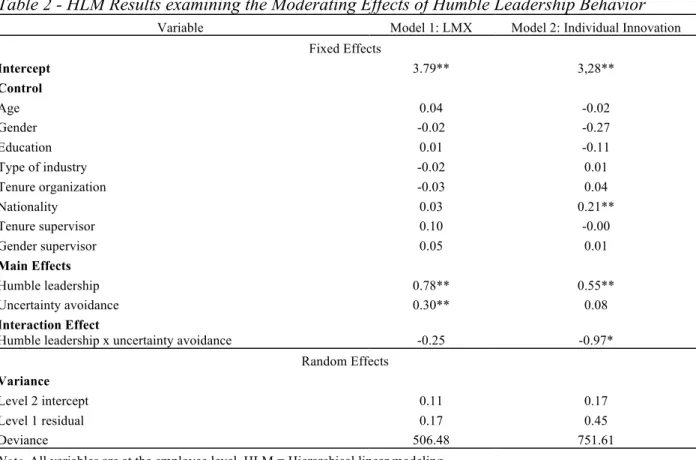
Hypothesis 1a suggests a direct negative effect of the individuals’ level of uncertainty avoidance on the level of individual innovation. Results (see Table 2 Model 2) do not support this direct effect (β = 0.08, p = 0.57). Hypothesis 1b suggests a direct positive effect of the individuals’ level of uncertainty avoidance on the level of LMX. Results (see Table 2 Model 1) fully support this direct effect (β = 0.30, p < 0.01).
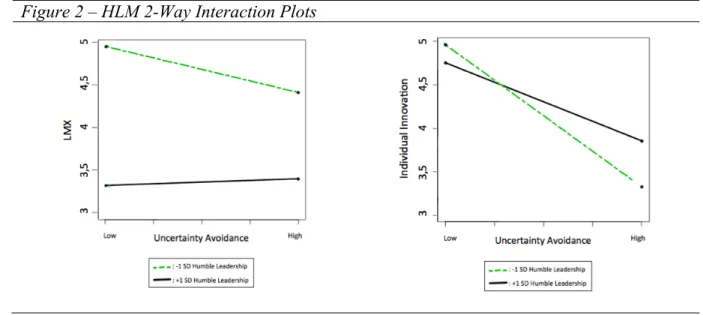
Hypothesis 2a posits an interactive effect between uncertainty avoidance and humble leadership behavior on individual innovation. Although the hypothesis proposes a positive moderating impact of humble leadership behavior, the results surprisingly lead toward a negative impact of humble leadership behavior. In terms of significance, results (see Table 2 Model 2) support this significant interaction between uncertainty avoidance and humble leadership behavior on individual innovation (β = -0.97, p < 0.05). The HLM 2-way interaction plot, with 1 SD below the mean and 1 SD above the mean confirms this negative significance. In addition, the negative steepness of the slope confirm the findings with regards to the Beta coefficient. In short, although proposed differently in hypothesis 2a, this research is able to signifcantly identify a negative influence of humble leadership behavior.
Table 1: Descriptive and Zero-Order Correlations of Study Variables (n=154)
Mean SD 1 2 3 4 5 6 7 8 9 10 11 12 1 Age 29.35 12.82 - 2 Gender 1.58 0.50 -0.14 - 3 Education level 2.69 1.00 -0.07 0.02 - 4 Industry type 9.55 4.32 0.18 0.02 0.20 - 5 Tenure in organization 1.83 1.30 0.56 -0.17 -0.03 0.26 - 6 Nationality 1.90 0.83 -0.04 0.04 0.01 0.10 0.01 - 7 Tenure for leader 1.29 0.56 0.30 -0.05 -0.21 -0.03 0.45 0.14 - 8 Gender of current supervisor 1.58 0.50 -0.03 0.33 0.00 -0.07 -0.10 0.04 -0.05 -
9 Humble Leadership Behavior 3.97 0.60 0.01 0.06 0.16 -0.02 0.00 0.10 -0.06 0.19 0.88
10 Uncertainty Avoidance 3.98 0.48 -0.05 0.06 -0.16 -0.15 -0.11 -0.02 0.01 0.06 0.22 0.77
11 Individual Innovation 3.08 0.82 0.03 -0.17 -0.10 0.07 0.07 0.23 0.07 -0.02 0.17 0.04 0.82
12 Leader-Member Exchange 3.97 0.59 0.03 -0.02 -0.02 -0.15 -0.06 0.04 0.11 0.09 0.55 0.25 0.15 0.88
Note. Reliability coefficients appear in bold along the diagonal. All correlation values larger than,13 but smaller than,17 are significant at p <
Hypothesis 2b tests the interactive effects between uncertainty avoidance and humble leadership behavior on LMX. These findings do not provide significant interactive effects (β = -0.25, p = 0.39) (see Table 2 Model 1). When plotting this moderating effect, the result confirms this non-significance as there are no touch points between the range of 1 SD above the mean and 1 SD below the mean. Still, one can identify the tendency towards each other when analyzing the effect of humble leadership behavior on LMX (see Figure 2). More specifically, the two slopes might even cross when working with a bigger, more representative sample size resulting in a significant interaction. From a different viewpoint, with regards to the non-significant influence of humble leadership behavior and uncertainty avoidance on LMX, the significant correlations between the variables provide a small indication there might be a small presence of multicollinearity in present research.
Table 2 - HLM Results examining the Moderating Effects of Humble Leadership Behavior
Variable Model 1: LMX Model 2: Individual Innovation
Fixed Effects Intercept 3.79** 3,28** Control Age 0.04 -0.02 Gender -0.02 -0.27 Education 0.01 -0.11 Type of industry -0.02 0.01 Tenure organization -0.03 0.04 Nationality 0.03 0.21** Tenure supervisor 0.10 -0.00 Gender supervisor 0.05 0.01 Main Effects Humble leadership 0.78** 0.55** Uncertainty avoidance 0.30** 0.08 Interaction Effect
Humble leadership x uncertainty avoidance -0.25 -0.97*
Random Effects
Variance
Level 2 intercept 0.11 0.17
Level 1 residual 0.17 0.45
Deviance 506.48 751.61
Note. All variables are at the employee level. HLM = Hierarchical linear modeling
Although not included in the direct hypotheses, one should pinpoint the strength of humble leadership behavior as a positive predictor for LMX as well as individual innovation. This nature is also identifiable in the strong correlation of humble leadership behavior with uncertainty avoidance, individual innovation and LMX. More specifically, it establishes a positive significant relation on individual innovation (β = 0.55, p < 0.01) as well as on LMX (β = 0.78, p < 0.01) (see Table 2). This result is in line with the findings of Zhang and Zhou (2014) and Owens and Hekman (2012) who present the positive link between supportive, humble leadership behavior and the level of individual innovation.
5
Discussion
This research is able to confirm certain well-founded associations. First, it establishes the positive relation between uncertainty avoidance and LMX (Clugston et al., 2000). This relationship implies that increasing levels of individual uncertainty avoidance are positively associated with higher levels of LMX. To explain this relation, one should understand and identify relationship differentiation as one key component of LMX where you establish different quality exchange relations with your followers (Henderson et al., 2009). More specifically, highly uncertainty avoidant followers will favor strong relationships with their leader. In contrast, low uncertainty avoidance followers will favor a different relation with
their leader resulting in a different individual approach between every follower. This need in relationship differentiation among the followers ought to result in a positive relation between uncertainty avoidance and LMX (differentiation).
Second, humble leadership behavior appears to negatively influence the negative relation between uncertainty avoidance and individual innovation in a significant manner. This negative influence is in line with the recent findings of Baker and Carson (2011) who argue that individuals low on uncertainty avoidance are likely to be more innovative (see the direction of the line in figure 2). Contrary to the expectations in which humble leadership behavior would mitigate the negative effect of uncertainty avoidance on individual innovation, results surprisingly show that humble leaderhip behavior strengthens this negative effect. Few scholars focus on the negative influences of humble leadership behavior. Hume (1994) is one of these scholars who does not believe in the positive influence of humble leadership behavior as this scholar argues that humble leaders do not have sufficient self-esteem in addition to an inferior sense of worth and importance (as cited in Owens & Hekman, 2012, p. 788). Consecutively, these results give reason to believe that the positive influence of humble leadership behavior has certain boundary conditions. More specifically, for a humble leader, it is undesirable to strive towards individual innovation when working with uncertainty avoidant colleagues.
Albeit these two significant links, the relation between uncertainty avoidance and individual innovation is not significant. Given that the zero-order correlation between these was nonsignificant, Scott and Bruce (1994) posit that a treshold effect might be in in place. More specifically, these authors argue that one should carefully bear in mind the nature of the sample when investigating individual innovation (Scott & Bruce, 1994). Since retail trade represents a large portion of this sample (where innovativeness & creativity are key success
factors to distinguish one outlet from another), outcomes might be above a certain treshold which might blur the effect of uncertainty avoidance (Scott & Bruce, 1994).
When further focusing on uncertainty avoidance, it is interesting to point out the non-significance of the zero-order correlations between nationality and uncertainty avoidance. Although certain prominent authors (Hofstede, 1984) thoroughly believe in the link between nationality and uncertainty avoidance, these zero-order correlations in this specific research guide us towards the line of reasoning where the within-country variability is larger than the actual between-country variability (Clugston et al., 2000). However, it is important to bear in mind that one cannot draw conclusions on these zero-order correlations as one requires inferential statistics to draw valid and reliable conclusions (Blumberg et al., 2011).
In short, this research looks into the question whether humble leadership behavior is a possible key to successful and efficient leadership. Despite certain non-significant links, this research can undoubtly confirm the positive predicting nature of humble leadership behavior with regards to individual innovation and LMX. Additionally, this research identifies certain boundary conditions through the negative moderating nature of humble leadership on uncertainty avoidance and individual innovation.
5.1 Theoretical contributions
When investigating the theory and practice of efficient leadership, leaders have long been depicted as superstars, heroes, and superhuman saviors (Owens & Hekman, 2012). This research is able to refute this line of reasoning and proposes a more realistic way towards leadership success. More specifically, it corroborates the fundamental strength of humble leadership behavior and uncertainty avoidance in the prediction of LMX and individual innovation. Consecutively, four additional valuable contributions can be delineated which add to the existing body of theoretical knowledge.
First, the type and nature of the researched data contribute theoretical value to the existing research field. More specifically, the quantitative nature of this research is able to
confirm the existing, qualitative knowledge (Owens & Hekman, 2012). Additionally, as self-ratings are likely to be inadequate (Morris et al., 2005), this research includes different followers rating one focal leader. Consecutively, by rating one focal leader, the cross-level connection between the leader and followers is fundamented. Blumberg et al. (2011) supports this line of reasoning as the authors argue that different perspective enable triangulation resulting in a more valid and reliable outcome for humble leadership behavior. Certain authors believe that humble leaders will be reluctant to report their actual level of humility (LaBouff et al., 2012). In resolving this issue, this research is able to identify the true level of humility for each leader by implementing other-rated data.
Second, in further contributing to the current knowledge of humble leadership behavior, this research implements a sample consisting of for-profit organizations which is preferrable compared to student samples which lack depth and richness of experience (LaBouff et al., 2012). Additionally, the fact that data was collected from for-profit organizations in Belgium, Germany and the Netherlands increases the positive purview of humble leadership behavior. More specifically, as most research has been performed in North America (Owens et al., 2013) or China (Huang et al., 2009), this research is able to shed a refreshing light on the influence of humble leadership behavior. Additionally, one might believe that humble leadership is a valuable asset in every culture.
Third, after establishing the positive influence of humble leadership behavior, this research positively advances the understanding of the actual impact of highly uncertainty avoidant followers. Although this contribution seems trivial, considerable amount of research solely focuses on low uncertainty avoidant individuals (Zhang & Zhou, 2014). Additionally, this research does not propose uncertainty avoidance as a negative attribute, instead it identifies certain positive outcomes of uncertainty avoidance with regards to LMX.
Fourth and finally, this research pinpoints certain boundary conditions of humble leadership and uncertainty avoidance. In detail, this research contributes that humble leadership and uncertainty avoidance are not able to jointly influence LMX in a significant manner. Additionally, uncertainty avoidance does not result to be a direct predictor for individual innovation. With further regards to boundary conditions, this research shows that humble leadership behavior is not desirable when working with highly uncertainty avoidance colleagues when striving towards individual innovation.
5.2 Managerial implications
One of the implications for practice is that humble leadership behavior is highly desirable for both managerial as well as non-managerial individuals in the organization (Huang et al., 2009). From a manager’s perspective, humble leadership has been confirmed as a successful tool in influencing positive follower’s outcomes (LMX and individual innovation). From a follower’s perspective, through the influence of humble leadership behavior on individual innovation and LMX, followers will not have to bottle up their doubts and they will feel more secure, more commited and more valued in the organization.
On a more aggregate level, this research posits certain boundaries and contingencies which might strengthen or hamper the full effect of humble leadership. At this moment, one might believe that current research on humble leadership has merely attempted to understand and identify the concept of humble leadership. By delineating the boundary conditions (not desirable when working with highly uncertainty avoidance colleagues when striving towards individual innovation), managers will be able to implement humble leadership in such a way that it will improve their overall leadership effectiveness (Nielsen et al., 2010).
Additionally, managers who decide to implement LMX in their leadership approach should realize that their differentiated behavior towards the followers is judged against the norms of fairness of the organization (Henderson et al., 2009). These leaders should create a
transparent and communicative environment wherein every relationship is developed and respected based upon the specific needs of that subordinate (Henderson et al., 2009).
5.3 Limitations and suggestions for further research
Although the findings in this research are valuable to the existing managerial and theoretical knowledge field, the findings are subject to a number of caveats.
First, this study works with a cross-sectional design rather than a longitudinal design. As this is simply one moment in time, this research is unable to assess how humble leadership might develop over different periods of time. More interestingly, it might be interesting to track the development process of humble leaders (Davis et al., 2013). Additionally, the cross-sectional nature of this design does not allow conclusions about causality which is a limitation of this research (Liborius, 2014). In the future, scenario experiments should be used when researchers decide to focus on the investigation of causality (Liborius, 2014).
Second, the size of the investigated sample might be on the edge of insufficiency with regards to the power of the test (Liborius, 2014). Especially because this research implements HLM, Woltman et al. (2012) specifically state that large sample sizes are necessary for adequate power when working with HLM. More specifically, this premise especially holds when detecting effects at the individual/psychological level (Clugston et al., 2000; Woltman et al., 2012). Besides increasing the actual sample size, it is highly advantageous to increase the groups as opposed to the number of observations per group (Woltman et al., 2012). This action will further increase the power and value of the test.
Third, when investigating the strength of the sampling strategy, it is important to point out the convenience sampling strategy in this research. Through this non-random sampling, the strength of the conclusions with regards to generalizability and replicability is limited (Olsson et al., 2012). To improve the strength of the conclusions, future research should implement random sampling and – if possible – sample entire work groups (Olsson et al.,
2012). When further analyzing the sample, future research will definitely benefit from including other control variables as for instance the size of the organization. One strength as well as limitation of this research is the wide-spread nature of the sample. More specifically, this research includes data from small and medium-sized enterprises as well as multinational corporations. One might expect differences in the identification and commitment towards the organization when working in small vs large organization. For this reason, future research will be strengthened when including these control variables (e.g. size of the organization) or by excluding one type of organizations which then narrows and the scope of the research.
Fourth, one should keep in mind the overrepresentation of retail trade businesses in this sample (44,2%). Industry characteristics might posit a certain treshold effect which blurs the significant findings (as is probably the case with uncertainty avoidance and individual innovation; (Scott & Bruce, 1994). For this reason, future research should focus on cross-industrial research in an attempt to clarify the true association between uncertainty avoidance and individual innovation on the one side and humble leadership, uncertainty avoidance and LMX on the other side as these links are not confirmed in this research.
Fifth, this research takes a narrowed viewpoint with regards to humble leadership and it omits other leadership styles. However, in present business environments, most leaders do not operate in a vacuum. In other words, humble leadership might fit together with another leadership approach in order to establish a leadership style which is applicable across different business environments. Future research could therefore examine how humble leadership behavior interacts with other leadership styles (Owens & Hekman, 2012).
Sixth, although this research has established certain links between uncertainty avoidance, humble leadership and overall leadership effectiveness (Nielsen et al., 2010), it is important to acknowledge the lack of predictive value with regards to the implemented dependent variables. In other words, individual innovation and LMX are not strong enough to
capture the overall value of leadership effectiveness. In the future, if one desires to research the impact of humble leadership behavior on leadership effectiveness, individual innovation and LMX should be complemented with other comprehensive variables.
Seventh and finally, this research used other-rated data for the level of humility which mitigates the humble leaders’ reluctance to report his/her actual level of humility. However, self-reports were put in place for the psychological/individual measures. Consecutively, one can doubt the accuracy and reliability of the individual innovation and LMX-measures (Morris et al., 2005). Still, Ferris and other scholars (2005) were able to propose valuable evidence that self-reports do not directly correlate with the individual social desirability (as cited in Sun & van Emmerik, 2014). Nevertheless, other-rated data is definitely desirable in establishing a reliable and accurate measure (LaBouff et al., 2012). Consecutively, future research will benefit from other-rated designs where supervisors rate their subordinates and subordinates rate their immediate supervisors. By doing this, reluctance of the humble leader to report his/her actual level of humility is removed, the hierarchical strength is captured as well as the social desirability bias is minimized.
5.4 Conclusion
Both academics and business professionals are challenging the traditional perspectives of power and grandiose leadership in recent research (Owens & Hekman, 2012). More specifically, these scholars are proposing humility as a fundamental component of efficient and successful leadership in business organizations (Morris et al., 2005; Nielsen et al., 2010). One plausible explanation for this increased call for humility finds its origins in the dynamic organizations and markets which continue to globalize and develop towards more complexity and diversity (Owens & Hekman, 2012). Consequently, this research pinpoints the positive effect of uncertainty avoidance and humble leadership in generating desirable relational and organizational outcomes with regards to LMX and individual innovation.
Humble leadership can be considered key in developing a successful leadership style in the short as well as the long run. In the short run, humble leadership appears to be key in establishing increased relationships when working with highly uncertainty avoidance followers (Clugston et al., 2000). Consecutively, a healthy business environment is created in the organization. Additionally, in the long term, humble leadership contributes substantially to an increased innovative professional environment (Yuan & Woodman, 2010). More importantly, with regards to the fundamental importance of humble leadership, the overall superior performance of that specific organization continues long past the tenure of their humble leader (Morris et al., 2005). In short, humble leadership is proven to be a strategic virtue which each organization should strive to possess (Vera & Rodriguez-Lopez, 2004).
Overall, this research refutes charisma as the most desirable leadership approach and it proposes humility as a true and realistic way towards success. Nonetheless, although humble leadership is gaining prominence in present business research, further research alleviating the established limitations of the present study is required to improve the overall understanding of humble leadership. As Einstein defines this conclusion: