Multibody simulations of trolleybus vertical dynamics and
influences of spring-damper structural elements
P. Polach
a,∗, M. Hajˇzman
aa
Section of Materials and Mechanical Engineering Research, ˇSKODA V ´YZKUM, s. r. o., Tylova 1/57, 316 00 Plzeˇn, Czech Republic
Received 29 August 2008; received in revised form 7 October 2008
Abstract
Vertical dynamic properties of the ˇSKODA 21 Tr low-floor trolleybus were investigated on an artificial test track when driving with a real vehicle and when simulating driving with a multibody model along a virtual test track. Driving along the artificial test track was aimed to determine vertical dynamic properties of the real trolleybus and on the basis of them to verify computer trolleybus models. Time histories and extreme values of the air springs rel-ative deflections are the monitored quantities. Due to differences of the experiments and the computer simulations results the influences of the characteristics of the spring-damper structural elements of the axles suspension and the radial characteristics of the tires used in the trolleybus multibody model on the extreme values of the monitored quantities are evaluated.
c
2008 University of West Bohemia in Pilsen. All rights reserved.
Keywords:vehicle dynamics, multibody model, spring-damper elements, sensitivity analysis, trolleybus
1. Introduction
Optimum dynamic properties of the vehicle intended for the public transport can usually be achieved in dependence on its structural design by the proper choice of axles suspension ele-ments (in some cases in combination with the proper choice of seats suspension eleele-ments). The design must be the compromise of the requirements for the vehicle behaviour during driving manoeuvres, for the riding comfort and for the body and the chassis parts lifetime when driving along an uneven road surface, and for the passenger safety (e.g. [26]).
Driving along the uneven road surface can reveal a lot about the vehicle vertical dynamic properties and about the suitability of the applied axles suspension elements. Especially time histories of relative deflections of springs, relative velocities in the shock absorbers, stress acting in the axles radius rods or radius arms and acceleration in various points in the vehicle interior are the monitored quantities [8]. On the basis of those quantities it is possible to determine the forces acting in the suspension elements of axles, which can be utilized for the stress analysis of structures, for the prediction of the fatigue life of the body and the chassis parts of the tested vehicle. The frequency domain responses of the acceleration in the vehicle interior can be used for the assessment of a riding comfort. In order to evaluate the vertical dynamic properties of the vehicle when driving along the uneven road surface it is necessary to know the surface characteristics, i.e. statistical properties of unevennesses of the surface or just its geometry (e.g. [26]). The geometry of the uneven surface profile of the run through the section is known in test polygons. Test tracks, which are created by distributing artificial vertical unevennesses (obstacles) on the smooth road surface, also are often used (e.g. [13]).
Fig. 1. The ˇSKODA 21 Tr low-floor trolleybus
Vertical dynamic properties of the ˇSKODA 21 Tr low-floor trolleybus (see fig. 1; its design concept is described in [22]) were investigated on the artificially created test track when driving the real vehicle and when simulating driving with the computer models along the virtual test track. Driving along the artificial test track was aimed to determine the vertical dynamic prop-erties of the real trolleybus and on the basis of them to verify computer models. The verified computer models will be further utilized for the simulations of driving along the virtual uneven road surfaces, which will be generated on the basis of the statistical evaluation of the measured quantities in the course of driving along the real city road with the real trolleybus [11, 12].
This article continues the work presented in [10, 17, 21, 22, 23, 24, 25]. Those papers deal with the influences of characteristics of various spring-damper structural elements and of the multibody models complexity on the air springs relative deflections determined by the simulations with the selected multibody models of the empty trolleybus. The extreme values of time histories of the air springs relative deflections are compared. It follows from those papers that the results of the simulations and the experimental measurement are not completely identical, especially in the rebound stage of the rear axle suspension. Therefore the sensitivity analysis of the influence of various model parameters has to be performed.
Usually the sensitivity analysis is connected with the problems of the parameter selection for design optimization and with the problems of gradient calculations in gradient-based optimiza-tion procedures [6]. The sensitivity analysis is also a tool used in many applicaoptimiza-tions in order to qualitatively analyse the behaviour of a chosen system. The general recursive approach to the calculation of sensitivities of multibody systems by means of direct differentiation is shown in [1]. The extension of this analytical approach for rigid-flexible systems is presented in [5]. However, in most practical cases of real multibody systems, the numerical approaches are the most suitable and efficient methods. Handling properties of road vehicles were investigated using the sensitivity analysis in [4]. The sensitivity analysis for the tyre wear evaluation was employed in [3]. Another application in rail vehicles and pantograph interaction can be found in [14].
axles suspension and the influence of changes of those characteristics on the extreme values of relative deflections of the air springs is monitored. The results of the sensitivity analysis of the influence of the different tire inflation are given in [25]. Sensitivity analyses in both cases were performed during the simulations of the trolleybus drive along the real test track at the trolleybus speed 44.13 km/h. The possibility of bounce of the tire from the road surface, which really occurs in the course of the vehicle relative speeding along the relatively demanding test track, is considered in the trolleybus multibody model. The influence of the change in the radial characteristics of the tires is not fully deterministic in the course of the simulation of drive along this test track and the results of the performed sensitivity analyses would be biased.
As it is possible to compare the influence of the loading characteristics of the spring-damper structural elements of the axles suspension and the radial characteristics (force-deformation characteristics and damping coefficient) of the tires on the results of the simulations, the speed of 10 km/h, at which the tire bounce from the uneven road surface does not occur yet, is chosen at simulating the trolleybus drive along the test track. The contribution of this paper is mainly in the complex analysis of the influences of various characteristics on the trolleybus vertical dynamics investigated by means of the comprehensive multibody model.
2. Experimental measurements with the real trolleybus
The experimental measurements on the empty ˇSKODA 21 Tr low-floor trolleybus were carried out in the depot of Hradec Kr´alov´e Public City Transit Co. Inc. (Dopravn´ı podnik mˇesta Hradce Kr´alov´e, a. s.) in October 2004.
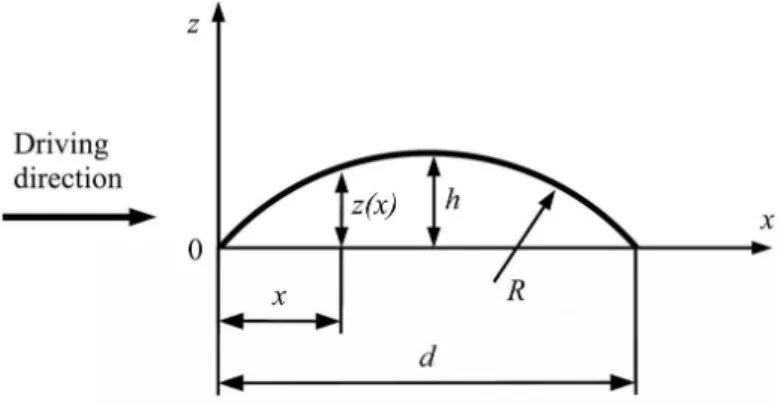
Fig. 2. The standardized artificial obstacle
The test track consisted of three standardized artificial obstacles (in compliance with the
Czech Standard ˇCSN 30 0560 Obstacle II:h = 60mm, R = 551mm,d = 500mm — see
fig. 2) spaced out on the smooth road surface 20 meters one after another. The first obstacle was run over only with right wheels, the second one with both and the third one only with left wheels (see fig. 3).
Fig. 3. A track scheme
the trolleybus structure and time histories of the vertical acceleration on seven places of the trolleybus structure were recorded during the test drives. The records of the time histories of the measured quantities were made during three test drives. Trolleybus speed moved within the range from 43 km/h to 47 km/h at that drives.
3. Trolleybus multibody model
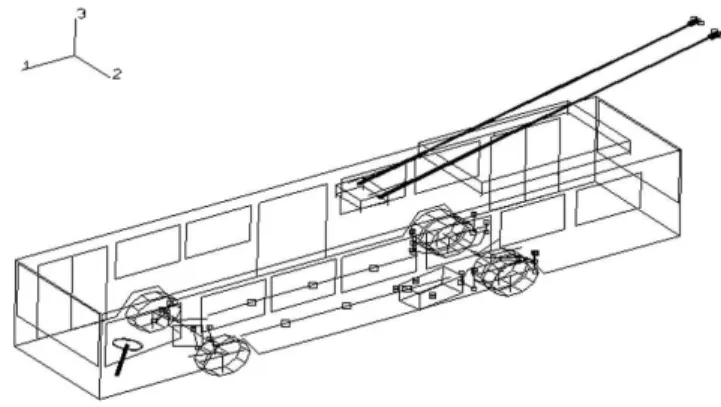
In order to simulate drives along the virtual test track, which corresponded to the artificially created test track in the depot of Hradec Kr´alov´e Public City Transit Co. Inc., the most complex multibody model [20] (see fig. 4) created in thealaska 2.3simulation tool [18] is used to inves-tigate the influences of the loading characteristics of the spring-damper structural elements of the axles suspension and the radial characteristics of the tires.
Fig. 4. Visualization of the multibody model of the ˇSKODA 21 Tr low-floor trolleybus in thealaska 2.3
simulation tool
3.1. Structure of multibody model
bushings in the places of mounting some trolleybus structural parts are modelled by connecting the corresponding bodies by nonlinear spring-damper elements [18]. When simulating driving along the uneven road surface the contact point model of tires is used in the multibody model; radial stiffness and radial damping properties of tires are modelled by nonlinear spring-damper elements considering the possibility of bounce of the tire from the road surface [16].
3.2. Characteristics of spring-damper structural elements
Dynamic properties of road vehicles are most influenced by the suspension springs, shock ab-sorbers, bushings and tires (e.g. [2]). In order that vehicle virtual computer model should re-liably approximate kinematic and dynamic properties of the real vehicle, knowledge of the characteristics of those decisive spring-damper structural elements is the important presump-tion (besides the proper approach to the model creating and knowledge of all the substantial vehicle parameters).
The characteristics of the air springs (force in dependence on deflection) of the ˇSKODA 21 Tr trolleybus were determined on the basis of the test reports of ˇSKODA OSTROV s. r. o. and of the Hydrodynamic Laboratory of the Technical University of Liberec [20].
In the multibody model of the ˇSKODA 21 Tr trolleybus the damping force dependence on the relative velocity of compression and rebound of the shock absorbers is used as the shock absorbers characteristics. The characteristics were measured by BRANO a. s. (the shock ab-sorbers producer) on the Schenck testing device [21].
In the shock absorbers structure rubber bushings are used in the places of mounting to the chassis frame and to the axles of the trolleybus [21]. In the multibody model the bushings are modelled by means of spring elements, the nonlinear force-deformation characteristics of which were determined under the laboratory conditions (they are taken over from [15]) and which are coupled in series to the damping elements representing the hydraulic shock absorbers themselves.
The review of the tire models used in the field of vehicle multibody dynamics can be found in the monograph [19]. The most important tire characteristics needed for solving the vehicle vertical dynamics tasks are their radial properties [2]. The used tire model for the vertical dynamics is the already mentioned contact point model based on the tire substitution by a single parallel spring and a damper. Radial stiffness and radial damping properties of the tires were experimentally measured in the Dynamic Testing Laboratory ˇSKODA V ´YZKUM s. r. o. The evaluation of the measured quantities for the purpose of generation of multibody models is given in [9].
4. Results of the simulations
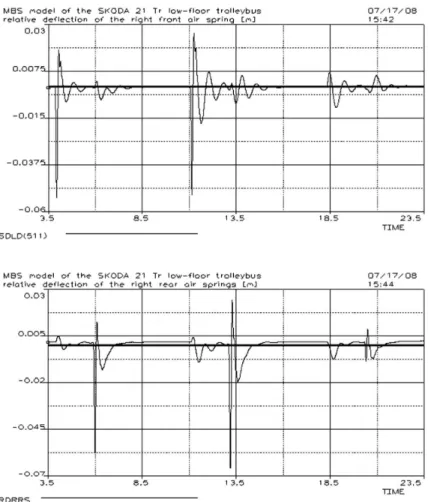
As it has been already stated the results of the simulations at speed 10 km/h (at which the tire bounce from the uneven road surface does not occur yet) during simulating the trolleybus drive along the test track are given in this article.
Fig. 5. Time histories of the front right and the rear right air springs relative deflection when simulating the test drive with the trolleybus multibody model at speed 10 km/h
Table 1. Extreme values of the relative deflections of air springs
Obstacle Value Extreme values of relative deflection of air springs [mm]
Right front Left front Right rear Left rear
1st min. −53 −9 −57 −9
max. 18 6 12 8
2nd min. −52 −51 −66 −68
max. 26 25 24 23
3rd min. −10 −53 −9 −58
5. Sensitivity analysis of the multibody model
The sensitivity analysis of the influence of the change of the characteristics of the spring-damper structural elements of the axles suspension and the radial characteristics of the tires in the trol-leybus multibody model is performed.
The sensitivity analysis of the influences of the selected parameters characterizing the sys-tem behaviour for the change in various syssys-tem parameters is applied especially in the field of optimization, identification and correction of the mathematical models of the investigated systems. By means of that it is possible to determine which parameters influence the change of the selected quantities most significantly and subsequently to select the parameters as the optimizing ones and to try to define them more precisely or to correct them.
As it was already mentioned the results of the computer simulations and the experimen-tal measurements with the ˇSKODA 21 Tr low-floor trolleybus, compared on the basis of the evaluation of the accordance of extreme values of the time histories of the air springs relative deflections with the measured extreme values of the relative displacements during the run along the test track, are not identical especially in the course of the rebound stage of the rear axle sus-pension (e.g. [23]). It is obvious that this fact is influenced by the course of the characteristics of the spring-damper structural elements. That is why the sensitivity analysis of the influences of the force-velocity characteristics of the hydraulic shock absorbers, the force-deflection char-acteristics of the air springs and the force-deformation charchar-acteristics of the shock absorbers bushings on the extreme values of the time histories of the air springs relative deflections was performed in [23] and the results of the sensitivity analysis of the influence of the different tire inflation were given in [25]. As it has been already stated it is possible to compare the influence of the spring-damper structural elements of the axles suspension and the radial characteristics of the tires on the results of the simulations, the speed of 10 km/h, at which the tire bounce from the uneven road surface does not occur yet, is chosen at simulating the trolleybus drive along the test track.
The influence of the changes in the parameters of the characteristics of the spring-damper structural elements and the radial characteristics of the tires on the extreme values of the relative deflections of all the air springs when running over each obstacle of the artificial test track is monitored.
5.1. The sensitivity analysis of the dynamic response of the trolleybus multibody model
Like in most cases of the complicated multibody systems it is not possible to derive analytical relations to express the dynamic response of the given multibody model to the general exci-tation. Neither it is possible to derive analytical formulas to calculate the sensitivity of the dynamic response to the change in the system parameters. In order to express the partial deriva-tive of the certain monitored quantityy=y(p)regarding the vector of theSselected parameters of the systemp= [p1, p2, . . ., pS]Tit is necessary to use relations for the numerical calculations
of sensitivity, so called difference formulas [7].
Change∆yof the monitored quantity ycan be expressed with a small change∆pof the initial parameters vectorp0, when the specific conditions of the continuity of derivations of the monitored quantityyare fulfilled, using the Taylor formula (approx. by two terms)
∆y=y(p0+ ∆p)−y(p0) =
S
j=1 ∂y(p0)
∂pj
After the modification of relation (1) it is obtained
∆y y(p0)=
S
j=1 ∂y(p0)
∂pj
· pj0 y(p0)·
∆pj
pj0
. (2)
From relation (2) it is possible to get relative sensitivity ∆¯yj of quantity y to the change in
parameterpj
∆¯yj=
∂y(p0)
∂pj
· pj0
y(p0). (3)
Partial derivative in relation (3) is approximated using the finite difference
∂y(p0)
∂pj
= y(p0+ ∆pj)−y(p0) ∆pj
, (4)
where vector∆pj = [0, . . .,0,∆pj,0, . . .,0]T.
Then differential relation for the calculation of relative sensitivity∆¯yj of quantityyto the
change in parameterpj, using relations (3) and (4), can be written in the final form
∆¯yj=
y(p0+ ∆pj)−y(p0)
∆pj
· pj0
y(p0). (5)
Thus in case of the sensitivity analysis of the ˇSKODA 21 Tr trolleybus multibody model when driving along the artificial test track the relative deflections of the air springs of axles are succes-sively the monitored quantitiesyand the relative changes in the characteristics of the decisive spring-damper structural elements are the vectors of parametersp.
5.2. Sensitivity analysis results
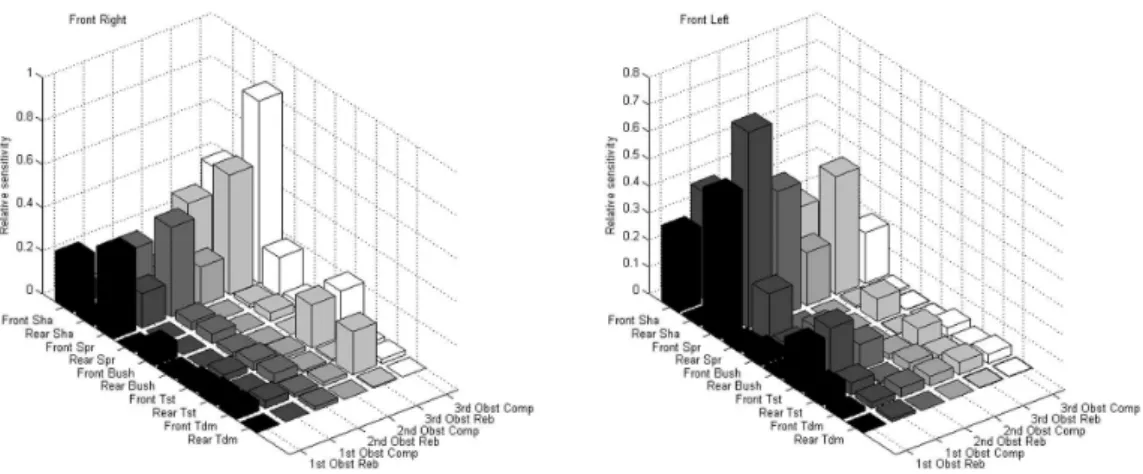
Fig. 6. Relative sensitivity of relative deflection of the front air springs (right and left) on the change in the individual parameters
Fig. 7. Relative sensitivity of relative deflection of the rear air springs (right and left) on the change in the individual parameters
The relative sensitivities of relative deflections of the air springs on the change in the indi-vidual parameters in the course of the simulations of driving along the virtual test track with the most complex multibody model (e.g. [20]) in the alaska 2.3simulation tool is given in fig. 6 and fig. 7 (Sha = influence of the force-velocity characteristics of the shock absorber; Spr = influence of the force-deflection characteristics of the air spring; Bush = influence of the force-deformation characteristics of the shock absorber bushing; Tst = influence of the tire ra-dial force-deformation characteristics; Tdm = influence of the tire rara-dial damping coefficients; 1st to 3rd Obst = obstacle sequence; Comp = compression of air springs; Reb = rebound of air springs).
6. Conclusion
The sensitivity analysis of the influence of the change of the characteristics of the spring-damper structural elements of the axles suspension and the radial characteristics of the tires in the trolleybus multibody model was performed. The results of the sensitivity analysis in the course of the simulations with the multibody model of the ˇSKODA 21 Tr low-floor trolleybus showed that the influence of the force-velocity characteristics of the hydraulic shock absorbers and the force-deflection characteristics of the air springs have greater influence on the results of driving along the virtual test track than the force-deformation characteristics of the tires. Results of the simulations at the trolleybus multibody model speed 10 km/h, during which the loss of the tire-road surface contact does not occur at driving over the obstacles of the test track (in contradiction to [23] and [25] at speed 44.13 km/h) partly differ from the results mentioned in [23] and [25]; especially in case of the front axle suspension it was not confirmed, that the results of driving along the virtual test track influence the force-velocity characteristics of the hydraulic shock absorbers more considerably than the force-deflection characteristics of the air springs.
In the nearest future the influence of the same characteristics of the decisive structural spring-damper elements during driving along the test track at the multibody model speed 44.13 km/h, i.e. the same as in [23] and [25], will be investigated. To be able to compare the influence of the characteristics of the spring-damper structural elements of the axles suspen-sion and the radial characteristics of the tires, i.e. in order that the loss of the tire-road surface contact may not occur, the height of the artificial obstacles will be virtually decreased.
Acknowledgements
The article has originated in the framework of solving the Research Plan of the Ministry of Education, Youth and Sports of the Czech Republic MSM4771868401.
References
[1] D. Bae, H. Cho, S. Lee, W. Moon, Recursive formulas for design sensitivity analysis of mechanical systems, Computer Methods in Applied Mechanics and Engineering 190 (2001) 3 864–3 879.
[2] M. Blundell, D. Harty, The Multibody Systems Approach to Vehicle Dynamics, Elsevier, Oxford, 2004.
[3] F. Braghin, F. Cheli, S. Melzi, F. Resta, Tyre Wear Model: Validation and Sensitivity Analysis, Meccanica 41 (2006) 143–156.
[4] D. A. Crolla, D. Horton, C. K. Yip, M. Woods, Vehicle Handling Case Studies: An on/off road vehicle and a 16t truck, Proceedings of the 13th IAVSD International Conference on the Dynamics of Vehicles on Roads and Tracks, Chengdu, IAVSD, 1993.
[5] J. M. P. Dias, M. S. Pereira, Sensitivity Analysis of Rigid-Flexible Multibody Systems, Multibody System Dynamics 1 (1997) 303–322.
[6] P. S. Els, P. E. Uys, J. A. Snyman, M. J. Thoresson, Gradient-based approximation methods ap-plied to the optimal design of vehicle suspension systems using computational models with severe inherent noise, Mathematical and Computer Modelling 43 (2006) 787–801.
[7] P. E. Gill, W. Murray, M. H. Wright, Practical Optimization, Academic Press, London, 1981.
[9] M. Hajˇzman, P. Polach, Identifikace radi´aln´ı tuhostn´ı a tlumic´ı charakteristiky pneumatiky trole-jbusu, Proceedings of the International Conference Dynamics of Rigid and Deformable Bodies 2006, ´Ust´ı nad Labem, University of J. E. Purkynˇe in ´Ust´ı nad Labem, 2006, pp. 55–62.
[10] M. Hajˇzman, P. Polach, V. Lukeˇs, Utilization of the trolleybus multibody modelling for the sim-ulations of driving along a virtual uneven road surface, Czestochowa, Proceedings of the 16th
International Conference on Computer Methods in Mechanics CMM-2005, Polish Academy of Sciences — Department of Technical Sciences, 2005, CD-ROM.
[11] M. Hejman, V. Lukeˇs, Generation of virtual tracks using tests and computer simulations, Pro-ceedings of the 8thConference on Dynamical Systems — Theory and Applications DSTA 2005, Department of Automatics and Biomechanics of the Technical University of ŁŁ´od´z, 2005, Vol. 2, pp. 683–686.
[12] M. Hejman, V. Lukeˇs, Generation of virtual tracks profiles using experiments and computer sim-ulations. Journal of Theoretical and Applied Mechanics 46 (2) (2008) 435–442.
[13] M. Kepka, M. Hejman, P. Polach, J. V´aclav´ık, Using the Computer Simulations at Trolleybus Development: Strength, Dynamic and Fatigue, Proceedings of the European Conference on Com-putational Mechanics ’99, Munich, German Association for ComCom-putational Mechanics, 1999, CD-ROM.
[14] J. W. Kim, H. C. Chae, B. S. Park, S. Y. Lee, C. S. Han, J. H. Jang, State sensitivity analysis of the pantograph system for a high-speed rail vehicle considering span length and static uplift force, Journal of Sound and Vibration 303 (2007) 405–427.
[15] J. Kopenec, Virtu´aln´ı prototyp autobusu SOR C9,5. 1.pˇribl´ıˇzen´ı modelu k re´aln´e soustavˇe, Tech-nical Report MSA MSA/SOR/2001/04, Kopˇrivnice, 2002.
[16] J. Kovanda, I. Resl, J. Socha, Konstrukce automobil ˚u. P´erov´an´ı vozidel, CTU Publishing House, Praha, 1997.
[17] V. Lukeˇs, M. Hajˇzman, P. Polach, Trolleybus Dynamic Response and Identification of the Tire Radial Properties, Proceedings of the National Conference with International Participation Engi-neering Mechanics 2005, Svratka, Institute of Thermomechanics AS CR, 2005, CD-ROM.
[18] P. Maißer, C.-D. Wolf, A. Keil, K. Hendel, U. Jungnickel, H. Hermsdorf, P. A. Tuan, G. Kielau, O. Enge, U. Parsche, H¨artel, T., Freudenberg, H.,alaska, User manual, Version 2.3, Institute of Mechatronics, Chemnitz, 1998.
[19] H. B. Pacejka, Tyre and Vehicle Dynamics, Butterworth-Heinemann, Oxford, 2002.
[20] P. Polach, Multibody modely n´ızkopodlaˇzn´ıho trolejbusu ˇSKODA 21 Tr — modifikace s dˇelenou pˇredn´ı n´apravou, Research Report ˇSKODA V ´YZKUM s. r. o. VYZ 0651/2003, Plzeˇn, 2003.
[21] P. Polach, M. Hajˇzman, M., Influence of the Hydraulic Shock Absorbers Model in Trolleybus Multibody Simulations on the Suspension Deformations and Comparison with the Experimen-tal Results, Proceedings of the National Conference with International Participation Engineering Mechanics 2005, Svratka, Institute of Thermomechanics AS CR, 2005, CD-ROM.
[22] P. Polach, M. Hajˇzman, Various Approaches to the Low-floor Trolleybus Multibody Models Gen-erating and Evaluation of Their Influence on the Simulation Results, Proceedings of the ECCO-MAS Thematic Conference Multibody Dynamics 2005 on Advances in Computational Multibody Dynamics, Madrid, Universidad Polit´ecnica de Madrid, 2005, CD-ROM.
[24] P. Polach, M. Hajˇzman, Multibody simulations of trolleybus vertical dynamics and influences of tire radial characteristics, Proceedings of The 12th World Congress in Mechanism and Machine Science, Besanc¸on, Comit´e Franc¸ais pour la Promotion de la Science des M´ecanismes et des Machines, 2007, Vol. 4, pp. 42–47.
[25] P. Polach, M. Hajˇzman, Multibody simulations of trolleybus vertical dynamics and influence of tire inflation, Proceedings of the National Conference with International Participation Engineering Mechanics 2008, Svratka, Institute of Thermomechanics AS CR, 2008, CD-ROM.