Cop
yright
© ABE&M t
odos os dir
eit
os r
eser
vados
.
Evaluation of thyroid function and
autoimmunity in HIV-infected women
Avaliação da função tiroidiana e autoimunidade em mulheres infectadas pelo HIV
Leiliane Gonçalves de Carvalho1, Patrícia de Fátima dos Santos Teixeira1,2, Ana Luiza Brandão Galotti Panico1, Marcela Vaisberg Cohen1, Maria Fernanda Miguens Castelar Pinheiro3,Paulo Feijó Barroso1,4, Mário Vaisman1,2
ABSTRACT
Autoimmune thyroid diseases (AITD) are the main causes of thyroid dysfunction and the most common autoimmune diseases in the world. An association between AITD and infections with the human immunodeiciency virus (HIV), in combination with the effects of highly active anti-retroviral therapy (HAART), has been suggested by several research groups. The aim of the present study was to evaluate the frequency of thyroid dysfunction and AITD in women > 35 years of age infected with HIV, and to identify factors associated with the emergence of these thyroid abnormalities. HIV-infected women (n = 153) selected from the infectious disease out-patient clinic at a University Hospital in Rio de Janeiro were characterized based on their cir-culating CD4+ lymphocytes levels, viral loads, serum TSH levels, and the presence of FT4 and anti-thyroperoxidase antibodies (TPO-Ab). A total of 129 participants were on HAART and 24 were not. The frequency of thyroid disorders was 7.8% (12/153 patients) and all were on HAART at the time of diagnosis, yielding a prevalence of 9.3% in patients receiving HAART compared with 0% in patients not on HAART. AITD, hyper, and hypothyroidism were detected in 4.6%, 3.1%, and 4.1% of HAART patients. It was not detected any thyroid dysfunction or autoimmunity in HIV-infected women not on HAART. This study demonstrated an association between HAART and the development of AITD. In addition AITD only developed in HAART patients also presenting with undetectable viral loads and slightly elevated CD4+ T cell counts. Arq Bras Endocrinol Metab. 2013;57(6):450-6
Keywords
Autoimmune thyroid disease; thyroid dysfunction; hypothyroidism; hyperthyroidism; HIV; anti-retroviral therapy; immunity
RESUMO
Doenças tiroidianas autoimunes (DTAI) são a maior causa de disfunção tiroidiana e são as doenças autoimunes mais comuns no mundo. A associação entre DTAI e infecções com o vírus da imuno-deiciência humana (HIV), em combinação com a terapia antirretroviral altamente ativa (HAART), foi sugerida por vários grupos de pesquisadores. O objetivo do presente estudo foi avaliar a fre-quência de disfunção tiroidiana e DTAI em mulheres com mais 35 anos de idade infectadas com o HIV e identiicar fatores associados com a emergência dessas anormalidades tiroidianas. As mulheres infectadas com HIV (n = 153), selecionadas do ambulatório de doenças infecciosas de um hospital universitário do Rio de Janeiro, foram caracterizadas com base no nível de linfócitos CD4+ circulantes, carga viral, níveis de TSH sérico e presença de anticorpos FT4 e antitiroperoxidase (TPO-Ab). Um total de 129 participantes se tratava com HAART e 24 não. A frequência de desordens da tiroide foi 7,8% (12/153 pacientes) e todas estavam em tratamento com HAART no momento do diagnóstico, levando a uma prevalência 9,3% em pacientes recebendo HAART, em comparação com 0% em pacientes não tratadas com HAART. DTAI, hipertireoidismo e hipotireoidismo foram detectados em 4,6%, 3,1% e 4,1% das pacientes tratadas com HAART. Não foram detectadas disfun-ção tiroidiana ou autoimunidade em mulheres infectadas com HIV e não tratadas com HAART. Este estudo demonstrou uma associação entre a HAART e o desenvolvimento de DTAI. Além disso, a DTAI apenas se desenvolveu em pacientes tratadas com HAART e que apresentavam cargas virais indetectáveis e contagens de células CD4+ T levemente elevadas. Arq Bras Endocrinol Metab. 2013;57(6):450-6
Descritores
Doença tiroidiana autoimune; disfunção tiroidiana; hipotiroidismo; hipertiroidismo; HIV; terapia antirretroviral; imunidade 1 Faculdade de Medicina,
Universidade Federal do Rio de Janeiro (UFRJ), Rio de Janeiro, RJ, Brazil
2 Hospital Universitário
Clementino Fraga Filho (HUCFF), UFRJ, Endocrinologia, Rio de Janeiro, RJ, Brazil
3 Sérgio Franco Medicina
Diagnóstica, Rio de Janeiro, RJ, Brazil
4 HUCFF/UFRJ, Doenças
Infecto-Parasitárias (DIP), Rio de Janeiro, RJ, Brazil
Correspondence to:
Leiliane Gonçalves de Carvalho Hospital Universitário Clementino Fraga Filho, Universidade Federal do Rio de Janeiro
Av. Brigadeiro Trompowski s/n Secretaria de Endocrinologia Cidade Universitária, Ilha do Fundão 21941-950 – Rio de Janeiro, RJ, Brazil [email protected]
Cop
yright
© ABE&M t
odos os dir
eit
os r
eser
vados
.
INTRODUCTION
A
utoimmune thyroid diseases (AITD) are the most prevalent autoimmune diseases worldwide. In ad-dition, they are the main causes of thyroid dysfunction, including hypo- and hyperthyroidism. The spectrum of thyroid autoimmune diseases includes Hashimoto thyroi-ditis, Graves’ disease and post-partum thyroidits (1-4).The association between thyroid dysfunction and HIV infection, in combination with the impact of hi-ghly active anti-retroviral therapy (HAART) has been demons trated in several studies (5-8). However, these studies did not demonstrate that AITD was associated with thyroid dysfunction (7). For these reasons, non-thy-roid sick syndrome and potential pituitary dysfunction should be included as part of the differential diagnosis in these patients. The possibility that different conditions, unrelated to primary thyroid disease, are cause of labo-ratorial abnormalities in thyroid hormone dosages was corroborated by other studies that did not ind associa-tions between thyroid diseases and HIV infection (9-11). Despite some evidence of this association, the precise mechanisms involved in the development of these disea-ses in HIV-infected subjects remains undeined (12-16). A population survey conducted in the city of Rio de Janeiro showed that 10% of women > 35 years of age had detectable circulating anti-thyroperoxidase an-tibodies (TPO-Ab) (17) and a prevalence of hypo- and hyperthyroidism (including overt and subclinical diag-nosis) in 12 and 3.5%, respectively (17). This indings are in accordance with other cross-sectional studies that evaluated different populations in other countries and found similar frequencies (17-23).
The aim of the present study was to evaluate the frequency of thyroid dysfunction and thyroid autoim-munity in HIV-infected women > 35 years of age, who were recruited from the outpatient clinic at the Univer-sity Hospital in Rio de Janeiro, Brazil. In addition, we evaluated determinants potentially associated with the emergence of these thyroid abnormalities in the stu-died population (demographic characteristics, levels of CD4+ T lymphocytes, viral load, duration of HIV
infec-tion, and HAART use).
MATERIALS AND METHODS
Study population
HIV-1 infected women were recruited from a cohort of subjects treated at the Clementino Fraga Filho
Univer-sity Hospital (HUCFF) at the Federal UniverUniver-sity of Rio de Janeiro (UFRJ). The HUCFF is a large teaching hos-pital located in Rio de Janeiro, Brazil. This study was ap-proved by the Ethics Committee of the HUCFF School of Medicine at the UFRJ. Informed consent was ob-tained from each patient before the study was initiated.
HIV-1 infected women were enrolled from a co-hort of HIV-1 infected subjects treated at the HUCFF. Women were > 35 years of age and attended regular outpatient visits. All participants had updated telephone numbers, current CD4+ T cell counts, and viral load
information. Patients that used drugs that potentially interfered with thyroid function (e.g., Amiodarone or costicosteroids) or who were recently hospitalized were excluded. Patients were invited to participate by tele-phone and enrollment was performed between August 2008 and January 2009. After informed consent was obtained a detailed interview and blood collection for laboratory analysis was performed. The interview was used to capture demographic information, family his-tory of thyroid diseases, time of HIV infection diagno-sis, and use of HAART.
Laboratory methods
Serum TSH (reference range: 0.4-4.0 mUI/L, FT4 (reference range: 0.8-1.9 ng/dL), and TPO-Ab levels (normal < 35 mUI/mL) were determined using im-munochemiluminescence (ECLIA, Modular, Roche, German) at the Sergio Franco Medicina Diagnóstica, Rio de Janeiro. Patients with low TSH levels (< 0.4
mUI/mL) also had anti-TSH receptor (TRAB) antibo-dy levels measured (RIE, RSR, UK). The most current HIV-1 viral load (b-DNA, Siemens, USA) and CD4+
lymphocyte count information was obtained from the patient’s charts. For patients with established history of thyroid disease, HIV-1 viral load and CD4+ lymphocyte
count at the time of thyroid disease diagnosis were ob-tained from the patient’s charts.
Cop
yright
© ABE&M t
odos os dir
eit
os r
eser
vados
.
There was one patient who had isolated hypothyro-xinemia, deined by the presence of low serum FT4 le-vels with serum TSH lele-vels in the normal range.
Data analysis
The SPSS program (version 13.0 for Windows) was used for data entry and statistical analysis. A descriptive analysis and comparisons of categorical variables be-tween the two groups were performed using the Chi--square or Fisher’s test when appropriate. Student’s t
test or Mann-Whitney tests were performed to compare continuous variables. P values < 0.05 were considered signiicant. Pearson’s coeficient was determined after logarithmic transformation to establish correlations be-tween two variables.
RESULTS
Female participants (n = 153) with a mean age of 46.5 ± 9.1 years (range 35-88) participated in the study. The mean interval time from HIV diagnosis to study inclusion was 11 years (ranging from 4 months to 20 years). One hundred twenty nine women (84%) were on HAART from 1 month to 19 years (mean number of years on HAART was 8).
Twelve (7.8%) of all participants of the study (12/153), presented some form of thyroid disorder (thyroid dysfunction or autoimmunity). Speciically, 6 patients were diagnosed with a thyroid disorder at the
time the study began, and 6 patients had an established history of thyroid disease. Thyroid disorders in these 12 women were diagnosed following the diagnosis of HIV infection and all 12 were on HAART at the time the thyroid disease diagnosis was determined (includ-ing 6 patients with previous history of thyroid disease). Among these 6 patients, 2 were on levothyroxine to treat overt hypothyroidism, and 2 were using anti-thy-roid drugs for the treatment of Graves’ disease at the time the study began.
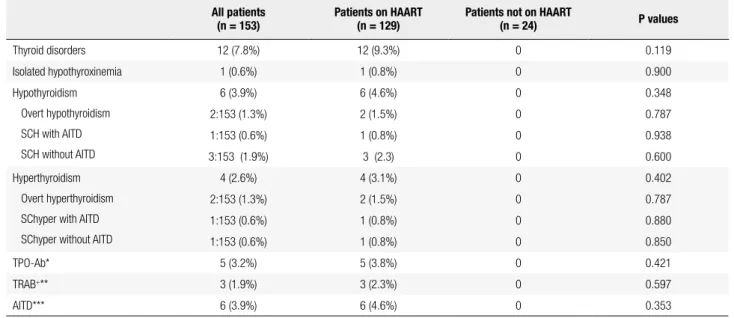
As shown in Table 1, six patients had AITD (de-ined by the presence of circulating TPO-Ab and/or TRAB) in the whole group studied (6/153), corre-sponding to 3.9% of the total. Evaluation of patients presenting primary hypothyroidism (n = 6) identiied 2 patients with circulating anti-thyroid antibodies (one of them with overt hypothyroidism). Another patient with overt hypothyroidism but not detectable circulat-ing anti-thyroid antibodies. Four patients had subclini-cal hypothyroidism (only one had positive circulating TPO-Ab). One patient had low serum FT4 levels with serum TSH levels in the normal range, and no detect-able circulating TPO-Abs. This last patient, with isola-ted hypothyroxinemia, had low CD4+ levels (103 cells/
µL) and a high viral load (> 10,000 copies).
One patient presented with Hashimoto’s thyroiditis but no thyroid dysfunction, and 4 patients had thyroidism. Among patients presenting with hyper-thyroidism (n = 4), only one did not have circulating
Table 1. Frequencies of thyroid disorders in women treated or untreated with HAART
All patients (n = 153)
Patients on HAART (n = 129)
Patients not on HAART
(n = 24) P values
Thyroid disorders 12 (7.8%) 12 (9.3%) 0 0.119
Isolated hypothyroxinemia 1 (0.6%) 1 (0.8%) 0 0.900
Hypothyroidism
Overt hypothyroidism
SCH with AITD
SCH without AITD
6 (3.9%) 6 (4.6%) 0 0.348
2:153 (1.3%) 2 (1.5%) 0 0.787
1:153 (0.6%) 1 (0.8%) 0 0.938
3:153 (1.9%) 3 (2.3) 0 0.600
Hyperthyroidism
Overt hyperthyroidism
SChyper with AITD
SChyper without AITD
4 (2.6%) 4 (3.1%) 0 0.402
2:153 (1.3%) 2 (1.5%) 0 0.787
1:153 (0.6%) 1 (0.8%) 0 0.880
1:153 (0.6%) 1 (0.8%) 0 0.850
TPO-Ab* 5 (3.2%) 5 (3.8%) 0 0.421
TRAB+** 3 (1.9%) 3 (2.3%) 0 0.597
AITD*** 6 (3.9%) 6 (4.6%) 0 0.353
Cop
yright
© ABE&M t
odos os dir
eit
os r
eser
vados
.
TRAB, and this patient had subclinical hyperthyroid-ism without circulating anti-thyroid antibodies.
Evaluation of the HAART treatment subgroup (129 patients) only identiied 12 patients with thyroid dis-orders (12/129) and 6 patients with AITD (6/129), corresponding to 9.3% and 4.6%, respectively, in this subgroup. Hypo- and hyperthyroidism were detected in 4.6% (6/129 patients) and 3.1% (4/129 patients) of the women in this subgroup (Table 1).
STUDY OF HIV-INFECTED WOMEN WITH THYROID
DISORDERS
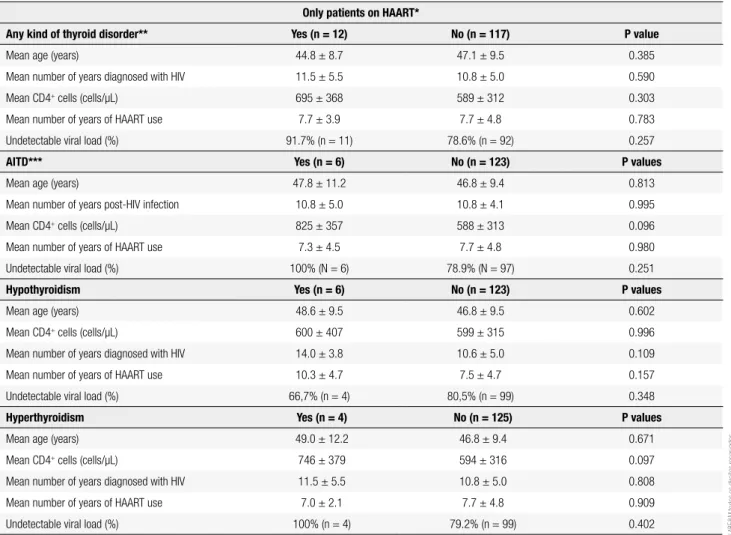
Table 2 compares selected variables between women in the study, based on the presence or absence of thyroid disorders. Mean age was not different between patients with or without thyroid abnormalities, nor was the time of HIV diagnosis or the mean time they were on
Table 2. Comparisons between HIV-infected patients on HAART, with or without diagnosis of thyroid abnormalities
Only patients on HAART*
Any kind of thyroid disorder** Yes (n = 12) No (n = 117) P value
Mean age (years) 44.8 ± 8.7 47.1 ± 9.5 0.385
Mean number of years diagnosed with HIV 11.5 ± 5.5 10.8 ± 5.0 0.590
Mean CD4+ cells (cells/µL) 695 ± 368 589 ± 312 0.303
Mean number of years of HAART use 7.7 ± 3.9 7.7 ± 4.8 0.783
Undetectable viral load (%) 91.7% (n = 11) 78.6% (n = 92) 0.257
AITD*** Yes (n = 6) No (n = 123) P values
Mean age (years) 47.8 ± 11.2 46.8 ± 9.4 0.813
Mean number of years post-HIV infection 10.8 ± 5.0 10.8 ± 4.1 0.995
Mean CD4+ cells (cells/µL) 825 ± 357 588 ± 313 0.096
Mean number of years of HAART use 7.3 ± 4.5 7.7 ± 4.8 0.980
Undetectable viral load (%) 100% (N = 6) 78.9% (N = 97) 0.251
Hypothyroidism Yes (n = 6) No (n = 123) P values
Mean age (years) 48.6 ± 9.5 46.8 ± 9.5 0.602
Mean CD4+ cells (cells/µL) 600 ± 407 599 ± 315 0.996
Mean number of years diagnosed with HIV 14.0 ± 3.8 10.6 ± 5.0 0.109
Mean number of years of HAART use 10.3 ± 4.7 7.5 ± 4.7 0.157
Undetectable viral load (%) 66,7% (n = 4) 80,5% (n = 99) 0.348
Hyperthyroidism Yes (n = 4) No (n = 125) P values
Mean age (years) 49.0 ± 12.2 46.8 ± 9.4 0.671
Mean CD4+ cells (cells/µL) 746 ± 379 594 ± 316 0.097
Mean number of years diagnosed with HIV 11.5 ± 5.5 10.8 ± 5.0 0.808
Mean number of years of HAART use 7.0 ± 2.1 7.7 ± 4.8 0.909
Undetectable viral load (%) 100% (n = 4) 79.2% (n = 99) 0.402
* Highly active anti-retroviral therapy; ** Thyroid disorders include: thyroid dysfunction (serum TSH out of the normal range) or thyroid autoimmunity (positive serum antibodies against TSH receptor [TRAB] or thyreoperoxidasis [TPO-Ab]). *** Autoimmune thyroid disease.
HAART. Only one of the AITD patients had a family history of thyroid disease.
All women with hyperthyroidism and AITD (in-dependent of thyroid function) had undetectable viral loads (Table 2). The median log10 viral load in women without hyperthyroidism and without AITD was 1.59. Independent of HAART use, CD4+ cells counts
tended to be higher in patients with hyperthyroidism or AITD (Table 2). However, these associations were not statistically signiicant. As expected, the absolute number of CD4+ T cells correlated negatively with viral copies (r = -0.422; p < 0.001).
DISCUSSION
re-Cop
yright
© ABE&M t
odos os dir
eit
os r
eser
vados
.
garding the general population (17-23). Furthermore, it was shown that some patients (4/153) had subclini-cal thyroid dysfunction without circulating anti-thyroid antibodies, which may not have clinical impact (19-23).
Also, the results demonstrated a frequency of thyroid abnormalities lower than previously reported by Schieri and cols., who analyzed Rio de Janeiro women of the same age as those described in this study. This study reported a 10 and 12.3% prevalence of Hashimoto’s thyroiditis and hypothyroidism, respectively (17). The inclusion of women of the same age and from the same city enabled the comparison between studies with less confounding bias. However, a limitation of this com-parison can be attributed to other inclusion criteria, since Schieri and cols. conducted a population survey on women who were not in an ambulatory setting (i.e., from a tertiary hospital).
A comparative analysis was performed between patients treated with and without HAART, which de-monstrated that all HIV-infected women were on HAART at the time of thyroid disease diagnosis. De-spite these indings, the relationship between HAART and the manifestation of thyroid dysfunction and au-toimmunity could not be proved. During the course of this study, we were also unable to identify associations with the duration of HAART therapy or HIV infection, and the development of different thyroid abnormalities. Previous studies conducted by Madeddu and cols. demonstrated a positive association between HAART and thyroid diseases. They evaluated 182 patients tre-ated with HAART and 20 who were not. This study demonstrated that thyroid dysfunction was diagnosed in 12.6% of HAART patients, but not in any patients in the untreated control group. However, the most preva-lent dysfunction reported was subclinical hypothyroi-dism in the absence of detectable serum TPO-Abs in patients with this thyroid dysfunction (5). Because of this, other diseases associated with elevated serum TSH levels should be included as part of the differential di-agnosis (5).
Jain and cols. also suggested that serum TSH le vels may be positively associated with the progression of HIV infection, but no association between AITD and HIV infection was demonstrated based on the evalua-tion of 50 patients (24).
Contributing to the data suggesting that there is no association between primary thyroid dysfunction and HAART is a cross-sectional, multicenter study of 350 HIV-infected patients presenting elevated
hypothy-roidism rates in males (16%) associated with low CD4+
counts (7). Based on these data, it was demonstrated that serum TSH levels did not correlate with autoim-mune disease and further suggested that non-thyroid diseases and pituitary disorders should be included as part of the differential diagnosis of these patients (7). In addition, a case control study carried out by Afhami and cols. was unable to demonstrate associations be-tween hypothyroidism and HAART, mean CD4+ T cell counts, or the duration of HIV infection (10). In this latter study, 85 subjects were evaluated including 15 hypothyroid cases and 70 euthyroid HIV-infected patients that served as controls (10). Despite these re-lated studies that demonstrated negative associations between HAART therapy and thyroid diseases, other studies have found correlations between thyroid disease and HIV infection (8,9).
Discrepancies regarding the effects of HAART on thyroid function are found in both small and large-scale studies (8,9). One of these studies was a prospective study examining HIV-positive individuals at the Royal Free Hospital that demonstrated a higher incidence of thyroid dysfunction in this population. Furthermo-re, based on these indings, they did not recommend routine thyroid testing for these patients. This cohort included 3,584 HIV-positive individuals tested for thyroid function at least once (from these 900, were on HAART) (9). The indings from the study carried out using the Chelsea and Westminster Hospital HIV cohort were published soon after that (8). In this study, 2,437 HIV-infected patients were evaluated over an 11-year period (1995-2006). The incidence of hyper-thyroidism was 3.4 per 10,000 treated patient-years and the incidence of hypothyroidism was 10.7 (95% conidence interval: 6.9 to 15.8) per 10,000 treated patient-years. In this retrospective cohort, there was a higher-than-expected incidence of hypothyroidism (8). Previous studies have suggested that hyperthyroid-ism (speciically Graves’ disease) and not hypothyroid-ism is associated with HIV infection and HAART (6-8). Furthermore, it was recently suggested that Graves’ disease development represents an immune recon-stitution inlammatory syndrome (IRIS) induced by HAART (25). Evaluation of the studies cited above suggested that the association between thyroid dys-function progression, or development of autoimmu-nity, in HAART patients remains controversial.
Cop
yright
© ABE&M t
odos os dir
eit
os r
eser
vados
.
vary signiicantly. However, induction of immune res-toration by HAART has been studied by several inves-tigators as a potential mechanism (13-15,28-19). In addition, the potential homology between HIV and thyroid proteins has been suggested especially with re-gard to TSH receptor proteins (12).
The immunopathogenesis resulting in Graves’ disea se following recovery from severe T cell depletion that occurs not only following immune reconstitution of HIV patients but also following alemtuzumab treat-ment (monoclonal anti-CD52 that depletes T and B cells) remains undeined. However, an acquired defect associated with tolerance induction may predispose some individuals to higher rates of autoimmune disease (12,16,28-32).
Central T cell tolerance may be lost as a result of thymic dysfunction in some HIV-infected patients and peripheral T cell tolerance may be impaired as a consequence of reduced CTLA-4 function, a molecu-le important in promoting T cell tomolecu-lerance to thyroid auto-antigens (33). Breaking self-tolerance and loss of immune regulation associated with HIV infection may be also associated with abnormalities in FOXP3
expression in CD4+ and CD8+ cells (34). Lim and cols.
showed that untreated HIV-infected patients had lower numbers of total FoxP3+ cells and FoxP3+CD4+ T cells
when the CD4+ T cells were < 300 cells/mL compared
with HIV-infected patients with higher than 400 CD4+
T cells/mL (34). Furthermore, these FoxP3+CD8+ T
cells expressed less CTL4 then Fox P3+CD4+ cells (34).
The present study compared CD4+ T cell levels and
viral loads in women with or without thyroid disorders, and demonstrated that CD4+ levels tended to be higher
and viral loads lower in patients with hyperthyroidism and AITD, suggesting that these patients had an effec-tive immune responses at the time of thyroid disease di-agnosis. Also, this study demonstrated that all patients diagnosed with hyperthyroidism and AITD had unde-tectable viral loads. These indings further suggest that differential diagnoses should be carried out during the evaluation of severely immunosuppressed HIV-infected patients presenting with low serum TSH levels.
The limitation of this comparative study was the in-clusion of women from a tertiary hospital where the majority of patients were on HAART. Furthermore, patients not receiving HAART in this study probably had elevated CD4+ cells levels and low viral loads, and
therefore, a functioning immune system.
CONCLUSION
The present study demonstrated a lack of correlation between thyroid dysfunction and/or autoimmuni-ty in HIV-infected women treated or untreated with HAART. An association between HAART and the de-velopment of autoimmune thyroid diseases was sugges-ted since AITD only developed in patients on HAART who had undetectable viral loads and slightly higher levels of CD4+ T cells. However, additional studies will
be needed to conirm this association.
Acknowledgements: we would like to thank Roche Diagnóstica Brasil Ltda. and Sergio Franco Medicina Diagnóstica who provi-ded some of the laboratory analyses described. We would also like thank Fundação de Amparo à Pesquisa (Faperj).
Disclosure: no potential conlict of interest relevant to this article was reported.
REFERENCES
1. Philippe J. Graves’ disease in 2009. Rev Med Suisse. 2009;5:764-8. 2. Brown RS. Autoimmune thyroid disease: unlocking a complex
puzzle. Curr Opin Pediatr. 2009;21:523-8.
3. Nakamura H, Usa T, Motomura M, Ichikawa T, Nakao K, Kawasaki E, et al. Prevalence of interrelated autoantibodies in thyroid diseases and autoimmune disorders. J Endocrinol Invest. 2008;31:861-5. 4. Weetman AP. Graves’ disease. N Engl J Med. 2000;343:1236-48. 5. Madeddu G, Spanu A, Chessa F, Calia GM, Lovigu C, Solinas P, et
al. Thyroid function in human immunodeiciency virus patients treated with highly active antiretroviral therapy (HAART): a longi-tudinal study. Clin Endocrinol (Oxf). 2006;64:375-83.
6. Jubalt V, Penfornis A, Schillo F, Hoen B, Izembart M, Timsit J, et al. Sequential occurrence of thyroid autoantibodies and Graves’ disease after immune restoration in severely immunocompromi-sed human immunodeiciency virus-1-infected patients. J Clin Endocrinol Metab. 2000;85:4254-7.
7. Beltran S, Lescure FX, Desailloud R, Douadi Y, Smail A, Esper IE, et al. Increase prevalence of hypothyroidism among human im-munodeiciency virus infected patients: a need for screening. Clin Infect Dis. 2003;37:579-83.
8. Nelson M, Powles T, Zeitlin A, Sen P, Scourield A, Bower M, et al. Thyroid dysfunction and relationship to antiretroviral therapy in HIV-positive individuals in the HAART era. J Acquir Immune Deic Syndr. 2009;50:113-4.
9. Madge S, Smith CJ, Lampe FC, Thomas M, Johnson MA, Youle M, et al. No association between HIV disease and its treatment and thyroid function. HIV Medicine. 2007;8:22-7.
10. Afhami S, Haghpanah V, Heshmant R, Rasoulinejad M, Izadi M, Lashkari A, et al. Assessment of the factors involving in the de-velopment of hypothyroidism in HIV-infected patients: a case--control study. Infection. 2007;35:334-8.
11. Hoffmann JC, Brown TT. Thyroid function abnormalities in HIV--infected patients. Clin Infec Diseases. 2007;45:488-94.
12. Desailloud R, Hober D. Viruses and thyroiditis: an update. Virol J. 2009;6:5.
13. Crum NF, Ganesan A, Johns ST, Wallace MR. Graves’ disease: an increasingly recognized immune reconstitution syndrome. AIDS. 2006;20:466-9.
Cop
yright
© ABE&M t
odos os dir
eit
os r
eser
vados
.
a late complication of immune reconstitution in patients with ad-vanced human immunodeiciency virus (HIV) disease. Medicine (Baltimore). 2005;84:98-106.
15. Knysz B, Bolanowski M, Klimczak M, Gladysz A, Zwolinska K. Gra-ves’ disease as an immune reconstitution syndrome in an HIV-1--positive patient commencing effective antiretroviral therapy: case report and literature review. Viral Immunol. 2006;19:102-7. 16. Zandman-Goddard G, Shoenfeld Y. HIV and autoimmunity.
Au-toimmun Rev. 2002;1:329-37.
17. Sichieri R, Baima J, Marante T, Vasconcellos MTL, Moura AS, Vais-mam M. Low prevalence of hypothyroidism among black and Mulatto people in a population-based study of Brazilian women. Clin Endocrinol. 2007;66:803-7.
18. Hoogendoom EH, Hermus AR, de Vegt F, Ross HA, Verbek AL, Kie-meney LA, et al. Thyroid function and prevalence of anti-thyrope-roxidase antibodies in a population with borderline suficient io-dine intake: inluences of age and sex. Clin Chem. 2006;52:104-11. 19. Hollowell JG, Staehling NW, Flanders WD, Hannon WH, Gunter
EW, Spencer CA, et al. Serum TSH, T4 and thyroid antibodies in the United States population (1988-1994): National Health and Nutrition. J Clin Endocrinol Metab. 2002;87:489-99.
20. Knudsen N, Jorgensen T, Rasmussen S, Christiansen E, Perrild H. The prevalence of thyroid dysfunction in a population with bor-derline iodine deiciency. Clin Endocrinol. 1999;52:361-7. 21. O’Leary PC, Fedderma PH, Michelangeli VP, Leedman PJ, Chew
GT, Knuiman M, et al. Investigations of thyroid hormones and antibodies based on a community health survey: The Busselton thyroid study. Clin Endocrinol. 2006;64:97-104.
22. Bjoro T, Holmen J, Kruger O, Midthjell K, Hunstad K, Schreiner T, et al. Prevalence of thyroid disease, thyroid dysfunction and thyroid pero-xidase antibodies in a large, unselected population. The health Stu-dy of Nord-Trondelag (HUNT). Eur J Endocrinol. 2000;143:639-47. 23. Canaris GJ, Manowitz NR, Mayor G, Ridgway EC. The Colorado
thyroid disease prevalence study. Arch Intern Med. 2000;160:526-34. 24. Jain G, Devpura G, Gupta BS. Abnormalities in the thyroid func-tion tests as surrogate marker of advancing HIV infecfunc-tion in infec-ted adults. J Assoc Physicians India. 57:508-10.
25. Rasul S, Delapenha R, Farhat F, Gajjala J, Zahra SM. Graves’ dise-ase as a manifestation of immune reconstitution in HIV-1-infected individuals after initiation of highly active antiretroviral therapy. AIDS Res Treat. 2011:743597.
26. Singer PA, Cooper DS, Levy EG, Ladenson PW, Braverman LE, Daniels G, et al. Treatment guidelines for patients with hyper-thyroidism and hypohyper-thyroidism. Standards of Care Committee, American Thyroid Association. JAMA. 1995;273:808:812. 27. Stagnaro-Green A, Abalovich M, Alexander E, Azizi E, Mestman
J, Negro R, et al. Guidelines of the American Thyroid Association for the Diagnosis and Management of Thyroid Disease. Thyroid. 2011;21:1-45.
28. French MA, King MS, Tschampa JM, Silva BA, Landay AL. Serum immune activation markers are persistently increased in patients with HIV infection after 6 years of antiretroviral therapy despite suppression of viral replication and reconstitution of CD4+ T cells. J Infect Dis. 2009;200:1212-5.
29. Price P, Mathiot N, Krueger R, Stone S, Keane NM, French MA. Immune dysfunction and immune restoration disease in HIV patients given highly active antiretroviral therapy. J Clin Virol. 2001;22:279-87.
30. French MA. Immune reconstitution inlammatory syndrome: a reappraisal. Clin Infec Dis. 2009;48:101-7.
31. Polkowska E, Bossowski A. The role of lymphocytes and secrete cytokines in autoimmune thyroid diseases. Pediatr Endocrinol Diabetes Metab. 2009;15:114-7.
32. Caporossi AP, Bruno G, Salemi S, Mastroianni C, Falciano M, Sa-lotti A. Autoimmune T-cell response to the CD4 molecule in HIV--infected patients. Viral Immunol. 1998;11:9-17.
33. French MA, Lewin SR, Dykstra C, Krueger R, Price P, Leedman PJ. Graves’ disease during immune reconstitution after highly active antiretroviral therapy for HIV-infection: evidence of thymic dys-function. AIDS Res Hum Retroviruses. 2004;20:157-62.