Semi-scale production of PHAs from waste frying oil
by
Pseudomonas fluorescens
S48
Rawia F. Gamal, Hemmat M. Abdelhady, Taha A. Khodair, Tarek S. El-Tayeb, Enas A.
Hassan, Khadiga A. Aboutaleb
Department of Agricultural Microbiology, Faculty of Agriculture, Ain Shams University, Shoubra El-Kheima, Cairo, Egypt.
Submitted: June 23, 2011; Approved: June 5, 2012.
Abstract
The present study aimed at developing a strategy to improve the volumetric production of PHAs by
Pseudomonas fluorescensS48 using waste frying oil (WFO) as the sole carbon source. For this pur-pose, several cultivations were set up to steadily improve nutrients supply to attain high cell density and high biopolymer productivity. The production of PHAs was examined in a 14 L bioreactor as one-stage batch, two-stage batch, and high-cell-density fed-batch cultures. The highest value of poly-mer content in one-stage bioreactor was obtained after 60 h (33.7%). Whereas, the two-stage batch culture increased the polymer content to 50.1% after 54 h. High-cell-density (0.64 g/L) at continuous feeding rate 0.55 mL/l/h of WFO recorded the highest polymer content after 54 h (55.34%). Semi-scale application (10 L working volume) increased the polymer content in one-stage batch, two-stage batch and high cell density fed-batch cultures by about 12.3%, 5.8% and 11.3%, respec-tively, as compared with that obtained in 2 L fermentation culture. Six different methods for biopolymer extraction were done to investigate their efficiency for optimum polymer recovery. The maximum efficiency of solvent recovery of PHA was attained by chloroform–hypochlorite disper-sion extraction. Gas chromatography (GC) analysis of biopolymer produced by Pseudomonas fluorescensS48 indicated that it solely composed of 3-hydrobutyric acid (98.7%). A bioplastic film was prepared from the obtained PHB. The isolate studied shares the same identical sequence, which is nearly the complete 16S rRNA gene. The identity of this sequence to the closest pseudomonads strains is about 98-99%. It was probably closely related to support another meaningful parsiomony analysis and construction of a phylogenetic tree. The isolate is so close to Egyptian strain named EG 639838.
Key words:Pseudomonas fluorescensS48, biopolymer, PHAs, batch, two-stage batch, high-cell-density fed batch, bioreactor, recovery.
Introduction
Plastic materials have become an integral part of con-temporary life because of many desirable properties includ-ing durability and resistance to degradation. The non-de-gradable plastics accumulate in the environment with an increasing rate. Recently, the problems concerning the glo-bal environment and solid waste management have created much interest in the development of biodegradable plastics, which must still retain the desired physical and chemical
properties of conventional synthetic plastics. One of the biodegradable plastic materials under development in-cludes polyhydroxyalkanoates (PHAs) (Slateret al., 1998). However, one of the problems facing the development of biodegradable polymers as substitutes for conventional plastics is their high price compared with petrochemical de-rived plastics. Therefore, many efforts have been made to reach low-cost PHA production processes (Verlindenet al., 2007). Different potent strains, which grow to high-cell-density in cheap cultivation media and accumulating high
Send correspondence to T.S. El-Tayeb. Department of Agricultural Microbiology, Faculty of Agriculture, Ain Shams University, 11241 Shoubra El-Kheima, Cairo, Egypt. E-mail: [email protected].
PHA content via cost-efficient fermentation process and enabling easy recovery methods as well, were described in numerous investigations and patented processes (Kinoshita
et al., 2005). Since one of the main obstacles that hinder an economic feasible production of PHA is the cost of carbon substrate (25% to 28% of total production cost). However, the abundance of inexpensive waste materials from agricul-ture, industry or agro-industrial such as waste frying oil present them as an alternative cheap substrates for micro-bial fermentations, in particular for the production of mi-crobial polyesters (Da Silvaet al., 2009).
Either fed-batch or continuous cultivation techniques can be used for the production of PHA with high productiv-ity. Fed-batch culture has been the most popular culture system to achieve a high cell density and PHB content (Kim
et al., 1994; Lee and Yoo, 1994; Kimet al., 2003; Valappil
et al., 2007). In this system, it is essential to maintain opti-mal concentration of nutrients during fermentation. This can be achieved by using various feeding strategies (Leeet al., 1997; Wang and Lee, 1997; Abdel Hafezet al., 2009; Lopez-Cuellaret al., 2011).
In view of these facts, the current investigation is aimed to study the semi-scale production of PHAs from waste frying oil using different fermentation techniques as batch and two-stage batch and high-cell-density fed-batch cultures in 14 L bioreactor.
Materials and Methods
Microorganism and culture conditions
Pseudomonas fluorescensS48 was used in this inves-tigation for accumulating PHAs from waste frying oil (WFO) (Gamalet al., 2011, 2012). The bacterial culture was maintained by transferring at regular intervals on nutri-ent agar slants. Slants were kept at 4 °C until used. For PHAs production, the bacterium was grown in basal me-dium modified by Gamalet al.(2012) called productive medium containing (g/L): (NH4)2SO4 1.0, KH2PO4 1.5, Na2HPO4.12H2O 9.0, MgSO4.7H2O 0.2, 1 mL of trace ele-ments solution (FeSO4.7H2O 10, ZnSO4.7H2O 2.25, CuSO4.5H2O 1.0, MnSO4.4H2O 0.5, CaCl2.2H2O 2.0, Na2B4O7.10H2O 0.23, (NH4)6Mo7O24 0.1 and 35% HCl 10 mL) and 10 mL waste frying oil as the sole carbon source. The pH was adjusted to 7.0 before sterilization.
Cultivation was done in a Bioflo 3000 14-liter fermenter (New Brunswick Scientific Co., Inc. Edison, NJ 08818-4005 USA), with a working volume of 10 liter (24 cm inner diameter and 45 cm height) and a d/D value (relation of stirrer diameter to vessel diameter) of 0.286 was used for cultivation. The bioreactor was equipped with three stirrers, each containing six paddles and a Funda-foam mechanical destroyer. In addition, sterilizable probes were inserted into ports to measure dissolved oxygen, pH and temperature. The operation were controlled and re-corded. Cultivation was carried out at 30 °C and
350 mM/L/h oxygen transfer rate obtained through powerful fermentation agitation motor and 6-bladed Rushton impellers dissolve 20% air saturation in the me-dium, which was controlled by agitation at 500 rpm and aeration rate 1 vvm. Unless otherwise stated, the pH of me-dium was adjusted at 7.0±1 by the controlled addition of NaOH (5 N) or 4 N HCl. The operations were controlled and recorded by a digital control unit (DCU) in combina-tion with the software package. Samples of 10-20 mL were withdrawn from the culture fluid for analytical purposes. Bioreactor as a one-stage batch culture
In this experiment the fermentation vessel (bio-reactor) containing 9800 mL productive medium without WFO was autoclaved at 121 °C for 40 min. WFO (1%) was added after sterilization. The fermentation medium was in-oculated with 1% standard inoculum of the bacterial strain. The standard inoculum was prepared in a conical flask (250 mL) containing 100 mL of nutrient broth medium in-oculated with a loop ofPs. fluorescensS48 and incubated at 28-30 °C with shaking (300 rpm) for 24 h prior to inocula-tion (5 x 10⁸cfu / mL).
The final working volume was 10 liter. Initial pH was adjusted to 7±0.1 which was not controlled during the fer-mentation period. Temperature, dissolved O2and speed of agitation were kept at 30 °C, 20% of air saturation and 500 rpm, respectively, during cultivation.
During fermentation, samples (10-20 mL) were with-drawn from the culture (fermentation vessel) periodically. The samples were centrifuged at 15000 xgfor 4 min at 4 °C. The sediment (biomass) was washed twice with distilled water, and then dried at 70 °C to constant weight.
Bioreactor as a two-stage batch culture
The production of PHAs was carried out in two-stage cultivation. In the first stage, two sterile conical flasks (1000 mL) each containing 400 mL nutrient medium was inoculated with 10 mL standard inoculum of the bacterial strain, then incubated at 30 °C for 24 h on rotary shaker (150 rpm) in order to get a luxurious growth. Then the cul-ture fluid was centrifuged at 15000 xgfor 4 min at 4 °C and the bacterial cells were collected and suspended in addi-tional sterile productive medium to inoculate the bioreactor vessel to give a final working volume of 10 L sterile pro-ductive medium. The cultivation conditions and microbio-logical determinations were done as mentioned before. Bioreactor as high-cell-density fed-batch culture
This experiment of fed-batch culture was constructed to study the effect of washed high-cell-densities (0.64 g/L) ofPs. fluorescensS48 on PHAs production. WFO was fed continuously at 0.55 mL/L/h during the first 18 h of cultiva-tion (according to the obtained results from Gamalet al.
aseptic conditions to determine the cell dry weight, PHAs produced and residual carbon.
In all cultivations, polymer in samples was generally precipitated and determined as dry weight and PHAs con-tent was determined as dry weight percent. The extraction of PHAs was implemented by the chloroform-sodium hypochlorite method (Hahnet al., 1994). Total organic car-bon was determined in supernatant according to Walingaet al.(1992). Polymer content (%) and productivity (g/L/h) were calculated according to Lee and Choi (1998) and Lee (1996), respectively. The parameters of polymer yield (%), conversion coefficient (%) and carbon utilization effi-ciency (%) were calculated according to Ramadanet al.
(1985).
PHAs recovery
Six different methods for bioplastic recovery were performed as the following:
Biopolymer recovery by commercial sodium hypochlorite solution
The culture fluid was centrifuged in polypropylene centrifuge tubes which had been previously washed thor-oughly with ethanol and hot chloroform to remove plas-ticizers. The cell paste was resuspended in a volume of commercial sodium hypochlorite solution (clorox or equiv-alent) equal to the original volume of medium. After 1 hr at 37 °C the lipid granules were centrifuged, washed with wa-ter, and then washed with acetone and alcohol. Finally, the polymer was dissolved by extraction with three small por-tions of boiling chloroform, the chloroform solution was filtered, and the filtrate was used for biopolymer assay (Law and Slepecky, 1961).
Biopolymer recovery by using dispersions of sodium hypochlorite and chloroform
A 1 g portion of freeze-dried cells was treated with a dispersion containing 50 mL of chloroform and 50 mL of a diluted sodium hypochlorite solution (3% vol/vol). After the cells were treated at 30 °C for 1 h, the mixture was cen-trifuged at 4000 xgfor 10 min, which resulted in three sepa-rate phases. The upper phase was a hypochlorite solution, the middle phase contained non-PHB cell material and undisrupted cells, and the bottom phase was chloroform containing PHB. The upper phase was removed first with a pipette, and the middle phase was separated by filtration from the chloroform phase. Finally, bottom phase was chloroform containing PHB. PHB was recovered from the chloroform phase by nonsolvent precipitation (mixture of methanol and water 7:3, vol/vol) five times the volume of chloroform and filtration (Hahnet al., 1994).
Biopolymer recovery by using acetone and chloroform
Freeze-dried cell powder was washed with hot ace-tone for 20 min. After drying, the cell powder was mixed with 50 volumes of chloroform for 48 h at 30 °C. The clear
polymer solution was recovered by centrifugation to re-move the majority of the non-PHB cell material; this was followed by polishing filtration. Finally, pure biopolymer was obtained by no solvent precipitation (five times the volume of chloroform) and filtration. The nonsolvent used was a mixture of methanol and water 7:3 (vol/vol) (Hahnet al., 1995).
Biopolymer recovery by sodium hypochlorite
A sodium hypochlorite solution was diluted with dis-tilled water to give concentrations 3% (vol/vol). The bio-mass was mixed with a hypochlorite solution, Biopolymer granules were separated from the aqueous fraction contain-ing cell debris by centrifugation. The Polymer recovered was rinsed with distilled water, centrifuged again, and then rinsed with acetone. 1% (wt/vol) biomass suspension was treated for 1 h at 30 °C (Hahnet al., 1995).
Biopolymer recovery by using chloroform
Lyophilized cell pellets were ground in a mortar and the resulting powder was extracted with chloroform for 4 h at 50 °C. The PHA-containing chloroform phase was con-centrated and extracted once with water to remove residual solid particles. The organic phase was evaporated to dry-ness and the resulting crude extract preserved for further analyses. Purified PHAs were obtained by repeated precipi-tations in 10 volumes of cold methanol (Simon-Colinet al., 2008).
Biopolymer recovery by using sodium dodecyl sulfate (SDS)
The cells were harvested and treated with 10% SDS at 100 °C for 20 min. After centrifugation, the pellets were washed, dried and extracted with chloroform at 60 °C for 1 h. The non-PHB cell matter was removed by filtration and the dissolved PHB was separated from chloroform by evap-oration, washed twice with methanol, filtered out and dried at 60-70 °C (Jianget al., 2008).
GC analysis of biopolymer composition
Composition of PHA was determined by GC as de-scribed by Mumtazet al.(2009).
Preparation of a biopolymer film
Totally 250 mg of PHB was dissolved in 28 mL chlo-roform. The solution was evenly distributed into 5 petri dishes. The dishes were maintained at 30 °C to allow com-plete evaporation of chloroform. The evaporation of sol-vent resulted in formation of PHB films in the petri dishes. Vacuum drying was further applied to completely remove any possible solvent remained in the films (Kai et al., 2003).
DNA extraction and PCR amplification
DNA Mini-Prep Kit (Axygen cat. No. V110440-05) was used to isolate DNA as advised by the manufacturer. The
universal 16S primers used were: F1 5’
AGAGTTT(G/C)ATCCTGGCTCAG 3’ R1 5’
ACGG(A/C)TACCTTGTTACGACTT 3’
Primers were checked for specificity using the PROBE CHECK function of the Ribosomal Database and the BLAST search facility at the National Center for Bio-technology Information. DNA amplification was con-ducted on pure 2 to 3mL DNA sample with about 150 ng of DNA per 1mL of sample in a perkin Elmer 2400 (Nowalk, CT) thermocycler. The F1 and R1 primers amplifying the PCR reactions were added with a final volume of 100mL with 0.2 mM of each primer, 2.0 mM MgCl2, 200 mM dNTPs and 2.5 units of Maxima® Hot start Taq DNA Poly-merase (Fermentas, www.fermentas.com) mixed in the 1X PCR buffer. DNA was amplified over 35 cycles of denatur-ation for 1 min at 94 °C, annealing at 55 °C for 1.5 min and extension at 72 °C for 2 min. After the last cycle, DNA was extended at 72 °C for 10 min. Amplification was confirmed by analyzing 5mL of PCR reaction mixture on 1% agarose gel (Promega). The resulting PCR products sizes were ranged from 1450 to 1500 bp.
DNA sequencing
The PCR-product was purified using QIAquik PCR Purification Kit (Qiagen), and sequenced using automatic ABI 310 DNA Sequencer, Big Dye Terminator Cycle Se-quencing Ready Reaction Kit, Perkin Elmer. The sequenc-ing was performed in one direction ussequenc-ing one of the previ-ously described primers (Lane, 1991; Laneet al., 1985). Sequencing data was analyzed by two different computer alignment programs, DNAStar (DNASTAR, Inc., USA) and Sequence Navigator (Perkin, Corp., USA).
Determination of phylogenetic relationships
The BLAST database (Altschulet al., 1997) of Na-tional Center for Biotechnology Information was used to compare resolved sequence of thePs. fluorescensS48 with known 16S rDNA sequences. Determination of phylogen-etic relationships was analyzed by the program Phylogen-etic Analysis megAlign of DNAstar version 7.0. The ro-bustness of the internal branches of the trees was estimated by bootstrap analyses using 1000 replications in a heuristic search with random stepwise addition (111 replications) (Vinnere et al., 2002). Bootstrap majority-rule (> 50%) consensus trees were obtained.
Statistical analysis
The collected data were statistically analyzed using IBM®SPSS®Statistics software (2011).
Results and discussion
Semi-scale production of PHAs
The successful production of PHAs in both shaken flasks (Gamalet al., 2011) and 3 L laboratory fermentor (Gamalet al., 2012) cultures generate the trials of semi-scale production of PHAs in 14 L laboratory fermentor cul-tures. Different fermentation techniques were applied in or-der to increase the PHAs yield using WFO as the sole carbon source.
One-stage batch culture
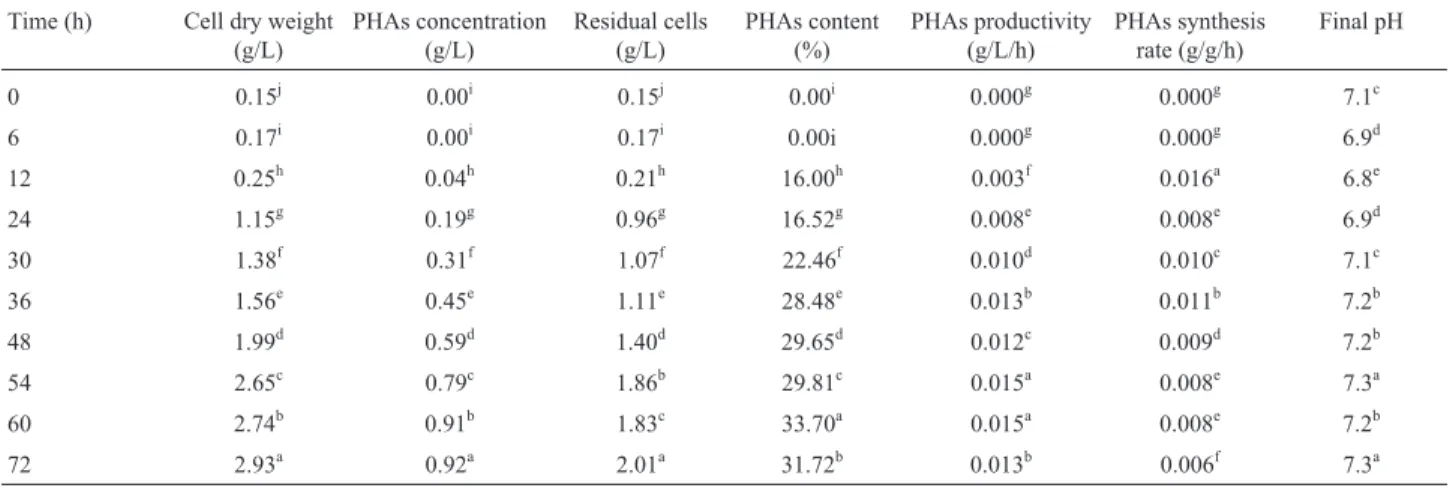
In batch culture, the cell mass increased gradually leading to record the maximum values of cell dry weight and polymer concentration (2.93 and 0.92 g/L, respec-tively) after 72 h of cultivation (Table 1). Whereas, the maximum PHAs content (33.7%) was obtained after 60 h
Table 1- Semi-scale production of PHAs byPs. fluorescensS48 on productive medium containing WFO (waste frying oil) as carbon source throughout 72 h at 30 °C using bioreactor as a batch culture.
Time (h) Cell dry weight (g/L)
PHAs concentration (g/L)
Residual cells (g/L)
PHAs content (%)
PHAs productivity (g/L/h)
PHAs synthesis rate (g/g/h)
Final pH
0 0.15j 0.00i 0.15j 0.00i 0.000g 0.000g 7.1c
6 0.17i 0.00i 0.17i 0.00i 0.000g 0.000g 6.9d
12 0.25h 0.04h 0.21h 16.00h 0.003f 0.016a 6.8e
24 1.15g 0.19g 0.96g 16.52g 0.008e 0.008e 6.9d
30 1.38f 0.31f 1.07f 22.46f 0.010d 0.010c 7.1c
36 1.56e 0.45e 1.11e 28.48e 0.013b 0.011b 7.2b
48 1.99d 0.59d 1.40d 29.65d 0.012c 0.009d 7.2b
54 2.65c 0.79c 1.86b 29.81c 0.015a 0.008e 7.3a
60 2.74b 0.91b 1.83c 33.70a 0.015a 0.008e 7.2b
72 2.93a 0.92a 2.01a 31.72b 0.013b 0.006f 7.3a
PHAs content (%) = Polymer concentration (g/L) / cell dry weight (g/L) x100.
PHAs productivity (g/L/h) = Polymer concentration (g/L) / fermentation time (h) (Lee, 1996).
fermentation period. The corresponding figures of polymer synthesis rate and productivity were 0.008 g/g/h and 0.015 g/L/h, respectively. A slight decrease was observed on pH values during the first 12 h of growth (7.1 to 6.8), and then increased to 7.3 at the end of fermentation period. Data recorded in Table 2 revealed, that the highest values of uti-lized carbon (UC), PHAs yield and carbon utilization effi-ciency (CUE) being 6.12 g/L, 12.11% and 80.53%, respec-tively, were obtained after 72 h. Whereas, the highest conversion coefficient and specific production rate of PHAs were recorded after 60 and 24 h fermentation period (15.22% and 0.13 h-1, respectively).
Two-stage batch culture
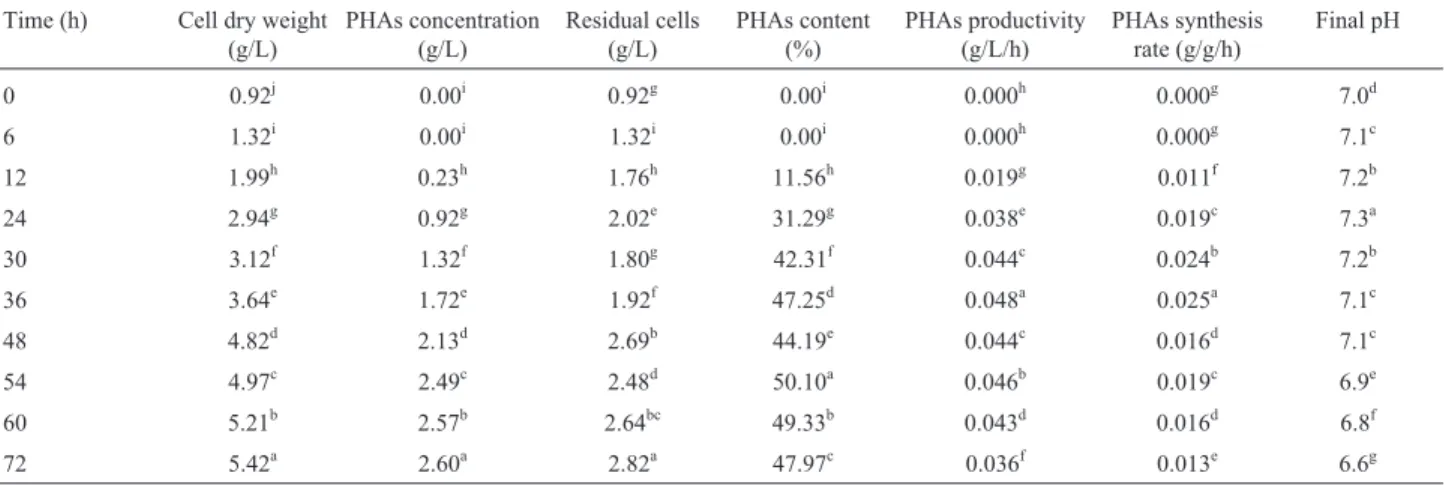
Data presented in Tables 3 and 4 indicated that the cell dry weight ofPs. fluorescensS48 and PHAs concentra-tion were increased gradually during the second stage of cultivation (production stage) to record the maximum val-ues (5.42 and 2.60 g/L) after 72 h in productive medium containing 1% WFO as the sole carbon source. The highest values of PHAs content (50.10%) was obtained after 54 h, whereas, the highest values of polymer synthesis rate and productivity were obtained after 36 h (0.025 g/g/h and 0.048 g/L, respectively). During fermentation period, a slight increase in pH value from 7.0 to 7.3 was recorded
Table 2- Impact of time course on the PHA’s parameters (CUE, yield,mpand CC) produced byPs. fluorescensS48 on productive medium containing
WFO as carbon source throughout 72 h at 30 °C using bioreactor as a batch culture.
Time (h) Cell dry weight (g/L)
PHAs concen-tration (g/L)
Carbon concen-tration (g/L)
Utilized carbon (g/L)
Carbon utiliza-tion efficiency (CUE) (%)
Yield (Y) (%) Specific pro-duction rate
(mp) (h -1
)
Conversion co-efficient (CC)
(%)
0 0.15j 0.00i 7.60a 0.00j 0.00j 0.00i 0.000h 0.00i
6 0.17i 0.00i 7.04b 0.56i 7.37i 0.00i 0.000h 0.00i
12 0.25h 0.04h 6.08c 1.52h 20.00h 0.53h 0.000h 2.63h
24 1.15g 0.19g 4.47d 3.13g 41.18g 2.50g 0.130a 6.07g
30 1.38f 0.31f 3.62e 3.98f 52.37f 4.08f 0.114b 7.79f
36 1.56e 0.45e 3.15f 4.45e 58.55e 5.92e 0.104c 10.11e
48 1.99d 0.59d 2.62g 4.98d 65.53d 7.76d 0.075d 11.85d
54 2.65c 0.79c 2.26h 5.34c 70.26c 10.39c 0.071e 14.79c
60 2.74b 0.91b 1.62i 5.98b 78.68b 11.97b 0.065f 15.22a
72 2.93a 0.92a 1.48j 6.12a 80.53a 12.11a 0.052g 15.03b
Carbon utilization efficiency (%) = Utilized carbon (g/L) / initial carbon (g/L) X 100 (Ramadanet al., 1985). Yield = PHAs (g/L) / initial carbon (g/L) x 100 (Ramadanet al., 1985).
Productivity (g/L/h) = Polymer concentration (g/L)/ fermentation time (h) (Lee, 1996).
Conversion coefficient (%) = Polymer concentration (g/L) / utilized carbon (g/L) X 100 (Ramadanet al., 1985).
Values in the same column followed by the same letter do not significantly differ from each other, according to Duncan’s at 5% level.
Table 3- Semi-scale production of PHAs byPs. fluorescensS48 on productive medium containing WFO as carbon source throughout 72 h at 30 °C using bioreactor as a two-stage batch culture.
Time (h) Cell dry weight (g/L)
PHAs concentration (g/L)
Residual cells (g/L)
PHAs content (%)
PHAs productivity (g/L/h)
PHAs synthesis rate (g/g/h)
Final pH
0 0.92j 0.00i 0.92g 0.00i 0.000h 0.000g 7.0d
6 1.32i 0.00i 1.32i 0.00i 0.000h 0.000g 7.1c
12 1.99h 0.23h 1.76h 11.56h 0.019g 0.011f 7.2b
24 2.94g 0.92g 2.02e 31.29g 0.038e 0.019c 7.3a
30 3.12f 1.32f 1.80g 42.31f 0.044c 0.024b 7.2b
36 3.64e 1.72e 1.92f 47.25d 0.048a 0.025a 7.1c
48 4.82d 2.13d 2.69b 44.19e 0.044c 0.016d 7.1c
54 4.97c 2.49c 2.48d 50.10a 0.046b 0.019c 6.9e
60 5.21b 2.57b 2.64bc 49.33b 0.043d 0.016d 6.8f
72 5.42a 2.60a 2.82a 47.97c 0.036f 0.013e 6.6g
PHAs content (%) = Polymer concentration (g/L) / cell dry weight (g/L) x100. Productivity (g/L/h) = Polymer concentration (g/L) / fermentation time (h) (Lee, 1996).
during the first 24 h of fermentation and then gradually de-creased to reach 6.6 after 72 h. The highest values of UC, CUE and polymer yield were recorded at the end of fermen-tation period (7.53 g/L, 99.08% and 34.21%, respectively). The corresponding figures of conversion coefficient of WFO carbon was 34.53%.
High cell density fed-batch culture
Using the previous improved results, further optimi-zations were done using the same fed-batch technique with continuous WFO feeding at 0.55 mL/L/h but with scaled up the volume of the bioreactor to 14 L. Aiming to reach a
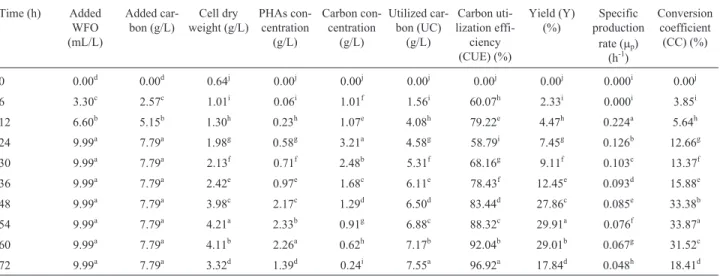
higher cell density and polymer productivity. Data given in Tables 5 and 6 show that the maximum values of cell dry weight ofPs. fluorescensS48, PHAs concentration, con-tent, yield and conversion coefficient were obtained after 54 h (4.21 g/L, 2.33 g/L, 55.34%, 29.91% and 33.87%, re-spectively), with initial cell dry weight of 0.64 g/L and WFO continuous feeding rate at 0.55 mL/L/h. At this time, the polymer productivity was 0.043 g/L/h. The highest spe-cific production rate of PHAs was obtained during the first 12 h of fermentation period being 0.224 h-1, whereas, the maximum UC and CUE were noticed after 72 h (7.55 g/L and 96.92%, respectively).
Table 4- Impact of time course on the PHAs parameters (CUE, yield,mpand CC) produced byPs. fluorescensS48 on productive medium containing
WFO as carbon source throughout 72 h at 30 °C using bioreactor as a two-stage batch culture.
Time (h) Cell dry weight (g/L)
PHAs concentra-tion (g/L)
Carbon concen-tration (g/L)
Utilized car-bon(UC)(g/L)
Carbon utiliza-tion efficiency (CUE) (%)
Yield (Y) (%)
Specific produc-tion rate (mp)
(h-1)
Conversion coef-ficient (CC) (%)
0 0.92j 0.00i 7.60a 0.00j 0.00j 0.00i 0.000h 0.00i
6 1.32i 0.00i 7.07b 0.53i 6.97i 0.00i 0.000h 0.00i
12 1.99h 0.23h 5.78c 1.82h 23.95h 3.03h 0.000h 12.64h
24 2.94g 0.92g 5.40d 2.20g 28.95g 12.11g 0.116a 41.82a
30 3.12f 1.32f 2.48e 5.12f 67.37f 17.37f 0.097b 25.78g
36 3.64e 1.72e 1.68f 5.92e 77.89e 22.63e 0.084c 29.05f
48 4.82d 2.13d 1.29g 6.31d 83.03d 28.03d 0.062d 33.76e
54 4.97c 2.49c 0.66h 6.94c 91.32c 32.76c 0.057e 35.88b
60 5.21b 2.57b 0.28i 7.32b 96.32b 33.82b 0.050f 35.11c
72 5.42a 2.60a 0.07g 7.53a 99.08a 34.21a 0.040g 34.53d
Carbon utilization efficiency (%) = Utilized carbon (g/L) / initial carbon (g/L) X 100 (Ramadanet al., 1985). Yield= PHAs (g/L) / initial carbon (g/L) x 100 (Ramadanet al., 1985).
Conversion coefficient (%): Polymer concentration (g/L) / utilized carbon (g/L) X 100 (Ramadanet al., 1985).
Specific production rate (mp) (h-1) = Ln polymer concentration (g/L) at (T) - Ln polymer concentration (g/L) at (T0) / T - T0(Ramadanet al., 1985).
Values in the same column followed by the same letter do not significantly differ from each other, according to Duncan’s at 5% level.
Table 5- Semi-scale production of PHAs byPs. fluorescensS48 on productive medium containing WFO as carbon source throughout 72 h at 30 °C using bioreactor as high-cell-density fed-batch culture with 0.64 g/L cell density and continuous WFO feeding at 0.55 mL/L/h.
Time (h) Added WFO (mL/L)
Added car-bon (g/L)
Cell dry weight (g/L)
PHAs concentra-tion (g/L)
Residual cells (g/L)
PHAs con-tent (%)
PHAs productiv-ity (g/L/h)
PHAs synthesis rate (g/g/h)
Final pH
0 0.00d 0.00d 0.64j 0.00j 0.64j 0.00j 0.000h 0.000i 7.0d
6 3.30c 2.57c 1.01i 0.06i 0.95i 5.94i 0.010g 0.011g 7.2b
12 6.60b 5.15b 1.30h 0.23h 1.07h 17.69h 0.019f 0.018e 7.2b 24 9.99a 7.79a 1.98g 0.58g 1.40g 29.29g 0.024e 0.017f 7.3a
30 9.99a 7.79a 2.13f 0.71f 1.42f 33.33f 0.024e 0.017f 7.2b 36 9.99a 7.79a 2.42e 0.97e 1.45e 39.98e 0.027d 0.019d 7.3a
48 9.99a 7.79a 3.98c 2.17c 1.81d 54.52c 0.045a 0.025a 7.1c 54 9.99a 7.79a 4.21a 2.33a 1.88b 55.34a 0.043b 0.023b 6.9e 60 9.99a 7.79a 4.11b 2.26b 1.85c 54.99b 0.038c 0.020c 6.8f
72 9.99a 7.79a 3.32d 1.39d 1.93a 41.87d 0.019f 0.010h 6.6g
PHAs content (%) = Polymer concentration (g/L) / Cell dry weight (g/L) x100.
PHAs productivity (g/L/h) = Polymer concentration (g/L) / Fermentation time (h) (Lee, 1996).
In the previous study fed-batch fermentation (bio-reactor 3 L) Gamalet al.(2012), a relatively high cell dry weight and high polymer content were achieved after a short incubation time (48 h). Both were higher by a factor of 2.4 and 4.14, respectively, than those recorded in shake flask experiments after 72 h (Gamalet al., 2011). Also, it could be noticed that the application of high cell density fed-batch culture in 10 L fermentation medium (bioreactor 14 L) increased the PHAs content by about 84% and 16.82% than that obtained by batch and two-stage batch cultures (bioreactor 3 L) Gamalet al.(2012), respectively, as well as shortened the fermentation period by about 6 h comparing with batch culture. Also it could be stated that using the 10 L fermentation culture led to increase the PHAs content of one-stage batch, two-stage batch and high cell density fed batch cultures about 12.3%, 5.8% and 11.3%, respectively, than that obtained by 3 L fermentation culture (Table 7). These results are in line with those ob-tained by Valappilet al.(2007), they stated that a simple glucose feeding strategy in 20 L batch fermentation in-creased the polymer yield by 31% compared to the batch culture. Additionally, Riesenberg and Guthke (1999) stated that high cell density cultivations represented an about 10-20 fold increase in growth in comparison to normal cell density growth. Problems encountered by high cell density cultivation are numerous, such as PO2deficiency, byprod-uct formation, and/or metabolic heat prodbyprod-uction. As a result of the growing industrial interest in high cell density, many attempts have been made to improve high cell density fer-mentations, such as improving potent strain, and/or apply-ing different types of bioreactors and cultivation strategies.
PHAs recovery
One of the most important prerequisites for an indus-trial strain for PHA production is how easy PHA can be re-covered from non-PHA cell matter (Suriyamongkolet al., 2007). Although several new downstream processes for the extraction of PHAs have been reported as economically ef-fective, such as the application of surfactants and the dis-persions of hypochlorite solution and chloroform, solvent extraction methods are still regarded as an adequate way to gain intact polymer with high purity and recovery yield (Ramsayet al., 1990). The organic solvents were investi-gated to determine their efficiency to recover PHAs and how easy the separation of them from cells debris after ex-traction could be. Data illustrated in Figure 1 show that the maximum efficiency of solvent recovery of PHA was at-tained by chloroform–hypochlorite dispersion extraction (method 2, 55%) followed by that extracted with chloro-form 60 °C for 1 h after pretreatment the cells with 10% SDS at 100 °C for 20 min (method 6, 53%). However, poly-mer recovery by hot acetone and chloroform (method 3) or sodium hypochlorite alone (method 4) gave the lowest PHA content (40% and 39%, respectively). The corre-sponding figures of PHA concentration were 2.3, 2.0, 1.5 and 1.42 g/L, respectively. There is still a need to develop and improve these extraction methods further to make the entire processes much simpler and cheaper.
Analysis of PHA by gas chromatography
Gas chromatography (GC) analysis revealed that polyhydroxyalkanoates (PHAs) produced from Ps. fluorescensS48 was solely composed of 3-hydroxybutyric Table 6- Impact of time course on the PHAs parameters (CUE, yield,mpand CC) produced byPs. fluorescensS48 on productive medium containing
WFO as carbon source throughout 72 h at 30 °C using bioreactor as high-cell-density fed-batch culture with 0.64 g/L cell density and continuous WFO feeding at 0.55 mL/L/h.
Time (h) Added WFO (mL/L)
Added car-bon (g/L)
Cell dry weight (g/L)
PHAs con-centration
(g/L)
Carbon con-centration
(g/L)
Utilized car-bon (UC)
(g/L)
Carbon uti-lization
effi-ciency (CUE) (%)
Yield (Y) (%)
Specific production
rate (mp)
(h-1)
Conversion coefficient (CC) (%)
0 0.00d 0.00d 0.64j 0.00j 0.00j 0.00j 0.00j 0.00j 0.000i 0.00j
6 3.30c 2.57c 1.01i 0.06i 1.01f 1.56i 60.07h 2.33i 0.000i 3.85i
12 6.60b 5.15b 1.30h 0.23h 1.07e 4.08h 79.22e 4.47h 0.224a 5.64h 24 9.99a 7.79a 1.98g 0.58g 3.21a 4.58g 58.79i 7.45g 0.126b 12.66g
30 9.99a 7.79a 2.13f 0.71f 2.48b 5.31f 68.16g 9.11f 0.103c 13.37f 36 9.99a 7.79a 2.42e 0.97e 1.68c 6.11e 78.43f 12.45e 0.093d 15.88e
48 9.99a 7.79a 3.98c 2.17c 1.29d 6.50d 83.44d 27.86c 0.085e 33.38b
54 9.99a 7.79a 4.21a 2.33b 0.91g 6.88c 88.32c 29.91a 0.076f 33.87a 60 9.99a 7.79a 4.11b 2.26a 0.62h 7.17b 92.04b 29.01b 0.067g 31.52c
72 9.99a 7.79a 3.32d 1.39d 0.24i 7.55a 96.92a 17.84d 0.048h 18.41d
Carbon utilization efficiency (%) = Utilized carbon (g/L) / initial carbon (g/L) X 100 (Ramadanet al., 1985). Yield = PHAs (g/L) / initial carbon (g/L) x 100 (Ramadanet al., 1985).
Productivity (g/L/h) = Polymer concentration (g/L)/ fermentation time (h) (Lee, 1996).
Conversion coefficient (%) = Polymer concentration (g/L) / utilized carbon (g/L) X 100 (Ramadanet al., 1985).
Gamal
et
al.
Cultivation vessel, fermen-tation strategy
Media used Cultivation time
(h)
Cell dry weight (g/L)
PHAs concentra-tion (g/L)
PHAs content (%) (wt/wt)
PHAs productiv-ity (g/L/h)
Yield (Y) (%) Conversion coef-ficient (CC) (%)
Batch shaker (250 mL) (Gamalet al., 2011)
Kimet al.(2003) medium (synthetic) 72 1.74 0.402 23.1 0.0056 4.02
-Modified Kimet al.(2003) medium (synthetic) 48 1.24 0.39 31.45 0.005 2.4
-Two-stage (washed cells) 48 1.92 0.72 37.5 0.015 4.5
-Rice straw 72 0.8 0.16 20.0 0.0022 1.6
-Glucose syrup 72 1.56 0.3 19.23 0.004 3.0
-Corn stalks 72 0.1 0.13 18.75 0.008 1.3
-Productive medium containing corn oil (2%) 72 1.90 1.03 54.0 0.014 5.1
-Productive medium containing soybean (1%) 72 3.47 1.8 52.0 0.03 26.09
-Productive medium containing WFO (1%) 72 1.44 0.26 12.0 0.036 2.6
-One-stage bioreactor (3 L) (Gamalet al., 2012)
Productive medium containing corn oil (2%) ex-tracted from meal
60 3.47 1.8 52.0 0.03 26.09
-Productive medium containing soybean (1%) extracted from meal
60 3.41 2.61 76.8 0.044 36.71
-Productive medium containing WFO (1%) 60 2.3 0.69 30.0 0.012 9.14 15.68
Two-stage bioreactor (3 L) (Gamalet al., 2012)
Productive medium containing corn oil (2%) ex-tracted from meal
48 2.75 68.7 68.7 0.057 39.9 74.9
Productive medium containing soybean (1%) extracted from meal
48 4.08 3.19 78.2 0.066 45.7 67
Productive medium containing WFO (1%) 60 3.8 1.8 47.37 0.03 22.5 35.29
Fed-batch bioreactor, fed with WFO (3 L) (Gamalet al., 2012)
Pulsed at specific addition rate of 0.023 mL/L/h 72 1.23 0.33 26.82 0.005 4.10 4.84
Continuous rate at 0.55 mL/h 72 1.71 0.49 41.88 0.007 6.13 8.75
High cell density (0.64 g/L) at continuous rate of 0.55 mL/L/h
48 3.46 1.72 49.71 0.036 21.5 29.00
One-stage bioreactor (14 L) Productive medium containing WFO (1%) 60 0.91 0.91 33.70 0.015 11.97 15.22
Two-stage bioreactor (14 L) Productive medium containing WFO (1%) 54 2.49 2.49 50.10 0.046 32.76 35.88
High-cell-density fed-batch culture in bioreactor (14 L) with 0.64 g/L cell density and continuous WFO feed-ing at 0.55 mL/L/h
Productive medium containing WFO (1%) 54 4.21 2.33 55.34 0.043 29.91 33.87
PHAs content (%) = Polymer concentration (g/L) /cell dry weight (g/L) x 100.
PHAs productivity (g/L/h) = Polymer concentration (g/L)/ fermentation time (h) (Lee, 1996). Yield= PHAs (g/L) / initial carbon (g/L) x 100 (Ramadanet al., 1985).
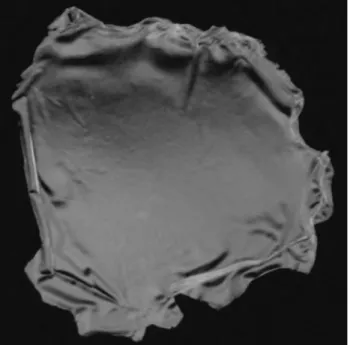
acid (98.7%) (Figure 2). Therefore, this feature made them highly competitive with polyethylene and petrochemical-derived plastics. The biodegradable biopolymer (PHB) are often preferred materials not only for environmental con-siderations, but also in medical application such as devel-oping therapeutic devices, for tissue engineering and for slow release drug delivery systems (Nair and Laurencin, 2007). The preparation of PHA polymer films which solely composed of 3-hydroxybutyric acid (98.7%) was imple-mented according to Kaiet al.(2003). A film made of PHB was shown in Figure 3.
Genotypic characterization
In case of genusPseudomonas, nearly complete se-quences have been determined for the PCR amplified 16S rRNA genes of about 21 species (Mooreet al., 1999). In this report, we have further investigated the taxonomic po-sition of the bacterial isolate Ps. fluorescensS48, which was proposed here to represent a species, upon sequencing most of the 16S rRNA gene, it was discovered that the iso-latePs. fluorescensS48 shares the same identical sequence, which is nearly the complete 16S rRNA gene. The identity of this sequence to the closest Pseudomonads strains is about 98-99%. Concerning the phylogenetic tree
con-structed in this study it was interesting to note that the iso-late Ps. fluorescens S48 is so close to Egyptian strain named EG 639838 (Figure 4). Based on phylogenetic study, the analysis of the 16S rRNA gene sequences data for the isolatePs. fluorescensshare the same sequence, but Figure 1- Efficacy of different recovery methods (1-6) on PHAs
extrac-tion fromPs. fluorescensS48.
Figure 2- Gas chromatography (GC) of 3HB-methyl ester indicating that the biopolymer produced byPs. fluorescensS48 was solely composed of 3-hydroxybutyric acid.
Figure 3- Plastic film made of PHB produced byPs. fluorescensS48.
slightly differ from another Pseudomonas species. The strain studied was probably closely related to support an-other meaningful parsimony analysis and construction of a phylogenetic tree. The genetic relationships between the
Ps. fluorescensS48 and known members of other species of
Pseudomonasgenus were estimated by parsimony analysis (Swofford, 1993) using haustoric search with TBR branch swapping (100 replicates). The bootstrap analyses were run with TBR MULPARS and 1000 replicates.
Acknowledgments
The authors are pleased to acknowledge Science and Technology Development Fund (STDF) for financial sup-port.
References
Abdel Hafez AM, Abdelhady Hemmat M, El-Sayed AA, Khodair TA (2009) Fermentative production of polyhydroxybutyrate (PHB) by high cell density culture ofR. eutrophaand A. latusin pH-stat fed-batch culture. J Biol Chem Environ Sci 4:93-107.
Altschul SF, Madden TL, Schaffer AA, Zhang J, Zhang Z, Miller W, Lipman DJ (1997) Gapped BLAST and PSIBLAST: A new generation of protein database search programs. Nu-cleic Acids Res 25:3389-3402.
Da Silva GP, Mack M, Contiero J (2009) Glycerol: A promising and abundant carbon source for industrial microbiology. Biotechnol Adv 27:30-39.
Gamal RF, Abdelhady HM, Hassan EA, El-Tayeb TS, Aboutaleb KA (2011) Production of Polyhydroxyalkanoate (PHAs) and Copolymer [P(HB-co-HV)] by soil bacterial isolates in batch and two-stage batch cultures. Egypt J Microbiol 46:85-90.
Gamal RF, Abdelhady HM, Hassan EA, El-Tayeb TS, Aboutaleb KA (2012) Production of PHAs from waste frying oil by
Pseudomonas fluorescens S48 using different bioreactor feeding strategies. Egypt J Microbiol 47:130-136.
Hahn SK, Chang YK, Kim BS, Chang HN (1994) Optimization of microbial poly (3-hydroxybutarate) recovery using disper-sions of sodium hypochlorite solution and chloroform. Bio-technol Bioeng 44:256-261.
Hahn SK, Chang YK, Lee SY (1995) Recovery and characteriza-tion of poly(3-hydroxybutyric acid) synthesized in Alcali-genus eutrophusand Recombinant Escherichia coli. Appl Environ Microbial 61:34-39.
IBM®SPSS®Statistics (2011) Version 19.0, SPSS Inc., Chicago, Illinois.
Jiang Y, Song X, Gong L, Li P, Dai C, Shao W (2008) High poly (b-hydroxybutyrate) production by Pseudomonas fluorescensA2a5 from inexpensive substrates. Enzym Mi-crob Technol 42:167-172.
Kai Z, Ying D, Guo-Qiang CH (2003) Effects of surface morphol-ogy on the biocompatibility of polyhydroxyalkanoates. Bio-chem Eng J 16:115-123.
Kim BS, Lee SC, Lee SY, Chang HN, Chang YK, Woo SI (1994) Production of polyb(3-hydroxybutyric acid) by fed-batch culture ofAlcaligenes eutrophuswith glucose concentration control. Biotechnol Bioeng 43:892-898.
Kim M, Cho KS, Ryu HW, Lee EG, Chang YK (2003) Recovery of poly (3-hydroxybutyrate) from high cell density culture ofRalstonia eutrophaby direct addition of sodium dodecyl sulfate. Biotechnol Lett 25:55-59.
Kinoshita K, Yanagida Y, Osakada F, Ueda Y, Narasimhan K, Cearley A, Yee K, Noda I (2005) Method for producing polyhydroxyalkanoates. US patent application US0239998. Lane DJ (1991) 16S/23S rRNA sequencing. In: E. Stackebrandt and M. Goodfellow, Editors, Nucleic Acid Techniques in Bacterial Systematics. John Wiley & Sons, Inc., New York, pp 115-148.
Lane DJ, Pace BG, Olsen J, Stahl DA, Sogin ML, Pace NR (1985) Rapid determination of 16S ribosomal RNA sequences for phylogenetic analyses. Proc Natl Acad Sci USA 82:6955-6959.
Law JH, Slepecky RA (1961) Assay of polybhydroxybutyric acid. J Bacteriol 82:33-36.
Lee SY (1996) Plastic bacteria. Progress and prospects for po-lyhydroxyalkanoate production in bacteria. Trends Bio-technol 14:431-438.
Lee SY, Choi J (1998) Polyhydroxyalkanoates biodegradable polymer. In: Manual of Industrial Microbiology and Bio-technology. 2ndedition. Demain AL, Davies JE (eds). ASM Press, Washington D.C., pp. 616-627.
Lee SY, Middelberg AP, Lee YK (1997) Poly(hydro-xybutytrate) production from whey using recombinantEscherichia coli. Biotechnol Lett 19:1033-1035.
Lee YW, Yoo YJ (1994) High cell density culture ofAlcaligenes eutrophusand poly-b-hydroxybutyrate production by opti-mization of medium compositions. J Appl Microbiol Bio-technol 22:401-406.
Lopez-Cuellar MR, Alba-Flores J, Gracida Rodrîguez JN, Pérez-Guevara F (2011) Production of polyhydroxyalkanoates (PHAs) with canola oil as carbon source. Inter J Biol Ma-cromol 48:74-80.
Moore E, Arnscheidt A, Kruger A, Stromple C, Mau M (1999) Simplified protocols for the preparation of genomic DNA from bacterial cultures. In: Molecular Microbial Ecology Manual, 1.6.1. Akkermans ADL, van Elsas JD, de Bruijn FJ (eds) Kluwer Academic Press, Dordrecht, pp 1-15. Mumtaz TS, Abd-Aziz N, Abdul Rahman P, Yee L, Shirai Y,
Hassan MA (2009) Fed-batch Production of P(3HB-co-3HV) Copolymer byComamonassp.EB 172 Using Mixed Organic Acids Under Dual Nutrient Limitation. Eur Sci Res 33:374-384.
Nair LS, Laurencin CT (2007) Biodegradable polymers as bio-materials. Prog Polym Sci 32:762-798.
Ramadan EM, El-Sawy M, Gamal RF, Abdelhady HM (1985) Growth parameters of yeast grown on agricultural residues using shake flasks as a batch culture. Annals Agric Sci, Fac Agri, Ain Shams Univ 30:25-45.
Ramsay BA, Lomaliza K, Chavarie C, Dube B, Bataille P, Ram-say JA (1990) Production of Poly-(b-hydroxybutyric-co-b -hydroxyvaleric) acids. Appl Environ Microbiol 56:2093-2098.
Riesenberg D, Guthke R (1999) High-cell-density cultivation of microorganisms. Appl Microbiol Biotechnol 51:350-360. Simon-Colin C, Raguénès G, Costa B, Guezennec J (2008)
Slater S, Houmiel KL, Tran M, Mitsky TA, Taylor NB, Padgette SR, Gruys KJ (1998) Multiple beta-ketothiolases mediate poly (beta-hydroxyalkanoate) copolymer synthesis in
Ralstonia eutropha. J Bacteriol 180:1979-1987.
Suriyamongkol PF, Weselake R, Narine S, Moloney M, Shah S (2007) Biotechnological approaches for the production of polyhydroxyalkanoates in microorganisms and plants. A re-view. Biotechnol Adv 25:148-175.
Swofford DL (1993) PAUP: Phylogenetic analysis using parsi-mony, version 3.1.1. Illinois Natural History Survey, Cham-paign.
Valappil SP, Misra SK, Boccaccini AR, Keshavarz T, Bucke C, Roy I (2007) Large-scale production and efficient recovery of PHB with desirable material properties, from the newly characterizedBacillus cereusSPV. J Biotechnol 132:251-258.
Vinnere O, Fatehi J, Wright SAI, Gerhardson B (2002) The causal agent of anthracnose of Rhododendron in Sweden and Lat-via. Mycol Res 106:60-69.
Verlinden RAJ, Hill DJ, Kenward MA, Williams CD, Radecka I (2007) Bacterial synthesis of biodegradable polyhydroxy-alkanoates. J Appl Microbiol 102:1437-1449.
Walinga I, Novozamsky I, Houba VJG (1992) Spectrophotomet-ric determination carbon of organic in soil. Commun Soil Sci Plant Anal 23:1935-1944.
Wang F, Lee SY (1997) Production of polyb(3-hydroxybutyrate) by fed-batch culture of filamentation-suppressed recombi-nant Escherichia coli. Appl Environ Microbiol 63:4765-4769.