810 Brazilian Journal of Physics, vol. 37, no. 2C, June, 2007
Inclusive Measurements on Diffractive Processes in
ep
Collisions
Xavier Janssen1, on behalf of the H1 and ZEUS Collaborations
1Universit´e Libre de Bruxelles, IIHE - CP 230, Boulevard du Triomphe, B-1050 Bruxelles, Belgium
Received on 25 November, 2006
Measurements from the H1 and ZEUS collaborations of the diffractive deep-inelastic scattering process, ep→eXY, whereY is a proton or a low mass proton excitation, are presented for photon virtualities in the range 2.2<Q2<1600 GeV2and squared four-momentum transfer at the proton vertex satisfying|t|<1 GeV2.
Diffractive parton distribution functions and their uncertainties are determined from a next-to-leading order DGLAP QCD analysis. Combining measurements of the inclusive diffractive deep-inelastic scattering process with an analysis of diffractive dijet production allows a very sensitive determination of both quark and gluon distributions.
Keywords: Diffraction; Deep inelastic scattering
I. INTRODUCTION
This proceeding summaries recent results [1–4] obtained with the H1 and ZEUS detectors at the HERA ep collider on measurements of the diffractive deep-inelastic scattering (DIS) process,ep→eXY, whereY is a proton or a low mass proton excitation, which represents at low Bjorkenx approx-imatively 10% of the total cross section. In diffractive inter-actions, a photon of virtuality Q2 is emitted by the incom-ing lepton and interacts strongly with the proton to form two hadronic final state systemsX andY separated by a large gap
0 0.05
0 0.05
0 0.05
0 0.05
0 0.05
0 0.05
0 0.05
0 0.05
0 0.05
0 0.05
0 0.05
0 0.05
0 0.05
0 0.05
0 0.05
0 0.05
10-4 10-210-4 10-210-4 10-210-4 10-210-4 10-210-4 10-210-4 10-2
xIP
σr
D(3) β=0.01 β=0.04 β=0.1 β=0.2 β=0.4 β=0.65 β=0.9 3.5 Q2
[GeV2]
5
6.5
8.5
12
15
20
25
35
45
60
90
200
400
800
xIP 1600
H1 Data H1 2006 DPDF Fit A (extrapol. fit)
FIG. 1: ThexIPdependence of the diffractive reduced cross section, multiplied byxIP, at fixed values ofβandQ2as measured by H1 [1]. The data are compared with the results of the “H1 2006 DPDF Fit A” resulting from a NLO DGLAP analysis.
in rapidity. Such processes are often discussed in terms of an exchange with net vacuum quantum numbers, the pomeron (IP), and a fractionxIPof the proton longitudinal momentum
is transferred to the systemX. Understanding the nature of the pomeron in terms of quarks and gluons is a challenge for Quantum Chromodynamics (QCD).
II. CROSS SECTION MEASUREMENTS
High statistic samples of diffractive DIS events are selected either by requesting a large rapidity gap (LRG) in the outgo-ing proton direction (H1 case [1]) or by a subtraction method differentially in the mass of theXsystem (MXMethod, ZEUS
case [3]). In such case, the measured process by H1 (ZEUS) isep→eXY, whereY corresponds to any baryonic system with massMY <1.6 GeV (MY<2.3 GeV). Both experiments
have also collected smaller samples for theep→eX pprocess by directly detecting the outgoing proton with Roman Pot de-tectors [2, 4]. This last selection method allows to measure the outgoing proton four-momentum and to reconstruct the squared four-momentum transfer at the proton vertext. In ad-dition tot,xIPand the usual DIS variablesxandQ2,
measure-ments are made as a function ofβ=x/xIP, which corresponds
to the fraction of the exchanged longitudinal momentum car-ried by the quark coupling to the virtual photon. Alltogether, the collected data are covering photon virtualities in the range 2.2<Q2<1600 GeV2,xIP<0.05 and|t|<1 GeV2.
A. Reduced cross sectionσDr(3)
As thetdependence can not be measured in the case of the LRG andMXMethods, the data are presented in the form of a
“diffractive reduced cross section”σDr(3), integrated overtand
MYin the ranges specified above and related to the differential
cross section measured experimentally by d3σep→eXY
dxIPdxdQ2 =2πα
2
xQ2 Y+σ D(3)
r (xIP,x,Q2)
whereY+=1+ (1−y)2. Similarly to inclusive DIS, the
func-Xavier Janssen 811
tionsF2D(3)andFLD(3)in the one-photon exchange approxima-tion according to
σDr(3)=F2D(3)−
y2 Y+
FLD(3).
The diffractive reduced cross section as measured via the LRG Method by the H1 experiment [1] is presented in Fig. 1 as function ofxIP at fixed values ofβ andQ2, together with
results of the “H1 2006 DPDF Fit A” presented below. These data presents unprecedented precision of 5% statistical, 5% systematic and 6% normalization in the best-measured region. Fig. 2 present a comparaison of the results on the diffrac-tive reduced cross section obtained via theMX Method by the
ZEUS experiment [3] with the H1 results. The two datasets are globally consistent with however some differences at low Q2and highβbeing observed.
B. tdependence
The datasets collected by the Roman Pot detectors allow to measure the t dependence of the diffractive cross sec-tions which is commonly parameterised with an exponential, dσ/dt∼eBt. The values ofBresulting from such fits to the H1 [2] and ZEUS [4] data are shown as a function ofxIPin
Fig. 3. At lowxIP, the H1 data are compatible with a
con-stant slope parameter, B≃6 GeV−2 wheather the high xIP
region is thought to be dominated by the exchange of sub-leading trajectory. In a Regge approach with a single lin-ear exchanged pomeron trajectory,αIP(t) =αIP(0) +α′IPt, the
slope parameter decreases with increasing xIP according to
B=B0−2α′IPlnxIP. The lowxIPH1 data favour a small value
ofα′IP≃0.06 GeV−2, thoughα′IP≃0.25 GeV−2, as obtained from soft hadronic interactions, cannot be excluded.
0 0.05
0 0.05
0 0.05
0 0.05
0 0.05
0 0.05
10-4 10-210-4 10-210-4 10-210-4 10-210-4 10-210-4 10-210-4 10-2
xIP
σr
D(3) β=0.01 β=0.04 β=0.1 β=0.2 β=0.4 β=0.65 β=0.9
3.5 Q2
[GeV2]
6.5
8.5
15
25
xIP 60
H1 Data ZEUS (Mx)
FIG. 2: Comparison of thexIPdependence of the diffractive reduced cross section, multiplied byxIP, at fixed values ofβandQ2as mea-sured by ZEUS [3] and H1 [1].
FIG. 3: Measurements of the slope parameterBby H1 and ZEUS.
III. QCD ANALYSIS OF H1 DATA AND DIFFRACTIVE
PARTON DISTRIBUTIONS
As proved in [5], QCD hard scattering collinear factorisa-tion is applicable to hard diffractive processes inep interac-tions such that cross secinterac-tions can be written in terms of con-volutions of partonic cross sections ˆσei(x,Q2)with Diffractive
Parton Distribution Functions (DPDF) fD i :
dσep→eXY(x,Q2,x
IP,t) =
∑
ifiD(x,Q2,xIP,t)⊗d ˆσei(x,Q2).
The partonic cross sections are the same as those for non-diffractive interactions. The DPDFs represent probability dis-tributions for partonsiin the proton under the constraint that the proton is scattered to a specified systemY with a speci-fied four-momentum. If such a theorem holds, the DPDFsfiD should be universal for all hard diffractive processes, e.g. in-clusive diffraction, jet or heavy-quark production. They are not known from first principles, but can be determined from fits to the data using the DGLAP evolution equations.
The kinematic range inxandQ2accessible being limited for a given value ofxIP, a parameterisation of thexIP
depen-dence of the DPDFs is necessary. The proton vertex factori-sation framework, in which the DPDFs are factorised into a term depending only onxIPandt and a term depending only
onx(orβ) andQ2, is often assumed:
fiD(x,Q2,xIP,t) =fIP/p(xIP,t) fi(β=x/xIP,Q2).
This is equivalent to treating the diffractive exchange as a “pomeron” with a partonic structure given by the parton dis-tributions fi(β,Q2), the “pomeron flux factor” fIP/p(xIP,t)
representing the probability that a pomeron with particu-lar values of xIP and t couples to the proton. The IP flux
can be parametrised using a Regge inspired form fIP/p =
AIPeBt/x 2αIP(t)−1
IP . The H1 data [1, 2] are consistent with the
vertex factorisation assumption and it is then used in their QCD fit.
The H1 collaboration performs next-to-leading order (NLO) QCD DGLAP fits to the reduced diffractive cross sec-tion in order to extract DPDFs. To avoid regions which are most likely to be influenced by higher twist contributions or other problems with the chosen theoretical framework, only data withMx>2 GeV,β<0.8 andQ2>8.5 GeV2are
812 Brazilian Journal of Physics, vol. 37, no. 2C, June, 2007
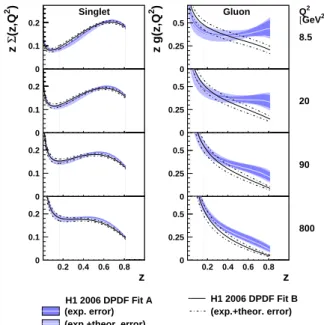
The DPDFs are modelled in terms of a singlet distribution
Σ(z), consisting of u, d and s quarks and anti-quarks with u=d =s=u¯=d¯=s¯, and a gluon distributiong(z). Here, zis the longitudinal momentum fraction of the parton entering the hard sub-process with respect to the diffractive exchange, such thatz=βat the lowest quark-parton order in inclusive diffraction, whereas 0<β<zfor higher order or other dif-fractive processes. The quark singlet and gluon distributions are parametrised at the starting scaleQ20as:
z fi(z,Q20) =AizBi(1−z)Ci,
whereAi,Bi andCi are free parameters of the fits, together
withαIP(0), which control the xIP dependence and the
nor-malisation of the sub-leading exchange contribution needed at highxIP. Information about fixed parameters and more details
on the fits can be found in [1].
0 0.1 0.2
0 0.25 0.5
0 0.1 0.2
0 0.25 0.5
0 0.1 0.2
0 0.25 0.5
0 0.1 0.2
0.2 0.4 0.6 0.8 0 0.25 0.5
0.2 0.4 0.6 0.8
z
Σ
(z,Q
2 )
z g(z,Q
2) Q2
[GeV2] 8.5
20
90
z z
800 Singlet Gluon
H1 2006 DPDF Fit A (exp. error) (exp.+theor. error)
H1 2006 DPDF Fit B (exp.+theor. error)
FIG. 4: The total quark singlet and gluon distributions, obtained from the “H1 2006 DPDF Fit A” and the “H1 2006 DPDF Fit B”, shown at four values ofQ2as a function ofz.
Resulting total quark singlet and gluon distributions, ob-tained from NLO QCD DGLAP fits to the H1 data are shown in Fig. 4 at four values ofQ2as a function ofz. The singlet
quark density is very closely related to the measured diffrac-tive cross section and is thus well constrained, with a typical error of 5%, the data requiring the inclusion of all three pa-rameters Aq, Bq andCq. By comparison, the gluon density
is weakly constrained by the data, especially at high z, and
insensitive to theBgparameter. In the “H1 2006 DPDF Fit
A”, the gluon density is parametrised atQ20=1.75 GeV2 us-ing only theAgandCg parameters, yielding a minimumχ2
value of 158/183 dof. However, leaving out also theCg
para-meter in the “H1 2006 DPDF Fit B”, i.e. that the gluon den-sity is a single constantAgatQ20=2.5 GeV2, leads to only
a small increase in theχ2(164/183 dof). The two fits being
quite different at highzpoints again to the weak constraint on the gluon density from the inclusive diffractive data. The frac-tion of the exchanged momentum carried by gluons integrated over 0.0043<z<0.8 is around 70% throughout theQ2range studied, confirming the gluon dominance in the diffractive ex-change. Fit A yields an effective pomeron intercept, indepen-dently ofQ2, ofα
IP(0) =1.118±0.008(exp.)+0−0..029010(model).
This is slightly higher than the valueαIP(0)≃1.08 describing
“soft” hadronic interactions. This result is compatible with that obtained from the ZEUS data [3] which are however indi-cating an increase ofαIP(0)forQ2>20 GeV2, which would
result in a breakdown of the proton vertex factorisation.
combined fit (exp. err.)
H1 2006 DPDF Fit
H1 2006 DPDF Fit B
0 0.025 0.05 0.075 0.1 0.125 0.15 0.175 0.2
0.2 0.4 0.6 0.8 0
0.025 0.05 0.075 0.1 0.125 0.15 0.175 0.2 0.225
0.2 0.4 0.6 0.8
0 0.1 0.2 0.3 0.4 0.5 0.6 0.7 0.8
0.2 0.4 0.6 0.8
Q2=25 GeV2 z
z*singlet(z)
H1 PRELIMINARY
quark
Q2=90 GeV2 z
z*singlet(z)
H1 PRELIMINARY
quark
Q2=25 GeV2 z
z*gluon(z)
H1 PRELIMINARY
gluon
Q2=90 GeV2 z
z*gluon(z)
H1 PRELIMINARY
gluon
0 0.2 0.4 0.6 0.8 1
0.2 0.4 0.6 0.8
FIG. 5: The total quark singlet and gluon distributions, obtained from a simultaneous fit to inclusive and dijet diffractive data, together with results from fits to the inclusive diffractive data only, shown at two values ofQ2as a function ofz.
To allow for a very sensitive determination of both the quark singlet and the gluon distributions in the range 0.05< z<0.9 with comparable precision, a third fit is performed si-multaneously to the H1 inclusive diffractive data [1] and to the diffractive dijet cross section in DIS as measured by the H1 collaboration [6]. A unique parametrisation compatible only with the “H1 2006 DPDF Fit B” is obtained, see Fig. 5.
[1] A. Aktaset al., H1 Collab., hep-ex/0606004. [2] A. Aktaset al., H1 Collab., hep-ex/0606003.
[3] S. Chekanovet al., ZEUS Collab., Nucl. Phys B713, 3 (2005). [4] S. Chekanovet al., ZEUS Collab., Eur. Phys. J C38, 43 (2004).
[5] J. Collins, Phys. Rev. D57, 3051 (1998) [Erratum Phys. Rev. D
61, 019902 (2000)]
![FIG. 1: The x IP dependence of the diffractive reduced cross section, multiplied by x IP , at fixed values of β and Q 2 as measured by H1 [1].](https://thumb-eu.123doks.com/thumbv2/123dok_br/18982784.457661/1.892.98.424.558.1010/dependence-diffractive-reduced-cross-section-multiplied-values-measured.webp)
![FIG. 2: Comparison of the x IP dependence of the diffractive reduced cross section, multiplied by x IP , at fixed values of β and Q 2 as mea-sured by ZEUS [3] and H1 [1].](https://thumb-eu.123doks.com/thumbv2/123dok_br/18982784.457661/2.892.97.419.722.1013/comparison-dependence-diffractive-reduced-cross-section-multiplied-values.webp)