Artigo
*e-mail: [email protected]
COMPUTATIONAL STUDY ON STRUCTURE AND PROPERTIES OF NEW ENERGETIC MATERIAL 3,7-BIS(DINITROMETHYLENE)-2,4,6,8-TETRANITRO-2,4,6,8-TETRAAZA-BICYCLO[3.3.0]OCTANE
Xinghui Jin*,a, Jianhua Zhou,a Shijie Wanga and Bingcheng Hub
aSchool of Chemistry and Pharmaceutical Engineering, Qilu University of Technology, Jinan 250353, China bSchool of Chemical Engineering, Nanjing University of Science and Technology, Nanjing, 210094, China
Recebido em 13/11/2015; aceito em 08/01/2016; publicado na web em 28/03/2016
The IR spectrum, crystal structure, electronic structure, thermodynamic properties, heat of formation and detonation properties of a new polynitro heterocyclic energetic material 3,7-bis(dinitromethylene)-2,4,6,8-tetranitro-2,4,6,8-tetraazabicyclo[3.3.0]octane were investigated theoretically. The calculated results show that this compound has a centrosymmetric structure and the molecular packing prediction indicates that the crystalline packing of the title compound is P212121 and the corresponding cell parameters are as follows:
Z=4, a= 22.03 Å, b=8.73 Å, c=8.42 Å, a=90°, b=90° and g=90°. Based on the high positive heat of formation (HOF, 740.4 kJ mol-1), excellent detonation properties (detonation velocity D, 9.77 km s−1; detonation pressure P, 45.9 GPa), energy gap (∆E
LUMO-HOMO) 4.19 eV and the molecular electrostatic potentials (MEP), it is predicted that 3,7-bis(dinitromethylene)-2,4,6,8-tetranitro-2,4,6,8-tetraazabicyclo[3.3.0] octane could be may be a superior high-energy density compound (HEDC) to RDX and HMX.
Keyword: density functional theory; heat of formation; energetic properties; electronic structure; crystal structure.
INTRODUCTION
Poly-nitro compounds continue to attract considerable interest for their wide applications in propellants, explosives and pyrote-chnics.1-4 Therefore, the design and synthesis of new HEDMs with high performance properties has been one of the most challenging tasks in this field. For instance, from the original well-known explo-sives 1,3,4,6-tetranitroglycouril (TNGU, Figure 1, A),5 hexahydro--1,3,5-trinitro-1,3,5-triazine (RDX)6 and 1,3,5,7-tetranitro-1,3,5,7--tetraazacyclooctane (HMX)7 to the present popular explosives 2,4,6,8,10,12-hexanitro-2,4,6,8,10,12-hexaazaisowurtzitane (CL-20),8 cis-2,4,6,8-tetranitro-1H,5H-2,4,6,8-tetraazabicyclo[3.3.0] octane (Bicycle–HMX),9 1,1-diamine-2,2-dinitroethene (FOX-7, Figure 1, B),10 etc., they are all HEDMs with high positive heats of formation (HOFs) and superior detonation performances (D, deto-nation velocity and P, detonation pressure). However, in most cases, the requirements of high detonation velocity and detonation pressure are often contradictory to their physical properties such as thermal and hydrolytic stability, sensitivity toward heat, shock, friction and electrostatic discharge, positive oxygen balance, environmentally benign decomposition products, low cost and so on.11 Take TNGU for example, it is moisture sensitive though its detonation performances are superior to those of RDX and HMX. Because there are four nitro groups in the molecule which will improve the heat of formation, while the carbonyl groups located at the end of the molecule makes it decompose easily under moisture. Research also reported that – C=C– group is more stable than –C=O or –N=N–group and thus, a new patent structure C6H10N4 (Figure 1, C) was designed.
On the other hand, five-membered nitrogen-rich heterocycles are potential candidates for traditional energetic materials. In this structure, there are four N-H bonds in the ring and four C-H bonds at the end of the ring which can be replaced by additional functional groups such as nitro, isocyano, azido functional groups and so on. The main difference between the nitro, isocyano, and azido functional groups is that when adding a nitro substituent into a molecule, it can improve the detonation properties of the compound more effectively
than adding either isocyano or azido groups.12 Herein, a new high--energy density material 3,7-bis(dinitromethylene)-2,4,6,8-tetranitro--2,4,6,8-tetraazabicyclo[3.3.0]octane (Figure 1, D) was designed on the basis of the structure of TNGU and FOX-7.
All computational details were performed on Gaussian 03 package13 with the density functional theory (DFT)14,15 at B3LYP method16,17 with 6-31G (d,p) basis set.18,19 Vibrational analyses at the same level of theory were performed to confirm that all of the optimized structures corres-pond to be the local energy minima on the potential energy surfaces. Meanwhile, natural bond orbital (NBO) analysis20 was carried out to investigate the trigger bond. All the calculations were performed using the default convergence criteria in the programs.
Calculation of the HOF of a new energetic material is necessary since it plays an important role in the detonation properties. To obtain the accurate HOF values, isodesmic reactions should be designed (Figure 2) in which the electronic environment of atoms in the reac-tants and products are very similar in isodesmic reactions, the errors of electronic correction energies can be counteracted, and then the errors of the calculated HOFs can be greatly reduced. The principle to design an isodesmic reaction is that the number of the atoms and the type of the bonds should be the same on both sides of the reaction. Previous studies also demonstrated this method as a feasible approach in estimation accurate of HOFs of new energetic materials.21,22
The HOF for the title compound at 298 K was derived from the following isodesmic reaction (Figure 2):
For the isodesmic reaction, the HOF can be calculated from the following equation:
(1) where ∆Hf,p and ∆Hf,Rare the HOFs of the products and reactants at 298 K, respectively. On the other hand, the HOF of a compound at 298 K can also be defined as follows:
difference between the zero-point energy (ZPE) of the products and reactants; and ∆HT is the thermal correction from 0 to 298 K. For reactions in the gas phase, ∆(PV) equals ∆nRT, and for isodesmic reactions, ∆n = 0. Based on equation (1) and (2), the HOF of the title compound can be easily obtained.
The experimental HOFs of the reference compounds NH3, CH4, NH2NO2 and CH3NO2 are available. However, the experimental HOF of compound C is unavailable and the additional calculations for the
atomization reaction C6H10N4 → 6C(g)+10H(g)+4N(g), must be car-ried out to accurately predict its HOF. It should be pointed out that the complete basis set CBS-Q method has been verified to be able to predict the HOFs accurately. Therefore, this method was used in this work to obtain the accurate HOF of compound C (345.2 kJ mol -1). Then HOF of the title compound was extracted easily while the HOFs of all the reference compounds were known.
Since the phase of most energetic compounds is solid, the HOFs for such compounds requires solid-phase HOFs (∆Hf,solid) rather than gas-phase HOFs (∆Hf,gas). According to Hess’ law,23 the ∆Hf,solid can be obtained from the ∆Hf,gas and heat of sublimation (∆Hsub):
∆Hf,solid = ∆Hf,gas – ∆Hsub (3) where ∆Hsub denotes the heat of sublimation.
Recently, Politzer et al.24 proposed that the ∆H
sub of energetic compounds correlates well with the molecular surface area and electrostatic interaction index (νσtot).The empirical expression of
the approach is as follows:
(4) where A is the surface area of the 0.001 e bohr−3 isosurface for the electronic density of the molecule; ν, the degree of balance between the positive and negative potentials on the isosurface; σ2
tot is a
mea-sure of the variability of the electrostatic potential on the molecular
surface; the coefficients a, b, and c were determined to be a = 2.670 × 10⁻⁴ kcal mol−1 A−4, b = 1.650 kcal mol−1, and c = 2.966 kcal mol−1. This approach has been demonstrated to be a reliable and popular approach to predict the heats of sublimation of energetic materials.
The detonation velocity (D) and detonation pressure (P) were calculated by the empirical Kamlet–Jacobs equations:25
(5) (6) where r is the loaded density of the explosive (g cm−3); D, the deto-nation velocity (km s−1); P, the detonation pressure (GPa); N is the number of moles of detonation gases per-gram explosive (mol g−1); —
M is the average molecular weight of these gases (g mol−1); and Q is the heat of detonation (cal g−1). For known explosives, their Q and ρ can be measured experimentally; thus their D and P can be calculated according to Kamlet–Jacobs equations. However, for new compounds, their Q and ρcannot be evaluated from experimental measures and therefore, to estimate their D and P, we first need to calculate their Q and ρ according to Table 1 and Monte-Carlo method, respectively.
Additionally, Politzer et al.26 found that the results for ρobtained using this method may have some errors for some systems, epecially in which there are strong hydrogen bonds. Thus, the ρ ofCHNO energetic materialsshould be corrected using the following equation to give an accurate result:
(7)
where ν is the degree of balance between the positive and negative potentials on the isosurface; σ2
tot is a measure of the variability of the
electrostatic potential on the molecular surface; and the coefficients b1, b2, and b3 are 0.9183, 0.0028, and 0.0443, respectively. Figure 1. Structures of the related compounds
Figure 2. Isodesmic reaction designed for the title compound
Table 1. Formulas for calculating the values of N, M, and Q for an explosive CaHbOcNd
Parameters Stoichiometric ratio
c≥2 a+b /2 2a+b/2 >c≥ b/2 b/2 > c
N (b+2c+2d )/4M (b+2c+2d)/4M (b+d)/2M
—
M 4M/(b+2c+2d) (56d+88c−8b)/(b+2c+2d) (2b+28d+32c)/(b+d)
Q*10-3 (28.9b+94.05a+0.239∆H
f)/M [28.9b+94.05(c/2−b/4)+0.239∆Hf]/M (57.8c+0.239∆Hf)/M aa, b, c and d stand for the number of C, H, O and N atoms in the explosive molecule respectively; bM in the formula is the molecular weight of the explosive (g mol-1); ∆H
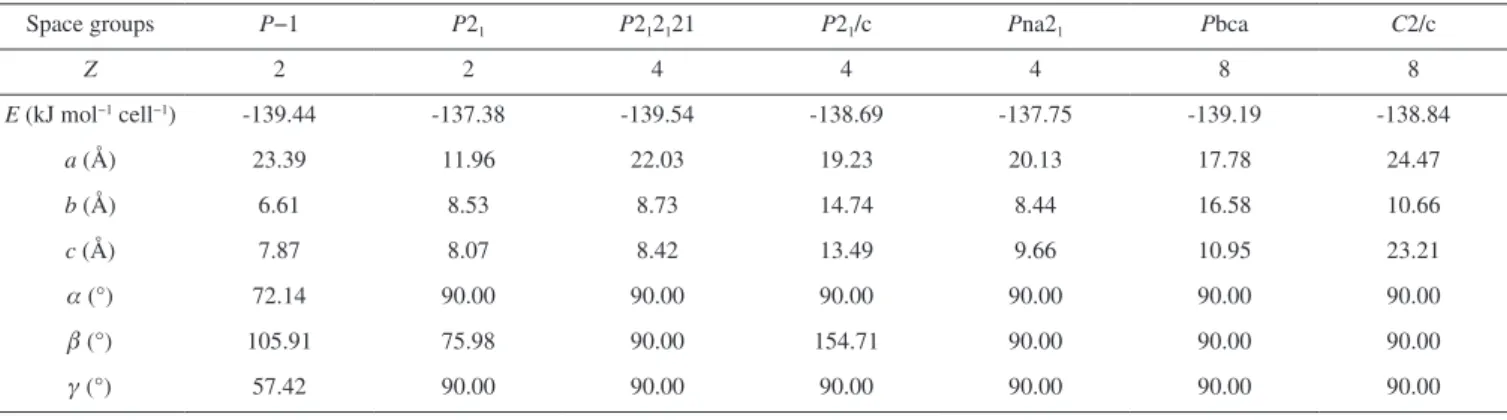
Since the high-energy density compounds are usually in solid phases, the possible polymorphs and crystal structure of the title compound were predicted using polymorph module of Materials Studio. The COMPASS force field is capable of predicting the con-densed phase properties by searching the possible molecular packing among the most probable seven space groups (P21/c, P-1, P212121, Pbca, C2/c, P21 and Pna21).
RESULTS AND DISCUSSION
Molecular geometrical structures
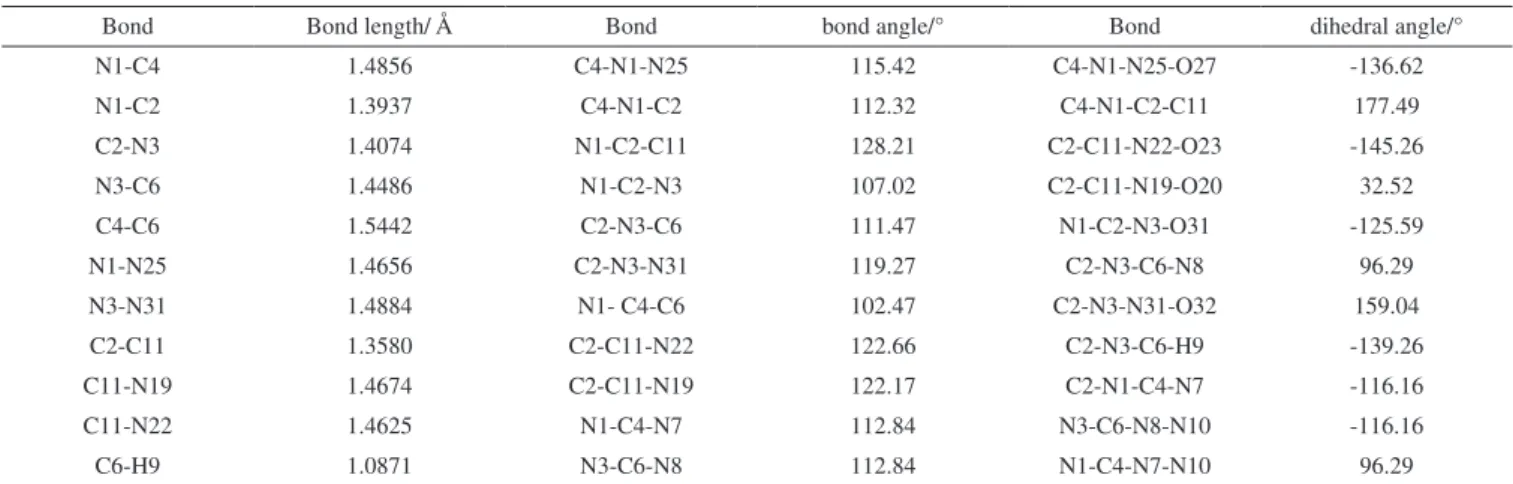
Figure 3 shows the optimized structure of the title compound at the B3LYP/6-31G (d,p) level. The selected bond length, bond angle and dihedral angle of the title compound that calculated at the same level were also presented in Table 2. From the table, it is seen that all the C–N bond lengths of the title compound range from 1.3937 to 1.4856 Å. They were between normal C–N bond length (1.49 Å) and the normal C=N bond length (1.28 Å) which indicates that the C–N bond lengths in the molecule tend to be average and form a large conjugated system. However, the C-C bond length (1.5442 Å) and the N-N bond length (1.4656 Å-1.4884 Å) in the molecule is slightly longer than the normal C-C (1.54 Å) or N-N bond length (1.45 Å) which may be due to the tension of the five-numbered ring and the electron withdrawing inductive effect of the nitro groups. Besides, the N–NO2 bond has been verified to be the trigger bond of nitramine explosives by both experimental and theoretical studies. Generally speaking, the bond length is closely related with the bond stability: the longer the bond is, the less stable the bond is and thus, is easier broken by accidental external stimulation. It is predicted that N3-N31 bond, which is longer than N1-N25, may be acted as the trigger bond when heated or attacked. On the other hand, the C4-N1-C2 bond angle in the five-numbered ring is 112°and is much bigger than the normal interior angle 108°. This may be caused by the steric strain between NO2 groups on the five-numbered rings. The bond angle of N1-C4-N7 is 112.84° which indicates that the two five-numbered rings in the molecule are not coplanar. Finally, the bond angle of N1-C4-N7 and N3-C6-N8 (112.84°), the dihedral angle of C2-N1-C4-N7 and N3-C6-N8-N10 (-116.16°), the dihedral angle of C2-N3-C6-N8 and N1-C4-N7-N10 (96.29°) were also found to be the same and thus, it is predicted that the title compound has a centrosymmetric structure.
Heat of formation and thermodynamic properties
Heat of formation (HOF) is usually considered when a new energetic material is designed since it plays an important role in the
energetic properties. HOF is always taken to be indicative of the ‘energy content’ of a HEDM and can be used to estimate the amount of energy released or absorbed in a chemical reaction. However, it is an extremely hazardous and difficult task to obtain the accurate HOF values for HEDMs experimentally. Hence, density functional theory and isodesmic reactions were employed jointly to calculate accurate HOF value of the title compound. Previous studies also demonstrated it as a reliable approach to calculate the accurate HOF values of energetic materials.
Table 3 lists the total energies (E0), thermal corrections (HT), zero-point energies (ZPE), and HOFs of the reference compounds. Since the ∆Hf,solid value was calculated using the Politzer approach, the related parameters such as molecular surface area A (353.1), the degree of balance between negative and positive potential ν(0.07), the square of the variability of the electrostatic potential σ2
tot(393.1 kcal mol−1), and the heat of sublimation ∆H
Sub (11.71 kcal mol−1) are obtained using the Multiwfn program.27 It is obviously seen that the title compound has a high positive HOF value (740.4 kJ mol-1) which may be attributed to the large number of the energetic N–N bonds and N–NO2 groups in the ring skeleton.
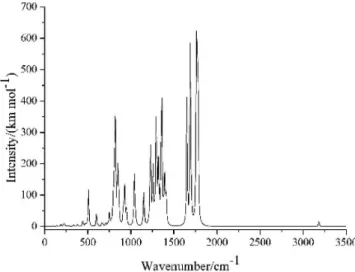
The IR spectrum together with their thermodynamic proper-ties often used to analyze or identify the structure and chemical properties of a compound. Figure 4 presents the simulated IR spectra of 3,7-bis(dinitromethylene)-2,4,6,8-tetranitro-2,4,6,8--tetraazabicyclo[3.3.0]octane at B3LYP/6-31G (d,p) level. It is obviously seen that there are several main characteristic regions: the
Table 2. Selected bond length, bond angle and dihedral angle of the title compound at B3LYP/6-31G (d,p) level
Bond Bond length/ Å Bond bond angle/° Bond dihedral angle/°
N1-C4 1.4856 C4-N1-N25 115.42 C4-N1-N25-O27 -136.62
N1-C2 1.3937 C4-N1-C2 112.32 C4-N1-C2-C11 177.49
C2-N3 1.4074 N1-C2-C11 128.21 C2-C11-N22-O23 -145.26
N3-C6 1.4486 N1-C2-N3 107.02 C2-C11-N19-O20 32.52
C4-C6 1.5442 C2-N3-C6 111.47 N1-C2-N3-O31 -125.59
N1-N25 1.4656 C2-N3-N31 119.27 C2-N3-C6-N8 96.29
N3-N31 1.4884 N1- C4-C6 102.47 C2-N3-N31-O32 159.04
C2-C11 1.3580 C2-C11-N22 122.66 C2-N3-C6-H9 -139.26
C11-N19 1.4674 C2-C11-N19 122.17 C2-N1-C4-N7 -116.16
C11-N22 1.4625 N1-C4-N7 112.84 N3-C6-N8-N10 -116.16
C6-H9 1.0871 N3-C6-N8 112.84 N1-C4-N7-N10 96.29
bands in 3100–3200 cm-1 are contributed from the C–H stretch in the five-numbered ring; the strongest characteristic peak at around 1600–1800 cm-1 is associated with the N=O asymmetric stretch of nitro groups; other remarkable signal ranges from 1000 to 1400 cm-1 is associated with the N–N asymmetric stretch while the signals less than 1000 cm-1 belongs to the fingerprint area which were mainly caused by the torsion of the skeleton and the bend vibration of nitro groups.
On the basis of vibrational analysis results and statistical ther-modynamic methods, therther-modynamic properties, including standard molar heat capacity Cp,m0 , standard molar entropy S0m and standard
molar enthalpy H0
m were evaluated and tabulated in Table 4.
The correlation equations between the thermodynamic func-tions and temperature from 200 K to 700 K were also summarized in Figure 5. From the figure, it is found that all the C0p,m, S0m and
H0m values increase evidently as the temperature increases and the
gradients of C0
p,m, S0m decrease whereas the gradients of H0m
incre-ases constantly. The mainly contributions to the thermodynamic functions are from the translation and rotation of molecules at low temperatures, considering that as the vibration motion is intensi-fied at higher temperatures, there will be more contribution to the enthalpy.30 Besides, the correlation equations were expressed as follows (where R2 is the correlation coefficients):
Cθ
p,m = 81.38 + 1.42T – 0.00078T2 R2=0.9999
Sθ
m = 311.56 + 1.84T – 0.00064T2 R2=0.9999
Hθ
m = –20.34 + 0.23T + 0.00036T2 R2=0.9999
Crystal structure
Molecular mechanics (MM) has been widely used to predict the molecular packing (crystal structure) of the energetic compounds. COMPASS,31 a force field able to produce the gas- and condensed--phase properties reliably for lots of energetic materials, was used to predict the crystal structure of 3,7-bis(dinitromethylene)-2,4,6,8--tetranitro-2,4,6,8-tetraazabicyclo[3.3.0]octane. Previous studies have demonstrated it as a reliable way in predicting the molecular structure. The high-density polymorph is sorted out from the large number of potential crystal structures, and the relative lattice parameters are presented in Table 5. Obviously, it is seen that the energies of the most probable seven space groups are in the range from -137.38 to -139.54 kJ mol-1 cell-1 and the structure with P2
12121 symmetry has the lowest energy. Therefore, it is predicted that the title compound may tend to exist in the P212121 group (Figure 6). The calculated cell Figure 4. Simulated IR spectra of the title compound at B3LYP/6-31G(d,p)
level
Table 3. Calculated total energies (E0, au), thermal corrections (HT, kJ mol-1), zero-point energies (ZPE, kJ mol-1), and heats of formation (HOFs, kJ mol-1) for
the reference compounds
Compound E0 ZPE HT ∆Hf,gas ∆Hsub ∆Hf,solid
NH3 -56.557769 0.034442 0.003807 -45.9a
CH4 -40.524020 0.045026 0.003810 -74.6a
NH2NO2 -261.035046 0.038304 0.004439 6.69b CH3NO2 -245.013375 0.050043 0.005254 -80.8a
C -453.6290523 0.167311 0.010011 345.2
D -2089.390301 0.184676 0.029665 789.4 49.0 740.4
aExperimental values taken from Ref. 28. bValues taken from Ref. 29.
Table 4. Thermodynamic properties of the title compound at different
tem-peratures
T(K) C0
p,m(J mol-1 K-1) Sm0(J mol-1 K-1) H0m(kJ mol-1)
200 332.79 652.09 40.16
300 435.89 806.97 78.69
400 523.39 944.76 126.77
500 593.54 1069.41 182.74
600 648.08 1182.66 244.91
700 690.08 1285.85 311.87
parameters are summarized as follows: Z = 4, a = 22.03 Å, b = 8.73 Å, c = 8.42 Å, a= 90°, b= 90° and g= 90°, respectively.
Detonation properties
Together with the calculated density of 2.08 g cm-3 obtained using Monte Carlo method from the volume inside an electron density contour of 0.001 e Bohr-3, the values of detonation velo-city and detonation pressure of 3,7-bis(dinitromethylene)-2,4,6,8--tetranitro-2,4,6,8-tetraazabicyclo[3.3.0]octane were listed in Table 6. In comparison with the r, D, and P values of the famous energetic material RDX and HMX, it is found that the calculated r, D, and P of 3,7-bis(dinitromethylene)-2,4,6,8-tetranitro-2,4,6,8-tetraaza-bicyclo[3.3.0]octane (r, 2.08 g cm-3; D, 9.77 km s-1 and P, 45.9 GPa) were superior to those of RDX (r, 1.82 g cm-3; D, 8.7 km s-1; P, 34.0 GPa) and HMX (r, 1.91 g cm-3; D, 9.1 km s-1; P, 39.0 GPa).32 In a word, the title compound can be considered as a potential high-energy density material according to the energy criterion for HEDMs (i.e., r>1.9 g cm-3, D>9.0 km s-1, P>40.0 GPa).33
Electronic structure and stability
Analysis of the molecular orbital of an energetic material is necessary since it can provide useful information on its physical and chemical properties. Previous studies have also proved that the larger the energy gap (∆ELUMO-HOMO) of the structure, the lower the
reactivity of a compound.35 The calculated energy of HOMO, LUMO and their energy gap of the title compound are -8.53 eV, -4.34 eV and 4.19 eV, respectively. It indicates that the title compound may have a lower reactivity. Figure 7 illustrates the highest occupied molecular orbital (HOMO, a), the lowest unoccupied molecular orbital (LUMO, b) and molecular electrostatic potentials (MEP, c) of 3,7-bis(dinitromethylene)-2,4,6,8-tetranitro-2,4,6,8-tetraaza-bicyclo[3.3.0]octane. From the figure, it is obviously found that title molecule has a symmetric structure and the symmetry delocalizes π electron cloud density of system, which makes the stability of the compound increase. It also can be seen that the molecule has 125 HOMOs and 126 LUMOs, and most of the HOMO and LUMO levels are of 2-fold degenerate. In view of the MEP, in which the colors range from -0.023 to 0.023 Hartree with red denoting the most nega-tive potential and blue denoting the most posinega-tive potential, neganega-tive potentials appear to be distributed mostly on the −NO2, specially the =C (NO2)2 groups at the end of the bicycle-skeleton; the positive ranges mainly characterize at the center of the bicycle-skeleton, which attributes some stabilization to the compound. This result is consistent with the stability criterion that proposed by Klapotke et al.36
Additionally, Politzer et al.37 proposed that h50, which can be calculated via Equation (8), is also an important parameter to predict the impact sensitivity of an energetic material. The calculated impact sensitivity (59 cm) shows that the title compound is more stable than those of HMX (29 cm) and RDX (26 cm).
(8)
where a, b and c are constants and can be obtained from Ref. 37; the quantities σ+2, σ–2 are indicators of the strengths and variabilities of the positive and negative surface potentials, respectively.
Stability under moisture
Previous studies have shown that compounds which contain dinitrourea segment are easier to decompose to other products under
Table 5. Unit cell parameters of the possible molecular packing of the title compound
Space groups P−1 P21 P212121 P21/c Pna21 Pbca C2/c
Z 2 2 4 4 4 8 8
E (kJ mol−1 cell−1) -139.44 -137.38 -139.54 -138.69 -137.75 -139.19 -138.84
a (Å) 23.39 11.96 22.03 19.23 20.13 17.78 24.47
b (Å) 6.61 8.53 8.73 14.74 8.44 16.58 10.66
c (Å) 7.87 8.07 8.42 13.49 9.66 10.95 23.21
a(°) 72.14 90.00 90.00 90.00 90.00 90.00 90.00
b (°) 105.91 75.98 90.00 154.71 90.00 90.00 90.00
g (°) 57.42 90.00 90.00 90.00 90.00 90.00 90.00
Figure 6. Simulated crystal structure of the title compound
Table 6. Detonation properties of the title compound, RDX and HMX
Compound r (g cm-3) D (km s-1) P (GPa)
Title compound 2.08 9.77 45.9
RDX 1.78a(1.82b) 8.87a(8.75b) 34.67a(34.0b) HMX 1.88a(1.91b) 9.28a(9.10b) 39.19a(39.10b) aTheoretical values are calculated at the B3LYP/6-31 G(d,p) level.34 b Experi-mental values are taken from Ref. 33.
moisture. This is because the carbon atom located in dinitrourea segment is more electropositive due to the inductive effect of nitro group and p-πconjugation effect of carbonyl group and thus, these types of compounds are easier to be attacked by nucleophilic reagents to form other products. In order to compare the moist stability of the title compound with TNGU, natural bond orbital (NBO) charges on the carbonyl-carbon atom was analyzed based on the hydrolysis mechanism at B3LYP/6–31G (d,p) level (Figure 8). From the figure, it is obviously that positive charges on the carbonyl-carbon atom of the title compound (0.37) is less than that of TNGU (0.83) and thus TNGU is easier to be attacked by water to form other products. On the other hand, C=C(NO2)2 segment is large than =O which may prevent carbonyl-carbon being attacked by H2O. Therefore, it can be concluded that water-resistance of the title compound is better than that of TNGU both from the point of view of electronic and the space steric effects.
Synthetic routes
From the above-discussions, it is seen that the title compound possesses superior detonation properties compared to those of RDX and HMX which makes it a new candidate as high-energy density material with a number of potential applications. Thus, a possible synthetic route was proposed according to the retro-synthetic analy-sis38 (Figure 9).
CONCLUSIONS
In this paper, a new high-energy density material (HEDM) 3,7-bis(dinitromethylene)-2,4,6,8-tetranitro-2,4,6,8-tetraaza-bicyclo[3.3.0]octane was designed and investigated theoretically. The following conclusions can be drawn:
Figure 8. NBO charges of the title compound (a) and TNGU (b)
Figure 9. Possible synthetic route of the title compound
(1) 3,7-Bis(dinitromethylene)-2,4,6,8-tetranitro-2,4,6,8-tetraazabicyclo[3.3.0]octane has a centrosymmetric structure and N3-N31 has the longest bond length which may be considered as the trigger bond when heated or attacked.
(2) The title compound has a high positive heat of formation (740.4 kJ mol-1) and the thermodynamic properties such as the standard molar heat capacity C0
p,m, standard molar entropy S0m and
standard molar enthalpy H0m increase evidently as the temperature
increases.
(3) The molecular packing prediction indicates that the title com-pound belongs to P212121 space group, with cell parameters Z=4, a= 22.03 Å, b=8.73 Å, c=8.42 Å, a=90°, b=90° and g=90°.
(4) The title compound has superior detonation properties (D, 9.77 km s-1; P, 45.9 GPa) to those of RDX and HMX. It meets the requirements and can be considered as a potential high-energy density material.
(5) The energy gap (∆ELUMO-HOMO) and the molecular electros-tatic potentials reveal that the title compound is consistent with the stability criterion.
REFERENCES
1. Sikder, A. K.; Sikder, N.; J. Hazard. Mater.2004, 112, 1. 2. Zhao, G. Z.; Lu, M.; Quim. Nova2013, 36, 513.
3. Jin, X. H.; Hu, B. C.; Lu, W.; Gao, S. J.; Liu, Z. L.; Lv. C. X.; RSC Adv.
2014,4, 6471.
4. Ma, C. M.; Liu, Z. L.; Yao. Q. Z.; Can. J. Chem.2014, 92, 803. 5. Pagoria, P. F.; Lee, G. S.; Mitchell, A. R.; Schmidt, R. D.; Thermochim.
Acta.2002, 384, 187.
6. Hudson, R. J.; Zioupos, P.; Gill, P. P.; Propellants, Explos., Pyrotech.
2012, 37, 191.
7. Landenberger, H. B.; Matzger, A. J.; Cryst. Growth Des.2012, 12, 3603.
8. Bayat, Y.; Zeynali, V.; J. Energ. Mater.2011, 29, 281. 9. Qiu, L.; Xiao,H. M.; J. Hazard. Mater.2009, 164, 329.
10. Anniyappan, M.; Talawar, M. B.; Gore, G. M.; Venugopalan, S.; Gandhe, B. R.; J. Hazard. Mater. 2006, 137, 812.
11. Klapötke, T. M.; Sabaté, C. M.; Chem. Mater.2008, 20, 3629. 12. Chi, W. J.; Li, L. L.; Li, B. T.; Wu, H. S.; J. Mol. Model.2012, 18, 3695.
13. Frisch, M. J.; Trucks, G. W.; Schlegel, H. B.; Scuseria, G. E.; Robb, M. A.; Cheeseman, J. R.; Zakrzewski, V. G.; Montgomery, J. A.;
Strat-mann, R. E.; Burant, J. C.; Dapprich, S.; Millam, J. M.; Daniels, A. D.; Kudin, K. N.; Strain, M. C.; Farkas, O.; Tomasi, J.; Barone, V.; Cossi, M.; Cammi, R.; Mennucci, B.; Pomelli, C.; Adamo, C.; Clifford, S.; Ochterski, J.; Petersson, G. A.; Ayala, P. Y.; Cui, Q. K.; Morokuma, D. K.; Malick, A. D.; Rabuck, K.; Raghavachari, J. B.; Foresman, J. C.; Ortiz, J. V.; Baboul, A. G.; Stefanov, B. B.; Liu, G.; Liashenko, A.; Piskorz, P.; Komaromi, I.; Gomperts, R.; Martin, R. L.; Fox, D. J.; Keith, T.; Al-Laham, M. A.; Peng, C. Y.; Nanayakkara, A.; Gonzalez, C.; Challacombe, M.; Gill, P. M. W.; Johnson, B.; Chen, W.; Wong, M. W.; Andres, J. L.; Gonzalez, C.; Head-Gordon, M.; Replogle, E. S.; Pople, J. A.; Gaussian, Inc.: Pittsburgh, PA. Gaussian 03, 2003.
14. Ravi, P.; Tewari, S. P.; Struct. Chem.2012, 23, 487.
15. Jin, X. H.; Hu, B. C.; Jia, H. Q.; Liu, Z. L.; Lv, C. X.; Quim. Nova2014,
37, 74.
16. Becke, A. D.; J. Chem. Phys. 1992, 97, 9173.
17. Lee, C.; Yang, W.; Parr, R. G.; Phys. Rev. B1988, 37, 785.
18. Sviatenko, L. K.; Gorb, L.; Hill, F. C.; J. Comput. Chem.2013, 34, 1094. 19. Dill, J. D.; Pople, J. A.; J. Chem. Phys.1975, 62, 2921.
20. Glendening, E. D.; Landis, C. R.; Weinhold, F.; Comput. Mol. Sci.2012,
21. Wu, Q.; Pan, Y.; Zhu, W. H.; Xiao, H. M.; J. Mol. Model.2013, 19, 1853.
22. Wu, Q.; Zhu, W. H.; Xiao, H. M.; J. Mol. Model. 2013, 19, 2945. 23. Atkins, P. W.; Physical chemistry, 2nd ed., Oxford University Press:
Oxford, 1982.
24. Politzer, P.; Ma, Y.; Lane, P.; Concha, M. C.; Int. J. Quantum Chem.
2005, 105, 341.
25. Kamlet, M. J.; Jacobs, S. J.; J. Chem. Phys.1968, 48, 23.
26. Politzer, P.; Martinez, J.; Murray, J. S.; Concha, M. C.; Toro-Labbé, A.;
Mol. Phys.2009, 107, 2095.
27. Lu, T.; Chen, F.; J. Comp. Chem.2012, 33, 580. 28. Fan, X. W;. Ju, X. H.; J. Comp. Chem.2008, 29, 505.
29. Wilcox, C. F.; Zhang, Y. X.; Bauer, S. H.; J. Mol. Struct.: THEOCHEM
2000, 528, 95.
30. Zhao, G.; Lu, M.; Struct. Chem. 2013, 24, 139.
31. Sun, H.; J. Phys. Chem. B1998, 102, 7338.
32. Liu, H.; Wang F.; Wang, G. X.; Gong, X. D.; J. Phys. Org. Chem. 2012,
26, 30.
33. Xiao, H. M.; Xu, X. J.; Qiu, L.; Theoretical design of high energy den-sity materials, Science Press: Beijing, 2008.
34. Zhou, H.; Ma, Z; Wang, J.; Wang D.; Def. Technol.2014, 10, 384. 35. Chi, W. J.; Li, L. L.; Li, B. T.; Wu, H. S.; J. Mol. Model.2013, 19, 571.
36. Hammerl, A.; Klapotke, T. M.; Nöth, H.; Warchhold, M.; Holl, G.;
Propellants, Explos., Pyrotech. 2003, 28, 165.
37. Pospíšil, M.; Vávra, P.; Concha, M. C.; Murray, J. S.; Politzer. P.; J. Mol. Model.2010, 16, 895.