THIS REPORT WAS PREPARED BY “STUDENT’S NAME”, A MASTERS IN FINANCE STUDENT OF THE NOVA SCHOOL OF BUSINESS AND ECONOMICS, EXCLUSIVELY FOR ACADEMIC PURPOSES.THIS REPORT WAS SUPERVISED BY ROSÁRIO ANDRÉ WHO REVIEWED THE
VALUATION METHODOLOGY AND THE FINANCIAL MODEL. (SEE DISCLOSURES AND DISCLAIMERS AT END OF DOCUMENT)
See more information at WWW.NOVASBE.PT Page 1/34
M
ASTERS IN
F
INANCE
E
QUITY
R
ESEARCH
We value BPI’s shares at 1.20 €, which gives us an upside of 16% from their current value. Hence, our recommendation is to buy.
In the following years we expect a decrease on BPI’s total assets (-3.5% YoY in 2013 and -2.1% YoY in 2014), since the bank will have to sell some of its non-core assets to accomplish the CoCos schedule payment.
BPI repaid in the 1Q 2013, 200 million euro of CoCos (of the 1.5 billion euro subscribed by the Portuguese State in June 2012, under the recapitalization plan). We expect that until the end of the year, the bank will be able to repay more 175
million of euro.
BPI already announced that it will close more 47 branches until the end of the 1H 2013. We expect a decrease of 50% YoY on the operating expense in the end of 2013. The cost-to-income is expected to rise 2 bps from 2012 to 2013, since we expect a decrease of 3% YoY of the operating income from banking activity – in 2012 this income was mostly driven by gains from its sovereign exposure.
BFA will continue to be crucial for BPI’s good performance, in terms of liquidity and solvency, as well growth perspectives.
Company description
BPI is one of the largest private banks in Portugal. The bank offers services in Investment Banking, Financial Investment, Private Equity, Domestic Commercial Banking, and International Commercial Banking in Angola and Mozambique. It has a market share in Portugal of closely to 10% of deposits, 9% loans, and above of 16% in asset management.
BPI
C
OMPANY
R
EPORT
B
ANKING
S
ECTOR
03
J
UNE2013
STUDENT: MADALENA TELO
GONÇALVES
[email protected]
Capital Reinforcement
Extraordinary Times Call for Extraordinary Measures
Recommendation: BUY
Price Target FY11: 1.20 €
Price (as of 31-May-2013) 1.03 € Reuters: BBPI.LS, Bloomberg: BPI PL
52-week range (€) 0.37-1.38
Market Cap (€mn) 1,433.1
Outstanding Shares (mn) 1,390
YtD Change (%) 9.33%
Source: Bloomberg
Source: Bloomberg
(Values in € millions) 2011 2012 2013E
NII 543 549 517
Operating Expenses 131 20 10
Net Income before tax (356) 400 275
Net Income (285) 249 179
EPS (0.29) 0.18 0.13
ROA 0.6% 0.4% 0.4%
ROE (35%) 12% 9.%
Cost-to-Income 67% 48% 50%
Loans-to-Deposits 114% 102% 98%
RWA 25,152 24,512 24,292
CT1 ratio 9.2% 15.0% 14.4%
BPI COMPANY REPORT
PAGE 2/34
Table of Contents
COMPANY OVERVIEW ... 3
HISTORY ... 3
International Presence ... 4
SHAREHOLDER STRUCTURE ... 4
MACROECONOMIC CONTEXT ... 6
PORTUGUESE CONTEXT ... 7
VALUE DRIVERS ...10
PORTUGAL ... 11
Loans Portfolio ... 11
Assets Quality... 13
Deposits ... 14
SOLVENCY AND PROFITABILITY ... 15
ANGOLA ... 16
Banking sector ... 17
EXTRAORDINARY TIMES ...17
EXTRAORDINARY REGULATION ... 18
BPI’S RECAPITALIZATION PLAN ... 19
CAPITAL REQUIREMENTS ... 21
ECBFUNDING ... 22
SOVEREIGN EXPOSURE ... 23
PENSION FUNDS ... 24
VALUATION ...25
METHODOLOGY ... 25
COST OF EQUITY ... 27
VALUATION SUMMARY ... 28
KEY INDICATORS ... 28
RISKS FACTORS ...29
CONCLUSIONS AND RECOMMENDATION ...30
APPENDIX ...31
BPI COMPANY REPORT
PAGE 3/34 Market Cap Total Assets
BPI 1.433 43.129 BES 3.066 84.946 BCP 2.109 89.474
As of 31st May 2013 in million of euro
Company overview
BPI is the 4th major financial group in Portugal, and market leader in Angola. With a market cap of 1.433,1 million of euro1 it has in Portugal a market share of close to 10% of loans, 9% of deposits, and above to 16% in asset management. In Angola, BFA has a market share of 9,7% in loans, 16% in deposits and 17% in branches, as of February 2013.
According to data of March 2013, BPI Group has total assets closely to 43 billion of euro, 1.7 million customers in Portugal and 1,1 million in Angola, which allows it to be placed it in the 4th and 2nd country positions respectively, ranked by market share.
History
The bank was founded in 1985 substituting a Portuguese Investment Society created originally in 1981 – Sociedade Portuguesa de Investimento (SPI). In 1986 BPI opened its capital to the public, listing its shares on the Lisbon and Oporto Stock Exchanges. In 1991, the bank started to direct its business for the commercial banking segment by the acquisition of the Fonsecas & Burnay Bank. In 1995, the bank was converted in a SGPS (holding company) becoming then, the first Portuguese financial group to be listed in the stock exchange.
At the beginning, as SPI, its main activity was to finance investment projects from private companies. Only in 1985, when it converted into a bank it became able to collect deposits and grant loans. Even so, until 1991, BPI was mainly an investment bank.
Since the bank became a SGPS, it decided to orient its business more to the commercial area. From 1992 until now, the bank increase its loans from 1.5 billion euro in year end 1992 to 28.1 billion euro in year-end 2012, and it increased its deposits from 3.1 billion in year end 1992 to 24.4 billion euro in year-end 2012 (Figure 4). As a consequence of the growth of the commercial business, the total loans have gained weight in the bank’s total assets. While at the end of 1992, the total loans accounted only 27% of the total assets, since 2000 the total loans represent more than 60% of the total assets in the balance sheet (Figure 5).
In the year end of 2012, the income from commercial banking was responsible for close to 60% of the total operating income from banking activity of the group.
1
As of 31st May, 2013
Fig. 2 – Loans Market Share in Portugal
Source: APB
Fig. 3 – Deposits Market Share in Portugal
Source: APB
Fig. 4 – BPI – total loans, total deposits and total assets
Source: Bloomberg, company data, NOVA Equity Research
BPI COMPANY REPORT
PAGE 4/34 In which refers to the activity in Portugal, the loans portfolio of the bank is highly composed by mortgages loans (44% in 2012). BPI in Portugal is recognized as a strong player on home loans bank.
In general, the services offered by the bank are Investment Banking, Financial Investments, Private Equity, Asset Management, Insurances, Domestic Commercial Banking and International Commercial Banking.
International Presence
Already in the beginning of the bank as a holding company, the group started to extend its activity aboard. Today, the most relevant sources of income in the international activity are the stake of 50,1% on the equity capital of Banco Fomento de Angola (BFA), in Angola, and the 30% interest held in Banco
Comercial e de Investimento (BCI), in Mozambique. Taking into account the
macroeconomic context and banking system in Portugal and the perspectives of growth and development in Angola, we strongly believe that BFA has a crucial role in the survival and growth of the group in the future. BFA is a commercial bank mainly focused in corporate banking, and it is inserted in an emerging market where the banking activity still has potential to increase a lot its profitability.
BPI was originally an investment bank, all the commercial activity was acquired (both national and international) (Figure 6). Thus, despite nowadays its main activity to be the commercial business, it still has a strong position in the Portuguese market in which respects the assets management – 16% market share.
Shareholder structure
Even with some fluctuations in 2012, we define the BPI Shareholder Structure as strong and cohesive, which is a positive variable when valuing the bank, since means stability and solidity. Today, the core shareholders holding BPI’s share capital are La Caixa (46.2%), Santoro (19.5%), Grupo Allianz (8.8%) and HVF SGPS (2.2%), (Figure 7). The bank has a share capital of 1,190 million euro made up by 1,390 million shares listed on the Euronext market.
In 2012 we assisted to some changes on the BPI’s shareholders structure (Figure 8):
In April 2012, the Brazilian bank Itlaú - one of the oldest shareholders of BPI – sold its participation in the group. This resulted in a less dissolved Fig. 5 – BPI – total loans % total
assets
Source: Bloomberg, company data, NOVA Equity Research
Fig. 6 –BPI’s acquisitions
Source: Company data
Fig. 7 –BPI’s Shareholder Structure
BPI COMPANY REPORT
PAGE 5/34 shareholders structure but even so protected by CMVM (Securities Market Comission) for any control by La Caixa.
In August 2012, BPI issued 400 million shares with a nominal value of 50 cents, entirely subscribed by BPI’s shareholders. BPI’s share capital increased from 990 million euro to 1.190 million euro, which resulted in an increase from 990 million to 1.390 million shares outstanding.
Since the recapitalization plan in August 2012, the market price of BPI shares has been always above the 50 cents (price of subscription), meaning it has been rewarding for the shareholders who subscribed the share capital increase. After the announcement of the increase of its share capital (19th July), BPI shares were traded below 50 cents in the secondary market. This determined which shareholders have subscribed the shares issuance – strong shareholders against the smaller ones. La caixa, Isabel dos Santos through Santoro, and Allianz subscribed more than 90% of the share capital increase. Nevertheless, the 400 million new shares were entirely subscribed and, in the beginning of this year, BPI shares traded at a high of 1.38 euro which means 176% return for those who subscribed by 50 cents in the share capital increase (Figure 9).
Therefore, there are only four big shareholders who have more than 2% of its share capital. The three bigger shareholders - La Caixa, Santoro and Allianz - have 74.5% of BPI’s share capital. Historically, La Caixa and Allianz are key shareholders since 1995, while Isabel dos Santos became a significant Fig. 8 –BPI’s Shareholder
Structure in 2011 and in 2012
Source: Company data
Fig. 9 –BPI’s share price following the share capital increase
Source: Bloomberg, company data, NOVA Equity Research
11 January: BPI shares traded at
BPI COMPANY REPORT
PAGE 6/34 shareholder in 2008, through Santoro. Close to three quarters of the share capital of the bank is controlled by only three big shareholders, and two of them are in the bank since the beginning. We then do not expect any significant changes in the strategy of the bank that could lead to instability and could compromise the confidence of the smaller investors.
Geographically known, Spain has 58.50%, Portugal 26.41%, Germany 10.98%, and the US 0.60%. In terms of ownership type, 85.35% belongs to investment advisors, 10.99% insurance companies, 1.01% holding companies, 0.86% to individuals and 0.67% to mutual funds.
Macroeconomic Context
A few years ago, the sub-prime crisis was a turning point in the banking system. The financial markets were strongly blamed by the crisis and consequently emerged the need to better regulate the banking sector through the requirement of higher capital ratios and a tighter control in the assets quality of each bank. Naturally, these measures have having a great impact on the banks’ profitability and activity.
For many years, a low equity-to debt ratio was not a concern factor, actually it was seen as a sign that the bank, or any other company in another industry, was being more productive. High amounts of equity were seen as money tied up in assets. Also, illiquid assets with high levels of risk associated, are expected to give the bank higher margins, so banks with high liquidity ratios was a sign that they were in some way compromising their profitability. The sustainability of that approach went down when toxic assets started to come out. The risk of default of one security would infect all the system, and banks did not have reserves to cover their losses.
The economy in general started a deleveraging process which has been transversal to all economy, including banks, companies, individuals and government states. That has had a huge impact in the banking sector as well in the stock markets, and all over the developed countries we have seen the deterioration of the macroeconomic indicators. As illustrative of the deleveraged process and dropped in the stock market, the Total Debt to Total Equity and the Total Debt to Total Assets of the STOXX Europe 6002 have decreased from 356.09% in 2007 to 226.59% this year and from 34.13% in 2007 to 26.38% this year respectively. Also, Total Debt to Total Equity and the Total Debt to Total
2
Index composed by 600 large, mid and small capitalisation companies across 18 European companies. Fig. 10 – STOXX Europe 600 and
STOXX Europe 600 Banks
Source: Bloomberg
Fig. 11 – GDP % change – World and Euro area
Source: IMF
BPI’s shareholder structure is
BPI COMPANY REPORT
PAGE 7/34 Fig. 13 – Portuguese general government
debt in % of GDP
Assets of Euro STOXX Banks Index have decreased from 1,204.94% in 2007 to 753.78% and from 45.64% in 2007 to 37.49% this year respectively.
Especially the banking activity, it is greatly dependent on investors’ confidence, all of bank’s activity is built on confidence. Pre-crisis, investors used to believe that since big banks were supporting the entire economy, they always be protected by the governments. In fact, the successful development of an economy is greatly dependent on the banking system as source of credit. In 2008, the Lehman Brothers bankruptcy uncovered the vulnerability of the high leverage ratios and high risk exposures of banks.
In Europe, the global macroeconomic deterioration put in evidence the unsustainability of rising government deficits and debt levels across some European countries. The concerns among investors and the risk-aversion context created huge spreads between the peripheral government bonds yields and core government yields (Figure 12). These high spreads created an uncertainty environment around the preservation of the single currency. It emerged a serious crisis of confidence all over Europe, which intensified the downtrend of the stock market and put in risk the capability of some European economies get funds in the debt market.
The ECB has intervened in a way to guarantee funds to the distressed economies and at the same time preserve the harmony between its member-states. We can see some confidence back to the European Union since the end of 2012 through the decreasing of the spread between peripheral and core government bonds yields and through the recovery of the stock market.
Portuguese Context
BPI is headquartered in Portugal, and in spite of the activity in Angola has a growing role in the profits of the BPI group, the bank is still very dependent on the Portuguese macroeconomic conditions. In Portugal, the sovereign debt crisis has having a tremendous impact on the country’s economic evolution and especially in the banking industry. Portugal is now facing several adjustments through painful austerity measures headed for budget consolidation. Considering the role of the banking system in the Portuguese economy, it becomes vital to reinforce its capability to face the current global adverse conditions by increasing the bank’s capital ratios. Also in order to anticipate the new capital standards required by the Basel III, that will be introduced from 2013 until 2018.
Looking for the evolution of the debt levels in Portugal we see that in the year end of 2012 the general government debt accounted 112%3 of the GDP, and it is
3
According to International Monetary Fund, World Economic Outlook Database, April 2013 Source: IMF
Source: Bloomberg
BPI COMPANY REPORT
PAGE 8/34
BPI Portuguese Republic
Moody's A1 Aa 2
Fitch A+ AA
S&P A
AA-Moody's A2 A1
Fitch A- A+
S&P A-
A-Moody's Ba a 2 Ba a 1
Fitch BBB-
BBB-S&P BBB-
BBB-Moody's Ba 3 Ba 3
Fitch BB+ BB+
S&P BB- BB
June 2007
Dec 2010
Apr 2011
March 2012
expected that this percentage continue to increase in the next years (Figure 13). When a few years ago, the global economy started to collapse, the high level of debt of Portugal became a concern factor for the investors. The uncertainty around its public finances moved away foreign investors, and the yields on public debt rallied for levels that put the country closed to bankruptcy. Rating agencies downgraded the Portuguese Republic, and the uncertainty around the country increased a lot the funding costs. Ultimately Portugal has needed an external rescue combined with a readjustment program. In May of 2011, Portugal signed an agreement with the Troika (European Commission, European Central Bank and the International Monetary Fund), where Portugal received a bailout of 78 billion of euro and compromised to apply a package of austerity measures in order to increase the investors’ confidence and be able to obtain funds in the market debt again.
In March 2013, the Eurozone ministries of finance decided to give seven years extension for Portugal repay their loans. It allows Portuguese republic to extend the maturities on their public debt and recover the credit rating of Portuguese Republic. However the international credit rating agencies maintain their outlook negative for Portugal and also for BPI.
Long Term Rating Moody's Standard & Poor's Fitch
BPI Ba3 BB- BB+
BES Ba3 BB- na
BCP B1 B+ BB+
Portuguese Republic Baa3 BB- BB+
The downgrade of Portuguese Republic has a great impact on the rating of BPI, and we assume that the bank can only recover its credit rating when the Portuguese republic recovers it.
The austerity measures that are being implemented right now are unsurprisingly compromising the economic growth (Figure 15). According to the International Monetary Fund (IMF), World Economic Outlook Database of April 2013, it is expected an economic deceleration in Portugal of 2.3% YoY for 2013 and a YoY growth of 0.6% in 2014. The unemployment rate is expected to continue to rise (Figure 17), while the consumption and public investments should continue their downtrends. In 2012, the Portuguese GDP decreased 3.2% YoY, the household consumption fell 5.3% YoY, and it was registered an unemployment rate of 15.7% in the year-end of 2012. Also the investment has been decreasing, not only the national investment as also the foreign investment. The total investment in Portugal, in percentage of GDP went from 18% in 2011 to 16% in 2012. It is Fig. 14 – BPI and Portuguese Republic
evolution
Source: Bloomberg and company data
Fig. 15 – Portuguese GDP, constant price, % change
Source: IMF
Fig. 16 – Portuguese total investment and gross national savings, in % of GDP
Source: IMF
BPI COMPANY REPORT
PAGE 9/34
Source: Bank of Portugal Source: Bank of Portugal
Source: Bank of Portugal Source: Bank of Portugal Source: Bank of Portugal
expected to decrease to 15% in 2012. The European economic deceleration reduces the investments made all over Europe. Also, the uncertainty around the country makes other economies more attractive for investment. This economic contraction increases the probability of default of companies and individuals, since reduces the income disposable to accomplish their obligations. Consequently the non-performing loans and insolvencies increase and banks have then to increase the amount of provisions in their balance sheets in order to cover the losses of loans in default. At the same time, as we already mentioned, the ideal debt-to-equity ratio of companies in all industries is not the same as it was in a few years ago. Now, with the current economic environment of uncertainty, companies try to decrease the risk of their companies, increasing the proportion of capital which finances their assets. Firstly, banks are more concern about their assets quality and then are requiring high warrants before grant a loan, secondly companies are deleveraging their balance sheets and then they are not asking as much credit as before. As result, the banks’ revenues decrease and the funds for new lends are also reduced.
In the first quarter of 2013, the credit downtrend continued in place: consumption loans decreased in March 9.4% YoY, the housing loans fell 3.6% YoY, and the loans to non-financial corporations fell 4.9% YoY. The household deposits also decreased 0.3% YoY, and the deposits of non-financial corporations dropped 15.1% YoY.
Fig. 18 – Non-financial corporations loans YoY% growth
Fig. 19 – Housing loans YoY% growth Fig. 20 – Consumer loans YoY% growth
Fig. 21 – Deposits of non-financial corporation YoY% growth
Fig. 22 – Deposits of households YoY% growth Fig. 17 – Unemployment rate in Portugal
and in the Euro area
BPI COMPANY REPORT
PAGE 10/34 million of euro 2010 2011 2012
Total Assets 41.088 38.325 39.659 Commercial Banking 42.781 39.822 40.414 Investment Banking 4.258 3.217 2.576 Equity Investments 142 128 137
Total Liabilities 39.809 38.088 38.216 Commercial Banking 47.709 39.845 39.166 Investment Banking 4.184 3.125 2.492 Equity Investments 9,0 - 41.276 27
Net Income 87 - 375 163 Commercial Banking 51 - 438 153 Investment Banking 6,8 - 1,4 6,3 Equity Investments 29 65 4,6
Domestic Activity
Source: Company data, NOVA Equity Reserach
Once the funding costs in the debt market achieved unbearable levels, banks have financed their operations with low costs ECB funds.
BPI took 4 billion of the Long-Term Refinancing Operations (LTRO) issued by the ECB in the end of 2011 and beginning of 2012. These operations will be used to refinance the next 2 years, and they are being used also for carry trades purposes.
With the recovery of the European confidence crisis and the improvement of macro indicators, it is expected that the ECB intervention will reduce and then the exposure of Portuguese banks to ECB funds will decrease.
In fact, with the back of markets’ confidence, this reliance is already going down. In the first quarter of the year, the Portuguese banks’ exposure to ECB funds accounted 47.79 billion of euro, according to BoP. That amount corresponds to a decrease of 3.46% MoM from February. The ability of some banks to issue senior debt also contributed to the decrease of that exposure. In the future we expect this value will continue to decline, once the economy will restore and banks will be able to finance themselves.
Value Drivers
Nowadays, BPI is mainly a commercial bank, being the net interest income from loans and deposits the main source of profit. The evaluation of the loans as source of interest income, and the deposits as users of interest expense is consequently one of the most relevant aspects under study in our valuation. The real GDP growth plus the inflation expected for a country in a specific period influences the volume of loans and deposits that we should expect. In normal circumstances, the demand of loans and deposits explains the interest rate applied on them. Apart of other factors, the higher the demand of loans, the higher the ability of banks increase the interest rate charged on the, and the higher the demand on deposits, the higher the ability of banks decrease the interest rate paid on them. Naturally, the larger the spread on those interest rates, the higher is the margin and the value creation for the bank. Besides the growth of the country, the stock market trend can also indicate the demand of deposits we should expect. In periods of bearish market, investors tend to allocate their money on deposits instead of invest it in the stock market, and vice-verse on periods of bullish market. In this era, regulation is a factor with increasingly importance when value a bank: it determines the interest rates as well the amounts of capital and reserves, which determines the bank’s performance.
Fig. 23 – Breakdown of domestic total assets, total liabilities and net income
The Portuguese bank’s
BPI COMPANY REPORT
PAGE 11/34 Dec- 11 Dec- 12 Mar- 13
Portugal 6,5% 5,7% 5,7% Euro area 3,5% 2,7% 2,6%
Portugal 4,3% 3,4% 3,3% Euro area 3,8% 3,2% 3,1%
Portugal 10,0% 9,7% 10,1% Euro area 6,5% 6,3% 6,6%
Non-financial corporations
Housing
Consumption
Annualized agreed interest rates
Source: Bank of Portugal
Portugal
Loans Portfolio
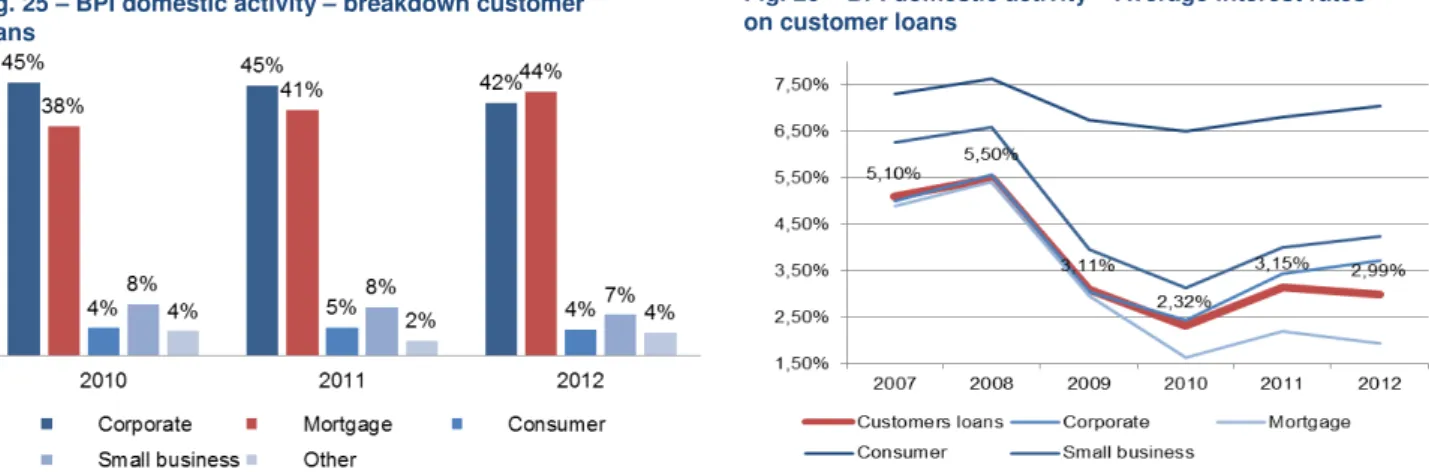
BPI is a strong player in the mortgage loans market in Portugal. In the end of 2012, 44% of its customer loans in Portugal were mortgage loans (Figure 25). We consider this proportion high and a concerning factor in which regards the sustainability of the bank. The housing loans market in Portugal continues to slide (-3.6% YoY in March 2013 – Figure 19), and the interest rate charged on them is much lower than other types of loans (Figure 24). According to the Bank of Portugal (BoP), the annualised agreed interest rates on housing loans stood at 3.31% in March 2013 in Portugal, and 3.14% in the Eurozone. Even with the decrease of Euribor to lowest historical levels, the spread on those loans is still tight since most of them are charged at variable rates.
In 2012, the average interest rate charged on BPI’s mortgage loans in Portugal stood at 1.94%, and the average interest rate charged on the portfolio of all customer loans in Portugal stood at 2.99% (Figure 26).
We believe that in the next years the bank will tend to diversify its loans portfolio getting higher portions of other types of loans where it can obtain higher interest margins. In terms of risk management, the bank should opt to diversify its portfolio by geographical area, sector, segment, counterparty, currency and maturity. Looking for the past, one of the errors that originated the subprime crisis was exactly the concentration of risk by some banks. The big financial institutions that ignited the global crisis in 2008 were overexposures to an asset class. Nevertheless, in the short-term we do not expect great changes in the proportion of loans segmentation.
Fig. 24 – Banking Interest Rates - Loans
Fig. 25 – BPI domestic activity – breakdown customer loans
Fig. 26 – BPI domestic activity – Average interest rates on customer loans
Source: company data, NOVA Equity Research Source: company data, NOVA Equity Research
BPI is a strong player in the mortgage market in Portugal
BPI domestic activity – 44% of the customer loans in the BS were mortgage loans in 2012
BPI COMPANY REPORT
PAGE 12/34 Source: Bloomberg
Source: Statistics of Portugal (INE)
The construction sector was one of the sectors which have suffered the most with the current conjuncture in the developed countries.
If we look through the market values returns in Europe we can see that the banking sector and Real Estate were the sectors with a higher decrease in their total returns since before the crisis, in Europe. In the Euro Stoxx 600, the total returns in the Banking sector since 2007 fell around 66%, in the Real Estate sector they declined around 49%, while in the Euro Stoxx 600 as a whole they fell 19% (as of 31st May, 2013).
Also in Portugal, the construction sector was one of the sectors more affected by the crisis. According to INE (Statistics of Portugal), the average price per square meter of private residential property and the number of residential buildings have been decreasing along the last years, reflecting the downtrend of the sector and resulting in less demand for mortgage loans. The Construction Works Index fell 17.6% YoY in the end of 2012, and 19.2% YoY in May 2013. We believe the construction sector will continue its downtrend while the economy in stabilizing. In terms of credit, the slowdown of the construction sector decreases the demand of credit by construction sector and also it contributes for the slowdown of the Real Estate sector, which naturally pushes down the mortgage loans market.
In practical terms for BPI, the impact of the mortgage loans market is the one who most affects the performance of the bank. BPI is a strong player on the housing loans markets in Portugal, while the credit for construction is not its core activity. In the next years, we expect a mortgage loans markets more conservative than in the past. In the scenario of economical macro indicators recovery, banks will still be cautious granting mortgage loans in order to avoid impairment losses again as they are facing right now. In the short and medium-term, liquidity will be the main aspect banks will follow.
We believe that in the next years the mortgage market will continue to deteriorate, and BPI will not have the possibility to increase the margin on this kind of loans. Additionally, in December 2012, the Government restricted the bank’s possibilities to increase the spreads on mortgage loans. After the revision of the regulation on mortgage loans, it was established that banks cannot increase the spread in several cases, as for example if one of the credit members got unemployed. These measures pretend to help Portuguese families who cannot pay their loans, but on the banks’ side it limits even more the banks’ profitability which has these loans on his portfolio.
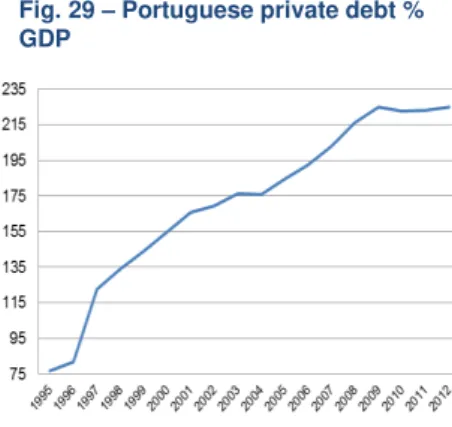
The high proportion of corporate loans is also a concerning factor, it has a great impact on the assets quality of the bank. Following the current economic situation of the country, corporates are still in a deleverage course. At the end 2012, the private debt in percentage of GDP in Portugal was still higher than in the previous Extraordinary law to protect
mortgage debt holders in difficult economic situation Fig. 27 – STOXX Europe 600 and STOXX Europe 600 Real Estate
BPI COMPANY REPORT
PAGE 13/34 year - 224.7% vs. 223.2% (Figure 29). Besides that, companies are still facing an increase on their financing costs (cost of debt higher than in a few years ago) and lower profitability (lower consume).
In order to get risk diversification, the bank should restructure its loans portfolio, decreasing the proportion of mortgage loans. This will result in higher interest margins. However it would need to accumulate higher provisions, since mortgage loans are usually protected with some collateral. BPI in Portugal has building an image of trust by the maintenance of a low risk profile. We expect that if occur a restructuring on its loans portfolio this will be slowly in order to maintain its low risk profile and getting advantage of the recovery of the Portuguese economic. Also this kind of loans (mortgage loans) usually has long-term maturities. So in the next years, we do not expect a great variation on loans composition proportion. Nevertheless, in perpetuity years we believe in a lower weight on mortgage loans, and higher weights on consumer and small business loans. Corporate loans we believe will take more advantage from the recovery of the macro indicators. Consequently, we consider the high amount of corporate loans a risk factor in the short-term while the high amount of mortgage loans will stuck the bank in the long-term, not allowing it to increase its NII.
Assets Quality
Taking into account the current macro context, one of the focus while looking for a bank, is the quality of its assets. As we already related, the deterioration of the macroeconomic indicators results in an up-trend of the Non-performing loans. Following the higher amounts of defaults, banks feel the need to increase their credit provisions which obviously has a substantial impact on the bank’s profitability. It influences the availability of the banks grant new credits: higher provisions mean a reduction on funds for new lending, and at the same time new lends could mean higher need of provisions. Then it affects the criteria of granting loans and reduces the profitability of the bank. BPI great exposure to the depressed real estate sector brings uncertainty about its assets quality. In the next years the austerity measures in place in Portugal, will continue to break the economic growth, meaning that BPI will remain with high level of provisions for bad loans. This constrains bank’s earnings and profits.
In the end of 2012 the NPL ratio in Portugal increased from 7.5% to 9% YoY. Regarding the segmentation of the NPL ratio, the household segment NPL ratio climbed from 4.1% in the end of 2012 to 4.2% in the end of the first quarter of 2013. The uptrend on the non-financial corporations sector is more aggressive, it went from 10.1% in the end of 2012 to 11% in March 2013 (Figure 30).
Fig. 29 – Portuguese private debt % GDP
Source: Eurostat
Fig. 30 – Portuguese NPL ratio of borrowers
BPI COMPANY REPORT
PAGE 14/34 Dec - 11 Dec - 12 Mar- 13
Portugal 2,9% 1,3% 2,1% Euro area 1,5% 1,1% 0,9%
Portugal 3,6% 2,3% 2,4% Euro area 2,8% 2,7% 2,3%
Households
Annualized agreed interest rates With agreed maturity, up to 1 year
Non-financial corporations
According to our estimations the NPLs will continue to rise in the next years following the expected high unemployment rate, and increase of companies insolvents. BPI’s cost of risk will be 1.09% in the end 2013 (vs 0.99% in 2012 and 0.75% in 2011 - Figure 31).The major impacts on bank’s operational activity:
Necessity to retain more capital that could be invested in earning assets – lower profitability;
Deterioration of credit rating – decrease the ability of the bank get funds – higher costs.
Despite the great correlation with the macroeconomic indicators, we believe that the restructuring of the banking system will make that banks stabilize on more conservative approaches while granting credit, and with more tied money on reserves than before the crisis.
Deposits
Portugal is going through a stabilization program. The deleveraging process will continue in place until the country gets a sustainable equilibrium, and the markets get confidence back. The current context leads to banks in general look for more liquidity, increasing their deposits and decreasing their loans. However, the BoP in order to preserve the profitability of the national banks, increased in 2012, the penalties for banks that paid interest rates on deposits higher than some limits on spreads established in accordance with maturities and amounts of deposits. This policy jointly with the ECB monetary policy, have made the deposits less attractive. In the last years the ECB had to face a difficult climate in Europe. The sovereign debt crises across several member states have weakened the European economy. In response to that, the ECB has lowered its benchmark interest rates through an expansionary monetary policy. Therefore BPI’s deposits that are indexed to Euribor became less attractive. BPI faces an interesting time regarding the deposits, from one point of view it wants to increase their deposits to increase its liquidity, though there are several factors making harder to collect resources from clients: the economic deceleration that reduce the disposable income of families and then decrease their savings, and the monetary policy of ECB and conservative policy of BoP that limits the interest paid on the deposits making them less profitable for clients and consequently reduces their willingness to save money as deposits.
Fig. 32 – BPI total deposits % of total assets
Source: Bloomberg, company data, NOVA Equity Research
Fig. 33 – Banking Interest Rates - Deposits
Source: Bank of Portugal Fig. 31 – BPI cost –of-risk
BPI COMPANY REPORT
PAGE 15/34 3-month 6-month 12-month
2004 2,12% 2,15% 2,28%
2005 2,15% 2,21% 2,34%
2006 2,49% 2,64% 2,86%
2007 3,73% 3,86% 4,03%
2008 4,67% 4,70% 4,73%
2009 2,86% 2,95% 3,03%
2010 0,70% 1,00% 1,25%
2011 1,00% 1,22% 1,50%
2012 1,34% 1,61% 1,94%
2013 0,19% 0,32% 0,54%
For the following years we believe that ECB and the BoP will continue with their current policies. The ECB has announced to continue its plan to buy government bonds easing the borrowing costs of the Eurozone countries.So the Euribor will remain at low levels and there will be no room to increase the interest rates paid on deposits. In that way, in the short-term it will be difficult for BPI increase their deposits. Nevertheless, with the recovery of the European economy, and assuming that Portugal will be able to honour the commitments made with Troika, the national economy will start to accelerate and the bank will be able to increase its deposits without compromising its profitability.
Solvency and Profitability
Banks in Portugal, as well all over Europe, have reinforced their balance sheets to become more solvents. Through a decreasing on credit granted and more conservative approaches while granting new loans, as well through an increase in the deposits or the sale of non-core assets. This readjustment has a tremendous impact on the profitability of the bank. In 2011, BPI had a net income negative, for the first time in its history.
Liquidity and sustainability became more vital to a banks’ balance sheet, which is naturally compromising their profitability. The inability for banks access to international funds has led to a capture of deposits in order to achieve solvency needed and still save its productivity.
As part of the deleveraging process, and the crisis of confidence in Europe, it became crucial for a bank to present good liquidity ratios. According to our calculations, at the end of 2012, BPI presented a LtD of 102% (vs. 114% in December 2011 and 141% in December 2007 – Figure 38). The Bank of Portugal Source: Company data, NOVA Equity Research
Fig. 35 – BPI domestic activity – Interest-bearing Liabilities and Interest expense
Source: Company data, NOVA Equity Research Fig. 36 – BPI domestic activity –
average interest rate on resources of customers
Fig. 37 – BPI - Return on Equity
Source: Company data, NOVA Equity Research
Fig. 34 – Euribor (2004 – 2013, 1st day of the year)
BPI COMPANY REPORT
PAGE 16/34 set a maximum indicative level of 120% for Portuguese banks by 2014, under the Economic and Financial Assistance Programme. BPI has presented a comfortable ratio below the BoP target level, even so it is important to refer the importance of the international activity for the liquidity of the group. The international activity in December 2012 reported a LtD of 51% while the domestic activity reported a LtD of 116%. While the domestic activity is driving a downtrend of net credit in percentage of the deposits, the international activity is expected to increase it. In terms of efficiency, the cost-to-income decreased from 67% in 2011 to 48% in 2012. This has resulted from a decrease of 22% in personnel costs, but more important, it accounts the extraordinary profit on financial operations the bank had from its sovereign exposure. In the next years we expect a continued cost-cutting either by close of branches as also by reducing the personnel costs.
Angola
The 50.1% stake on Banco Fomento Angola (BFA) is a crucial resource of income for the Portuguese bank. The exposure to an emerging market is a key-factor for the sustainability of the bank. While developed countries are facing times of economic retraction, the emerging markets are in beginning of a long way of economic expansion.
The deterioration of European and US economies, since 2008, have had a clearly impact on the emerging markets. The main driver of Angola’s economic growth is the oil exportation, which it ended to be a decisive channel for contagion all over the world. The lower demand and lower investment rate from developed countries had a negative impact on the exporter countries. Nevertheless, after the failure of the developed system, the multinationals corporates and large funds are all focus on the emerging markets as resource of growth and investment user.
According with IMF predictions, the Angolan GDP is expected to grow 5.6% in 2013 and 5.4% in 2014. This corresponds to a deceleration of the economic growth from the last years, which comes from a slowing on growth rate of oil production.
In the long-term, the oil sector is expected to continue to be a strong source of economic growth for Angola. Even with a decline of the industrial production and oil consumption on Europe and US, globally the oil demand will continue to grow. China has being the main exporter for Angola oil production, and it expects a rapid growth rate on its oil demand. Moreover, in the last years, the government has made great efforts to diversify the country’s production, through public investments that are pushing up the activity in non-oil sectors. In that way, the Fig. 38 – BPI Loans-to-Deposits
Source: Company data, NOVA Equity Research
Source: IMF
Source: IMF
Fig. 39 – Angolan GDP % growth
BPI COMPANY REPORT
PAGE 17/34 government intends to substitute importations by national production, diversify the exportations and lastly reduces the GDP’s correlation with the oil market.
Nevertheless, the expectation of economic growth in Angola is still greatly dependent of the trend of the oil sector.
Banking sector
The banking system in Angola is in a completely different stage than Portugal. The evolution of the banking activity in Angola has improved a lot in the last years, and it is expected to continue its fast growing trend as disposable income in population rise and new investments emerge. In opposition to Portugal, in Angola there is a lot of room to increase the NII from new loans and deposits: 1) middle class development, 2) bankarization, 3) higher income disposable in population, 4) comfortable solvency ratios. According to the Banco Nacional de Angola loans and deposits in Angola rose in the first quarter of 2013, 14% YoY and 11% YoY respectively (Figure 42).
In our valuation we expect a CAGR (2013-2019) of 6% in loans and 4% in deposits. The development of the banking industry in Angola is an opportunity for BFA increase its loans and deposits, even though, we took conservative assumptions to taking into consideration the increase of competitiveness in the market. BFA have been losing its market share in the Angolan market. The deterioration of the developed countries has turned the emerging markets more attractive. In the current stage of the Angolan economy, and with the increase of foreign investment in the country, we naturally expect an increase of competitiveness of the banking industry. Not only by increase of scales of the banks in that market, as well by the introducing of new financial institutions. Taking all of that into consideration, we expect the weight of BFA’s Net Income will be growing in the BPI group’s Net Income.
A risk factor regarding the activity in Angola, is the dependency on the oil exportations. Despite the government’s announcement of efforts to reduce the correlation between the Angolan real GDP growth and the oil production, the economic growth is still strongly reliant on the oil exportations.
Extraordinary Times
The banking sector performance is greatly dependent on future regulatory requirements which will be following European Union integration developments, either monetary either political. The sustainability of the monetary union has been topic of a lot political discussions. In our analysis we always assume a persistence Fig. 41 – Angola – value of oil exports
Source: IMF
Fig. 42 – Angola – total credit and total deposits in billions of KWZ
BPI COMPANY REPORT
PAGE 18/34
CGD 1.65 € bn
BCP 3.5 € bn
BPI 1.5 € bn
Banif 1.1 € bn
Public Injection of CT1 capital
of the European monetary union. However it is important to refer the reintegration of the monetary policies into the sovereign policies context, and how it could be bringing a lot of changes into the system that are difficult to predict.
Europe has made several efforts to avoid a contagion effect all over Europe through its monetary policy that it has been done mostly by temporary measures. The European Central Bank has introduced liquidity into the system and has funded the restructuring of the banking system all over Europe, in order to preserve the availability of credit for households and companies among the members of the Eurozone. It has reduced the interest rates to historically low levels and it has implemented several non-standard provisional measures. According to the central bank, these temporary measures will be gradually dismissed in line with the recovery of the financial markets and macroeconomic indicators. Since the end of 2012 the market has shown more confidence in the ECB action – investors are more confident that the central bank will be supporting the Portuguese banks as last resource of credit. Nevertheless it is coming a long way of restructuring measures to the banking system. The question now is when will the banking system recover its self-efficiency? And how profitable it will be out of the extraordinary context?
Extraordinary Regulation
In which concerns regulation and supervision to the banking system, it was published in December 2010 the new Basel Accord - Basel III, which demands for stronger capital ratios and constrain banks’ leverage and liquidity ratios. Even though, the European authorities felt the need to quickly restore stability and confidence in the markets through the creation of a temporary authority. Therefore, the European Parliament established the European Banking Authority (EBA), a regulatory agency which officially started its activity in January 2011. Its main role is to monitor bank’s capital structures through stress tests in order to increase transparency and stability in the European financial system. EBA imposed capital targets coming into force at the end of June 2012. This intervention submitted 27 banks all over Europe to a recapitalization exercise. These banks were given to plans in order to strengthen their capital position by €116 billion, and in that way achieved the EBA’s goals.
In Portugal, besides EBA capital requirements, banks also have to accomplish the ratios required by the Economic and Financial Assistance Program imposed by the Troika. In Portugal, the banking system recapitalization plan was composed by: €1.65 billion injection of core tier 1 capital to CGD, €3.5 billion injection of core When will the Portuguese
banking system recover its self-efficiency?
How profitable it will be out of the extraordinary context?
Source: Bank of Portugal
Fig. 43 – Portuguese baking system recapitalization exercise
BPI COMPANY REPORT
PAGE 19/34 tier 1 capital to BCP and €1.5 billion injection of core tier 1 capital into BPI. In that way, the Portuguese banks would fulfill EBA and BoP requirements.
In January of this year, Banif was added to the list of Portuguese banks submitted to a recapitalization plan (€1.1 billion injection of core tier 1 capital).
BPI’s Recapitalization Plan
The BPI’s recapitalization plan was concluded in two stages:
In June 2012, the Portuguese Sate fully subscribed the issue of 1.5 billion euro of CoCos – Contingent Convertible bonds, accounted as core tier 1 instrument that it will convert in equity if the bank will not achieve the Core Tier 1 ratio established by the Troika and the EBA, or if it will not repay them until maturity (2017).
In August the bank increased the share capital, from 990 million euro to 1.190 million euro, through the issuance of 400 million ordinary shares, which the cash proceeds the bank used to repay 200M of the 1,5B Eur of the CoCos subscribed by the Portuguese State in June. Therefore, the amount of CoCos on BPI’s balance sheet were immediately reduced to 1,3 billion euro by directing the cash incomes of the capital increase.
This capital injection was supported by the 12 billion euro Bank Solvency Support Facility established under the Economic and Financial Assistance Program of the Troika.
According to this agreement the bank has to repay the entire amount of convertible instruments until 2017. The scheduled presented by the bank predicted the repayment of 150 million in 2013, 270 million in 2014, 310 million in 2015, and 295 million in 2016 and 275 million in 2017. Meanwhile the annual interest rate defined was, 8.5% in 2012 and 2013, and 9% in the remaining years. In the next five years the bank will have to consolidate its capital structure in order to continue to be a 100% private bank. In our valuation we assume the bank will take advantage from the Portuguese economy recovery, through increase in NII as well through its sovereign exposure, to repay the CoCos and still maintain solid capital ratios. Also the activity in Angola will be crucial to bank respond to its original repayment plan. Nonetheless, we reinforce the idea that we believe that the bank, even in a distressed scenario, will repay the convertible instruments even if it had to compromise other components of its activities. Ultimately the bank will not become a public bank.
June 2012 Portuguese State fully
subscribed the issue of 1.5 billion euro of
CoCos
August 2012 BPI issue 400 million
shares
BPI repaid 200 million of CoCos
Fig. 44 – BPI Recapitalization Plan
Source: Company data, NOVA Equity Research
BPI COMPANY REPORT
PAGE 20/34 million of euro 2012 2013 2014 2015 2016 2017 Original Repayment Plan (as of
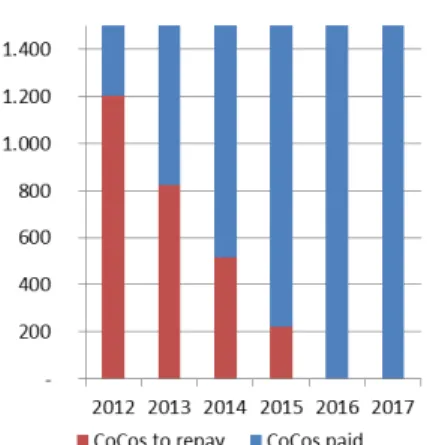
September 2012) 1.300 1.150 880 570 275 0 Estimated Repayment Plan (including
the advanced repayments already made, as of May 2013)
1.200
825 515 220 0 0
Cost Reduction 4,2 18,1 29,3 29,3 27,0 2,4 At 4th December of 2012, after the Portuguese government’s permission, BPI repaid 100 million euro of CoCos in advanced from the original repayment schedule. At the end of the year it had in its balance sheet 1.2 billion of euro in CoCos subscribed by the Portuguese State. In 13th March 2013, BPI repaid more 200 million of euro having now in its accounts 1 billion of euro of contingent convertible bonds. BPI has already asked permission to repay more 100 million of euro in advance. We believe at the end of the first semester the bank will have only in its accounts 900 million of CoCos. In our valuation we assumed the bank will be able to pay more 75 million until the end of the year (half of the 150 million scheduled), and after that it will end the year 2013 with 825 million of euro contingent convertible bonds subscribed the Portuguese state, and from there on the bank will follow the initial schedule. In that way it will have repaid all the CoCos at the end of 2016. In order to accomplish this last schedule payment, the bank will have to originate cash flows through its activity, always keeping the core capital ratio above the limits of the BoP and the EBA. In the following years we expect a decrease of the total assets of the bank, driven by the repayment of the convertible instruments. Through our analysis we assumed that there will not be any more repayment in advance from the original plan. The good performer of the bank in the last quarter of 2012 it was mainly from one-off gains from profits from financial operations – it allowed the bank to repay CoCo’s above the amount predicted without compromising its core assets.
The ability of the bank repay the CoCo’s in advance has two positive impacts:
It has shown to investors that the bank is in a comfortable position to fulfill the Troika requirements, and it will not allow that the convertible bonds will be converted in State’s shares;
It has decreased the costs with those instruments, initially planned. In the table below we can see the costs reduction from the original repayment plan the one we estimated with the repayments already made in advance.
Source: Company data, NOVA Equity Research Source: Company data, NOVA Equity
Research
BPI COMPANY REPORT
PAGE 21/34
Capital Requirements
EBA required that at the end of June 2012, banks should have Core Tier 1 ratio of 9% including a sovereign buffer that considers the valuation of sovereign debt at market prices on 30th September of 2011.
The Bank of Portugal required, at the end of 2012, banks should have a Core Tier 1 ratio of at least 10%.
At the end of June 2012, BPI had a Core Tier 1 of 9.4% by EBA calculations, and 14.5% by BoP calculations. On the sovereign buffer BPI, at that time, BPI had an exposure of 1,389 million euro at market prices. Meanwhile the bank recognized in its accounts an impairment loss related to Greek public debt, which resulted on a reduction the sovereign buffer to 1,184 million euro. As of 31th March 2013, the bank has informed the investors, that the temporary sovereign buffer calculated at the current market prices would be only 544 million. Nevertheless, the buffer was constituted in order to cover losses banks may have in distressed times. In the next years, the EBA will maintain the buffer as market prices of September 2011 since it represents the distress scenario where yields will rose to those levels. Banks with large exposures will face higher losses, so in order to avoid critical situations as we are living now, banks should conserve amounts of capital to cover the losses may occur in those situations. In the next years, the regulatory framework will continue to be under extraordinary times, where the risk on sovereigns is still too high. Therefore we do not assume any reduction on the EBA’s buffer requirement.
At the end of 2012, BPI reported a Core Tier I capital of 3,7 billion euro which corresponds a 15% of its risk-weighted-assets (RWA). The BoP demanded the Portuguese banks to have 10% of RWA at that time, which should be close to 2,5 billion of euro. The bank reported 1,2 billion of euro of core tier 1 capital above the required by the BoP.
Out of the extraordinary times, the Basel Committee on Banking Supervision decided to change the guidelines for capital, leverage and liquidity standards to reinforce the banking regulation and supervision, substituting the Basel II by Basel III. The procedures recommended: i) minimum Tier 1 capital ratio change from 4% to 6%. Banks should have a core Tier 1 capital ratio of 4.5% at the end of 2013, 5.5% at the end of 2014, and 6% at the end of 2015. The restructuring of the Basel also proposes ii) new capital conservation buffer to be used to absorb losses during periods of financial distress. This capital should be met with common equity. Therefore the minimum common equity ratio should be 3.5% at Source: Company data, NOVA Equity
Research
Fig. 48 – BPI – Core Tier 1 (calculated according BoP rules)
Fig. 47 – BPI – RWA (calculated according BoP rules)
Source: Company data, NOVA Equity Research
Fig. 46 – CT1 ratio – Portuguese Banking System
BPI COMPANY REPORT
PAGE 22/34 the end of 2013, 4% at the end of 2014, 4,5% at the end of 2015, and it will have to increase more 2.5% in the next years in order to be 7% at the end of 2019.
ECB Funding
With the aim of preserve the access to credit for households and companies, the ECB has injected liquidity into the system through several procedures. The sovereign debt crisis in Europe has brought great gaps between north and south countries in which respects their ability to finance themselves in the debt market. The peripheral countries have seen their government bonds climbed to high levels, following the investors’ uncertainty around the future of their public finances. In order to reduce the yields spreads between core and peripheral countries, the ECB has issued two 3-year Long-Term Refinancing Operations (LTRO) at reduced cost (0.75%). In December 2011 the central bank issued 489.2 billion of euro and in February 2012 it issued another 529.5 billion of euro. BPI took close to 2 billion of the first LTRO issue and another 2 billion in the second. The bank has used this ability to have cheaper funding (0.75% interest rate) to get gains from carry trade strategies. Basically, BPI has get funds at 0,75% of costs and used that funds to invest in sovereign government bonds which returned higher rates. We have seen BPI increased its sovereign exposure. The bank will have refinancing needs in 2014 and 2015 and we have concerns regarding the sustainability of its earnings in the future. It will decrease its dependence from ECB and it will have to substitute these one-off earnings by operational sustainable earnings. Nevertheless we expect that the ECB will slowly reduce its Fig. 50 – Portuguese government bonds
yields
Source: Bloomberg
8%
Source: Bank of Settlements, Basel Committee on Banking Supervision Fig. 49 – Basel III – Capital ratios
BPI COMPANY REPORT
PAGE 23/34 support to the banking system, while it could recover from the improvements in the macroeconomic indicators.
Sovereign Exposure
BPI has had considerable gains from it sovereign exposure since the middle of 2012.
More recently, ECB has implemented another tool to respond to the sovereign debt crisis. It used the European Stability Mechanism and European Financial Stability funds to realize Outright Monetary Transactions (OMT) - the Central Bank buys government-issued bonds with maturities between 1-3 years, once the certain issuers’ countries implement several austerity measures. Through OMT the ECB is pushing the Government Bond’s market and giving confidence to investors. Since November 2012, the Portuguese 10-year government bond yield has already decreased 332 bps (as of 3th April, 2013).
BPI has increased its Portuguese sovereign exposure and it is taking advantage from the downtrend of Portuguese yields.
As of 31 the December of 2012, the bank had in its bonds and T-bills portfolio:
2.2 billion euro of Portuguese T-bonds (vs 2,0 billion in year-end 2011); 3.3 billion euro of Portuguese T-bills (vs 0,9 billion in year-end 2011); 1.4 billion euro of Italian and Irish public debt (vs 1,2 billion in year-end
2011);
1.1 billion euro of corporate bonds (vs 1.1 billion in year-end 2011).
The Portuguese sovereign exposure accounts close to 12% of its assets, which we consider to be too high to assume in the long-term. The OMT make part of a temporary plan of stabilization of the European debt crisis. Once economy restores its growth prospects, peripheral countries will be able to finance themselves in the debt market and their government bonds’ yields will not go back to the high levels we have seen in the beginning of 2012. As soon as it stabilizes, it will flow in a smaller range, and then the bank could not take as much profits as they have been taking. Even though, the total confidence on Portuguese market was not restored yet, the country has shown strong compromise with Europe and great effort to achieve their goals, which has attracted foreign investment. Also the ECB intervention has pushed down the yields on Portuguese government bonds and t-bills. Nevertheless, the yields on public debt are still far from the “risk-free level”. We believe we are in the turning point, and the way will be made with a Source: Company data, NOVA Equity
Research
Fig. 51 – BPI - Sovereign debt in billion euro
15% of total assets 10% of
total assets 9% of
total assets
2H 2012 and 1Q 2013 BPI registered a YoY increase of 42% and 81% in financial gains – that came from its sovereign exposure
BPI COMPANY REPORT
PAGE 24/34 decreasing ECB role while Portuguese economy restores the market confidence. In that road, there will be room to BPI get profits from its sovereign exposure. As we said in the beginning of this report, we totally assume the maintenance of the European Union and the persistence of the single currency. Even though, we are conscious about the uncertainty around the European Union evolution. The large sovereign exposure has a negative impact on the capital ratios as well in its systemic risk - the higher exposure to sovereign debt increases the bank’s dependence on country’s recover. As matter of fact we recognize that BPI’s volume of sovereign exposure exceeds the advisable levels. Therefore, we recognize it as a risk factor.
Pension Funds
Banks in Portugal usual have funds established to pay retirement benefits to employees, the so called Pension Funds. These funds are composed by assets that are totally independent of the general assets of the bank. In that way, the bank cannot use these assets to finance any other liability besides the pension liabilities.
At the end of 2011 BPI transferred 60% (1.3 billion euro) of its pension fund to the Social Security under the financial assistance program from Troika. Four Portuguese banks transferred a total of 5.6 billion euro of assets from their pension funds – BPI, BES, BCP and Santander Totta.
After the transference of part of the fund to the Social Security, 27% of the funds’ assets were Portuguese equities, and 26% were real estate assets. The pensions’ obligations funding are consequently very dependent of the market tendencies.
Since the liabilities side is quite stable while the assets side has a great volatility associated to it, the higher the pension fund the higher the systemic risk of the group BPI. We considered then, that the decrease on the fund size had a positive impact decreasing the systemic risk of the bank as a whole and decreasing the pension costs. On the other hand, banks used to use in the previous regulation, the corridor method to account the differences between the present value of the assets and liabilities of the pension funds, that now it will be deducted from capital – 25% of the actuarial differences will have to be covered with core capital.
Decreasing of the systematic Transference of the Pension Funds – lower systematic risk
BPI COMPANY REPORT
PAGE 25/34
Valuation
We identified two distinct segments in terms of valuation - domestic operations and international operations. We valued them separately and then we used the sum-of-the-parts model to get the fair value of BPI.
To value international segment we considered the Angolan market since operations from Banco Fomento de Angola (BFA) accounted 95% on average, of international’s Net Income, in the last 5 years.
Each one of the segments – Portugal and Angola - is in a different stage of development, with different growth perspectives, different macroeconomic environments and different capital regulations. The growth assumptions and the country risk premium expected by investors are then different in both countries. In spite of Portugal is under a bailout program because it could not finance itself in the debt market, we still believe investors will expect for a higher return while investing in an emerging market than in Portugal.
Million of euro 2011 2012 2013E 2014E 2015E 2016E 2017E 2018E
Financial Margin 379 401 367 386 413 486 429 472
Operating income from
banking activity 715 1.018 960 903 807 845 812 877
Net Income before tax (536) 233 102 92 96 163 156 224
Net Income (375) 163 97 90 93 147 141 196
Million of euro 2011 2012 2013E 2014E 2015E 2016E 2017E 2018E
Financial Margin 198 181 183 200 197 212 256 326
Operating income from
banking activity 305 312 326 352 359 368 427 515
Net Income before tax 180 167 173 188 184 183 239 324
Net Income 90 87 81 93 88 85 134 208
Methodology
After estimated separately the net income of the two segments for an explicit period of 7 years (2013 – 2019), we used the Free Cash Flow to Equity Model to estimate our target price. We opted by this model, since we are not able to separate the financing activity from the operational activity. We then discounted the cash flows to equity (cash flows available to shareholders) to the cost of
Domestic Activity