Key words:
Prostatitis; Diagnosis; Lower Urinary Tract Symptoms
Int Braz J Urol. 2013; 39: 683-91
__________________
Submitted for publication: January 30, 2013
__________________
Accepted after revision: August 15, 2013 Objectives: To create a Brazilian version of the National Institutes of Health – Chronic
Prostatitis Symptom Index (NIH-CPSI) using a cross-cultural adaptation process. Materials and Methods: The nine items of the NIH-CPSI were translated to Portuguese, by two independent translators, of native Portuguese language origin, and it was obtained a single version, that was retranslated to English by two English native spoken translators, in order to correct any discrepancies. Those versions were compared to the original text, the modifications were applied and it was created a final version in Portuguese. That was pre-tested and applied to 30 patients with pain or perineal or ejaculatory disorder. To each item of the pre-final version it was assigned a score according to the grade of un-derstanding and clarity in order to implement the adequate corrections. The final version in Portuguese was submitted to evaluations including face validation and psychometric proprieties of reproducibility and internal consistency, respectively evaluated by the (p) Pearson correlation coefficient and α Cronbach coefficient.
Results: All items applied to 30 patients during pre-test phase had a grade higher than 8 of understanding and clarity, and were considered clearly understandable by the patients. However, at face validation evaluation, there was an inconsistency of item three that was redone. The final produced version, called NIH-CPSI (Braz) showed good reproducibility (p = 0.89-0.99) and internal consistency (α Cronbach coefficient = 0.85-0.93).
Conclusions: NIH-CPSI was adapted to Brazilian spoken Portuguese and its original pro-prieties were maintained, being a valid instrument for evaluations of symptoms of chro-nic prostatitis in Brazilian patients.
INTRODUCTION
Many urological consults refer to symp-toms of chronic prostatitis/chronic pelvic pain syndrome (CP/CPPS). Those are very frequent diagnosis in men less than 50 years old with a significant impact of quality of life (1). According to the National Institutes of Health (NIH) (2), there are four categories of prostatitis. CP/CPPS is type III, and includes IIIA (inflammatory) and IIIB
(non--inflammatory), and represents most cases. This category (III) also presents a challenging diagno-sis, has several symptoms and no pathognominic clinical finding (1). It presents chronic pelvic pain, associated to micturition disorders, psychological aspects and impact on quality of life of patients. It has high prevalence with a global rate of 8.2% (3). Laboratorial evaluation using Meares-Stamey diagnostic tests is complex (4), not sensible to non-inflammatory chronic prostatitis (5) and not
Cultural Adaptation of the National Institutes of Health
– Chronic Prostatitis Symptom Index (NIH-CPSI) - to
Brazilian Spoken Portuguese: NIH-CPSI (Braz)
_______________________________________________
Cristiano Novotny, Eduardo Deves, Rodrigo Novotny, Igor Kunze Rodrigues, Fabrício Souza Neves
Federal University of Santa Catarina, Brazil
ABSTRACT
ARTICLE
INFO
easily reproducible in clinical practice (6). Labora-tory findings are non-specific and clinical hisLabora-tory is important to diagnosis. It is important the use a valid instrument for correct diagnosis, follow-up and evaluation of treatment.
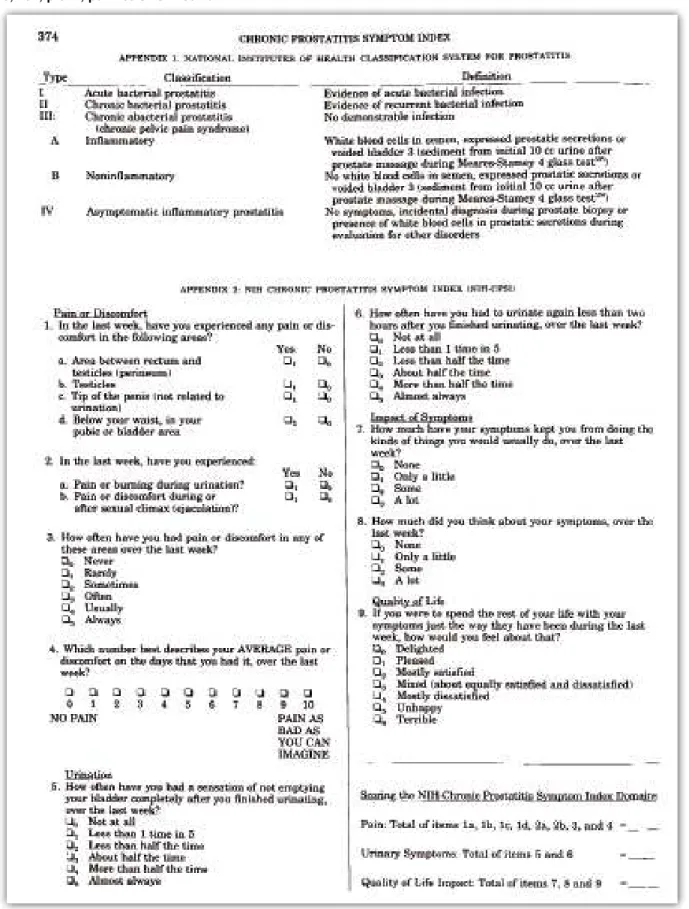
Several symptomatic index for prostatitis were developed, most of them not validated scien-tifically (7,8). Only the National Institutes of Heal-th (NIH) Chronic Prostatitis Collaborative Research Network produced a valid instrument for evalua-tion of symptoms of CP/CPPS: the NIH – Chronic Prostatitis Symptom Index (NIH-CPSI) (9). It has nine items, divided in three domains (pain, urina-ry symptoms and quality of life) and it is used as diagnostic tool for the diagnosis and follow-up of CP/CPPS. Initially it was presented in English, but it was adapted to Spanish (10), Japanese (11), Ger-man (12), Italian (13), Estonian (14), Malay (15), Finnish (16), and French (17). However, it was not adapted to Brazilian spoken Portuguese until now. Our goal was to create a Brazilian version of the NIH-CPSI, using a cross-cultural process based on the north-American version.
MATERIALS AND METHODS
NIH-CPSI description
NIH-CPSI (Figure-1) includes the main uri-nary symptoms related to CP/CPPS with a final score 0-43, divided in three domains: pain or discomfort (4 items, with a total score of 0-21), urinary symptoms (2 items, with a total score of 0-10 points), and im-pact of quality of life (3 items, with a total score of 0-12 points) (9).
Patients with pain or perineal or ejaculatory discomfort with NIH-CPSA score ≥ 4 are considered with symptoms of CP/CPPS. Those with pain or pe-rineal or ejaculatory discomfort and score ≥ 8 are considered as patients with CP/CPPS moderate to se-vere (18). The higher the score, more important is the impact of symptoms.
Cross-cultural adaptation
For the process of cross-cultural adaptation, it was followed the “Guidelines of Institute for Work
guese translators: an urologist physician (T1) and a non-medical translator without knowledge on the subject (T2). A second phase, mediated by a native Portuguese spoken mediator, included comparison and summarization of both translations, producing a single consensual version called T12. From T12, two different back-translations were performed by English, by two independent English native spoken non-medical translators (BT1 and BT2). In a next phase, a panel of specialists, including all translators, Portuguese and English teachers and a moderator evaluated all reported data, solved any discrepancies and created a pre-final version of the questionnaire.
Pre-Test
Pre-final version was submitted to pre--test. At this phase, the version was submitted to 30 consecutive patients that spontaneously atten-ded the Urologic Service of the University Hospital of Universidade Federal de Santa Catarina (UFSC) with pain or perineal or ejaculatory discomfort as the main complains. The exclusion criteria included illiterate patients or those with cognitive deficit that prevented reading and understanding the instrument and those who refused to participate on the project. All patients were informed about the observational characteristic of the study, without any immediate benefit and that the result would be useful for the diagnosis and follow-up of CP/CPPS in the future. At pre-final version, after each of the nine translated items of NIH-CPSI it was included a table in order to the patients score each item, from 1 to 10, accor-ding to their grade of understanaccor-ding and clarity. The translated questions scored 1 to 4 were considered confusing, those 5 to 7 with low understanding and those with 8 to 10 were considered understandable.
Test
During this test phase, the instrument was applied twice for each patient. First time was self--administrated and second time, after a time break of one hour, by an oriented medical interview. In this second application, the urologist (C.N.) asked again each question in order to evaluate the understanding of each patient of every item of the instrument and the adequacy of this comprehension to the question intent of the original instrument (NIH-CPSI). This analysis was an evaluation of face validation (15) of final version of the instrument, and determined that the answers of the Brazilian patients really referred to the questions originally proposed by the instru-ment created by Litwin et al. (9).
The reproducibility of the instrument was evaluated by the coefficient of correlation of Pear-son among the answers of the questions of the self--administered questionnaire and those during the interview with the urologist (C.N.) Internal consis-tency was estimated by the coefficient of α Cronba-ch, of each domain, D1 (pain and discomfort - items 1-14), D2 (urinary symptoms - items 5-6) and D3 (impact of symptoms on quality of life – items 7-9) in relation to the final score. It was also calculated the coefficient of α Cronbach among all items and final score. SPSS 17-0 software (Statistical Package for Social Sciences) for Windows© was used for sta-tistical analysis.
The research protocol was approved by the Ethical Committee of Research involving Human Beings of the Federal University of Santa Catarina, Brazil (CEPSH-UFSC) # 2388/12.
RESULTS
Cross-cultural adaptation
There were some discrepancies among ver-sions T1, T2, T12, BT1 and BT2 during the process of cross-cultural adaptation. The nine items of the questionnaire (questions and answers) were re--evaluated in order to solve these differences, and some adequacies were introduced to maintain the original meaning of the questionnaire in a collo-quial Brazilian manner. Simple common terms and expressions were used always as possible in order to
“have you experienced any pain or discomfort”, is an expression in past participate in English and was translated to simple perfect preterit in Portuguese. Due to these adequacies the back-translations pre-sented some differences but without change of the meaning. Some terms, as “experienced”, were trans-lated to common terms in Portuguese, more usual in ordinary language, in order to refer to the original question. Words as “perineum” and “sexual climax” of the original English version were omitted in the Brazilian version, since they are not usual in ordi-nary Brazilian language, without changing the me-aning of the sentences. In the original version, some questions started with an adverbial time adjunct as “in the last week”, and others ended with “over the last week”, in order to determine the observational time of symptoms throughout one week. The Portu-guese version maintained both options but always in the beginning of the sentence in order to facilita-te the understanding of the instrument.
Pre-Test
All 30 patients that answered the pre-final version were male with ages from 18 to 65 years old, median 41.4 years. Eight patients (26.7%) attended pre-school, nine (30.0%) high school and 13 (43.3%) universities. During this phase and also in the others no patient refused to participate in the study.
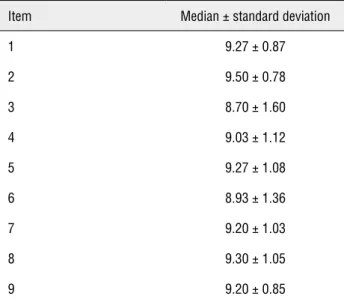
All items showed a median score of un-derstanding and clarity superior to 8 (Table-1). Worse median (8.7) and the highest standard de-viation (1.6) referred to item 3 and it was made an adaptation of the translation in order to improve understanding.
Since all other items were adequate in the pre-test phase, it was obtained the Final Version without any further modifications of the pre-final version, and it was called NIH-CPSI (Braz).
Test
although in pre-test phase all items were considered clear (since they obtained an index of clarity and understanding above 8), during the questionnai-re assisted by a doctor patients understood poorly item 3. The main reason was that the question in Portuguese induced to misinterpretation of the lo-cal of symptoms instead the symptoms itself. After
clarifying with Litwin the purpose of the question (personal contact) we changed the version to “how often do you present any of the symptoms of ques-tions 1 and 2”.
So, the final version of NIH-CPSI (Braz) in-cluded a modification after the pre-test phase, in or-der to reassure the face validation of the instrument. After this last modification (item 3), the question-naire was again applied to 30 patients that atten-ded the Urologic Departament of UFSC with pain or perineal or ejaculatory discomfort in order to verify the clarity and understanding as was done in the pre-test phase. Median score given by the patients was 9.06 and standard deviation 1.08. The item was clear (with a superior score than obtained in pre--test phase) and the validation of the instrument was adequate. So it was proposed the Brazilian ver-sion of NIH-CPSI, called NIH-CPSI (Braz), or Indice de Sintomas da Prostatite Crônica (Figure-2). That version was submitted to the original authors and they considered it adequate.
DISCUSSION
Questionnaires for clinical evaluation of subjective symptoms, that transform them in ob-jective measures, are more frequent and are
be-Table 1 - Score of understanding and clarity of items of NIH--CPSI (Braz) during pre-test phase.
Item Median ± standard deviation
1 9.27 ± 0.87
2 9.50 ± 0.78
3 8.70 ± 1.60
4 9.03 ± 1.12
5 9.27 ± 1.08
6 8.93 ± 1.36
7 9.20 ± 1.03
8 9.30 ± 1.05
9 9.20 ± 0.85
Table 2 - Reproducibility and internal consistency of NIH-CPSI (Braz).
Domain (score scale) Item Median (IC 95%) Correlation α
T1 T2
Pain localization (0-6) 1.2 1.8 (1.4-2.2) 1.9 (1.5-2.3) 0.91
Pain frequence (0-5) 3 2.3 (1.8-2.7) 2.4 (2.0-2.8) 0.89
Pain intensity (0-10) 4 3.8 (2.8-4.8) 4.1 (3.2-5.0) 0.94
Domain: pain (0-21) 1-4 7.9 (6.3-9.4) 8.4 (7.0-9.8) 0.92 0.90
Domain: Urinary symptoms (0-10) 5.6 3.8 (2.4-5.2) 3.8 (2.4-5.2) 0.99 0.85
Impact (0-6) 7.8 2.6 (1.9-3.2) 2.5 (1.9-3.1) 0.96
Quality of life (0-6) 9 3.6 (2.9-4.2) 3.5 (2.9-4.2) 0.96
Domain: impact on quality of life (0-12) 7-9 6.1 (4.9-7.4) 6.0 (4.9-7.1) 0.97 0.93
Results obtained after application and reapplication of NIH-CPSI (Braz) in 30 patients. Correlation evaluated using (p) Pearson coefficient. = α
NIH – CHRONIC PROSTATITIS SYMPTOM INDEX (BRAZ) / (ÍNDICE DE SINTOMAS DA PROSTATITE CRÔNICA)
Dor ou Desconforto
1. Na última semana, você sentiu alguma dor ou desconforto nas seguintes áreas?
Sim Não a. Entre o ânus e os testículos
b. Testículos c. Na ponta do pênis (Não
cionadacom o ato de urinar) d. Na área abaixo da cintura gião púbica ou área da bexiga)
2. Na última semana, você sentiu:
Sim Não a. Dor ou queimação ao urinar? b. Dor ou desconforto durante
ou após a ejaculação?
3. Com que frequência você apresentou algum dos sintomas relacionados às questões 1 e 2?
0 Nunca
1 Raramente
2 Algumas vezes
3 Frequentemente
4 Quase sempre
5 Sempre
4. Durante a última semana, que número melhor descreve sua dor ou desconforto MÉDIO, sendo zero nenhuma dor e 10 a pior dor que você possa imaginar.
0 1 2 3 4 5 6 7 8 9 10
NENHUMA A PIOR DOR DOR QUE
VOCÊ POSSA IMAGINAR
Micção
5. Durante a última semana, com que frequência você teve a sensação de não esvaziar completamente a bexiga depois de terminar de urinar?
0 Nenhuma vez
1 Menos de 1 em 5 vezes
2 Menos de metade das vezes
6. Durante a última semana, com que frequência você teve que urinar de novo antes de completar duas horas de ter urinado?
0 Nenhuma vez
1 Menos de 1 em 5 vezes
2 Menos de metade das vezes
3 Metade das vezes
4 Mais de metade das vezes
5 Quase sempre
Impacto dos Sintomas
7. Na última semana, até que ponto os sintomas o impediram de fazer as coisas que você normalmente faz?
0 Nada
1 Apenas um pouco
2 Algumas vezes
3 Muito
9. Na última semana, quanto você pensou sobre seus sintomas?
0 Nada
1 Apenas um pouco
2 Algumas vezes
3 Muito
Qualidade de Vida
10. Se você passasse o resto da sua vida com os sintomas que sentiu durante a última semana, como você se sentiria?
0 Contente
1 Satisfeito
2 Geralmente satisfeito
3 Igualmente satisfeito e insatisfeito
4 Geralmente insatisfeito
5 Infeliz
6 Péssimo
Índice final = _____ (soma dos escores dos 3 domínios)
Dor: Total dos itens 1a, 1b, 1c, 1d, 2a,
2b, 3 e 4 = ____ Sintomas Urinários: Total dos
itens 5 e 6 = ____ Impacto sobre Qualidade de Vida:
Total dos itens 7, 8, e 9 = ____
Figure 2 - Brazilian version of the National Institutes of Health Chronic Prostatits Symptom Index, called NIH-CPSI (Braz).
1 0
1 0
1 0
1 0
1 0
coming essential in clinical practice, mainly in scientific researches (19). Such instruments, ade-quately proposed and validated scientifically, are useful tools for diagnosis and grading of symp-toms. Both diagnostic and symptomatic evalua-tion quesevalua-tionnaires, when validated to different cultures, homogenize scores, allowing compari-sons in different places, and different languages and cultures.
In order to use these instruments in di-fferent places, cultures and languages than ori-ginally proposed, it is necessary to submit them to cross-cultural adaptation. This process involves translation and adaptation to the target culture; only a diligent process maintains equivalent me-asures and this process must be reliable. This is why we choose to follow the guidelines of Beaton et al. (19) that include translation, synthesis, back--translation, panel of specialists’ evaluation, pre--test and evaluation by the original authors.
After the process of adaptation, we pro-ceeded to validate the instrument, evaluating its psychometric proprieties. During validation we evaluated reproducibility, internal consistency and face validation. The reproducibility of the ori-ginal instrument, described by Litwin et al., was made by comparison of answers of the self-applied questionnaire in two different moments, with an interval or two weeks (9). During validation of the Brazilian version, the reproducibility was made by correlating the answers of self-applied naire to those of the medical assisted question-naire. We decided not to submit the questionnaire twice (self-application) in order to avoid repeated errors of interpretation. The same error, in both moments, would indicate a good correlation and good reproducibility of the instrument, but wi-thout validation. When applying the instrument during a medical interview, it was possible to ve-rify the face validation.
Internal consistency, evaluated by the co-efficient of α Cronbach, was made in the same way than in the original work of Litwin et al. (9). The Brazilian version showed a coefficient of α = 0.90; 0.85 and 0.83 of domains D1, D2 and D3 and final score, respectively. In the original questionnaire the coefficient of α Cronbach of the same com-parisons was 0.86; 0.79 and 0.87. The coefficient
of α Cronbach among all nine individual items and final score was 0.85 in the Brazilian version and 0.86 in the original version. The reproducibi-lity of 9 items of the Brazilian version, using the correlation coefficient of Person, showed values from 0.89 to 0.90. The original instrument sho-wed coefficients from 0.83 to 0.93 (9). In conclu-sion, the reproducibility and internal consistency of NIH-CPSI (Braz) were similar to the results of the original questionnaire. Other cross-cultural adaptations of NIH-NCSI showed similar results. For example, the Japanese version showed a re-producibility coefficient from 0.63-0.91 (11). The
α Cronbach coefficient varied from 0.83 to 0.87 in the Japanese version and from 0.60 to 0.74 in the German version (12).
The main difference of the Brazilian ver-sion from the original NIH-CPSI was related to item 3. If the same translated sentence had been used in the process of cross-cultural adaptation, the answers would be related only to the symp-toms of item 1. After talking to the original au-thor, it was clarified that the item 3 should address the symptoms of items 1 and 2 and the question was reformulate in order to be equivalent to the original instrument.
Only patients with prostatitis symptoms were included in the study. The ability of the questionnaire to discriminate symptoms of CP/ CPPS from other genitourinary diseases or even asymptomatic patients was well established in se-veral studies (11,16). Items 5 and 6, of the urinary symptoms domains, are very similar to questions1 and 2 of the IPSS (International Prostate Symptom Score) (20), except in relation of time (during last week in NIH-CPSI instead of last month in I-PSS) and represent bladder symptoms of voiding and storage, respectively.
The final result of the present work, the Brazilian version called NIH-CPSI (Braz) presen-ted in Figure-2 (Indice de Sintomas da Prostatite Crônica) will allow the development in our coun-try of clinical studies of patients with symptoms of CP/CPPS similar to those already performed in different cultures, with comparable results inter-nationally. It will help us establish an epidemio-logical profile of Brazilian patients and determine the prevalence of these symptoms. It can be used as a complementary tool in clinical practice simi-lar to I-PSS (20), used for the evaluation of benign prostatic hyperplasia.
ACKNOWLEDGMENTS
To Dr. Mark Litwin, that kindly allowed the elaboration of the Brazilian version of NIH-CPSI.
To Mr. Arno Blass, retired professor of UFSC, native Brazilian spoken non-medical translator.
To Mr. Eugene Nelson and Mrs. Sandy Reyes, native English translators, who performed the back-translation from Portuguese to English.
To the patients who answered the questio-nnaires.
CONFLICT OF INTEREST
None declared.
REFERENCES
1. Collins MM, Stafford RS, O’Leary MP, Barry MJ: How com-mon is prostatitis? A national survey of physician visits. J Urol. 1998; 159: 1224-8.
2. Krieger JN, Nyberg L Jr, Nickel JC: NIH consensus definition and classification of prostatitis. JAMA. 1999; 282: 236-7. 3. Krieger JN, Lee SW, Jeon J, Cheah PY, Liong ML, Riley DE:
Epidemiology of prostatitis. Int J Antimicrob Agents. 2008; 31(Suppl 1): S85-90.
4. Meares EM, Stamey TA: Bacteriologic localization patterns in bacterial prostatitis and urethritis. Invest Urol. 1968; 5: 492-518.
5. Sharp VJ, Takacs EB, Powell CR: Prostatitis: diagnosis and treatment. Am Fam Physician. 2010; 82: 397-406.
7. Neal DE Jr, Moon TD: Use of terazosin in prostatodynia and validation of a symptom score questionnaire. Urology. 1994; 43: 460-5.
8. Nickel JC, Sorensen R: Transurethral microwave thermother-apy for nonbacterial prostatitis: a randomized double-blind sham controlled study usingnew prostatitis specific assess-ment questionnaires. J Urol. 1996; 155: 1950-4; discussion 1954-5.
9. Litwin MS, McNaughton-Collins M, Fowler FJ Jr, Nickel JC, Calhoun EA, Pontari MA, et al.: The National Institutes of Health chronic prostatitis symptom index: development and validation of a new outcome measure.Chronic Prostatitis Col-laborative Research Network. J Urol. 1999; 162: 369-75. 10. Collins MM, O’Leary MP, Calhoun EA, Pontari MA, Adler A,
Eremenco S, et al.: The Spanish National Institutes of Health-Chronic Prostatitis Symptom Index: translation and linguistic validation. J Urol. 2001; 166: 1800-3.
11. Kunishima Y, Matsukawa M, Takahashi S, Itoh N, Hirose T, Fu-ruya S, et al.: National institutes of Health Chronic Prostatitis Symptom Index for Japanese men. Urology. 2002; 60: 74-7. 12. Hochreiter W, Ludwig M, Weidner W, Wagenlehner F, Naber K,
Eremenco S, et al.: National Institutes of Health (NIH) Chronic Prostatitis Symptom Index. The German version. Urologe A. 2001; 40: 16-7.
13. Giubilei G, Mondaini N, Crisci A, Raugei A, Lombardi G, Trava-glini F, et al.: The Italian version of the National Institutes of Health Chronic Prostatitis Symptom Index. Eur Urol. 2005; 47: 805-11.
14. Korrovits P, Punab M, Mehik A, Mändar R: The Estonian ver-sion of the National Institutes of Health chronic prostatitis symptom index. Andrologia. 2006; 38: 106-9.
15. Cheah PY, Liong ML, Yuen KH, Lee S, Yang JR, Teh CL, et al.: Reliability and validity of the National Institutes of Health: Chronic Prostatitis Symptom Index in a Malaysian population. World J Urol. 2006; 24: 79-87.
16. Leskinen MJ, Mehik A, Sarpola A, Tammela TL, Järvelin MR: The Finnish version of The National Institutes Of Health Chronic Prostatitis Symptom Index correlates well with the vi-sualpain scale: translation and results of a modified linguistic validation study. BJU Int. 2003; 92: 251-6.
17. Karakiewicz PI, Perrotte P, Valiquette L, Benard F, McCormack M, Menard C, et al.: French-Canadian linguistic validation of the NIH Chronic Prostatitis Symptom Index. Can J Urol. 2005; 12: 2816-23.
20. Barry MJ, Fowler FJ Jr, O’Leary MP, Bruskewitz RC, Holtgrewe HL, Mebust WK, et al.: The American Urological Association symptom index for benign prostatic hyperplasia. The Mea-surement Committee of theAmerican Urological Association. J Urol. 1992; 148: 1549-57; discussion 1564.
21. Nickel JC, Downey J, Hunter D, Clark J: Prevalence of prosta-titis-like symptoms in a population based study using the Na-tional Institutes of Health chronic prostatitissymptom index. J Urol. 2001; 165: 842-5.
22. Kunishima Y, Mori M, Kitamura H, Satoh H, Tsukamoto T: Prevalence of prostatitis-like symptoms in Japanese men: Population-based study in a town in Hokkaido. Int J Urol. 2006; 13: 1286-9.
23. Ejike CE, Ezeanyika LU: Prevalence of chronic prostatitis symp-toms in a randomly surveyed adult population of urban-com-munity-dwelling Nigerianmales. Int J Urol. 2008; 15: 340-3.
24. Bartoletti R, Cai T, Mondaini N, Dinelli N, Pinzi N, Pavone C, et al.: Prevalence, incidence estimation, risk factors and charac-terization of chronic prostatitis/chronic pelvic pain syndrome in urological hospital outpatients in Italy: results of a multicenter case-control observational study. J Urol. 2007; 178: 2411-5; discussion 2415.