Flávia Helena Pontes de CarvalhoI
Maria Rosângela Cunha Duarte CoêlhoI,II
Tatiana de Aguiar Santos VilellaI Jéfferson Luis Almeida SilvaI Heloísa Ramos de Lacerda MeloIII
I Setor de Virologia. Laboratório de Imunopatologia Keizo-Asami. Universidade Federal de Pernambuco (UFPE). Recife, PE, Brasil
II Departamento de Fisiologia e Farmacologia. UFPE. Recife, PE, Brasil
III Departamento de Medicina Clínica. UFPE. Recife, PE, Brasil
Correspondence:
Maria Rosângela C Duarte Coêlho Laboratório de Imunopatologia Keizo Asami (LIKA)
Setor de Virologia
Universidade Federal de Pernambuco (UFPE) Campus Universitário, Cidade Universitária 50670-901 Recife, PE, Brasil
E-mail: [email protected] Received: 7/13/2007 Revised: 6/5/2008 Approved: 6/25/2008
HIV/HCV coinfection at an
university hospital in
Recife, Brazil
ABSTRACT
OBJECTIVE: To estimate the prevalence of hepatitis C virus (HCV) infection and risks factors associated with coinfection in HIV-positive individuals.
METHODS: A cross-sectional descriptive study was conducted with 343 HIV
patients attended at a university hospital in Recife, Northeastern Brazil, from March to December 2003. A standardized questionnaire about risk factors was administered. Serum samples were analyzed for anti-HCV antibodies using enzyme-linked immunosorbent assay (ELISA), HCV-RNA using reverse transcription-polymerase chain reaction (RT-PCR), and genotyping using the ABI 377 (PE Biosystems®). Univariate and multivariate analyses and multiple
logistic regression were performed.
RESULTS: HCV prevalence was 4.1% (14/343) using ELISA and 3.2% (11/343)
using RT-PCR. The most common genotypes were 1b (45%), 3 (33%) and 1a (22%). Co-infection was higher among those aged 30 to 39 years, and predominantly in males (64.3 %). In the multiple logistic regression, the variable blood transfusion was the single remaining risk factor for HCV (OR=4.28; 95% CI 1.44;12.73).
CONCLUSIONS: The prevalence of HIV/HCV coinfection was low. Blood
transfusion was a risk factor and HCV genotype 1b was the most frequently found.
DESCRIPTORS: HIV Infections, epidemiology. Hepatitis C,
Coinfection by the hepatitis C virus (HCV) in people who are carriers of the human immunodefi ciency virus (HIV) is often observed due to the similar transmission route, particularly in relation to the parenteral route.23 It
is estimated that approximately 30% of all HIV-positive individuals are coinfected with HCV in the United States and Europe.21
In Brazil, prevalence depends on the geographic area, ranging from 8.9% to 54%.9,16,22,27 Therefore, the
interac-tion of these viruses raises concern and constitutes one of the most important pubic health problems to be faced by health professionals and authorities worldwide. Coinfection is higher in patients who acquired HIV through injecting drug use or blood transfusions than in patients who were contaminated through sexual intercourse.26
The highly active antiretroviral therapy (HAART) has been used over the last years and led to an improve-ment in the survival of HIV-infected patients. On the other hand, there is a high risk of hepatotoxicity in individuals coinfected with HCV because of the use of antiretroviral drugs.19
The progression of the disease caused by HCV among coinfected individuals is usually more aggressive and presents a high level of viremia. There is also a greater risk of the association of HCV with hepatic cirrhosis and/or hepatocarcinoma.8 The prevalence of cirrhosis is
three times higher in patients with HIV/HCV coinfec-tion than in patients exclusively infected with HCV.17
Studies have shown that risk factors such as illicit injecting drug use, blood transfusions and sex with in-fected partners are important in determining coinfection determinants.1,13-15
The objective of the present study was to estimate the prevalence of HCV and risk factors associated with coinfection among HIV-positive individuals.
METHODS
A cross-sectional analytical study was carried out. The sample size was calculated based on a 17.1% prevalence (Mendes Corrêa et al13 2001), error of 4% and 95%
confi dence intervals (CI). A total of 345 individuals living with HIV or AIDS, from both sexes, attending a university hospital in the municipality of Recife, Northeastern Brazil, were invited to participate in the study between March and December, 2003. There were two refusals, thus totaling 343 participants.
The population attending this hospital was comprised of individuals from the state capital and from inner state areas. During the research period, around 700 people living with HIV/AIDS were attended per year.
INTRODUCTION
The service had four consultation rooms and 15 beds for admissions.
The HIV load and the CD4 lymphocyte count of pa-tients who had made a prior appointment were weekly checked in the hospital’s clinical analyses laboratory. These patients were studied because they would have to draw blood for medical monitoring examinations. Those who agreed to participate in the research answe-red a standard questionnaire.
The analyzed and categorized variables were: age, gender, history of blood transfusion and/or derivatives (yes or no), number of transfusions (one, two to fi ve, and more than fi ve transfusions), period of hemotrans-fusion (before 1993, after 1993 and had never had one), tattoos (yes or no), injecting drug use (yes or no) and history of homosexual relationships (yes or no, and only considered for males).
Ten milliliters of blood were collected from each individual by venipuncture. Serum was obtained by centrifuging and stored at -20°C until serology was carried out.
The immunoenzymatic test (ELISA) was carried out on all the serum samples to check for anti-HCV, using commercial third generation kits (Hepatitis C anti-HCV Wiener® lab.) and following the manufacturer’s instructions.
The polymerase chain reaction (RT-PCR) was carried out for all samples, regardless of the serological result. The method used was the nested PCR10,11 with some
modifi cations. Quality control norms, proposed by Kwok & Higushi12 (1989), were followed to avoid
contamination of the rooms and consequently of the material and serums being handled.
The genomic fragments of HCV amplifi ed through PCR technique were sequenced in ABI377 equipment (PE Biosystems®) using the “DNA sequencing kit Big
Dye™ Terminator” from Applied Biosystems®, in
accordance with the manufacturer’s instructions. The data for each patient were stored and analyzed using the EpiInfo (v.6.04) program for univariate analy-sis, calculation of means, frequency distribution, the prevalence ratio (PR) and 95% confi dence intervals. In the univariate analysis, the variables that had signifi -cance probability below 20% (p<0.20) were analyzed in the multiple logistic regression model, using backward elimination.
The study was approved by the Ethics Committee of the Health Sciences Center of the Universidade Federal
de Pernambuco (Protocol 008/2003). All participants
signed a free and informed consent statement.
RESULTS
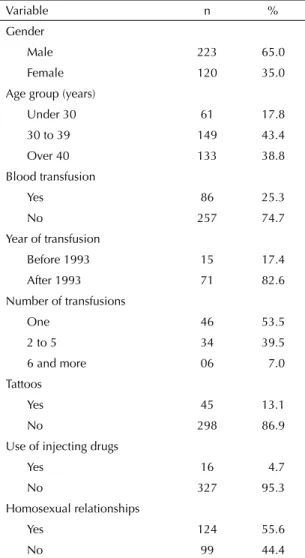
The majority of the 343 participants in the survey were males (65%), aged between 30 and 39 years (43.4%). Of all the patients surveyed, 25.3% (86) had received blood transfusions. Of these, 82.6% (71) had received a transfusion after 1993 and 53.5% (46) only one transfusion. As for the presence of tattoos, 13.1% (45) of the patents mentioned this item and 4.7% used illicit injecting drugs. Of the 223 men interviewed, 55.6% (124) reported homosexual experiences (Table 1). The prevalence of coinfection based on the detection of anti-HCV was 4.1% (14) and 3.2% (11) when the RT-PCR technique was used. The most frequent genotypes were 1b (45%), 3 (33%) and 1a (22%).
There was a higher prevalence of males (9/14), re-presenting 64.3% of all those coinfected and aged between 35 and 39 years. However, there was no evidence of a statistically signifi cant association in both cases (Table 2).
Table 3 shows the results of the association of the variables, according to positive results for anti-HCV obtained form the univariate analysis. Blood trans-fusions proved to be statistically signifi cant (p<0.05) for coinfection. With regard to the period when the transfusion was carried out, the risk for HCV infection was higher in patients who had received transfusion before 1993, with a prevalence ratio of 5.71. The risk of infection increased with the raise in the number of transfusions, but it was only signifi cant in the six transfusions or more category. However, the confi dence interval was very wide due to the small population in this particular category.
The variables with signifi cance probability below 20% (p<0.20) in the univariate analysis – age group, blood and/or hemoderivatives transfusions, period and num-ber of transfusions, tattoos and injecting drug use – were then included in the multiple logistic regression model, with backward elimination. After multivariate analysis, only the blood transfusion variable remained as a risk factor for HCV (OR= 4.28; 95% CI: 1.44;12.73, p= 0.0087).
DISCUSSION
The prevalence of HIV/HCV coinfection found in our study was low (4.1%) when compared with the studies in the literature,6,15 possibly due to differences in the risk
factors for acquiring HCV in different places.
There is evidence of an evolving pattern of the epide-miology of infection by HIV in various countries in the Americas, including Brazil. Substantial differences in case distribution according to risk factors have been found in the current decade, when compared with the 1980s. Initially, the epidemiology was predominant among male homosexuals, bisexuals, hemophiliacs or in those who had received blood transfusions.24
However, there has been a signifi cant increase in HIV transmission among users of injecting drugs, particularly cocaine and heroin, and in heterosexuals who have un-protected sexual practices. On the other hand, as HCV transmission occurs principally by parenteral route, HIV-positive individuals who are drug users have a four times higher risk of becoming infected with HCV.24
In Northeastern Brazil, only 8.4% of the patients acqui-re HIV through injecting drug use, diffeacqui-rently from the Southeastern and Southern regions, where the fi gures are 25.8% and 30.7%, respectively.25
Table 1. Characteristics of the HIV-positive patients. Municipality of Recife, Northeastern Brazil, 2003. (n=343)
Variable n %
Gender
Male 223 65.0
Female 120 35.0
Age group (years)
Under 30 61 17.8
30 to 39 149 43.4
Over 40 133 38.8
Blood transfusion
Yes 86 25.3
No 257 74.7
Year of transfusion
Before 1993 15 17.4
After 1993 71 82.6
Number of transfusions
One 46 53.5
2 to 5 34 39.5
6 and more 06 7.0
Tattoos
Yes 45 13.1
No 298 86.9
Use of injecting drugs
Yes 16 4.7
No 327 95.3
Homosexual relationships
Yes 124 55.6
In the population studied, there was no statistically signifi cant association between the use of injecting drugs and HCV, perhaps because of the reduced number of coinfected patients who were illicit injecting drug users. In the Northeast, marijuana is the main drug used, unlike in other regions in Brazil and the world, where injecting drugs predominate. Consequently, HIV/HCV coinfection is higher in users of this type of drugs. In the sample studied, there was no statistically sig-nifi cant association between age group and gender.
However, the most affected coinfected patients be-longed to the 30-39 years age group and were predo-minantly male, thereby corroborating other literature fi ndings.6,15
The performance of a blood and/or hemoderivati-ve transfusion is a signifi cant risk factor for HCV transmission. In addition, the period in which the fi rst transfusion occurred is also relevant, since there was no screening for HCV in Brazilian blood banks before 1993.5
Table 2. Distribution of patients coinfected with HIV, according to gender and age group. Municipality of Recife, Northeastern Brazil, 2003.
Variable Anti-HCV PR 95% CI p
Positive % Negative %
Gender
Male 9 4.0 214 96.0 0.97 0.33;2.83 0.953
Female 5 4.2 115 95.8 1.00 – –
Age group (years)
Under 30 5 3.8 128 96.2 1.00 –
30 to 39 9 6.0 140 94.0 1.61 0.55;4.67 0.544
Over 40 0 0.0 61 100.0 Not calculated 0.327
Table 3. Association of the variables related to HIV-infected patients, according to positive results for anti-HCV, after univariate analysis. Municipality of Recife, Northeastern Brazil, 2003.
Risk factor Anti-HCV PR 95% CI p
Positive % Negative %
Blood transfusion
Yes 08 9.3 78 90.7 3.98 1.42;11.1 0.009
No 06 2.3 251 97.7 1.00 – –
Year of transfusion
Had never had one 06 2.3 251 97.7 1.00 – –
Before 1993 02 12.5 13 87.5 5.71 1.26;25.9 0.065
After 1993 06 8.3 65 91.7 3.62 1.20;10.8 0.025
Number of transfusions
Had never had one 06 2.3 251 97.7 1.00 – –
One 03 6.5 43 93.5 2.79 0.72;10.7 0.141
2 to 5 03 8.8 31 91.2 3.78 0.99;14.4 0.074
6 and more 02 33.3 04 66.7 14.2 3.59;56.7 0.011
Tattoos
Yes 04 8.9 41 91.1 2.65 0.87;8.09 0.096
No 10 3.4 288 96.6 1.00 – –
Use of injecting drugs
Yes 02 12.5 14 87.5 3.41 0.83;13.9 0.133
No 12 3.7 315 96.3 1.00 – –
Homosexual relationships
Yes 05 4.2 119 95.8 1.00 0.28;3.62 0.997
Studies show that the number of transfusions is an im-portant factor for acquiring HCV, with indices as high as 30% for testing positive for anti-HCV in patients who have had multiple transfusions.15
In univariate analysis, three variables were indicated as risk factors: receiving a blood transfusion, the pe-riod and the number of transfusions. However, only receiving a blood transfusion remained associated with testing positive for HCV in the multiple logistic regression model, with a risk 4.28 times higher of an HIV-positive individual acquiring HCV. Therefore, the other variables were considered confounding factors. No association was found between the presence of tattoos and testing positive for HCV, corroborating other studies.3
For the laboratory analysis of hepatitis C, in addition to serological methods to detect anti-HCV, molecular methods are also necessary. RT-PCR is a suitable method for detecting cases when there has not been serum-conversion yet, but the virus is circulating. It is also useful for monitoring response to treatment by the viral load.28
It can be observed that all patients who were seronega-tive for HCV were also negaseronega-tive by RT-PCR. Conside-ring that these are serious immunosupressed patients,
in whom the immunological response may be altered, this result indicates that ELISA is a good diagnosis me-thod for HCV infection. However, the immunological response to HCV may be detected within one to three months, thus making RT-PCR an important method for confi rming the diagnosis.
Another important molecular method is genotyping, which is clinically signifi cantly important, both from the prognosis and treatment points of view, since there are data indicating worse prognosis for the disease when genotype 1 is present. Therefore, genotyping is indicated as one of the parameters used for assessing prognosis and planning therapy for patients infected with HCV.4
The frequency of the HCV genotypes in patients coin-fected by HIV was similar to various studies carried out in Europe18,20 and Brazil,2,7 with a high frequency
of genotypes 1 and 3.
The research data show a low prevalence of coinfec-tion in Recife in comparison with other cities in Brazil and the world. On the other hand, the study provides evidence of the signifi cance of hemotransfusions in the transmission of infection by HCV and the greater frequency of the 1b genotype of this virus.
1. Amin J, Kaye M, Skidmore S, Pillay D, Cooper DA, Dore GJ. HIV and hepatitis C coinfection within the
CAESAR study. HIV Med. 2004;5(3):174-9. DOI:
10.1111/j.1468-1293.2004.00207.x
2. Braga EL, Lyra AC, Ney-Oliveira F, Nascimento L, Silva A, Brites C, et al. Clinical and epidemiological features of patients with chronic hepatitis c co-infected
with HIV. Braz J Iinfect Dis. 2006;10(1):17-21. DOI:
10.1590/S1413-86702006000100004
3. Bräu N, Bini EJ, Shahidi A, Aytaman A, Xiao P, Stancic S, et al. Prevalence of hepatitis c and coinfection with HIV among United States Veterans in the New
York City metropolitan area. Am J Gastroenterol.
2002;97(8):2071-8.
4. Campiotto S, Pinho JRR, Carrilho FJ, Da Silva LC, Souto FJD, Spinelli V, et al. Geographic distribution
of hepatitis C virus genotypes in Brazil. Braz J Med
Biol Res. 2005;38(1):41-9. DOI: 10.1590/S0100-879X2005000100007
5. Carneiro MA, Teles SA, Dias MA, Ferreira RC, Naghettine AV, Silva SA, et al. Decline of hepatitis C infection in hemodialysis patients in Central Brazil:
a ten years of surveillance. Mem Inst Oswaldo
Cruz. 2005;100(4):345-9. DOI:
10.1590/S0074-02762005000400002
6. Caseiro MM, Braz IAN, Costa SOP, Ebner W. Prevalência de marcador para vírus da hepatite c (anti-HCV) em pacientes infectados pelo HIV-1,
em 6 municípios da baixada santista [resumo]. Rev
Soc Bras Med Trop. 2004;37:112. [Apresentado no 40. Congresso da Sociedade Brasileira de Medicina Tropical; 2004; Aracaju, BR]
7. Corvino MS, Henriques RMS, Grotto MT, Pardini MIMC. Co-Infecção HIV/HCV em pacientes
de Botucatu e região. Rev Bras Epidemiol.
2007;10(4):537-43. DOI: 10.1590/S1415-790X2007000400012
8. Darby SC, Ewart DW, Giangrande PL, Spooner RJ, Rizza CR, Dusheiko GM, et al. Mortality from liver cancer and liver disease in hemophiliac men and boys in UK given blood products contaminated with
hepatitis C. Lancet. 1997;350(9089):1425-31. DOI:
10.1016/S0140-6736(97)05413-5
9. Ferraz GGS, Menezes JA, Gazineo JL, Passoni LFC, Lessa MPM, Pinto PTA, et al. Prevalência de infecção pelo vírus B e C da hepatite em pacientes com
infecção pelo vírus da imunodefi ciência humana. Rev
Med HSE. 2002;36:6-11.
10. Garson, JA, Tedder RS, Briggs M, Tuke P, Glazebrook JA, Trute A, et al. Detection of hepatitis C viral sequences in blood donation by “nested” polymerase
chain reaction and prediction of infectivity. Lancet.
1990;335(8703):1419-22. DOI: 10.1016/0140-6736(90)91446-H
Article based on the master’s dissertation by Carvalho FHP presented to Programa de Pós-graduação em Medicina Tropical da Universidade Federal de Pernambuco, in 2004.
patterns in hemophiliacs treated with
hepatitis-C-virus-contaminated factor VIII concentrates. Lancet.
1990;336(8722):1022-25. DOI: 10.1016/0140-6736(90)92487-3
12. Kwok S, Higushi R. Avoiding false positives
with PCR. Nature. 1989;339(6221):237-8. DOI:
10.1038/339237a0
13. Mendes-Corrêa MCJ, Barone AA, Guastini C. Hepatitis C virus Seroprevalence and risk factors
among patients with HIV infection. Rev Inst Med Trop
Sao Paulo. 2001;43(1):15-9. DOI: 10.1590/S0036-46652001000100003
14. Monteiro MRCC, Nascimento MMP, Passos ADC, Figueiredo JFC. Hepatite C: prevalência e fatores de risco entre portadores de VIH/SIDA em Belém, Pará,
na Amazônia brasileira. Rev Soc Bras Med Trop.
2004;37(2):40-6.
15. Motta TQR, Tose S, Boni M, Gonçalves FL, Fausto MLC, Pereira L. Prevalência e fatores de risco para a infecção com o vírus da hepatite C em pacientes
infectados com o HIV em Vitória [resumo]. Rev Soc
Bras Med Trop. 2004;37(Supp 1):104. [Apresentado no 40. Congresso da Sociedade Brasileira de Medicina Tropical; 2004; Aracaju, BR]. DOI: 10.1590/S0037-86822004000300018
16. Pavan MH, Aoki FH, Monteiro DT, Goncales NS, Escanhoela CA, Goncales Júnior FL. Viral hepatitis in patients infected with human immunodefi ciency virus.
Braz J Infect Dis. 2003;7(4):253-61. DOI: 10.1590/ S1413-86702003000400005
17. Perrilo RP. The role of liver biopsy in hepatitis C.
Hepatology. 1997;26(Supp 3):S57-61. DOI: 10.1002/ hep.510260710
18. Rockstroh JK, Mudar M, Lichterfeld M, Nischalke HD, Klausen G, Gölz J, et al. Pilot study of interferon alpha high-dose induction therapy in combination with ribavirin for chronic hepatitis C in
HIV-co-infected patients. AIDS. 2002;16(15):2083-5. DOI:
10.1097/00002030-200210180-00016
19. Rodriguez-Rosado R, Garcia-Samaniego J, Soriano V. Hepatotoxicity after introduction of highly active
antiretroviral therapy. AIDS 1999;12(10):1256. DOI:
10.1097/00002030-199810000-00025
20. Rubio M, Rubio C, Nogués A, Manonelles A. Hepatitis C virus genotypes. Study of 302 patients coinfected by
the human immunodefi ciency virus. Med Clin (Barc).
2001;116(17):650-1.
21. Soriano V, Sulkowski M, Bergin C, Hatzakis A, Cacoub P, Katlama C, et al. Care of patients with chronic hepatitis C and HIV coinfection: recommendations
from the HIV-HCV International Panel. AIDS.
2002;16(6):813-28. DOI: 10.1097/00002030-200204120-00001
22. Segurado AC, Braga P, Etzel A, Cardoso MR. Hepatitis C virus coinfection in a cohort of HIV-infected individuals from Santos, Brazil: seroprevalence and associated
factors. AIDS Patient Care STDS. 2004;18(3):135-43.
DOI: 10.1089/108729104322994829
23. Sherman KE, Rouster SD, Chung RT, Rajicic N. Hepatitis C virus prevalence among patients infected with human immunodefi ciency virus: a cross-sectional analysis of the US adult AIDS Clinical
Trials Group. Clin Infect Dis. 2002;34(6):831-7. DOI:
10.1086/339042
24. Szwarcwald CL, Bastos FI, de Castilho EA. The dynamics of the AIDS epidemic in Brazil: a space-time
analysis in the period 1987-1995. Braz J Infect Dis.
1998;2(4):175-86.
25. Szwarcwald CL, Bastos FI, Esteves MAP, Andrade CLT. A disseminação da epidemia da AIDS no Brasil, no
período de 1987-1996: Uma análise espacial. Cad
Saude Publica. 2000;16(Supp 1):S07-19.
26. Thomas DL. Hepatitis C and human immunodefi ciency
virus infection. Hepatol. 2002;36(5 Supp 1):S201-9.
DOI: 10.1053/jhep.2002.36380
27. Tovo CV, Santos DE, Mattos AZ, Almeida PR, Mattos AA, Santos BR. Prevalência ambulatorial em um hospital geral de marcadores para hepatites B e C em pacientes com infecção pelo vírus da imunodefi ciência
humana. Arq Gastroenterol. 2006;43(2):73-6. DOI:
10.1590/S0004-28032006000200002
28. Zein NN. Clinical signifi cance of hepatitis C virus
genotypes. Clin Microbiol Rev. 2000;13(2):223-35.