Heliox in the treatment of status asthmaticus:
case reports
INTRODUCTION
Helium (He) was discovered in 1868 by the French astronomer Pierre-Jules-César Janssen.(1,2) In 1934, Barach described the irst application of He for the
treatment of airway obstruction and asthma exacerbations and demonstrated that its low density reduced the work of breathing and improved ventilation.(3-5)
Since that time, several mixtures of He and oxygen (so-called “heliox” -
He/O2) have been used for the treatment of several respiratory problems, such
as exacerbations of asthma and chronic bronchitis, i.e., obstructive diseases associated with increased expiratory resistance.(1,2,5)
He/O2 can be used with any oxygen delivery device, including nasal
cannulas, face masks, noninvasive ventilation, and conventional mechanical ventilation devices.(1,4,6)
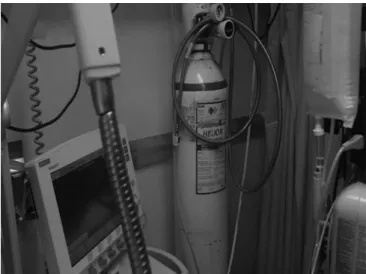
Some requirements are needed for heliox to be used during invasive mechanical ventilation, including the availability of a ventilator (e.g., the Maquet Servo-i) with a speciic module for automatic recalibration of the
replacement of air by He/O2 (supplied by pressurized bottles in a ratio of 80%
He:20% O2 - Figure 1). he fraction of inspired oxygen (FiO2) is titrated as a
function of the oximetry target values. he efect of He/O2 on the ventilatory
mechanics is inversely proportional to the FiO2 in the inspired gas mixture.
Inês Carvalho1, Sara Querido1, Joana Silvestre1,2, Pedro Póvoa1,2
1. Polyvalent Intensive Care Unit, Hospital de São Francisco Xavier, Centro Hospitalar de Lisboa Ocidental - Lisboa, Portugal.
2. Center of Studies on Chronic Diseases, Faculdade de Ciências Médicas, Universidade Nova de Lisboa - Lisboa, Portugal.
Helium was discovered in 1868 by the French astronomer Pierre-Jules-César Janssen and was irst used as a therapeutic treatment for airway obstruction by Barach almost 70 years later, in 1934. Heliox is characterized by its low density, which makes it more luid under conditions of turbulence, thus minimizing airway pressure and facilitating the occurrence of laminar low. he present article describes two clinical cases of patients with status asthmaticus subjected to mechanical ventilation and refractory to treatment in whom heliox was used, which
Conflict of interest: None. Submitted on November 12, 2015 Accepted on December 27, 2015
Corresponding author:
Inês Carvalho
Rua Diogo de Silves lote 35, 5º Esq 1400-107 - Lisboa, Portugal E-mail: [email protected]
Responsible editor: Flávia Ribeiro Machado
Heliox no tratamento do mal asmático: relato de casos
ABSTRACT
Keywords: Heliox; Airway obstruction; Asthma; Acute disease; Respiration, artiicial; Case reports allowed optimization of the eicacy of conventional pharmacological treatments. Although heliox is still used sporadically and its true eicacy has not been well demonstrated, the unique physical properties of helium and the theoretical improvement of the airlow in obstructed airways have produced scientiic interest and stimulated research. Heliox can be used simultaneously with conventional therapies in cases of serious and refractory exacerbations of severe obstructive disease.
Rodrigoet al.(7) performed a systematic review with a
meta-analysis of randomized clinical trials comparing the
eicacy of He/O2 and oxygen for driving beta2 agonist
nebulization in patients with acute asthma. he primary outcomes were change in spirometric parameters and severity scores; the secondary outcomes were hospital admission rate and severe adverse efects. he patients
who received He/O2 presented a statistically signiicant
improvement of the peak expiratory low of 20L/m (95% conidence interval - 95%CI: 5.2 - 29.4; p = 0.005), which was more evident in the subgroup of patients with severe and very severe asthma).
He/O2 also produced signiicant decreases in the
hospital admission rate (odds ratio - OR 0.49; 95% CI:
0.31 - 0.79; p = 0.003). he groups did not difer in the occurrence of serious adverse efects. herefore, it may be
concluded that the beneits of He/O2 on airlow limitation
associated with airway obstruction as well as on hospital admission rate are clinically signiicant.
Few reports in the literature describe the use of He/O2 in patients subjected to mechanical ventilation, and most consist of retrospective studies and case reports; no controlled studies have been conducted with intubated patients.(1)
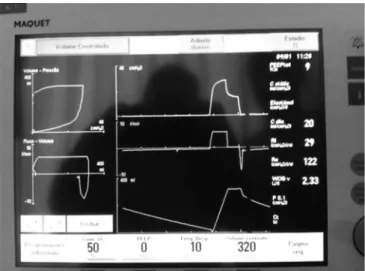
Our ventilation protocol for patients with severe obstructive disease was based on controlled hypoventilation; volume-controlled ventilation with high inspiratory output (approximately 60L/min) was combined with controlled hypoventilation (low respiratory rate: 8 - 10 cycles per minute (cpm) when the patient tolerated a pH of 7.25-7.28), a positive end-expiratory pressure (PEEP) of 0 to optimize the expiratory time, and limitation of the
plateau pressure (Pplateau) to 30cmH2O (Figure 2).
As the present study was a case report, informed consent was waived by the local ethics committee.
CASE REPORTS
Clinical case 1
he case of a male, 39-year-old patient with history of bronchial asthma since childhood, irregular treatment (budesonide and terbutaline), and without outpatient monitoring is described. he patient had an episode of status asthmaticus requiring invasive mechanical ventilation approximately 10 years earlier.
he patient was brought to the emergency department due to dyspnea and wheezing that began 24 hours earlier
Figure 1 - Use of heliox (80:20) with a Maquet Servo-I ventilator.
Except for the Maquet Servo-i, volume readings are inaccurate on all ventilators because the low meter is calibrated for air.(1) Furthermore, the dosing of the amount
of administered aerosols is also afected by the type of gas used. It should be noted that no adverse efects associated with the use of He/O2 have been described.(4,7) herefore,
administration of He/O2 is safe and does not require the
use of any type of gas exhaustion system.
Literature review
From the 1930s to the present time, several studies
have evaluated the impact of He/O2 delivery on the
maximum low rate, airway peak pressure, dyspnea scores, and performance in pulmonary function tests. However, the data provided by such studies were often contradictory
concerning the usefulness of He/O2 in pulmonary
obstructive disease.(1,3)
Colebournet al.(8) conducted a systematic review of all
of the controlled randomized trials that compared He/O2
toair-oxygen mixtures in patients with acute exacerbations
Figure 2 - Parameters and ventilatory mechanics before heliox administration. Controlled hypoventilation protocol.
and did not improve after short-acting bronchodilator therapy with salbutamol. Upon admission, the patient was in state of respiratory exhaustion; he was subjected to orotracheal intubation and connected to a ventilator, and bronchodilator therapy was started. Clinical, laboratory, and radiological assessments did not detect evidence of infection.
Due to the need for ventilatory support, the patient was transferred to the intensive care unit (ICU), where bronchodilator therapy and sedoanalgesia were optimized with administration of midazolam, alfentanil, and ketamine. Curarization was performed with vecuronium, and a controlled hypoventilation protocol was started. In terms of ventilatory mechanics, the patient exhibited increased expiratory time, severe bronchospasm, and a marked
expiratory low limitation pattern (time constant (τ),
1.69 seconds). In addition to the hypoventilation strategy, continuous high-dose inhaled and intravenous corticosteroid therapy (methylprednisolone) and magnesium sulfate were added to the nebulized bronchodilator therapy. Because his IgE levels were high, omalizumab was also administered.
On the 9th day of admission, the patient still exhibited
global respiratory failure, with severe acidemia and persistent expiratory low limitation (peak inspiratory
pressure (Ppeak), 57cmH2O; Pplateau, 25cmH2O; static
compliance (Cs), 45mL/cmH2O; τ, 3.55 seconds; intrinsic PEEP (PEEPi), 1).
Ventilation with He/O2 was started (and maintained
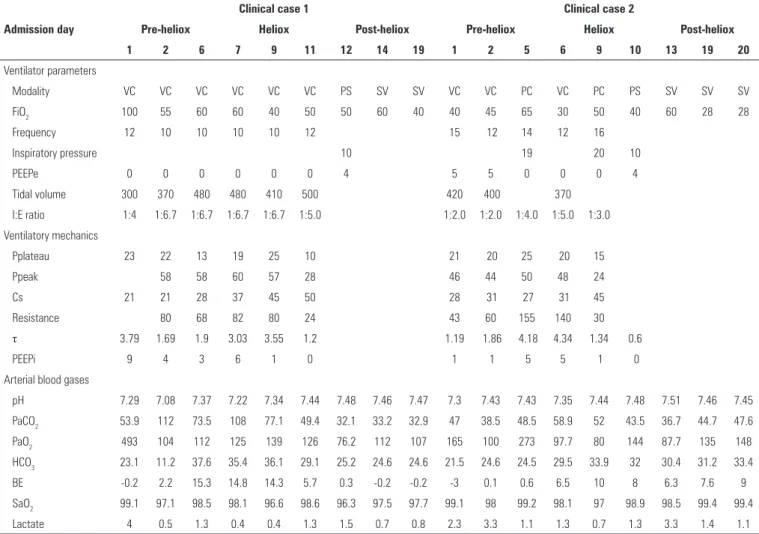
for three days), which produced signiicant improvement of the airway resistance and obstructive pattern, as shown by reduction of the peak pressure, resistance, τ, and PEEPi (Table 1).
On the 11th day, progressive and consistent
improvement of the blood gases was observed, curarization was discontinued, and sedation was decreased. On the
16th day, the patient was weaned from the ventilator and
extubated without any complications. he patient was free from hospital-acquired infections during his stay at the hospital, and thus, no antibiotic therapy was required.
he patient exhibited gradual clinical improvement without fever, was stable with regard to ventilation and hemodynamic parameters, and maintained adequate blood gases with an oxygen supply of 5L/min via a nasal cannula (Table 1).
On the 19th day, because he no longer required
intensive care, the patient was transferred to a hospital near his place of residence.
Hospital discharge occurred on the 30th day.
Clinical case 2
he case of a female, 53-year-old patient with a history of bronchial asthma, followed-up at a pneumology service since the age of 30, is described. he patient had several hospital admissions for decompensated asthma (requiring ventilatory support on two occasions) and one episode of seizures related to decompensated asthma. She was regularly treated with budesonide, formoterol, montelukast, omeprazole, hydroxyzine, and home oxygen therapy (2L/min).
he patient was transported to the emergency department for dyspnea starting 36 hours earlier and progressed into respiratory arrest, resulting in orotracheal intubation and mechanical ventilation.
Due to her state of status asthmaticus/respiratory failure, she was transferred to the ICU, where her condition improved during the irst 48 hours and was stable with regard to hemodynamic and ventilation parameters. Extubation was attempted, but it was complicated by immediate occurrence of severe bronchospasm.
On the 5th day, the patient exhibited an episode of severe
hypoxia, requiring an increase in sedation, curarization, and adjustment of bronchodilators. Regarding her ventilatory parameters, she exhibited marked expiratory
low limitation (Cs, 27mL/cmH2O; τ, 4.18 seconds;
PEEPi, 5) due to severe bronchospasm.
he controlled hypoventilation protocol was
restarted and combined with He/O2 (for four days)
and inhaled intravenous corticosteroid therapy using methylprednisolone and montelukast (10mg/day).
Table 1 - Ventilation, blood gases, and ventilatory dynamics parameters during the hospital stay Admission day
Clinical case 1 Clinical case 2
Pre-heliox Heliox Post-heliox Pre-heliox Heliox Post-heliox
1 2 6 7 9 11 12 14 19 1 2 5 6 9 10 13 19 20
Ventilator parameters
Modality VC VC VC VC VC VC PS SV SV VC VC PC VC PC PS SV SV SV
FiO2 100 55 60 60 40 50 50 60 40 40 45 65 30 50 40 60 28 28
Frequency 12 10 10 10 10 12 15 12 14 12 16
Inspiratory pressure 10 19 20 10
PEEPe 0 0 0 0 0 0 4 5 5 0 0 0 4
Tidal volume 300 370 480 480 410 500 420 400 370
I:E ratio 1:4 1:6.7 1:6.7 1:6.7 1:6.7 1:5.0 1:2.0 1:2.0 1:4.0 1:5.0 1:3.0
Ventilatory mechanics
Pplateau 23 22 13 19 25 10 21 20 25 20 15
Ppeak 58 58 60 57 28 46 44 50 48 24
Cs 21 21 28 37 45 50 28 31 27 31 45
Resistance 80 68 82 80 24 43 60 155 140 30
τ 3.79 1.69 1.9 3.03 3.55 1.2 1.19 1.86 4.18 4.34 1.34 0.6
PEEPi 9 4 3 6 1 0 1 1 5 5 1 0
Arterial blood gases
pH 7.29 7.08 7.37 7.22 7.34 7.44 7.48 7.46 7.47 7.3 7.43 7.43 7.35 7.44 7.48 7.51 7.46 7.45
PaCO2 53.9 112 73.5 108 77.1 49.4 32.1 33.2 32.9 47 38.5 48.5 58.9 52 43.5 36.7 44.7 47.6
PaO2 493 104 112 125 139 126 76.2 112 107 165 100 273 97.7 80 144 87.7 135 148
HCO3 23.1 11.2 37.6 35.4 36.1 29.1 25.2 24.6 24.6 21.5 24.6 24.5 29.5 33.9 32 30.4 31.2 33.4
BE -0.2 2.2 15.3 14.8 14.3 5.7 0.3 -0.2 -0.2 -3 0.1 0.6 6.5 10 8 6.3 7.6 9
SaO2 99.1 97.1 98.5 98.1 96.6 98.6 96.3 97.5 97.7 99.1 98 99.2 98.1 97 98.9 98.5 99.4 99.4
Lactate 4 0.5 1.3 0.4 0.4 1.3 1.5 0.7 0.8 2.3 3.3 1.1 1.3 0.7 1.3 3.3 1.4 1.1
VC - volume-controlled ventilation; PS - pressure support ventilation; SV - spontaneous ventilation; PC - pressure-controlled ventilation; FiO2 - fraction of inspired oxygen; PEEPe - extrinsic positive end-expiratory pressure; I:E - inspiration:expiration; Pplateau - plateau pressure; Ppeak - peak inspiratory pressure; Cs - static compliance; τ - time constant; PEEPi - intrinsic positive end-expiratory pressure; PaCO2 - partial pressure of carbon dioxide; PaO2 - partial pressure of oxygen; HCO3 - bicarbonate; BE - base excess; SaO2 - arterial oxygen saturation.
Weaning from mechanical ventilation was complicated by episodes of bronchospasm; eventually she was extubated on the 18th day. he patient was free from hospital-acquired
infections and was not subjected to antibiotic therapy. At the time of transfer (20th day), the patient was awake,
calm, and cooperative, with eicient cough and preserved swallowing relex, in addition to liquid respiratory secretions. he blood gases were adequate, with an oxygen supply of 2L/min through a nasal cannula, and she was capable of standing in a chair.
Hospital discharge occurred on the 40th day.
DISCUSSION
Many of the recently published studies on the use of
He/O2 for refractory asthma have concluded that such
treatments aim to reduce airlow resistance in obstructed airways, with consequent improvement of alveolar ventilation and of the eicacy of bronchodilator therapy
by increasing the difusion of drugs so that they might reach the smaller airways.(5,7,9,10)
Currently, He/O2 has been mainly used in both
pediatric and adult patients as adjuvant treatment while waiting for the onset of efects of conventional pharmacological treatments.(5,6) In the two clinical cases
described here, we observed improvement of airway resistance to low as well as the alveolar ventilation (demonstrated in the tables by progressive reduction of
Ppeak, resistance, τ, and PEEPi). hus, we believe that
He/O2 might represent an option for refractory upper
airway obstruction treatment in patients exhibiting progressive aggravation despite optimized ventilatory strategies and pharmacological treatment.
he use of He/O2 in mechanically ventilated patients
hus, recognizing the limitations of the present study, we consider the performance of controlled randomized studies essential to assess the identiied beneits of
He/O2 in adult patients subjected to invasive mechanical
ventilation.
CONCLUSION
Heliox is still sporadically used, and its true eicacy has not been well demonstrated. It appears to be an appropriate gas for oxygen and pharmacological treatment delivery, in respiratory diseases, due to its characteristic low
density. It can be used simultaneously with conventional treatment for serious and refractory exacerbations of severe obstructive disease.
he level of evidence currently available does not allow a formal recommendation of heliox use in the intensive care unit; however, further clinical studies are required.
ACKNOWLEDGMENTS
he authors would like to thank Maquet Portugal-Comércio de Equipamentos Hospitalares Unipessoal Lda., Mr. João Faria, and Engineer Vítor Brás for allowing, free of charge, the use of the software for temporary use of heliox.
O hélio foi descoberto em 1868 pelo astrônomo francês Pierre-Jules-César Janssen e teve seu uso terapêutico pela primeira vez na obstrução das vias aéreas, feito por Barach, quase 70 anos depois, em 1934. O heliox é caracterizado por sua baixa densidade, o que lhe confere melhor luidez sob condições de turbulência, minimizando a pressão das vias aéreas e facilitando a ocorrência de um luxo laminar. Este artigo apresenta dois casos clínicos de doentes com mal asmático sob ventilação mecânica, refratários à terapêutica, em que
se recorreu ao heliox, permitindo uma otimização da eicácia do tratamento farmacológico convencional. Apesar de sua utilização permanecer esporádica e sua verdadeira eicácia não se encontrar bem demonstrada, as propriedades físicas únicas do hélio e a melhoria teórica do luxo de ar nas vias aéreas obstruídas fomentam o interesse e a pesquisa cientíicos. Sua aplicação pode ter lugar simultaneamente em terapêuticas convencionais nas exacerbações graves e refratárias da doença obstrutiva grave.
RESUMO
Descritores: Heliox; Obstrução vias respiratórias; Asma; Doença aguda; Respiração artiicial; Relatos de casos
REFERENCES
1. Wigmore T, Stachowski E. A review of the use of heliox in the critically ill. Crit Care Resusc. 2006;8(1):64-72.
2. McGarvey JM, Pollack CV. Heliox in airway management. Emerg Med Clin North Am. 2008;26(4):905-20, viii.
3. Hunt T, Williams MT, Frith P, Schembri D. Heliox, dyspnoea and exercise in COPD. Eur Respir Rev.2010;19(115):30-8. Review.
4. Cruz L, Ferreira AR, Coimbra A, Castel-Branco MG. Helium-oxygen mixtures and acute severe asthma. Allergol Immunopathol (Madr). 2009;37(4):216-7.
5. Hashemian SM, Fallahian F. The use of heliox in critical care. Int J Crit Illn Inj Sci. 2014;4(2):138-42.
6. Chevrolet JC. Helium oxygen mixtures in the intensive care unit. Crit Care. 2001;5(4):179-81.
7. Rodrigo GJ, Castro-Rodriguez JA. Heliox-driven β2-agonists nebulization for children and adults with acute asthma: a systematic review with meta-analysis. Ann Allergy Asthma Immunol. 2014;112(1):29-34.
8. Colebourn CL, Barber V, Young JD. Use of helium-oxygen mixture in adult patients presenting with exacerbations of asthma and chronic obstructive pulmonary disease: a systematic review. Anaesthesia. 2007;62(1):34-42. 9. Reuben AD, Harris AR. Heliox for asthma in the emergency department: a
review of the literature. Emerg Med J. 2004;21(2):131-5.