Nonextensive relativistic nuclear and subnuclear equation of state
A. Lavagno, P. Quarati, A. M. Scarfone
Dipartimento di Fisica, Politecnico di Torino, I-10129 Torino, Italy Istituto Nazionale di Fisica Nucleare (INFN), Sezione di Torino e di Cagliari, Italy
(Received on 19 January, 2009)
Following the basic prescriptions of the Tsallis’ nonextensive relativistic thermodynamics, we investigate the relevance of nonextensive statistical effects on the relativistic nuclear and subnuclear equation of state. In this framework, we study the first order phase transition from hadronic to quark-gluon plasma phase by requiring the Gibbs conditions on the global conservation of the electric and the baryon charges. The relevance of small deviations from the standard extensive statistics is investigated in the context of intermediate and high energy heavy-ion collisions.
Keywords: Nonextensive thermostatistics, Relativistic nuclear equation of state, Hadron-quark phase transition
1. INTRODUCTION
The determination of the properties of nuclear matter as functions of densities, temperature and protons fraction is a fundamental task in nuclear and subnuclear physics. Several experimental observations and theoretical calculations clearly indicate that hadrons dissociate into a plasma of their elemen-tary constituents, quarks and gluons (QGP), at density several times the nuclear matter density and/or at temperature above few hundreds MeV, which is the critical temperature Tc of the transition from the QGP phase to the hadronic gas phase and viceversa. Such a QGP is expected to have occurred in the early stages of the Universe and can be found in dense and hot stars, neutron stars, nucleus-nucleus high energy col-lisions where heavy ions are accelerated to relativistic ener-gies [1]. After collision, a fireball is created which may re-alize the conditions of the QGP. The plasma then expands, cools, freezes-out into hadrons, photons, leptons that are de-tected and analyzed [2].
It is a rather common opinion that, because of the ex-treme conditions of density and temperature in ultrarelativis-tic heavy ion collisions, memory effects and long–range color interactions give rise to the presence of non–Markovian cesses in the kinetic equation affecting the thermalization pro-cess toward equilibrium as well as the standard equilibrium distribution [3–5]. A rigorous determination of the condi-tions that produce a nonextensive behavior, due to memory effects and/or long–range interactions, should be based on microscopic calculations relative to the parton plasma origi-nated during the high energy collisions. At this stage we limit ourselves to consider the problem from a qualitative point of view on the basis of the existing theoretical calculations and experimental evidences.
On the other hand, over the last years, there has been an increasing evidence that the generalized non-extensive statis-tical mechanics, proposed by Tsallis [6–8] and characterized by a power-law stationary particle distribution, can be con-sidered as a basis for a theoretical framework appropriate to incorporate, at least to some extent and without going into microscopic dynamical description, long-range interactions, long-range microscopic memories and/or fractal space-time constraints. A considerable variety of physical issues show a quantitative agreement between experimental data and theo-retical analysis based on Tsallis’ thermostatistics. In partic-ular, there is a growing interest in high energy physics ap-plications of non-extensive statistics [9–14]. Several authors
outline the possibility that experimental observations in rela-tivistic heavy-ion collisions can reflect non-extensive statisti-cal mechanics effects during the early stage of the collisions and the thermalization evolution of the system [5, 15–20]. In this context, it is relevant to observe that the statistical ori-gin of the nonextensive statistics lies in the deformation of the Boltzmann entropy. Let us note that in literature other statistical generalizations are present, such as theq-deformed thermostatistics inspired toq-deformed quantum algebra and quantum groups with a different origin [21–24].
From the above considerations, it appears reasonable that in regime of high density and temperature both hadron and quark-gluon Equation Of State (EOS) can be sensibly af-fected by nonextensive statistical effects [25]. Furthermore, in this context it is very remarkable to observe that the rele-vance of these effects on the relativistic hadronic equation of state has also been recently investigated in Ref. [26].
The aim of this paper is to study the behavior of the nuclear equation of state at finite temperature and baryon density and to explore the existence of a hadron-quark mixed phase at a fixed value of the proton fractionZ/A.
2. RELATIVISTIC NONEXTENSIVE
THERMODYNAMICS
In order to study, from a phenomenological point of view, experimental observable in relativistic heavy-ion collisions, in this Section we present the basic macroscopic thermody-namic variables and kinetic theory in the language of the nonextensive relativistic kinetic theory.
Let us start by introducing the particle four-flow in the phase space as [27]
Nµ(x) = 1 Zq
Z d3p p0 p
µf(x,p), (1)
and the energy-momentum flow as
Tµν(x) = 1 Zq
Z d3p p0 p
µpνfq(x,p),
(2)
where we have set ~=c=1, x≡xµ= (t,x), p≡ pµ= (p0,p), p0 =p
p2+m2 being the relativistic energy and
f(x,p)the particle distribution function. In the aboveZq= R
stands for the corresponding phase space volume element and qis the deformation parameter. The four-vector Nµ= (n,j) represents the probability densityn=n(x)(which is normal-ized to unity) and the probability flowj=j(x). The energy-momentum tensor contains the normalizedq-mean expecta-tion value of the energy density, as well as the energy flow, the momentum and the momentum flow per particle. Its ex-pression follows directly from the definition of the meanq -expectation value in nonextensive statistics [7]; for this reason Tµνit is given in terms of fq(x,p).
On the basis of the above definitions, one can show that it is possible to obtain a generalized non-linear relativistic Boltz-mann equation [27]
pµ∂µ[f(x,p)]q=Cq(x,p), (3) where the functionCq(x,p)implicitly defines a generalized nonextensive collision term
Cq(x,p) = 1 2
Z d3p
1
p01 d3p′
p′0 d3p′1
p′01
n
hq[f′,f′1]W(p′,p′1|p,p1) −hq[f,f1]W(p,p1|p′,p′1)
o
. (4)
Here W(p,p1|p′,p′1) is the transition rate between a two-particle state with initial four-momenta p and p1 and a fi-nal state with four-momenta p′ and p′1; hq[f,f1] is the q -correlation function relative to two particles in the same space-time position but with different four-momenta p and p1, respectively. Such a transport equation conserves the probability normalization (number of particles) and is con-sistent with the energy-momentum conservation laws in the framework of the normalized q-mean expectation value. Moreover, the collision term contains a generalized expres-sion of the molecular chaos and forq>0 implies the validity of a generalizedH-theorem, if the following, nonextensive, local four-density entropy is assumed (henceforward we shall set Boltzmann constantkB to unity)
Sµq(x) =−
Z d3p p0 p
µf[(x,p)]q[lnqf(x,p)−1], (5)
where we have used the definition lnqx= (x1−q−1)/(1−q), the inverse function of the Tsallis’q-exponential function
eq(x) = [1+ (1−q)x]1/(1−q), (6) which satisfies the propertyeq(lnqx) =x.
The above expression is written in a covariant form, in fact Sµq= (S0q,Sqi), withi=1,2,3, and correctly transforms as a four-vector under Lorentz transformations [27], whereS0qis the relativistic Tsallis nonextensive local entropy density and Si
qis the Tsallis entropy flow. Note that for q→1, Eq.(5) reduces to the well known four-flow entropy expression [28]. At equilibrium, the solution of the above Boltzmann equa-tion is a relativistic Tsallis-like (power law) distribuequa-tion and can be written as
feq(p) = 1 Zq
1−(1−q)p µU
µ T
1/(1−q)
, (7)
whereUµis the hydrodynamic four-velocity [28] and feq de-pends only on the momentum in the absence of an external
field. At this stage, T is a free parameter and only in the derivation of the equation of state it will be identified with the physical temperature.
We are able now to evaluate explicitly all other thermo-dynamic variables and provide a complete macroscopic de-scription of a relativistic system at the equilibrium. Con-sidering the decomposition of the energy-momentum tensor: Tµν=εUµUν−P∆µν, whereεis the energy density,P the
pressure and∆µν=gµν−UµUν, the equilibrium pressure can
be calculated as
P=−1 3T
µν∆µ
ν=− 1
3Zq Z d3p
p0 p µpν∆µ
νfqeq(p). (8) Settingτ=p0/T andz=m/T, the above integral can be ex-pressed as
P=4π Zq
m2T2K2(q,z), (9) where we have introduced theq-modified Bessel function of the second kind as follows
Kn(q,z) = 2nn! (2n)!
1 zn
Z ∞
z
dτ(τ2−z2)n−1/2 e−qτq , (10) andeq(x)is theq-modified exponential defined in Eq.(6).
Similarly, the energy densityεcan be obtained from the following expression
ε=TµνUµUν= 1
Zq Z d3p
p0 (p µU
µ)2fqeq(p), (11) and, after performing the integration, it can be cast into the compact expression:
ε=4π Zq
m4
3K2(q,z) z2 +
K1(q,z)
z
. (12)
Thus the energy per particlee=ε/nis e=3T+mK1(q,z)
K2(q,z)
, (13)
which has the same structure of the relativistic expression ob-tained in the framework of the equilibrium Boltzmann-Gibbs statistics [28].
In the non-relativistic limit (p≪1) the energy per particle reduces to the well-known expression
e≃m+3
2T, (14)
and no explicitq-dependence is left over.
Hence from the above results it appears that, in search-ing for the relevance of nonextensive statistical effects, both microscopic observable, such as particle distribution, corre-lation functions, fluctuations of thermodynamical variables, and macroscopic variables, such as energy density or pres-sure, can be affected by the deformation parameterq.
kinetic equations, in Ref.[18] the authors have recently for-mulated a nonextensive hydrodynamic model for multiparti-cle production processes in relativistic heavy-ion collisions. These works represent an important bridge for a close con-nection between a microscopic nonextensive model and ex-perimental observable.
Finally, let us remind the reader that for a system of par-ticles in a degenerate regime the above classical distribution function (7) has to be modified by including the fermion and boson quantum statistical prescriptions. For a dilute gas of particles and/or for small deviations from the standard exten-sive statistics (q≈1) the equilibrium distribution function, in the grand canonical ensemble, can be written as [29]
n(k,µ) = 1
[1+ (q−1)(E(k)−µ)/T]1/(q−1)±1, (15) where the sign+stands for fermions and−for bosons: hence all previous results can be easily extended to the case of quan-tum statistical mechanics.
3. NONEXTENSIVE NUCLEAR EQUATION OF STATE
The EOS at densities below the saturation density of nu-clear matterρ0≈0.16 fm−3is relatively well known due to the large amount of experimental nuclear data available. At larger densities there are many uncertainties due the lack of experimental data; the strong repulsion at short distances of nuclear force makes, in fact, the compression of nuclear mat-ter to larger densities quite difficult. Otherwise, in relativistic heavy ion collision the baryon densities can reach values of a few timesρ0and the temperature can exceed the deconfine-ment critical temperatureTc≈170 MeV.
As partially discussed in the Introduction, hadronic mat-ter is expected to undergo a phase transition into a deconfined phase of quarks and gluons at large densities and/or high tem-peratures. However, the extraction of experimental informa-tion about the EOS of matter at large densities and tempera-tures at intermediate and high energy heavy-ion collisions is very complicated. Possible indirect indications of a softening of the EOS at the energies reached at AGS have been dis-cussed several times in the literature [30, 31]. In particular, a recent analysis [32] based on a 3-fluid dynamics simulation suggests a progressive softening of the EOS tested through heavy-ion collisions at energies ranging from 2A GeV up to 8A GeV. On the other hand, the information coming from ex-periments with heavy-ions at intermediate and high energy collisions is that, for symmetric or nearly symmetric nuclear matter, the critical density (at low temperatures) appears to be considerably larger than nuclear matter saturation densityρ0. Concerning non-symmetric matter, general arguments based on Pauli principle suggest that the critical density decreases withZ/A. Therefore, the transition’s critical densities are ex-pected to sensibly depend on the isospin of the system [33]. Moreover, the analysis of observations of neutron stars, which are composed ofβ-stable matter for which Z/A≤0.1 (the matter constituting neutron stars is strongly isospin asymmet-ric, being composed of a large amount of neutrons and a small fraction of protons) can also provide hints on the structure of extremely asymmetric matter at high density. No data on
the quark deconfinement transition are at the moment avail-able for intermediate values ofZ/A. Recently, it has been proposed by several groups to produce unstable neutron-rich beams at intermediate energies. These new experiments can open the possibility to explore in laboratory the isospin de-pendence of the critical densities.
The scenario we are going to explore in this last Section corresponds to the situation realized in experiments at not too high energy. In this condition, only a small fraction of strangeness can be produced and, therefore, we limit our-selves to study the deconfinement transition from nucleonic matter into up and down quark matter. In the next two subsec-tions, we will study the two corresponding EOSs separately, on the basis of the previously reported nonextensive relativis-tic thermodynamic relations. The existence of the hadron-quark mixed phase will be studied in the third subsection. This investigation may be helpful also in view of the future experiments planned, e.g., at the facility FAIR at GSI [34].
3.1. Nonextensive hadronic equation of state
The relativistic, field theoretical approach to nuclear EOS was used first by Walecka and Boguta-Bodmer in the mid-1970s [35, 36]. This theory describes the interaction between nucleons through the exchange of two mesons, the scalar field σand the vector fieldω. The model of Walecka has two free parameters: the two ratios between the nucleon-meson cou-pling constants and the masses of the mesons. The saturation density and binding energy per nucleon (calculated at the the saturation density) of nuclear matter can be fitted exactly in the simplest version of this model but other properties of nu-clear matter, as e.g. incompressibility, cannot be reproduced. To overcome these difficulties, the model has been modified introducing in the Lagrangian two terms of self-interaction for theσwhich are crucial to reproduce the empirical incom-pressibility of nuclear matter and the effective mass of nucle-onsM∗(again calculated at the saturation density). Moreover, the introduction of an isovector mesonρallows to reproduce the correct value of the empirical symmetry energy [37, 38].
In the following, we will use a relativistic mean field self-consistent theory of nuclear matter in which nucleons interact through the nuclear force mediated by the exchange of virtual isoscalar and isovector mesons (σ,ω,ρ) with a Lagrangian density [38]
L
= ψ¯[iγµ∂µ−(M−gσσ)−gωγµωµ−gργµ~τ·~ρµ]ψ +12(∂µσ∂ µσ−m2
σσ2)−U(σ) +
1 2m
2
ωωµωµ
+1 2m
2
ρ~ρµ·~ρµ−
1 4FµνF
µν−1
4G~µνG~
µν, (16)
where M =939 MeV is the vacuum baryon mass, (σ,ωµ) are the isoscalar (scalar,vector) meson fields, while~ρµ is the corresponding isovector ones. The field strength ten-sors for the vector mesons are given by the usual expressions Fµν≡∂µων−∂νωµ, ~Gµν≡∂µ~ρν−∂ν~ρµ, and theU(σ) is a
nonlinear potential ofσmeson
U(σ) =1 3aσ
3+1 4bσ
This last term is usually introduced to achieve a reasonable compression modulus for equilibrium nuclear matter.
The field equations in a mean field approximation are
(iγµ∂µ−(M−gσσ)−gωγ0ω0−gργ0τ3ρ0)ψ=0,
m2σσ+aσ2+bσ3=gσ<ψψ¯ >=gσρS,
mω2ω0=gω<ψγ¯ 0ψ>=gωρB,
m2ρρ0=gρ<ψγ¯ 0τ3ψ>=gρρI, (18)
whereρI=ρp−ρnis the isospin density,ρBandρSare the baryon and the scalar densities, respectively. They are given by
ρB=2
∑
i=n,pZ d3k
(2π)3[ni(k)−ni(k)], ρS=2
∑
i=n,p Z d3k
(2π)3
M⋆i Ei⋆[n
q i(k) +n
q
i(k)], (19)
whereni(k)andni(k)are theq-deformed fermion particle and antiparticle distributions given in Eq.(15); more explicitly
ni(k) =
1
[1+ (q−1)(Ei⋆(k)−µi⋆)/T]1/(q−1)+1, (20) ni(k) =
1 [1+ (q−1)(E⋆
i(k) +µ⋆i)/T]1/(q−1)+1
. (21)
The nucleon effective energy is defined as Ei⋆(k) = p
k2+M
i⋆2, whereMi⋆=Mi−gσσ. The effective
chemi-cal potentialsµ⋆i are given in terms of the vector meson mean fields µ⋆i =µi−gωω0∓gρρ0(−proton,+neutron), where
µiare the thermodynamical chemical potentialsµi=∂ε/∂ρi. At zero temperature they reduce to the Fermi energiesEFi≡ q
k2
Fi+M⋆i2and the nonextensive statistical effects disappear. The meson fields (σ,ω0andρ0) are obtained as a solution of the field equations in mean field approximation and the re-lated couplings (gσ,gωandgρ) are the free parameter of the
model [38].
On the basis of Eqs.(2), (8) and (11), the pressure and the energy density can be written as
P = 2 3i=
∑
n,pZ d3k (2π)3
k2 Ei⋆(k)[n
q i(k) +n
q i(k)]
− 1
2m 2
σσ2−U(σ) +
1 2m
2
ωω20+ 1 2m
2
ρρ20, (22)
ε = 2
∑
i=n,pZ d3k (2π)3E
⋆ i(k)[n
q i(k) +n
q i(k)]
+ 1
2m 2
σσ2+U(σ) +
1 2m
2
ωω20+ 1 2m
2
ρρ20, (23)
Note that statistical mechanics enters as an external ingre-dient in the functional form of the ”free” particle distribution of Eq. (15). Since all the equations must be solved in a self-consistent way, the presence of nonextensive statistical effects in the particle distribution function influences the many-body interaction in the mean field self-consistent solutions obtained for the meson fields.
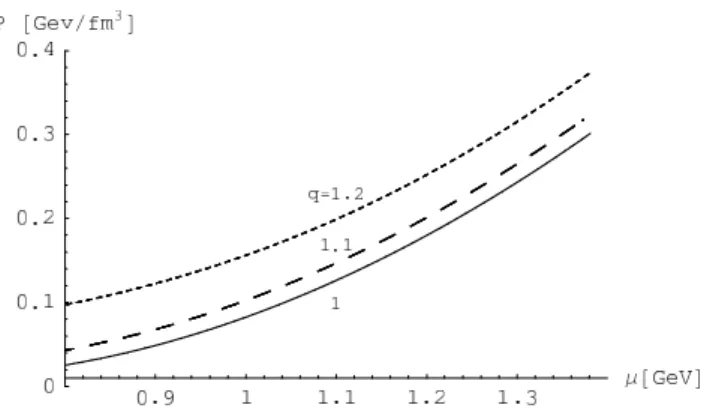
In Fig. 1, we report the resulting hadronic EOS: pressure as a function of baryon chemical potential for different values of
FIG. 1: Hadronic equation of state: pressure versus baryon chemical potential for different values ofq. In the figureT=100 MeV and Z/A=0.4.
q. Since in the previous investigations we have phenomeno-logically obtained values ofqgreater than unity [5, 20] , we will concentrate our analysis toq>1. The results are plotted at the temperatureT =100 MeV, at fixed value ofZ/A=0.4 and we have used the GM2 set of parameters of Ref.[38]. The range of the considered baryon density and the chosen values of the parameters correspond to a physical situation which can be realized in the recently proposed high energy heavy-ion collisheavy-ions experiment at GSI [39].
3.2. Nonextensive QGP equation of state
In high density hadronic matter, baryons are forced to stay so close one to another that they would overlap. At such den-sities, constituent quarks are shared by neighboring baryons and should eventually become mobile over a distance larger than the typical size of one baryon. This means that quarks become deconfined and that at large densities and/or high temperatures they are the real degrees of freedom of strongly interacting matter instead of baryons. The process of decon-finement and the EOS of quark matter can in principle be de-scribed by quantum chromodynamics. However, in energy density range reached in the core of compact stars and in rel-ativistic heavy-ion collisions, non-perturbative effects in the complex theory of QCD are present. For these reasons, sim-ple phenomenological models are usually adopted to describe quark matter [40–42].
written, respectively, as
P =γf 3 f=
∑
u,dZ ∞
0 d3k (2π)3
k2 ef
[nqf(k) +nqf(k)]−B, (24)
ε =γf
∑
f=u,dZ ∞
0 d3k (2π)3ef[n
q f(k) +n
q
f(k)] +B, (25) ρ =γf
3 f=
∑
u,d Z ∞0 d3k
(2π)3[nf(k)−nf(k)], (26) where the quark degeneracy for each flavor isγf =6, ef = (k2+m2
f)1/2,nf(k)andnf(k)are theq-deformed particle and antiparticle quark distributions
nf(k) =
1
[1+ (q−1)(ef(k)−µf)/T]1/(q−1)+1
, (27)
nf(k) =
1
[1+ (q−1)(ef(k) +µf)/T]1/(q−1)+1
. (28)
Similar expressions for the pressure and the energy density can be written for the gluons treating them as a masslessq -deformed Bose gas with zero chemical potential. Explicitly, we can calculate the nonextensive pressurePgand density en-ergyεgfor gluons as
Pg = γg
3 Z ∞
0 d3k
(2π)3
k
[1+ (q−1)k/T]q/(q−1)−1, (29)
εg =3Pg, (30)
with the gluon degeneracy factorγg=16. Let us observe that, in the limitq→1, we recover the usual analytical expression for the pressure of gluons:Pg=8π2/45T4.
Since one has to employ the fermion (boson) nonextensive distributions, the results are not analytical, even in the mass-less quark approximation. Hence a numerical evaluations of the integrals in Eq.s (24)–(26) and Eq.s (29)–(30) must be performed. Let us remember that a similar calculation, only for the quark-gluon phase, was also performed in Ref.[45] by studying the phase transition diagram.
As previously discussed, in this investigation we are lim-iting our study to the two-flavor (f =u,d) massless quarks. As already remarked, this appears rather well justified for the application to heavy ion collisions at relativistic (but not ultra-relativistic) energies, the fraction of strangeness produced at these energies being small [43, 44].
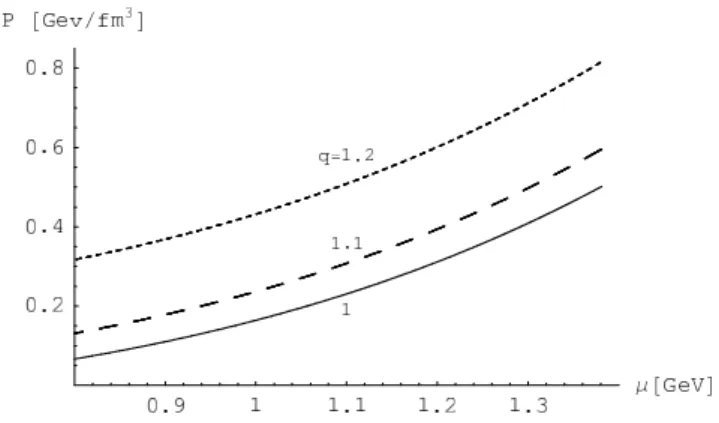
In Fig. 2, we report the pressure as a function of the baryon chemical potential for massless quarks u,d and gluons, for different values ofq. As in Fig. 1, the results are plotted at the temperatureT=100 MeV and at a fixed value ofZ/A=0.4; the bag parameter isB1/4=170 MeV. In both figures 1 and 2 one can observe sizable effects in the behavior of the EOS even for small deviations from the standard statistics.
3.3. Mixed hadron-quark phase
In this subsection we investigate the hadron-quark phase transition at finite temperature and baryon chemical potential by means of the previous relativistic EOSs. Lattice calcula-tions predict a critical phase transition temperatureTcof about
FIG. 2: The same as in Fig. 1 for the case of the quark-gluon equa-tion of state.
170 MeV, corresponding to a critical energy densityεc≈1 GeV/fm3[1]. In a theory with only gluons and no quarks, the transition turns out to be of first order. In nature, since theu anddquarks have a small mass, while the strange quark has a somewhat larger mass, the phase transition is predicted to be a smooth cross over. However, since it occurs over a very narrow range of temperatures, the transition, for several prac-tical purposes, can still be considered of first order. Indeed the lattice data with 2 or 3 dynamical flavours are not pre-cise enough to unambigously control the difference between the two situations. Thus, by considering the deconfinement transition at finite density as a the first order one, a mixed phase can be formed, which is typically described using the two separate equations of state, one for the hadronic and one for the quark phase.
To describe the mixed phase we use the Gibbs formalism, which in Ref. [46] has been applied to systems where more than one conserved charge is present. In this contribution we are studying the formation of a mixed phase in which both baryon number and isospin charge are preserved. The main result of this formalism is that, at variance with the so-called Maxwell construction, the pressure in the mixed phase is not constant and therefore the nuclear incompressibility does not vanish. It is important to notice that from the viewpoint of Ehrenfest’s definition, a phase transition with two conserved charges is considered, in the literature, not of first, but of sec-ond order [47].
The structure of the mixed phase is obtained by imposing the Gibbs conditions for chemical potentials and pressure and by requiring the global conservation of the total baryon (B) and isospin densities (I) in the hadronic phase (H) and in the quark phase (Q)
µ(BH)=µ(BQ), µ(IH)=µ(IQ),
P(H)(T,µ(BH,I)) =P(Q)(T,µ(BQ,I)), ρB= (1−χ)ρHB+χρ
Q B, ρI= (1−χ)ρHI +χρ
Q
I , (31)
FIG. 3: Pressure versus baryon chemical potential in the mixed hadron-quark phase for different values ofq. The long-dashed line corresponds toq=1.05. The temperature is fixed a T=60 MeV and the proton fractionZ/A=0.4.
phase coexistence region in the(T,ρB,ρI)space. For a fixed value of the conserved chargeρI, related to the proton fraction Z/A≡(1+ρI/ρB)/2, we study the boundaries of the mixed phase region in the(T,ρB)plane. We are particularly inter-ested in the lower baryon density (or baryon chemical poten-tial) border, i.e. the critical/transition densityρcr, in order to check the possibility of reaching such(T,ρcr,ρI)conditions in a transient state during a heavy-ion collision at relativistic energies.
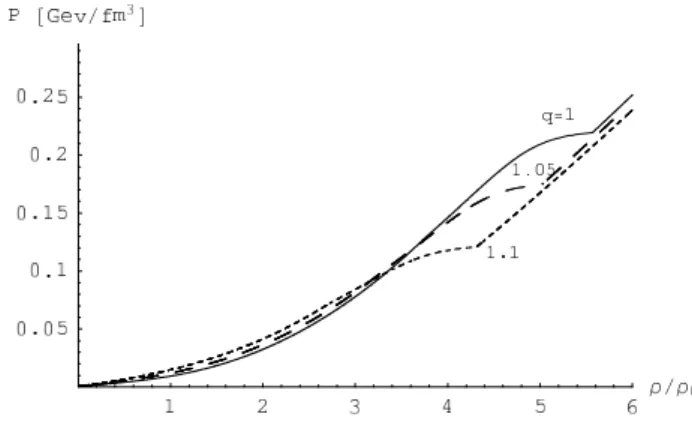
In Fig. 3, we report the pressure versus the baryon chemi-cal potential, in Fig. 4, the pressure as a function of the energy density and in Fig. 5 we report the pressure versus baryon density (in units of the nuclear saturation densityρ0) in the mixed hadron-quark phase for different values ofq. For the hadronic phase we have used the so-called GM2 set of param-eters [38] and in the quark phase the bag parameter is fixed toB1/4=170 MeV. The temperature is fixed atT =60 MeV and the proton fraction atZ/A=0.4, physical values which are estimated to be realistic for high energy heavy-ion collisions. The mixed hadron-quark phase starts atρ=3.75ρ0forq=1, atρ=3.31ρ0forq=1.05 and atρ=2.72ρ0forq=1.1. It is important to observe that forq=1.1 the second critical transi-tion density is also reached, separating the mixed phase from the pure quark-gluon matter phase, atρ=4.29ρ0while for
q=1.05 the second critical density is reached atρ=5.0ρ0 and atρ=5.57ρ0forq=1.
As a concluding remark we note that nonextensive statisti-cal effects become extremely relevant at large baryon density and energy density, as the ones which can be reached in high energy collisions experiments. This fact can be an important ingredient in the realization of a hydrodynamic model as well as to obtain a deeper microscopic connection with the exper-imental observable.
FIG. 4: Pressure versus energy density in the mixed hadron-quark phase for different values ofq. The temperature is fixed a T=60 MeV and the proton fractionZ/A=0.4.
FIG. 5: Pressure versus baryon density (in units of the nuclear sat-uration densityρ0) in the mixed hadron-quark phase for different
values ofq.
[1] R.C. Hwa and X.N. Wang,Quark Gluon Plasma 3, (World Sci-entific, 2004).
[2] T.S. Bir´o, J. Phys. G: Nucl. Part. Phys.35, 044056 (2008). [3] H. Heiselberg and X.N. Wang, Phys. Rev. C53, 1892 (1996). [4] T.S. Bir´o and C. Greiner, Phys. Rev. Lett.79, 3138 (1997). [5] W.M. Alberico, A. Lavagno and P. Quarati, Eur. Phys. J. C12,
499 (2000); W.M. Alberico, A. Lavagno and P. Quarati, Nucl. Phys. A680, 94c (2001).
[6] C. Tsallis, J. Stat. Phys.52, 479 (1988).
See also http://tsallis.cat.cbpf.br/biblio.htm for a regularly up-dated bibliography on the subject.
[7] C. Tsallis, R.S. Mendes and A.R. Plastino, Physica A261, 534
(1998).
[8] M. Gell-Mann and C. Tsallis (Editors),Non-extensive Entropy: Interdisciplinary Applications, (Oxford University Press, USA, 2004).
[9] G. Wilk and Z. Włodarczyk, Phys. Rev. Lett.84, 2770 (2000); O.V. Utyuzh, G. Wilk and Z. Włodarczyk, J. Phys. G 26, L39 (2000); F.S. Navarra, O.V. Utyuzh, G. Wilk and Z. Włodarczyk, Phys. Rev. D67, 114002 (2003).
[12] I. Bediaga, E.M.F. Curado and J.M. de Miranda, Physica A 286, 156 (2000).
[13] C. Beck, Physica A 286, 164 (2000); Physica A 305, 209 (2002); Physica A331, 173 (2004).
[14] T.S. Bir´o and G. Purcsel, Phys. Rev. Lett.95, 162302 (2005). [15] T.S. Bir´o and B. M¨uller, Phys. Lett. B578, 78 (2004); T.S. Bir´o
and A. Peshier, Phys. Lett. B632, 247 (2006).
[16] T.S. Bir´o and G. Purcsel, Phys. Lett. A372, 1174 (2008). [17] N. Biyajima, M. Kaneyama, T. Mizoguchi and G. Wilk, Eur.
Phys. J. C40, 243 (2005); N. Biyajima et al., Eur. Phys. J. C 48, 597 (2006).
[18] T. Osada and G. Wilk, Phys. Rev. C77, 044903 (2008). [19] A. Lavagno, Physica A305, 238 (2002).
[20] W.M. Alberico, P. Czerski, A. Lavagno, M. Nardi and V. Som´a, Physica A387, 467 (2008).
[21] G. Kaniadakis, A. Lavagno and P. Quarati, Phys. Lett. A227, 227 (1997); G. Kaniadakis, A. Lavagno and P. Quarati, Nucl. Phys. B466, 527 (1996).
[22] A. Lavagno and P. Narayana Swamy, Phys. Rev. E61, 1218 (2000); A. Lavagno and P. Narayana Swamy, Phys. Rev. E65, 036101 (2002).
[23] A. Lavagno, A.M. Scarfone and P. Narayana Swamy, Eur. Phys. J. C47, 253 (2006); A. Lavagno, A.M. Scarfone and P. Narayana Swamy, J. Phys. A: Math. Theor.40, 8635 (2007). [24] A. Lavagno, J. Phys. A: Math. Theor.41, 244014 (2008). [25] A. Drago, A. Lavagno and P. Quarati, Physica A 344, 472
(2004).
[26] F.I.M. Pereira, R. Silva and J.S. Alcaniz, Phys. Rev. C 76, 015201 (2007).
[27] A. Lavagno, Phys. Lett. A301, 13 (2002).
[28] S.R. Groot, W.A. van Leeuwen, Ch. G. van Weert,Relativistic kinetic theory, North-Holland, Amsterdam, 1980.
[29] U. Tirnakli, F. B¨uy¨ukkilic¸ and D. Demirhan, Phys. Lett. A245, 62 (1998).
[30] H. Stoecker, Nucl. Phys. A750, 121 (2005); M. Isse et al., Phys. Rev. C72, 064908 (2005).
[31] L. Bonanno, A. Drago and A. Lavagno, Phys. Rev. Lett.99, 242301 (2007).
[32] V. N. Russkikh and Y. B. Ivanov, Phys. Rev. C74, 034904 (2006).
[33] M. Di Toro, A. Drago, T. Gaitanos, V. Greco and A. Lavagno, Nucl. Phys. A775, 102 (2006); A. Drago, A. Lavagno and I. Parenti, Ap. J.659, 1519 (2007).
[34] P. Senger, J. Phys. G30, S1087 (2004). [35] J.D. Walecka, Ann. of Phys.83, 491 (1974).
[36] J. Boguta and A.R. Bodmer, Nucl. Phys. A292, 413 (1977). [37] B.D. Serot and J.D. Walecka, Phys. Lett. B87, 172 (1979). [38] N.K. Glendenning and S.A. Moszkowski, Phys. Rev. Lett.67,
2414 (1991).
[39] GSI, Scientific Report 2007 and GSI Proposal for an Interna-tional Accelerator Facility for Research with Ions and Antipro-tons.
[40] A. Chodos et al., Phys. Rev. D9, 3471 (1974).
[41] S.L. Schertler and J. Schaffner-Bielich, Phys. Rev. C 60, 025801 (1999).
[42] A. Drago and A. Lavagno, Phys. Lett. B511, 229 (2001); A. Drago, A. Lavagno and G. Pagliara, Phys. Rev. D69, 057505 (2004); Z. Berezhiani et al., ApJ.586, 1250 (2003).
[43] G. Ferini, M. Colonna, T. Gaitanos and M. Di Toro, Nucl. Phys. A762, 147 (2005); A. Drago, A. Lavagno and G. Pagliara, Phys. Rev. D71, 103004 (2005).
[44] C. Fuchs, Prog. Part. Nucl. Phys.56, 1 (2006).
[45] A. Teweldeberhan and H.G. Miller, R. Tegen, Int. J. Mod. Phys. E12, 395 (2003).