w w w . s b f g n o s i a . o r g . b r / r e v i s t a
Original
Article
Preformulation
study
and
influence
of
DMSO
and
propylene
glycol
on
the
antioxidant
action
of
isocoumarin
paepalantine
isolated
from
Paepalanthus
bromelioides
João
Paulo
Loureiro
Damasceno
a,
Cristiane
dos
Santos
Giuberti
a,b,
Rita
de
Cássia
Ribeiro
Gonc¸
alves
a,b,
Rodrigo
Rezende
Kitagawa
a,b,∗aProgramadePós-graduac¸ãoemCiênciasFarmaceuticas,UniversidadeFederaldoEspíritoSanto,Vitória,ES,Brazil
bDepartamentodeCiênciasFarmaceuticas,UniversidadeFederaldoEspíritoSanto,Vitória,ES,Brazil
a
r
t
i
c
l
e
i
n
f
o
Articlehistory:
Received30May2015 Accepted13July2015 Availableonline1August2015
Keywords:
Antioxidant Paepalantine Preformulation
a
b
s
t
r
a
c
t
Coumarinsarephenoliccompoundsandhavevariousbiologicalproperties,includingantioxidant activ-ity.Theisocoumarinpaepalantine,isolatedfromofPaepalanthusbromelioidesSilveira,Eriocaulaceae, exhibitsawiderangeofbiologicalactivities,includingantimicrobial,anti-inflammatory,antioxidant andcytotoxicproperties.Studiesonpaepalantineoftenusedimethylsulfoxideasasolvent.Howeverthe dimethylsulfoxideinterfereswithantimicrobial,cytotoxicandantioxidantassays.Thus,thisstudyaims toevaluatealternativesolventsforpaepalantineandevaluatetheirpotentialtointerferewithantioxidant assays(ABTS•+,O2•−,HOCl).Oftheselectedsolvents,propyleneglycolhadgoodsolubilityandremained stablethroughoutthestudyperiod.Theresultssuggestedthatthereisnointerferencefrompropylene glycolinantioxidantassays,whiledimethylsulfoxidesignificantlyinterferedwiththeHOClassay.The antioxidantassaysshowedthatpaepalantinedemonstratedsimilarorevenbetterantioxidantactivity thanTrolox.Thus,propyleneglycolmaybethesolventofchoiceforpaepalantine,acompoundthathas significantbiologicalpotential.
©2015SociedadeBrasileiradeFarmacognosia.PublishedbyElsevierEditoraLtda.Allrightsreserved.
Introduction
Naturalproductshavealwayscontributedtothediscoveryand development of novel molecules. An analysisof all substances approvedbytheFDAasnewmolecularentitiesdemonstratesthat morethanone-thirdofthetotalnumberofsubstancescorresponds tonaturalproductsandtheirsemi-syntheticderivatives(Patridge et al., 2015). Among natural products, plants are a rich source oftherapeuticagentsandbasesforsyntheticdrugs.Despitethe advancesinorganicsynthesis,currently25%ofprescribeddrugs worldwidearestillderivedfromplantsources,thusshowingthat plantspeciesarestillanimportantsourceofnoveldrugsfor dis-easesthatcontinuetolacktreatmentoption(NewmanandCragg, 2012;Rates,2001).
The Eriocaulaceae family distributed in the mountainous regionsofSouthAmerica,especiallyintherockysavannasofBrazil,
∗ Correspondingauthor.
E-mail:[email protected](R.R.Kitagawa).
containsabout1400speciesbelongingtoelevengenera(Alvarado etal., 2013).Paepalanthus,withabout500species,is oneofits principalgeneracommonlyfoundintheStatesofBahiaandMinas Gerais,Brazil.Anumberofstudieshavedemonstratedthatalmost allspeciesofPaepalanthussubgenusPlatycaulonpossessflavonoids, naphthoquinones,caffeicacid,andnaphthopyranonederivatives, including paepalantine (1)and 8,8-paepalantinedimer isolated fromP.bromelioides(Vilegasetal.,1990;Coelhoetal.,2000), plani-folinisolatedfromP.planifolius(SantosandVilegas,2001;Varanda etal.,2006), and5-methoxy-3,4-dehydroxanthomegninisolated fromP.latipesSilveira(Kitagawaetal.,2004).
Currently,someofthesecompoundsareof notable pharma-cological interest owing totheir proven biological activity; for example,ithasbeenreportedthattheisocoumarinpaepalantine (1), present in different extracts of P. bromelioides and P. vel-lozioides,exhibitsawiderange ofbiologicalactivities,including antimicrobial(DevienneandRaddi,2002;Devienneetal.,2005), anti-inflammatory (Di Stasiet al., 2004), antioxidant (Kitagawa et al., 2003; Devienne et al., 2007), cytotoxic (Varanda et al., 1997;Devienneetal.,2002),genotoxic(Tavaresetal.,1999)and
http://dx.doi.org/10.1016/j.bjp.2015.07.008
mutagenicactivities(Varandaetal.,2004).
O
O
1 OH
H3C
OCH3
OCH3
OH
Despite several studies reporting biological activities of paepalantine(1),thedataregardingthebehaviourofpaepalantine indifferentsolventsarelimited.Studiesperformedwith paepalan-tineoftenusedimethylsulfoxide(DMSO)asthesolvent.However, this solventis toxic tohumans and experimentalanimal mod-els(White et al., 2013; Galvão et al., 2014), induces apoptosis anddisruptionofthemembraneincellculturemodels(Ménorval etal.,2012;Yuanetal.,2014),interfereswithantioxidantactivity (Kabeyaetal.,2013),andexertsmultipleharmfulsystemiceffects, thusmakingitacontroversialmoleculeforresearch(Santosetal., 2003;Qietal.,2008;Galvãoetal.,2014).
Theevaluationofitsbacteriostaticpotentialinvitroshowedthat DMSOsolution30%ishighly bactericidaltowardsawide range ofmicroorganisms(JacobandHerschler,1986).Thereby,DMSOin solutionforminterfereswiththetestsevaluatingthebactericidal potentialofnaturalproducts.
Animportantstepinthedevelopmentofa noveldrugisthe evaluationofitsphysicochemicalcharacteristicsandpossible inter-actions with adjuvants that may be used for its development. Chemicalinteractionsofthedrugwithpotentialsolventscanalter its solubility, bioavailability, validity, and ultimately mask the assessedbiologicalactivity(Wangetal.,2006).Additionally,this stepis important for determining thenon-toxic adjuvants that canbe used in animals and humans,while analytical methods forqualitycontrolofthemoleculeareinvestigatedandevaluated (GowthamarajanandSingh,2010).
Takentogether,theobjectiveofthecurrentstudywasto evalu-atesolventsthatsolubilisepaepalantine,withoutanyinterference withitsanalysisandwhichhaveminimaltoxicityincaseofinvivo tests.
Materialandmethods
Plantmaterial
PaepalanthusbromelioidesSilveira,Eriocaulaceae,wascollected inSerradoCipo,StateMinasGerais,Brazil,andidentifiedbyDr. PauloTakeoSanoassociatedwiththeInstituteofBiosciences, Uni-versityof São Paulo. Thevoucher specimen (CFSC, 13839)was depositedattheHerbariumintheDepartmentofBotany,Institute ofBiosciences,UniversityofSãoPaulo,Brazil.
Chemicals
Dimethyl sulfoxide (DMSO), nitrotetrazolium blue chloride (NBT), 5,5′-dithiobis(2-nitrobenzoic acid) (DTNB), 2,2′
-azino-bis(3-ethylbenzothiazoline-6-sulfonicacid)(ABTS),nicotinamide adenine dinucleotide (NADH), potassium persulfate, phenazine methosulfate(PMS),sodiumborohydride,Trolox,andEDTAwere purchasedfromSigmaChemicalCo.(St.Louis,MO,USA).Propylene glycolwaspurchasedfromNeonComercialLtda.(SãoPaulo,SP,BR). Paepalantinewasobtainedaccordingtotheprocedurepreviously reportedbyVilegasetal.(1990),andthestocksolutionwas pre-paredat10mg/mlindifferentsolventsincludingDMSO.Maximum absorbanceofpaepalantinewasobservedat265nm.
Solubilitytest
Thesolvents selectedhad values closetothedielectric con-stantofDMSO.Thus,propyleneglycol,isopropanol,andglycerin wereselectedandevaluatedincontextofthedissolutionprofile of paepalantine taking thefollowing parameters into consider-ation:concentration(10,20and40mg/ml),temperature(ambient or37◦C),pH(5.0and7.5)andadditionofsurfactant(0.02%Tween
80 or Tween20). The evaluation consistedof determination of homogeneityandtransparencyofthesolutionbyvisualanalysis. Thepresence of paepalantine crystalswasevaluated byoptical microscopy(Olympus AX70,OlympusopticalCo., Tokyo,Japan) usingtheappropriatesoftware(LeicaIM1000Software,Wetzlar, Germany).The microscopewasequippedwithadigital camera (AxiocamERc5s,Zeiss,Jena, Germany).Basedonfindingsfrom thesolubilitytests,appropriatesolventswereselectedforfuture experiments.
UVspectrophotometry
SpectroscopymeasurementswerecarriedoutbyaUV/VIS spec-trophotometerNANODROP2000ThermoScientific(Wilmington, USA).UVspectraat200–800nmwererecordedforpeak identifi-cation.
Validationofspectrophotometricanalyticalmethod
TheitemsvalidationfollowedREN◦899ofMay29,2003ofthe
GuideofValidationofanalyticalandbioanalyticalmethodsfrom NationalAgencyforSanitaryVigilance(Anvisa,2003).
Selectivity
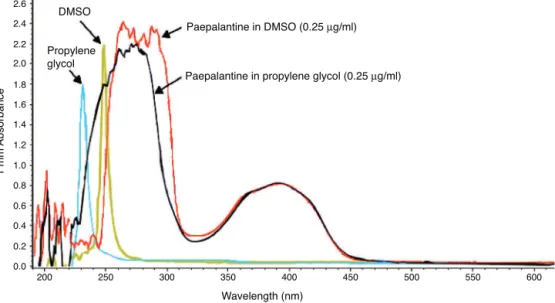
TheselectivitywasdeterminedfromthecomparisonoftheUV spectraof thefollowingsolutions:propyleneglycol,DMSO,and paepalantinesolutionsinpropyleneglycolorDMSO.
Linearity
Paepalantine(1)(10mg/ml) wasdissolvedin 1mlofsolvent (propyleneglycolorDMSO).Aliquotsofthissolutionwerediluted indifferentconcentrations:0.1,0.25,0.37,0.5,and0.75mg/ml, pre-paredintriplicate.Theamountofpaepalantinewasdeterminedby meansofUVspectrophotometry.Calibrationcurvesof concentra-tionversusareawereplotted,andtheobtaineddataweresubjected toregressionanalysisusingtheleast-squaresmethod.
Precision
Repeatabilityofspectrophotometricmethodwastestedby ana-lyzingconcentrationslevelsof0.1,0.5and,0.75mg/mlonthree differentdays(n=10).Paepalantineconcentrationwasdetermined andtheRelativeStandardDeviation(RSD)wascalculated.
Stabilityofsolutions
Paepalantine(0.1,0.25,0.37,0.5,and0.75mg/ml)stabilityin propyleneglycolorinDMSOwasdeterminedby spectrophotome-ter.Post-preparationofthesolutionsanalyseswerecarriedouton days1,2,3,7,14,21,and28(n=10)foreverysolution.Absorbance dataweregraphicallyrepresentedasafunctionoftime.
Antioxidantassays
100g/ml. Trolox® was used as thestandard antioxidant
sub-stance.Theassays wereperformedintriplicateand repeatedat leastthreetimes.
Theresultsareexpressedaspercentinhibition(%)and50%
effectiveconcentration(EC50).Theequationusedforcalculating thepercentinhibitionwasasfollows:%=(A0−A/A0)*100,where A0istheabsorbanceofthetestsolutionwithoutasample(control), andAistheabsorbanceobservedwithsample.
ABTS•+assay
TheantioxidantactivityagainstABTS•+wasdeterminedusing
amodified methodoriginallydescribed byReet al.(1999). Ini-tially,anaqueousmixtureofABTS(7mM)andpotassiumpersulfate (2.45mM)wasincubatedatroomtemperatureinthedarkfor16h. ThesolutionformedfromABTS•+exposurewasdilutedinethanol
togenerateanabsorbanceof0.7at734nm.Ina96-wellmicroplate, 300lofABTS•+and3lofthesamplesatdifferentconcentrations
wereadded.After5min,spectrophotometricmeasurementswere carried at734nmusing iMark® Microplate Absorbance Reader,
fromBioRadLaboratories(Washington,U.S.A.).
NBTassay
Amodifiedsuperoxideradicaltest(O2•−)wasperformedbased on a method previously described by Suzumura et al. (1999). Ina96-wellmicroplate,varyingconcentrationsofpaepalantine, phenazine methosulfate (PMS) (0.5mM), nitrotetrazolium blue chloride (NBT)(0.045mM)and phosphate buffer, pH7.4, were added.Themixture wasincubated for2min,followed by addi-tionof0.125mMnicotinamideadeninedinucleotide(NADH).After incubationfor 10minatroomtemperature,spectrophotometric measurementswerecarriedoutat560nm.
Reactionwithhypochlorousacid(HOCl)
HOCl reactions were studied using a previously described methodbyChingetal.(1994),whichwasbasedontheoxidation of5-thio-2-nitrobenzoicacid(TNB).TNBwasobtainedbyreducing a1mMsolutionof5,5′-dithiobis(2-nitrobenzoicacid)(DTNB)ina
50mMKH2PO4–KOHbuffer(pH6.6),containing5mMEDTA,and 20mMsodiumborohydride.Inordertoperformtheassay,25mM HOClwasincubatedwith50mM TNBfor5mininthepresence orabsenceofpaepalantineinafinalvolumeof200l.Theability ofpaepalantinetoscavengeHOClwasdeterminedbymeasuring
theoxidationofTNBtoDTNBat412nm,uponpre-incubatingof paepalantinewithHOCl,followedbyadditionofTNB.
Statisticalanalysis
Theparameterswereexpressedasmean±standarddeviation.
Datawereanalysedusinganalysisofvariance(ANOVA)andlinear regressionanalysis.Differencesbetweengroupswereconsidered significantatp<0.05.
Resultsanddiscussion
Preformulationstudiesassistscientistsinscreeninglead can-didates based on theirphysicochemical and biopharmaceutical properties. Preformulationinformation (permeability, solubility, andstability)isusefulforselectionofnewchemical entitiesfor preclinicalefficacy/toxicitystudies,whichisamajorsectionunder investigationalnewdrugapplications(BharateandVishwakarma, 2013).
In thiscontext, thepresentstudyevaluatedthesolubilityof paepalantineinsolventsotherthanDMSO,andthesolvent’s poten-tialtointerferewithantioxidantassays.Accordingtoresultsfrom thesolubilitytest,paepalantinewassolubleonlyinpropylene gly-colat10mg/ml,pH7.5,withcompletedissolution(nocrystalswere observed)asconfirmedbyopticalmicroscopyanalysis.Further,the useofsurfactantswasnotfavourabletosolubilisationof paepalan-tineinpropyleneglycolandotherselectedsolvents.
Aftertheanalysis ofspectra ofpure solventsand paepalan-tine’ssolutions,theanalyticalwavelengthofchoicewasat391nm (Fig.1).
Linear correlation wasfound for both propylene glycol and DMSOsolutionscontainingpaepalantine.Theregressionanalysis dataareshowninFig.2.Theregressioncoefficient(R2)obtained washigherthan0.98whichatteststothelinearityofthemethod.
The repeatability of spectrophotometric method for the paepalantine’ssolutions(propyleneglycolandDMSO)resultedin RSDvaluesbelow5%indicatingtheprecisionofthemethod.
ThestabilityofpaepalantineinpropyleneglycolandDMSOwas assessed byspectrophotometric analysisindifferent concentra-tionsduring28days(Fig.3).Paepalantine’ssolutioninDMSOwas consideredstableduringtheperiodofstorage,whilepaepalatine’s solution in propylene glycol showeda concentration reduction (p<0.05).
2.6
DMSO
Paepalantine in DMSO (0.25 µg/ml)
Paepalantine in propylene glycol (0.25 µg/ml) Propylene
glycol
2.4
2.2
2.0
1.8
1.6
1.4
1.2
1.0
0.8
0.6
0.4
0.2
0.0
200 250 300 350 400 450
Wavelength (nm)
1 mm
Absorbance
500 550 600
0.1 0.25
0.37 0.5
0.75 0.0 0.2 0.4 0.6 0.8 1.0 1.2 1.4 1.6 1.8 2.0
Pa
ep
a
lan
tine
´s
A
bso
rb
an
c
e
(3
91
nm
)
Concentration (mg/ml)
Paepalantine in propylene glycol Paepalantine in DMSO
Fig.2.Linearityanalysisforspectrophotometriccalibrationcurves.Paepalantinein propyleneglycol(R2=0.99;a=−0.20;b=1.33)andPaepalantineinDMSO(R2=0.98; a=−0.17;b=1.58).Allabsorbancesweremeasuredintriplicate.
DespiteDMSO,beingwidelyusedasauniversalsolventfor nat-uralproductsespeciallyplant-derivedproducts,previousstudies havereported interferencefromthis solvent owingtoits toxic effectsonvarious celltypes,microorganisms, andanimal mod-els.Hence,ithasbeenreplacedwithothersuitablesolvents for ininvivoexperiments(BaschandGadebusch,1968;Voginetal., 1970;Qietal.,2008;Hanslicketal.,2009;Ménorvaletal.,2012; Whiteetal.,2013; Yuanetal.,2014).Propyleneglycolis a fre-quentlyco-administeredsolventinformulationsusedinpreclinical andclinicalstudies.Thissolventisgenerallynontoxicand noncar-cinogenic,andcommonlyusedsolventfororal,intravenous,and topicalpharmaceuticalagents(Kuloetal.,2012;Fiumeetal.,2012; Healingetal.,2015).
Somestudieshave reportedtheability of DMSOtoact as a freeradicalscavenger,whichgivesitantioxidantproperties.The antioxidant properties of DMSO limit its use as a solvent for thedevelopmentofnewantioxidantdrugs(Kabeyaetal.,2013; Sanmartín-Suárezetal.,2011;Bektasogluetal.,2006).
Coumarinsarelow-molecularweightphenoliccompoundsand havevariousbiologicalproperties,includingantioxidantactivity. Ingeneral,freeradicalscavengingandantioxidantactivityofthis classofcompoundsmainlydependonthenumberandpositionof hydrogen-donatinghydroxylgroupsonthearomaticring(Kostova etal.,2011).
Table1
Effectiveconcentration(EC50)ofpaepalantinedissolvedinpropyleneglycoland
DMSOandTroloxinABTS•+assay.
Compound EC50(g/ml)
Paepalantineinpropyleneglycol 2.42±0.5
PaepalantineinDMSO 3.33±0.56
Trolox 1.07±0.04
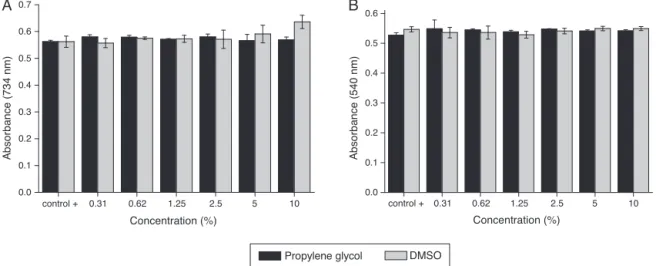
Previous studies have reported the antioxidant potential of paepalantineintherespiratoryburstofneutrophils(Kitagawaetal., 2003)andinthemitochondria(Devienneetal.,2007).Inthisstudy, weevaluatedthescavengingcapacityofthiscompoundagainstthe ABTSradical,reactiveoxygenspeciessuchasO2•−,HOCl,andthe interferencefromsolvents,DMSOandpropyleneglycol,inthese assays.TheeffectofsolventsonABTS•+andO2•−assaysisshown
inFig.4.
Accordingtothesedata,DMSO andpropylene glycoldo not interferewiththeseassaysandtheantioxidanteffectof paepalan-tineisunchanged,whichissimilartoTrolox(Fig.5andTable1).
However,DMSOhadanantioxidanteffectagainstHOClatall concentrationstested.Onthecontrary,thisphenomenonwasnot observedwithpropyleneglycol, whichshows interferenceonly athigherconcentrationsthatwerenotemployedinthetestwith paepalantine(Fig.6).Kabeyaetal.(2013)observedtheantioxidant interferenceofDMSOinassaysinvolvingcaptureofHOCl. Stud-iessuggestthatthepresenceofthesulphuratominthemolecule favourstheoxidationofDMSObyHOCl(PeskinandWinterbourn, 2001;Ruffetal.,2012),directlyinfluencingtheresults.
Paepalantine dissolved in propylene glycol showed higher antioxidantactivityinthisassay,whichseemedtobebetterthan Trolox(Fig.7).
Theresultsshowedthatpaepalantine hassignificant antiox-idant activity against the reactive species studied, similar to or better than that observed with Trolox. Further, paepalan-tinepossesses9-OHand10-OHgroupsprovidingacatechol-like arrangementaswellasaplanarstructure,bothofwhicharehighly favourabletoelectrondelocalizationthatissimilartothe ortho-diphenolicarrangement ontheB-ringof flavonoids,which is a well-establishedrequirementfortheROS-scavengingactivitiesof polyphenols(Pietta,2000;Tejeroetal.,2007;Devienneetal.,2007). Theresultsofthecurrentstudydemonstrate thatpropylene glycolcanbeanalternativetotheuseofDMSOwhichshows inter-ferenceinbiologicalassaysasantioxidantassays.
Additionally,previousstudies showedthatpaepalantine is a promisingcompoundforpharmaceuticaluse;thereforethisstudy
28 21 14 7 3 2 1 0.0 0.2 0.4 0.6 0.8 1.0 1.2 1.4 1.6 1.8 2.0
A
Paepalantine´s Absorbance (391nm)
Time(days)
28 21 14 7 3 2 1 0.0 0.2 0.4 0.6 0.8 1.0 1.2 1.4 1.6 1.8 2.0
B
Paepalantine´s Absorbance (391nm)
Time(days)
0.75 0.5 0.37 0.25 0.1
µg/ml
10 5 2.5 1.25 0.62 0.31 control + 0.0 0.1 0.2 0.3 0.4 0.5 0.6
A
bs
or
b
ance (540 nm)
Concentration (%)
Propylene glycol DMSO 10
5 2.5 1.25 0.62 0.31 control + 0.0 0.1 0.2 0.3 0.4 0.5 0.6 0.7
A
bsorban
ce
(734
nm
)
Concentration (%)
A
B
Fig.4.ScavengingeffectofpropyleneglycolandDMSO(v/v%)againstABTS•+(A)andO 2• −(B).
100 50 25 12.5 6.25 3.12 Control + 0 20 40 60 80 100
In
hib
it
ion
%
Concentration (µg/ml)
Paepalantine in Propylene Glycol Paepalantine in DMSO Trolox
Fig.5. AntioxidantactivityofpaepalantineinpropyleneglycolandDMSOand TroloxintheNBTassay(O2• −).
10 5 2.5 1.25 0.62 0.31 TNB+HOCl TNB 0.0 0.1 0.2 0.3 0.4 0.5 0.6
Absorbance
(412
nm
)
Concentration (%)
Propylene Glycol DMSO
Fig.6.EffectofpropyleneglycolandDMSO(v/v%)onHOClscavenging.
mayleadtofuturedevelopmentofaformulationwithsolvent com-patiblefor preclinicalandclinicalstudiesand moreappropriate underthetechnologicalview.
Authors’contributions
JPLDcontributedtorunningthelaboratoryworkforisolation andidentificationofthepaepalantine,biologicalstudies,analysis
100 50 25 12.5 6.25 3.125 TNB+HOCl TNB 0.0 0.1 0.2 0.3 0.4 0.5 0.6
Abso
rba
nc
e (
4
1
2
nm
)
Concentration (µg/ml)
Paepalantine in Propylene Glycol Paepalantine in DMSO
Fig.7.AntioxidantactivityofpaepalantinedissolvedinpropyleneglycolandDMSO andTroloxintheTNBassay(HOCl).
ofthedata,anddraftingthepaper.RRKdesignedthestudy, super-visedthelaboratoryworkfor theisolation andidentificationof thepaepalantineandantioxidanttest,andcontributedtocritical readingofthemanuscript.CSsupervisedthelaboratoryworkin thepreformulationstudiesandcontributedtocriticalreadingof themanuscript.RCRGsupervisedthelaboratoryworkin antiox-idanttestand contributedtocritical readingofthemanuscript. Alltheauthorshavereadthefinalmanuscriptandapprovedthe submission.
Conflictsofinterest
Theauthorsdeclarenoconflictsofinterest.
Acknowledgements
Thisstudywassupportedbya grantofFAPEStoJ.P.L.D.,and financialaidofFAPEStoR.R.K.ThankstoLaboratoryofBiomolecular Analysis(LABIOM)atHealthSciencesCenterfromFederal Univer-sityofEspíritoSanto,Vitória-ES,Brazilfortheirsupportwiththe useofspectrophotometerUV/VISNANODROP.
References
Anvisa,2003.Resoluc¸ãoRDCn899de29demaiode2003.Guiaparaavaliac¸ão demétodosanalíticosebioanalíticos.AgênciaNacionaldeVigilânciaSanitária, D.O.U.,26jun,sec¸ão1,Brasília,Brazil.
Basch,H.,Gadebusch,H.H.,1968.Invitroantimicrobialactivityofdimethylsulfoxide. Appl.Microbiol.12,1953–1954.
Bektasoglu,B.,Celik,S.E.,Ozyerk,M.,Güklü,K.,Apak,R.,2006.Novelhydroxyl rad-icalscavengingantioxidantactivityassayforwater-solubleantioxidantsusing amodifiedCUPRACmethod.Biochem.Biophys.Res.Commun.345,1194–1200.
Bharate,S.,Vishwakarma,R.A.,2013.Impactofpreformulationondrug develop-ment.ExpertOpin.DrugDeliv.10,1239–1257.
Ching,T.L.,Jong,J.,Bast,A.,1994.Amethodforscreeninghypochlorousacid scaven-gersbyinhibitionoftheoxidationof5-thio-2-nitrobenzoicacid:applicationto anti-asthmaticdrugs.Anal.Biochem.218,377–381.
Coelho,R.G.,Vilegas,W.,Devienne,K.F.,Raddi,M.S.G.,2000.Anewcytotoxic naph-topyranonedimerfromPaepalanthusbromelioides.Fitoterapia71,497–500.
Devienne,K.S.,Raddi, M.S.,2002.Screeningofantimicrobial products usinga microplaquephotometer.Braz.J.Microbiol.33,166–168.
Devienne,K.S.,Raddi,M.S.,Varanda,E.A.,Villegas,W.,2002.Invitrocytotoxicityof somenaturalandsemi-syntheticisocoumarinsfromPaepalanthusbromelioides. Z.Naturforsch.57,85–88.
Devienne,K.F.,Raddi,M.S.G.,Coelho,R.G.,Vilegas,W.,2005.Structure-antimicrobial activityofsomenaturalisocoumarinandtheiranalogues.Phytomedicine12, 378–381.
Devienne,K.F.,Cálgaro-Helena,A.F.,Dorta,D.J.,Prado,I.M.R.,Raddi,M.S.G., Ville-gas,W.,Uyemura,S.A.,Santos,A.C.,Curti,A.C.,2007.Antioxidantactivityof isocoumarinisolatedfromPaepalanthusbromelioidesonmitochondria. Phyto-chemistry68,1075–1080.
DiStasi,L.C.,Camuesco,D.,Nieto,A.,Villegas,W.,Zarzuelo,A.,Galvez,J.,2004. Intesti-nalanti-inflammatoryactivityofpaepalantineanisocoumarinisolatedfrom capitulaofPaepalanthusbromelioides,inthetrinitrobenzenosulfonicacidmodel ofratcolitis.PlantaMed.70,315–320.
Fiume,M.M.,Bergfeld,W.F.,Belsito,D.V.,Hill,R.A.,Klaassen,C.D.,Liebler,D.,Marks Jr.,J.G.,Shank,R.C.,Slaga,T.J.,Snyder,P.W.,Andersen,F.A.,2012.Safety assess-mentofpropyleneglycoltripropyleneglycol,andPPGsasusedincosmetics.Int. J.Toxicol.31,245–260.
Galvão,J.,Davis,B.,Tilley,M.,Normando,E.,Duchen,M.R.,Cordeiro,M.F.,2014.
Unexpectedlow-dose toxicityoftheuniversalsolventDMSO.FASEB J.28, 1317–1330.
Gowthamarajan,K.,Singh,S.K.,2010.Dissolutiontestingforpoorlysolubledrugs– acontinuingperspective.Dissolut.Technol.17,24–32.
Hanslick,J.L.,Lau,K.,Noguchi,K.K.,Olney,J.W.,Zorumsky,C.F.,Mennerick,S.,Farber, N.B.,2009.Dimethylsulfoxide(DMSO)produceswidespreadapoptosisinthe developingcentralnervoussystem.Neurobiol.Dis.34,1–10.
Healing,G.,Sulemann,T.,Cotton,P.,Harris, J.,Hargreaves,A.,Finney,R.,Kirk, S., Schramm, C., Garner, C., Pivette, P., Burdet, L., 2015. Safety data on 19vehiclesforusein1monthoralrodentpre-clinicalstudies: administra-tionofhydroxypropyl--cyclodextrincausesrenaltoxicity.J.Appl.Toxicol.,
http://dx.doi.org/10.1002/jat.3155.
Jacob,S.W.,Herschler,R.,1986.PharmacologyofDMSO.Cryobiology23,14–17.
Kabeya,L.M.,Andrade,M.F.,Piatesi,F.,Azzolini,A.E.C.S.,Poliezzo,A.C.M., Lucisano-Valim,Y.M.,2013.3,3′,5,5′-Tetramethylbenzidineinhypochlorousacidand taurinechloraminescavengingassays:interferenceofdimethylsulfoxideand othervehicles.Anal.Biochem.437,130–132.
Kitagawa,R.R.,Raddi,M.S.G.,Khalil,N.M.,Vilegas,W.,Fonseca,L.C.,2003.Effectof theisocoumarinpaepalantineontheluminolandlucigeninamplified chemo-luminescenceofratneutrophils.Biol.Pharm.Bull.26,905–908.
Kitagawa,R.R.,Raddi,M.S.G.,Santos,L.C.,Vilegas,W.,2004.Anewcytotoxic naph-toquinonefromPaepalanthuslatipes.Chem.Pharm.Bull.52,1487–1488.
Kostova,I.,Grigorov,P.,Balkansky,S.,Parmar,V.S.,Prasad,A.K.,Saso,L.,2011.
Coumarinsasantioxidants.Curr.Med.Chem.18,3929–3951.
Kulo,A.,Smits,A.,Naulaers,G.,Hoon,J.,Allegaer,K.,2012.Biochemicaltolerance dur-inglowdosepropyleneglycolexposureinneonates:aformulation-controlled evaluation.J.Pharm.Sci.20,1–5.
Ménorval,M.A.,Mir,L.M.,Fernández,M.L.,Reigada,R.,2012.Effectsofdimethyl sulfoxideincholesterol-containinglipidsmembranes:acomparativestudy experimentsinsilicoandwithcells.PLoSONE7,1–12.
Newman,D.J.,Cragg,G.M.,2012.Naturalproductsassourcesofnewdrugsoverthe 30yearsfrom1981to2010.J.Nat.Prod.75,311–335.
Patridge, E., Gareiss, P., Kinch, M.S., Hoyer, D., 2015. An analysis of FDA-approveddrugs:naturalproductsandtheirderivatives.DrugDiscov.Today,
http://dx.doi.org/10.1016/j.drudis.2015.01.009.
Peskin,A.V.,Winterbourn,C.C.,2001.Kineticsofthereactionsofhypochlorousacid andaminoacidchloramineswiththiols,methionine,andascorbate.FreeRadic. Biol.Med.5,572–579.
Pietta,P.G.,2000.Flavonoidsasantioxidants.J.Nat.Prod.63,1035–1042.
Qi,W.,Ding,D.,Salvi,R.J.,2008.Cytotoxiceffectsofdimethylsulphoxide(DMSO) onchoclearorganotypiccultures.Hear.Res.236,52–60.
Rates,S.M.K.,2001.Plantsassourceofdrugs.Toxicon39,603–613.
Re,R.,Pellegrini,N.,Proteggente,A.,Pannala,A.,Yang,M.,Rice-Evans,C.,1999.
AntioxidantactivityapplyinganimprovedABTSradicalcationdecolourisation assay.FreeRadic.Biol.Med.26,1231–1237.
Ruff,F.,Jalsovszky,I.,Szabó,D.,Rábai,J.,Farkas,O.,Kucsman,A.,2012.Mechanism forthereactionsofsulfidesandsulfoxideswhithhypochlorites:racemization andoxygenexchangeofoxysulfoniumsaltsandsulfoxides.J.Phys.Org.Chem. 25,1086–1096.
Sanmartín-Suárez,C.,Soto-Otero,R.,Sánchez-Sellero,I.,Méndez-Álvez,E.,2011.
Antioxidantpropertiesofdimethylsulfoxideanditsviabilityasasolventinthe evaluationofneuroprotectiveantioxidants.J.Pharmacol.Toxicol.Methods63, 209–215.
Santos,L.C.,Vilegas,W.,2001.Preparativeseparationofthenaphthopyranone gly-cosidesbyhigh-speedcounter-currentchromatography.J.Chromatogr.915, 259–263.
Santos,N.C.,Figueira-Coelho,J., Martins-Silva,J.,Saldanha,C.,2003. Multidis-ciplinary utilization of dimethyl sulfoxide: pharmacological, cellular, and molecularaspects.Biochem.Pharmacol.65,1035–1041.
Suzumura,K.,Yasuhara,M.,Narita,H.,1999.Superoxideanionscavengingproperties offluvastatinanditsmetabolites.Chem.Pharm.Bull.47,1477–1480.
Tavares,D.C.,Varanda,E.A.,Andrade,F.D.P.,Vilegas,W.,Takahashi,C.S.,1999. Eval-uationofthegenotoxicpotentialoftheisocoumarinpaepalantineinvivoand invitromammaliansystems.J.Ethnopharmacol.68,115–120.
Tejero,I.,Gonzalez-Garcia,N.,Gonzáles-Lafont,A.,Lluch,J.M.,2007.Tunnelingin greentea:understandingtheantioxidantactivityofchatecol-containing com-pounds.Avariationaltransition-statetheorystudy.J.Am.Chem.Soc.129, 5846–5854.
Varanda,E.A.,Raddi,M.S.G.,Dias,F.L.,Araujo,M.C.P.,Gibran,S.C.A.,Takahashi,C.S., Vilegas,W.,1997.Mutagenicandcytotoxicactivityofanisocoumarin (Paepalan-tine)isolatedfromPaepalanthusvellozioides.Teratog.Carcinog.Mutagen.17, 85–95.
Varanda,E.A.,Devienne,K.F.,Raddi,M.S.G.,Furuya,E.M.,Vilegas,W.,2004. Muta-genicityofpaepalantinedimerandglycosidederivativesfromPaepalanthus bromelioides.Toxicol.InVitro18,109–114.
Varanda,E.A.,Varella,S.D.,Rampazo,R.A.,Kitagawa,R.R.,Raddi,M.S.G.,Vilegas,W., Santos,L.C.,2006.Mutagenicandcytotoxiceffectofplanifolin:a naphtopyra-nonedimerisolatedfromPaepalanthusplanifolius.Toxicol.InVitro20,664–668.
Vilegas, W., Roque, N.F., Salatino, A., Giesbrecht, A.M., Davino, O.S., 1990.
IsocoumarinfromPaepalanthusbromelioides.Phytochemistry29,2299–2301.
Vogin,E.E.,Carson,S.,Cannon,G.,Linegar,C.R.,Rubin,L.,1970.Chronictoxicityof DMSOinprimates.Toxicol.Appl.Pharmacol.16,606–612.
Wang,Q.,Ma,D.,Higgins,J.P.,2006.Analyticalmethodselectionfordrugproduct dissolutiontesting.Dissolut.Technol.13,6–13.
White,E.A.,Orazem,M.E.,Bunge,A.L.,2013.Characterizationofdamagedskinby impedancespectroscopy:chemicaldamagebydimethylsulfoxide.Pharm.Res. 30,2607–2614.