w w w. s b f g n o s i a . o r g . b r / r e v i s t a
Original
Article
Morpho-anatomical
study
of
rhizome
of
Limonium
brasiliense
Tânia
Mara
Antonelli-Ushirobira
a,
Andressa
Blainski
a,
Naiara
Cássia
Gancedo
b,
Fernanda
Gaburo
b,
Kátia
Aparecida
Kern
Cardoso
c,
Eneri
Vieira
de
Souza
Leite-Mello
d,
João
Carlos
Palazzo
de
Mello
a,∗,
Maria
Auxiliadora
Milaneze-Gutierre
eaProgramadePós-graduac¸ãoemCiênciasFarmacêuticas,DepartamentodeFarmácia,UniversidadeEstadualdeMaringá,Maringá,PR,Brazil bDepartamentodeFarmácia,UniversidadeEstadualdeMaringá,Maringá,PR,Brazil
cComplexodeCentraisdeApoioàPesquisa,UniversidadeEstadualdeMaringá,Maringá,PR,Brazil dDepartamentodeCiênciasMorfológicas,UniversidadeEstadualdeMaringá,Maringá,PR,Brazil
eDepartamentodeBiologiaeMuseuDinâmicoInterdisciplinar,UniversidadeEstadualdeMaringá,Maringá,PR,Brazil
a
r
t
i
c
l
e
i
n
f
o
Articlehistory: Received5June2015 Accepted15July2015 Availableonline6August2015
Keywords: Baicuru Guaicuru Limoniumbrasiliense Phenoliccompounds Rhizome
a
b
s
t
r
a
c
t
Limoniumbrasiliense(Boiss.)Kuntze,Plumbaginaceae,isanherbpopularlyknownasguaicuru,guaicurá orbaicuru.ThespeciesinhabitssaltmarshesfromthecoastalregionofsouthernBrazil,includingRio deJaneiro,toUruguayandArgentina.AlthoughwidelyusedinfolkmedicineinthestateofRioGrande doSultotreatgenitourinaryinfectionsandtoregulatemenstrualperiods,L.brasiliensehasbeenlittle studied.Thepresentmorpho-anatomicalstudywasundertakentoresolvesomedoubtsintheliterature astothenatureofthepartoftheplantthatisusedformedicinalpurposes,atruerhizomeoraroot.The morpho-anatomicalcharacteristicswereanalyzedwiththeaidoflightandscanningelectronmicroscopy. Thebotanicalmaterialwascharacterizedasarhizomewithinternodesthatareevidentintheyounger butnottheolderportions.Microscopicanalysisrevealedthepresenceofamultilayeredperidermwith acortex,rayparenchyma,andpith,formedbycollenchymatissuewithabundantintercellularspacesin theouterportionsofthecortex,responsiblefortherigidityofthebody,andwithwallsimpregnatedwith phenoliccompounds.Thevascularbundlesarecollateralwithellipticaltoelongatedcells,andwithfew conductingandsclerenchymalelements.Groupsofsclereidsaredispersedthroughthecortexandpith. Thesemorpho-anatomicalcharacteristicsdefinethestructureasarhizome.
©2015SociedadeBrasileiradeFarmacognosia.PublishedbyElsevierEditoraLtda.Allrightsreserved.
Introduction
LimoniumMill.,themostspecies-richinthePlumbaginaceae,
includesabout350speciesofherbs.Thegenusisbestrepresented intheMediterraneanregionsofEuropeandinAsia,andcanalsobe foundincoastalregionsofNorthandSouthAmerica,SouthAfrica, andAustralia(Mobot,2015).Ingeneral,speciesofLimoniumlive ashalophytes,includinginalpineregions(Chant,1993).Inother countries,suchasChina,stemsandrootsofvariousspeciesof
Limo-niumareusedinfolkmedicine,andsomeofthemaresimilarin
morphologyandanatomy,makingthemdifficulttoidentifyusing
traditionalmethods(Dingetal.,2012).
Limoniumbrasiliense(Boiss.)Kuntzeisanherbpopularlyknown
asguaicuru,guaicuráorbaicuru(DiasdaSilva,1920)inthestateof RioGrandedoSul,Brazil.Itisgrownandmarketedbysmallfarmers inestuarineregionsoftheRiverPlateBasin.AccordingtoSimões
∗ Correspondingauthor.
E-mail:[email protected](J.C.P.deMello).
etal.(1998),thisherbiscommonincoastalsaltmarshesin
south-ernBrazil,fromParanátoRioGrandedoSul,andinUruguayand
Argentina;Zappi(2015)gavetherangeasextendingfromsouthern BraziltothestateofRiodeJaneiro.
AlthoughitwasdescribedinthefirsteditionoftheBrazilian
Pharmacopoeia(1929),L.brasilienseisnotincludedinthecurrent
Pharmacopoeia.Itispopularlyusedtotreatuterineandovarian
inflammation,vaginaldischargeanddysmenorrhea(Mouraetal.,
1985),andisusefultoregulatemenstrualperiods(Lifchitz,1981), aswellashavinganantimicrobialeffect(Rosito,1975).Murray
etal.(2004)isolatedfiveantioxidantcompoundsfromextractsof
L.brasilienseroots.Theirchemicalcompositionincludes
hydrolyz-ableandcondensedtannins,4-O-methylgallicacid,sitosterol,and triterpenicsaponins,thestructuresofwhichhavenotbeen deter-mined(Rosito,1975).
ThefirstbotanicaldescriptionofL.brasiliensewascontainedin
theFlorabrasiliensis(Martius,1840–1906).DiasdaSilva(1920)
pro-videdadetailedanatomicaldescription,notingtheorganoleptic
characteristicsoffreshplants,i.e.astrongunpleasantodorthat disappearsupondissection,andaspicyastringentflavor.Martius
http://dx.doi.org/10.1016/j.bjp.2015.07.010
T.M.Antonelli-Ushirobiraetal./RevistaBrasileiradeFarmacognosia25(2015)320–327 321
(1840–1906)named it Staticebrasiliensis Boiss.,an herb witha
moreorlessscalyrhizome.In1920,DiasdaSilva,indescribingthe species,initiallyreferredtotherhizomeascylindrical-irregular, short,thick,moreorlesscoveredwithscales;butindescribingthe anatomyofthisorganasusedmedicinally,reportedthatthe“roots” are1–2cmindiameter,cylindrical-fusiformandcrooked.The char-acterizationasa“root”mayhavebeenaconceptualerror,because hismorphologicaldescriptionmakesitclearthatthisisarhizome.
Reitz(1965)describedthespeciesashavingthickrootswithred
scales,andthiserrorintermingtherhizomeofL.brasiliensearoot isalsofoundinthestudiesofCorrêa(1952),Coimbra(1958),Cruz
(1982),Mouraetal.(1985),Murrayetal.(2004),Fenneretal.(2006)
andBlainskietal.(2013).
Given the possibility of exploitation of the species and the
inexactcategorizationof the organused,this study provided a
morpho-anatomicaldescriptionofthepartoftheplantusedin
pop-ularmedicine,contributingtothepharmacognosticevaluationof
L.brasiliense.
Materialsandmethods
Plantmaterial
This study used rhizomes of Limonium brasiliense (Boiss.)
Kuntze,Plumbaginaceae,collectedinMay2010andJanuary2013
ontheIlhadosMarinheiros(31◦59′33′′S,052◦10′43′′W)inthecity
ofRioGrande,RioGrandedoSul,Brazil.Thecollectionofplant
materialisregisteredwithIBAMA-SISBIOundernumber
11995-3of2November2010,authenticationcode46367613,underthe
responsibilityofJoãoCarlosPalazzodeMello.Accesstothe botani-calmaterialwasauthorizedandlicensedbytheConselhoNacional
deDesenvolvimento Científico eTecnológico (CNPq),registered
underno.010252/2015-0.Samplesofthereproductivephaseare
heldintheHerbariumoftheUniversidadeEstadualdeMaringá
(HUEM)underregistrationnumbers21151and27725forthe
mate-rialcollectedin2010and2013,respectively.Theplantmaterialwas identifiedbyProf.Dr.LilianAulerMentz(UniversidadeFederaldo RioGrandedoSul).
Morpho-anatomicalanalysis
ThemacroscopiccharacterizationoftherhizomeofL.brasiliense wasbasedonthenotesofOliveiraetal.(1998).Forthe
anatom-icalanalysisunderlightmicroscopy(LM)andscanningelectron
microscopy(SEM),segmentsofrhizomewithdifferentdiameters
(from0.77to1.53cm)wereused.Thesegmentswererehydrated
byboilingin asolutionof10%glycerinfor15–30min(2times)
andstoredin70%ethanol(Johansen,1940),withweekly
replace-mentoftheethanoltoeliminatetheexcessredpigmentreleased
bytheirtissues.Sectionsforlightmicroscopyweremadefreehand
withsteelblades,onthestandardplanesforplantanatomy.The
sectionswerebleachedwithsodiumhypochlorite(30%),
double-stainedwithAstrablue(1%)andsafranin(1%),andmountedon
semi-permanentslideswithglyceringelasdescribedbyKrausand
Arduin(1997).Thesameprocedurewasusedtoprepareslideswith
therehydratedpowderfromrhizomes.
Histochemicaltestsweredonewithcross sections,prepared
as above, of samples hydrated in glycerin–water, which were
stainedwithLugol’siodinesolutiontorevealthepresenceofstarch grains;iodinatedzinc chloride,for lignin;SudanIVglycerin,for
lipophilic substances; ferricchloride, for polyphenols; and 60%
chloralhydrate with25%sulfuricacid,forcalciumoxalate
crys-tals(Johansen,1940;BerlynandMiksche,1976;KrausandArduin,
1997;FarmacopeiaBrasileira,2010).
Foranalysisunderscanningelectronmicroscopy(SEM),the
seg-mentsofrhizomeswererehydratedandcutwithsteelbladesinto
0.3mmsectionsondifferentanatomicalplanes,andthenfixedin 1%glutaraldehydein0.1MsodiumphosphatebufferpH7.2(Kraus
andArduin,1997).After72hinglutaraldehyde,thesampleswere
dehydratedinanascendingethanolseries(30,50,70,90,95%,v/v) for15mineach,endinginabsoluteethanolfor10mintwice,and thencriticalpoint-driedwithCO2 (BalzersCPD30 critical-point
dryer)(HorridgeandTamm,1969).Thenthesampleswere
pos-itionedonthedifferentanatomicalplanesonmetalstubs,attached
withdouble-sidedcarbontape,andsputter-coatedwithgoldina
ShimadzuIC-50unit.Thephotomicrographswereobtainedwithan
OlympusBX50opticalmicroscope,andtheultrastructuralanalyses
usedaShimadzuSS550SEM(at15kV).
Resultsanddiscussion
TherhizomeofL.brasilienseislongandthick;theolderportions
measure 0.77–1.53cm in diameter(Fig.1A–C) with a very
evi-dentradialappearancewhenbroken(Fig.1D).Thesidebudsmore
clearlyshowinternodeswithameanlengthof0.38cm,partially
coatedwithfragmentsofthepetiolebasethatarereddishwhen
dry(Fig.1B),similartothedescriptionsofMartius(1840–1906)
andDiasdaSilva(1920).Thepresenceofrhizomesandtubersthat
functionasstorageorgansandforasexualreproductioniscommon
inherbaceousspeciesofwetlands,asconcludedbyBraendleand
Crawford(1999).
ThesurfaceoftherhizomeofL.brasilienseisdarkbrownand bearsdelicatelongitudinalstriae,andsmallordeeptransverse fis-sures(Figs.1Cand2A).Theperidermisblackandtheinnertissues arereddishbrown(Fig.1D),asdescribedbyDiasdaSilva(1920).To thenakedeye,therhizomeincrosssection(Fig.1D)appearsgrainy inthecorticalandinthepith,whilethemiddleportion,filledwith vascularbundles,appearsstreaked.Becauseofitscolorandgrowth partiallyburiedincoastalsandysoil,therhizomeofthisspeciescan beconfusedwithatuberoustaproot,asseeninthedescriptionsof
Reitz(1965).Nostructuraldifferenceswereobservedinthetwo
groupsofsamples.
TheLMandSEManalysesrevealedthattheperidermofthe
rhi-zomeofL.brasilienseisthick,formedbydozensofcelllayers(Fig.2)
whichreactpositivelytoSudanIV.Infrontalviewthesecellsare polyhedralandrelativelyelongated(Fig.2BandC).Incross-section theyappearquadrangulartotabular,withslightlythickenedwalls (Fig.2D–F),becomingcollapsedwiththeorgansurface,butalways
withareddish-browncontentthatdoesnotbleachinthe
pres-enceofsodiumhypochlorite.Boththecolorandthecellstructure oftheperiderm,describedabove,areinaccordwiththe observa-tionsofDiasdaSilva(1920),althoughtheauthorhasdesignated thestructureasroots.
Thecortex oftherhizomeof L.brasilienseis welldeveloped
(Fig.3A),composedofcylindricalcellslikecollenchymaannular withwideprimarypit-fieldsthatinmostcasesareelongated tan-gentiallyintotheouterportionoftheorgan.Thesecellssometimes havesmalllobedprojections(Figs.3Band4A,B),allowingthe
for-mationofintercellularspaces thatcomposeanaerenchyma. An
aerenchymaisformedinrootsandstemsofspeciesthatinhabit
wetlands,ordrylocationsunderadverseconditions,asaresultof abioticstress(Evans,2003),aswhereL.brasiliensegrowsinflooded soilsandsalinesaltmarshesofParaná(Zappi,2015).
Macroscop-ically, this aerenchyma lends a friable appearanceto thedried
rhizomes.
Fig.1. DriedsamplesofLimoniumbrasiliense.Longthickrhizome(closedarrows)(A)withthinnerlateralbranchessurroundedbyreddishpetiolebases(openarrows)(B); detailsofperiderm(C)andinternaltissues(D).
T.M.Antonelli-Ushirobiraetal./RevistaBrasileiradeFarmacognosia25(2015)320–327 323
Fig.3.RhizomeofLimoniumbrasiliense.Generalappearance(A)anddetailofaerenchyma(B)intransversalsectionsunderSEM.cx:cortex,p:periderm,vb:vascularbundles.
stem,butalwaysallowingtheformationofrelativelylarge inter-cellularspaces.
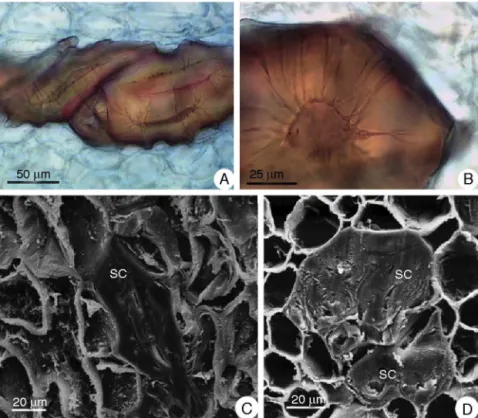
Sclereidswithvery varieddimensions arescatteredthrough
thecortex,individually(rarely,asinFig.4A)oringroupsoffive
toa few dozen elements, positionedparallel to themajor axis
ofthe rhizome.Thesecells have a smalltovoluminouslumen,
rounded,beveledoranomalousends,butalwayswithbranched
pits(Fig.5A–C),similartothosedescribedbyMetcalfeandChalk
(1950)inthecortexoftheundergroundstemsofLimonium
bellid-ifolium(Gouan) Dumortand Limoniumbinervosum(G.E.Sm.)C.E.
Salmon.The multiplelayers ofthe secondary wallofthis
scle-renchymaticcelltypebecomeevenmoreapparentinSEM(Fig.5D).
ThepresenceofgroupsofsclereidswasalsoreportedbyGrigore
etal.(2014)inthecortexoftherhizomeofLimoniumfurfuraceum
Kuntze,althoughinlargegroups.Similargroupsofsclereidsarealso
presentinthepithoftherhizomeofL.brasiliense.
ThevascularbundlesoftherhizomeofL.brasiliensearecollateral withanelliptical-elongatedshape,shorttoverylong,dependingon thespecimen(Fig.6);butalwaysnarrowandradiallyarranged,as describedbyDiasdaSilva(1920),composedofasmallnumberof conductingelementsinrelationtotheparenchymacells.Solitary,
randomlypositionedvascularbundleswereobservedinthecortex
andinthepith(Fig.6A),sometimestransversetothemajoraxisof
therhizome.
Thevascularcambiumwasdetectedonlywithinthevascular
bundle(fasciculartype),withadelicateandinconspicuous appear-ance(Fig.7A),similartotherhizomeofSeneciojuergensiiMattf., aspeciesofAsteraceaeanalyzedbyBagatini(2008),which,likeL.
brasiliense,occursinfloodedareas.Nosclerifiedcellswerefound
inthephloem(Fig.7),whileinthexylem(Fig.8),thevessel
ele-ments,solitaryorinsmallgroups,maybeaccompaniedonlyby
parenchymacells orbyshortfiber-sclereidswithalargelumen
Fig.5.GroupofsclereidsinrhizomeofLimoniumbrasilienseinradialsection(AandC)anddetailofsecondarywallincrosssection(B)withmultiplelayers(D).AandB underSEM,CandDunderLM.sc:sclereid.
Fig.6. Generalviewofvascularbundles(highlighted)fromdifferentrhizomesamplesofLimoniumbrasilienseincrosssection.Shorter,underSEM(A)orlonger,underLM (B).cx:cortex,sc:sclereids,vb:vascularbundle.Arrowsindicateanomalousvascularbundlesincortexandpith.
T.M.Antonelli-Ushirobiraetal./RevistaBrasileiradeFarmacognosia25(2015)320–327 325
Fig.8. XylemofrhizomeofLimoniumbrasiliense.Overallappearanceofunalignedvesselelements(A);detailsoffiber-sclereidsaccompanyingvesselelements(B),bothin radialsection;detailofxylemelementsincrosssection(CandD),andvesselelementsintangentialsection(EandF).fs:fiber-sclereids,rp:radialparenchyma,sc:esclereids, ve:vesselelement.A,B,CandFunderLM;DandEunderSEM.
andbeveledends(Fig.8BandC).Thesecharacteristicsarevery dif-ferentfromthestemofaspeciesofPlumbagoL.,Plumbaginaceae, nativetoSouthAfrica(Galaletal.,2013),whichhasthickstrands
ofsclerenchymasurroundingthelargevascularbundles;andfrom
thespeciesofLimoniumanalyzedbyColomboandTrapani(1992)
andtherhizomeofL.furfuraceum(Grigoreetal.,2014),although
thesecondaryxylemof thislastspecies appearstobericherin
sclerenchymathanthoseoftheothers.
When examined in more detail, the phloem elements are
arrangedintheformofdelta(Fig.7AandB),withonlyafew con-ductorelements(Fig.7C).Thexylemvesselelements(Fig.8A)are shortandunalignedwiththemajoraxisoftheorgan,having sec-ondarywallswithscalariformthickeningwithborderedpitsanda simpleperforationplate(Fig.8B–F).
ThepithoftherhizomeofL.brasilienseisbulky,comprisedof collenchymatouscellssimilartothoseofthecortex,allowingthe formationoflargeintercellularspaces(Fig.9A).Groupsofsclereids arevisible(Fig.9A),similarlytothethreespeciesofPlumbago ana-lyzedbyGalaletal.(2013),P.auriculataLam.,P.indicaL.,andP.
zeylanicaL.;aswellasanomalousvascularbundles,asdescribed
above(Figs.6Aand9B).
TherehydratedpowderoftherhizomeofL.brasiliense(Fig.10)
contains easilyidentified fragments withcollenchymatous cells
characteristic ofthecortex, parenchyma rays,and pith,as well
asgroupsofsclereidsandvesselelementswiththeirtypicalwall
ornamentationandsimpleperforatedplate.
Allparenchymacells of therhizomein this speciesof
Limo-niumshowastrongreactiontoferricchloride,indicatingthatits
Fig.10.FragmentsobservedinrehydratedpowderofrhizomeofLimoniumbrasilienseunderLM.Cortexcells(A),sclereids(B)andvesselelement(C).
wallsareimpregnatedwithpolyphenols,similarlytothe observa-tionsofColomboandTrapani(1992)onthreespeciesofLimonium,
L.albidum (Guss.) Pignatti,L. intermedium(Guss.) Brullo, and L.
lopadusanumBrullo,nativetothePelagicIslands(Italy).Lin and
Chou(2000)confirmedthepresenceofflavonoidsand20phenolic
compoundsintheleavesandstemofL.sinense(Girard)Kuntze,and
Grigoreetal.(2014)observedtanninsimpregnatingthesclerified
cellwallsoftherhizomeofL.furfuraceum.Nostarchgrainsorother
ergasticsubstancesweredetectedintheparenchymacellsofthe
rhizomeofL.brasiliense.
Conclusion
Theanalyses confirmedthat theorgan of L.brasiliense used
inpopularmedicineisarhizome,althoughtheinternodes,
char-acteristicof this type of stem, areevident only inthe younger
portions.Themainpharmacognosticfeaturesobservedinpowder
fromthisspeciesisthecollenchymatouscortextissuewithsmall
lobedprojections,whosecellwallsareimpregnatedwith
pheno-liccompounds;theelliptical-elongatedvascularbundleswithfew
conductingelementsandsclerenchyma;and groupsofsclereids
withverythickwallsandbranchedpits.
Authors’contributions
TMAUassistedinthelaboratorywork,analysis,discussion,and
writing and formatting the article. AB collected and dried the
plantmaterial,preparedthevoucherspecimen,andassistedwith
writing.NCGandFG(undergraduatestudents)conductedthe
lab-oratorywork,preparedtheplantmaterialformicroscopicanalysis, andassistedwithwriting.KAKCcontributedtothescanning elec-tronmicroscopeanalysis.EVSLMassistedintheprojectdesignand
reviewedthemanuscript.JCPMwasresponsibleforconceivingthe
projectandassistedwiththewriting,reviewandsupervisionof
thestudy.MAMGsupervisedthelaboratorywork,performedthe
microscopicanalyses,andsupervisedthewriting.
Conflictsofinterest
Theauthorsdeclarenoconflictsofinterest.
Acknowledgements
TheauthorsthankProf.Dr.M.H.MirandaNetoforallowingthe useofthelightmicroscopewithcamera,andA.Arantesfor techni-calsupport.ThanksareduetoDr.JanetW.Reid,JWRAssociates,
Trumansburg,New York,for Englishrevision.Financial support
fromCNPq,CAPES,FINEP,andFundac¸ãoAraucária.Weare
grate-fultotheInstitutoNacionaldeCiênciaeTecnologiaparaInovac¸ão Farmacêutica(INCTif)forafellowshipawardedtoT.M.
Antonelli-Ushirobira(Grant #573663/2008-4).DedicatedtoProfessorDr.
AdolfNahrstedtontheoccasionofhis75thbirthday.
References
Bagatini,K.P.,(Dissertac¸ãodeMestrado)2008.Ontogêneseeanatomiadaraiz, anatomiadorizomaefolhasdeSeneciojuergensiiMattf.(Asteraceae) (mar-garidinhadobanhado)dosambienteslênticograminosoelótico,evariac¸ões morfoanatômicasdosestádiosvegetativoereprodutivodestesórgãosnosdois ambientes.ProgramadePós-graduac¸ãoemBotânica,UniversidadeFederaldo Paraná,Curitiba,105pp.
Berlyn,G.P.,Miksche,J.P.,1976.BotanicalMicrotechniqueandCytochemistry.Iowa StateUniversity,Ames.
Blainski,A.,Lopes,G.C.,deMello,J.C.P.,2013.ApplicationandanalysisoftheFolin Ciocalteumethodforthedeterminationofthetotalphenoliccontentfrom Limo-niumbrasilienseL.Molecules18,6852–6865.
Braendle,R.,Crawford,R.M.M.,1999.Plantsasamphibians.Pers.PlantEcol.Evol. Syst.2,56–78.
Chant,S.R.,1993.Plumbaginaceae.In:Heywood,V.H.(Ed.),FloweringPlantsofthe World.B.T.Batsford,London.
Coimbra,R.,1958.NotasdeFitoterapia.SilvaAraújo,RiodeJaneiro.
Colombo,P.,Trapani,S.,1992.Morpho-anatomicalobservationsonthreeLimonium speciesendemictothePeladicIslands.FloraMedit.2,77–90.
Corrêa,M.P.,1952.DicionáriodasPlantasÚteisdoBrasiledasExóticasCultivadas. MinistériodaAgricultura,RiodeJaneiro.
Cruz,G.L.,1982.DicionáriodasPlantasÚteisdoBrasil.DIFEL,RiodeJaneiro. DiasdaSilva,R.A.,1920.PlantasMedicinaesdoBrasil,OGuaycurú.Bol.Ass.Bras.
Pharm.1,4–14.
DiasdaSilva,R.A.,1929.StaticebrasiliensisBoissier,Plumbaginaceae.Nacional,São Paulo.
Ding,G.,Zhang,D.,Yu,Y.,Zhang,B.,Zhao,L.,2012.Geneticidentificationand rela-tionshipanalysisofmedicinalLimoniumbyrDNAITSsequence,singlenucleotide polymorphism(SNP)andamplificationrefractorymutationsystem(ARMS).J. Med.PlantsRes.6,4535–4539.
Evans,D.E.,2004.Aerenchymaformation.NewPhytol.161,35–49.
FarmacopeiaBrasileira,2010.AgênciaNacionaldeVigilânciaSanitária.Brasília,DF. Brasil.
Fenner,R.,Betti,A.H.,Mentz,L.A.,Rates,S.M.K.,2006.Plantasutilizadasnamedicina popularbrasileiracompotencialatividadeantifúngica.Braz.J.Pharm.Sci.42, 369–394.
Galal,A.M.,Raman,V.,Avula,B.,Wang,Y.H.,Rumalla,C.S.,Weerasooriya,A.D.,Khan, I.A.,2013.ComparativestudyofthreePlumbagoL.species(Plumbaginaceae)by microscopy,UPLC-UVandHPTLC.J.Nat.Med.67,554–561.
Grigore,M.N.,Ivanescu,L.,Toma,C.,2014.Plumbaginaceae.In:Grigore,M.N.,et, al.(Eds.),Halophytes:AnIntegrativeAnatomicalStudy.SpringerInternational PublishingSwitzerland.
Horridge, G.A., Tamm, S.L., 1969. Critical point drying for scanning electron microscopystudyofciliarymotion.Science163,817–818.
Johansen,D.A.,1940.PlantMicrotechnique.McGraw-Hill,NewYork.
Kraus,J.,Arduin,M.,1997.ManualBásicodeMétodosemMorfologiaVegetal.EDUR, Seropédica.
Lifchitz,A.,1981.PlantasMedicinales;GuiaPracticodeBotânicaMedicinal.Kier, BuenosAires.
Lin,L.C.,Chou,C.J.,2000.FlavonoidsandphenolicsfromLimoniumsinense.Planta Med.66,382–383.
T.M.Antonelli-Ushirobiraetal./RevistaBrasileiradeFarmacognosia25(2015)320–327 327
Metcalfe,C.R.,Chalk,L.,1950.AnatomyoftheDicotyledons:Leaves,Stem,and WoodinRelationtoTaxonomywithNotesonEconomicUses.ClarendonPress, Oxford.
MOBOT,2015.AngiospermPhylogenyWebsite,http://www.mobot.org/MOBOT/ research/APweb/(accessedJanuary2015).
Moura,T.F.A.L.,Schenkel,E.P.,Schapoval,E.E.S.,Simões,C.M.O.,Santos,R.I.D.,1985. EstudosfarmacológicospreliminaresdasraízesdoLimoniumbrasiliense(Boiss.) Kuntze–Plumbaginaceae(Baicuru).Cad.Farm.1,45–54.
Murray,A.P.,Rodriguez,S.,Frontera,M.A.,Tomas,M.A.,Mulet,M.C.,2004. Antioxi-dantMetabolitesfromLimoniumbrasiliense(Boiss.)Kuntze.Z.Naturforsch.59, 477–480.
Oliveira,F.,Akisue,G.,Akisue,M.K.,1998.Farmacognosia.EditoraAtheneu,São Paulo.
Reitz,P.R.,1965.Plumbagináceas.FloraIlustradaCatarinense.HerbárioBarbosa Rodrigues,Itajaí.
Rosito,J.F.,1975.Contribuic¸ãoàanálisedasraízesdeLimoniumbrasiliense(Boiss.). In:Moura,T.F.A.L.,Schenkel,E.P., Schapoval,E.E.S.,Simões,C.M.O.,Santos, R.I.dos(Eds.),1985.Estudosfarmacológicospreliminaresdasraízesdo Limo-niumbrasiliense(Boiss.)Kuntze–Plumbaginaceae(Baicuru)(Dissertac¸ãode Mestrado).Programadepósgraduac¸ãoemFarmácia.UniversidadeFederaldo RioGrandedoSul,PortoAlegre,37pp.
Simões,C.M.O.,Mentz,L.A.,Schenkel,E.P.,Irgang,B.E.,Stehmann,J.R.,1998.Plantas daMedicinaPopulardoRioGrandedoSul.UFRGS,PortoAlegre.