
Article
0103 - 5053 $6.00+0.00*e-mail: [email protected]
Acid-Catalyzed Oligomerization of Glycerol Investigated by
Electrospray Ionization Mass Spectrometry
Miguel A. Medeiros,a Maria H. Araujo,a Rodinei Augusti,*,a
Luiz C. A. de Oliveirab and Rochel M. Lagoa
aDepartamento de Química, Instituto de Ciências Exatas, Universidade Federal de Minas Gerais,
31270-901 Belo Horizonte-MG, Brazil
bDepartamento de Química, Universidade Federal de Lavras, 37200-000 Lavras-MG, Brazil
A oligomerização do glicerol catalisada por ácido foi investigada por espectrometria de massas com ionização electrospray, em modo de íon positivo, i.e. ESI(+)-MS. Os dados de ESI(+)-MS revelaram que a 280 °C e em meio ácido (pH 2), glicerol sofre sucessivas condensações intermoleculares para produzir espécieis oligoméricas, i.e. [(glicerol)n – (n – 1) H2O] (n = 2-5). Esses resultados de ESI(+)-MS, em associação com as informações obtidas por análises de infravermelho e RMN de 1H e 13C, indicaram que esses oligômeros sofrem desidratações para formar uma mistura de produtos, composta principalmente por compostos cíclicos, assim como alquenos e derivados carbonílicos (aldeídos e cetonas).
Acid-catalyzed oligomerization of glycerol was investigated by direct infusion electrospray ionization mass spectrometry in the positive ion mode, i.e. ESI(+)-MS. The ESI(+)-MS data revealed that at 280 oC and in acidic medium (pH 2), glycerol undergoes successive intermolecular condensations to produce oligomeric species, i.e. [(glycerol)n – (n – 1) H2O] (n = 2-5). These ESI(+)-MS data, in association with the information provided by IR, 1H and 13C NMR analyses, indicated that these oligomers undergo intramolecular dehydrations to form miscellaneous products comprised mainly by cyclic compounds as well as alkenes and carbonylic derivatives (aldehydes and ketones).
Keywords: electrospray ionization, mass spectrometry, glycerol, oligomerization, monitoring
Introduction
Vegetable and animal oil trans-esteriication (synthesis of biodiesel) has been widely studied in recent years.1-9
Glycerol is the most important byproduct of biodiesel and approximately 200 million liters per year are estimated to be produced only in Brazil by 2013. For this reason, the development of processes to convert glycerol into valuable chemicals is of considerable interest.10 The main processes
usually employed to convert glycerol into different products have been pyrolysis, oxidation, and condensation/ etheriication. Pyrolysis11-13 has been investigated as an
alternative approach to produce hydrogen and synthesis gas. Catalytic oxidation by palladium and gold has been proposed as a convenient route to synthesize glyceric acid.14-17 However, self-condensation to produce oligomers
and etheriication with assorted alcohols have been the most investigated processes.18-24
Most of the oligomerizations have been carried out in the presence of acid catalysts, such as H2SO4, clay, and zeolites, or bases, e.g. Ca(OH)2, NaOH, and KOH. In general, high yields (14-47%) of diglycerol, i.e. [(glycerol)2 – H2O], and triglycerol, i.e. [(glycerol)3 – 2 H2O], have been reported.25
Electrospray ionization mass spectrometry (ESI-MS), because of its appealing features, has quickly becoming an alternative approach to be conveniently employed to monitor a great variety of reactions.26-42 ESI-MS allows
variety of products.
Experimental
Ultrapure glycerol (272 mmol), H2SO4 (2.72 mmol), and distilled water (3 mL) were mixed in a 200 mL glass reactor connected to a condenser and a collector lask. The system was placed inside a ceramic furnace and heated with a slope of 30 °C min-1 up to 280 °C. Aliquots were
taken at intervals of 30 min and diluted 1000 times with MeOH/H2O 1:1. The pH of the diluted samples were adjusted to 2 by dropping H2SO4 0.1 mol L-1.
ESI-MS analyses were conducted in an MS instrument (Agilent Trap XCT, Santa Clara, CA) equipped with an electrospray source operating in the positive ion mode. The diluted aliquots were directly infused into the ESI source at a low rate of 5 µL min-1 by a micro syringe. ESI source
conditions were as follows: heated capillary temperature 150 °C; sheath gas (N2) low rate 5 L min-1; spray voltage
4 kV; tube lens offset voltage 25 V, capillary voltage 25 V. The mass spectra were acquired in a 50-500 m/z
range and were obtained as an average of 50 scans, each one requiring 0.2 s. For the MS/MS experiments, the precursor ions were isolated with an isolation width of 1 m/z unit and fragmented via collision-induced dissociation (CID) with the target gas (helium). The relative collision energy was adjusted to yield product ions in quantiiable abundance.
The aliquots were also analyzed by FTIR (Fourier Transform Infrared Spectrometry), as liquid ilms using a Perkin Elmer model GX FT-IR instrument (Norwalk, CT, USA), and 1H and 13C NMR (Nuclear Magnetic
Resonance), in D2O solution and recorded on a Bruker CXP-200 spectrometer (Billerica, MA, USA).
Results and Discussion
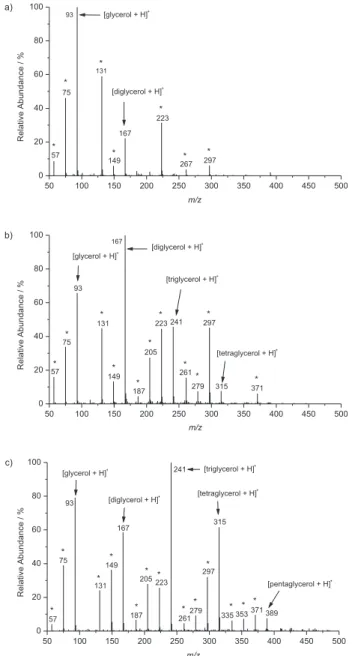
Typical ESI(+)-MS of the reaction aliquots taken at different times are shown in Figure 1. The presence of an intense ion of m/z 93 (protonated glycerol = [glycerol + H]+) is
clearly noticeable indicating the subsistence of glycerol in the reaction medium even after 2 h reaction. Furthermore, other ions of m/z 75 ([glycerol – H2O + H]+) and 57 ([glycerol –
2 H2O + H]+) are also detectable. These ions probably arises
from in-source dehydrations of [glycerol + H]+ as they are
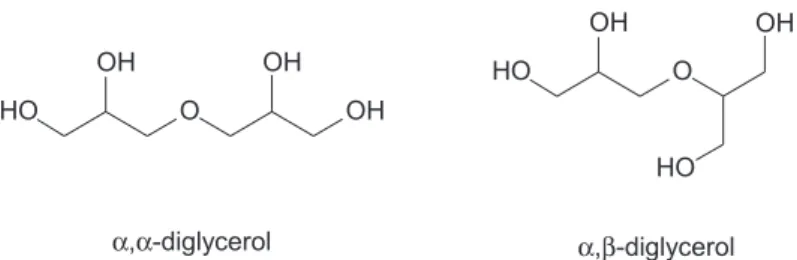
A remarkable presence of an ion of m/z 167 is also noticed in Figure 1. This corresponds to the protonated form of diglycerol, i.e. [(glycerol)2 – H2O], formed under these reaction conditions via the condensation of two molecules of glycerol and loss of water. This condensation can occur via the primary or secondary hydroxyl groups at the glycerol molecule to yield linear (α,α-diglycerol) and branched (α,β-diglycerol; β,β-diglycerol) isomers, as displayed in Scheme 1.
As expected, the mass-selection and fragmentation of the ion of m/z 167 (Figure 2) yielded mainly product ions arising from losses of one or two molecules of water (m/z 149 and 131, respectively) besides to other product ions, such as [glycerol + H]+ (m/z 93), [glycerol – H
2O + H] +
(m/z 75), and [glycerol – 2 H2O + H]+ (m/z 57). To
illustrate the formation of such fragments, the dissociation pathways for protonated α,α-diglycerol are shown in Scheme 2.
In the ESI(+)-MS (Figure 1), the presence of ions of
m/z 149 and m/z 131 is also promptly recognized. These ions are ascribed to be the protonated forms of products formed by successive dehydrations of diglycerol, namely [diglycerol – H2O] and [diglycerol – 2 H2O], respectively (Table 1).
Scheme 1. Linear (α,α-diglycerol) and branched (α,β-diglycerol, β,β-diglycerol) isomers of diglycerol.
Figure 2. ESI(+)-MS/MS experiment with the ion of m/z 167. For a complete interpretation of the fragmentation pathways of protonated
α,α-diglycerol, see Scheme 2.
These findings thus indicate that under these experimental conditions (acidic medium and heating), diglycerol can easily lose one or two molecules of water to form a myriad of isomeric products. Scheme 3 shows, for instance, prototype products possibly formed as a result of the mono-dehydration of diglycerol, such as the cyclic species 1a-c (their formation have been reported by Barrault and coworkers18-24 that submitted glycerol to
similar reaction conditions than those employed herein) besides the acyclic carbonyl compounds 2a-b and the alkene 2c. Thepresence of the last products in the reaction medium was evidenced by the data from IR and NMR
well as 177 and 178 ppm in the C NMR) in addition to
alkenes (owing to the existence of signals at 7.1 ppm in the 1H NMR as well as 100 and 166 ppm in the 13C NMR).
Note that all the products resulting from the mono-dehydration of diglycerol, including the ones shown in Scheme 3 (1a-c and 2a-c), possess the same chemical formula (C6H12O4) and bear similar functional groups (especially hydroxyl substituents). Hence, as these protonated molecules are simultaneously selected inside the ion trap and dissociate in a quite similar way (yielding a number of fragments arising mainly from successive losses of water and other small molecules), the unambiguous characterization of a particular product based exclusively on such fragmentation proile is certainly unfeasible.
The ESI(+)-MS (Figure 1) reveals that besides diglycerol, heavier oligomers, comprising three, four, and ive glycerol units, i. e. triglycerol ([(glycerol)3 – 2 H2O]), tetraglycerol ([(glycerol)4 – 3 H2O]), and pentaglycerol ([(glycerol)5 – 4 H2O]), respectively (Table 1 and Scheme 4), were also formed.
As expected, the mass-selection and fragmentation of such protonated oligomers, of m/z 241, 315, and 389, respectively, yielded product ions arising mainly from successive eliminations of water (Table 2). As previously stated, these products are likely comprised by a mixture [diglycerol – 2 H2O] (131)
triglycerol (241) [triglycerol – H2O] (223)
[triglycerol – 2 H2O] (205)
[triglycerol – 3 H2O] (187)
tetraglycerol (315) [tetraglycerol – H2O] (297)
[tetraglycerol – 2 H2O] (279)
[tetraglycerol – 3 H2O] (261)
pentaglycerol (389) [pentaglycerol –H2O] (371)
[pentaglycerol – 2 H2O] (353)
[pentaglycerol – 3 H2O] (335)
of different isomers (linear and branched) that are formed depending on the nature of the OH group (primary or secondary) active in the condensation step.
Similarly to that veriied for diglycerol, the heavier oligomers, i.e. triglycerol, tetraglycerol, and pentaglycerol, promptly generate a number of dehydration products (possibly comprised by a mixture of cyclic and unsaturated acyclic compounds: alkenes, aldehydes, and ketones) under these experimental conditions. The protonated forms of such compounds are detected in the ESI(+)-MS (Figure 1) and a general overview of their chemical compositions is presented in Table 1.
In Figure 3, the fraction of the ions of m/z 93, 167, 241, 315, and 389 (protonated glycerol, diglycerol, triglycerol, tetraglycerol, and pentaglycerol, respectively), given as a quotient ratio between the absolute intensity of one of such ions and the sum of the absolute intensities of the whole set of ions, are plotted against the reaction time. This is certainly a convenient approach to monitor the changes in the relative concentrations of such species during the reaction course. Hence, the results show that after 2 h reaction more than 90% of glycerol is consumed. Furthermore, during the irst 30 min a relatively high concentration of diglycerol is formed. At longer reaction times, however, its concentration decreases whereas the amount of the heavier oligomers (triglycerol, tetraglycerol, and pentaglycerol) concomitantly increases. These results, in association with the observed gradual rise in the medium
viscosity (from 1000 cp for pure glycerol to 5978 cp for the raw material obtained after 2 h reaction), strongly support the assumption that glycerol is continuously converted into the heavier and more viscous oligomeric compounds.
In Figure 4 the fraction of protonated diglycerol (of
m/z 167) and its dehydration products (of m/z 149 and 131) are plotted against the reaction time. Curiously, the results show that diglycerol only becomes predominant after a reaction time of 30 minutes. Before this time, the fully dehydrated compound, [diglycerol – 2 H2O], is found to be the major product. Similar trend was observed for triglycerol and its dehydration products (not shown). These indings probably indicate that at the beginning of the reaction process, diglycerol and triglycerol are quickly converted into their dehydration products. At longer reaction times, however, the increasingly amount of water in the reaction medium allows the reconstitution of the initial condensation adducts.
Scheme 4. Oligomeric products formed by the self-condensation of glycerol in aqueous acidic medium at 280 oC. Note that only the linear isomers, formed
via condensations of the primary hydroxyl groups, are displayed herein.
Table 2. Major product ions arising from the collision-induced dissociation (CID) of protonated triglycerol (m/z 241) and tetraglycerol (m/z 315)
Precursor ion (m/z) Product ions (relative abundance / %)
[triglycerol + H]+ (241) 223 (14), 205 (3), 167 (14), 149 (37), 131
(24), 93 (3), 75 (5)
[tetraglycerol + H]+ (315) 297 (10), 279 (1), 241 (13), 223 (17), 205
(4), 167 (18), 149 (20), 131 (16)
Figure 4. (a) Fractions of the ions of m/z 167 ([diglycerol + H]+), 149
([diglycerol – H2O + H]+), and 131 ([diglycerol – 2 H 2O + H]
+) as a
function of reaction time. Each fraction was calculated as the quotient ratio between the absolute intensity of one of such ions and the sum of the absolute intensities of the whole set of ions.
Conclusions
The results described herein demonstrated the usefulness of ESI-MS in revealing new and relevant aspects on the acid-catalyzed oligomerization of glycerol. Hence, under the drastic conditions employed herein (acidic medium and heating) a number of oligomers (diglycerol, triglycerol, tetraglycerol, and pentaglycerol) could be detected. In addition, ESI(+)-MS, in conjunction with the data provided by IR and NMR techniques, clearly revealed the presence of secondary products formed by the dehydration of such primary oligomers. These dehydration products are possibly comprised by a mixture of cyclic and unsaturated acyclic compounds (alkenes, aldehydes, and ketones).
Acknowledgments
The authors are grateful to UFMG, FAPEMIG, CNPq and CAPES for the inancial support.
References
1. Macedo, C. C. S.; Abreu, F. R.; Tavares, A. P.; Alves, M. B.; Zara, L. F.; Rubim, J. C.; Suarez, P. A. Z.; J. Braz. Chem. Soc.
2006, 17, 1291.
2. Domingos, A. K.; Saad, E. B.; Vechiatto, W. W. D.; Wilhelm, H. M.; Ramos, L. P.; J. Braz. Chem. Soc. 2007, 18, 416. 3. Freitas, L.; Perez, V. H.; Santos, J. C.; de Castro, H. F.; J. Braz.
Chem. Soc. 2007, 18, 1360.
4. Chaves, E. S.; Saint’Pierre, T. D.; dos Santos, E. J.; Tormen, L.; Bascunan, V. L. A. F.; Curtius, A. J.; J. Braz. Chem. Soc.
2008, 19, 856.
8. Chen, X. Q.; Liu, C. J.; Wang, J.; Li, Y. P.; Chin. J. Org. Chem.
2009, 29, 128.
9. Guru, M.; Artukoglu, B. D.; Keskin, A.; Koca, A.; Energy Convers. Manage. 2009, 50, 498.
10. Pinto, A. C.; Guarieiro, L. L. N.; Rezende, M. J. C.; Ribeiro, N. M.; Torres, E. A.; Lopes, W. A.; Pereira, P. A. P.; de Andrade, J. B.; J. Braz. Chem. Soc. 2005, 16, 1313.
11. Buhler, W.; Dinjus, E.; Ederer, H. J.; Kruse, A.; Mas, C.; J. Supercrit. Fluid 2002, 22, 37.
12. Stein, Y. S.; Antal, M. J.; Jones, M.; J. Anal. Appl. Pyrolysis
1983, 4, 283.
13. Valliyappan, T.; Bakhshi, N. N.; Dalai, A. K.; Bioresour. Technol. 2008, 99, 4476.
14. Li, M. Y.; Zhou, C. H.; Beltramini, J. N.; Yu, W. H.; Fan, Y. X.; Prog. Chem. 2008, 20, 1474.
15. Garcia, R.; Besson, M.; Gallezot, P.; Appl. Catal., A 1995, 127, 165.
16. Ketchie, W. C.; Murayama, M.; Davis, R. J.; J. Catal. 2007, 250, 264.
17. Villa, A.; Campione, C.; Prati, L.; Catal. Lett. 2007, 115, 133. 18. Barrault, J.; Clacens, J. M.; Pouilloux, Y.; Top. Catal. 2004, 27,
137.
19. Behr, A.; Eilting, J.; Irawadi, K.; Leschinski, J.; Lindner, F.; Green Chem. 2008, 10, 13.
20. Clacens, J. M.; Pouilloux, Y.; Barrault, J.; Appl. Catal., A 2002, 227, 181.
21. Karinen, R. S.; Krause, A. O. I.; Appl. Catal., A 2006, 306, 128.
22. Klepacova, K.; Mravec, D.; Bajus, M.; Chem. Pap.-Chem. Zvesti
2006, 60, 224.
23. Barrault, J.; Jerome, F.; Pouilloux, Y.; Lipid Technol. 2005, 17, 131.
24. Klepácová, K.; Miravec, D.; Hájeková, E.; Bajus, M.; Petrol. Coal 2003, 45, 54.
25. Zhou, C. H. C.; Beltramini, J. N.; Fan, Y. X.; Lu, G. Q. M.; Chem. Soc. Rev. 2008, 37, 527.
26. Arakawa, R.; Lu, J.; Mizuno, K.; Inoue, H.; Doe, H.; Matsuo, T.; Int. J. Mass Spectrom. 1997, 160, 371.
27. Dalmazio, I.; Almeida, M. O.; Augusti, R.; Alves, T. M. A.; J. Am. Soc. Mass Spectrom. 2007, 18, 679.
28. Dalmázio, I.; de Urzedo, A. P. F. M.; Alves, T. M. A.; Catharino, R. R.; Eberlin, M. N.; Nascentes, C. C.; Augusti, R.; J. Mass Spectrom. 2007, 42, 1273.
30. de Urzedo, A. P. F. M.; Diniz, M. E. R.; Nascentes, C. C.; Catharino, R. R.; Eberlin, M. N.; Augusti, R.; J. Mass Spectrom.
2007, 42, 1319.
31. de Urzedo, A. P. F. M.; Nascentes, C. C.; Diniz, M. E. R.; Catharino, R. R.; Eberlin, M. N.; Augusti, R.; Rapid Commun. Mass Spectrom. 2007, 21, 1893.
32. Florencio, M. H.; Pires, E.; Castro, A. L.; Nunes, M. R.; Borges, C.; Costa, F. M.; Chemosphere 2004, 55, 345.
33. Griep-Raming, J.; Meyer, S.; Bruhn, T.; Metzger, J. O.; Angew. Chem., Int. Ed. 2002, 41, 2738.
34. Hess, T. F.; Renn, T. S.; Watts, R. J.; Paszczynski, A. J.; Analyst
2003, 128, 156.
35. Kotiaho, T.; Eberlin, M. N.; Vainiotalo, P.; Kostiainen, R.; J. Am. Soc. Mass Spectrom. 2000, 11, 526.
36. Madeira, P.; Nunes, M. R.; Borges, C.; Costa, F. M. A.; Florencio, M. H.; Rapid Commun. Mass Spectrom. 2005, 19, 2015.
37. Meyer, S.; Koch, R.; Metzger, J. O.; Angew. Chem., Int. Ed.
2003, 42, 4700.
38. Moura, F. C. C.; Araujo, M. H.; Dalmazio, I.; Alves, T. M. A.; Santos, L. S.; Eberlin, M. N.; Augusti, R.; Lago, R. M.; Rapid Commun. Mass Spectrom. 2006, 20, 1859.
39. Sabino, A. A.; Machado, A. H. L.; Correia, C. R. D.; Eberlin, M. N.; Angew. Chem., Int. Ed. 2004, 43, 4389.
40. Santos, L. S.; Dalmazio, I.; Eberlin, M. N.; Claeys, M.; Augusti, R.; Rapid Commun. Mass Spectrom. 2006, 20, 2104. 41. Santos, L. S.; Knaack, L.; Metzger, J. O.; Int. J. Mass Spectrom.
2005, 246, 84.
42. Santos, L. S.; Pavam, C. H.; Almeida, W. P.; Coelho, F.; Eberlin, M. N.; Angew. Chem., Int. Ed. 2004, 43, 4330.
Received: February 10, 2009

![Figure 4. (a) Fractions of the ions of m/z 167 ([diglycerol + H] + ), 149 ([diglycerol – H 2 O + H] + ), and 131 ([diglycerol – 2 H 2 O + H] + ) as a function of reaction time](https://thumb-eu.123doks.com/thumbv2/123dok_br/18993009.461316/6.892.71.410.111.353/figure-fractions-ions-diglycerol-diglycerol-diglycerol-function-reaction.webp)
