Artigo
*e-mail: [email protected]
A SIMPLE SQUARE-WAVE VOLTAMMETRIC METHOD FOR THE DETERMINATION OF SCOPOLAMINE IN PHARMACEUTICALS USING A BORON-DOPED DIAMOND ELECTRODE
Simone Birkheur Santos, Camila Farinha Valezi, Jessica Scremin, Carlos Alberto Rossi Salamanca-Neto, Luiz Henrique Dall’Antonia and Elen Romão Sartori*
Departamento de Química, Universidade Estadual de Londrina, Rodovia Celso Garcia Cid, PR 445 Km 380, 86057-970 Londrina – PR, Brasil
Recebido em 09/01/2014; aceito em 22/08/2014; publicado na web em 08/10/2014
A simple procedure is described for the determination of scopolamine by square-wave voltammetry using a cathodically pretreated boron-doped diamond electrode. Cyclic voltammetry studies indicate that the oxidation of scopolamine is irreversible at a peak potential of 1.59 V (vs. Ag/AgCl (3.0 mol L-1 KCl)) in a 0.50 mol L–1 sulfuric acid solution. Under optimized conditions, the analytical curve obtained was linear (r = 0.9996) for the scopolamine concentration range of 1.0 to 110 µmol L–1, with a detection limit of 0.84 µmol L–1. The method was successfully applied to the determination of scopolamine in pharmaceutical formulations with minimum sample preparation.
Keywords: scopolamine determination; hyoscine butylbromide determination; BDD electrode.
INTRODUCTION
Scopolamine, or hyoscine butylbromide, is a tropane alkaloid drug with analgesic, sedative and anticonvulsant properties.1 Thus simple
and rapid analytical procedure for the determination of scopolamine in pharmaceutical formulations is highly desirable, especially for drug-quality control purposes.
Several methods for the determination of scopolamine in pharma-ceutical formulations, plasma and urine samples have been reported in the literature, including gas chromatography mass spectrometry (GC-MS),2 liquid chromatography electrospray ionization tandem
mass spectrometry (LC-ESI MS/MS),3 high performance liquid
chromatography (HPLC) with UV4,5 and indirect conductometric6
detection, liquid chromatography and tandem mass spectrometry (LC–MS/MS),7 capillary electrophoresis,8-10 spectrophotometry,11,12
potentiometry.13-18 Many of these procedures are laborious and
time--consuming, that are not appropriate for simple and rapid quality control to support pharmaceutical production processes.
Square-wave voltammetry (SWV) represents one of the most promising techniques for development of analytical procedures for several routine applications. This technique has several distinct advantages including a low nonfaradaic current, high sensitivity and rapidity of data acquisition. Furthermore, the analysis of the charac-teristic parameters of this technique enables the assessment of the electrochemical mechanistic process of the analyte.19
There are one voltammetric method published for scopolamine determination, underscoring the importance of this work for publi-cation. Farhadi and Karimpour20 develop a voltammetric method
for determination of scopolamine in pharmaceutical and urine samples by the oxidation of this analyte on the platinum electrode in aqueous solution (0.10 mol L–1 HNO
3) and organic solution
(ace-tonitrile containing 0.10 mol L–1 tetrabutylammonium perchlorate).
This method presents a linear concentration range of 10 to 1000 µmol L–1 exploring differential-pulse voltammetry (DPV). The
regeneration of the surface of platinum electrode was realized in a 0.10 mol L–1 hydroxide sodium solution after each scan, which it was
the greatest drawback in the practical application of this electrode.
One of the carbon electrodes that have been used with successful in individual and simultaneous determination of organic compounds is a boron-doped diamond electrode (BDDE).21-28 It has low and stable
background current, extreme electrochemical stability in alkaline and acidic media, excellent long-term response stability, high response sensitivity, and a very wide working potential window.29-36 Moreover,
BDDE can be readily coupled with flow system analysis.27,28
In the present study, a new voltammetric method for the determi-nation of scopolamine in pharmaceutical formulations is proposed. This method is based on the electrochemical oxidation of scopolamine in 0.50 mol L–1 sulfuric acid solution. In the following sections we will
show the advantages of the proposed procedure, with detach to the good sensibility, simplicity, and rapidity obtained using the BDDE. The obtained results were compared with those from the reference potentiometric method of Brazilian Pharmacopoeia.16
EXPERIMENTAL
Reagents and solutions
All chemicals were of analytical grade: scopolamine and sulfu-ric acid were obtained from Sigma-Aldsulfu-rich. All the solutions were prepared with ultra-purified water supplied by a Milli-Q system (Millipore®) with resistivity greater than 18 MΩ cm. Commercial
pharmaceutical samples (tablets and liquid) were purchased from a local drugstore.
A 0.50 mol L–1 H
2SO4 supporting electrolyte solution was chosen
for the scopolamine determination. Stock solutions of 10 mmol L–1
scopolamine were prepared before use in this supporting electrolyte. Appropriate dilutions were made from this solution. Scopolamine working solutions were protected from light by using amber-glass material.
Instrumentation
were conducted at room temperature in a three-electrode single--compartment glass cell, with a BDDE (doped with 8000 ppm; 0.33 cm2 exposed area; obtained from Centre Suisse de Electronique et
de Microtechnique SA (CSEM), Switzerland) employed as working electrode. Detailed information on the preparation of the diamond films was reported elsewhere.37 A platinum sheet and an Ag/AgCl
(3.0 mol L–1 KCl) were used as auxiliary electrode and reference
electrode, respectively. The reference electrode was constructed by insert a silver wire coated with anodized AgCl(s) in a glass tube (3 mm
of diameter) containing 3.0 mol L–1 KCl, which one end contained a
sintered glass disc. Since dissolved oxygen did not interfere in anodic potential window, no deaeration of solution was needed.
Prior to the experiments, the BDDE was electrochemically pretre-ated in a 0.50 mol L–1 H
2SO4 solution, either anodically by applying
0.5 A cm–2, during 30 s, or cathodically by applying –0.5 A cm–2,
during 120 s. With the anodic or cathodic pretreatment, the BDDE is made predominantly oxygen- or hydrogen terminated, respectively, according to previously reported results including XPS analysis.34-36
All experiments were carried out at room temperature. The pH was measured at 25.0 ± 0.5 °C using a pH-meter (Hanna Instruments), model HI-221, employing a combined glass electrode with an Ag/ AgCl (3.0 mol L–1 KCl) external reference electrode.
Measurement procedures
After optimization of experimental parameters for the proposed method, the analytical curves were obtained by adding different ali-quots of 1.0 mmol L–1 scopolamine solution into the electrochemical
cell containing 10 mL of the 0.50 mol L–1 H
2SO4. All measurements
were carried out in triplicate for each concentration.
The proposed method was carried out for determining scopola-mine in different pharmaceutical formulations samples (tablets and liquid). Ten tablets of each sample were reduced to a homogeneous fine powder. These powders were weighed and transferred to 10 mL calibrated volumetric flask containing 0.50 mol L–1 H
2SO4 solution.
Non-dissolved solids were filtered using a filter paper. Then, 200 µL of this solution was diluted to 2.0 mL using 0.50 mol L–1 H
2SO4
solution. For liquid sample, an adequate aliquot was diluted in a 10.0 mL calibrated flask containing 0.50 mol L–1 H
2SO4 solution.
Then, 200 µL of this solution was diluted to 2.0 mL using 0.50 mol L–1 H
2SO4 solution. For each sample (tablet or liquid), an aliquot of
each these solutions was directly transferred to the electrochemical cell containing 10 mL of 0.50 mol L–1 H
2SO4 solution, after which the
square-wave voltammograms were obtained. Finally, the scopolamine concentration in each sample solution was determined directly by interpolation in the previously obtained analytical curve.
Recovery studies were done in triplicate, which aliquots of the standard solution of scopolamine were added to the solutions of the commercial pharmaceutical samples of scopolamine.
The results obtained using the proposed SWV method were compared with the reference potentiometric method recommended by Brazilian Pharmacopoeia.16 For such, accurate representative
powdered amounts of the commercial pharmaceutical samples of scopolamine were dissolved in deionized water and potentiometrically titrated with AgNO3 0.10 mol L
–1 using a silver indicator electrode. RESULTS AND DISCUSSION
Electrochemical behavior of scopolamine
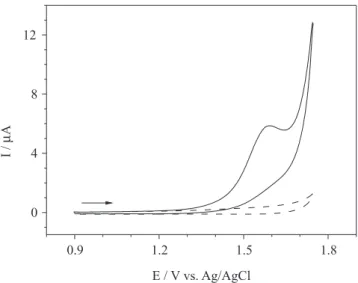
Preliminary electrochemical measurements were carried out in order to identify the general behavior of scopolamine on the BDDE surface. Figure 1 shows cyclic voltammograms obtained at a
cathodically pretreated BDDE in a 0.010 mol L–1 H
2SO4 solution in the
presence and absence of 0.20 mmol L–1 scopolamine. As can be seen,
an anodic current due to the oxidation of scopolamine is observed with a peak potential at 1.59 V and no reduction peak is observed, which indicate that this is an irreversible charge-transfer process.
Next, the BDDE was anodically or cathodically pretreated and both responses were compared (Figure 2). The voltammograms ob-tained for scopolamine with the anodically pretreated BDDE presents a higher current intensity, but poor repeatability of analytical signals. On the other hand, the cathodically pretreated BDDE presented a less positive oxidation peak potential and a better repeatability of analytical signals, without adsorption effect, which allowed the use of the electrode for a long time with the same response. The adsorption effects were observed by Farhadi and Karimpour20 using a platinum
electrode, which it should be cleaned in a 0.10 mol L–1 hydroxide
sodium solution after each scan. The cathodic surface of BDDE (hydrophobic characteristic) facilitated the oxidation of scopolamine and a lower potential than anodic surface was obtained. With this pre-treatment is not observed adsorption effects of the scopolamine in the surface of BDDE and a better repeatability of signals were observed. Figure 1. Cyclic voltammograms (40 mV s–1) in 0.010 mol L–1 H
2SO4 solution obtained using a cathodically pretreated BDDE: (dashed line) absence and (solid line) presence of 0.20 mmol L–1 scopolamine
Thus, this pretreatment was selected for further experiments, as was previously observed for several other analytes.22-26,28 The subsequent
scopolamine analytical determinations were all carried out using a BDDE that was cathodically pretreated during 120 s. This pretre-atment, which was repeated daily before starting the voltammetric measurements, was always preceded by a 30 s anodic pretreatment, to cleanse the electrode surface by oxidizing any contaminant on its surface. This procedure guarantees reproducibility of the electrode response.
The electrochemical responses to scopolamine were studied in different supporting electrolytes, as sulfuric acid, Britton-Robinson buffer, phosphate buffer and acetate buffer. However, the best voltam-metric response (repeatability of the obtained analytical signals) was obtained in sulfuric acid solution. Thus, H2SO4 concentrations from
0.010 mol L−1 to 0.75 mol L−1 were evaluated. Higher current values
were obtained for the 0.50 mol L−1 H
2SO4 solution. Hence, taking
into account the repeatability of the obtained analytical signals of the scopolamine solutions, the concentration of 0.50 mol L−1 H
2SO4 was
selected as the supporting electrolyte for the scopolamine determina-tion. This repeatability was obtained by six measurements of current signals with a relative standard deviation (RSD) of 0.5%. In addition, despite the high potential value for detection of the drug, this would not be a problem for analysis in pharmaceutical formulations.
The effect of scan rate (5–200 mV s–1) for 100 µmol L–1
scopol-amine was also evaluated using cyclic voltammetry (CV) (Figure 3) in 0.50 mol L–1 H
2SO4 solution. Increasing the scan rate, the peak current
increased and the peak potentials shifted to more positive values. A linear behavior was found when peak currents were plotted versus the square root of the scan rate, indicating that rate determining step of the reaction is characterized by electroactive species reaching the cathodically pretreated BDDE by diffusion,38 according to the linear
relation Ipa (µA) = –8.12 × 10 –7 + 1.16
× 10–6v1/2 (r = 0.9934). In
ad-dition, plot of the logarithm of the peak current versus the logarithm of the scan rate was linear (inserted in Figure 3), according to: log Ipa = –0.039 + 0.53 log v (r = 0.9960), which the value of slope is
close to the theoretical value of 0.50 expected for an ideal reaction of species in solution.38
In order to develop an analytical method for determination of scopolamine, both DPV and SWV at cathodically pretreated BDDE were studied. The effects of experimental parameters of the DPV and
SWV on the peak potential and peak current were optimized for a 50 µmol L–1 scopolamine in 0.50 mol L–1 H
2SO4 solution.
For DPV, the parameter ranges studied were: 10–175 mV, for the pulse amplitude (a); 5–20 mV s–1, for the scan rate (
ν); and 3–7 ms, for the modulation time (t). The optimized values were a = 150 mV,
ν = 10 mV s–1, and t = 5 ms.
For SWV, the corresponding investigated ranges were:10–40 s–1, for the square-wave frequency (f); 10–60 mV, for the pulse
amplitude (a); 1–6 mV, for the scan increment (∆ES). The obtained
optimized values were f = 30 s–1, a = 50 mV, and
∆ES = 5 mV. The
slope of 0.0576 V obtained from the ∆Eapvs.∆log f plot (not shown)
was used to estimate the number of electrons transferred (n) in the redox process by the following equation ∆Eap/∆log f = 2.3RT/αnF,
19
where α is the charge transfer coefficient and other symbols have their usual meanings. The αn value was estimated to be 0.972 and thus, assuming α= 0.5, which is commonly done for totally irreversible system,39n is estimated as 2; thus also indicating that two electrons per
molecule are involved in the oxidation of scopolamine in the sulfuric acid 0.50 mol L–1. The functional group involved in this oxidation is
probably the OH of the scopolamine molecule (Figure 4). Farhadi and Karimpour20 describes that this oxidation can be stated that two
moles of Br- ions in aqueous solution are reversibly oxidized to Br 2
with the loss of two electrons.
Analytical curves
Using the optimal DPV and SWV instrumental parameters, corresponding analytical curves for scopolamine were constructed in 0.50 mol L–1 H
2SO4 solutions using a cathodically pretreated
BDDE. The analytical parameters thus obtained for both the DPV and SWV proposed methods are summarized in Table 1, where the detection limit (LOD) is equal to three times the standard deviation of the blank solution divided by the slope of the analytical curve. As can be observed, higher sensitivity and lowest detection limit was obtained using SWV. Other advantage of the use of SWV is that this technique is faster than DPV to routine analysis of pharmaceutical formulations. Hence, this method was selected for determination of scopolamine in pharmaceuticals. The intra-day repeatability of the magnitude of peak current was determined by successive measure-ments (n = 10) of 15 µmol L–1 scopolamine solution using SWV and
DPV techniques. The inter-day repeatability of magnitude of the peak current was evaluated by measuring the peak current for similar fresh solutions over a period of 5 days. As can be seen in Table 1, a good RSD values were obtained. No significant differences were observed between the values found for the repeatability of scopolamine ob-tained by both techniques.
Figure 5 shows the square-wave voltammograms obtained for solution containing scopolamine (1.0 to 110 µmol L–1) in 0.50 mol L–1
H2SO4 solution. The insert in this figure depicts the respective
analyti-cal curve obtained for scopolamine, whose corresponding equation is Iap (µA) = –0.018 + 0.066 [c (µmol L
–1)] (r = 0.9996), where I ap is
the anodic peak current and c the scopolamine concentration. The calculated LOD value was 0.84 µmol L–1.
The LOD value obtained by scopolamine using the herein proposed method is ten times lower than that obtained by Farhadi Figure 3. Cyclic voltammograms for 0.10 mmol L–1 scopolamine in 0.50 mol
L–1 H
2SO4 solution obtained using a cathodically pretreated BDDE at different scan rates (ν): 5 – 200 mV s–1. Insert: linear dependence of log Iap with log v
and Karimpour20 using a platinum electrode. In addition, platinum
electrode should be clean in sodium hydroxide solution after each measurement, which it makes a lengthy procedure. The use of the BDDE did not lead to any passivation effect, which allowed using the electrode for a long time with the same response. It should be emphasized that the pretreatment of BDDE surface is done once, at the beginning of a day’s work, which led to excellent reproducibility in the scopolamine determination, because adsorption effects were not observed on its surface. The proposed voltammetric method is simple and does not involve the use of AgNO3, as is the case in the
reference method of the Brazilian Pharmacopeia.
The selectivity of the proposed method was evaluated by the addi-tion of possible interferents present in commercial samples containing 10 mg scopolamine labeled. Some possible interferent compounds (commonly present in analyzed pharmaceutical formulations), such as povidone, ethyl alcohol, saccharose, magnesium stearate, calcium phosphate, paracetamol, and dipyrone were investigated for 15 µmol L–1 scopolamine solutions at the concentration ratios (standard
solution:interferent compound) of 1:1, 1:10, and 10:1 (m/m). The corresponding current signals were compared with those obtained in the absence of each interferent compound. The responses obtained showed that these compounds do not interfere (except dipyrone) with
the determination of scopolamine at the used working conditions. The analyzed samples do not contained paracetamol or dipyrone.
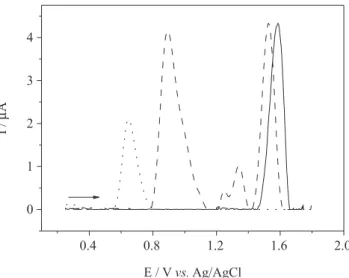
Figure 6 shows the voltammetric behavior of scopolamine in comparison with paracetamol and dipyrone in 0.50 mol L–1 H
2SO4
solution using a cathodically pretreated BDDE. Paracetamol is oxidized in a small potential compared to scopolamine, thus it does not interfered in determination of scopolamine in the sample of pharmaceuticals. However, dipyrone shows the oxidation peak in same potential of oxidation of scopolamine. Therefore, the proposed method is limited to samples of pharmaceutical formulations that not contain dipyrone labelled.
Analytical application
To evaluate the accuracy of the application of the proposed method, scopolamine was determined in three different commercial pharmaceutical samples (tablets and liquid) using a cathodically pretreated BDDE in 0.50 mol L–1 H
2SO4 solution. Addition and
re-covery studies were evaluated for investigated commercial tablets. Recoveries from 95.2% to 103% of scopolamine were obtained, indicating the proposed method does not suffer from any significant effects of matrix interference.
Furthermore, the results obtained employing the proposed method were compared with those obtained employing the reference poten-tiometric method presented at the Brazilian Pharmacopoeia16 (Table
2). As it can be seen in this Table 2, no significant differences were observed between the values found for the amounts of scopolamine in samples using the SWV proposed method and the reference po-tentiometric method. Besides, considering that the paired t-test was applied to these results and the calculated t value (1.084) is smaller than the critical value (4.303, α= 0.05), one may conclude that the results obtained with either method are not statistically different, at a 95% confidence level.
CONCLUSIONS
A cathodically pretreated BDDE was successfully used for square-wave voltammetric determination of scopolamine in real pharmaceutical samples using 0.5 mol L–1 H
2SO4 solution. Under this
condition, a linear analytical curve was obtained for the scopolami-ne concentration range 1.0 to 110 µmol L–1, with a detection limit
Table 1. Analytical parameters for the voltammetric determination of scopolamine in 0.50 mol L–1 H
2SO4 solution by SWV and DPV using a cathodically pretreated BDDE
DPV SWV
Peak potential (V) 1.54 1.54
Linear range (µmol L–1) 1.0 to 110 1.0 to 110 Correlation coefficient, r 0.9919 0.9996 Slope (µA µmol–1 L) 0.044 0.066
Intercept (µA) –0.43 –0.018
Detection limit (µmol L–1) 0.90 0.84 Repeatability Intra-day (RSD%) 1.9 1.8 Repeatability Inter-day (RSD%) 3.4 3.2
Figure 5. Square-wave voltammograms in 0.50 mol L–1 H
2SO4 solution ob-tained using a cathodically pretreated BDDE for the following of scopolamine: (1) 0, (2) 1.0, (3) 2.0, (4) 3.5, (5) 5.0, (6) 6.5, (7) 7.9, (8) 9.9, (9) 15, (10) 20, (11) 29, (12) 38, (13) 48, (14) 57, (15) 65, (16) 74, (17) 83, (18) 91, (19) 110 µmol L–1. Insert: Corresponding analytical curve
Figure 6. Square-wave voltammograms obtained using the cathodically pre-treated BDDE for (solid line) 75 µmol L–1 scopolamine, (dotted line) 25 µmol L–1 paracetamol, and (dashed line) 25 µmol L–1 dipyrone in 0.50 mol L–1 H
of 0.84 µmol L–1. The obtained detection limit was lower than that
reported by Farhadi and Karimpour20 using DPV with a platinum
electrode. No absorption effects were observed on the BDDE, without the necessity of renovation of surface of this electrode. Furthermore, recoveries of scopolamine from commercial samples range from 95.2% to 103%. In addition, the reported results demons-trate that the proposed method is simple, rapid, sensitive, precise and accurate, being applicable directly to the analysis of the commercial pharmaceutical simply after dissolution of their samples, dispensing any use of organic reagents or expensive apparatus.
ACKNOWLEDGEMENTS
The authors gratefully acknowledge financial support and scho-larships from the Brazilian funding agencies CNPq and CAPES. The anonymous reviewers are also thanked for constructive criticism of an earlier manuscript version.
REFERENCES
1. Hardman, J. G.; Limbird, L. E., Gilman, A. G.; Goodman & Gilman’s – The Pharmacological Basis of Therapeutics, 9th ed., McGraw-Hill: New York, 1996.
2. Oertal, R.; Richter, K.; Ebert, U.; Kirch, W.; J. Chromatogr. B 1996, 682, 259.
3. John, H.; Binder, T.; Höchstetter, H.; Thiermann, H.; Anal. Bioanal. Chem. 2010, 396, 751.
4. Ceyhan, T.; Kartal, M.; Altun, M.L.; Tülemis, F.; Cevheroglu, S.; J. Pharm. Biomed. Anal. 2001, 25, 399.
5. Nakamura, M.; Ono, M.; Nakajima, T; Ito, Y.; Aketo, T.; Haginaka, J.; J. Pharm. Biomed. Anal. 2001, 37, 231.
6. Lau, O.-W.; Mok, C.-S.; J. Chromatogr. A 1997, 766, 270.
7. Chen, H.; Chen, Y.; Wang, H.; Dub, P.; Han, F.; Zhang, H.; Talanta 2005, 67, 984.
8. Yu, Z.; Wu, Z.; Gong, F.; Wong, R.; Liang, C.; Zhang, Y.; Yu, Y.; J. Sep. Sci. 2012, 35, 2773.
9. Cherkaoui, S.; Mateus, L.; Christen, P.; Veuthey, J.; J. Pharm. Biomed. Anal. 1998, 17, 1167.
10. Cherkaoui, S.; Mateus, L.; Christen, P.; Veuthey, J.; J. Pharm. Biomed. Anal. 1999, 21, 165.
11. Gouda, A. A.; Arabian J. Chem. 2010, 3, 33.
12. Gouda, A. A.; El-Shafey, Z.; Hossny, N. El-Azzazy, R.; Spectrochim. Acta, Part A 2008, 70, 785.
13. Ionescu, M. S.; Negoiu, D.; Cosofret, V. V.; Anal. Lett. 1983, 16, 553. 14. Abramovic, B. F.; Guzsvány, V. J.; Gaál, F. F.; J. Pharm. Biomed. Anal.
2005, 37, 265.
15. Mostafa, G. A. E.; Anal. Sci. 2002, 18, 1335.
16. Scopolamine, Farmacopéia Brasileira – Part II, 4a ed., Atheneu Editora, São Paulo, 2002.
17. El-Saharty, Y. S.; Metwaly, F. H.; Refaat, M.; El-Khateeb, S. Z.; Talanta 2007, 72, 675.
18. Ganjali, M. R.; Norouzi, P.; Golmohammadi, M.; Rezapour, M.; Salavati-Niasari, M.; Electroanalysis 2004, 16, 910.
19. Scholz, F.; Electroanalytical Methods – Guide to Experiments and Ap-plications, Springer: New York, 2002.
20. Farhadi, K.; Karimpour, A.; J. Chin. Chem. Soc. 2007, 54, 165. 21. Pecková, K.; Musilová, J.; Barek, J.; Crit. Rev. Anal. Chem. 2009, 39,
148.
22. Sartori, E. R.; Medeiros, R. A.; Rocha-Filho, R. C.; Fatibello-Filho, O.; J. Braz. Chem. Soc. 2009, 20, 360.
23. Ardila, J. A.; Sartori, E. R.; Rocha-Filho, R. C.; Fatibello-Filho, O.; Talanta 2013, 103, 201.
24. Eisele, A. P. P.; Clausen, D. N.; Tarley, C. R. T.; Dall’Antonia, L. H.; Sartori, E. R.; Electroanalysis 2013, 25, 1734.
25. Santos, M. C. G., Tarley, C. R. T., Dall’Antonia, L. H, Sartori, E. R.; Sens. Actuators, B 2013, 188, 263.
26. Sartori, E. R.; Trench, A. B.; Rocha-Filho, R. C.; Fatibello-Filho, O.; J. Braz. Chem. Soc. 2013, 24, 1504.
27. Lima, A. B.; Chaves, S. C.; da Silva, L. M.; Richter, E. M.; Santos, W. T. P.; Quim. Nova 2013, 36, 1296.
28. Lopes, A. C. V.; Luz, R. C. S.; Damos, F.S.; Santos, A. S.; Franco, D. L.; Santos, W. T. P.; J. Braz. Chem. Soc. 2012, 23, 1800.
29. Pleskov, Y. V.; Russ. J. Electrochem. 2002, 38, 1275.
30. Compton, R. G.; Foord, J. S.; Marken, F.; Electroanalysis 2003, 15, 1349.
31. Hupert, M.; Muck, A.; Wang, R.; Stotter, J.; Cvackova, Z.; Haymond, S.; Show, Y.; Swain, G. M.; Diamond Relat. Mater. 2003, 12, 1940. 32. Yagi, I.; Notsu, H.; Kondo, T.; Tryk, D. A.; Fujishima, A.; J. Electroanal.
Chem. 1999, 473, 173.
33. Girard, H.; Simon, N.; Ballutaud, D.; Herlern, M.; Etcheberry, A.; Dia-mond Relat. Mater. 2007, 16, 316.
34. Suffredini, H. B.; Pedrosa, V. A.; Codognoto, L.; Machado, S. A. S.; Rocha-Filho, R. C.; Avaca, L. A.; Electrochim. Acta 2004, 49, 4021. 35. Popa, E.; Notsu, H.; Miwa, T.; Tryk, D. A.; Fujishima, A.; Electrochem.
Solid-State Lett. 1999, 2, 49.
36. Salazar-Banda, G. R.; Andrade, L. S.; Nascente, P. A. P.; Pizani, P. S.; Rocha-Filho, R. C.; Avaca, L. A.; Electrochim. Acta 2006, 51, 4612. 37. Gandini, D.; Michaud, P.; Duo, I.; Mache, E.; Haenni, W.; Perret, A.;
Conminellis, C.; New Diamond Front. Carbon Technol. 1999, 9, 303. 38. Gosser, D. K.; Cyclic Voltammetry, VCH Publishers: New York, 1994. 39. Li, C.; Colloids Surf., B 2007, 55, 77.
Table 2. Scopolamine content in pharmaceutical formulations determined by the proposed SWV method, using a cathodically pretreated BDDE, and a reference potentiometric method16
Samples Scopolamine (mg) Relative errorb (%)
Label value Reference methoda SWV methoda
Ac 10 9.58 ± 0.03 9.37 ± 0.02 –4.4
Bc 10 9.73 ± 0.02 9.82 ± 0.01 0.92
Cd 10 10.1 ± 0.4 9.90 ± 0.02 –2.0