ISSN 0104-6632 Printed in Brazil
www.abeq.org.br/bjche
Vol. 33, No. 01, pp. 215 - 223, January - March, 2016 dx.doi.org/10.1590/0104-6632.20160331s20140112
*To whom correspondence should be addressed
Brazilian Journal
of Chemical
Engineering
STERIC MASS ACTION MODEL FOR
LACTOFERRIN ADSORPTION IN CRYOGEL
WITH IMMOBILIZED COPPER IONS
B. M. A. Carvalho
1*, W. F. Silva Júnior
2, L. M. Carvalho
3,
L. A. Minim
4and G. G. P. Carvalho
51
Institute of Agricultural Sciences, Federal University of Minas Gerais, 39404-547, Montes Claros - MG, Brazil. Phone: + 55 021 38 21017915
E-mail:[email protected] 2
Department of Chemistry, Biotechnology and Bioprocess Engineering, Federal University of São João Del Rei, 36420-000, Ouro Branco - MG, Brazil.
3
Department of Veterinary, Federal University of Viçosa, 36570-000, Viçosa - MG, Brazil. 4
Department of Food Technology, Federal University of Viçosa, 36570-000, Viçosa - MG, Brazil. 5 Department of Animal Science, Federal University of Bahia, 40110-909, Salvador - BA, Brazil.
(Submitted: October 14, 2014 ; Revised: March 8, 2015 ; Accepted: March 18, 2015)
Abstract - Parameters of equilibrium adsorption obtained from experiments using immobilized metal affinity chromatography (IMAC) were used to evaluate the applicability of the steric mass-action (SMA) model to describe the adsorption of lactoferrin to cryogel resin under different conditions. The adsorption of lactoferrin on continuous supermacroporous cryogel with immobilized Cu2+ ions was evaluated in batch adsorption
experiments at different pH (6-8) and temperature (293-313 K) values. Estimated values of the equilibrium constant (K) and characteristic number of binding sites (n) showed that these parameters decreased with increasing ionic strength, pH and temperature, while the nonlinear parameter, the steric factor (), increased with increasing ionic strength and temperature. Expressions correlating these parameters with pH, ionic strength and temperature were then derived.
Keywords: SMA; IMAC; Cryogel; Protein.
INTRODUCTION
The recent requirements of high purity proteins (both natural and recombinant), and the need of re-ducing costs of downstream processes have stimu-lated the development of more efficient and cheaper separation techniques (Frerick et al., 2008). It has been shown that Immobilized Metal Affinity Chro-matography (IMAC) meets these requirements (Car-valho et al., 2014; Wang et al., 2008; Cheung et al., 2012). This technology is based on the chemical affinity displayed by certain groups of amino acid residues present on the surface of proteins (e.g., the
imidazole group of histidine, thiol group of cysteine and tryptophan’s indole group) with the metal ions immobilized on chromatographic resins (Gupta et al., 2002; Çimen and Denizli, 2012).
pro-216 B. M. A. Carvalho, W. F. Silva Júnior, L. M. Carvalho, L. A. Minim and G. G. P. Carvalho
Brazilian Journal of Chemical Engineering teins, IMAC may present some challenges since the
amount of histidine on the surface accounts for only 1% of the total number of amino acids (Ueda et al., 2003). Then, optimum conditions of the medium, such as temperature, salt concentration and pH, should be determined to improve the specific adsorp-tion of the target protein. Over the years, acceptance of IMAC as a reliable technique for separation on a laboratory scale has increased. However, its use on an industrial scale has still been only slightly ex-plored.
The main interaction in IMAC is the coordinate bond. However, other interactions, such as electro-static and hydrophobic, may also occur due to the environmental conditions. Generally, these three types of interplay should be considered. Nonetheless, it is not always possible to determine the relative contribution of each of them. It is known that the prevalence of a particular type of interaction over the others is essentially governed by certain variables, such as the nature of the chelating agent, the com-position of the protein’s surface and the chemical environment where the interplay occurs, that is, the solution’s ionic strength, pH and type of salts are also determinants of the driving forces (Bresolin et al., 2009).This makes IMAC less predictable and its optimization a difficult task. Projects for IMAC on a preparative scale require a deep understanding of all the fundamental mechanisms that govern the protein adsorption. The knowledge of these processes pro-vides a rational basis to establish chromatographic conditions for purification and scale-up (Bornhorst and Falke, 2000; Ueda et al., 2003).
Although the adsorption process in IMAC is con-siderably different from conventional methods, pre-vious studies have shown that the interaction be-tween a protein molecule and immobilized metal ions may be explained based on the application of isotherm models of both affinity and ion exchange phenomena (Jiang and Hearn, 1996; Chen et al.. 2005). Nonetheless, the universal applicability of a model to elucidate the precise molecular mechanisms by which proteins are retained in resins with chelated metals still must be established.
Brooks and Cramer (1992) presented a new model, steric mass action (SMA), for protein adsorp-tion equilibrium in nonlinear ion exchange systems. This model combines the stoichiometric displace-ment model (Rounds and Regnier, 1984; Drager and Regnier, 1986) with the concept of steric shielding of macromolecules presented later by Velayudhan (1990). Mainly used in ion exchange chromatog-raphy, the model involves three parameters, the num-ber of identical binding sites (n), the equilibrium
constant (K) and the steric factor (). It is assumed that the adsorption is an exchange process between the free protein molecule and a certain number of ions bound to the resin, which considers explicitly the steric hindrance of the counter ions of the salt on the binding of proteins. Recent studies have used the SMA model to describe protein adsorption equilib-rium and the results have shown its efficiency for predicting the non-linear adsorption behavior of pro-teins (Chen et al., 2006; Barz et al., 2010).
Given the high demand for purified proteins, the development of mechanistic models which both pre-dict adsorption with accuracy and provide one with process information (e.g., pH, salt concentration, temperature) is needed to design purification plants. Langmuir and other adsorption models, for example, do not explain the process at the molecular level. Detailed models like the SMA can indicate more clearly the driving force for the adsorption. Thus, in the present study, the applicability of the SMA model and the parametric sensitivity that describes the adsorption equilibrium of bovine lactoferrin in cryogel resins with copper ions immobilized through iminodiacetic acid (IDA-Cu+2-cryogel) was analyzed under different conditions (pH, salt concentration and temperature) as an approach to mechanistic modeling for further industrial process development applications.
MATERIALS AND METHODS
Materials
Lactoferrin (LF) (M.W., 80 kDa), acrylamide (AAm, 99.9% electrophoretic grade), N,N-methylene-bisacrylamide (MBAAm, 99%), ammonium persul-phate (APS, 98%), CuSO4·4H2O (98%),
iminodiace-tic acid (IDA), N-2-hydroxyethylpiperazine-N’-2-ethanosulfenic acid (HEPES), N,N,N’,N’-tetrame-thyl-ethylenediamine (TEMED, 99%) and allyl glyc-idylether (AGE, 99%) were purchased from Sigma– Aldrich (Steinheim, Germany). Imidazole was pur-chased from Merck (Germany). Ultrapure water was used during all experiments (Milli-Q system, Millipore Inc., USA).
Methods
Synthesis of IDA-Cu2+ Cryogel Adsorbent Resin
cryo-copoly-Steric Mass Action Model for Lactoferrin Adsorption in Cryogel with Immobilized Copper Ions 217
Brazilian Journal of Chemical Engineering Vol. 33, No. 01, pp. 215 - 223, January - March, 2016 merization reaction of solution containing AAm,
MBAAm, AGE, TEMED and APS was performed. IDA was used as chelating agent to load copper within the matrix. All experiments were performed in triplicate.
Obtaining Adsorption Isotherms
Adsorption isotherm data were obtained by batch experiments, as described by Carvalho et al. (2013). 3 mg of dried cryogel matrix were weighed in eppen-dorf tubes. Initially, the resin was equilibrated with 400 μL of equilibration buffer (20 mmol.L-1 HEPES containing 200 mmol.L-1 NaCl, pH 7.0). The tubes were left under mild stirring for a period of two hours to condition the resin. After this period, the equilibration buffer was removed and different vol-umes (0 to 300 μL) of a 10 mg.mL-1 solution of lac-toferrin were added. Adsorption buffer (20 mmol.L-1 HEPES containing 400 mmol.L-1, different pHs) was then added to make the volume up to 1200 L. The final protein concentrations in the tubes were 0, 0.1, 0.2, 0.3, 0.4, 0.6, 0.9, 1.2, 1.5, 1.8 and 2.2 mg.mL-1. The tubes were kept under constant agitation for 24 hours under controlled temperature (101M Mod BOD/3 Eletrolab ®, Brazil), to achieve the equilib-rium state. Subsequently, the resin was removed from the eppendorf tubes and the concentration of protein contained in the supernatant was determined spectrophotometrically at 280 nm (Thermo Scientific Model BIOMATE 3). The protein concentration in the solid phase was determined according to Equation (1):
0
( )
V C C
q
M
(1)
where q (mg.g-1) is the concentration of protein in the solid phase, V (mL) the volume of the liquid phase, M
(g) is the mass of the solid phase, C0 (mg.mL-1) is the initial concentration of protein in the liquid phase and (mg.mL-1) C is the final protein concentration in the liquid phase after the equilibrium state has been established. The experiment was conducted using a factorial design with three temperatures (20, 30 and 40 °C), three different pHs (6.0, 7.0 and 8.0) and a salt concentration of 400 mmol.L-1.
Modeling the Equilibrium Data - The SMA Model
The applicability of the Zhang and Sun (2002) SMA model to describe the adsorption of LF onto IDA-Cu+2-cryogel was evaluated in this work. In this model, the protein (Lactoferrin) would interact with
ligands (immobilized Cu2+ ions), present at a density
Lt (mmol.L-1), according to a “characteristic number of binding sites”, ni. Further, during the protein ad-sorption, there may be a number of copper ions blocked by the 3D structure of the molecule, which prevents that other proteins coordinate to the ions. The number (average) of shielded cooper ions is given by the steric factor, i. The following interac-tion balance can be written for each protein of the mixture (i):
v i 1,2,...,N
K
i i i
C n L Q i (2)
where Ci and Qi represent, respectively, the concen-trations of protein free in solution and bound to metal ions immobilized in the cryogel, andLv is the amount of immobilized copper free and unblocked to bind to molecules of LF. The equilibrium constant Ki for the metal affinity process is given by:
v
1,2, ...,N i
i
i n
i
Q
K i
L C
(3)
Because many ligands may be blocked by bound LF molecules, the equilibrium constant is redefined as:
1
( )
i i
i n
N
t i i i i
i
Q K
L n Q C
(4)
where the term
1
( )
N
t i i i
i
L n Q
is a mass
bal-ance for the copper ions and is equal to the density of metal available for protein binding. In this study, the equilibrium adsorption of lactoferrin onto IDA-Cu2+ -cryogel was studied to examine the usefulness of the SMA model in describing such process. For this system, Equation (4) may be reduced to:
t ( )
nQ C
K L n Q
(5)
In a dilute protein solution, the isotherm can be written as:
0
lim n
C t
Q K
CL
21 fr o is re re m th st is it T ca se co is th d ce at u eq te io Q w p an an to co m is at in li 18
rom which o f Q, C and L
s important t esin’s partitio e-written as: n t Q m KL C
The plot o he SMA mo
teric factor c
RE
Equation ( sotherm mod ty factor equ Thus, one can
alculated thr ent the adsor oncentration s indefinitely he lactoferri
erivation of entration clo t high lactofe
To overco sed to fit the quation (Equ eins into affi ons. ( ) m d Q C Q K C
where Qm is t rotein and K
nd Kd are th nd supernata oferrin conc oefficient ca m d Q m K
As can be s a straight l ted. The line ndicates that inear parame
B
one can obtai
Lt, which are to note that on coefficien
of ln m versu odel paramet could be calcu
ESULTS AND
(7) can be se del (Carvalho ual to 1 (first
n conclude th rough the SM rption proces ns, since it co y proportion n in the me f equation (7 ose to zero, K
errin concent ome this, th e experiment uation (8)) ca
nity adsorbe
)
the maximum
Kd is the diss he concentrat
ant in the eq centrations, an be describe
seen in Figu line at each ear relationsh t the hypothe eters from the
B. M. A. Carvalh
in K and n, g obtained ex the ratio Q/
nt m, so Equa
us ln Lt was ters (K, and
ulated.
D DISCUSS
een as a kind o et al., 2014 t order adsor hat the equili MA model m ss accurately onsiders that nal to the co
edia. Beside 7) assumes l
K values will trations. he Langmuir
tal data, sinc an fit the ads ents containin
m concentrati ociation con tion of LF in quilibrium fo respectively ed as:
ure 1, the plo pH and tem hip between esis of indep e ion density
ho, W. F. Silva Jú
Brazilian Jou given the val xperimentally
/C indicates ation (6) can
s used to obt
n), so that
SION
d of Freundl 4b), with cap rption proce ibrium const may not rep y for all prot t the adsorpt oncentration es, because lactoferrin c not be realis
r isotherm w e the Langm sorption of p ng immobiliz
ion of adsorb nstant. Since
n the adsorb or different l y, the partit
ot ln m vs. ln mperature eva n ln m and ln pendence of y is acceptabl
únior, L. M. Carva
urnal of Chemica ues y. It the n be (7) tain the lich pac-ss). tant pre-tein tion n of the on-stic was muir pro-zed (8) bed Qm bent lac-tion (9)
n Lt alu-n Lt the le. Fig tio liz sor mm tem Th 6.0 0.9 0.9 0.9 of and wi dep on cys
alho, L. A. Minim
al Engineering gure 1: Plot on coefficien zed copper i
rption on ID mol.L-1, 400 mperatures: he coefficien
0, R2= 0.989 9791, at 30 9343, pH 8.0 9013, pH 7.0
Table 1 sho the SMA m d pH. The n th the increa protonation n the surface
steine pKa =
m and G. G. P. Ca
(a
(b
(c ts of the natu t vs. natural ion concent DA-Cu2+- cry
mmol.L-1 N (a) 293 K, ( nt of determin
97, pH 7.0, °C: pH 6.0, 0, R2= 0.960 0, R2= 0.9813 ows the value model at diffe
number of b ase of pH, w of electron of lactoferr 8.18). With arvalho a) b) c) ural logarithm logarithm o ration for l yogel in HEP NaCl, at diffe (b) 303 K an nation were,
R2= 0.8888 R2= 0.9879 09; at 40 °C 3, pH 8.0, R2 es of two line erent values o binding sites which most li donor amin rin (histidine a higher dens
m of the part of the immob actoferrin a PES buffer 2 ferent pHs an nd (c) 313 K , at 20 °C: p
, pH 8.0, R2 9, pH 7.0, R2 C: pH 6.0, R2
2
= 0.9954.
ear paramete of temperatu s, n, increase
d cu in ra th p L d L 2 th la fa te w T o to ch lo in C an ti (2 m in T b sh nu in cl so th co sq is th b onor residue ule may coor The param ncreasing tem anges from 8 he protein is ossibly lead LF and Cu2+ i riving force) Lewis base re 013), which he prevalent actoferrin on avorable (Ca emperature is when the pH a
Table 1: Lin btained fro oferrin on cr
Temperature 293K 303K 313K The mode hange system og Cs are ge ndependent Cramer, 1992
nd Sun (200 ially with the 2010) studie min (BSA) on
ng ligand de The SMA mo ehavior of B howed that t umber of bi ncreased with
luded that it orption of B he ion exchan
Since K an ould be esti quares of th sotherm equ he steric fact etween the e
Steric
Brazilia es exposed i rdinate to mo meter K (exce
mperature. S 8.0 to 8.5 (Go
s positively ding to elect ions (electro ). At higher esidues are d implies that t interaction
nto IDA-Cu arvalho et a
s bound to in and salt conc
near param m experime
ryogel-IDA-e pH 6 7 8 6 7 8 6 7 8
el’s linear p m, determine enerally con
of salt co 2; Gadam et a
02) showed t e increase in d the adsorp n Sorbent DE ensities of 0 odel was use BSA. The re
the equilibri inding sites h ligand den is possible t SA by modu nge adsorben nd n were d imated by m he deviation uation (5). In
tor was calcu experimental
Mass Action Mo
an Journal of Che in its structu ore metal ion ept for pH 6) Since the pI onzález-Cháv charged at p trostatic repu static interac
values of p deprotoned (C
t the coordin n. Since the
u2+-cryogel
al., 2013), t ncrease the Δ centration are
meters of the ents on adso
-Cu2+.
K 370.184 345.848 238.651 310.443 446.304 577.668 822.213 810.783 823.036
parameters f ed from a pl nsidered to b oncentration
al., 1993). H that K and n
ionic strengt ption of bovi EAE Sepharo 0.020 to 0.1 ed to analyze esults found ium constant and steric f nsity. Thus, th
to adjust the ulation of lig nt.
determined, t minimizing t ns obtained n the estima ulated based l values of p
odel for Lactoferri
emical Engineerin ure, each mo n ligands. ) increased w
I of lactofer vez et al., 200 pH equal to ulsion betwe ction is then pH, most of Carvalho et
nate bonding adsorption is entropica the increase
ΔG of adsorpt e kept constan
e SMA mo orption of l
n 4 0.602 8 0.472 1 0.791 3 0.826 4 0.849 8 1.110 3 0.611 3 0.859 6 1.155
for the ion lot of log K
be constant a (Brooks a However, Zha
n fall expon th. Huang et
ine serum alb ose FF conta 83 mmol.mL e the adsorpt
by the auth t, characteris factor gradua he authors c e multipoint gand density
the steric fac the sum of
with the SM ation proced
on the residu protein conc
in Adsorption in
ng Vol. 33, No. 0 ole-with rrin 09), o 6, een the the al., g is of ally in tion nt. odel lac- ex-vs. and and ang
nen-t al. bu- ain-L-1. tion hors stic ally on- on ctor the MA dure ues cen-tra Eq vid ma of ID Fig mm 8.0 mo
Cryogel with Imm
01, pp. 215 - 223 ation and th quation (5). ded a better ated steric fac
SMA isothe DA-Cu+2-cryo
gure 2: Ads mol.L-1 NaC 0. Solid lin odel.
mobilized Coppe
, January - Marc e protein co Then, the l steric factor ctors are sho erms for lacto ogel system a
(a
(b
(c orption isoth Cl: (a) pH 6.
nes were ca
er Ions
ch, 2016 oncentration
east squares value. The wn in Table 2 oferrin adsor are shown in F
a)
b)
c)
herms of lact 0, (b) pH 7 alculated fro
2
estimated b s method pr
values of es 2 and the plo rption onto th
Figure 2.
toferrin in 40 .0 and (c) p om the SM
220 B. M. A. Carvalho, W. F. Silva Júnior, L. M. Carvalho, L. A. Minim and G. G. P. Carvalho
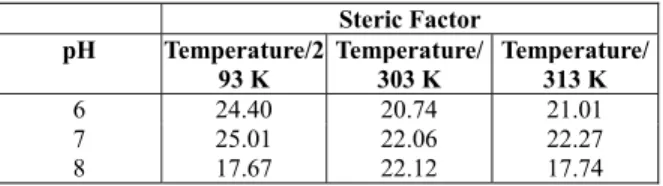
Brazilian Journal of Chemical Engineering As shown in Table 2, for the majority of the cases
studied, the steric factor value decreases with in-creasing temperature and, in some cases, it passes through a minimum at a temperature equal to 303 K. Indeed, as seen in Figure 2, the temperature increase leads to an increase of adsorption capacity of lac-toferrin on IDA-Cu+2-cryogel. When the temperature rise occurs in the adsorption process, there is a de-crease in the energy of protein-water interaction, which results in increasing interactions between pro-tein-copper ion. Thus, the increase of temperature is sufficient to break down the diffuse region of the electrical double layer, and thus the protein mole-cules interact more strongly with the resin, favoring the adsorptive phenomenon.
Table 2: Steric factor of the lactoferrin- IDA-Cu2+ cryogel system at different pHs and temperatures.
Steric Factor pH Temperature/2
93 K
Temperature/ 303 K
Temperature/ 313 K 6 24.40 20.74 21.01 7 25.01 22.06 22.27 8 17.67 22.12 17.74
Regarding the behavior of the steric factor values with respect to ionic strength and pH, it was ob-served that the steric factor decreased with increas-ing ionic strength, except for the conditions of pH 8, 293 K and 303 K. With regard to the pH, it is noted that, in some cases, the steric factor decreased with increasing pH, except at pH 7.0, where there was a peak in its value. Reasons for such behavior may be due to the fact that, in IMAC, the adsorption capacity and selectivity depend not only on the metal chelates immobilized on the chromatographic matrix, but also on the composition of the mobile phase. The protein retention in IMAC adsorbents occurs due to the con-tribution of various physico-chemical interactions, which may be enhanced or minimized depending on the composition of the mobile phase. When IMAC is operated at high salt concentration (0.5 to 1.0 mol.L-1 NaCl, for example), the predominant interaction is the coordinate bond between the immobilized metal ions and amino acid residues accessible on the sur-face proteins, while the electrostatic interactions occur with a lesser intensity. The electrostatic effects are more intense when employing a mobile phase with low ionic strength. These effects occur between charged proteins and the positive charges of the metal ions or negative charges remaining on the sur-face of the matrix (unreacted functional groups re-maining from the activation and coupling of the che-lator, or residual carboxylic groups of chelating
agents due to incomplete chelation of metal ions) (Winzerling et al., 1992; Guitiérrez et al., 2007).
In IMAC, regarding the pH, coordinate bonds are favored when ionizable groups of electron donors amino acid residues present in biomolecules are par-tially deprotonated, i.e., when the pH of the solution is above the pKa of the ionizable groups (Bresolin et al. 2009). Moreover, since the coordinate bonds with the immobilized metal ions may occur simultane-ously with electrostatic interactions, protein adsorp-tion on IMAC is pH dependent. However, the effects of each interaction on the protein adsorption are dif-ficult parameters to be determined.
On the one hand, high ionic strength leads to strong binding of salt ions to the IDA-Cu2+-cryogel resin, reducing the number of accessible binding sites for the protein (Wrzosek et al., 2009). On the other hand, there is a greater selectivity of coordinate binding, which is favored by high salt concentra-tions. The decreased resin adsorption capacity is a direct result of the binding of salt ions to metal lig-ands. It is shown in the SMA model as an apparent increase in σ.
Figure 2 shows a comparison between the simula-tions of the SMA model and equilibrium affinity data for the lactoferrin- IDA-Cu2+-cryogel complex at 400 mmol.L-1 NaCl, temperatures equal to 293 K, 303 K and 313 K, and pH 6.0, 7.0 and 8.0. It was found that the predicted adsorption capacities had higher values than the corresponding experimental ones, in most of the analyzed cases. At pHs near the lactoferrin isoe-lectric point, the accuracy of the model decreased further. It is known that the net charge and three-dimensional structure of proteins are influenced by the pH of the buffer solution. Because lactoferrin has nine histidine residues (responsible for protein re-tention on the IDA-Cu2+-cryogel complex) having pKa = 6.5, in conditions above this value the medium is deprotonated, favoring other types of binding, not only the affinity. Thus, under these conditions, the SMA model failed to predict the change in behavior.
ch ch A st cl n co p F ti b at (2 eq li io so b ra m ce th p du S o m en A A A hromatograp hromatograp A, cytochrom
tudy of Osbe luded that “t istic model f omfortable w arameters” (
Figure 3: Plo ions predicte ovine serum t different pH 293, 303 and
The SMA quilibrium a ithic column ons. The mo orption equ atch. The an ameters prov mechanism o
ess paramete hat, at high t oint of the p ue to intera MA model w f lactoferrin ment of this m
nce of factor
AAm Ac AGE Al APS Am
Steric
Brazilia phy when th phic data we me c and ly
erghaus et a the inverse m for column c way to estab
Osberghaus
ots of the ex ed by the S
under condi Hs (6.0, 7.0 d 313 K).
CONCL
A model was affinity of bo ns of cryoge
odel paramet uilibrium ex nalysis of th
vided valua of interaction
ers and prote temperature rotein, accur actions othe was able to p in IDA-Cu2+ model would
rs in the prot
NOMENC
crylamide lyl glycidyle mmonium pe
Mass Action Mo
an Journal of Che heoretical an ere compared ysozyme we
l. (2012). Th method base chromatograp
lish highly p
et al., 2012)
xperimental SMA model
tions of abou and 8.0) an
LUSION
s applied to ovine lactofe l with immo ters were es xperiments he dependenc able informa
n between m ein. The simu and pH near racy of the m er than coo predict adsor
+
-cryogel. Fu d take into ac
ein structure
CLATURE
ether ersulphate
odel for Lactoferri
emical Engineerin nd experimen d. Ribonucle ere used in he authors c ed on a mec phy is the m predictive SM
.
and concent for lactofer ut 400 mmol nd temperatu
the adsorpt errin on mo obilized cop stimated by
performed ce of these ation about metal ions, p ulations show
r the isoelec model decrea ordination. T rption isother
urther impro count the inf e.
in Adsorption in
ng Vol. 33, No. 0 ntal ease the on- cha-most MA tra-rrin .L-1 ures tion no-pper ad-in pa-the pro-wed tric sed The rms ove- flu-BS C C0 ΔG HE ID IM K LF Lt v L m M MB n σ q Qi Qm SM TE t0 tR V Ak Ba Bo Br
Cryogel with Imm
01, pp. 215 - 223
SA Bov
Colu Fina supe
0 Initi
liqu G Gib EPES N-2 etha DA Imin MAC Imm Chr Equ F Lac Den resin
v Den
adso Part Mas BAAm N,N Cha Ster Con pha Con ion
m Max
prot MA Ster EMED N,N Rete Rete Volu
kgol, S., Tur corporated, complexing metal chela Sci., 93, 26 arz, T., Loffle
G., Optima model param batch exper (2010). ornhorst, J. A
teins using Enzymol., 3 resolin, I. T. A., Cromato imobilizado
mobilized Coppe
, January - Marc vine serum al umn phase r al protein con ernatant (mg ial concentra uid phase (mg bs free energ 2-hydroxyeth anosulfenic a nodiacetic ac mobilized Me romatography uilibrium con toferrin nsity of ligan
n’s surface (m nsity of copp
orption of pr tition coeffic ss of the soli N-methyleneb
aracteristic nu ric factor ncentration o
se (mg.g-1) ncentration o
(mg.mL-1) ximum conce tein (mg.mL -ric Mass Act N,N’,N’-tetra ention time o ention time o ume of the li
REFERE
rkmen, D. a histidine-co g beads as ate affinity of 69 (2004). er, V., Arella al determinat meters for riments. J. C
A. and Falke polyhistidin 326, 245 (20
L., Miranda ografia de af os (IMAC) d
er Ions
ch, 2016 lbumin atio
ncentration i g.mL-1)
ation of prote g.mL-1) gy of adsorpt hylpiperazine acid cid etal Affinity y nstant(mmol nd immobiliz mmol.L-1) er accessible roteins (mmo cient
d phase (g) bisacrylamid
umber of bin
of protein in t
of protein bou
entration of a
-1
) ion
amethyl-ethy of protein (s) of the liquid iquid phase (
ENCES
and Denizli, ontaining, m specific sor f albumin. J.
ano-Garcia, H tion of steri
-lactoglobul hromatogr., A
e, J. J., Purifi ne affinity t
00). a, E. A. and finidade por de biomolécu
2
in the
ein in the
tion
e-N’-2--1 L )ni
zed on the
e for the ol.L-1)
de
nding sites
the solid
und to metal
adsorbed lenediamine ) phase (s) (mL) A., Cu(II)-i agnetic-meta rbents for th . Appl. Polym
H. and Wozn c mass actio lin using stat
A, 1217, 426
ication of pr tags. Metho
222 B. M. A. Carvalho, W. F. Silva Júnior, L. M. Carvalho, L. A. Minim and G. G. P. Carvalho
Brazilian Journal of Chemical Engineering fundamentais e aplicações. Quím. Nova, 32, 1288
(2009). (In Portuguese).
Brooks, C. A. and S. M. Cramer., Steric mass-action ion exchange: Displacement profiles and induced salt gradients. AIChE J., 38, 1969 (1992).
Brooks, C. A. and Cramer, S. M., Solute affinity in ion-exchange displacement chromatography. Chem. Eng. Sci., 51, 3847 (1996).
Carvalho, B. M. A., Carvalho, L. M., Silva Jr., W. F., Minim, L. A., Soares, A. M., Carvalho, G. G. P. and da Silva, S. L., Direct capture of lactoferrin from cheese whey on supermacroporous column of polyacrylamide cryogel with copper ions. Food Chemistry, 154, 308 (2014a).
Carvalho, B. M. A., Da Silva, L. H. M., Carvalho, L. M., Soares, A. M., Minim, L. A. and Da Silva, S. L., Microcalorimetric study of the adsorption of lactoferrin insupermacroporous continuous cryo-gel with immobilized Cu2+ ions. J. Chromatogr., A, 1312, 1 (2013).
Carvalho, B. M. A., Carvalho, L. M., Silva Jr., W. F., Minim, L. A. and Carvalho, G. G. P., Interaction of whey lactoferrin with copper immobilized in polyacrylamide cryogel. J. Bioproces. Biotech., 4, 7 (2014b).
Chen, W. -D., Hu, H. -H. and Wang, Y. -D., Analysis of steric mass-action model for protein adsorption equilibrium onto porous anion-exchange adsor-bent. Chemical Engineering Science, 61, 7068 (2006).
Chen, W., Wang, Y. and Su, Z., Suitability of steric mass-action model for ion-exchange equilibrium of micromolecule. Chin. J. Chem. Eng., 13, 18 (2005).
Cheung, R. C. F., Wong, J. H. and Ng, T. B., Immo-bilized metal ion affinity chromatography: A re-view on its applications. Appl. Microbiol. Bio-technol., 96, 1411 (2012).
Cimen, D. and Denizli, A., Immobilized metal affinity monolithic cryogels for cytochrome C purification. Colloids Surf., B, Biointerfaces, 93, 29 (2012). Drager, R. R. and Regnier, F. E., Application of the
stoichiometric displacement model of retention to anion-exchange chromatography of nucleic acid. J. Chromatogr., A, 359, 147 (1986).
Frerick, C., Kreis, P., Górak, A., Tappe, A. and Melz-ner, D., Simulation of a human serum albumin downstream process incorporating ion-exchange membrane adsorbers. Chem. Eng. and Process., 47, 1128 (2008).
Gadam, S. D., Jayaraman, G. and Cramer, S. M., A predictive model for salt effects on the dye-ligand affinity adsorption equilibrium of protein. J. Chro-matogr., A, 630, 37 (1993).
Gaberc-Porekar, V. and Menart, V., Potential for using histidine tags in purification of proteins at large scale. Chem. Eng. Technol., 28(11), 1306 (2005). González-Chávez, S. A., Arévalo-Gallegos, S. and
Rascón-Cruz, Q., Lactoferrin: Structure, function and applications. International Journal of Antimi-crobial Agents, 33, 301.e1 (2009).
Gupta, M. N., Jain, S. and Roy, I., Immobilized metal affinity chromatography without chelating ligands - Purification of soybean trypsin inhibitor on zinc alginate beads. Biotechnol. Prog., 18, 78 (2002).
Gutiérrez, R., Martín del Valle, E. M. and Galán, M. A., immobilized metal-ion affinity chromatog-raphy: Status and trends. Sep. Purif. Rev., 36, 71 (2007).
Hage, D. S., Anguizola, J. A., Bi, C., Li, R., Matsuda, R., Papastavros, E., Pfaunmiller, E., Vargas, J. and Zheng, X., Pharmaceutical and bio-medical applications of affinity chromatography: Recent trends and developments. Pharm. Biomed. Anal., 69, 93 (2012).
Huang, Y., Bi, J., Zhao, L., Ma, G. and Su, Z., Regu-lation of protein multipoint adsorption on ion-ex-change adsorbent and its application to the purifi-cation of macromolecules. Protein Expression and Purif., 74, 257 (2010).
Jiang, W. and Hearn, M. T. W., Protein interaction with immobilized metal ion affinity ligands under high ionic strength conditions. Anal. Biochem., 242, 45 (1996).
Kumar, A., V. Bansal, K. S., Nandakumar, I. Y., Galaev, P. K., Roychoudhury, R., Holmdahl, and Mattiasson, B., Integrated bioprocess for the pro-duction and isolation of urokinase from animal cell culture using supermacroporous cryogel ma-trices. Biotechnol. Bioeng., 93, 636 (2006). Osberghaus, A., Hepbildikler, S., Nath, S., Haindl,
M., Von Lieres, E. and Hubbuch, J., Optimizing a chromatographic three component separation: A comparison of mechanistic and empiric modeling approaches. J. Chromatogr., A, 1237, 86 (2012). Petzold, M., Coghlan, C. J., Hearn, M. T. W., Studies
with an immobilized metal affinity chroma-tography cassette system involving binuclear triazacyclononane-derived ligands: Automation of batch adsorption measurements with tagged re-combinant proteins. Journal of Chromatography A, 1351, 61 (2014).
Steric Mass Action Model for Lactoferrin Adsorption in Cryogel with Immobilized Copper Ions 223
Brazilian Journal of Chemical Engineering Vol. 33, No. 01, pp. 215 - 223, January - March, 2016 Rounds, M. A. and Regnier, F. E., Evaluation of a
retention model for high-performance ion-ex-change chromatography using two different dis-placing salts. J. Chromatogr., A, 283, 37 (1984). Shukla, A. A., Bae, S. S., Moore, J. A., Barnthouse,
K. A. and Cramer, S. M., Synthesis and charac-terization of low molecular mass displacers for cation exchange chromatography. Ind. Eng. Chem. Res., 37, 4090 (1998).
Ueda, E. K. M., Gout, P. W. and Morganti, L., Cur-rent and prospective applications of metal ion– protein binding. Journal of Chromatography A, 988, 1 (2003).
Velayudhan, A., Studies in nonlinear chromatog-raphy. PhD Thesis, Yale University (1990). Wanga, L., Shenb, S., Heb, X., Yunb, J., Yaob, K.
and Yao, S., Adsorption and elution behaviors of bovine serum albumin in metal-chelated affinity cryogel beds. Biochemical Engineering Journal, 42, 237 (2008).
Wankat, P. C., Rate Controlled Separations. Elsevier, New York (1990).
Winzerling, J. J., Berna, P. and Porath, J., Methods: A companion to Methods in Enzymology. Aca-demic Press, New York (1992).
Wrzosek, K., Gramblicka, M. and Polakovic, M., Influence of ligand density on antibody binding capacity of cation-exchange adsorbents. J. Chro-matogr., A, 1216, 5039 (2009).