Abstract
In this paper the nonlinear forced vibration of an orthotropic circu-lar plate resting on Winkler, Pasternak and nonlinear Winkler foun-dation is investigated. Plates with edges elastically restrained against rotation and inplane displacement are analyzed and the Von-Karman geometric nonlinear equations are employed. In this study it is assumed that the plate can be subjected to any periodic distributed lateral loading with respect to time. The Galerkin method is used to obtain Duffing's equation for the central deflec-tion. The Homotopy Perturbation Method was used to study the effects of various parameters including orthotropic parameter, elas-tic foundation parameters and initial deflection on frequency ratio. Highly accurate results were obtained by the application of the aforementioned method.
Keywords
Nonlinear forced Vibration; Circular Plate; Orthotropic; HPM.
Assessment of Homotopy Perturbation Method for Study
the Forced Nonlinear Vibration of Orthotropic Circular Plate
on Elastic Foundation
1 INTRODUCTION
The increase in the use of thin composite structures, especially in aerospace engineering, leads to the rise of difficulties in nonlinear vibrations in various modern engineering challenges, which may results in the size of the vibration amplitude of these structures. This situation attains greater importance when the plate is subjected to the vibration amplitude of the same order of the plate thickness. There are a large number of publications concerning plate theories and plate dynamics. An extensive survey of the early investigations on the free vibration of the circular plates is given by Leissa (1969). Huang and Sandman (1979) used Kantorovich aver-aging method to investigate the nonlinear vibrations of a circular plate with a clamped and immovable boundary. The forced response of the plate under several different distributions of sinusoidal input was also investigated.
Ali A. Yazdi a
aDepartemnt of Mechanical Engineering,
Quchan University of Advanced Tech-nology, P.O. Box 94717-84686, Quchan, Iran
http://dx.doi.org/10.1590/1679-78252436
Latin American Journal of Solids and Structures 13 (2016) 243-256
Nath and Alwar (1979) used the Chebyshev series to study the nonlinear dynamic response of orthotropic circular plates for both clamped and simply supported edge conditions. They considered the influence of orthotropic parameter under three types of dynamic loadings on the response of circular plates. Yamaki et al. (1981) investigated the axisymmetric nonlinear vibra-tions of a clamped isotropic circular plate under uniformly distributed lateral loading. In this study the effect of both initial deflection and initial edge displacement were considered. Addi-tionally, Nath (1982) studied the effect of foundation parameters on the large amplitude re-sponse of orthotropic circular plates.
Dumir presented an approximation solution for the large deflection axisymmetric responses of isotropic (1986) and cylindrically orthotropic (1986) thin circular plates resting on nonlinear Winkler foundations. According to the results of these studies the buckling load and the linear frequency increased with the foundation parameters and the rotational stiffness of the edge support. Hadian and Nayfeh (1990) used the method of multiple scales to obtain the symmetric response of a circular plate to a harmonic external excitation. The results showed that internal resonance is responsible for the coupling of the modes involved and the excited mode is not necessarily the dominant one. Wang (2000) used the power series method in solving the non-linear differential equations of the circular plates to obtain the exact axisymmetric post-buck-ling equilibrium.
Eihab et al. (2003) utilized the Von-Karman thin plate theory to account for large static deformations in axisymmetric annular plates. The natural frequencies and mode shapes were obtained numerically for a series of uniform loads. Shirong and Zhou (2003) investigated the axisymmetric nonlinear vibration and the thermal post-buckling of a heated polar orthotropic annular plate with both its inner and outer edges immovably hinged. Alipour et al. (2010) used the differential transform method to study free vibration of FG circular plates resting on two parameter elastic foundations. This study focused on the non-axisymmetric vibration and the modal stress analysis.
There exists a wide arsenal of analytic, semi-analytic and numerical tools for the nonlinear analysis of continuous systems. To investigate these problems, different methods such as the numerical methods (1995) (1998) and perturbation methods (1973) (1979) were employed alt-hough they have their own limitations as well. The perturbation methods on the other hand are also limited as that they can only be applied to the weakened nonlinear differential equations.
Latin American Journal of Solids and Structures 13 (2016) 243-256
equation for the central deflection. The results of this investigation demonstrated the applica-bility of HPM for analysis of circular plate for correct quantitative predictions and for qualita-tive description of operations.
2 GOVERNING EQUATIONS
The nonlinear Winkler foundation is adopted to model the elastic foundation. For the axisym-metric case, a distributed force on the circular plate is introduced as follow Dumir (1986):
(1) where w is the transverse deflection, is the Winkler parameter, is the Winkler nonlinear parameter, and g is the shear parameter of the Pasternak Foundation. The governing equation for large axisymmetric deflection of an orthotropic circular plate in terms of w and stress func-tion is as follow Dumir (1986):
∗ ∗ ∗ ∗
∗ ∗
∗
∗ ∗ ∗
(2)
∗ ∗
∗ ∗ (3)
where , can be any periodic distributed lateral loading function of time and
(4)
In this study it is assumed that q(r) is constant. In order to reduce the governing equation to dimensionless form the following dimensionless parameters are introduced:
∗
∗ (5-a)
(5-b)
Substituting Eq. (5) into Eqs. (2) and (3) yield Dumir (1986):
(6)
(7)
Latin American Journal of Solids and Structures 13 (2016) 243-256
3 METHOD OF SOLUTION
The plate deflection , is expressed as follow:
, /
, ,… / (8)
where is the maximum deflection at the center of the plate and constants C2 and C4 are
defined by the boundary conditions. The general solution of Eq. (7) is obtained by the solution of the substitution of Eq. (8) into Eq. (7):
, (9)
The value of is accordingly found to be finite at the origin, . Additionally, the constant of integration is to be determined from inplane boundary conditions. The ki coefficients
are defined as:
(10-a)
(10-b)
(10-c)
The Substitution of the expressions for w and given by Eqs. (8) and (9) respectively into Eq. (6) and the application of the Galerkin procedure in the nonlinear time differential equation obtained in the form:
(11)
(12)
(13)
Latin American Journal of Solids and Structures 13 (2016) 243-256
As it can be seen coefficients L1, L2 and L3 are function of , , , and . These constants
can be determined from boundary conditions. For a plate with an elastically restrained outer edge, with rotational and inplane stiffness ∗ and ∗, subjected to applied inplane radial force resultant N* at the outer edge the boundary conditions are:
: ∗ ∗ ∗ ∗ ∗ (15)
where ∗ is the radial displacement at midplane. Introduce dimensionless parameters Kb, Ki
and N:
∗
∗ ∗ (16)
The boundary conditions at take the following dimensionless form:
(17-a)
(17-b)
(17-c)
Constants and can be found from the two first Eqs.(17-a) and (17-b) and is ob-tained from Eq. (17-c):
(18)
(19)
(20)
(21)
(22)
Latin American Journal of Solids and Structures 13 (2016) 243-256
4 HE’S HOMOTOPY PERTURBATION METHOD
The homotopy perturbation method (HPM) is a combination of the classical perturbation technique and homotopy concept. By the homotopy method, He constructed a homotopy
r p
Rw , : 0,1 which satisfies He (2003):
, (23)
where p is an embedding parameter, L and N are linear and nonlinear parts of Eq. (11) and u0
is initial approximation of Eq. (11) which satisfies the initial conditions. Assuming the solution of Eq. (11) can be expressed as a power series of p:
⋯ (24)
In Eq. (24) when → the approximate solution of Eq. (11) is obtained. In order to inves-tigate primary resonance of the system and implementation of the HPM the following homotopy is constructed:
/ Ω / (25)
where is the second derivative of with respect to , and Ω is excited frequency. The solution of Eq. (25) and the square of natural frequency can be expressed by the parameter p
as follow:
⋯ (26)
Ω ⋯ (27)
Introducing new variable ∗ Ω then Eq. (25) can be written as:
Ω / ∗ / (28)
Substituting Eqs. (26) and (27) into Eq. (28) and equating the terms with identical power of p, one can obtain:
, (29)
/ τ∗ / , (30)
If ∗ is a periodic function of ∗ then it can be represented by infinite series of harmonic functions known as a Fourier series. Replacing ∗ by its corresponding Fourier series one can obtain:
cos ∗ sin ∗
Latin American Journal of Solids and Structures 13 (2016) 243-256
where T is the period of the function. If Ω then we have:
∗ /
/ (32-a)
∗ /
/ cosΩ
∗ ∗ (32-b)
∗ /
/ sinΩ
∗ ∗ (32-c)
To satisfy the initial conditions, the initial guess of u0 is chosen as follow:
∗ ∗ cos ∗ (33)
where is the phase angle. Substituting Eq. (33) into (31) results in:
sin sin
cos sin cos
cos
(34)
where . In order to identify the nonlinear frequency the secular term which may occur in the next iteration should be eliminated. By setting the coefficients of cos and
sin to zero and ignoring the parameter θ the following equation is resulted:
Wmax/h
Present study Ramachandran (1977) Haterbouch & Benamar (2003) Yamaki (1961) Huang Al-Khattat (1977) 0.2 0.4 0.5 0.6 0.8 1 1.5 2 1.007 1.0238 1.0414 1.0597 1.1049 1.1564 1.3262 1.5241 1.0066 1.263 1.0408 1.0583 1.1015 1.1547 1.3229 1.527 1.0072 1.0284 1.0439 1.0623 1.1073 1.1615 1.3255 1.5147 1.007 1.0278 1.0431 1.0614 1.1065 1.1617 1.3343 1.5423 1.0075 1.0296 1.0459 1.0654 1.1135 1.1724 1.3568 1.579
Table 1: Frequency ratio for an isotropic circular plate for different values of
non-dimensional vibration amplitudes.
(35)
Latin American Journal of Solids and Structures 13 (2016) 243-256
Ω (36)
Substituting Eq. (36) into (35) one can obtain:
Ω (37)
5 RESULTS
In table 1 to verify the accuracy of the presented method, a comparison has been made between the results of previous works exist in the literature and the data given by Eq. (37) for non-resonance conditions (X=0). As it can be seen, discrepancy between numerical results obtained by HPM and previous works at large vibration amplitudes is about 3.6% at Wmax/h=2.
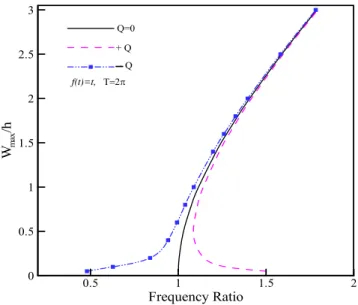
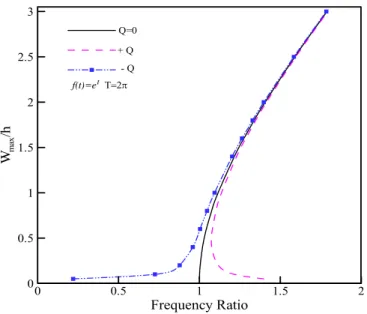
In figures 1 and 2 the primary resonance response of an isotropic thin circular plate for two different cases; f(t)=et and f(t)=t with T=2π are shown, respectively. It should be noted that the predicted results are reliable since the vibration amplitude is smaller than the thickness of plate. The influence of orthotropic parameter on the frequency ratio of the circular plate is indi-cated in Fig. 3. As it can be seen for β<10 the results show hardening type nonlinearity while for β≥10 turning to softening for vibration amplitude. Fig. 4 demonstrates the effect of Winkler linear foundation ( ) and Winkler nonlinear foundation ( ) parameters for constant Pas-ternak foundation parameter (G=50) on primary resonance response for f(t)=et.
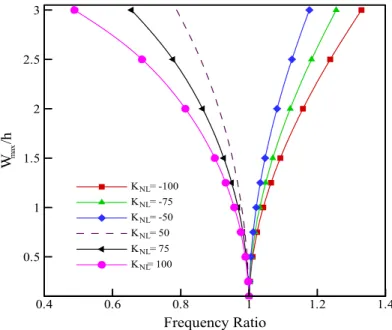
It can be concluded that the Winkler nonlinear foundation parameter ( ) may have a positive effect on the response behavior. The similar behavior for different values of on frequency ratio for free vibration can be seen in Fig. 5. According to this figure, the positive values of can have a positive effect on the hardening nonlinearity degree in comparison with negative values of .
Figure 1: Effects of large vibration amplitudes on frequency ratio for f(t)=t and T=2π.
Frequency Ratio
W/
h
0.5 1 1.5 2
0 0.5 1 1.5 2 2.5 3
- Q Q=0
+ Q
ma
x
Latin American Journal of Solids and Structures 13 (2016) 243-256
Figure 2: Effects of large vibration amplitudes on frequency ratio for f(t)=et and T=2π.
Additionally, it is clear that for while vibration amplitude (Wmax/h) remains constant an
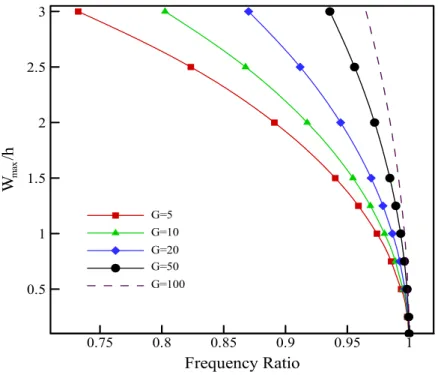
increase in the value of results in the reduction of the frequency ratio. The variation of frequency ratio for various values of Pasternak foundation parameter (G) is depicted by Fig. 6. It demonstrates that all response curves exhibit initial softening trends and revert to hardening amplitudes at large amplitudes although the degree of hardening vary.It is interesting to note that for higher amplitude vibration ratios, increasing the Pasternak foundation parameter yields the discrepancy reduction between linear and nonlinear frequency. In other words, the Paster-nak foundation parameter has the ability to limit the effect of large amplitude vibration on nonlinear response.
Frequency Ratio
W/
h
0.5 0.6 0.7 0.8 0.9 1 1.1 1.2 0.5
1 1.5 2 2.5 3
ma
x
1
3
5
20
10
Figure 3: The influence of orthotropic parameter on the frequency ratio of the circular plate.
Frequency Ratio
W/
h
0 0.5 1 1.5 2
0 0.5 1 1.5 2 2.5 3
- Q Q=0
+ Q
ma
x
Latin American Journal of Solids and Structures 13 (2016) 243-256
Figure 4: The effect of Winkler foundation parameters on the frequency ratio
of the circular plate for f(t)=et and T=2π.
Figure 5: The effect of Winkler nonlinear foundation parameter on the frequency ratio.
Fig. 7 illustrates the effect of outer edge radial force resultant on frequency ratio. According to this figure the results are divided in two parts. The positive value of Winkler nonlinear foundation parameter increases the value of radial force resultant resulting in the rise of fre-quency ratio. While the negative values of KNL resulting in the increase of N leads to the
Frequency Ratio
W/
h
0 0.2 0.4 0.6 0.8 1 1.2 1.4 1.6
0 0.5 1 1.5 2 2.5 3
K =25, K =-50, Q=0 K =0, K =50, Q=0
K =25, K =50, -Q
K =-25, K =50, -Q K =-25, K =-50, +Q
ma
x
L NL
L NL
L NL
L NL
L NL
Frequency Ratio
W/
h
0.4 0.6 0.8 1 1.2 1.4
0.5 1 1.5 2 2.5 3
K = 100NL
KNL= -100
KNL= -75
KNL= -50
KNL= 50
KNL= 75
ma
Latin American Journal of Solids and Structures 13 (2016) 243-256
reduction of frequency ratio. This behavior can be attributed to the fact that the variation of
N can affect the stiffness of orthotropic circular plate.
In Fig. 8 the influence of Pasternak foundation parameter and radial force resultant on frequency ratio are considered. As it is shown, a decrease in the value of Pasternak foundation parameter results in the rise of frequency ratio. In the other word the increase in the value of the Pasternak foundation parameter results the discrepancy reduction between linear and non-linear frequency. This fact is also emphasized in Fig. 6. Additionally similar conclusions can be reached from the decrease in the value of the resultant radial force.
As was indicated previously, the influences of Winkler nonlinear foundation and Pasternak foundation parameters in comparison with the other system properties on frequency ratio are more effective and considerable which is illustrated in Fig. 9. According to the results a com-bination of negative values of KNL, with an increase in the value of the Pasternak foundation
parameter leads to a reduction in the frequency ratio. Contrariwise, for KNL>0, combined with
an increase in the value of G can result in the achievement of higher values of the frequency ration. According to this figure, KNL=0 is a turning point. Also, it should be noted that
reduction of KNL yields the growth of frequency ratio. Based on these results, the frequency
ratio is deeply depending on KNL and G.
Figure 6: The effect of Pasternak foundation parameter on the frequency ratio.
Frequency Ratio
W/
h
0.75 0.8 0.85 0.9 0.95 1
0.5 1 1.5 2 2.5 3
G=100 G=5 G=10 G=20 G=50
ma
Latin American Journal of Solids and Structures 13 (2016) 243-256
Figure 7: The effect of outer force radial resultant force on the frequency ratio.
Figure 8: The influence of Pasternak foundation parameter and radial force resultant on frequency ratio.
N
Fr
equenc
y
R
at
io
-200 -150 -100 -50 0 50 100 150 200
0.9 0.95 1 1.05 1.1 1.15 1.2
K =25, KNL=-100 K =0, KNL=50 K =25, KNL=50 K =-25, KNL=50 K =-25, KNL=-50 K =25, KNL=-50
L L
L
L
L
L
N
Fr
equenc
y
R
at
io
-200 -150 -100 -50 0 50 100 150 200
1 1.2 1.4 1.6 1.8 2 2.2 2.4
Latin American Journal of Solids and Structures 13 (2016) 243-256
Figure 9: The influences of Winkler nonlinear foundation and Pasternak foundation parameters
on frequency ratio of circular plate.
5 CONCLUSION
In this paper the nonlinear forced vibration of orthotropic circular plate resting on elastic foun-dation is investigated. The Galerkin method and homotopy perturbation method are both em-ployed to study the nonlinear forced vibration of circular plate. The effect of different parame-ters such as elastic foundation parameparame-ters and orthotropic parameter are considered. According to the results, the effects of Winkler nonlinear foundation and Pasternak foundation parameters on frequency ratios are more considerable.
References
Leissa A.W. (1969). Vibration of Plates, NASA Sp-160, office of Technology Utilization, NASA, Washington DC.
Huang C. L. and Sandman B. E. (1971). Large amplitude vibrations of a rigidly clamped circular plate, Int. J. Non-Linear Mechanics, 6(4):451-468.
[3] Nath Y. and Alwar R. S. (1979). Nonlinear dynamic analysis of orthotropic circular plates, Int. J. Solids Structures, 16:433-443.
Yamaki N. Otomo K. and Chiba M. (1981). Non-linear vibrations of a clamped circular plate with initial deflection and initial edge displacement, Part I: Theory, J. Sound and Vibration, 79(1):23-42.
Nath Y. (1982). Large amplitude response of circular plates on elastic foundations, Int. J. Non-Linear Mechan-ics, 17(4):285-296.
K
Fr
equenc
y
R
at
io
-100 -75 -50 -25 0 25 50 75 100
0.7 0.8 0.9 1 1.1 1.2 1.3
NL
Latin American Journal of Solids and Structures 13 (2016) 243-256
Dumir P.C. (1986). Non-linear vibration and postbuckling of isotropic thin circular plates on elastic foundations, 107(2), 253-263.
Dumir P.C. (1986). Non-linear vibration and postbuckling of orthotropic thin circular plates on elastic founda-tions, Applied Acoustics, 19:401-419.
Hadian J. and Nayfeh A.H. (1990) Modal interaction in circular plates, J. Sound and Vibration, 142(2):279-292.
Wang A. (2000). Axisymmetric postbuckling and secondary bifurcation buckling of circular plates, Int. J. Non-Linear Mechanics, 35:279-292.
Eihab M. Rahman A. Faris W.F. and Nayfeh A.H. (2003) Axisymmetric natural frequencies of statically loaded annular plates, Shock and Vibration 2003; 10:301-312.
Shirong L. and Zhou Y. (2003) Nonlinear vibration of heated orthotropic annular plates with immovably hinged edges, J. Thermal Stresses, 26:691-700.
Alipour M.M., Shariyat M. and Shaban M. (2010) A semi-analytical solution for free vibration and modal stress analyses of circular plates resting on two-parameter elastic foundations, J. Solid Mechanics2(1):63-78.
Ganapathi, M. and Varadan, T. K. (1995) Nonlinear free flexural vibrations of laminated circular cylindrical shells, Composite Structures 30:33-49.
Lakis, A. A., Selmane, A., Toledano, A. (1998) Nonlinear free vibration analysis of laminated orthotropic cylindrical shells, Int. J. Mech. Sci. 40:27-49.
Nayfeh A.H. (1973) Perturbation methods, Wiley, New York.
Nayfeh A.H. and Mook D.T. (1979) Nonlinear oscillations, Wiley, New York.
Barari, A., Abdoul, R., Ghotbi, F., Farrokhzad, F., and Ganji, D.D. (2008) Variational iteration method and homotopy-perturbation method for solving different types of wave equations, J. Applied Sciences 8(1):120-126. Liao, S. J. (2003). Beyond perturbation: Introduction to homotopy analysis method, Chapman & Hall/CRC Press, Boca Raton.
Liao, S. J. (1995) An approximate solution not depending on small parameters: a special example, International J. Nonlinear Mechanics 30:371-380.
He J. H. (1999) Homotopy perturbation technique, Computer Methods in Applied Mechanics and Engineering 178:257-262.
He J. H. (2003) Homotopy perturbation method: a new nonlinear analytical technique, Applied Mathematics and Computations 133:73-79.
Huang, C.L.D, and Al-Khattat, I.M. (1977) Finite amplitude vibrations of a circular plate, International Journal of Nonlinear Mechanics,12: 297-306.
Haterbouch, M., and Benamar, R. (2003) The effects of large vibration amplitudes on the axisymmetric mode shapes and natural frequencies of clamped thin isotropic circular plates, part I: iterative and explicit analytical solution for non-linear transversevibrations, Journal of Sound and Vibration, 265: 123-154.
Yamaki, N. (1961) Influence of large amplitudes on flexural vibrations of elastic plates, Zeitschrift fur An-gewandte Mathematik und Mechanik, 41: 501-510.