Article
0103 - 5053 $6.00+0.00*e-mail: [email protected]
Micelle-mediated Extraction and Determination of Tin in Soft Drink and Water Samples
Tayyebeh Madrakian* and Fariba Ghazizadeh
Faculty of Chemistry, Bu- Ali Sina University, Hamadan, Iran
Desenvolveu-se a pré-concentração em fase micelar de traços de estanho na determinação de Sn(IV) por espectrofotometria baseada na extração no ponto de nuvem (CPE) do complexo de Sn(IV) com violeta de pirocatecol em um meio surfactante. Violeta de pirocatecol (PCV) foi usado como agente quelante e brometo de cetiltrimetilamônio (CTAB) como agente surfactante catiônico. Foram estudadas as condições da reação e otimização da extração do elemento, ou seja, a concentração do surfactante, concentração do reagente, inluência do pH e tempo de reação/extração. As iguras de mérito do método (limite de detecção, linearidade e fator de
pré-concentração) foram estabelecidas. A linearidade se encontra na faixa de 0,30-175,00 ng mL−1
(2,0 × 10⁻⁹ a 1,5 × 10⁻⁶ mol L-1) de Sn(IV). O limite de detecção do método (LOD) foi de
0,16 ng mL−1 (1,3 × 10⁻⁹ mol L−1) de Sn(IV). O desvio padrão relativo (R.S.D.) e o erro relativo
para 5 replicatas foi de 0,71% e 2,9% para a concentração de 30,00 ng mL−1 Sn(IV) e de 1,6% e
3,4% para a concentração de 50,00 ng mL−1 de Sn(IV) respectivamente. O efeito de interferência
de alguns cátions e ânions também foi avaliado e o método foi aplicado na determinação de estanho em amostras de sucos em conserva e amostras de água com resultados satisfatórios.
A micelle-mediated phase preconcentration of trace quantities of Sn(IV) as a prior step to its determination by spectrophotometry has been developed, based on cloud point extraction (CPE) of the complex of Sn(IV) with pyrocatechol violet complex in surfactant media. Pyrocatechol violet (PCV) and cetyltrimethylammonium bromide (CTAB) were used as chelating agent and cationic surfactant, respectively. The optimal extraction and reaction conditions (e.g. surfactant concentration, reagent concentration and the effects of pH and time) were studied and the analytical characteristics of the method (e.g., limit of detection, linear range and preconcentration factor) were obtained. Linearity was obeyed in the range of 0.30-175.00 ng mL−1 (2.0 × 10⁻⁹ to 1.5 × 10⁻⁶ mol L−1)
of Sn(IV). The detection limit (LOD) of the method was 0.16 ng mL−1 (1.3 × 10⁻⁹ mol L−1) of
Sn(IV). The relative standard deviation (R.S.D.) and relative error for ive replicate measurements
of 30.00 ng mL−1 Sn(IV) were 0.71% and 2.9%, and for 50.00 ng mL−1 of Sn(IV) were 1.6%
and 3.4%, respectively. The interference effect of some anions and cations was also tested. The method was applied to the determination of tin in soft drinks (canned juices) and water samples, with satisfactory results.
Keywords: tin, pyrocatechol violet, specrtophotometry, cloud point extraction
food industry and for the production of beverage cans. The use of tinplate for food and beverage packaging may result in some tin dissolving into the food content.4 Differential
toxicities of the different forms of an element have required an increasing development and use of analytical determination of the chemical species. The behavior of inorganic tin as a moderately corrosion-resistant metal is of considerable interest due to its important applications in food and electronic industries.4Therefore, the analysis
and monitoring of inorganic tin species in environmental samples is extremely important. For the determination of inorganic tin, the separation methods reported in the literature are usually based on solvent extraction,5 liquid
Introduction
Tin is a toxic metal which could gather in a human body and animal tissue.1There are mainly two chemical species
of inorganic tin (Sn(II) and Sn(IV)) in environmental samples. Sn(II) seems to be more toxic than Sn(IV).2High
concentrations of tin brings serious interference to the metabolism of zinc.3 Tin is extensively used as a coating
chromatography,6 gas chromatography7 and solid phase
extraction.8
Cloud point extraction (CPE) has become one of the most preferred preconcentration steps for enhancing the sensitivity in inorganic analysis and it has been applied to the separation of environmental and biological samples with a complicated matrix.9-13 CPE is an outstanding alternative
to conventional solvent extraction because it produces high extraction eficiencies and preconcentration factors, and uses inexpensive, non-toxic reagents. Several methods have also been reported for the FAAS and GFAAS determination of Sn after cloud point extraction.14-16 This paper proposes
a method for preconcentration and determination of tin by spectrophotometry based on cloud point extraction (CPE) of the complex of Sn(IV) with pyrocatechol violet complex in surfactant media.
Experimental
Apparatus
A Perkin-Elmer Lambda 45 UV/Vis spectrometer was used for recording absorbance spectra. Absorption measurements at ixed wavelength were performed using a Shimadzu UV-mini-1240 V spectrophotometer with 1 cm quartz cell (0.5 mL). A Metrohm pHmeter (model 713) with a combined glass electrode was used for pH measurements. A centrifuge with 10 mL calibrated centrifuge tubes (Superior, Germany) were used to speed up the phase separation process.
Reagents
The surfactant, cethyltrimethylammounium bromide (CTAB), (Sigma Company) was used without further puriication. Stock solution of Sn(IV) at a concentration of 1000 µg mL−1 was prepared by dissolving appropriate
amount of SnCl4.5H2O salt (Fluka) in triply distilled water. Working standard solutions were obtained by appropriate dilution of the stock solution. A solution of 1.30 × 10⁻³ mol L−1 of pyrocathechol violet (PCV), (Merck)
was prepared by dissolving appropriate amounts of this reagent in triply distilled water. The solution pH of 3.0 ± 0.1 was adjusted with glycine/hydrochloric acid buffer. N,N-dimethylformamide (DMF) solvent and potassium iodide salt were purchased from Merck.
Procedure
An aliquot of a Sn(IV) standard solution was transferred to a 10 mL centrifuge tube, 0.6 mL of the
1.3 × 10⁻³ mol L−1 PCV solution and 2.0 mL of pH 3.0
buffer solution were added. This was followed by the addition of 0.4 mL of 2.74 × 10⁻³ mol L−1 surfactant
CTAB solution and 2.0 mL of 0.4 mol L−1 of KI solution.
The solution was made up to the mark with triply distilled water and allowed to stand for 10 min at room temperature. Clouding of the solution took place without heating.Separation of the aqueous and surfactant- rich phase was accomplished by centrifugation for 15 min at 3,800 rpm. Then, the aqueous phase could be separated by inverting the tube. The surfactant rich phase of this procedure was dissolved and diluted to 0.5 mL with DMF and transferred into a 0.5 mL quartz cell. The absorbance of the solution was measured at 576 nm. The blank solution was submitted to the same procedure and its absorbance was measured at 576 nm.
Determination of tin in canned juice samples
A 10 mL sample (canned pineapple) was transferred to a 100 mL conical lask, and 2.5 mL of concentrated nitric acid was added. The sample was then carefully heated and evaporated to near dryness. After cooling, the pH of the digested sample was adjusted to 4.0 by adding sodium hydroxide solution. Then the solution was transferred and diluted to 10 mL using water.4 The tin content of canned
juices was determined with proposed method.
Results and Discussion
Pyrocatechol violet (pyrocatechol sulfonaphthalein or 3,3’,4’-trihydrooxyfuchsone-2’-sulfonic acid, PCV) has been applied as a sensitive reagent for colorimetric determination of tin. Pyrocatechol violet forms at least two complexes with Sn(IV).17 The absorption spectra of PCV
in the presence of two different amounts of Sn(IV) show that at low ratios of Sn(IV):PCV the predominant form of the complex is a 1:2 Sn(IV):L complex, with a λmax at 550 nm, while at high ratios of Sn(IV):PCV both the 1:1 and 2:1 Sn(IV):L complexes are present in the solution.18
The addition of surfactant improves the selectivity and sensitivity of the metal determinations due to the batho- and hyperchromic effects. The reaction of Sn(IV) with pyrocatechol violet in surfactant media has been studied.19
Pyrocatechol violet forms a red-colored complex with quadrivalent tin at pH 2.5. Apparently bivalent tin does not form a colored complex with pyrocatechol violet under the condition used for development of Sn(IV) complex, but is readily oxidized to the higher oxidation state and is included in the measurement of Sn(IV).20 Complex of Sn(IV) with
maximum absorbance at 660 nm. Addition of the iodide ion caused turbidity of the solution. Therefore the ternary complex of Sn(IV)-PCV-CTAB can be extracted by CPE method. The absorption spectrum of the ternary complex in surfactant-rich phase shows a maximum absorbance at 576 nm (Figure 1). After separation of surfactant-rich phase, the absorbance was measured at 576 nm against a reagent blank as the reference.
Optimization of the system
To take full advantage of the procedure, the reagent concentrations and reaction conditions must be optimized. Various experimental parameters were studied in order to obtain an optimized system. These parameters were optimized by setting all parameters to be constant and optimizing one each time.
The effect of pH on the extraction and determination of Sn(IV) was investigated in the range 1.0-7.5. The pH was adjusted using HCl and NaOH. The absorbance of the Sn(IV)-PCV-CTAB system at 576 nm in surfactant-rich phase was studied against the reagent blank. Maximum absorbance was obtained at pH 2.5-3.5. In more acidic or more alkaline solutions, the absorbance decreased because of incomplete complex formation and/or incomplete extraction of the complex. Therefore pH 3.0 was selected as optimum pH. Different buffer solutions of pH 3.0, including acetate, phosphate and glycine/HCl were tested, and glycine/HCl buffer solution was found as the best.
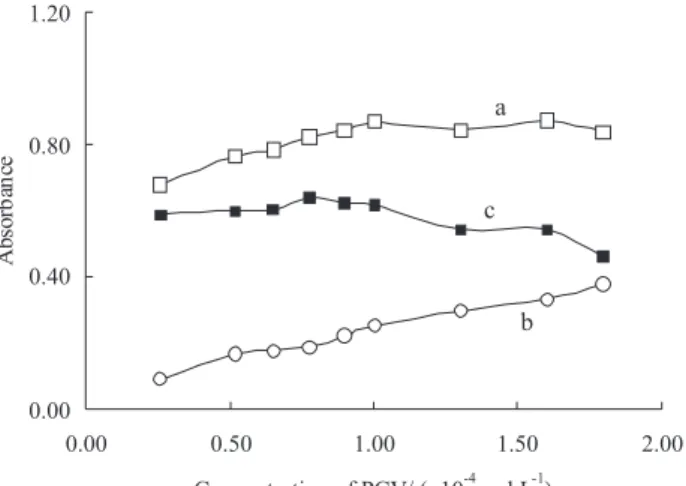
Effect of PCV concentration on the extraction and determination of Sn(IV) was investigated in the range 1.3 × 10⁻⁵ to 1.8 × 10⁻⁴ mol L−1. The results are shown
in Figure 2. The sensitivity of the method increased by increasing PCV concentration up to 7.8 × 10⁻⁵ mol L−1
and decreased at higher concentrations. At concentrations higher than 7.8 × 10⁻⁵ mol L−1 the concentration of complex
did not change significantly but the concentration of uncomplexed PCV increased significantly. Therefore, probably the decrease of absorbance at concentrations higher than 7.8 × 10⁻⁵ mol L−1 is due to the fact that the
free PCV competes with the complexes in extraction to surfactant rich phase. A concentration of 7.8 × 10⁻⁵ mol L−1
of PCV was selected as the optimum.
Effect of CTAB concentration on the extraction and determination of Sn(IV) was investigated in the range 2.7 × 10⁻⁵
to 2.7 × 10⁻⁴ mol L−1. The results are shown in Figure 3. The
absorbance increased by increase in CTAB concentration up to 1.1 × 10⁻⁴ mol L−1. The blank signal also increased slowly
by increasing CTAB concentration. But the difference between the sample and blank signals (at 576 nm) increased by increasing CTAB concentration up to 1.1 × 10⁻⁴ mol L−1 and decreased slowly at higher concentrations.
Therefore, 1.1 × 10⁻⁴ mol L−1 of CTAB was chosen as
the optimum.
Figure 3. Effect of CTAB concentration on the extraction and
determination of tin (IV); sample (a), blank (b) and their difference (c). Conditions: tin (IV), 0.1 µg mL−1; [KI] = 0.02 mol L–1;
[PCV] = 7.8 × 10⁻⁵ mol L–1; pH 3.0.
Figure 1. Absorption spectra for PCV in the presence of CTAB (a), its
complex with Sn (IV) in aqueous media (b) and its complex after extraction in surfactant rich phase (c). Conditions in surfactant rich phase: Sn(IV), 0.1 µg mL–1; [PCV] = 7.7 × 10⁻⁵ mol L–1; [CTAB] = 1.1 × 10⁻⁴ mol L–1;
[KI] = 8.0 × 10⁻² mol L–1; pH 3.0.
Figure 2. Effect of PCV concentration on the extraction and determination
of Sn(IV); sample (a), blank (b), and their difference (c). Conditions: Sn(IV), 0.1 µg mL−1; [KI] = 0.02 mol L–1; [CTAB] = 4.9 × 10⁻⁴ mol L–1;
Addition of proper inorganic salts can cause cationic surfactant solutions to separate into immiscible surfactant-rich and surfactant-poor phases and causes clouding of the solution at room temperature. Several inorganic salts including NaCl, NaF, KNO3, KBr and KI, were tested and KI was found as the best.Therefore, iodide was added to induce micellar growth and extraction of complex. The effect of iodide concentration was studied in the range 0.01-0.20 mol L−1. The results show that addition of
0.08 mol L−1 iodide was suitable for maximum extraction
of the complex. A concentration of 0.08 mol L−1 iodide was
selected for further experiments.
Effect of time on the reaction and also on the CPE procedure was investigated. The results showed that complexation reaction was completed in 10 min. Also a 15 min centrifugation at 3,800 rpm was found to be adequate for successful phase separation.
In order to select the proper dilution solvent for the precipitated surfactant rich phase, different solvents (DMF, DMSO, ethanol and acetonitrile) were tried so as to select the one producing the best sensitivity. DMF gave the best results due to its high sensitivity and solubility. Therefore, DMF was chosen to have an appropriate amount of sample for transferring and measuring the sample absorbance. Finally, surfactant rich phase was dissolved and diluted to 0.5 mL with the DMF.
Analytical characteristic
A calibration graph was constructed by measuring the difference between sample and blank absorbance (∆A) for surfactant-rich phase as a function of Sn(IV) concentration at ixed wavelength of 576 nm. The analytical characteristics of the optimized method, including regression equation, linear range, limit of detection, and preconcentration factor are given in Table 1. The limit of detection, deined as CL = 3SB/m (where CL, SB and m are the limit of detection, standard deviation of the blank and slope of the calibration graph, respectively), was 0.16 ng mL−1. Because the amount
of Sn(IV) in 10 mL of sample solution is measured after preconcentration by CPE in a inal volume of 0.5 mL of DMF, the maximum preconcentration factor is 20.
In order to obtain the accuracy and precision of the method, two different concentrations of Sn(IV) were analyzed using the proposed method. The relative standard deviation (R.S.D) and relative error for five replicate measurements of 30.00 ng mL−1 of Sn(IV) were 0.71% and 2.9% and for 50.00 ng mL−1 of Sn(IV) was 1.6% and
3.4%, respectively.
Interference study
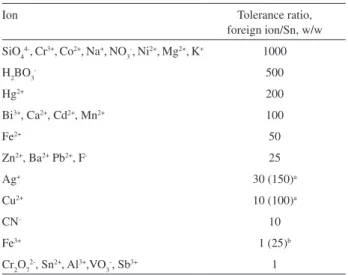
The effects of different ions on the preconcentration and determination of 0.1 µg mL−1 Sn(IV) by the proposed
method under the optimum conditions were tested. The results are summarized in Table 2. The tolerance limit was deined as the concentration of added ion that caused less than ± 5% relative error. Most of the cations and anions examined did not interfere with the extraction and determination of Sn(IV). Ag+ interfered at 3.0 µg mL−1 and
Cu2+ interfered at 1.0 µg mL−1. The interfering effects of Ag+
and Cu2+ up to 15.0 and 10.0 µg mL−1 were removed by the
addition of 4.2 × 10⁻⁵ mol L−1 EDTA, and the interfering
effects of Fe3+ up to 2.5 µg mL−1 was removed by the
addition of 4.2 × 10⁻⁴ mol L−1 ascorbic acid to the solution. .
Application
Determination of tin in water samples
The proposed method was successfully applied to the determination of tin ions in water samples. River water sample was taken from a river in the city of Hamadan (Iran). The sample was iltered on-site through nitrocellulose
Table 1. Analytical features of the proposed method
Regression equation (n = 15) ∆A = 0.0047C - 0.0045, r = 0.9995
Linear range (ng mL-1) 0.30 - 175.00,a (0.24 - 1.42 µg mL-1)
Limit of detection ( ng mL-1) (n=5) 0.16a (10)
Maximum preconcentration factor 20
a Linear range before preconcentration
Table 2. Tolerance ratios of diverse ions on the determination of
0.1 µg mL−1 of Sn(IV) using the proposed method.
Ion Tolerance ratio,
foreign ion/Sn, w/w
SiO44-, Cr3+, Co2+, Na+, NO 3
-, Ni2+, Mg2+, K+ 1000
H2BO3- 500
Hg2+ 200
Bi3+, Ca2+, Cd2+, Mn2+ 100
Fe2+ 50
Zn2+, Ba2+ Pb2+, F- 25
Ag+ 30 (150)a
Cu2+ 10 (100)a
CN- 10
Fe3+ 1 (25)b
Cr2O72-, Sn2+, Al3+,VO 3
-, Sb3+ 1
As Sn(II) is readily oxidized to Sn(IV), the obtained results for the amounts of tin in water and canned juice samples may be considered as the total amounts of Sn(II) and Sn(IV).
Comparison of the proposed method with other methods
A comparison between the proposed method with the previously reported methods for preconcentration and determination of Sn(IV) (Table 5) indicates that this method provides a lower detection limit and/or wider linear range for the determination of trace quantities of Sn(IV) and total Sn in real samples.14,15,21-23
Conclusions
The preconcentration and determination of Sn(IV) and total Sn using PCV and CTAB reagents and cloud point extraction shows interesting features. This combination resulted in a simple, sensitive and inexpensive analytical procedure successfully used to tin preconcentration and determination in real samples. The procedure is very economical, because it consists of much low equipment and running costs and shows also simplicity in apparatus and manipulation.
Table 4. Determination of Sn in canned juice samples by the proposed
method.
Sample
Sn (µg L-1)
Recovery(%) Added (as Sn(IV)) Found
1 - 55.90 ± 0.32
-2 30.00 86.39 ± 0.57 101.6
3 50.00 106.42 ± 1.36 101.0
Table 5. Comparison of the proposed method with some preconcentration methods
Sorbent/reagent Analytical
method
Detection Limits (µg L-1)
Linear range (µg L-1)
Sample Ref
Pyrocatechol violet aFI-SPE 0.3 2.0-40.0 Fruit 21
Pentahydroxylavone SPE 60.0 Up to 1.2 ( µg mL-1) Zinc material 22
8-HQ/Triton X-114 bCPE-GFAAS 0.012 0.05-2.00 Water 15
PAN CPE-GFAAS 0.51 0.0-5.0 (µg mL-1) Water 14
Saccharomyces cerevisiae cSPE-ICP-OES 1.1 40-200 Water 23
PCV/CTAB CPE 0.16 0.30-175.00 Water, sheep liver,
canned juices
This work
a Flow injection –solid phase extraction, b cloud point extraction – graphite furnace atomic absorption spectrometry, c solid phase extraction- inductively
coupled plasma – optical emisson spectrometry
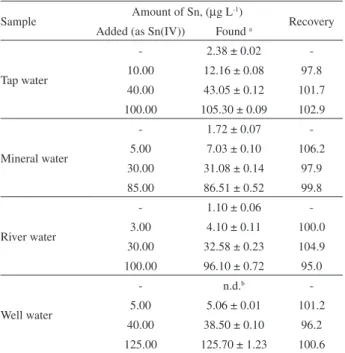
membrane (0.45 µm, Sartorius, Germany). The sample was adjusted to the respective pH and spiked with Sn(IV). The results are shown in Table 3. The recoveries are close to 100% and indicate that the proposed method is applicable for the determination of tin in water samples.
Determination of tin in canned juice samples
The accuracy and applicability of the proposed method was applied to the determination of tin in canned juice samples. The results are given in Table 4 and indicate the successful applicability of the proposed method for the determination of tin in such samples.
Table 3. Determination of Sn in water samples by the proposed method
Sample Amount of Sn, (µg L
-1)
Recovery Added (as Sn(IV)) Found a
Tap water
- 2.38 ± 0.02
-10.00 12.16 ± 0.08 97.8
40.00 43.05 ± 0.12 101.7
100.00 105.30 ± 0.09 102.9
Mineral water
- 1.72 ± 0.07
-5.00 7.03 ± 0.10 106.2
30.00 31.08 ± 0.14 97.9
85.00 86.51 ± 0.52 99.8
River water
- 1.10 ± 0.06
-3.00 4.10 ± 0.11 100.0
30.00 32.58 ± 0.23 104.9
100.00 96.10 ± 0.72 95.0
Well water
- n.d.b
-5.00 5.06 ± 0.01 101.2
40.00 38.50 ± 0.10 96.2
125.00 125.70 ± 1.23 100.6
References
1. Malla, M. E.; Alvarez, M. B.; Batistoni, D. A.; Talanta2002,
57, 277.
2. Skowronska, B. P.; Kaczorowska, R.; Skowronski, T.; Environ. Pollut.1997, 97, 65.
3. Zhang, X.; Toxic. Det. Tin Sanit. Res. 2002, 31, 324. 4. Gholivand, M. B.; Babakhanian, A.; Raiee, E.; Talanta 2008,
76, 503.
5. Alvarez, P. E.; Ribotta, S. B.; Folquer, M. E.; Gervasi, C. A.; Vilche, J. R.; Corros. Sci.2002,44, 49.
6. Saleha, S. M.; Saida, S. A.; El-Shahawi, M. S.; Anal. Chim. Acta 2001,436, 69.
7. Yang, H. J.; Jiang, S. J.; Yang, Y. J.; Hwang, C.; Anal. Chim. Acta 1995,312, 141.
8. Chou, Y. K.; Wong, P. T. S.; Bengert, G. A.; Anal. Chem. 1982,
54,246.
9. Zaporozhets, O. A.; Ivanko, L. S.; Marchenko, I. V.; Orlichenko, E. V.; Sukhan,V.V.; Talanta 2001, 55, 313.
10. Madrakian, T.; Ghazizadeh, F.; J. Hazard. Mater. 2008, 153, 695.
11. Bahram, M.; Madrakian, T.; Bozorgzadeh, E.; Afkhami, A.;
Talanta 2007, 72, 408.
12. Afkhami, A.; Madrakian, T.; Bozorgzadeh, E.; Talanta 2007,
71, 1103.
13. Madrakian, T.; Afkhami, A.; Mousavi, A.; Talanta 2007, 71, 610.
14. Afkhami, A.; Madrakian, T.; Siampour, H.; J. Braz. Chem. Soc.
2006, 17, 797.
15. Zhu, X.; Zhu, X.; Wang, B.; J. Anal. At. Spectrom. 2006, 21, 69.
16. Yuan, C. G.; Jiang, G. B.; He, B.; Liu, J.; Microchim. Acta 2005,
150, 329.
17. Qiong, L.; Guanghan, L.; Heng, W.; Xiaogang, W.; Food Chem.
1999, 64, 129.
18. Wakley, W.D.; Varga, L. P.; Anal. Chem. 1972, 44, 169. 19. Corbin, H. B.; Anal. Chem.1973, 45, 534.
20. Dagnall, R. M.; West, T. S.; Young, P.; Analyst 1967, 92, 27. 21. Ross, W. J.; White, J. C.; Anal. Chem. 1961,33, 421. 22. Capitán-Vallvey, L. F.; Valencia, M. C.; Mirón, G.; Anal. Chim.
Acta, 1994, 289, 365.
23. Zaporozhetsm, O.; AIvanko, L. S.; Marchenko, I. V.; Orlichenko, E. V.; Sukhan, V. V.; Talanta 2001,55, 313.
Received: January 3, 2009