Compiler Optimizations Impact the Reliability
of the Control-Flow of Radiation-Hardened
Software
Ronaldo Rodrigues Ferreira1, Rafael Baldiati Parizi1, Luigi Carro1, Álvaro Freitas Moreira1
ABSTRACT:This paper discusses how compiler optimizations inluence software reliability when the optimized application is compiled with a technique to enable the software itself to detect and correct radiation-induced control-low errors. Supported by a comprehensive fault-injection campaign using an established benchmark suite in the embedded systems domain, we show that the compiler is a non-negligible source of noise when hardening the software against radiation-induced soft errors.
KeywoRdS: Compilers, Radiation effects, Single event upsets, Software reliability, Software engineering.
INTRODUCTION
Compiler optimizations are taken for granted in modern sotware development, enabling applications to execute more eiciently in the target hardware architecture. Modern architectures have complex inner structures designed to boost performance, and if the sotware developer were to be aware of all those inner details, performance optimization
would jeopardize the development processes. Compiler
optimizations are transparent to the developer, who picks the appropriate ones to the results s/he wants to achieve, or, as it is more common, allowing this task to be performed by the compiler itself by lagging if it should be more or less aggressive in terms of performance.
Industry already offers microprocessors built with 22 nm transistors, with a prediction that by 2026, the size of the transistor will reach 5.9 nm (ITRS, 2012). This aggressive technology scaling creates a big challenge concerning the reliability of microprocessors using newest technologies. Smaller transistors are more likely to be disrupted by transient sources of errors caused by radiation, known as soft-errors (Borkar, 2005). Radiation particles originated from cosmic rays when strikes a circuit induces bit flips during software execution, and because transistors are becoming smaller in size, there is a higher probability that these transistors will be disrupted by a single radiation particle with smaller transistors requiring a smaller amount of charge to disrupt their stored logical value. The newest technologies are so
1.Universidade Federal do Rio Grande do Sul – Porto Alegre/RS – Brazil
Author for correspondence: Ronaldo Rodrigues Ferreira | Instituto de Informática, Universidade Federal do Rio Grande do Sul | Avenida Bento Gonçalves, 9500, Campus do Vale – Bloco IV – Agronomia | CEP 91.509-900 Porto Alegre/RS – Brazil | Email: [email protected]
sensitive to radiation that their usage will be compromised at the sea level, as predicted in the literature (Normand, 1996). Rech et al., (2012) have shown that modern graphics processing unit (GPU) cards are susceptible to such an error rate that makes their usage unfeasible in critical embedded systems. However, industry is already investing in GPU architectures as the platform of choice for high performance and low power embedded computing, such
as the ARM Mali®
embedded GPU (ARM, n.d.).
The classical solution to harden systems against radiation is the use of spatial redundancy, i.e., the replication of hardware modules. However, spatial redundancy is prohibitive for embedded systems, which usually cannot afford extra costs of hardware area and power. The increase on power is a severe problem, because it is expected that 21% of the entire chip area must be turned off during its operation to meet the available power budget, and an impressive chip area of 50% at 8 nm (Esmaeizadeh, 2011).
This creates the dark silicon problem (Esmaeizadeh,
2011), i.e., a huge area of the circuit cannot be used during its lifecycle. This problem gets worse when the microprocessor has redundant units, because system’s reliability could be compromised if redundant units were turned off. The current solution to this problem is to use radiation-hardened microprocessors, which are designed to endure radiation. The problem with this approach is the low availability, high unit pricing, and International Traffic in Arms Regulations (ITAR) restrictions of those radiation-hardened components. For instance, a 25 MHz microprocessor has a unitary price of $ 200,000.00 (Mehlitz and Penix, 2005). This high unit pricing makes the use of radiation-hardened microprocessors unfeasible for embedded systems used in aircrafts, not to say about cars and low-end medical devices, such as pacemakers. For these critical embedded systems, where cost and ITAR restrictions are hard constraints, a cheaper, but yet effective approach for reliability against radiation, is necessary.
Software-Implemented Hardware Fault-Tolerance
( SIHFT) (Goloubeva, 2006) is an approach for
radiation reliability that adds redundancy in terms of extra instructions or data to the application, keeping the hardware unchanged. SIHFT techniques work by
modifying the original program by adding checking
mechanisms to it. SIHFT techniques are classified
either as control-flow or as data-flow. The former is
designed to detect when an illegal jump has occurred during application execution to possibly proceed with the resolution of the correct jump address or at least signaling that such an error has occurred. The latter checks if a data variable being read is correct or not. While the effects of data-flow SIHFT methods are clear (usually, the duplication of program variables or the addition of variable checksums solves the problem), the impacts of the control-flow ones, are yet not well understood. Because the control-flow methods modify the program’s control-flow graph (CFG), which happens to be the same artifact used by compiler optimizations, the efficiency of control-flow reliability techniques might be influenced by the optimizations in an unpredictable way.
In this paper, we evaluate how the cumulative usage of compiler optimizations inluence reliability of applications hardened with the state-of-the-art Automatic Correction of Control-low Errors (ACCE) (Vemu, Gurumurthy and Abraham, 2007) control-low SIHFT technique, which is selected, because it is the current most eicient method in terms of reliability, attaining an error correction rate of ~70%. he application set we use in this paper is drawn from the MiBench suite (Guthaus et al., 2001).
RADIATION EFFECTS ON SOFTWARE RELIABILITY
Highly energized radiation particles are known hazard sources in electronics since the 1970s (Binder et al., 1975), as well as the mitigation schemes for such sources. Single-Event Transient (SET) is the observed physical efect of radiation on electronics, corresponding to voltage glitches in circuitry, which by itself does not incur on system hazards. System hazards originate when SETs are caught up by memories (e.g., SRAM’s) and sequential logic (e.g., registers), thus, becoming a Single-Event Upset (SEU). An SEU is a non- permanent damage to the systems (i.e., transient) that results in a bit with logical value 1 that lips to 0 and vice-versa. Mitigation approaches might be as follows:
• Substrate and gate-level: he reduction of charge generation and collection.
• System level: he addition of redundancy at system level, e.g., sotware hardening.
Deinitely, the system level mitigation approach is the most feasible for components of-the-shelf and to overcome ITAR restrictions.
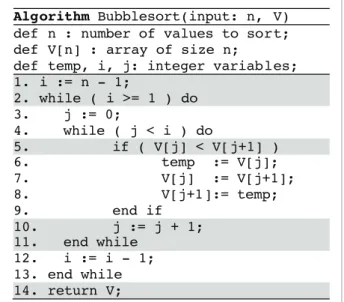
A bit lip caused by a radiation-induced SEU can compromise the sotware in two diferent ways. Firstly, an SEU can corrupt data, i.e., the values of program variables. Secondly, an SEU can corrupt control, i.e., the program low of execution. To illustrate these two situations, consider the program presented in Fig. 1, which corresponds to the Bubble Sort algorithm. Bubble Sort is a naïve O(n2) solution for sorting an array of arbitrary numbers.
he Bubble Sort algorithm is divided in labeled regions named basic blocks (identiied by the gray and white regions in the Bubble Sort source code). A basic block is a region of a program where the contained program instructions does not contain any branch, i.e., iteration loops (e.g., for and while commands), if-conditionals, function call, and return. herefore, a basic block only contains variable assignments and logical evaluations. he CFG of a program P is a graph GP=(V, E), where the set V of vertices contains the program’s basic blocks and the set E of edges contains the transitions in the execution low. To illustrate this, the CFG of the Bubble Sort algorithm is presented in Fig. 2.
An executed branch of the program P (represented by an arrow in Fig. 2) is said to be legal, if and only if, it is an element
Figure 1. Bubble Sort algorithm with explicit basic-blocks,
which are represented by the grouped numbered lines.
Figure 2. Control-low graph of the Bubble Sort algorithm.
The blue arrow is a legal branch (together with the black arrows), the purple arrow is a wrong branch, and the red arrow is an illegal branch.
of the set E of GPand the condition to execute it is satisied (e.g., the blue arrow in Fig. 2); it is wrong if the executed branch is an element of the set E, but its condition to execute cannot be satisied (e.g., the purple arrow in Fig. 2); and an executed branch is wrong if it is not an element of the set E (e.g., the red arrow in Fig. 2).
A control-low error (CFE) occurs when either a wrong or illegal branch is executed. Notice that in these two cases, a CFE cannot exist if the program execution is not corrupted, i.e., an illegal branch cannot exist in a correct program execution, because it only executes branches from the set E; a wrong branch cannot exist, because it is always possible to satisfy the logical conditions of all branches if program execution is correct. A CFE can be created by a radiation-induced SEU in any of the following three scenarios:
• A non-branch instruction being executed changes
into a non-valid branch, i.e., the operation code data is corrupted.
• he target address of a valid branch is corrupted.
• One of the variables composing a logical expression that activates a branch is corrupted.
Scenarios (1) and (2) leads to an illegal branch, and scenario (3) leads to a wrong branch.
A data-low error (DFE) is caused by a radiation-induced SEU that corrupts variables within a basic block. A DFE might lead to erroneous results or even to a CFE, in case the corrupted variable is used in a logical expression controlling a branch. he focus of this paper is CFE’s. For an extensive review of mitigation techniques of CFE and DFE, interested readers may refer to the work of Goloubeva et al., (2006).
0 1 2
3
4 5 6
Algorithm Bubblesort(input: n, V) def n : number of values to sort; def V[n] : array of size n;
def temp, i, j: integer variables; 1. i := n - 1;
2. while ( i >= 1 ) do
3. j := 0;
4. while ( j < i ) do
5. if ( V[j] < V[j+1] )
6. temp := V[j];
7. V[j] := V[j+1];
8. V[j+1]:= temp;
9. end if
10. j := j + 1;
11. end while
12. i := i - 1;
he detection of transient CFE was established in the literature with techniques that check assertions during runtime. he general idea is to compute signatures identifying each basic block, and checking the signatures generated during compilation and runtime. If they do not match, an error is signaled. CFE’s were irst identiied by the usage of watchdog processors, which are intrusive in the hardware design ( Saxena and McCluskey, 1990). Lately, techniques based on the signature checking scheme in sotware, such as the Control-flow Checking Approach (CCA) (Kanawati et al., 1996), were identiied, but with a coverage rate of only 38% and a performance overhead of 50%.
Advances in the signature checking method offered some improvements on coverage and performance, such as the Control-Flow Checking by Software Signatures, which incurs in 50% of overhead in execution time and program size (Oh et al., 2002). The most efficient technique of signature checking capable of correcting errors is the ACCE (Vemu et al., 2007), which incurs in approximately 20% of overhead in execution time to produce an average 70% of correct answers in fault-injection campaigns. However, ACCE is not capable of correcting errors that occur within a basic block, i.e., in the data flow; hence, the use of complementary techniques is required. When ACCE is enhanced with data-flow correction, its coverage rate achieves the average of 91.6% (Vemu et al., 2007).
Because the CFG is one of the most important sotware artifacts used by compilers when analyzing and modifying programs, it is important to measure how the compiler impacts the reliability of the sotware mitigation techniques for radiation-induced CFE. he understanding of these impacts is imperative to employ sotware mitigation techniques in real systems. his paper presents a study using the ACCE mitigation technique, which is briely reviewed in the next section.
AUTOMATIC CORRECTION OF CONTROL-FLOW ERRORS
ACCE (Vemu et al., 2007) is a sotware technique for reliability that detects and corrects CFE’s due to random and arbitrary bit-lips that might occur during sotware execution. he hardening of an application with ACCE is done at compilation, because it is implemented as a transformation pass in the compiler. ACCE modiies the applications’ basic blocks with the insertion of extra instructions that perform
the error detection and correction during sotware execution. In this section, we briely explain how the ACCE works in two separate subsections, one dedicated to error detection and the other to error correction are discussed in the subsequent subsections. he reader should refer to the ACCE article for a detailed presentation and experimental evaluation (Vemu et al., 2007). he fault model that ACCE assumes is further described in the “Fault Model and Methodology” section.
Control-Flow Error Detection
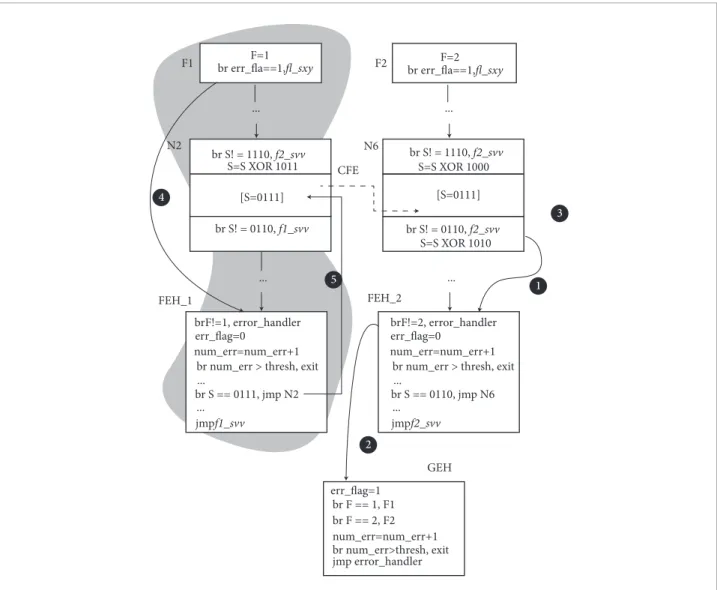
ACCE performs online detection of CFE-s by checking the signatures in the beginning and in the end of each basic block of the CFG, thus, ACCE is classified as a signature checking SIHFT technique as termed in the published literature. The basic block signatures are computed and generated during compilation; the signature generation is critical, because it requires computing non-aliased signatures between the basic block, i.e., each block must be unambiguously identified. In addition, for each basic block found in the CFG, two additional code regions are added, the header and the footer. The signature checking during execution takes place inside these code regions. Figure 3 shows two basic blocks (labeled as N2 and N6) with the additional code regions. The top region corresponds to the header and the bottom to the footer. Still, at compilation, the ACCE creates two additional blocks for each function, namely the function entry block and the Function Error Handler (FEH). For instance, Fig. 3 depicts a portion of two functions, f1 and f2, both owning entry blocks labeled as F1 and F2, and FEHs, labeled as FEH_1 and FEH_2, respectively. Finally, ACCE creates a last extra block, the Global Error Handler (GEH), which can only be reached from a FEH block. The role of these blocks will be presented soon.
(represented as F), which stores the unique identifier of the function currently being executed. The current function register is only assigned at the extra entry function block. This process encompasses the detection of an illegal and erroneous branch due to a soft error.
Figure 3 depicts an example of the checking and update of signatures performed in execution time that occurs in a basic block. In this example, the CFE occurs in the block N2 of function F1, where an illegal jump incorrectly transfers the control low to the basic block N6 of function F2. When the execution reaches the footer of the block N6, the signature register S is checked against the signature generated at compilation. In this case, S = 0111 (i.e., the previous value
assigned in the header of the block N2). hus, the branch test in the N6 footer will detect that the expected signature does not match with the value of S, and thus, the CFE must be signaled (step 1 in Fig. 3). In this example, the application branches to the address f2_err, making the application enter the FEH_2 block (because the error was detected by a block owned by the function F2, the FEH invoked is the FEH_2). At this point, the CFE is detected and ACCE can proceed with the correction of the detected CFE.
Control-Flow Error Correction
he correction process starts as soon as an illegal jump is detected by the procedure described in the last subsection,
F1 F2
N2 N6
CFE
FEH_1 FEH_2
GEH F=1
br err_fla==1,fl_sxy br err_fla==1,F=2 fl_sxy
br S! = 1110, f2_svv S=S XOR 1011 S=S XOR 1000
[S=0111] [S=0111] br S! = 1110, f2_svv
br S! = 0110, f2_svv br S! = 0110, f1_svv
S=S XOR 1010
1 3
5
2 4
brF!=1, error_handler
err_flag=0 err_flag=0 num_err=num_err+1
br num_err > thresh, exit
... ...
... ...
br S == 0111, jmp N2 ...
jmpf1_svv
brF!=2, error_handler
num_err=num_err+1 br num_err > thresh, exit
br S == 0110, jmp N6 ...
jmpf2_svv
err_flag=1 br F == 1, F1 br F == 2, F2 num_err=num_err+1 br num_err>thresh, exit jmp error_handler
... ...
Figure 3. Depiction of how the control is transferred from a function to the basic blocks that ACCE has created when a
with the control low transferred to the FEH corresponding to the function where the CFE is found. he FEH checks if the illegal jump was originated in the function it is responsible to handle its detected errors by comparing the value of the function’s identiier (F1 or F2, in the example of Fig. 3) with the current function register F. If the error occurred in the function stored in the F register, FEH evaluates the current value of the signature register and then transfers the control to the basic block that is the origin of the illegal jump (this origin is stored in the S register). On the other hand, if the illegal jump is not originated in the function where the detection has occurred, the FEH then transfers the control low to the GEH. In this case, the GEH is responsible for identifying the function where the CFE has occurred and to transfer the control low back to this function, so that the error is correctly treated by the function’s FEH. he GEH searches the function where the error has occurred and transfers the control to its entry block, which then sends the control low to the proper FEH so that the error can be corrected, i.e., branching the control to the basic block where the CFE has occurred.
Recalling the example depicted in Fig. 3, ater the CFE is detected and the control is transferred to FEH_2 (step 1), the F register is matched against the function identiier of the function from where the control originated. However, because the CFE originated in the basic block N2 of the function F1, F = 1. herefore, FEH_2 is not capable of inding the basic
block where the CFE originated, and then it transfers the control to the GEH so that the correct FEH can be found (step 2). he GEH searches for the function identiier stored in F, until it inds that it should branch to F1 (step 3). Upon reaching the entry block F1, the variable err_lag=1, because it is assigned to 1 in the GEH, meaning that there is an error that should be ixed, thus, the control branches to FEH_1 (step 4). Now, because F=1, FEH_1 knows that it is the FEH capable of handling the CFE and, as such, it sets the variable err_lag to 0. Finally, it searches for the basic block that has the signature equal to the register S. Upon inding it, the control branches to this basic block, i.e., N2 in Fig. 3 (step 5). his last branch restores the control low to the point of the program right before the occurrence of the CFE. Notice that inside all the FEH and the GEH, there is the variable num_error, counting how many times the control has passed through a FEH or a GEH. his acts as a threshold for the number of how many times the correction must be attempted, which is
necessary to avoid an ininite loop in case the registers F or S get corrupted for any reason. his process concludes the
correction of a CFE with the ACCE.
FAULT MODEL AND METHODOLOGY
he fault model we assume in the experiments is the single bit lip, i.e., only one bit of a word is changed when a fault is injected. he ACCE is capable of handling multiple bit lip as long as the bits lipped is within a same word. Because the fault injection, as it will be discussed later, guarantees that the injected fault ultimately turned into a manifested error, it does not matter how many bits are lipped, i.e., there is no silent data corruption, meaning the faults that cause a word to change its value neither change the behavior of the program nor its output. his could happen in the case that the fault lipped the bits of a dead variable.
The ACCE technique was implemented as a transformation pass in the Low Level Virtual Machine (LLVM; Lattner and Adve, 2004) production compiler, which performs all the modifications in the CFG using the LLVM Intermediate Representation (LLVM-IR). The LLVM was selected as our compilation platform, because of its increased use in the industry, accompanied with a very detailed documentation and quality of its source
code. The ACCE transformation pass was applied after
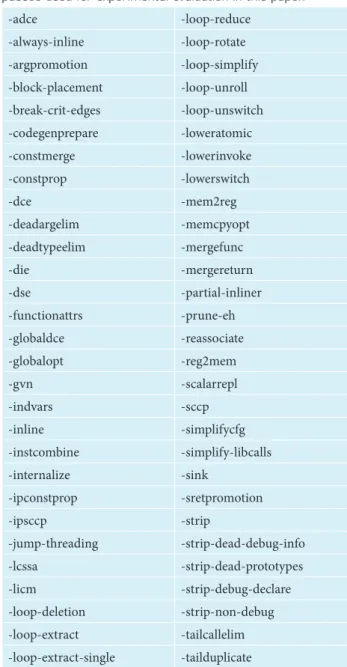
the set of compiler optimizations, because executing in the opposite order, a compiler optimization could invalidate the ACCE generated code and semantics. Table 1 presents the LLVM optimization passes used in the experiments.
Because the ACCE is a SIHFT technique to detect and correct CFE-s, the adopted fault model simulates three distinct control-low disruptions that might occur due to a CFE. Remember that a CFE is caused by the execution of an illegal branch to a possibly wrong address. he branch errors considered in this paper are as follows:
• Branch creation: he program counter is changed, transforming an arbitrary instruction (e.g., an addition) into an unconditional branch.
• Branch deletion: he program counter is set to the next program instruction to execute independently if the current instruction is a branch.
Table 1. Set of Low Level Virtual Machine optimization passes used for experimental evaluation in this paper.
-adce -loop-reduce
-always-inline -loop-rotate
-argpromotion -loop-simplify
-block-placement -loop-unroll
-break-crit-edges -loop-unswitch
-codegenprepare -loweratomic
-constmerge -lowerinvoke
-constprop -lowerswitch
-dce -mem2reg
-deadargelim -memcpyopt
-deadtypeelim -mergefunc
-die -mergereturn
-dse -partial-inliner
-functionattrs -prune-eh
-globaldce -reassociate
-globalopt -reg2mem
-gvn -scalarrepl
-indvars -sccp
-inline -simplifycfg
-instcombine -simplify-libcalls
-internalize -sink
-ipconstprop -sretpromotion
-ipsccp -strip
-jump-threading -strip-dead-debug-info
-lcssa -strip-dead-prototypes
-licm -strip-debug-declare
-loop-deletion -strip-non-debug
-loop-extract -tailcallelim
-loop-extract-single -tailduplicate We implemented a sotware fault injector, using the GDB
(GNU Debugger), in a similar fashion as implemented by Krishnamurthy et al., (1998), which is an accepted fault-injection methodology in the embedded systems domain, to perform the fault-injection campaigns. he steps of the fault-injection process are the following:
• he LLVM-IR program resulting from the compilation
with a set of optimization and with ACCE is translated to the assembly language of the target machine.
• he execution trace in assembly language is extracted
from the program execution with GDB.
• A branch error (branch creation, deletion, or disruption) is randomly selected. On an average, each branch error accounts for 1/3 of the amount of injected errors.
• One of the instructions from the trace obtained in step 2 is chosen at random for fault injection. In this step, a histogram of each instruction is computed because instructions that execute more oten have a higher probability to be disrupted.
• If the chosen instruction in step 4 executes n times, choose at random an integer number k with 1 ≤ k ≤ n.
• Using GDB, a breakpoint is inserted right before the k-th execution of the instruction selected in step 4.
• During program execution, upon reaching the breakpoint inserted in step 6, the program counter is intentionally corrupted by lipping one of its bits to reproduce the branch error chosen in step 3.
• he program continues its execution until it inishes.
A fault is only considered valid, if it has generated a CFE, i.e., silent data corruption and segmentation faults were not considered to measure the impacts of the compiler optimizations on reliability. All the experiments in this paper were performed in a 64-bit Intel Core i5 2.4 GHz desktop with 4 GB of RAM and the LLVM compiler version 2.9. For all program versions, where each version corresponds to the program compiled with a set of optimizations plus the ACCE pass, 1,000 faults were injected using the aforementioned fault-injection scheme. In the experiments we considered ten benchmark applications from the MiBench (Guthaus et al., 2001) embedded benchmark suite as follows: basicmath, bitcount, crc32, dijkstra, t, patricia, quicksort, rijndael, string search, and susan (comprising susan corners, edge, and smooth).
IMPACT OF COMPILER OPTIMIZATIONS ON SOFTWARE RELIABILITY
thus all data discussed in this section considers the
correction rate as the data to compute the efficiency
metric. In this analysis, we use 58 optimizations
provided by the LLVM production compiler. Finally, the results were obtained using the fault model and fault injection methodology described in the section “Fault Model and Methodology”.
he impact of the compiler optimizations when compiling for reliability is measured in this paper using the metric Relative Improvement Percentage (RIP; Pan and Eigenmann, 2006). he RIP is presented in Eq. 1, where Fi is a compiler optimization, E(Fi) is the error correction rate obtained for a hardened application compiled with Fi, and EB is the error correction rate obtained for the baseline, i.e., the application compiled only with ACCE and without any optimization.
% 100 )
( )
( = − .
B B i i B
E E F E F RIP
(1)
Figure 4 shows a scatter plot of the obtained RIP for each application, with each of the 58 LLVM optimizations being a point in the y-axis. Each point represents the hardened application compiled with a single LLVM optimization at a time, with each application compiled with 58 distinct optimizations. Figure 4 shows that several optimizations increase the RIP considerably, sometimes reaching a RIP of ~10%. his is a great result, which shows that reliability can be increased for free by just picking appropriate optimizations that facilitates for ACCE the process of error detection and correction. However, we also ind that some optimizations totally jeopardize reliability, reaching a RIP of -73.27% (bottom illed red circle for bitcount).
It is also possible to gather evidence that the structure of the application also inluences how an optimization has an impact on the RIP of reliability. Let us consider the block-placement optimization, which is represented by the white diamond in Fig. 4. In the case of the qsort application, block-placement has a RIP of -42.75% and a RIP of +11.68%. he reader can notice that other optimizations also show this behavior (increasing RIP for some applications and decreasing it for others). It also happens that some hardened applications are less sensitive to compiler optimizations, as it
is the case of the crc_32 one, where the RIP is within the ±5% interval around the baseline.
Figure 5 depicts the RIP of a selected subset of the 58 LLVM optimizations, making it clear that even within a small subset, the variation in the RIP for reliability is far from negligible. For instance, the always-inline LLVM optimization has an error correction RIP interval of [-4.55%, +9.24%].
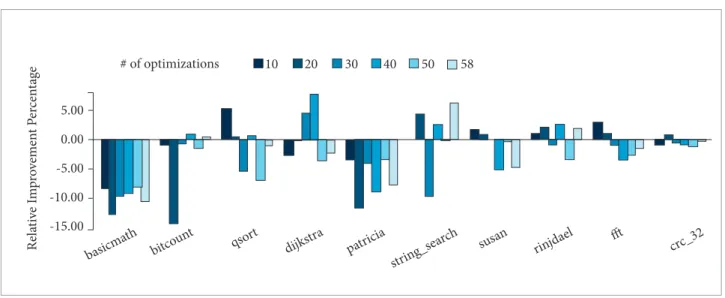
Usually compiler optimizations are applied in bulk, using several of them during compilation. herefore, it is also important to examine if successive optimization passes could compromise or increase sotware reliability of a hardened application. Figure 6 presents the error correction rate RIP, where the hardened application was compiled with a subset of the 58 LLVM optimizations. In this experiment, we used six sizes of subsets: 10, 20, 30, 40, 50, and 58. he RIP shown in Fig. 6 is the average of ive random subsets, i.e., it is an average of distinct subsets of the same size. Taking the average and picking the optimizations at random, reproduces the efects of indiscriminately picking the compiler optimizations, or at least, selecting optimizations with the object of optimizing performance without previous knowledge of how the selected optimizations together inluences the sotware reliability.
It is possible to see that the cumulative efect of compiler optimizations in the error correction RIP is in most of the cases deleterious, but for a few exceptions. Figure 6 conirms that some applications are less sensitive to the efects of compiler optimizations, e.g., the crc32 has its RIP within the interval [-1.11%–0.73%]. On the other hand, basicmath, bitcount, and patricia, are jeopardized. It is interesting to notice that the RIP in case of picking a subset of optimizations is not subject to the much severe reduction that was measured when only a single optimization was used (Fig. 4), providing an evidence that the composition of distinct optimization may be beneicial for reliability.
Figure 4. Relative Improvement Percentage for the error correction rate of applications hardened with ACCE under further compiler optimization. Each hardened application was compiled with a single optimization at a time, but all applications were compiled with the 58 Low Level Virtual Machine optimizations, thus, each hardened application has 58 versions. The baseline (Relative Improvement Percentage = 0%) is the error correction rate of the hardened application compiled without any Low Level Virtual Machine optimization.
10.00 8.00 6.00 4.00 2.00 0.00
-2.00
-4.00 -6.00
R
el
at
iv
e I
m
p
ro
vem
en
t P
er
cen
ta
ge
basicm ath
bitcount qso
rt
dijkstra patrici
a
string_s
earch susan rinjdael fft crc_32
always-inline inline loop-unroll tailduplicate
Figure 5. Relative Improvement Percentage of a selected subset of the 58 Low Level Virtual Machine optimizations. The
base-line (Relative Improvement Percentage=0%) is the error correction rate of the hardened application compiled without any Low Level Virtual Machine optimization.
-80.00
-70.00
-60.00
-50.00
-40.00
-30.00
-20.00
-10.00
0.00
10.00
20.00
R
el
a
ti
ve
I
mp
rove
me
n
t P
er
ce
n
tage
basicm ath
bitcoun t
qsort dijkstra patrici a
string_s
earch susan rinjdael fft crc_32 -80.00
-70.00 -60.00 -50.00 -40.00 -30.00 -20.00 -10.00 0.00 10.00 20.00
R
el
at
iv
e I
m
p
ro
vem
en
t P
er
cen
ta
RELATED WORK
Much attention has been devoted to the impact of compiler optimizations on program performance in the published literature. However, the understanding of how those optimizations work together and how they influence each other is a rather recent research topic. The
Combined Elimination (CE) (Pan and Eigenmann, 2006)
is an analysis approach to identify the best sequence of optimizations for a given application set using the GNU Compiler Collection (GCC). The authors discuss that
simple orchestration schemes between the optimizations
can achieve near-optimal results as if it has performed an exhaustive search in all the design space created by the optimizations. CE is a greedy approach that first compiles the programs with a single optimization, using this version as the baseline. From those baseline versions, the set of RIP is calculated, which is the percentage that the program’s performance is either reduced or increased. With the RIP at hand for all baselines, the CE starts removing the optimizations with negative RIP, until the total RIP of all optimizations applied into a program do not reduce. CE was evaluated in different architectures, achieving an average RIP of 3% for the SPEC2000, and up to 10% in case of the Pentium IV for the floating point applications.
he Compiler Optimization Level Exploration (COLE) (Hoste and Eeckhout, 2008) is another approach to achieve performance increase by selecting a proper optimization s equence. COLE uses a population-based multi-objective optimization algorithm to construct a Paretto optimal set of optimizations for a given application using the GCC compiler. he data found with COLE give some insightful results about how the compiler optimizations behave when they are applied with several of them at the same time. For instance, 25% of the GCC optimizations appear in at most one Paretto set, and some of them appear in all sets. herefore, 75% of all the optimizations do not contribute to improve the performance, meaning that they can be safely ignored! COLE also shows that the quality of an optimization is highly tied with the application set.
he Architectural Vulnerability Factor (AVF) (M ukherjee et al., 2003) is a metric to estimate the probability that the bits in a given hardware structure will be corrupted by a sot error when executing a certain application. he AVF is calculated as the total time the vulnerable bits remains in the hardware architecture. For example, the register ile has a 100% AVF, because all of its bits are vulnerable in case of a sot error. he AVF metric is highly inluenced by the application due to liveness of program’s variables. For instance, a dead variable has a 0% 5.00
0.00
-5.00
-10.00
-15.00
R
el
at
iv
e I
m
p
ro
vem
en
t P
er
cen
ta
ge
basicm ath
bitcount qso
rt
dijkstra patrici
a
string_s
earch susan rinjdael fft crc_32
# of optimizations 10 20 30 40 50 58
Figure 6. RIP of random subsets of the 58 Low Level Virtual Machine optimizations with a varying number of optimizations for
AVF, because it is not used in a computation. he impact of the GCC optimizations in the AVF metric is evaluated by trying to reduce the AVF-delay-square-product (ADS), introduced by the authors (Jones et al., 2008). he ADS considers a linear relation of the AVF between the square of the performance in cycles, clearly prioritizing performance over reliability. It is reported that the -O3 optimization level is detrimental both to the AVF and performance, because the benchmarks that are considered (MiBench) have increased the number of loads executed. Again, it was found that the patricia application was the one with the highest reduction in the AVF at 13%.
Bergaoui and Leveugle (2011) analyzed the impact of compiler optimizations on data reliability in terms of variable liveness. Liveness of a variable is the time period between the variable that is written and it is last read before a new write operation. he authors concluded that the liveness is not related only with the compiler optimization, but it also depends on the application being compiled, which is in accordance with the discussion of this paper. his paper shows that some optimizations tend to extend the time a variable is stored in a register instead of memory. he goal behind this is obvious, i.e., it is much faster to fetch the value of a variable when it is in the register than in the memory. However, the memory is usually more protected than registers because of cheap and eicient error correction code (ECC) schemes, and thus, thinking about reliability, it is not a good idea to expose a variable in a register for a longer time. he solution to that could be the application of ECC, such as Hufman to the program variables itself. Decimal Hamming (DH) ( Argyrides et al., 2011) is a sotware technique that performs this for a class of programs where the program’s output is a linear function of the input. he generalization of the eicient data-low SIHFT techniques, such as DH (i.e., ECC of program variables) is still an open research problem.
CONCLUSION
In this paper, we characterized the problem of compiling embedded sotware for reliability, given that compiler optimizations impact the coverage rate. he study presented in this paper makes clear that selecting optimizations indiscriminately, can decrease sotware reliability to unacceptable levels, probably avoiding the sotware to be deployed as originally planned. Embedded sotware and systems deployed in space applications must always be certiied with evidence that they support harsh radiation environments, and given the increasing technology scaling, other safety critical embedded systems might have to tolerate radiation-induced errors in a near future. herefore, the embedded sotware engineers must be very careful while compiling the safety critical embedded sotware.
Future research work is focused on the formalization of the ACCE transformation pass to generate automatic proofs about the correctness of programs compiled with the ACCE. his step is important to allow the certiication of sotware hardened with ACCE.
ACKNOWLEDGEMENTS
his work is supported by the CAPES foundation of the Ministry of Education, CNPq research council of the Ministry of Science and Technology, and FAPERGS research agency of the State of Rio Grande do Sul, Brazil. R. Ferreira was supported with a doctoral research grant from the Deutscher Akademischer Austauschdienst (DAAD) and from the Fraunhofer-Gesellschat, Germany.
REFERENCES
Argyrides, C., Ferreira, R., Lisboa, C. and Carro, L., 2011, “Decimal Hamming: A Novel Software-Implemented Technique to Cope with Soft Errors”, Proceedings of the 26th IEEE International Symposium on Defect and Fault Tolerance in VLSI and Nanotechnology Systems, pp. 11-17, doi: 10.1109/DFT.2011.35
ARM, n.d. 2012, “ARM Mali Graphics Hardware”, Retrieved in December 21, 2012, from http://www.arm.com/products/ multimedia/mali-graphics-hardware/index.php.
Bergaoui, S. and Leveugle, R., 2011, “Impact of Software Optimization on Variable Lifetimes in a Microprocessor-Based System”, Proceedings of the 6th IEEE International Symposium on Electronic Design, Test and Application, pp. 56-61, doi: 10.1109/DELTA.2011.20
Borkar, S., 2005, “Designing Reliable Systems from Unreliable Components: The Challenges of Transistor Variability and Degradation”, IEEE Micro, Vol. 25, No. 6, pp. 10-16, doi: 10.1109/ MM.2005.110
Esmaeizadeh, H., Emily, B., Renee, A. and Sankaralingam, K., 2011, “Dark Silicon and the End of Multicore Scaling”, IEEE Micro, Vol. 32, No. 3, pp. 122-134, doi: 10.1109/MM.2012.17
Goloubeva, O., Rebaudengo, M., Sonza Reorda, M. and Violante, M., 2006, “Software-Implemented Hardware Fault Tolerance”, Ed. Springer, New York, NY, USA, p 228.
Guthaus, M.R., Ringenberg, J.S., Ernst, D., Austin, T.M., Mudge, T. and Brown, R.B., 2001, “MiBench: A Free, Commercially Representative Embedded Benchmark Suite”, Proceedings of the IEEE International Workshop of Workload Characterization, pp. 3-14, doi: 10.1109/WWC.2001.990739
Hoste, K. and Eeckhout, L., 2008, “Cole: Compiler Optimization Level Exploration”, Proceedings of the 6th Annual IEEE/ACM International Symposium on Code Generation and Optimization, pp. 165-174, doi: 10.1145/1356058.1356080
ITRS, 2012, “ITRS 2009 Roadmap”, International Technology Roadmap for Semiconductors.
Jones,T.M., O’Boyle, M.F.P. and Ergin, O., 2008, “Evaluating the Effects of Compiler Optimisations on AVF”, Proceedings of the Workshop on Interaction Between Compilers and Computer Architecture, 6p.
Kanawati, K., Krishnamurthy, N., Nair, S. and Abraham, J.A., 1996, “Evaluation of Integrated System-level Checks for On-Line Error Detection”, Proceedings of the 2nd International Computer Performance and Dependability Symposium, pp. 292-301, doi: 10.1109/ IPDS.1996.540230
Krishnamurthy, N., Jhaveri, V. and Abraham, J.A., 1998, “A Design Methodology for Software Fault Injection in Embedded Systems”, Proceedings of the Workshop on Dependable Computing and its applications, pp. 12
Lattner, C. and Adve, V., 2004, “LLVM: A Compilation Framework for Lifelong Program Analysis & Transformation”, Proceedings of the International Symposium on Code Generation and Optimization, pp. 75-86, doi: 10.1109/CGO.2004.1281665
Mehlitz, P.C. and Penix, J., 2005, “Expecting the unexpected – radiation hardened software”, NASA Ames Research Center, pp. 10.
Mukherjee, S.S., Shrewsbury, M.A., Weaver, C., Emer, J. and Reinhardt, S.K., 2003, “A Systematic Methodology to Compute the Architectural Vulnerability Factors for a High-Performance Microprocessor”, Proceedings of the 36th Annual IEEE/ACM International Symposium on Microarchitecture, pp. 29-40, doi: 10.1109/MICRO.2003.1253181
Normand, E., 1996, “Single Event Upset at Ground Level”, IEEE Transactions on Nuclear Science, Vol. 43, No. 6, pp. 2742-2750, doi: 10.1109/23.556861
Oh, N., Shirvani, P.P. and McCluskey, E.J., 2002, “Control-low Checking by Software Signatures”, IEEE Transactions on Reliability, Vol. 51, No. 1, pp. 111-122, doi: 10.1109/24.994926
Pan, Z. and Eigenmann, R., 2006, “Fast and Effective Orchestration of Compiler Optimizations for Automatic Performance Tuning”, Proceedings of the International Symposium on Code Generation and Optimization, pp. 319-332, doi: 10.1109/CGO.2006.38
Rech, P., Aguiar, C., Ferreira, R., Silvestri, M., Griffoni, A., Frost, C. and Carro, L., 2012, “Neutron-Induced Soft Errors in Graphic Processing Units”, IEEE Radiation Effects Data Workshop, pp. 1-6, doi: 10.1109/REDW.2012.6353714
Saxena, N. and McCluskey, E., 1990, “Control Flow Checking using Watchdog Assists and Extended-Precision Checksums”, IEEE Transactions on Computers, Vol. 39, No. 4, pp. 554-559, doi: 10.1109/12.54849