Universidade Federal do Rio de Janeiro – Rio de Janeiro/RJ – Brazil
Author for correspondence: Jules Ghislain Slama | Departamento de Engenharia Mecânica/COPPE/UFRJ/C.P. 68.503 | CEP 21.945-970 Rio de Janeiro/RJ – Brazil |
email: [email protected]
Received: 02/02/12 | Accepted: 30/10/12
1.Universidade Federal do Rio Grande do Sul – Porto Alegre/RS – Brazil
Author for correspondence: Thiago Hanna Both | Universidade Federal do Rio Grande do Sul | Avenida Bento Gonçalves, 9500, Campus do Vale, Bloco IV | CEP: 91.509-900 Porto Alegre/RS – Brazil | Email: [email protected]
Received: 19/01/13 | Accepted:19/04/13
Analysis of Total Ionizing Dose Effects
on 0.13 μm
Technology-Temperature-Compensated Voltage References
Thiago Hanna Both1, Dalton Colombo1, Ricardo Vanni Dallasen1, Gilson Inácio Wirth1
ABSTRACT: The purpose of this work is to briely discuss the effects of the total ionizing dose (TID) on MOS devices in order to estimate the results of future irradiation tests on temperature-compensated voltage references that are implemented on a mixed-signal chip fabricated using IBM 0.13 µm technology. The analysis will mainly focus on the effects of the parametric variations on different voltage references. Monte-Carlo analyses were performed in order to determine the effects of threshold voltage shifts in each transistor on the output voltage.
KEYWORDS: Ionizing dose, Radiation, TID, Voltage reference.
INTRODUCTION
Space and high-altitude aeronautical applications of electronics are exposed to a continuous action of ionizing radiation. he interaction between radiation and the structure of semiconductor devices results in undesired efects, which may be either transient or accumulated. Predicting these efects and accurately addressing solutions that guarantee operation under radiation is a challenge for the aerospace industry.
he transient efects occur when an energetic particle interacts with a sensitive region of the structure, resulting in a generation of charge that produces an electric pulse at a circuit node (Single Event Efect–SEE). Transient efects may result in hard errors, which are permanent, destructive, faults (Sexton, 2003); sot errors, which are non-destructive faults that afect circuit operation (Karnik and Hazucha, 2004); or disturbances that do not cause a fault.
Ionizing radiation generates electron-hole pairs in the oxides of semiconductor devices. hese electron-hole pairs sufer from an initial recombination that is a function of the electric ield applied and the energy and type of the incident particle. Ater this initial recombination, the electrons, which have a higher mobility inside the insulator, escape from the oxide in a few picoseconds. he holes, on the other hand, have lower mobility and are eventually trapped in oxide traps, border traps or interface traps. he detailed mechanism of hole trapping in oxides can be found elsewhere (Oldham and McLean, 2003). In both NMOS and PMOS transistors, oxide-trapped charge is typically net positive, whereas interface-trapped charge is typically net positive for PMOS transistors and negative for NMOS transistors.
The consequence of this trapped charge is the degradation of electric parameters of the semiconductor devices, such as the threshold voltage, the leakage current, and the carrier mobility. It is also reported in the works of Fleetwood and Scofield (1990) and Fleetwood et al., (1994) that TID effects increase the 1/f noise in MOS devices, as shown in Fig. 1. It should be noted that the spikes in Fig.1 are related to the power-line fundamental frequencies and their harmonics.
he 1/f noise in MOS devices is associated with charge carrier trapping near or at the interface between the semiconductor and the insulator. Charge trapping causes
carrier number luctuations and mobility luctuations in the channel region of transistors. he activity of these traps results in discrete variations of the signal, known as Random Telegraph Signal (RTS), which, in MOS devices, is the major source of 1/f noise. It has also been reported that the annealing of the device ater irradiation, for relatively thick oxides, results in a reduction of 1/f noise (Meisenheimer and Fleetwood, 1990), as observed in Fig. 2. he degradation of electric parameters of the device and the increase in the 1/f noise may either result in malfunction or fully disable an electronic system.
he purpose of this work is to review the TID efects on MOS devices in order to estimate the efects of an irradiation test on diferent temperature-compensated voltage references that are integrated in one chip using IBM 0.13 µm technology. Monte-Carlo analyses were performed in order to identify how parametric variations afect diferent topologies.
TEMPERATURE-COMPENSATED VOLTAGE REFERENCES
Voltage references are building blocks that are present in a large variety of circuits; for instance, voltage regulators, comparators, and data converters. A voltage reference circuit should provide a stable output voltage despite variations in temperature, power supply, and process. Since voltage reference circuits can limit the accuracy of these applications, it is important to verify the impact of TID on the generated output voltage (VREF).
Figure 1. 1/f noise spectra for an irradiated NMOS transistor (oxide thickness of 48 nm). Adapted from Meisenheimer and Fleetwood, 1990.
Figure 2. Noise power response during irradiation and annealing of an NMOS transistor (oxide thickness of 48 nm). Adapted from Meisenheimer and Fleetwood, 1990.
Vd=100mV
tox=48nm
Vg-Vt=3.0V
Frequency (Hz)
500 krad
P
o
w
er S
p
ec
tra
l D
en
si
ty (V
2/H
z)
10-12
200 krad 100 krad 30 krad PRE
10-13
10-14
100 101 102
80ºC Anneal
tox=48nm
Vg-Vt=3.0V
Time (s)
N
o
is
e P
o
w
er
, K (10
-9 V 2) 6.0
PRE 4.0
2.0
101 102 103
Irradiate
0.0
104 105 106
Vd=100mV
he traditional implementation for voltage reference is the bandgap circuit, where the generated VREF is the bandgap voltage of silicon extrapolated to absolute zero Kelvin (i.e., ~1.2 V). Due to its stability regarding temperature and process, bandgap references have been used for the past forty years.
Bandgap references generate a temperature-compensated VREF through a balanced sum of the diode voltage and the thermal voltage. he diode voltage (or base-emitter voltage) has a negative temperature coeicient (TC), while the thermal voltage has a positive TC. he thermal voltage is given by k∗T/q, where k is the Boltzmann constant, T is the temperature and q is the electron charge.
Another topology of voltage reference that is widely used in the industry is the threshold-voltage-(VTH)-based reference. his topology of reference generates VREF that is equal to the threshold of a transistor extrapolated to absolute zero Kelvin (Colombo et al., 2011). he threshold-based voltage reference has gained increasing importance recently because of its ability to operate under low supply voltages (e.g., less than 1 V). Diferent from bandgap circuits that use diodes or BJTs, VTH-based references use the gate-source voltage (VGS) of MOS transistors to generate a voltage with negative a TC.
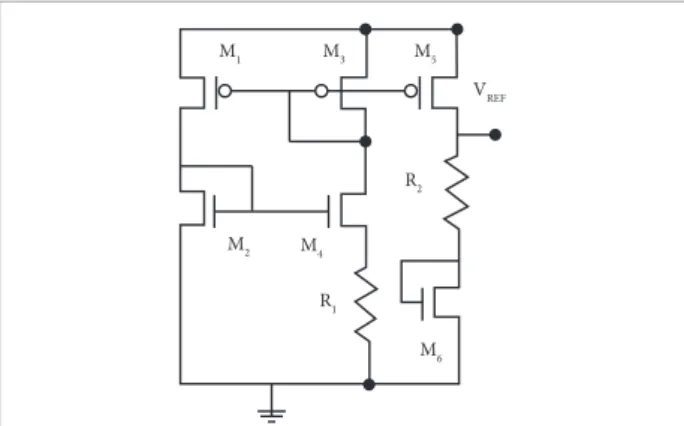
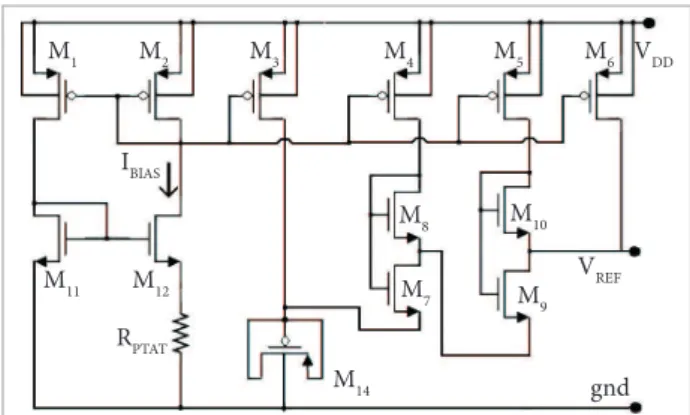
Bandgap and threshold-voltage-based references are two of the most frequently used techniques to generate temperature-compensated VREF and, consequently, they are chosen as the case study for our project. An integrated circuit with ive diferent voltage references was designed. In the fabricated chip, there are four references based on VTH, shown in Figs. 3 to 5. and one bandgap-based reference, shown in Fig. 6.
Figure 3. Simulated voltage reference 1 (Colombo et al.,
2011).
Figure 4. Simulated voltage reference 2 (Colombo et al.,
2011).
Figure 5. Simulated voltage reference 3 (using a resistor rather than the MR1 NMOS transistor) and voltage reference 4 (using the MR1 NMOS transistor) (Ueno et al., 2009).
Reference 2 is the simplest VTH-based voltage reference that can be implemented. Its output voltage is given by the sum of VGS of M6 and the voltage across R2, which is proportional to the temperature. Reference 1 is similar to reference 2, but the temperature compensation is done by adding currents with opposite TC instead of voltages. Reference 3 and 4 are alternative VTH-references that can be implemented with either one or none resistors, respectively. These architectures are appropriate for applications with requirement of a low silicon area. Reference 5 is a bandgap reference that uses a PMOSFET acting as a diode to generate VREF. Further information regarding the designed voltage references can be found elsewhere (Colombo et al., 2012; Banba et al., 1999; Ueno et al., 2009). These circuits were simulated under TID effects.
M1 M3 M5
A
M6
VDD
M2 M4 C1
M8 M9 M7
B C
VREF M10 M11
R2 R3 R1
M1 M3 M5
M6
M2 M4
VREF
R2
R1
M1
M3 M5
M6 M2
M4 M7
VREF
MR1
Current source subcircuit Bias voltage subcircuit
SIMULATIONS
In order to evaluate total ionizing dose efects on each voltage reference, SPICE simulations were performed, applying threshold voltage shits to each transistor of the circuit. Data regarding threshold voltage shits due to total ionizing dose efects on 0.13 µm MOS transistors were obtained from (Haugerud et al., 2005).
The voltage references were simulated for different bias conditions and under different temperature conditions. A total of 10,000 Monte-Carlo simulations were performed for each voltage reference. Process variability, provided in the IBM 0.13 µm commercial design kit, was also included in thesimulations, in an attempt to evaluate TID effects for different circuit conditions. For each of the 10,000 Monte-Carlo simulations, threshold voltage shifts due to process variability and also due to total ionizing dose effects were pseudo-randomly selected from normal distributions and assigned to each transistor of the circuit, meaning that for each simulation every transistor has its own threshold voltage shifts due to TID and also due to variability. It is important to state that data regarding total ionizing dose effects on 0.13 µm technology obtained from (Haugerud, et al., 2005) were not obtained for the 0.13 µm IBM technology used for integration and simulation.
For references 1, 2, 3, and 4, DC simulations were performed for temperature conditions ranging from -40°C to 80°C, at a ixed supply voltage of 1.2 V. For reference 5, DC simulations were performed for temperature conditions ranging from -40 to 80°C, at a ixed supply voltage of 2.5 V. All simulations were performed while considering a pre- irradiation situation (0 krad) and under total doses of 50 krad (Si) and 70 krad (Si).
RESULTS AND DISCUSSION
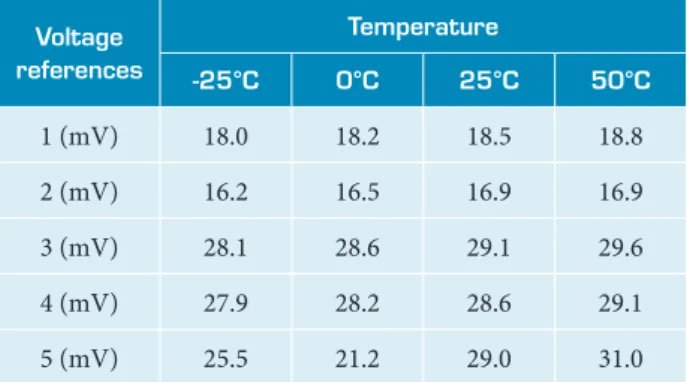
he output voltage obtained for the ive voltage references simulated under 0 krad (Si), 50 krad (Si), and 70 krad (Si) is presented in Figs. 7 to 11. he variation of the standard deviation as a function of temperature and total dose is presented in Tables 1 to 3.
Figure 6. Simulated voltage reference 5 (Colombo et al., 2012).
Figure 7. Output voltage for reference 1.
Figure 8. Output voltage for reference 2.
Figure 9. Output voltage for reference 3. M1 M2 M3 M4 M5 M6 VDD
M8
M9
M7 VREF
M10
M11 M12
M14 gnd
IBIAS
RPTAT
Temperature (ºC)
0 krad(Si)
V
o
lt
ag
e (V
) 50 krad(Si)70 krad(Si)
0.324
-40 -20
0.322
0.32
0.318
0.316
0.314
0.312
0 20 40 60 80
Temperature (ºC)
0 krad(Si)
V
o
lt
ag
e
(V
)
50 krad(Si) 70 krad(Si) 0.33
-40 -20
0.328
0.326
0.324
0.322
0 20 40 60 80
Temperature (ºC)
0 krad(Si)
V
o
lt
ag
e (V
)
50 krad(Si) 70 krad(Si)
0.696
-40 -20
0.695
0.694 0.693
0.692
0 20 40 60 80
0.691
0.69
he average output voltage for all voltage references also presented a small variation between 50 and 70 krad compared with the variation observed between 0 rad and 50 krad. his is expected due to similar threshold voltage shits for such doses.
he results obtained in this work indicate that these voltage references are functional for doses of approximately 70 krad (Si), and are hence suitable for most space applications. he standard deviation increase of the output voltage due to TID efects, however, should also be considered in order to guarantee proper circuit operation. It is necessary to observe, however, that the data regarding
Figure 10. Output voltage for reference 4.
Figure 11. Output voltage for reference 5.
Table 1. Standard deviation of the output voltage for 0 krad (Si).
Voltage references
Temperature
-25°C 0°C 25°C 50°C
1 (mV) 14.7 14.9 15.2 15.4
2 (mV) 14.6 14.9 15.2 15.6
3 (mV) 27.8 28.2 28.8 29.2
4 (mV) 32.0 32.3 32.7 33.1
5 (mV) 23.8 25.5 27.2 29.2
Table 2. Standard deviation of the output voltage for 50 krad (Si).
Voltage references
Temperature
-25°C 0°C 25°C 50°C
1 (mV) 18.0 18.2 18.5 18.8
2 (mV) 16.2 16.5 16.9 16.9
3 (mV) 28.1 28.6 29.1 29.6
4 (mV) 27.9 28.2 28.6 29.1
5 (mV) 25.5 21.2 29.0 31.0
he simulation results indicate that for the 0.13 µm technology voltage references, total ionizing dose is not a major concern. Compared with pre-irradiation simulations, both 50 and 70 krad simulations for the ive voltage references showed shits of a few millivolts in the average output voltage. he standard deviation compared with the pre-irradiation, which considers only process variability, increased by a few millivolts under total ionizing dose for voltage references 1, 2, 3 and 5. On the other hand, voltage reference 4 experienced a decrease of the standard deviation under TID. his reduction was also observed when threshold voltage shits due to total ionizing dose were applied only to the NMOS transistor MR1, as shown in Fig. 5. he mechanism responsible for this reduction of the standard deviation, however, was not identiied.
he observed overall reduction in the standard deviation between 50 krad and 70 krad was expected due to the fact that the standard deviation of the threshold voltage shit data from Haugerud et al., (2005) is reduced between 50 krad and 70 krad, regardless of the fact that the average shit increases.
Table 3. Standard deviation of the output voltage for 70 krad (Si).
Voltage references
Temperature
-25°C 0°C 25°C 50°C
1 (mV) 16.6 16.7 17.0 17.2
2 (mV) 15.6 15.9 16.2 16.5
3 (mV) 28.0 28.5 29.0 29.5
4 (mV) 27.8 28.1 28.5 28.9
5 (mV) 24.7 26.3 28.1 30.0
Temperature (ºC)
0 krad(Si)
V
o
lt
ag
e (V
)
50 krad(Si) 70 krad(Si)
0.825
-40 -20
0.82
0.815
0 20 40 60 80
Temperature (ºC)
0 krad(Si)
V
o
lt
ag
e (V
)
50 krad(Si) 70 krad(Si)
1.48
-40 -20
1.478
1.476
1.474
1.472
0 20 40 60 80
threshold voltage shits due to TID, employed in simulation, were not obtained for the 0.13 µm IBM technology. Further irradiation tests are necessary to conirm the simulation results.
In addition, the simulations performed in this work did not take circuit layout into consideration. his is an important issue considering that circuit layout techniques, such as the layout of an enclosed gate for NMOS transistors to reduce leakage current beneath the bird’s beak region (Mavis and Alexander, 1997), afect radiation tolerance.
CONCLUSIONS
The five voltage references simulated in this work presented tolerance to total ionizing dose effects for
doses of approximately 70 krad (Si). For the simulated 0.13 μm technology, parametric shifts due to TID effects resulted in shifts of a few millivolts in the output voltage of voltage references, and in the standard deviation of the output voltage. Despite the positive results in simulations, irradiations tests are required, as circuit layout, for instance, was not accounted for during simulation.
ACKNOWLEDGMENTS
he authors would like to acknowledge the support rendered by CNPq, FAPERGS, and AEB for partially funding this research.
REFERENCES
Banba, H., Shiga, H., Umezawa, A., Miyaba, T., Tanzawa, T., Atsumi, S. and Sakui, K., 1999, “A CMOS bandgap reference circuit with sub-1-V operation”, IEEE Journal of Solid-State Circuits, Vol. 34, pp. 670-674.
Colombo, D., Fayomi, C., Nabki, F., Ferreira, L.F., Wirth, G. and Bampi, S., 2011, “A Design Methodology Using the Inversion Coeficient for Low-Voltage Low-Power CMOS Voltage References”, Journal of Integrated Circuits and Systems, Vol. 6.
Colombo, D., Werle, F., Wirth, G. and Bampi, S., 2012, “A CMOS 25.3 ppm/°C bandgap voltage reference using self-cascode composite
transistor”, IEEE Third Latin American Symposium on Circuits and
Systems (LASCAS), pp. 1-4.
Fleetwood, D.M. and Scoield, J.H., 1990, “Evidence that similar point defects cause 1/f noise and radiation-induced-hold trapping in metal-oxide-semiconductor transistors”, Physical Review Letters, Vol. 64, pp. 579-582.
Fleetwood, D.M. Meisenheimer, T.L. and Scoield, J.H., 1994, “1/f noise and radiation effects in MOS devices”, IEEE Transactions on Electron Devices, Vol. 41, pp. 1953-1964.
Haugerud, B.M. Venkataraman, S., Sutton, A.K., Prakash, A.P.G., Cressler, J.D., Guofu Niu, Marshall, P.W. and Joseph, A.J., 2005, “The impact of substrate bias on proton damage in 130 nm CMOS technology”, IEEE Radiation Effects Data Workshop Proceedings, pp. 117-121.
Karnik, T. and Hazucha, P., 2004, “Characterization of soft errors caused by single event upsets in CMOS processes”, IEEE Transactions on Dependable and Secure Computing, Vol. 1, pp. 128-143.
Mavis, D.G. and Alexander, R., 1997, “Employing radiation hardness by design techniques with commercial integrated circuit processes”, Digital Avionics Systems Conference, 16th DASC., AIAA/IEEE, Vol. 1, pp. 15-22.
Meisenheimer, T.L. and Fleetwood, D.M., 1990, “Effect of Radiation-Induced Charge on 1/f Noise in MOS Devices”, IEEE Transactions on Nuclear Science, Vol. 37.
Oldham, T.R. and McLean, F.B., 2003, “Total Ionizing dose effects in MOS oxides and devices”, IEEE Transactions on Nuclear Science, Vol. 50, pp. 483-499.
Sexton, F.W., 2003, “Destructive single-event effects in semiconductor devices and ICs”, IEEE Transactions on Nuclear Science, Vol. 50, pp. 603-621.
Srour, J.R., 2003, “Review of displacement damage effects in silicon devices”, IEEE Transactions on Nuclear Science, Vol. 50, pp. 653-670.