Predicting Soil Salinity with Vis
–
NIR Spectra
after Removing the Effects of Soil Moisture
Using External Parameter Orthogonalization
Ya Liu1,2, Xianzhang Pan1*, Changkun Wang1, Yanli Li1,2, Rongjie Shi1,2
1Key Laboratory of Soil Environment and Pollution Remediation, Institute of Soil Science, Chinese Academy of Sciences, Nanjing, 210008, China,2University of Chinese Academy of Sciences, Beijing, 100049, China
Abstract
Robust models for predicting soil salinity that use visible and near-infrared (vis–NIR)
reflec-tance spectroscopy are needed to better quantify soil salinity in agricultural fields. Currently available models are not sufficiently robust for variable soil moisture contents. Thus, we used external parameter orthogonalization (EPO), which effectively projects spectra onto the subspace orthogonal to unwanted variation, to remove the variations caused by an external factor, e.g., the influences of soil moisture on spectral reflectance. In this study, 570 spectra between 380 and 2400 nm were obtained from soils with various soil moisture contents and salt concentrations in the laboratory; 3 soil types × 10 salt concentrations × 19 soil moisture levels were used. To examine the effectiveness of EPO, we compared the par-tial least squares regression (PLSR) results established from spectra with and without EPO correction. The EPO method effectively removed the effects of moisture, and the accuracy and robustness of the soil salt contents (SSCs) prediction model, which was built using the EPO-corrected spectra under various soil moisture conditions, were significantly improved relative to the spectra without EPO correction. This study contributes to the removal of soil moisture effects from soil salinity estimations when using vis–NIR reflectance spectroscopy
and can assist others in quantifying soil salinity in the future.
Introduction
Soil salinization is a primary ecological degradation process, especially in arid and semi-arid areas [1], that limits water uptake by crops (by reducing the osmotic potential and the total soil water potential) [2], inhibits crop growth and reduces crop yield [1]. Thus, timely detection of the extent and magnitude of soil salinity is important for agriculture practices [3–5].
It is difficult to obtain up-to-date soil salinity information by using conventional techniques to identify and monitor soil salinity because these techniques are time consuming and expen-sive and require high sampling densities and frequencies [6,7]. Efforts are being made to obtain more cost-effective methods for mapping soil salinity. During the last two decades, OPEN ACCESS
Citation:Liu Y, Pan X, Wang C, Li Y, Shi R (2015) Predicting Soil Salinity with Vis–NIR Spectra after Removing the Effects of Soil Moisture Using External Parameter Orthogonalization. PLoS ONE 10(10): e0140688. doi:10.1371/journal.pone.0140688
Editor:Jingdong Mao, Old Dominion Univ., UNITED STATES
Received:June 8, 2015
Accepted:September 28, 2015
Published:October 15, 2015
Copyright:© 2015 Liu et al. This is an open access article distributed under the terms of theCreative Commons Attribution License, which permits unrestricted use, distribution, and reproduction in any medium, provided the original author and source are credited.
Data Availability Statement:All relevant data are within the paper and its Supporting Information file.
Funding:This study was financially supported by the National Natural Science Foundation of China (No. 41071140), the Strategic Priority Research Program of the Chinese Academy of Sciences (No. XDA05050509), and the fund from the Institute of Soil Science (No. Y112000016).
visible and near-infrared (vis—NIR) spectroscopy has been used as a rapid, cost-effective and relatively accurate method for analyzing conventional soil properties [8–10]. Previously, sev-eral studies indicated that pure sodium chloride is featureless in vis—NIR regions because salt is not a strong or direct chromophore [11,12]. However, the presence of salts in soils may result in subtle spectral responses when combined with—OH, which is common in soils [8]. Therefore, some studies have shown that soil salinity can be characterized by soil spectral reflectance or salinity spectral indexes using partial least squares regression, artificial neural network, and stepwise multiple linear regression methods [5,13,14] and can be detected using high-resolution spectroscopy [15–18]. Accordingly, interest in using vis—NIR spectral reflec-tance as a rapid and effective tool for mapping soil salinity has recently grown.
Several studies have estimated the soil salt contents (SSCs) of air-dried soils with reasonable accuracy using vis—NIR reflectance spectroscopy [13]. However, when vis—NIR is deployed in the field, several external factors, including soil moisture, a major obstacle for vis—NIR field applications, influence the prediction accuracy [19]. Because soil moisture influences the entire optical domain [20], especially the infrared domain [21], it may dramatically degrade the pre-diction accuracy of several soil properties [5,22–24]. Therefore, a method for removing the effects of soil moisture from reflectance spectra is urgently needed.
Recently, the external parameter orthogonalization (EPO) algorithm, which was initially designed by Roger et al. [25] to correct for temperature effects when predicting the sugar con-tents of intact fruits, was successfully applied to remove unwanted disturbances from spectra collected from several fields. Amat-Tose et al. [26] applied EPO to improve the prediction val-ues of two major properties of gasoline, and Hansen et al. [27] used EPO to detect variations in ultrafiltrated milk permeates. Minasny et al. [28] initially applied EPO to eliminate the effects of soil moisture on predicting soil organic matter contents, and Wang et al. [29] later used the EPO algorithm to construct a more robust calibration model for estimating crop residue cover. Both of these researchers attempted to adjust the EPO algorithm for their specific purposes.
This paper investigated an improved method for predicting soil salinity by using vis—NIR spectra after removing the effects of soil moisture by using EPO. The main objectives of this study were (i) to adjust the EPO algorithm according to our specific study objects (soils with a wider range of soil moisture) and verify the effectiveness of the algorithm for removing soil moisture effects from vis—NIR spectra and (ii) to evaluate the performance of EPO corrected spectra for predicting soil salinity by comparing the partial least squares regression (PLSR) pre-diction results of the EPO corrected and uncorrected spectra.
Materials and Methods
Ethics statement
The authors confirm that none of the soil samples were collected from national parks or other protected areas. No specific permissions were required for the soil sampling locations/activities. In addition, the authors confirm that the field studies did not involve endangered or protected species.
Laboratory experiment design
narrow range. Therefore, a controlled experiment using three randomly selected soils was designed to acquire artificial soil samples with various salt and moisture contents. The proper-ties of the three base soils are shown inTable 1, and the original spectra of the three base soils are presented inFig 1.
Our previous studies revealed that Cl−and Na+were the predominant anions and cations in the sampling zone. We observed a strong correlation between these two ions [31]; thus, a NaCl solution was added to the three base soils to create soil samples with different salt levels. Each of the three base soils was air-dried, passed through a 2-mm sieve, and placed into ten dishes (diameter of 6.5 cm and depth of 2 cm) that contained small holes in the bottom to allow the NaCl solution to enter the soil. After weighing, the 30 dishes were placed in 10 shallow contain-ers with distilled water or salt solutions (0.15, 0.3, 0.6, 0.9, 1.2, 1.6, 2, 3 and 3.5%; w/w) and then removed and drained for 12 h. Next, the dishes were weighed to calculate the salt (g kg-1) and moisture (g g-1) contents of each soil sample, and the 30 soil samples (3 base soils × 10 salt concentrations) with various salt contents were prepared for evaporation to obtain various soil moisture contents.
The samples were placed in the laboratory to simulate evaporation and were weighed every 12 h, and the soil reflectance spectra were measured for each sample using an ASD spectrome-ter (Fieldspec 3 Hi-Res, PANalytical, Boulder, CO, USA) with wavelengths of 350 to 2500 nm and a spectral resampling interval of 1 nm. Soil samples were illuminated using two 50-W quartz-halogen lamps, which were placed to collect light beams that were 45° from vertical using an 8° field of view sensor that was perpendicular to the sample at a distance of 25 cm. A white Spectralon panel (25 by 25 cm; Labsphere, Inc., North Sutton, NH, USA) was used to obtain the reflectance factor and was calculated as the sample reading divided by the reference panel reading. Five reflectance spectra were measured in four directions, each by successively rotating the sample by 90° between readings. The 20 spectra were averaged to minimize instru-ment noise, and all spectral measureinstru-ments were performed in a dark room to reduce the effects of light scattering.
When the weight and spectral reflectance changes of the samples were no longer dramatic, the sample observation was completed. The observation period lasted approximately 10 days, and 570 spectra were obtained from the 30 soil samples at 19 soil moisture content levels (S1 File).
External parameter orthogonalization
To improve the calibration performance, an EPO algorithm was used to remove unwanted dis-turbance effects and reduce the effects of soil moisture on spectral reflectance. The EPO algo-rithm was used to eliminate the influences of clearly identified factors by using a characterized spectrum [32]. This algorithm detects areas in the spectra that are affected by external factors and projects the spectra onto the subspace orthogonal to this variation, which allows the unde-sired variations to be successfully eliminated [28]. The theory of the EPO algorithm [25,29] is demonstrated below (capital bold characters will be used for matrices (e.g.,X), lowercase bold italic characters will be used for column vectors, andxiwill denote theith row ofX).
IfX(sizem×p) is defined as the matrix of the measured spectra (m) in the dimension space affected by the external parameter (p), the spectra matrix (X)can be written as follows:
X¼XPþXQþR ð1Þ
affected by the external parameters; andRis the residual matrix (sizem×p). The objective of EPO is to separate the useful portion (X=XP) from the undesirable portion (X#=XQ).
The estimatedQ(Q) can be calculated as follows:^
^
Q¼G^G^T ð2Þ
whereG (size^ p×k,k<p) is the standard orthogonal matrix ofX#. Thus, an estimationP of^ P Table 1. Physical-chemical properties of the base soils.
Base soil ID SOM Salt contents Total N Total P Total K pH Clay Silt Sand
g kg-1 %
No. 1 18.61 0.03 0.96 0.94 17.30 8.3 11.0 70.6 18.3
No. 2 17.85 0.09 1.01 0.68 17.75 8.1 8.4 79.1 12.5
No. 3 13.53 0.04 0.92 0.92 17.40 8.1 7.0 81.5 11.5
doi:10.1371/journal.pone.0140688.t001
Fig 1. Original reflectance spectra of the three base soils.
can be obtained as follows:
^
P¼I G^G^T ð3Þ
Therefore, the estimatedX(X^) can be calculated as follows:
^
X¼X^P ð4Þ
The matrix ofG can be obtained by computing the PCA of^ D(sizen×p), which is defined as a difference matrix and includes adequate variations (here,nlevels) that are induced by an external parameter [25]. In addition,Dis calculated as follows:
dh¼xh x1 ð5Þ
wherexhis the mean spectrum among the spectra that are influenced by thehth variation in
the external parameter, and the value ofhis between 1 andn; thus,d1= 0.
Because the firstkprincipal components normally represent the most information forD,G^ can be built using thefirstkeigenvectors. Ifk=p, the EPO algorithm will remove all of the information regarding the response of the variable of interest. Thus, the largest value ofkwas
p-1, and for each value ofk(from 1 up top-1),G can be obtained. Next,^ Q,^ P and^ X^can be cal-culated, and the optimal value ofkcan be determined from the coefficient of determination (R2cv) and the root mean square error (RMSEcv) values in the cross validation step.
In this study, we identified the responses of various SSCs and eliminated the influences of soil moisture on spectral reflectance. In addition, all of the spectra before the EPO process were subjected to standard normal variate (SNV) pre-processing [33] to reduce the multiplicative interferences of scatter and particle size [26,28,34] by usingEq (6).
XijðSNVÞ ¼
Xij xi
SDevi
ð6Þ
whereiis the spectrum counter,jis the reflectance value counter of theith spectrum, Xij(SNV)
is the corrected reflectance value, Xijis the measured reflectance value,xiis the mean
uncor-rected value of theith spectrum, and SDeviis the standard deviation of the reflectance values of
theith spectrum.
The SNV spectra of the three base soils were defined asXall, for which a globalPallvalue
was calculated from the globalDallvalue. Then,Pallwas used to correctXall, and the corrected
spectra were used to form dataset B.
The EPO process was performed using the four steps outlined below [25,26,28,29].
1. The mean spectrum corresponding to themSNV spectra was calculated forndifferent soil moisture contents by dividing all of the soil moisture contents intonlevels at 0.03 g g-1 intervals (n= 17 according to our experiment in which the soil moisture contents spanned from 0.02 to 0.51 g g-1).
2. The difference spectra matrix,D(sizen×p), was calculated usingEq (5), wherepis the number of wavelengths andx1is the mean of the spectra collected from soil samples with
moisture contents less than 0.03 g g-1.
4. The projection matrixP(sizep×p) was calculated usingEq (3). Next, the transformed spec-tra matrix was calculated usingEq (4), whereX(sizem×p) is the spectra matrix built with
mspectra after SNV pre-processing.
The EPO algorithm was performed using Matlab 7.9.0 (MathWorks Inc., Natick, MA, USA).
Partial least squares regression
Partial least squares regression (PLSR) was applied to establish a correlation between the soil spectral values (independent variable) and the SSCs (dependent variable). Because the reflec-tance data in the extreme wavelength ranges of 350–379 nm and 2401–2500 nm were signifi-cantly affected by noise, the reflectance data between 380–2400 nm were used for the PLSR analysis. Two datasets were used for the PLSR analysis, the SNV reflectance data without EPO correction were identified as dataset A, and the spectra in dataset A after EPO correction were identified as dataset B. Both of the datasets contained 570 (3 base soils × 10 salt concentra-tions × 19 soil moisture levels) sets of data. Each dataset was divided into two subsets, with one-third of the dataset (selected every third set of data) forming the prediction set and the remaining two-thirds of the dataset forming the calibration set. Four subsets were sampled and operationally defined as subsets Ac(N = 380), Ap(N = 190), Bc(N = 380) and Bp(N = 190).
Normally, cross validation can be used to test how well a model fits a hypothetical validation set when an additional validation dataset is not available (limited by the number of samples) [35]. In our study, enough samples were collected to build a validation dataset. Thus, cross vali-dation performed in calibration was only used to choose the optimal PLSR factors (c) and EPO dimensions (k) by comparing theR2cvand RMSEcvvalues. Validation of the optimal calibration
model obtained by cross validation was performed using the prediction data sets (subsets Ap
and Bp).
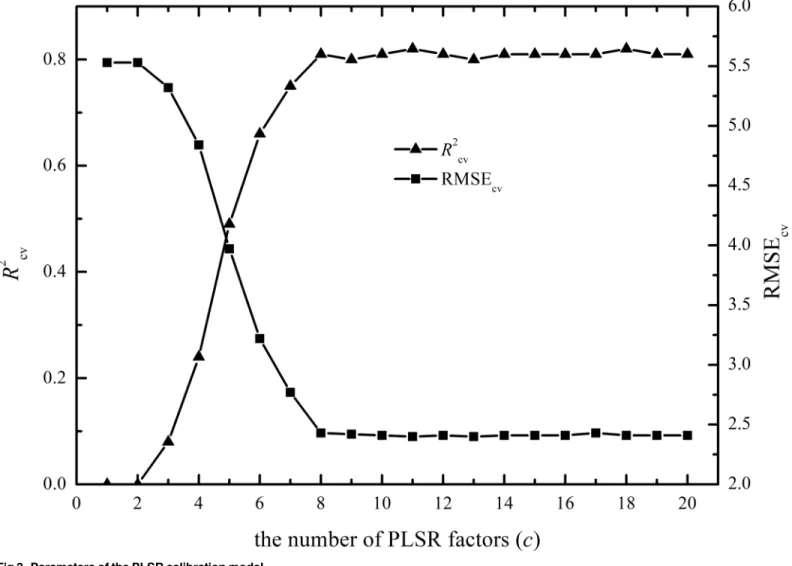
For dataset A, thecparameter must be optimized, which corresponds to the number of PLSR factors (latent variables or orthogonal factors). Thus, we selected the optimalcvalue by choosing the lowest RMSEcvandR2cvvalues of the calibration models with differentcvalues.
When the number of PLSR factors that resulted in the lowest RMSEcvvalues did not
corre-spond with the number of PLSR factors that resulted in the largestR2cvvalues,R2cvwas
consid-ered more important than RMSEcv. We calculated the RMSEcvandR2cvvalues using 20 more
PLSR factors, which indicated that the RMSEcvandR2cvvalues did not change after 20 PLSR
factors. Therefore, the use of additional PLSR factors was meaningless and ineffective. Conse-quently, we used a maximumcvalue of 20 in this study to show the RMSEcvandR2cvresults.
For a range of PLSR factors (cvalues of 1 to 20), we derived different PLSR calibration models by using the subset Ac(calibration dataset of SNV spectra; N = 380). Next, we calculated the
RMSEcvandR2cvvalues of the calibration models for differentcvalues and selected the optimal cvalue with the lowest RMSEcvand highestR2cvvalues.
In addition to thecvalue, the optimal value ofkmust be determined for dataset B, which is the number of EPO dimensions. For eachkvalue between 1 and 10, we calculated the projec-tion matrixPand then corrected the dataset usingP. The PLSR model was established for each value ofc(from 1 to 20) for each dataset formed by the corrected spectra using each value ofk. Thus, there werek×c(the combination ofkandc) PLSR models in the process, and the opti-mal numbers forkandcwere determined by using the lowest RMSEcvand highestR2cvvalues.
Accuracy assessment
Various parameters were calculated to determine the accuracies of the models, including the coefficient of determination in the cross validation (R2cv), the coefficient of determination in
the prediction (R2p), the root mean square error of cross validation (RMSEcv), the root mean
square error of prediction (RMSEp), and the ratio of the standard deviation to the root mean
square error of prediction (RPD).
RPD¼SD=RMSEp ð7Þ
where SD is the standard deviation of the measured values of the prediction samples.
Results
Soil moisture effects before and after EPO
As expected, the original spectra from the soils with the same salt contents were different under different moisture conditions (Fig 2a). The shapes of the spectra were similar, with obvi-ous absorption features near 1400, 1900, and 2200 nm. These features are mainly associated with—OH (e.g., the—OH features of free water occur at 1400 and 1900 nm and lattice—OH features occur at 1400 and 2200 nm [36]). The reflectance value across the entire wavelength domain decreased as the soil moisture content increased; thus, the soil moisture content had a large influence on reflectance, which masked the subtle responses of various salt contents on reflectance and should not be ignored.
After EPO correction, which transformed the spectra into a space that was nearly unaffected by moisture content, the condition remarkably improved. SNV minimized the differences between the original spectra and the spectra obtained at various soil moisture contents (Fig 2a vs. 2b). However, the shapes of the SNV spectra were different, especially near the water absorption bands of approximately 1400 and 1900, and 2200 nm, which were related to clay minerals. The SNV transformation that was performed on the individual spectrum was intended to reduce spectral noise and eliminate background effects. Obviously, the SNV trans-formation could not correct the spectra for soil moisture effects; therefore, the soil spectra var-ied for different soil moisture conditions.
However, after EPO correction, the spectra under various soil moisture conditions were identical, and the differences among the water absorption bands were not obvious (Fig 2c). The spectra representing the unwanted portion are shown inFig 2d, and the spectra from the soil samples with different moisture contents were different at all wavelengths, especially near the major absorption wavelengths of 1400, 1900 and 2200 nm. Thus, the EPO algorithm success-fully eliminated the effects of soil moisture from the spectra.
Prediction of SSCs using the PLSR method
The EPO correction resulted in an improved spectral response to changes in salt contents once the influence of soil moisture was removed. Therefore, we evaluated the performance of EPO corrections for predicting SSCs by PLSR.
For dataset A, the RMSEcvandR2cvvalues did not obviously change when the PLSR factor
was greater than 8 (Fig 3). Therefore, we selectedc= 8.
For dataset B, the highestR2cv(0.93) and lowest RMSEcv(1.45 g kg-1) values were obtained
when using an EPO dimension of 2, and theR2cvand RMSEcvvalues did not obviously change
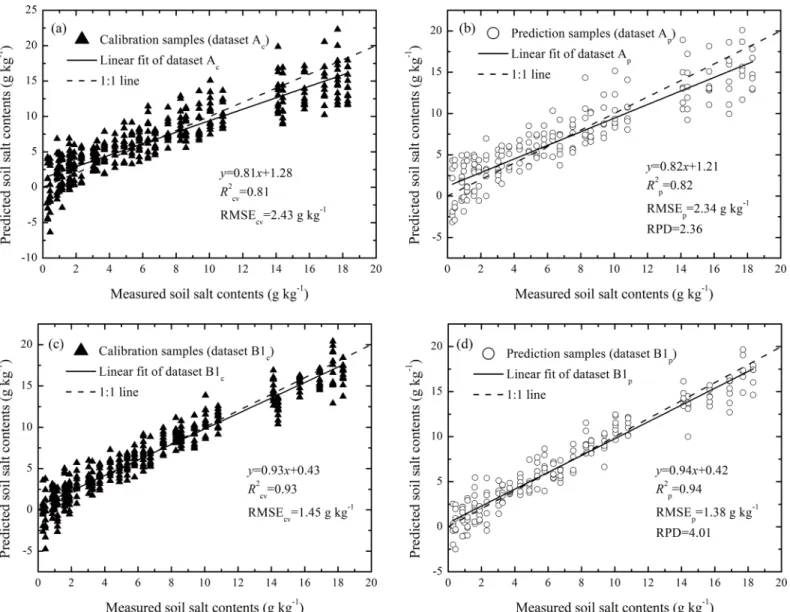
RMSEcv= 2.43 g kg−1(Fig 5a). Using the model calibrated by subset Ac, the SSCs were
pre-dicted using subset Apwith the following values:R2p= 0.82, RMSEp= 2.34 g kg-1and
RPD = 2.36. In this case, the fitted linear regression line deviated from the 1:1 line (Fig 5b). However, for dataset B, the calibration and prediction results both improved relative to dataset A. The relationships between the measured and predicted SSCs from calibrating and predicting dataset B are shown inFig 5c and 5d, respectively. TheR2pvalues were>0.90, and the RMSEp
values were<1.50 g kg-1. The slope of the fitted linear regression equation of the prediction dataset was nearly 1 with RPD = 4.01 (Fig 5d).
These results suggested that the prediction accuracy was greatly improved, with highR2
and RPD values and low RMSE values when the influences of soil moisture on reflectance were removed using EPO relative to uncorrected spectra under various soil moisture conditions.
Fig 2. (a) The original reflectance spectra, (b) SNV spectra, (c) EPO spectra and (d) the spectra of the unwanted portion of one sample with the same soil salt content and different soil moisture contents (g g-1).
Discussion
In this study, soil spectra were obtained at various soil salt and moisture contents. We observed that soil moisture could shape reflectance spectra and mask the subtle effects of SSCs on reflec-tance spectra. The spectra with the same SSCs were considerably different among the different moisture contents without EPO correction (Fig 2a and 2b); however, the spectra were similar to one another after EPO (Fig 2c), which suggested that the moisture effects were effectively eliminated. The prediction accuracies of the models built on the EPO-corrected spectra were considerably greater than those of the models built on uncorrected spectra, with higherR2and RPD values and lower RMSE values. The better performance of the model built on EPO-cor-rected spectra mainly occurred because the effects of soil moisture on reflectance were largely removed by the EPO projection.
Many studies have successfully applied the EPO method to remove the effects of external factors from spectral reflectance [25–29]. Compared with the study conducted by Minasny et al. [28], this study provides a better method for establishing the difference matrixD, which is important for the EPO process and the experimental design. First, in contrast with our method of using averaged moisture contents from 17 soil samples (at 0.03 g kg-1intervals) to establish
Fig 3. Parameters of the PLSR calibration model.
D, Minasny et al. [28] used rewetted samples from the first and third days. The method used in our study is similar to the method provided by Roger et al. [25], which has been successfully used to remove external parameter effects. Second, the study of Minasny et al. [28] involved rewetted samples with averaged moisture contents of 0 to 18% (gravimetric). Our study consid-ered a wider range of moisture contents (from 2% to 51%) that were closer to the actual field conditions and we used a different rewetting method in which water was added to the bottom of the dish rather than to the soil surface. This method allowed the samples to soak up the water, which resulted in more uniform moisture conditions in each sample and a wider range of soil moisture contents (from air dry to field moisture capacity). The good prediction results (R2p>0.90 and RMSEp<1.50 g kg-1) after the EPO correction indicated that our method for
establishingDwas appropriate in the studied area for eliminating soil moisture effects when predicting SSCs. The results of our study verified that the EPO correction could be applied to soils with all levels of moisture without sacrificing robustness.
The fitted numbers of EPO dimensions (k) and PLSR factors (c) are important because they significantly affect prediction accuracy and efficiency (Figs3and4); thus, it is important to select optimal numbers for the two parameters. Selecting optimalcandkvalues with the high-estR2and lowest RMSE values is the most common method for determining these optimal parameters and was used in this study [25,28,29].
Because the difference matrix,D, can greatly affect estimations ofG,^ Q and^ P, the methods^ and samples used to constructDare both important. TheDmatrix was defined as a difference matrix and should be built with spectra that show sufficient variation in their external parame-ters. Thus, the projection matrix,P, can be effective. In this study, all three base soils were used to establishD,which contained both soil moisture content variations and soil property varia-tions. Thus, thePmatrix was effective for all of the soil samples. In addition, thePmatrix derived from each of the three base soils was used to correct all of the soil samples and yielded satisfactory results. These results indicated that thePmatrix from a small dataset could be applied to a large dataset, which will be verified in our future work.
Because our study area was not very large and was located on the coastal plain, the 102 soil samples collected from the field all had the same texture according to the WRB and USDA
Fig 4. (a)R2
cvand (b) RMSEcvvalues of SSCs in dataset B using the corrected spectra with different numbers for the EPO dimension (k, denoted in
the legend) and PLSR factor (c, denoted on the x- axis).
texture classification schemes. Thus, the variations in the three base soils used in this study were limited, it remains unclear whether EPO can be used in areas that are more complex, and the number of samples required to constituteDremains unknown. We are looking forward to solving these unknown factors in our ongoing work.
Because the dominant soluble salt in our study area was sodium chloride (NaCl), our study focused on soils rich in NaCl and did not consider the effects of salt type on the robustness of the EPO model. This effect must be investigated in other areas to determine whether this method is effective for soils containing other types of salts, such as soda, chloride-soda, sulfate-soda and other anion groups. Furthermore, the model we provide was based on controlled lab-oratory experiments and was not validated for field applications. Field measurements must consider naturally varying salt and moisture conditions and other soil properties (e.g., soil tex-ture) that are different from the conditions used in this study. Thus, additional field investiga-tions should be conducted.
Fig 5. Scatter plots of the measured vs. predicted soil salt contents (SSCs) that were derived from the PLSR analysis of soil spectra based on subsets (a) Ac, (b) Ap, (c) Bc, and (d) Bp.
The data processing approach used in this study offers a rapid and inexpensive method for quantifying the spatial variability of soil salinity for agricultural purposes, which can provide appropriate information for managing agricultural inputs, such as tillage, water, fertilizer, and seeds, according to the magnitude of salinization. Because soil moisture is highly variable and difficult to control in the field, we hypothesize that the method proposed in this study will facil-itate the acquisition of soil properties from field spectral reflectance with improved efficiency and accuracy at a reduced cost. Thus, the rapid and inexpensive collection of precise, quantita-tive, fine resolution data using proximal remote sensing will be much easier.
Conclusions
Soil moisture significantly influences the reflectance of saline soil and reduces the accuracy of soil salinity estimations when using vis—NIR techniques. The EPO method provides an effec-tive method for removing the effects of soil moisture when estimating SSCs and improves the prediction accuracy of SSCs relative to spectra without EPO correction. This approach may facilitate a field method for rapidly measuring SSCs; thus, we expect that this method will be widely applied for large-scale SSCs mapping.
Supporting Information
S1 File. Vis-NIR spectra of 570 samples.To every tenth wavelength was retained to reduce the size of the file.
(XLSX)
Author Contributions
Conceived and designed the experiments: XZP YL. Performed the experiments: YL RJS YLL. Analyzed the data: YL XZP. Contributed reagents/materials/analysis tools: YL CKW. Wrote the paper: YL XZP.
References
1. FAO. Salt-affected soils and their management. In: FAO, Soils Bulletin, 39. Food and Agriculture Orga-nization of the United Nations, Rome; 1988.
2. Corwin DL, Lesch SM. Application of soil electrical conductivity to precision agriculture. Agron J. 2003; 95: 455–471.
3. Dehaan RL, Taylor GR. Field-derived spectra of salinized soils and vegetation as indicators of irriga-tion-induced soil salinization. Remote Sens Environ. 2002; 80: 406–417.
4. Metternicht GI, Zinck JA. Remote sensing of soil salinity: potentials and constraints. Remote Sens Envi-ron. 2003; 85: 1–20.
5. Wang Q, Li PH, Chen X. Modeling salinity effects on soil reflectance under various moisture conditions and its inverse application: A laboratory experiment. Geoderma. 2012; 170: 103–111.
6. Nanni MR, DemattêJAM. Spectral reflectance methodology in comparison to traditional soil analysis. Soil Sci Soc Am J. 2006; 70: 393–407.
7. Shepherd KD, Walsh MG. Development of reflectance spectral libraries for characterization of soil prop-erties. Soil Sci Soc Am J. 2002; 66: 988–998.
8. Ben-Dor E. Quantitative remote sensing of soil properties. Adv Agron. 2002; 75: 173–243.
9. Nocita M, Stevens A, van Wesemael B, Brown DJ, Shepherd KD, Towett E, et al. Soil spectroscopy: an opportunity to be seized. Global Change Biol. 2015; 21: 10–11.
10. Summers D, Lewis M, Ostendorf B, Chittleborough D. Visible near-infrared reflectance spectroscopy as a predictive indicator of soil properties. Ecol Indic. 2011; 11: 123–131.
12. Metternicht GI, Zinck JA. Spatial discrimination of salt- and sodium-affected soil surfaces. Int J Remote Sens. 1997; 18: 2571–2586.
13. Weng YL, Gong P, Zhu ZL. A spectral index for estimating soil salinity in the Yellow River Delta Region of China using EO-1 hyperion data. Pedosphere. 2010; 20: 378–388.
14. Zhang TT, Zeng SL, Gao Y, Ouyang ZT, Li B, Fang CM, et al. Using hyperspectral vegetation indices as a proxy to monitor soil salinity. Ecol Indic. 2011; 11: 1552–1562.
15. Csillag F, Pasztor L, Biehl LL. Spectral band selection for the characterization of salinity status of soils. Remote Sens Environ. 1993; 43: 231–242.
16. Hick RT, Russell WGR. Some spectral considerations for remote sensing of soil salinity. Soil Res. 1990; 28: 417–431.
17. Jin P, Li P, Wang Q, Pu Z. Developing and applying novel spectral feature parameters for classifying soil salt types in arid land. Ecol Indic. 2015; 54: 116–123.
18. Szilagyi A, Baumgardner MF. Salinity and spectral reflectance of soils. In Proceedings of the Annual Meeting of ASPRS/ACSM, 25–29, March, Baltimore, Maryland; 1991. pp. 430–437.
19. Bricklemyer RS, Brown DJ. On-the-go VisNIR: Potential and limitations for mapping soil clay and organic carbon. Comput. Electron Agr. 2010; 70: 209–216.
20. Lobell DB, Asner GP. Moisture effects on soil reflectance. Soil Sci Soc Am J. 2002; 66: 722–727.
21. Minasny B, McBratney AB, Pichon L, Sun W, Short MG. Evaluating near infrared spectroscopy for field prediction of soil properties. Soil Res. 2009; 47: 664–673.
22. Liu HJ, Zhang YZ, Zhang XL, Zhang B, Song KS, Wang ZM, et al. Quantitative analysis of moisture effect on black soil reflectance. Pedosphere. 2009; 19: 532–540.
23. Nocita M, Stevens A, Noon C, van Wesemael B. Prediction of soil organic carbon for different levels of soil moisture using Vis-NIR spectroscopy. Geoderma. 2013; 199: 37–42.
24. Rienzi EA, Mijatovic B, Mueller TG, Matocha CJ, Sikora FJ, CastrignanòA. Prediction of soil organic carbon under varying moisture levels using reflectance spectroscopy. Soil Sci Soc Am J. 2014; 78: 958–967.
25. Roger JM, Chauchard F, Bellon-Maurel V. EPO—PLS external parameter orthogonalisation of PLS
application to temperature-independent measurement of sugar content of intact fruits. Chemometr Intell Lab. 2003; 66: 191–204.
26. Amat-Tosello S, Dupuy N, Kister J. Contribution of external parameter orthogonalisation for calibration transfer in short waves—Near infrared spectroscopy application to gasoline quality. Anal Chim Acta.
2009; 642: 6–11. doi:10.1016/j.aca.2009.01.003PMID:19427453
27. Hansen CL, van den Berg F, Rasmussen MA, Engelsen SB, Holroyd S. Detecting variation in ultrafil-trated milk permeates-Infrared spectroscopy signatures and external factor orthogonalization. Chemo-metr Intell Lab. 2010; 104: 243–248.
28. Minasny B, McBratney AB, Bellon-Maurel V, Roger JM, Gobrecht A, Ferrand L, et al. Removing the effect of soil moisture from NIR diffuse reflectance spectra for the prediction of soil organic carbon. Geo-derma. 2011; 167–168: 118–124.
29. Wang CK, Pan XZ, Liu Y, Li YL, Shi RJ, Zhou R, et al. Alleviating moisture effects on remote sensing estimation of crop residue cover. Agronomy J. 2013; 105: 967–976.
30. World Reference Base for Soil Resources. International Soil Classification System for Naming Soils and Creating Legends for Soil Maps. World Soil Resources Report No 106, FAO, Rome; 2014. 31. Liu Y, Pan XZ, Wang CK, Li YL, Zhou R, Xie XL, et al. Prediction of coastal saline soil salinity based on
VIS-NIR reflectance spectroscopy. Acta Pedol Sin. 2012; 49: 824–829. Chinese
32. Boulet JC, Doco T, Roger JM. Improvement of calibration models using two successive orthogonal pro-jection methods. Application to quantification of wine mannoproteins. Chemometr Intell Lab. 2007; 87: 295–302.
33. Barnes RJ, Dhanoa MS, Lister SJ. Standard normal variate transformation and de-trending of Near-infrared diffuse reflectance spectra. Appl Spectrosc. 1989; 43: 772–777.
34. Igne B, Roger JM, Roussel S, Bellon-Maurel V, Hurburgh CR. Improving the transfer of near infrared prediction models by orthogonal methods. Chemometr Intell Lab. 2009; 99: 57–65.
35. Li D, Chen XZ, Peng ZP, Chen SS, Chen WQ, Han LS, et al. Prediction of soil organic matter content in a litchi orchard of South China using spectral indices. Soil Till Res. 2012; 123: 78–86.