Brazilian Journal of Physics, vol. 37, no. 2C, June, 2007 851
Jet Quenching Measurements at RHIC
Olga Barannikova1
1 University of Illinois at Chicago,
845 W. Taylor St. M/C 273 Chicago IL 60607-7059 USA
Received on 4 December, 2006; revised version received on 8 March, 2007
Experimental observation of jet quenching in ultra-relativistic heavy-ion collisions is one of the most re-markable discoveries at RHIC. High-pT hadron suppression, disappearance of back-to-back jets, and strong
away-side modification at intermediate to low pT have provided us many insights into the matter created at
RHIC. Particularly, angular correlations have become a powerful tool to study the QCD matter through its in-teractions with jets. Di-hadron correlations reveal significant broadening and softening of associated hadrons on the away side of a triggered high-pT particle. Many mechanisms have been proposed to accommodate the
data, including the intriguing Mach cone shock waves in a thermalized hydrodynamic matter, which can be discriminated by 3-particle correlations. Here a brief overview of these remarkable experimental measurements on jet quenching is presented and implications of these measurements are discussed.
Keywords: RHIC; Heavy ion; Jet quenching; Energy loss
I. INTRODUCTION
The physics program at RHIC has enabled remarkable ad-vances in the study of hot strongly interacting matter [1–4]. An extended reach in particle momentum at RHIC allowed for development of “hard probes” to study the behavior of the created medium that was difficult to access at lower collision energies. The hard penetrating probes are now one of the ma-jor experimental tools successfully explored at RHIC.
High pT hadrons are predominantly produced by initial
hard-scattered partons. Partons and/or fragmented hadrons need finite time to escape the collision zone, during which the dense medium is formed. During this time they may lose energy via strong interactions with the medium, therefore pro-viding the means to investigate its properties. The effect of energy loss due to these interactions with the medium is ap-parent in various experimental observations at RHIC. Two of the most striking early results showing large effects due to the traversed matter wereRAB(pT), the ratio of hadron yields in
A+B (either Au+Au or d+Au) collisions to pp, corrected for geometric effects via scaling by number of binary (nucleon-nucleon) collisions [5–7], and the disappearance of back-to-back jets in the di-hadron azimuthal correlations [8].
The suppression of hadrons, apparent in inclusive charged hadron measurements as well as in identified hadrons (see, for example, Fig. 1), begins in the intermediate sector (pT ∼
2 GeV/c), then saturates and remains constant as a function of pT throughout the entire hard region accessible in the
ex-perimental data. Conventional nuclear effects, such as nu-clear shadowing of the parton distribution functions and initial state multiple scattering, cannot account for the observed sup-pression. Also, such suppression is not seen in d+Au colli-sions, indicating that it is a final-state effect associated with the matter produced in Au+Au events [9]. The results are consistent with the effects of parton energy loss in travers-ing dense medium, predicted before the data were available [10, 11]. Those pQCD calculations can efficiently describe both the centrality- and pT-dependence of the observed
sup-pression. To reproduce the magnitude of the suppression,
however, these calculations need to assume that the initial gluon density is more than an order of magnitude (∼30 times)
greater than that of cold, confined nuclear matter (or energy density of ∼100 times higher) [12]. At the same time, a
hadronic transport calculation [13] also leads to conclusion that the absorption of formed hadrons in the medium fails to account for the magnitude of the observed suppression. Re-cent experimental results of single inclusive measurements are discussed in greater details in [14].
(GeV/c) T p
0 1 2 3 4 5 6 7 8 9 10
R
0 0.2 0.4 0.6 0.8 1 1.2 1.4 1.6 1.8 2
=200 GeV
NN
s
neutral pions - dAu min. bias (PbGl)
dA
R
- dAu min. bias (PbSc)
dA
R
- AuAu 0-10% central
AA
R
FIG. 1: PHENIX measurements [6] of nuclear modification factors
RAB(pT)for minimum bias d+Au and central Au+Au collisions
il-lustrate the strong suppression of pion yields in central Au+Au col-lisions, in comparison to the expectations fromppcollisions, scaled by the number of contributing binary collisions. No suppression is observed in the d+Au data.
II. DIRECT DI-JET OBSERVATION
852 Olga Barannikova
0 2 4
0 0.5 1 1.5 2
|<1.0 η |
pp Au+Au 5%
0.15 < p < 4 < ptrig < 6 GeV/c
φ∆
d
ch
dN
trig
N
1
φ ∆
FIG. 2: Background-subtracted∆φdistributions forppand central Au+Au data by STAR [15]. As seen in the plot, more soft associated hadrons are found per trigger particle in central Au+Au than in pp, on both the near and away sides.
0.1 0.2 0.3
0.05 0.1 0.15 0.2
0.05 0.1
(assoc) < 4
T
3 < p
(assoc) < 6
T
4 < p
(assoc) > 6
Tp
(rad)
φ ∆
0 π 0 π 0 π
d+Au Au+Au, 20-40% Au+Au, 0-5%
)
φ∆
d(
dN
trig
N
1
FIG. 3: STAR measurements of di-hadron azimuthal correlations as-sociated with a charged hadron trigger with 8<pT<15 GeV/cfor
200 GeV Au+Au and d+Au collisions.
with pp and peripheral Au+Au collisions, the momentum-balancing hadrons, associated with a high-pT trigger hadron
on away side, are greater in number, dispersed wider in az-imuthal angle, and significantly softer (Fig. 2). These results indicate that particles from two different sources, initial hard-scattered partons (or jets) and the bulk medium, have inter-acted intensively approaching to some degree equilibration with each other. This may in fact reflect a high degree of ther-malization in the medium itself, a necessary condition for the formation of quark-gluon plasma. It has been found also that correlation strength is sensitive to the in-medium path length of the parton [16], confirming the jet-medium interaction as a source for the observed modifications.
)
T
D(z
-1 10
1
| < 0.63 φ ∆ Near side, |
d+Au min bias Au+Au 20-40% Au+Au 0-5%
| < 0.63 π - φ ∆ Away side, |
0.4 0.6 0.8 1
dAu
/ D
AuAu
D
0 1
(trig) T (assoc) / p T = p T z
0.4 0.6 0.8 1
FIG. 4: Upper panels: trigger-normalized charged hadron fragmenta-tion funcfragmenta-tion D(zT) with triggers 8<pT<15 GeV/c, for near- (left)
and away-side (right) correlations in 200 GeV d+Au and Au+Au col-lisions. Lower panels: ratio of D(zT) for Au+Au relative to d+Au.
With the increased statistics of experimental data, the di-hadron azimuthal correlation studies have advanced substan-tially in recent years in terms of transverse momentum reach. A new effect, in contrast to the previously seen disappear-ance or modification of the away-side jet in central Au+Au collisions, has been observed for an intermediate transverse momentum threshold. Di-hadron azimuthal correlations, in which the trigger and the associated particle are both from the hard sector, show clear jet-like peaks in both near- and away-sides (Fig. 3) [17]. Little modification is apparent in the shape of the peaks, but the height of the away-side peak shows a clear suppression in central Au+Au collisions with respect to that in d+Au collisions. Systematic studies of correlation strengths and shapes provided further insights about the prop-erties of the matter formed at RHIC. An observed increase in the correlated yield on a trigger side with increasing trigger pT is expected in a jet fragmentation picture due to bias
to-wards higherET jets provided by higherpT trigger.
Suppres-sion of the away side peak is consistent with the observation of the hadron suppression in the single inclusive and measure-ments. However, as mentioned, no significant shape modifica-tions of an away-side peak is observed at this high momentum range. This counter-intuitive observation is in contrast with a multiple scattering scenario, where one would expect that the strong suppression to be accompanied by a broadening of the away-side peak [18, 19].
No effects of the jet-medium interactions at highpT are
Brazilian Journal of Physics, vol. 37, no. 2C, June, 2007 853
range ofzT=pTassoc/pTtrigforpp, d+Au and Au+Au colliding
systems. Strong away-side hadron suppression at highpTthat
is not accompanied by modification of angular correlations or momentum distributions suggests in-medium partonic energy loss followed by in-vacuum fragmentation and provides chal-lenges for many theoretical calculations.
III. THREE-PARTICLE CORRELATIONS
Although at RHIC jet fragmentation seem to be unaffected by the medium in a high energy limit, modifications of jet shapes and momentum distributions are quite significant in the intermediate and soft sectors. Not only are the correlated hadrons on the away side of the trigger particle found to be broadly distributed, their transverse momentum distribution is similar to that of the bulk, indicating partial thermalization of the jet products in the strongly interacting medium. The away-side broadening becomes increasingly prominent for the lower energy triggers. In fact, for some particular kinematic selections of correlated particles the overall broadening of the away-side distribution is accompanied by the developing of a dip at∆φ≈πas illustrated in Fig. 5 by PHENIX and STAR
measurements.
, ,
1.0PT assoc2.5PT trig4.0 GeV/c
AU+Au 0-5% PHENIX
φ ∆
0 0.5 1 1.5 2 2.5 3
0 0.1 0.2 0.3 0.4 0.5 0.6 0.7 0.8 0.9
STAR Preliminary
Au+Au 0-5%
<4 GeV/c
Trig T
<2.5<p
Assoc T
1<p
FIG. 5: ∆φ correlations in central 5% Au+Au collisions from PHENIX [20] (up) and STAR [21] (down).
This novel shape of the away side distributions stirred many theoretical discussion and investigations. Various scenarios and different mechanisms of jet-medium interactions have
been proposed to explain the experimental observations [22– 25]. In particular, shock wave induced conical flow (“sonic boom”), ˇCerenkov gluon radiation, and a “deflected jet” in-duced by interactions between the propagating partons and the flowing medium. Mach-cone shock waves in the hy-drodynamic medium would be generated at a certain pT
-independent angle, determined by the speed of sound in the medium. On the other hand, ˇCerenkov gluon radiation would be characterized by a pT-dependent angular spread of the
double-peak structure. Detailed studies of three particle cor-relations as function of transverse momentum of correlated particles could help discriminating various energy loss sce-narios. The importance of such investigations is recognized by both PHENIX and STAR experiments, which have recently reported preliminary results of three particle studies, employ-ing slightly different analysis techniques.
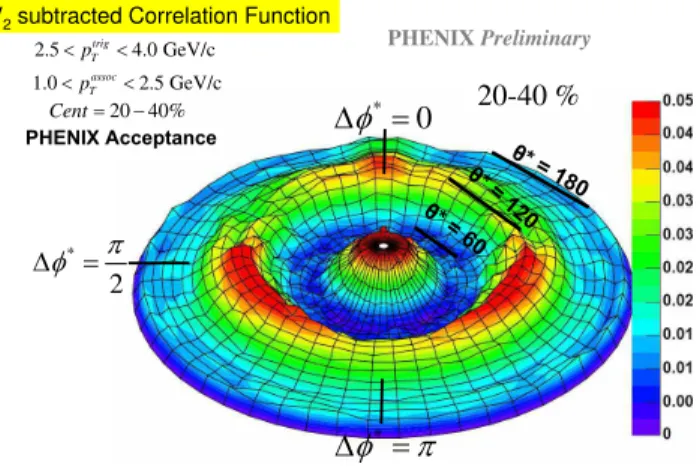
PHENIX studies jet properties via three-particle correlation functions built by combining a highpThadron in a transverse
momentum range 2.5<pT <4.0 GeV/cwith two lower pT
(1.0 to 2.5 GeV/c) associated hadrons in the frame of refer-ence, where Z-axis is defined by the highpT particle
momen-tum vector, and a two dimensional correlation function is ob-tained inθ∗,∆φ∗ space, whereθ∗ is the polar angle of one of the lowpT particles and∆φis the difference of azimuthal
angles of the two associated particles) [26]. Fig. 6 shows the resulting correlation surface (for 20-40% mid-central Au+Au data) after removal of the background contributions [27].
The away-side jet in this correlation analysis show a broad minimum at 180◦for most of the∆φ∗, and an apparent max-imum (or quite sizable correlation) in this distribution at the away-side angle of 120◦, that is intriguingly close to theoreti-cally estimated Mach-cone angle, and has been interpreted as initial evidence for a sonic boom in hot QCD matter. Studies are underway to evaluate all possible background contribu-tions to the measured correlation.
V2subtracted Correlation Function
2.5 4.0 GeV/c 1.0 2.5 GeV/c
trig T assoc T
p
p
20 40%
Cent
ș
* = 120
ș
* = 60
ș
* = 180
* 2
S I '
*
I
S
'
* 0
I
'PHENIX Acceptance
PHENIXPreliminary
20-40 %
FIG. 6: Three particle correlation surface for charged hadrons detected in semi-central (20-40%) Au+Au collisions within the PHENIX acceptance.
854 Olga Barannikova
trig φ
-1 φ
= 1 φ ∆
trig
φ
-
2φ
=
2φ∆
2φ∆d
1φ∆
d
N2
d
trigN 1
-1 0 1 2 3 4 5
-1 0 1 2 3 4 5
-0.02 0 0.02 0.04 0.06 0.08 0.1 0.12
-1 0 1 2 3 4 5
-1 0 1 2 3 4 5
-0.02 0 0.02 0.04 0.06 0.08 0.1
-1 0 1 2 3 4 5
-1 0 1 2 3 4 5
-0.05 0 0.05 0.1 0.15
-1 0 1 2 3 4 5
-1 0 1 2 3 4 5
-0.2 -0.1 0 0.1 0.2 0.3 0.4 0.5 STAR Preliminary
FIG. 7: Background subtracted 3-particle azimuthal correlations from STAR for pp (top left), d+Au (top right), Au+Au 50-80% (bot-tom left), and ZDC triggered 0-12% central Au+Au (bot(bot-tom right).
systems studied (Au+Au, d+Au and pp collisions at 200 GeV) the kinematic selection is slightly different than that of PHENIX selections: trigger particles are selected in the transverse momentum range of 3.0<pT <4.0 GeV/c, and
the correlation function is build with hadrons with transverse momentum between 1.0<pT <2.0 GeV/c. The correlation
surface reveals more details about the jet fragmentation and propagation through the medium. The elongation of away-side peak along the diagonal in the∆φ1,∆φ2space is already
observed in ppand d+Au data and is interpreted as possible effects ofkT broadening. This elongation becomes more
pro-nounced in Au+Au collisions potentially indicating the pres-ence of some additional mechanisms, such as for example deflected jets, contributing to shape of the observed correla-tion. Observation of off-diagonal peaks evident in more
cen-tral Au+Au data is consistent with conical flow or ˇCerenkov radiation scenarios. Further detailed studies of the precise lo-cation and the pT dependence of this off-diagonal structure
should provide the discriminating power between the two sce-narios.
IV. SUMMARY
In summary, significant advances have been made in hard sector studies at RHIC by means of single- and di-hadron penetrating probes. The magnitudes of the measured sup-pressions of high pT yields and jet-like angular correlations
in central Au+Au collisions suggest that the initial energy density of the created medium is orders of magnitude larger than the normal nuclear density. Clear evidence of energy loss is apparent in both soft-hard and hard-hard correla-tions. Re-emerging of the away side jet at higher transverse momentum allows to investigate directly the features of jet fragmentation functions in heavy-ion collisions. Observation of unmodified associate distributions suggests that fragmen-tation time exceeds the medium traversal time of the leading parton. Recent results of energy loss studies via three-particle correlation techniques by both PHENIX and STAR yielded very suggestive results, with evidence for both presence of the deflected jets and conical emission, that seem to support a Mach-cone shock waves emission at RHIC. Studies are underway to evaluate all possible background contributions of those complex analyzes and finalize the results, so that the speed of sound and the equation of state for the medium created at RHIC could be extracted.
Acknowledgments
The author would like to thank the organizers for the kind invitation to participate in this conference. This work was supported by a grant from the US Department of Energy DE-FG02-94ER40865.
[1] I. Arseneet al.(BRAHMS), Nucl. Phys. A757, 1 (2005). [2] K. Adcoxet al.(PHENIX), Nucl. Phys. A757, 184 (2005). [3] B. B. Backet al.(PHOBOS), Nucl. Phys. A757, 28 (2005). [4] J. Adams etal.(STAR), Nucl. Phys. A757, 102 (2005). [5] I. Arseneet al.(BRAHMS), Phys. Rev. Lett.91, 072301 (2003). [6] S. Adleret al.(PHENIX), Phys. Rev. Lett.91, 072303 (2003). [7] B. Backet al.(PHOBOS), Phys. Rev. Lett.91, 072302 (2003). [8] J. Adams etal.(STAR), Phys. Rev. Lett.91, 072304 (2003). [9] J. Adamset al.(STAR), Phys. Rev. Lett.91, 072304 (2003). [10] I. Vitev and M. Gyulassy, Phys. Rev. Lett.89, 252301 (2002). [11] X.-N. Wang, nucl-th/0305010.
[12] X.N. Wang, Phys. Lett. B595, 165 (2004).
[13] W. Cassing, K. Gallmeister, and C. Greiner, Nucl. Phys. A735, 277 (2004).
[14] J. Lajoie, in these proceedings Braz. J. Phys.37, 825 (2007). [15] J. Adamset al.(STAR), Phys. Rev. Lett.95, 152301 (2005). [16] J. Adamset al.(STAR), Phys. Rev. Lett.93, 252301 (2004).
[17] J. Adamset al.(STAR), Phys. Rev. Lett.97, 162301 (2006). [18] R. Baieret al., Nucl. Phys. B484, 265 (1997).
[19] I. Vitev, Phys. Lett. B630, 78 (2005).
[20] S. Adleret al.(PHENIX), Phys. Rev. Lett.97, 052301 (2006). [21] J. Ulery (STAR), Nucl. Phys. A774, 581 (2006).
[22] H. Stoecker, Nucl. Phys. A750, 121 (2005)
[23] J. Casalderrey-Solana, E. V. Shuryak and D. Teaney, J. Phys. Conf. Ser.27, 22 (2005); Nucl. Phys. A774, 577 (2006). [24] J. Ruppert and B. Muller, Phys. Lett. B618, 123 (2005). [25] V. Koch, A. Majumder, and X. N. Wang, Phys. Rev. Lett.96,
172302 (2006).
[26] N. Ajitanand (PHENIX), Nucl. Phys. A783, 519 (2007). [27] N. Ajitanandet al., Phys. Rev. C72, 011902 (2005). [28] F. Wang, nucl-ex/0610027 (2006).
![FIG. 1: PHENIX measurements [6] of nuclear modification factors R AB ( p T ) for minimum bias d+Au and central Au+Au collisions il-lustrate the strong suppression of pion yields in central Au+Au col-lisions, in comparison to the expectations from pp coll](https://thumb-eu.123doks.com/thumbv2/123dok_br/18982886.457705/1.892.496.806.571.785/phenix-measurements-modification-collisions-lustrate-suppression-comparison-expectations.webp)