1 INTRODUCTION
Tracking features along image sequences has been a long-standing problem in Computational Vision, as no known framework has been able to demonstrate its robustness to all kinds of changeling problems that may occur (for instance, image sequences with complex motions, cluttered scenes, noisy data, oc-clusions, topology variations or high number of mage frames to analyze). To accomplish that goal, many attempts have been made. However, none is known to be able to automatically detect, track and interrupt the procedure when appropriate, indepen-dently of the scenes’ conditions or features’ motion.
The tracking results are not independent of the used methodology, and their outcome may vary ac-cording to the used approaches. In this paper, the tracking of feature points is done on a stochastic strategy. Thus, to contribute to the purpose of ro-bustness, we compare the results obtained with two stochastic filters, which can be used in a tracking framework.
The Kalman Filter (KF) is a well known efficient recursive approach that optimally estimates the state of a linear dynamic system from a series of noisy measurements. It is composed by a set of mathemat-ical equations that provide an efficient computation-al mean to estimate the state of a system, in a way that minimizes the mean of the squared error. The KF is very powerful in several aspects: it supports estimations of past, present and even future states, even when the precise nature of the modeled system
is unknown, [Welch & Bishop (2006)]. However, its major drawback is it linear assumption; that is, the KF tries to estimate the state of a discrete-time con-trolled process that is governed by a linear stochastic difference equation; consequently, it does not relia-bly overcome nonlinear occurrences.
Therefore, to overcome KF’s drawbacks, other filters have been proposed, as the Unscented Kalman Filter (UKF). These filters endeavor to propagate mean and covariance information through nonlinear transformations. Regarding the UKF, the authors present it as more accurate, easier to implement, and indicate that it uses the same order of computation as the linearization, [Julier & Uhlmann (2004)]. In this work, we will present and analyze the results ob-tained by these filters in a tracking framework. 1.1 Related Work
The Kalman Filter has been widely used, but to sur-pass its limitation several approaches have been sug-gested. For instance, the Extended Kalman Filter (EKF) is probably the most commonly used estima-tion algorithm for nonlinear systems. It linearizes about the current mean and covariance. However, more than 35 years of experience in the estimation community have shown that is difficult to imple-ment, complicated to tune, and only reliable for sys-tems that are almost linear on the time scale of the updates, [Julier & Uhlmann (2004)].
Comparison between Kalman and Unscented Kalman Filters in Tracking
Applications of Computational Vision
Raquel R. Pinho & João Manuel R. S. Tavares
Instituto de Engenharia Mecânica e Gestão Industrial, Lab. de Óptica e Mecânica Experimental Universidade do Porto, Faculdade de Engenharia
ABSTRACT: In this paper, the problem of tracking feature points along image sequences is addressed. The establishment of correspondences between points and their tracking along image sequences is a complex prob-lem in Computational Vision; especially, when intricate motions, erroneously detections or cases of occlusion or appearance/disappearing of features are involved. To overcome some of those difficulties, a statistical ap-proach is frequently used in a multi-object data association and state estimation framework. Additionally, the correspondence between each measurement and predicted feature can be performed by minimizing the overall Mahalanobis distance. Under these circumstances, the estimation of the system can be accomplished using different stochastic filters. Hereby, a comparison is made between the results obtained, with the described framework, either by the Kalman Filter or the Unscented Kalman Filter, in the tracking of linear and non-linear motions of feature points along image sequences.
A central and crucial operation performed in the KF is the propagation of a Gaussian Random Varia-ble (GRV) through the system’s dynamics. In the EKF, the state distribution is approximated by a GRV, which is then propagated analytically through the first-order linearization of the nonlinear system. This can introduce significant errors in the true post-erior mean and covariance of the transformed GRV, which may lead to sub-optimal performance and sometimes divergence of the filter.
Other filters have been proposed, such as the Ite-rated Extended Kalman Filter (IEKF), the Central Difference Filter (CDF) and the first order Divided Difference Filter. The conventional EKF and IEKF algorithms do not take the linearization errors into account, which leads to inconsistent state estimates when these errors cannot be neglected, [Lefebvre et al. (2003)].
The UKF addresses that problem by using a de-terministic sampling approach. The state distribution is again approximated by a GRV, which is represented using a set of carefully chosen sample points. These sample points completely capture the true mean and covariance of the GRV, and when propagated through the true nonlinear system, also approach the posterior mean and covariance accu-rately to the third order (Taylor series expansion) for any nonlinearity. The EKF, in contrast, only achieves first order accuracy. Remarkably, the computational complexity of the UKF is of the same order as the EKF’s, [Wan & Van Der Merwe (2000)].
A variation of the original UKF algorithm (called the Reduced Sigma Point Filters [Julier & Uhlmann (2002)]) chooses only n+1 sampling points. This
means that the linear regression through those points is exact; therefore, it does not take the linearization errors into account. Hence, as was the case for the (I)EKF, the state estimates are generally inconsis-tent, [Lefebvre, Bruyninckx and De Schutter (2003)].
An arising estimation model is the Particle Filter (PF): the key idea is to represent the posterior densi-ty function by a set of random samples with asso-ciated weights and to compute estimates based on these estimates and weights. Comparing PF to KF, the former has a more robust performance in the case of non-Gaussianity and non-linearity due to the si-mulated posterior distribution. In a PF, a large num-ber of particles are desirable to represent the post-erior distribution, especially in situations where new measurements appear in the tail of the prior, or if the likelihood is strongly peaked. To solve the computa-tional problem raised by the large particle numbers that can be generated, for example, in [MacCormick & Isard (2000)] a partitioned sampling is proposed, which requires that the state-space can be sliced. With the same purpose, Sullivan et al., in [Sullivan et al. (1999)], proposed layered sampling using mul-tiscale processing of images. It turns out that these
solutions significantly reduce the computational costs, but in-depth efforts are desirable for better ef-ficiency, [Zhou et al. (2009)].
In [Merwe et al. (2000)] an Unscented Particle Filter (UPF) is introduced. The UKF allows the PF to incorporate the latest observations into a prior up-dating routine. In addition, the UKF generates pro-posal distributions that match the true posterior more closely and also has the capability of generating heavier tailed distributions than the well known EKF. Consequently, the convergence results predict that UPF should outperform standard PF, EKF and UKF. However, its computational cost can also be questioned.
Other comparison studies between predictive fil-ters have been published; for example, in [LaViola (2003)] the performance of the UKF and EKF is compared towards improving human head and hand tracking using quaternions, and in [Lefebvre, Bruy-ninckx and De Schutter (2003)] the process and measurement update performances are studied sepa-rately, instead of analyzing their overall behavior of some KF variants.
Along the last years, numerous applications of state estimation have been reported, such as in sen-sor fusion and navigation, [Metzger et al. (2005)], state estimation for chemical processes, [Vachhani et al. (2005)], weather forecasting, [Carme et al. (2001)], and training of neural networks [Rios Neto (1997)].
1.2 Adopted Tracking Framework
In the applied tracking framework, the measured da-ta is integrated using optimization upon the corres-pondence step. The proposed criterion minimizes the global matching cost based on the Mahalanobis dis-tance, under the assumption that the matching cost is superior to a threshold value. To deal with the ap-pearance and disapap-pearance of features during the tracking process a management model is considered, [Pinho et al. (2007)].
1.3 Paper Overview
This paper is organized as follows. In the next sec-tions, a brief introduction is made to KF and UKF. In section 4, some experimental results are presented with synthetic and real image sequences. In the last section, the main conclusions are held as well as perspectives of future work.
2 THE KALMAN FILTER
The equations of the KF fall into main two groups: time update (or prediction) and measurement update (or correction) equations. The time update stage is responsible for projecting forward (in time) the cur-rent state and error covariance to obtain the a priori
estimates for the next time step. The measurement update phase is responsible for the feedback (i.e. for incorporating a new measurement into the a priori estimation to obtain an improved a posteriori ap-proximation), [Welch & Bishop (2006)].
The prediction step is based on the Chapman-Kolmogorov equation for a first order Markov process: 1 x x t t − + = Φ − , (1)
where Φ relates the system state x 1 t
+
− at the previous
time step t−1 to the state x
-t at the current step t.
The superscripts + and − indicate if the measure-ment data have been or not considered, respectively. The related uncertainty is given by:
1 T P P Q t t − = Φ + Φ + − , (2)
where P is the covariance matrix and Q models the
process noise.
The correction equations that update the predicted estimations upon the incorporation of new u
t
mea-surements are given by:
1 T T K P H HP Ht Rt t t − − − = + , (3) x x K ut Hxt t t t + = − + − − , (4) P I K H Pt t t + = − − , (5)
where K is chosen to be the gain that minimizes the
a posteriori error covariance equation, H processes
the coordinates transformation between the predicted space and the measurement space, R
t is the
mea-surement noise involved, and I is the identity
ma-trix.
3 THE UNSCENTED KALMAN FILTER As formerly mentioned the UKF addresses the major shortcomings of the EKF and is more appropriate for nonlinear movement. It considers a set of sigma-points from the distribution of the state vector x at
the beginning of the time step. Those points are all propagated through true nonlinearity, and the para-meters of the Gaussian approximation are then re-estimated. If these sigma-points are appropriately chosen, it can be shown that the mean and cova-riance of x at the end of the time step are pth-order
accurate for any nonlinearity, [Mariani & Ghisi (2007)]. The order p of accuracy depends primarily
on the number of sigma-points. In general, 2L+1
points are considered, being L the dimension of the
state vector, although other proposals have been made with fewer points (see, for instance, [Julier & Uhlmann (2002)]).
In the prediction phase, the sigma-points
{
,}
S wi i
i = χ , i=0, ..., 2L are obtained using the
un-scented transformation: ( )
(
)
( )(
)
0 if 1,..., if 1,...,2 x x L Px i L i i x L Px i L L i i χ χ λ χ λ = = + + = = − + = + , (6) with: 0 m w L λ λ = + , ( ) 1 2 0 c w L λ α β λ = + + − + , (7) and: ( ) 2 m c w w i i L λ λ = = + , if i=1, ..., 2L, (8)where w is the weight associated with the i ith
sig-ma-point such that:
2 1
0 L wi i
∑= = , (9)
and λ is a scaling parameter in order that ( )
(
L Px)
i
λ
+ is the ith column (or row) of the square
root of the weighted covariance matrix, (L )P x
λ
+ . The values of α and β parameters should be deter-mined experimentally.
Each sigma point is now propagated through the nonlinear function:
( )
Y g i
i = χ , (10)
with i=0, ..., 2L, and the approximated mean and
co-variance of y are as follows: 2 0 L yi w Yi i i ∑ ≈ = , (11) 2 ( )( ) 0 L T P w Yi i y Yi y y i ∑ ≈ − − = , (12)
( )
Z h i i = χ , (13) 2 0 L zi w Zi i i ∑ ≈ = . (14)The measurement update equations are given by:
2 ( )( ) 0 L T P w Zi i z Zi z zz i ∑ ≈ − − = , (15) 2 ( )( ) 0 L T P w Yi i y Zi z yz i ∑ ≈ − − = , (16) 1 yz zz K =P P− , (17)
( i )
y= +y K Z − , z (18)
T zz
P= −P KP K . (19)
The computational cost of the above algorithm is
( )
3 nϑ , being the most expensive operations the computation of the matrix square root and the outer products required to obtain the covariance of the projected sigma points.
4 EXPERIMENTAL RESULTS
The first example considers a synthetic sequence of eight images of 300x300 pixels, in which the cen-tre of a square is moving according to a linear model given by (in pixels):
5 0 250 0 30 1 250 1 x y xi xi yi yi = = = + − = − + . (20)
The tracking error, that is, the differences be-tween the estimated and measured features’ posi-tions, along the sequence is represented in Figure 1. In that figure, one can notice that the UKF gets bet-ter estimations for the undergoing motion, but as time goes by KF tends to draw near UKF results.
Figure 1. Tracking error associated to a point that undergoes the linear motion according to (20).
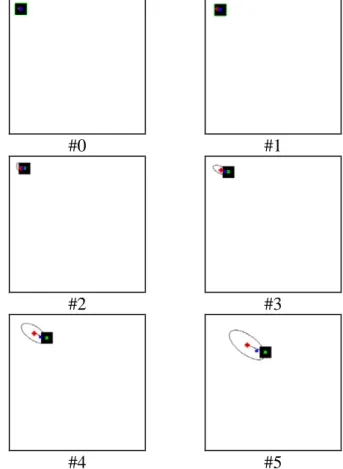
The second example is an image sequence com-posed by 6 frames with the same dimensions of the previous example, also synthetically built (Figures 2 and 3). In those images, the + crosses represent the filters’ prediction, the x crosses in the centre of the
tracked squares represent the accurate measurements and the x crosses between the other two represent the corrected results after the measurement incorpora-tion. But, in this case, the motion of the tracked fea-ture is defined by a nonlinear model (in pixels):
6 0 10 0 2 2( 1) 12.5 1 12.5 1 x y xi xi i yi xi = = = + − + − = + − . (21)
In this second example, the tracking error, represented in Figure 4 shows that as increases the features’ distance between frames, the UKF gets more accurate results than the KF, which can also be noticed in the obtained images, some of which represented in Figure 3.
In the third example, a real sequence of 30 images is considered, where three mice are tracked in im-ages of 320x240 pixels. Several difficulties arise in tracking the center of the mice’s bodies in the ac-quired images. One of which comprehends the fast movement of the mice, as they may go back and forth changing drastically their movement direction, or may move very quickly along one direction. Fig-ure 5 represents the tracking results obtained in 3 frames, at which the upper mouse changes severely its movement direction. However, as by visual ob-servation it is difficult to distinguish accurately the shown images results, in Figure 6 the tracking posi-tion error of the mice is represented. Hence, from Figure 6, one can notice that in general UKF (results represented by dashed lines) achieves better ap-proaches to the undergoing motion; nevertheless, in the case of the third mouse the results obtained by each filter are very similar. Moreover, as tracking was successfully accomplished by both filters, main-ly due to the used association approach, taking into account the computational cost related to the un-scented transformation, one can think that in this case KF could be more advantageous.
#0 #1
#2 #3
#4 #5
Figure 2. Tracking a point (the centre of the square) in a nonli-near sequence using KF.
#4 #5
Figure 3. Tracking results of the last frames of sequence in Fig-ure 2 using UKF.
Figure 4. Error involved in the nonlinear tracking of the square shown in Figure 2.
Figure 5. Tracking results for frames 15, 16 and 17 of a 30 im-age sequence obtained using KF and UKF.
5 CONCLUSIONS AND FUTURE WORK
In this paper, we have analyzed the influence of the used filter (KF and UKF) in the tracking of points undergoing linear and non-linear motions. In this
comparison one noticed that if the movement is highly nonlinear, then the UKF is worth its computa-tional load; otherwise, the KF with the undertaken matching methodology suits reasonably the tracking process with lower computational requirements.
Hence, the decision to use KF or UKF in this tracking framework is application dependent: if the computational requirements are strongly constrained, then KF can be considered with a good matching strategy; when such constrains are not presented, then UKF should be considered as it generally ob-tains more robust tracking results.
ACKNOWLEDGMENTS
We would like to thank Prof. Hemerson Pistori and Prof. João Bosco Monteiro (Dom Bosco Catho-lic University, Brazil) for gently sharing the mice image sequences used in the last experimental ex-ample.
This work was partially done in the scope of the research project Segmentation, Tracking and Motion
Analysis of Deformable (2D/3D) Objects using Physical Principles, with reference
POSC/EEA-SRI/55386/2004, financially supported by the Portu-guese FCT - Fundação para a Ciência e Tecnologia.
The first author would like to thank the support of her PhD grant SFRH/BD/12834/2003 from FCT.
Figure 6. Errors of the predicted position of the mice’s centre point motion in a real image sequence.
REFERENCES
Carme, S.; Pham, D. T.; Verron, J. 2001. Improving the singu-lar evolutive extended Kalman filter for strongly nonlinear models for use in ocean data assimilation. Inverse Problems 17(5): 1535/1559.
Julier, S.; Uhlmann, J. 2002. Reduced Sigma Point Filters for the Propagation of Means and Covariances Through Nonlinear
KF UKF
#15
#16
Transformations. American Control Conference Alaska, USA:887/892.
Julier, S. J.; Uhlmann, J. K. 2004. Unscented Filtering and Nonlinear Estimation. Proceedings of the IEEE 92(3): 401-422.
LaViola, J. J. 2003. A comparison of unscented and extended Kalman filtering for estimating quaternion motion. Proceedings
of the 2003 American Control Conference 3:2435/2440.
Lefebvre, T.; Bruyninckx, H.; De Schutter, J. 2003. Kalman fil-ters for nonlinear systems: a comparison of performance.
Inter-national Journal of Control 77(7): 639-653.
MacCormick, J.; Isard, M. 2000. Partitioned sampling, articu-lated objects, and interface-quality hand tracking. Proceedings
of the European Conference on Computer Vision:390-395.
Mariani, S.; Ghisi, A. 2007. Unscented Kalman filtering for nonlinear structural dynamics Nonlinear Dynamics Journal 49 (1-2): 131/150.
Merwe, R.; Doucety, A.; Freitas, N.; Wan, E. 2000. The Un-scented Kalman Filter Advances in Neural Information
Processing Systems 2000 Vancouver, Canada
Metzger, J.; Wisotzky, K.; Wendel, J.; Trommer, G. 2005. Sigma-point filter for terrain referenced navigation. AIAA
Guidance, Navigation, and Control Conference San Francisco,
California (U.S.A.)
Pinho, R.; Tavares, J.; Correia, M. 2007. An Improved Man-agement Model for Tracking Missing Features in Computer Vi-sion Long Image Sequences WSEAS Transactions on
Informa-tion Science and ApplicaInforma-tions 4(1): 196-203.
Rios Neto, A. 1997. Stochastic optimal linear parameter esti-mation and neural nets training in systems modelling. Journal
of the Brazilian Society of Mechanical Sciences 19(2):
138/146.
Sullivan, J.; Blake, A.; Isard, M.; MacCormick, J. 1999. Object localization by bayesian correlation. Proceedings of the
Se-venth International Conference on Computer
Vision:1068-1075.
Vachhani, P.; Rengaswamy, R.; Gangwal, V.; Narasimhan, S. 2005. Recursive estimation in constrained nonlinear dynamical systems. AIChE Journal 51 (3): 946/959.
Wan, E. A.; Van Der Merwe, R. 2000. The unscented Kalman filter for nonlinear estimation. IEEE Adaptive Systems for Signal Processing, Communications, and Control Symposium 2000 Lake Louise, Alta., Canada:153-158.
Welch, G.; Bishop, G. 2006. An Introduction to Kalman Filter. University of North Carolina at Chapel Hill
Zhou, H.; Yuan, Y.; Shi, C. 2009. Object tracking using SIFT features and Mean Shift. Computer Vision and Image