ABSTRACT: The non-linear estimators are certainly the most important algorithms applied to real problems, especially those involving the attitude estimation of spacecraft. The purpose of this paper was to use real data of sensors to analyze the behavior of Unscented Kalman Filter (UKF) in attitude estimation problems when it is represented in different ways and compare it with the standard estimator for non-linear estimation problems. The robustness of the estimation was performed when this was subjected to imprecise initial conditions. The attitude parametrization was described in Euler angles, quaternion and quaternion incremental. The satellite China-Brazil Earth Resources Satellite and measurements provided by the Satellite Control Center of the Instituto Nacional de Pesquisas Espaciais were considered in the study. The results indicate that the behaviors for both estimators were equivalent for such parameterizations under the same conditions. However, comparing the Unscented Kalman Filter with the standard ilter for non-linear systems, Extended Kalman Filter (EKF), it was observed that, in the presence of inaccurate initial conditions, the Unscented Kalman Filter presented a fast convergence whereas Extended Kalman Filter had problems and only converged later on.
KEYWORDS: Attitude estimation, Real data, Unscented Kalman Filter, Extended Kalman Filter, Quaternion, Euler angles.
Unscented Kalman Filter for Determination
of Spacecraft Attitude Using Different
Attitude Parameterizations and Real Data
Roberta Veloso Garcia1, Hélio Koiti Kuga2, Maria Cecília F. P. S. Zanardi3INTRODUCTION
he basic principle of state estimators is to produce a state estimate of the dynamic system at the current time using the knowledge of measurements at the current time and an estimate of the state at the previous time with knowledge of error associated with the system. here are several estimation methods, each one being suitable for a particular type of application. hus, it is necessary to evaluate the processing time and accuracy to be reached. he method to estimate the attitude used is Unscented Kalman Filter (UKF), since this estimator is capable of performing state estimation in non-linear systems, besides taking into account measurements provided by diferent attitude sensors. his paper considers real data supplied by gyroscopes, Earth sensors and solar sensors, which are on board of the China-Brazil Earth Resources Satellite (CBERS-2).
REPRESENTATION OF ATTITUDE
he attitude of a spacecrat is deined as its orientation with respect to some reference frame, and, for a successful mission, it is essential that the satellite is stabilized in a determined attitude. he attitude of a rigid body in three-dimension space can be represented in diferent ways, among which Euler angles and quaternions have been highlighted.
1.Universidade de São Paulo – Escola de Engenharia de Lorena – Departamento de Ciências Básicas e Ambientais – Lorena/SP – Brazil. 2.Instituto Nacional de Pesquisas Espaciais – Coordenação Geral de Engenharia e Tecnologia Espacial – Divisão de Mecânica Espacial e Controle – São José dos Campos/SP – Brazil.
3.Universidade Federal do ABC – Centro de Engenharia, Modelagem e Ciências Sociais Aplicadas – Santo André/SP – Brazil.
Author for correspondence: Roberta Veloso Garcia | Universidade de São Paulo – Escola de Engenharia de Lorena – Departamento de Ciências Básicas e Ambientais – Estrada Municipal do Campinho, s/n – Pte. Nova – CEP: 12602-810 - Lorena/SP – Brazil | [email protected]
REPRESENTATION OF ATTITUDE BY EULER ANGLES
he attitude of CBERS-2 satellite is stabilized in three axes called geo-pointed and can be described with respect to the orbital system. In this reference system, the motion around the direction of the orbital velocity is called roll; the motion
around the direction normal to the orbit is called pitch; and
the motion around the direction nadir/zenith is called yaw.
Deining the state vector composed by Euler angles (ϕ, θ and ψ)
and the componentes of the gyros bias (εx, εy, εz), and assuming
that ϕ and θ are small angles, the diferential equations of state
for attitude and bias of the gyros are modeled as follows (Silva et al. 2014):
Given that the gyro dataset is at a ixed rate and the angular velocity of the spacecrat system is constant throughout the sampling interval, a solution to q is presented by (Wertz 1978):
where: ϕ, θ and ψ are the attitude angles obtained by some
estimation process; ω0 is the orbital angular velocity; ωx, ωy and ωz are the components of the angular velocity ω on the satellite
system. he rotation sequence used in this paper for the Euler angles was the 3-2-1.
REPRESENTATION OF ATTITUDE BY QUATERNIONS
he quaternion is a four-dimensional vector, deined as (Markley et al. 2005):
with
where: n is the Euler axis and φ is the rotation angle. Because
a four-dimensional vector is used in the description of three dimensions, the quaternion elements cannot be independent and should comply with the constraint qTq = 1.
he parcel of attitude shown by Eq. 1 is represented by quaternions as:
where: Δt is the sampling interval; q(t) is the quaternion at
time t; q(t + Δt) is the quaternion propagated to the next time t + Δt; and Φq is the transition matrix that moves the system
from time t to t + Δt.
he transition matrix is given by:
where: Ω is the 4 × 4 antisymmetric matrix (Lefferts et al. 1982).
REPRESENTATION OF ATTITUDE BY QUATERNION INCREMENTAL
A diferent approach to represent the attitude is by quaternion incremental, where the quaternion is obtained by (Crassidis et al. 2007; VanDyke et al. 2004):
where: q is the estimated unit quaternion and δq(φ)
is a unit quaternion expressing the rotation from qto
the true attitude q, parameterized by a three-component
vector in terms of φ.
he supporting idea is that the three-vector δX will be
estimated and the correctly normalized four-componentq
provides a globally non-singular attitude representation. In this way, Eq. 7 shows that δq(φ) X q is the estimate of the true
attitude quaternion q. he main advantages of this option are
that q is a unit quaternion by deinition,the covariance matrix
has the minimum dimensionality, and the three-vector δX
ˆ ˆ
ˆ
ˆ
ˆ
ˆ ˆ
~
~ ~
ˆ
ˆ
ˆ
ˆ
ˆ
˙
(1)
(5)
(6) (4)
(2) (7)
never approaches a singularity, since it represents only small attitude errors. For small-angle approximation, the quaternion incremental is represented by (Crassidis et al. 2007):
unmodelled efects.
THE MEASUREMENT MODEL FOR INFRARED EARTH SENSORS
he Infrared Earth Sensors (IRES) are located on the satellite and aligned with its axes of roll and pitch, providing direct
measurements of these angles. he measurement equations for the Earth sensors are given by (Lopes and Kuga 2005): The quaternion incremental between the quaternion
“measured” and the estimated quaternion follows Eq. 7 and is deined by:
THE MEASUREMENTS SYSTEM OF
SATELLITE
he attitude of spacecrat can be determined by one or by a combination of several types of sensors. his section presents the mathematical models of the sensors that are on board the CBERS-2 satellite, which are responsible for the measures used in the estimation process.
THE MEASUREMENT MODEL OF GYROSCOPE
he advantage of using gyro measures is that it can provide the angular displacement and/or angular velocity of the satellite directly. However, gyros have an error due to driting (bias),
meaning that their measurement error increases with time. he rate-integration gyros (RIGs) are used to measure the angular velocities of the roll, pitch and yaw axes of the satellite. he
mathematical model of the RIGs is (Lopes and Kuga 2005):
where: ΔΘ are the angular displacements of the satellite
in a time interval Δt. hus, the measured components of the
angular velocity of the satellite are given by:
where: g is the output vector of the gyroscope; η represents
a Gaussian white noise process covering all the remaining
where: νϕ and νθ represent the Gaussian white noise related
to small remaining efects of misalignment during installation and/or assembly of sensors.
THE MEASUREMENT MODEL FOR DIGITAL SUN SENSORS
The Digital Sun Sensors (DSS) do not provide direct measurements but coupled angles of pitch (αθ) and yaw (αψ).
he measurement equations for the sun sensor are established as follows (Lopes and Kuga 2005):
where: Sx, Sy and Sz are the components of the unit vector
associated to the sun vector in the satellite system; the Gaussian white noises are represented by ναψand ναθ and represent small
effects of misalignment during installation and/or during sensor assembly.
ATTITUDE ESTIMATION BASED ON
NON-LINEAR KALMAN FILTER
he state of non-linear estimator covered in this study was UKF. he UKF uses the unscented transformation which calculates a set of samples, or sigma points, deined from the a priori mean and
covariance of the state (VanDyke et al. 2004). he sigma points
undergo the non-linear transformation, and the posterior mean and covariance of the state results from the transformed sigma points.
(8)
(9)
(12)
(13)
(10)
Consider the system model given by:
MEASUREMENT UPDATE STEP
To compute this step, irst we must transform the columns of χk through the measurement function to Yk. In this way:
where: f represents the non-linear vector function of state x with dimension n; y is the vector of sensor measurement
with dimension m; h is the function associated with the model
of sensors shown by Eqs. 12 and 13; ηand νrepresent the
process and measurement noise with Gaussian white noise and covariances given by Q and R respectively.
In this paper, the state vector is composed by attitude and
bias of gyro. he two forms used here are shown by Eqs. 1 and 4.
Given the state vector at step k − 1, we compute a collection
of sigma-points, stored in the columns of the n × (2n + 1) sigma
point matrix χk–1 in which n is the dimension of the state vector.
In our case, n = 6 for Euler angles parameterization, Eq. 1, or n = 7 for quaternion parameterization, Eq. 4. he columns of χk–1 are computed by (Julier and Uhlmann 2004):
where: λ ∈ R; P is the covariance of the state estimation error;
√(n + λ)Pk–1)is the ith column of the matrix square root of (n + λ)Pk–1.
TIME UPDATE STEP
Once χk–1 is computed, we perform this irst step by predicting
each column of χk–1 through time by Δt, using:
where: f is the diferential equation deined in Eqs. 1 or 4,
depending on the selected parameterization.
In the formulation with Euler angles, Eq. 1, the integration of the state is made via Runge-Kutta. With (χk)icalculated, the a priori state estimate and the a priori error covariance are:
With the mean measurement vector yk, we compute the a posteriori state estimate using:
where: Kkis the Kalman gain. In the UKF formulation, Kk
is deined by:
where
where: Rk represents the measurement error covariance
matrix.
Finally, the last calculation in the step is the a posteriori
estimate of the error covariance given by:
RESULTS
The results presented below compares the satellite attitude and the estimated gyro bias considering the estimators
UKF and Extended Kalman Filter (EKF). For this, it is used ˆ
-(14)
(18)
(19)
(20)
(21)
(22)
(23)
(24) (15)
(16)
real data of sensors on board the CBERS-2 satellite. Results obtained in previous studies, like Garcia et al. (2012, 2014),
are used to compare the different parameterizations. The CBERS-2 satellite was launched on October 21st, 2003. he
measurements were collected in April 22nd, 2006, available
to the ground system at a sampling rate of about 8.56 s. he algorithm was implemented through MATLAB software. he Attitude Control System (ACS) on board the satellite has full access to sensor measurements sampled at a rate of 4 Hz for the three gyros, to axes x, y and z of the satellite; 1 Hz for the two
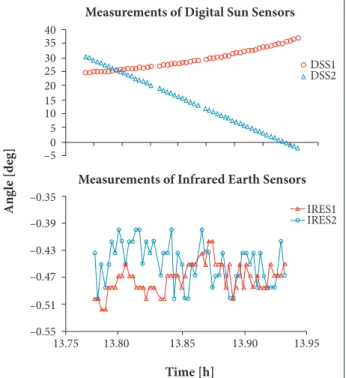
IRES; and 0.25 Hz for both DSS. However, due to limitations, the telemetry system can only acquire telemetries from sensors at 9-s sampling rate when the satellite passes over the tracking station. his means that the ground system does not have the full set of measurements that are available to the ACS on board. In total, we have a set of 54 measurements from 13h46min25s until 13h55min27s, and the measurements are spaced by 10 s on average. he measures of DSS and IRES are presented in Fig. 1, and the measures of gyroscope are presented in Fig. 2. hese measures were provided by the Satellite Control Center of the Instituto Nacional de Pesquisas Espaciais (INPE). he set of initial conditions used by the algorithms is presented in Tables 1 to 3. To analyze the algorithm performance with different parametrizations, the values obtained by UKF and Euler angles
σ
DSS1(deg)σ
DSS2(deg)σ
IRES1(deg)σ
IRES2(deg)0.6 0.6 0.06 0.06
Table 3. Values of the diagonal of the error observation matrix R.
σ
ϕ(deg)
σ
θ(deg)
σ
ψ (deg)σ
εx(deg/h)
σ
εy(deg/h)
σ
εz(deg/h)
0.5 0.5 2.0 1.0 1.0 1.0
Table 2. Values of the diagonal of the initial covariance matrix P0.
ϕ
(deg)
θ
(deg)
ψ
(deg)
ε
x(deg/h)
ε
y(deg/h)
ε
z(deg/h)
0 0 0 5.76 4.64 2.68
Table 1. Initial conditions of attitude and bias of gyroscope.
Figure 1. Real measurements supplied by attitude sensors from CBERS-2.
Figure 2. Real measurements supplied by gyroscope from CBERS-2.
A
n
g
u
la
r vel
o
ci
ty
[10
–3 d
eg/h]
Time [h] 13.75
–0.4 –0.2 0 0.2 0.4 0.6 0.8
13.80 13.85 13.90 13.95
Gyro z
A
n
g
u
la
r v
el
o
ci
ty [d
eg/h]
–0.0308 –0.0306 –0.0304
–0.0302 ✳ ✳ ✳✳✳✳✳✳✳✳✳✳ ✳✳✳✳ ✳✳
✳ ✳
✳ ✳ ✳ ✳ ✳ ✳ ✳ ✳ ✳ ✳ ✳ ✳ ✳
✳✳✳✳✳✳✳✳✳✳✳✳✳✳✳✳✳✳✳✳✳
–0.0300
Gyro y
A
n
g
u
la
r vel
o
ci
ty
[10
–3 d
eg/h]
0.2
0.1 0
–0.1
–0.2
–0.3 0.3
Gyro x
A
n
g
le [d
eg]
Time [h] 13.75
–0.55 –0.51 –0.47 –0.43 –0.39 –0.35 –5 0 5 10 15 20 25 30 35 40
13.80 13.85 13.90 13.95
Measurements of Infrared Earth Sensors Measurements of Digital Sun Sensors
DSS1 DSS2
IRES1 IRES2
(UKFe) were used as reference (Garcia et al. 2012). he term
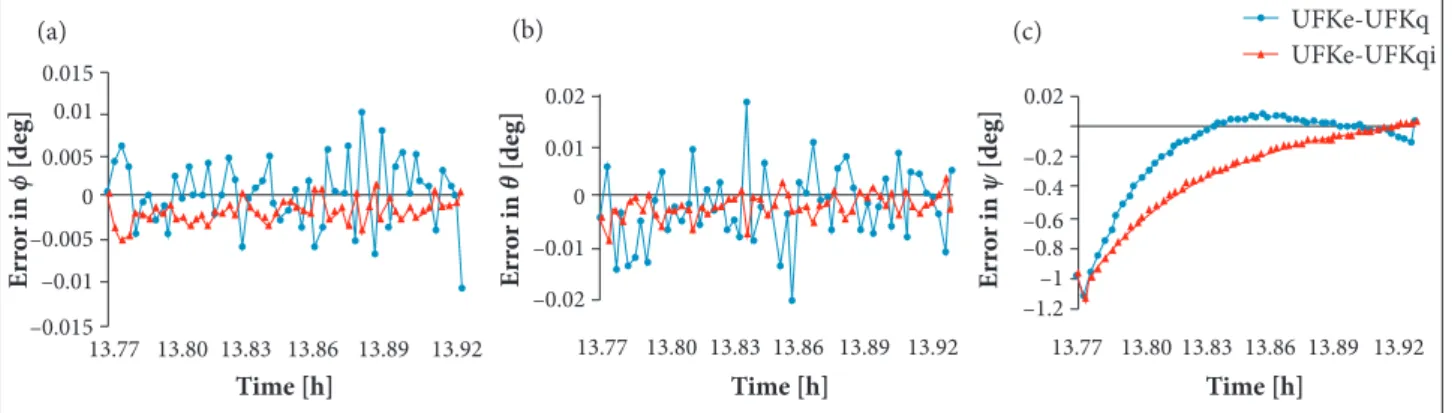
show the diference between the state estimated by the UKF when the attitude is represented via Euler angles (UKFe) and the estimated state: (1) via quaternions (q) and quaternion incremental (qi) Figs. 3 and 4; (2) through EKF with Euler angles, q and qi, Figs. 5 and 6. Figures 3a and 3b show that the
roll and pitch estimated by UKF with quaternion incremental
(qi) get close to the reference, when compared with results
obtained by quaternion (q). he reason for the results with
quaternions being more distant from the results of attitude via
Figure 3. Comparison between attitude estimated by UKFe and different attitude parametrizations.
Figure 4. Comparison between bias estimated by UKFe and different attitude parametrizations.
Figure 5. Comparison between attitude estimated by UKFe and EKF and different attitude parametrizations.
E rr o r in ϕ [d eg] Time [h] –0.01 –0.015 0.015 –0.005 0 0.005 0.01 E rr o r in θ [d eg] Time [h] –0.02 –0.01 0 0.01 0.02 E rr o r in ψ [d eg] Time [h] –1.2
13.77 13.80 13.83 13.86 13.89 13.92 13.77 13.80 13.83 13.86 13.89
13.77 13.80 13.83 13.86 13.89 13.92 13.92
–0.8 –1 –0.4 –0.6 –0.2 0.02 UFKe-UFKq UFKe-UFKqi E rr o r in εx [d eg/h] Time [h] –0.15 –0.2 0.05 –0.1 –0.05 0
13.77 13.80 13.83 13.86 13.89 13.92
E rr o r in εy [d eg/h] Time [h] 0 –0.05 0.2 0.05 0.1 0.15
13.77 13.80 13.83 13.86 13.89 13.92
E rr o r in εz [d eg/h] Time [h] –0.3 –0.35 0 –0.05 –0.25 –0.2 –0.15 –0.1
13.77 13.80 13.83 13.86 13.89 13.92 UFKe-UFKq UFKe-UFKqi E rr o r in ϕ [d eg] Time [h] 0 0.02 –0.2 0.14 0.12 0.04 0.06 0.08 0.1
13.77 13.80 13.83 13.86 13.89 13.92
E rr o r in θ [ d eg ] Time [h] –0.16 –0.12 0 –0.04 –0.08
13.77 13.80 13.83 13.86 13.89 13.92
E rr o r in Ψ [ d eg ] Time [h] –1.2 –1.4 0.2 0 –0.8 –1 –0.6 –0.4 –0.2
13.77 13.80 13.83 13.86 13.89 13.92 UFKe-UFKq
UFKe-UFKqe ✳ UFKe-UFKqi
✳ ✳ ✳✳ ✳✳✳ ✳✳ ✳✳ ✳✳ ✳✳ ✳ ✳✳ ✳ ✳ ✳✳✳✳ ✳ ✳✳ ✳ ✳ ✳ ✳ ✳ ✳✳ ✳ ✳ ✳ ✳ ✳ ✳ ✳ ✳ ✳ ✳ ✳ ✳ ✳ ✳ ✳ ✳ ✳ ✳ ✳ ✳ ✳ ✳ ✳ ✳ ✳ ✳ ✳ ✳ ✳ ✳ ✳ ✳ ✳ ✳ ✳ ✳ ✳ ✳ ✳ ✳ ✳ ✳ ✳ ✳ ✳ ✳ ✳ ✳ ✳ ✳ ✳ ✳ ✳ ✳ ✳ ✳ ✳ ✳ ✳ ✳ ✳ ✳ ✳ ✳ ✳ ✳ ✳ ✳ ✳ ✳ ✳ ✳ ✳ ✳ ✳ ✳ ✳ ✳ ✳ ✳ ✳ ✳ ✳ ✳ ✳ ✳ ✳ ✳ ✳ ✳ ✳ ✳ ✳ ✳ ✳ ✳ ✳ ✳
Euler angles can be justiied by the need to reduce the order of the covariance matrix (7 to 6) during the estimation process. For
yaw angle, Fig. 3c, we can notice an approximate behavior for
the two approaches (q and qi) in relation to the reference (Euler angles). However, it is not possible to verify the tendency of error converging to zero in the proposed dataset. A larger measurement dataset is necessary to evaluate such behavior. When the UKF estimator is compared with the EKF estimator it was observed a similar behavior between both for the roll and pitch angles,
(b)
Figure 6. Comparison between bias estimated by UKFe and EKF with different attitude parametrizations.
E
rr
o
r in
εx
[d
eg/h]
Time [h] –0.14
–0.16 –0.18 0.02
–0.1 –0.12 –0.06 –0.08 –0.04 –0.02 0
13.77 13.80 13.83 13.86 13.89 13.92
E
rr
o
r in
εy
[d
eg/h]
Time [h] 0
–0.08 –0.06 –0.04 –0.02 0.14
0.02 0.03 0.06 0.080.1 0.12
13.77 13.80 13.83 13.86 13.89 13.92
E
rr
o
r in
εz
[d
eg/h]
Time [h] –0.35
–0.4 0 –0.05 0.05
–0.3 –0.25 –0.2 –0.15 –0.1
13.77 13.80 13.83 13.86 13.89 13.92 UFKe-UFKq
UFKe-UFKqe UFKe-UFKqi
✳ ✳
✳ ✳✳ ✳✳✳✳
✳ ✳ ✳
✳✳✳ ✳✳✳
✳ ✳
✳✳✳ ✳
✳✳✳✳✳✳✳ ✳
✳ ✳✳
✳ ✳
✳
✳✳ ✳
✳✳✳ ✳✳
✳ ✳✳✳
✳
✳✳ ✳ ✳✳✳
✳ ✳ ✳✳ ✳
✳✳ ✳✳✳✳
✳ ✳
✳✳✳ ✳✳
✳
✳ ✳✳
✳✳ ✳✳
✳ ✳ ✳
✳✳✳ ✳
✳ ✳✳✳✳
✳✳ ✳
✳ ✳
✳ ✳
✳✳✳✳ ✳
✳
✳✳✳ ✳✳✳
✳✳✳✳ ✳✳
✳✳✳ ✳✳
✳ ✳
✳✳ ✳
✳ ✳
✳ ✳✳✳✳✳
✳✳✳✳✳✳✳✳✳ ✳✳✳✳✳✳ ✳✳✳
✳✳ ✳✳
✳ ✳
Figs. 5a and 5b. For the yaw angle, signiicant diferences were
not observed between Extended Kalman Filter with quaternion (EKFq) and Extended Kalman Filter with quaternion incremental
(EKFqi) compared to UKFe, Fig. 5c. he mean and standard
deviation of error for the estimated attitude related to the reference are presented in Table 4. With respect to estimated
bias, it is not possible to observe the convergence of algorithms
for the set of measures used in the study, Fig. 4. However, it is noted that the order of the error associated with the results obtained by EKFq and EKFqi is the same when compared with the Extended Kalman Filter with Euler angles (EKFe), Fig. 6. For the same parameterization attitude, UKFe and EKFe estimators have shown the same behavior. Such considerations can be better evaluated in Table 5.
ROBUSTNESS TEST
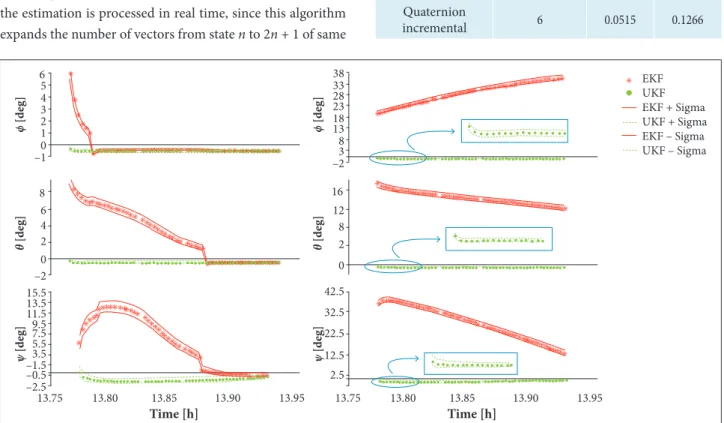
he performance of UKF is evaluated by comparing the estimated attitude with Euler angles by EKF and UKF estimators when both are subjected to imprecise initial conditions. In the irst column of Fig. 7, we considered the initial values of attitude components very distant from true values, with roll, pitch and yaw equal to 10 deg each. It is known that expected
values are close to zero, approximately –0.5, –0.45 and –1.5 deg to the set of measurements on test. The other conditions were kept constant. It is observed that, even taking longer, the EKF still converges to the expected value of the attitude (approximately –0.5 deg for roll and pitch and –1.5 deg for yaw), unlike UKF, which converges instantaneously. We also notice an incompatibility of attitude errors estimated by EKF (covariance)
UKFq/EKFq: Quaternions; UKFqi/EKFqi: Quaternion incremental; UKF with Euler angles – UKFe: Reference value.
ε
x (deg/h)ε
y (deg/h)ε
z (deg/h)UKFe–UKFq –0.0170 ± 0.0117 0.0302 ± 0.0221 –0.0595 ± 0.0304 UKFe–UKFqi –0.0958 ± 0.0472 0.0858 ± 0.0473 –0.2109 ± 0.1087 UKFe–EKFe –0.0105 ± 0.0048 0.0226 ± 0.0042 0.0060 ± 0.0038 UKFe–EKFq –0.0633 ± 0.0499 0.0387 ± 0.0443 –0.2120 ± 0.1095 UKFe–EKFqi –0.0643 ± 0.0503 0.0391 ± 0.0445 –0.2137 ± 0.1104
Table 5. Mean and standard deviation of error from estimated bias of gyro by different approaches. UKFq/EKFq: Quaternions; UKFqi/EKFqi: Quaternion incremental; UKF with Euler angles – UKFe: Reference value.
ϕ (deg) θ (deg) ψ (deg)
UKFe–UKFq 0.0007 ± 0.0039 –0.0014 ± 0.0072 –0.1470 ± 0.3052 UKFe–UKFqi -0.0014 ± 0.0014 –0.0011 ± 0.0024 –0.3026 ± 0.3092 UKFe–EKFe 0.0090 ± 0.0164 –0.0123 ± 0.0183 –0.0313 ± 0.0272 UKFe–EKFq 0.0073 ± 0.0189 –0.0145 ± 0.0224 –0.3203 ± 0.3124 UKFe–EKFqi 0.0072 ± 0.0190 –0.0145 ± 0.0224 –0.3247 ± 0.3169
Figure 7. Attitude estimated by EKF and UKF with Euler angles considering initial conditions of ϕ, θ, ψ: 10 deg (irst column) and 20 deg (second column).
EKF UKF EKF + Sigma UKF + Sigma EKF – Sigma UKF – Sigma –10
1 2 3 4 5 6
ϕ
[d
eg]
–2 0 2 4 6 8
θ
[d
eg]
–2.5
13.75 13.80 13.85
Time [h]
13.90 13.95
–0.5 –1.53.5 5.5 7.5 9.5 11.5 13.5 15.5
ψ
[d
eg]
–23 8 13 18 23 28 33 38
ϕ
[d
eg]
0 2 8 12 16
θ
[d
eg]
13.75 13.80 13.85
Time [h]
13.90 13.95
2.5 12.5 22.5 32.5 42.5
ψ
[d
eg]
✳
✳ ✳
✳ ✳
✳
✳ ✳
✳✳✳✳✳✳✳✳✳✳ ✳✳✳✳✳
✳✳✳✳ ✳✳✳✳✳
✳✳ ✳✳✳✳✳
✳
✳ ✳✳
✳✳✳ ✳✳✳✳✳✳✳✳✳
✳✳✳✳ ✳✳
✳✳✳✳ ✳✳
✳✳✳✳
✳✳✳✳✳✳✳✳✳✳✳✳✳✳✳ ✳✳✳ ✳
✳✳✳ ✳✳ ✳✳ ✳✳ ✳✳ ✳✳ ✳✳ ✳✳ ✳✳ ✳✳ ✳✳
✳✳✳✳✳✳✳✳✳✳✳✳✳✳✳✳✳✳ ✳✳ ✳✳✳✳✳✳
✳✳✳✳✳✳✳✳✳ ✳✳✳✳✳✳✳✳✳✳
✳✳ ✳
✳✳✳✳✳ ✳ ✳
✳✳✳✳✳✳✳✳✳✳✳✳ ✳✳✳✳✳✳✳✳✳✳✳ ✳✳✳✳✳✳✳✳ ✳✳
✳✳✳✳✳✳✳ ✳✳✳
✳
✳✳✳✳ ✳✳✳✳✳✳✳✳✳✳✳✳✳✳
✳✳✳✳✳✳✳✳✳✳✳ ✳✳✳✳✳✳✳✳✳✳✳✳✳✳✳✳✳✳✳✳✳✳✳✳✳ ✳✳✳✳✳✳ ✳✳
✳✳✳✳✳✳✳✳✳ ✳✳ ✳✳✳✳✳✳✳✳✳✳✳✳✳
✳✳✳✳✳✳ ✳✳
✳ ✳ ✳ ✳ ✳ ✳ ✳ ✳ ✳
Parameterization State vector
dimension n
EKF (s)
UKF (s)
Euler 6 0.0515 0.1430
Quaternions 7 0.0514 0.1389
Quaternion
incremental 6 0.0515 0.1266
Table 6. Estimated processing time of measures of attitude sensors by UKF and EKF.
because the estimated attitude is far from the expected value of convergence and the EKF assumes small errors (sigma). his behavior is observed until the EKF reaches convergences and its errors remain around the ones obtained by UKF. In the second column of Fig. 7, it is considered the radically incorrect value of 20 deg for initial angles of roll, pitch and yaw. It clearly
appears that the UKF converges in the initial stages, unlike the behavior obtained by the EKF, which is clearly diferent in
roll. his case shows that, for degraded initial conditions, the
linearizations performed in EKF are not effective, causing the ilter to lose its capacity to accurately estimate the state of the system during the considered period. On the other hand, UKF is converged clearly, showing its robustness and superior performance in this situation
.
PROCESSING TIME: UNSCENTED KALMAN FILTER VERSUS EXTENDED KALMAN FILTER
A quantitative analysis of the processing time spent by the CPU in the estimation process for diferent representations of attitude (Euler angles, quaternions and quaternions incremental) is held. We know that the amount of time is not an absolute indicator. However, even if quantitative, this analysis aids in assessing the applicability of UKF in problems in which the estimation is processed in real time, since this algorithm expands the number of vectors from state n to 2n + 1 of same
dimension. Table 6 shows the CPU time spent to process the measurements from the sensors in diferent approaches used to estimate attitude. The average of 100 runs was calculated for each ilter in each parameterization. We remember that the programs were coded in MATLAB language in an Intel Core i3 with 3 GB of dynamical memory, running Windows 7, 64 bits version.
It may be noted that, although the processing time consumed by UKF is greater than that by the EKF, the increase is not proportional to the number of points generated in the UKF (note that UKF works with 2n + 1 vectors of dimension n (6 or
7), unlike the EKF, which uses only a vector of dimension n).
due to non-linearities. In EKF, we note that the processing time is independent of the formulation adopted. In UKF, it is noticeable that the formulation via the Euler angles has higher computational expense, since this method requires numerical
integration of the attitude dynamics. he lower expense occurs
in the formulation via quaternion incremental, where the dynamic approach is obtained analytically and the state vector is reduced to dimension n = 6.
FINAL COMMENTS
he UKF was tested through diferent parameterizations of attitude, using real data supplied by attitude sensors that are on board the CBERS-2 satellite. Results obtained in previous studies served as a reference for comparisons between parameterizations. he attitude estimated by UKF was adequate when compared to the EKF. his is expected because the best performance of the UKF is based on inaccurate measurements of observations,
estimated state errors or even systems involving highly non-linear equations, which is not the purpose of this study. However, the UKF was more consistent in comparison to EKF, since the results indicated that the performance of UKF far exceeds the conventional EKF for large initialization errors. he time spent in the estimation process for the UKF was higher compared to the EKF, but the processing time was adequate for real-time applications. Among the parameterizations considered, the quaternion incremental provided a smaller CPU load, reducing the dimension of the state vector, and its dynamic model equations are linear.
ACKNOWLEDGEMENTS
The authors would like to thank the financial support received by Fundação de Amparo à Pesquisa do Estado de São Paulo (FAPESP; 2012/21023-6) and Conselho Nacional de Desenvolvimento Cientíico e Tecnológico (CNPq; 303119/2010-1).
REFERENCES
Crassidis JL, Markley FL, Cheng Y (2007) Survey of nonlinear attitude estimation methods. J Guid Contr Dynam 30(1):12-28.
Garcia RV, Kuga HK, Zanardi MC (2012) Unscented Kalman Filter applied to the spacecraft attitude estimation with Euler angles. Math Probl Eng 2012(2012):Article ID 985429. doi: 10.1155/2012/985429
Garcia RV, Kuga HK, Zanardi MC (2014) Attitude estimation process of the sensing remote satellite CBERS-2 with Unscented Kalman Filter and quaternion incremental, using real data. Proceedings of the 24th International Symposium on Space Flight Dynamics; Laurel, USA.
Julier SJ, Uhlmann JK (2004) Unscented iltering and nonlinear estimation. Proc IEEE 92(3): 401-422. doi: 10.1109/JPROC.2003.823141
Lefferts EJ, Markley FL, Shuster MD (1982) Kalman iltering for spacecraft attitude estimation. J Guid Contr Dynam 5(5):417-429. doi: 10.2514/3.56190
Lopes RVF, Kuga HK (2005) CBERS-2: on ground attitude determination from telemetry data. Internal Report C-ITRP. São José dos Campos: INPE.
Markley FL, Crassidis JL, Cheng Y (2005) Nonlinear attitude iltering methods (AIAA 2005-5927). Proceedings of the AIAA Guidance, Navigation, and Control Conference and Exhibit. San Francisco; USA.
Silva WR, Kuga HK, Zanardi MC, Garcia RV (2014) Least square method for attitude determination using the real data of CBERS-2 Satellite. Applied Mechanics and Materials 706:181-190. doi: 10.4028/www.scientiic.net/AMM.706.181
VanDyke MC, Schwartz JL, Hall CD (2004) Unscented Kalman Filter for spacecraft attitude state and parameter estimation. AAS-04-115.