Article
0103 - 5053 $6.00+0.00
*e-mail: [email protected]
3-Arylisoxazolyl-5-Carboxylic Acid and 5-(Hydroxymethyl)-3-Aryl-2-Isoxazoline
as Molecular Platforms for Liquid-Crystalline Materials
Aline Tavares,a Paolo R. Livotto,a Paulo F. B. Gonçalvesb and Aloir A. Merlo*,a
aInstituto de Química, Universidade Federal do Rio Grande do Sul, 91501-970 Porto Alegre-RS, Brazil
bCentro Universitário La Salle, 92010-000 Canoas-RS, Brazil
A síntese de uma plataforma molecular para materiais líquido-cristalinos derivados do ácido 3-arilisoxazolil-5-carboxílico (1) e do 5-(hidroximetil)-3-aril-2-isoxazolina (2) é descrita. Os intermediários 1 e 2 são obtidos através da reação de cicloadição [3+2] 1,3-dipolar entre arilóxidos
de nitrilas e os dipolaróilos ácido acrílico e álcool alílico, respectivamente. Os compostos cristais líquidos são sintetizados através de uma estratégia de alongamento molecular do núcleo primitivo isoxazolínico pela conexão de subunidades arilacetilênicas, as quais foram obtidas da reação de Sonogashira. Sob essas condições, séries de cristais líquidos 5a-c, 6, 7a-g e 8a-d têm sido sintetizadas com rendimentos de médios para bons. Os compostos inais apresentam propriedades líquido-cristalinas nematogênica e esmectogênica. Um cálculo DFT no nível B3LYP/6-31G(d,p) é também apresentado e alguns parâmetros estruturais obtidos são analisados.
The synthesis of the molecular platform for liquid-crystalline materials based on 3-arylisoxazolyl-5-carboxylic acid (1) and 5-(hydroxymethyl)-3-aryl-2-isoxazoline (2) is
described. The key intermediates 1 and 2 are obtained by [3+2] 1,3-dipolar cycloaddition
reaction between an arylnitrile oxide and an acrylic acid and allylic alcohol as the dipolarophile. The liquid crystals (LC) compounds are synthesized through a “molecular elongation strategy” from the initial isoxazolinic core by connecting the arylacetylene moiety obtained from the Sonogashira reaction. Under these conditions, the series of liquid crystals 5a-c, 6, 7a-g and 8a-d have been successfully synthesized in fair to good yields. The inal compounds display
nematic and smectic liquid-crystalline properties. The structural properties of the series of the liquid crystals has been studied using DFT methods at level B3LYP/6-31G(d,p). The equilibrium geometries in the gas phase are presented and analyzed.
Keywords: 3,5-disubstituted isoxazolines, [3+2] 1,3-dipolar cycloaddition, liquid crystals,
molecular platform
Introduction
The [3+2] 1,3-dipolar cycloaddition reaction of a nitrile oxide to an alkene or alkyne has proven to be extremely useful in the preparation of a variety of compounds in organic chemistry. Among the various classes of compounds which are prepared from these cycloadducts are enones,1 1,3-amino alcohols,2 β,γ
-dihydroxy ketones3and β-hydroxy ketones.4In the area
of materials, the construction of the isoxazoline and isoxazole rings by this methodology constitute an easy way to prepare a molecular platform for the synthesis of smart molecules, such as polymers and non-polymer liquid-crystallines materials.5
Our previous results showed that the introduction of an isoxazoline ring lanked by aromatic rings or polar groups opened a route to prepare useful intermediates in the ield of liquid crystals.6 Herein we describe the preparation of
four homologous series of 3,5-disubstituted isoxazoline rings. A complete study of the thermal behavior of these compounds is also presented with the goal to understanding the correlation between the molecular structure and liquid crystal parameters.
Based upon the considerations discussed above, we now report a convenient and practical route to the synthesis of isoxazoline ring platform for liquid crystal (LC) materials. The compounds from series 5 and 6 are
derived from3-arylisoxazolyl-5-carboxylic acid (1) while
the members of the homologous series 7 and 8 are derived
Results and Discussion
Synthesis
To synthesize the isoxazoline LC, the molecular platforms 1 and 2 bearing carboxyl or hydroxyl groups
suitable for further derivation were prepared (Chart I). The acid 1a-d and alcohol 2a-d were obtained using [3+2]
1,3-dipolar cycloadditions according to reference 6.
To achieve our goal of the isoxazoline LC material it was necessary to synthesize the phenols 3 and 4 as the
chemical counterparts of the acid 1. The synthesis of the
key intermediates 3 is reported elsewhere.6 Compound 4
was prepared following the experimental procedure to 3.
The chemical connection between the intermediates 3
and 4 and acid 1 was made through an esteriication reaction
using the DCC-DMAP protocol. Thus, the compounds 5a-c
and 6 were synthesized as representative members of these
homologous series.
The third and fourth homologous series 7a-g and 8a-d
are derived from 5-(hydroxymethyl)-3-aryl-2-isoxazoline (2). The compounds 7a-g were quickly prepared by
an esterification reaction (DCC/DMAP) between the corresponding p-n-alkoxybenzoic acid7 and the alcohol 2.
In order to synthesize the elongated (anisotropic)
liquid-crystalline isoxazolines 8a-d, we again applied the DCC/
DMAP protocol to introduce the ester linkage by reaction of p-bromobenzoic acid with the alcohol 2a. To accomplish
the synthesis of the homologous series 8a-d the triple
bond was inserted through the Sonogashira cross-coupling reaction between the 1-alkoxy-4-ethynylbenzene8 and the
ester derived from p-bromobenzoic acid.
Liquid-crystalline behavior
Thermal analysis of all isoxazolines 5a-c, 6, 7a-g and 8a-d was performed by differential scanning calorimetry
(DSC). The texture of the mesophase9 was identified
by microscopy studies on cooling from the isotropic liquid state of the samples (Figure 1). The transition temperatures and enthalpy values were collected from a second heating scan and is compiled in Table 1. Polarizing optical photomicrographs of the representative LCs are shown in Figure 1.The 3-phenylisoxazolyl-5-carboxylate esters 5a-c exhibited enantiotropic liquid-crystalline
properties (Figures 1a and 1b). The ester 6 did not exhibit
mesomorphic behavior under optical polarized light microscopy (Figure 1c). The LC 5-(hydroxymethyl)-3-aryl-2-isoxazolyl benzoates 7c-g and 8a-d displayed
monotropic liquid-crystalline phase where the smectic C and nematic mesophases were observed in these series (Table 1), respectively.
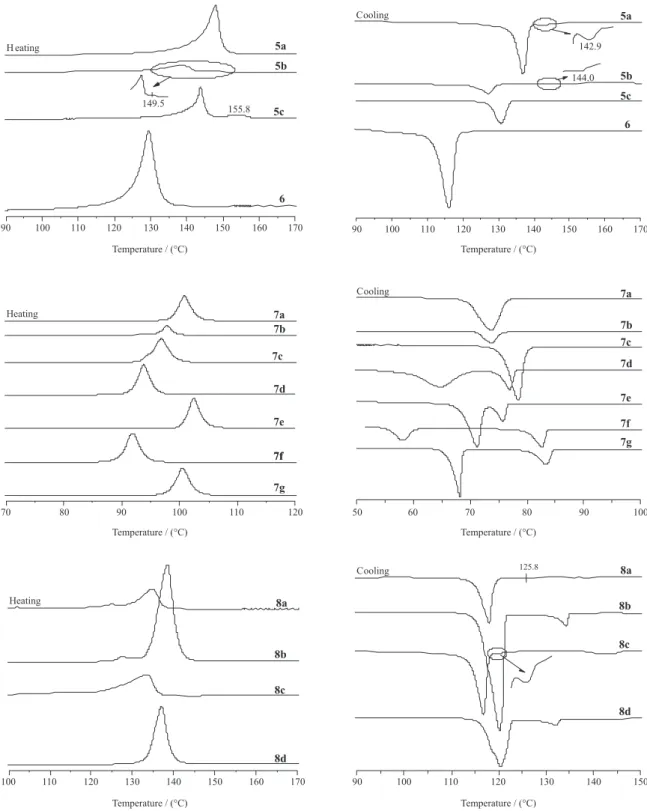
The mesophase characterization was made by polarized optical microscopy studies (POM, Figure 1) and the enthalpy values were obtained from DSC traces (Figure 2). The schlieren textures of series 5a-c and 7d-g
show singularity lines with two and four dark brushes, which correspond to the extinction orientation of the
OC8H15 HO
OC8H15 HO 4 3 RO O N O O Ar
6 Ar = 4-C6H4OR'; R' = C8H17;R = C7H15
5a Ar = 6-C10H6OR'; R' = C8H17;R = C7H15
5b Ar = 6-C10H6OR'; R' = C8H17;R = C8H17
5c Ar = 6-C10H6OR'; R' = C8H17;R = C10H21
N O
RO
O O
OR'
7a R = C7H15;R' = C6H13
7bR = C7H15; R' = C7H15
7c R = C7H15; R' = C8H17
7d R = C9H19; R' = C7H15
R=CnH2n+1
7e R = C7H15; R' = C10H21 7f R = C9H19; R' = C9H19 7g R = C9H19; R' = C10H21
N O
RO
O O
Ar
8a R = C7H15;R' = C7H15 8bR = C7H15; R' = C8H17
8c R = C7H15; R' = C9H19
8d R = C7H15; R' = C10H21
Ar = 4-C6H4OR'
RO O N O OH N O RO OH
1a n = n-heptyl; 1b n = n-octyl;
1c n = n-nonyl; 1d n = n-decyl.
R=CnH2n+1
2a n = n-heptyl; 2b n = n-octyl;
2c n = n-nonyl; 2d n = n-decyl.
R=CnH2n+1
liquid crystals. The singularity points are defects in the structure where two or four brushes meet. In the smectic C phase, only singularities with four brushes are observed (Figures 1e and 1f). Nematic phase may also showed singularities with two brushes (Figures 1a and 1b).
The homologous series 8a-d exhibited a thread-like
texture when the sample was sandwiched between two glass plates that had not been rubbed or treated (Figure 1d). This texture is usually observed in thin samples placed between two crossed polarizers. The dark lines, the so-called threads, are line singularities, which either connect two point defects or form closed loops. The planar thread-like texture is characteristic of liquid-crystalline nematic phase.
Compounds 5a-c displayed enantiotropic nematic
phase whereas compound 6 is a non-mesomorphic
compound. The non-liquid crystal 6 melts at 129.5 oC
from its crystalline state to an isotropic liquid and it crystallizes at 116.1 oC without any trace of a LC mesophase
(Figures 1c and 2). The lack of LC behavior for this compound is probably related to the geometrical anisotropy when the napthyl group is changed to phenyl group.
Compounds belong to 5a-c series showed enantiotropic
behavior when analyzed by POM. However, the DSC traces of the 5a did not exhibit K → N on heating and whereas 5c
did not exhibit I → N on cooling (Figure 2). For example, on heating, the sample 5a enters into the nematic phase Table 1. Transition temperatures (°C) for homologous series 5a-c, 6, 7a-g and 8a-d and enthalpies values (DH, kcal mol-1)
Entry R/R´C
nH2n+1
Phase Transition Temperatures / (°C)
DTd Enthalpies values
Heating Cooling Meltc Iso-phase-Kd
5a 7/8 K 144.5a N 148.0a I I 142.9 N 136.9 K 3.5 6.74 I 0.015 N 6.59 K
5b 8/8 K 134.4a N 150.5a I I 144.0 N 127.3 K 16.1 6.05 I 0.031 N 6.00 K
5c 10/8 K 142.6a N 151.0a I I 149.5a N 130.7 K 8.4 5.93 If N 6.01 K
6 7/8 K 129.5 I I 116.1 K - 12.31 I 12.74 K
7a 7/6 K 100.8 I I 73.7 K - 13.07 I 12.87 K
7b 7/7 K 97.8 I I 73.7 K - 15.10 I 15.29 K
7c 7/8 K 96.7 I I 78.6b,e K - 12.64 I 12.64 K
7d 9/7 K 93.8 I I 76.9b SmC 64.8 K 12.1 18.69 I 4.19 SmC 10.88 K
7e 7/10 K 102.5 I I 75.7b SmC 71.2 K 4.5 13.40 I 2.81 SmC 11.79 K
7f 9/9 K 91.9 I I 82.5b SmC 58.1 K 24.4 12.79 I 3.01 SmC 6.15 K
7g 9/10 K 100.4 I I 83.3b SmC 68.2 K 15.1 16.67 I 3.66 SmC 11.82 K
8a 7/7 K 134.7 I I 125.8a,b N 118.0 K 7.8 6.26 I f N 8.36 K
8b 7/8 K 138.4 I I 134.3b N 120.2 K 14.1 13.91 I 0.67 N 13.53 K
8c 7/9 K 133.5 I I 120.0b N 116.7 K 3.3 15.01 I 0.087 N 15.66 K
8d 7/10 K 137.8 I I 132.5b N 121.4 K 11.1 11.94 I 0.72 N 11.01 K
Scan rate: 10 °C min-1 for all samples; K = Crystal phase; SmC = Smectic C phase and N = Nematic phase. aTransition temperatures were obtained from
POM analyze. bMonotropic behavior. cEnthalpies values (second heating/cooling stage) were determined from crystal phase to LC phase or isotropic phase
for compound 6. dHeating for 5a-c and cooling for 7a-g and 8a-d. eUpon slow cooling the samples crystallizes. Upon fast cooling the sample displayed a
at 144.5 oC and melts to an isotropic liquid at 148.0 oC.
The range of temperature for the mesophase is small for
5a (DT = 3.5 oC) and large for 5b (DT = 16.1 oC) and 5c
(DT = 8.4 oC). On cooling, the mesophase range follows
the same tendency. They are larger for compounds 5b
(DT = 16.7 oC) and 5c (DT = 18.8 oC) than for 5a
(DT = 6.0 oC), while the transition enthalpies (Table 1) for
the isotropic to nematic transition of the 5a-c are rather
low. These values are consistent with a less ordered nematic mesophase.
The third homologous series 7a-g displayed a
monotropic smectic C mesophase only for the superior
members 7c-g. For the irst and second members (7a and 7b) of this series no mesophase was observed. While the
next member 7c exhibited a monotropic smectic C phase.
The smectic C phase appeared only under fast cooling and the mesophase range was too short to be determined under these conditions. On cooling, 7c crystallizes at 78.6 °C. The
broken-fan focal conic texture of the SmC phase appears during the crystallization process. The broken-fan can be visualized simultaneously with the crystals and they disappear very fast. This situation makes it impossible to get some information about the range of this mesophase. Upon slow cooling, no traces of the mesophase were detected and
observed. For the superior members 7d-g the range of the
monotropic SmC phase was determined. The DSC traces are shown in Figure 2 and the thermal data for this series is shown in Table 1. The melting points of these compounds display a regular tendency if we compare them in pairs. The compounds containing odd carbon atoms in their alkyl chains melt at higher temperatures than the next member
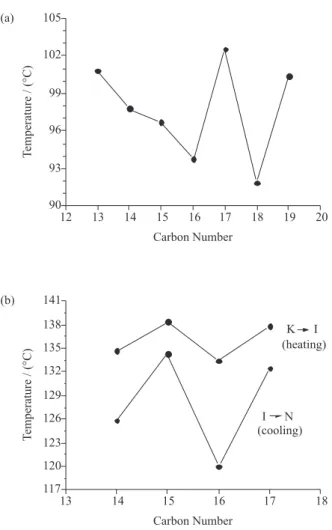
having an even carbon in the alkyl chains. For instance, the melting points of 7a, 7c, 7e and 7g are higher than 7b, 7d and 7f. Figure 3a shows the dependence of the melting
points on the number of carbon atoms in the alkyl tail for the 7a-g homologues. Also, from Figure 3a it is possible to
for 7e doesn’t follow the tendency, and it is higher than 7d. However it is possible to establish the same correlation
between the melting point and the length of the terminal n-alkyl chain to the last three members of this series. For instance 7e with an odd number of carbon atoms in its
alkyl chain has a higher melting point than 7f. The melting
points of compounds 7e-g display an odd-even effect as
seen with the four irst compounds. The deviation observed jumping from 7a-d to 7e-g may be associated with the
increase in the molecular weight of the latter compounds. The tendency observed in both groups of the LC series
7a-d and 7e-g related to the lowering of the melting point
is probably a manifestation of the lipophilic effect as the length of the alkyl chains increase. The transition enthalpies of the isotropic to smectic transitions of 7d-g are higher
than for both 5a-c and 8a-d. The enthalpy value suggests a
more ordered phase going from isotropic to smectic phase compared to compounds 5a-c or 8a-d.
In general, as the length of the alkyl chains increases the mesophase range becomes wider, especially with respect to smectic phase; the opposite is observed for the nematic phase (see discussion for 8a-d below). The reduction of
the length of the alkyl chain may be responsible for the absence of the mesophase. A delicate balance between many structural parameters favors the appearance of the mesophase for the intermediate compounds 7c-g. The
inversion of the ester group and the insertion of a methylene unit between the isoxazolyl and carboxyl groups are other two factors that should have considered when we compare the compounds 7a-g with 5a-c and 6.
In contrast to the compounds 5a-c, the homologous
series 8a-d displayed monotropic nematic mesophase
with planar thread-like texture. The thermal, optical and thermodynamic data of these compounds are compiled in Table 1. All compounds displayed similar thermal behavior. The DSC traces are shown in Figure 2. For 8a and 8c
(DT = 7.8 oC; DT = 3.3 oC) the mesophase range was
smaller than for 8b and 8d (DT = 14.1 oC; DT = 11.1 oC).
The melting points of this series have the same tendency observed to the series 7a-g. The LCs 8a and 8c melt at
lower temperature than 8b and 8d. The LCs with odd
carbon atoms in the alkyl group, considering R plus R’, melt ca. 4 oC above the LCs containing even carbon atoms on their terminal tails. The transition temperatures I → N obtained on cooling exhibited the same behavior. For example, on cooling, 8b and 8d enter into the nematic
phase at higher temperature than 8a and 8c.
The usual even-odd alternations of temperature range of the crystal-isotropic phase and of the isotropic-nematic phase transition are observed. For the odd number of the carbon atoms the mesophase range is higher than for the
even number of the carbon atoms in the alkyl tail. Figure 3b shows the dependence of the transition temperatures on the number of carbon atoms in the alkyl tail for the 8a-d series.
The tendency observed upon heating of the melting points is similar to the transition temperatures I → N observed on cooling process. The compounds that have an odd number of carbon atoms exhibit higher values than for those with an even number of carbon atoms. This can be seen in Figure 3b: the superior line is related to the melting point and inferior line is associated with the temperature when the compounds 8a-d enter into nematic phase. It
should be noted that, when compared with 8b and 8d, the
enthalpy values for these isotropic-nematic transitions of
8c also showed the odd-even effect. The enthalpy value of
the 8a was too small to be detected by DSC. The phase
transition for this member was observed with a polarizing microscope. However the values for the compounds with odd carbon atoms in the alkyl tail, 8b and 8d, are larger than
the conventional nematic ↔ isotropic transition enthalpies (< 0.50 kcal mol-1) for calamitic liquid crystals. In addition,
these enthalpy values for compounds 8a-d are higher than
series 5a-c. This may be indicating that relatively strong
intermolecular interactions might exist in its nematic phase and could be attributed to the inversion of the carboxylate group between 5a-c and 8a-d.
A theoretical study was performed in order to understand the phase behavior and correlate it to the structural features of these compounds. We selected the LC compounds 5b, 7b and 8c as a representative of this study and their energy
and its corresponding geometry of all model systems were obtained by full optimization without any constraint. The calculation was performed with the GAUSSIAN 9810
program using the B3LYP hybrid functional,10 employing
a 6-31G(d,p) basis set.
The molecular shape of a compound has a critical effect on its liquid-crystalline behavior. Two facts are important and need to discuss relating to the mesomorphic behavior of the calamitic liquid crystals (rod-like mesogen). First, the linear-shape of the calamitic LC changes to a bent-shape with the introduction of ive-membered heterocycles into the center of the mesogenic core.11 The bent-shape is
the 3- and 5-carbon atom of the isoxazoline ring, the inal central core must be as long as possible and possess high polarizability. In this way, the potential LC materials are reached through an “elongating molecular strategy” from the isoxazoline intermediates. This elongation builds off the rigid isoxazoline core to form a more polarizable and mesogenic one.
The mesomorphic behavior found in this work is due to the presence of the long aromatic moiety laterally bonded to the isoxazoline ring. However, in some cases the molecular dimensions (length-to-breadth ratio) of the aromatic moiety are not suficient to overcome the non-coplanarity of the aryl group connected on the isoxazoline ring. In this situation no mesophase or unstable mesophase (i.e, monotropic behavior) appears. By changing the hybridization of the C4 and C5 carbon atoms of the isoxazolinic system the liquid-crystalline state forms vigorously. Our previous work showed that oxidation of the isoxazoline to isoxazol ring yield LC materials with a large enantiotropic nematic mesophase.6 The appearance of stable mesophase in
isoxazol systems12 is due to the substitution of a tetrahedral
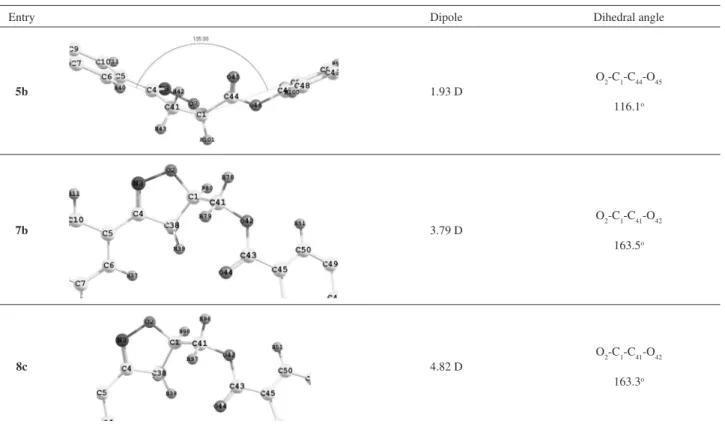
to planar carbon in the heterocyclic so that the two aryl and the isoxazoyl groups are coplanar and thus fully conjugated. Table 2 shows the three lowest-energy conformations of the 5b, 7b and 8c compounds. The other conformations
of these compounds are not energetically favorable (by more than 1.00 kcal mol-1) and these contributions can
be neglected because they are local minima. The energy proile of the conformational population largely favors the conformation shown in Table 2. Therefore, we focused our analysis on the lowest-energy conformations so that the high energy conformations are not considered during this study. Modeling of these structures allows certain interesting conclusions to be drawn concerning their mesomorphic behavior. The distance between the oxygen of the carboxylate group and the hydrogen (O45-H42) for the
5b, O44-H39 for the 7b and 8c are 2.37, 2.46 and 2.45 Å,
respectively. These values reveal a weak hydrogen bond in these conformers and they supported that this interaction is important to maintain the conformers in their lowest-energy state. As we can see in the Figure 4a, the hydrogen atom bonded to carbon 4 in the isoxazolinic ring shows a more positive charge than the others, interacting to the carboxylic oxygen as a weak hydrogen bond.
The dipole moment of these conformers may also play an additional role in the stabilization of the mesomorphic state. Compound 5b has the lowest value whereas 8c
presents the highest value. A probable conclusion about this data is that compounds having the smallest molecular dipole values display enantiotropic behavior as we can see from the data for series 5a-c (Table 1). On the other hand,
compounds belonging to the series 7a-g and 8a-d having
high values of the molecular dipole show monotropic LCs. A preliminary conclusion from the modeling data is that a large increase in the molecular dipole does not favor the formation of an enantiotropic mesophase (Table 1). However it is important to point out that monotropic behavior, or the absence of a mesogenic state, observed in the series 7a-g and 8a-d is mainly due to the deviations
of the coplanarity between aromatic molecular segments connected by the polar isoxazoline ring.
The dihedral angle of the 5b, 7b and 8c conformers
was selected and they are listed in Table 2. The theoretical calculations reveal that rotation about C1-C44 and C1-C41 bond of the compounds 5b, 7b and 8c, respectively, play
an important role on their corresponding liquid crystalline behavior. The rotation about the C1-C44 bond of 5b yielded
the more stable conformer which is separated by more than 1.00 kcal mol-1 from the another unstable conformer of 5b (not shown). The angle between two planes (right and
left) of the molecule is about 135.9º. The dihedral angle
O2-C1-C44-O45 to the most stable conformation is 116.1º. This molecular arrangement favors mesophase formation probably due to the tendency of the polar mesogenic phase to self-assemble during the melting or passing from the isotropic to mesogenic state.
The insertion of methylene unit between the isoxazoline ring and carboxyl group changes the relative disposition of the two planes in the conformers of 7b and 8c. As we can
see in Table 2 the conformers 7b and 8c present two distinct
planes connected by the C1-C41 bond. These planes are slightly collinear, twisted and non-coplanar. The estimated angles between these planes are 30.47° for 7b and 28.45°
for 8c (Figure 4b,c). The dihedral angles O2-C1-C41-O42 to
the most stable conformation of the 7b and 8c are 163.5º
and 163.3°, respectively. This arrangement favors the short-weak hydrogen bond interaction between O44-H39 atoms in both rotamers. The conclusion that can be drawn from these data is that the methylene unit, as described above,
produces two distinct planes which disfavor the molecular interaction in the liquid-crystalline state. The electrostatic interaction and dispersion interaction (van der Waals forces,
π-stacking effects, etc) cannot compensate for the structural constraints that are imposed by the methylene group in the 5-(hydroxymethyl)-3-aryl-2-isoxazoline ring.
Experimental
Materials
Ethanol, diethyl ether, p-bromobenzoic acid, copper(I) iodide (CuI), triphenylphosphine (PPh3), 4-(N , N-dimethylamino)pyridine (DMAP) and 1,3-dicyclohexylcarbodiimide (DCC) were used without further puriication from Aldrich. The p-n-alkoxybenzoic acid and 1-alkoxy-4-ethynylbenzene were prepared according to references 7 and 8, respectively. Bis -(triphenylphosphine)palladium (II) chloride [PdCl2(PPh3)2] was prepared following the procedure reported in reference 13. Triethylamine (Et3N) was distilled over potassium hydroxide. Tetrahydrofuran (THF) was dried over sodium metal-benzophenone and distilled immediately before use. Anhydrous sodium sulphate (Na2SO4) was used to dry organic extracts.
Characterization
Nuclear magnetic resonance spectra were obtained on a Varian 300 MHz instrument. Chemical shift are given in parts per million (d) and are referenced from tetramethylsilane (TMS). GC-MS spectra are obtained using a Varian Saturn 2100T CG-MS equipped with a 100 meter CP Sil Pona CB (0.25 mm) column. The column temperature is started at 50 oC and is gradually ramped
to 230 oC (15 oC min-1) until the end of the run. Infrared
spectra were recorded on a Perkin-Elmer Spectrum One FTIR Spectrometer Instruments using NaCl plates in case of solids (nujol dispersions) and as thin ilm supported between NaCl plates in case of liquids and are reporter as wavenumber (cm-1). Elemental analyses were performed on
a Perkin-Elmer model 2400 instrument. All new compounds
5a-c, 6, 7a-g and 8a-d gave satisfactory spectral, MS data
and elemental analysis. The DSC analyses were obtained on a DSC 2910 TA Instruments.
Thermal characterization
Melting points, thermal transitions and mesomorphic textures were taken using an Olympus BX41 microscope equipped with a Mettler Toledo FP82 Hot Stage FP90
Table 2. Lowest-energy conformations for the 5b, 7b and 8c compounds. The alkyl groups have been omitted for clarity
Entry Dipole Dihedral angle
5b 1.93 D
O2-C1-C44-O45 116.1o
7b 3.79 D
O2-C1-C41-O42 163.5o
8c 4.82 D
O2-C1-C41-O42 163.3o
Central Processor. The rate of heating or cooling was 10 ºC min-1.
Theoretical calculations
The energy and its corresponding geometry of all model systems were obtained by full optimization without any constraint. The calculation was performed with the GAUSSIAN 9810 program using the B3LYP hybrid
funcional, employing a 6-31G(d,p) basis set.
Synthesis
The 3-arylisoxazolyl-5-carboxylic acid (1a-d) and
5-(hydroxymethyl)-3-aryl-2-isoxazoline (2a-d) were
prepared according to our previous report.6
4-[(6-Octyloxy-2-naphthyl)ethynyl]phenol (3)
This compound was prepared according to previous report.6,8 4-[(4-Octyloxyphenyl)ethynyl]phenol (4) was
obtained by procedures similar to that used to prepare compound 3 (Yield: 300 mg, 34%, three steps); white solid;
mp 69.1 oC; IR ν
max/cm-1: 2925, 2855, 1727, 1466, 1377,
1251, 1182, 898, 876, 829, 721, 666; 1H NMR (300 MHz,
CDCl3) d 0.88 (m, 3H, CH3), 1.39 (m, 10H, (CH2)5), 1.78 (m, 2H, CH2CH2O), 3.97 (t, 2H, CH2O, J 6.6 Hz), 6.80 (d, 2H, Ar, J 8.4 Hz), 6.86 (d, 2H, Ar, J 8.4 Hz), 7.40 (m, 4H,
Ar); 13C NMR (75 MHz, CDCl
3)d 14.1, 22.6, 26.0, 29.1,
29.2, 29.3, 31.8, 68.1, 87.7, 88.0, 114.5, 115.4, 115.5, 115.9, 132.8, 133.0, 155.5, 159.0.
4-[(6-Alkyloxy-2-naphthyl)ethynyl]phenyl 3-(4-alkyl-oxyphenyl)-4,5-dihydroisoxazole-5-carboxylate (5a-c)
These compounds were prepared according to the protocol reaction DCC/DMAP/DCM following the experimental procedure described in reference 6.
Representative data for 5a
Yield 115 mg, 70%; white solid; mp 144.5 oC; Anal.
Found: C, 78.48; H 7.58, N 2.07; calc. for C43H49NO5: C, 78.27; H, 7.48; N, 2.12%; IR νmax/cm-1: 2924, 2854, 1763,
1596, 1464, 1378, 1224, 1045, 897, 859, 818, 722, 666;
1H NMR (300 MHz, CDCl
3) d 0.88 (m, 6H, (CH3)2), 1.38
(m, 18H, (CH2)9), 1.82 (m, 4H, (CH2CH2O)2), 3.75 (m, 2H, CH2CH), 3.98 (t, J 6.6 Hz, 2H, CH2O), 4.07 (t, J 6.6 Hz, 2H, CH2O), 5.37 (dd, J 7.2, 11.1 Hz, 1H, CH2CH), 6.92 (d, J 8.7 Hz, 2H, Ar), 7.14 (m, 4H, Ar), 7.50 - 7.72 (m, 7H, Ar), 7.96 (s, 1H, Ar); 13C NMR (75 MHz, CDCl
3)
304, 290, 279, 258, 233, 218 (100), 190, 129, 128, 116 and 91.
4-[(4-Octyloxyphenyl)ethynyl]phenyl 3-(4-heptyl-oxyphenyl)-4,5-dihydroisoxazole-5-carboxylate (6)
This compound was obtained by procedures similar to those used to prepare compound 5a. Yield: 110 mg, 50%;
white solid; mp 129.5 oC; Anal. Found: C, 76.58; H 7.68,
N 2.42; calc. for C39H47NO5: C, 76.82; H, 7.77; N, 2.30%; IR νmax/cm-1: 2924, 2855, 1765, 1595, 1467, 1378, 1224,
1043, 896, 859, 820, 722, 666;1H NMR (300 MHz, CDCl 3)
d 0.88 (m, 6H, (CH3)2), 1.40 (m, 18H, (CH2)9), 1.78 (m, 4H, (CH2CH2O)2), 3.75 (m, 2H, CH2CH), 3.98 (m, 4H, CH2O), 5.37 (dd, 1H, CH2CH, J 7.2, 10.5 Hz), 6.86 (d, 2H, Ar, J 8.4 Hz), 6.93 (d, 2H, Ar, J 8.4 Hz), 7.13 (d, 2H, Ar, J 8.4 Hz), 7.44 (d, 2H, Ar, J 8.4 Hz), 7.52 (d, 2H, Ar, J 8.4 Hz), 7.64 (d, 2H, Ar, J 8.4 Hz); 13C NMR (75 MHz, CDCl3) d 14.0, 14.1, 22.6, 22.7, 25.9, 26.0, 29.0, 29.1, 29.2, 29.3, 29.4, 31.7, 31.8, 39.3, 68.1, 68.2, 77.8, 87.0, 90.0, 114.5, 114.8, 120.5, 121.3, 121.9, 128.6, 132.6, 133.0, 149.8, 155.7, 159.3, 161.1, 168.6; EI-MS: m/z 609 [M+], 496, 494, 480, 418, 380, 349, 321, 306, 305, 288, 258, 233, 218 (100), 205, 191, 129, 115 and 91.
General procedure for synthesis of homologue series 7a-g
The corresponding alcohol 2a or 2c (5.8 × 10⁻⁴ mol) and
the respective p-n-alkoxybenzoic acid(5.8 × 10⁻⁴ mol) were
suspended in dry THF(5 mL) and stirring for 15 min under argon atmosphere. Then DCC (8.7 × 10⁻⁴ mol) and DMAP
(7.6 × 10⁻⁵ mol) were added. The reaction mixture was
stirred for 24 h at room temperature. The white precipitate was iltered off and washed with THF. The solvent was removed and the crude product was recrystallized from ethanol (double recrystallization).
Representative data for [3-(4-heptyloxyphenyl)-4,5-dihydroisoxazol-5-yl]methyl 4-decyloxybenzoate (7e)
Yield: 83.0 mg, 60%; white solid; mp 102.5 oC; Anal
Found: C, 74.15; H, 9.13; N, 2.54; calc. for C34H49NO5: C, 74.01; H, 8.95; N, 2.54%; IR νmax/cm-1: 2924, 2854, 1715,
1606, 1510, 1466, 1377, 1249, 1169, 1127, 1014, 882, 834, 768, 722, 699, 666, 649; 1H NMR (300 MHz, CDCl
3) d
0.89 (m, 6H, (CH3)2), 1.38 (m, 22H, (CH2)11), 1.79 (m, 4H, (CH2CH2O)2), 3.22 (dd, J 16.5, 6.9 Hz, 1H, N=CCHHCH), 3.49 (dd, J 16.5, 10.8 Hz, 1H, N=CCHHCH), 3.98 (t, J 6.6 Hz, 4H, (CH2O)2), 4.44 (m, 2H, CHCH2OCO), 5.06 (m, 1H), 6.85 (d, J 8.7 Hz, 2H, Ar), 6.91 (d, J 8.4 Hz, 2H, Ar), 7.61 (d, J 8.7 Hz, 2H, Ar), 7.95 (d, J 9.0 Hz, 2H, Ar); 13C NMR (75 MHz, CDCl3) d 14.0, 14.1, 22.5, 22.6, 25.9, 28.9, 29.0, 29.1, 29.2, 29.3, 29.5, 31.7, 31.8, 37.6, 65.2, 68.0,
68.1, 78.0, 114.0, 114.6, 121.5, 121.6, 128.2, 131.7, 155.8, 160.7, 163.1, 166.0; EI-MS: m/z 436, 360, 325, 291, 290, 277, 274, 260, 235 (100), 190, 156, 116 and 91.
General procedure of the series 8a-d
(i) Esterification reaction: alcohol 2a (4.4 mmol)
and p-bromobenzoic acid (4.4 mmol) were suspended in dry THF(30 mL) and stirred for 15 min under argon atmosphere. Then DCC (6.6 mmol) and DMAP (0.58 mmol) were added. The reaction mixture was stirred for 24 h at room temperature. The white precipitate was iltered off and washed with THF. The solvent from the filtrate was removed and the solid was recrystallized twice from ethanol to afford the corresponding esters as white crystals in 70-90% of yield. All the compounds gave satisfactory analytical data. (ii)Sonogashira’s coupling:A one-neck round-bottom lask equipped with septum stoppers was charged with the ester produced in step (i)(0.8 mmol), the corresponding 1-alkoxy-4-ethynylbenzene (1.2 mmol) and Et3N (20 mL) under argon atmosphere. The suspension was stirred for 20 min and then CuI (1.2 × 10⁻⁵ mol), PPh
3
(4.0 × 10⁻⁵ mol) and [PdCl
2(PPh3)2] (0.8 × 10⁻⁵ mol) were
added. The mixture was heated under relux for 48 h. The solution was cooled to room temperature and the solid was iltered through a Celite pad and washed with diethyl ether
(2 × 100 mL). The iltrate was then extracted with H2O (4 × 20 mL) and the organic extracts were dried (Na2SO4) and the solvent evaporated. The solid was recrystallized in ethanol affording the respective products.
Representative data for [3-(4-heptyloxyphenyl)-4,5-dihydroisoxazol-5-yl]methyl 4-[(octyl oxyphenyl)ethynyl] benzoate (8b)
Yield: 63 mg, 40%; orange solid; mp 138.4 oC; Anal.
Found: C, 76.96; H, 8.07; N, 2.14; calc. for C40H49NO5: C, 77.01; H, 7.92; N, 2.25%; IR νmax/cm-1: 2924, 2855, 1723,
1600, 1517, 1465, 1377, 1286, 1251, 1177, 1108, 1045, 890, 834, 765, 721, 695, 666; 1H NMR (300 MHz, CDCl
3)
([M + H]+), 623 [M+], 430, 364, 349, 333, 306, 290, 274,
260, 234 (100), 230, 204, 190, 116 and 91.
Conclusions
In this work a molecular platform for liquid-crystalline materials based on 3-arylisoxazolyl-5-carboxylic acid and 5-(hydroxymethyl)-3-aryl-2-isoxazoline was described. In this context, a new series of liquid-crystalline 5a-c, 6a, 7a-g and 8a-d derived from isoxazolinic molecular
platforms were synthesized and their mesomorphic behavior was investigated using POM and DSC techniques. The compounds belonging to series 5a-c showed an
enantiotropic nematic phase while 6 was not mesogenic.
The monotropic smectic C phase of the third series was observed in 7c-g. The irst two 7a-b did not exhibit a smectic
LC phase. The last series 8a-d displayed a monotropic
nematic phase. A theoretical study was performed in order to understand the phase behavior and structural features of these compounds. The reported calculations further support the role of the insertion of a methylene unit between the isoxazoline ring and the carboxylate group disfavoring the molecular interaction in the liquid-crystalline state.
Acknowledgments
This work was supported by Conselho Nacional de Desenvolvimento Cientíico e Tecnológico (project MCT/ CNPq No. 555785/2006-8 and MCT/CNPq Universal No. 471194/2008-5), PROCAD-CAPES, INCT-CMN/CNPq and Coordenação de Aperfeiçoamento de Pessoal de Nível Superior (CAPES) for fellowship.
Supplementary Information
Copies of 1H NMR, 13C NMR spectrum and ESI-MS are
available free of charge at http://jbcs.sbq.org.br, as PDF ile.
References
1. Carmella, P.; Grünanger, P.; 1,3-Dipolar Cycloaddition Chemistry; Padwa, A., ed.; Wiley: New York, 1984; vol. 1,
pp. 291-392; Torsell, K. B. G.; Nitrile Oxides, Nitrones and Nitronates; VCH: Weinheim, 1988.
2. Kozikowski, A. P.; Acc. Chem. Res. 1984, 17, 410; Jager, V.; Muller, I.; Tetrahedron1985, 41, 3519.
3. Curran, D. P.; Zhang, J.; J. Chem. Soc. Perkin Trans. I1991, 2613.
4. Kenar, J. A.; J. Am. Oil Chem. Soc. 2002, 79, 351.
5. Kovganko, V. N.; Kovganko, N. N.;Russ. J. Org. Chem. 2006, 42, 696; Ritter, O. M. S.; Giacomelli, F. C.; Passo, J. A.; Silveira,
N. P.; Merlo, A. A.; Polym. Bull. 2006,56, 549; Kauhanka, U. M.; Kauhanka, M. M.; Liq. Cryst. 2006, 33, 121; Bezborodov,
V.; Kauhanka, N.; Lapanik, V.; Mol. Cryst. Liq. Cryst. 2004,
411, 1145; Merlo, A. A.; Gallardo, H.; Taylor, T. R.; Quim. Nova2001, 24, 354.
6. Tavares, A.; Schneider, P. H.; Merlo, A. A.; Eur. J. Org. Chem. 2009, 889; Passo, J. A.; Vilela, G. D.; Schneider, P. H.; Ritter, O. M. S.; Merlo, A. A.; Liq. Cryst. 2008, 35, 833; Gallardo, H.;
Conte, G.; Bryk, F.; Lourenço, M. C. S.; Costa, M. S.; Ferreira, V. F.; J. Braz. Chem. Soc.2007, 18, 1285.
7. Gimeno, N.; Ros, M. B.; De la Fuente, M. R.; Serrano, J. L.;
Chem. Mater. 2008,20, 1262; Naoum, M. M.; Saad, G. R.;
Nessim, R. I.; Abdel Aziz, T. A.; Seliger, H.; Liq. Cryst. 1997,
23, 789.
8. Vasconcelos, U. B.; Dalmolin, E.; Merlo, A. A.; Org. Lett. 2005,
7, 1027; Vasconcelos, U. B.; Merlo, A. A.; Synthesis2006, 7,
1141; Vasconcelos, U. B.; Vilela, G. D.; Schrader, A.; Borges, A. C. A.; Merlo, A. A.; Tetrahedron2008, 64, 4619; Sonogashira,
K.; Tohda, Y.; Hagihara, N.; Tetrahedron Lett. 1975, 16, 4467; Chinchilla, R.; Nájera, C.; Chem. Rev. 2007, 107, 874; Cristiano,
R.; Santos, D. M. P. O.; Conte, G.; Gallardo, H.; Liq. Cryst. 2006, 33, 997; Melissaris, A. P.; Litt, M. H.; Macromolecules 1994, 27, 883.
9. Gray, G. W.; Goodby, J. W. G.; Smectic Liquid Crystals. Textures and Structures; Leonard Hill: London, 1984.
10. Frisch, M. J.; Trucks, G. W.; Schlegel, H. B.; Scuseria, G. E.; Robb, M. A.; Cheeseman, J. R.; Zakrzewski, V. G.; Montgomery J. A.; Stratmann, Jr., R. E.; Burant, J. C.; Dapprich, S.; Millam, J. M.; Daniels, A. D.; Kudin, K. N.; Strain, M. C.; Farkas, O.; Tomasi, J.; Barone, V.; Cossi, M.; Cammi, R.; Mennucci, B.; Pomelli, C.; Adamo, C.; Clifford, S.; Ochterski, J.; Petersson, G. A.; Ayala, P. Y.; Cui, Q.; Morokuma, K.; Malick, D. K.; Rabuck, A. D.; Raghavachari, K.; Foresman, J. B.; Cioslowski, J.; Ortiz, J. V.; Stefanov, B. B.; Liu, G.; Liashenko, A.; Piskorz, P.; Komaromi, I.; Gomperts, R.; Martin, R. L.; Fox, D. J.; Keith, T.; Al-Laham, M. A.; Peng, C. Y.; Nanayakkara, A.; Gonzalez, C.; Challacombe, M.; Gill, P. M. W.; Johnson, B.; Chen, W.; Wong, M. W.; Andres, J. L.; Gonzalez, C.; Head-Gordon, M.; Replogle, E. S.; Pople, J. A.; Gaussian 98, Revision A.5.
Gaussian, Inc.: Pittsburgh, PA., 1998; Becke, A. D.; J. Chem. Phys.1993, 98, 5648; Lee, C.; Yang, W.; Parr, R. G.; Phys. Rev. B1988, 37, 785.
11. Dingemans, T. J.; Samulski, E. T.; Liq. Cryst.2000, 27, 131; Cai, R.; Samulsky, E. T.; Liq. Cryst.1991, 9, 617.
12. Vieira, A.; Bryk, F.; Conte, G.; Bortoluzzi, A.; Gallardo, H.;
Tetrahedron Lett.2009, 50, 905; Gallardo H.; Cristiano, R.;
Ely, F.; Vieira, A.; Liq. Cryst.2006, 33, 381. 13. King, A. O.; Negishi, E.; J. Org. Chem. 1978, 43, 358.
Received: March 31, 2009
Supplementary Information
*e-mail: [email protected]
3-Arylisoxazolyl-5-Carboxylic Acid and 5-(Hydroxymethyl)-3-Aryl-2-Isoxazoline
as Molecular Platforms for Liquid-crystalline Materials
Aline Tavares,a Paolo R. Livotto,a Paulo F. B. Gonçalvesb and Aloir A. Merlo*,a
aInstituto de Química, Universidade Federal do Rio Grande do Sul, 91501-970 Porto Alegre-RS, Brazil
bCentro Universitário La Salle, 92010-000 Canoas-RS, Brazil
Figure S1.1H NMR spectrum of compound 5a (CDCl
3, 300 MHz).
*Solvent impurity.
Figure S3. FT-IR spectrum of compound 5a (nujol).
Figure S4. Mass spectra (EI-MS) of compound 5a. Figure S2.13C NMR spectrum of compound 5a (CDCl
Figure S6.13C NMR spectrum of compound 5b (CDCl
3, 75 MHz).
Figure S7. Mass spectra (EI-MS) of compound 5b.
Figure S9.13C NMR spectrum of compound 5c (CDCl
3/DMSO-d6, 75
MHz).
Figure S10. Mass spectra (EI-MS) of compound 5c. Figure S5.1H NMR spectrum of compound 5b (CDCl
3, 300 MHz).
*Solvent impurity.
Figure S8.1H NMR spectrum of compound 5c (CDCl
3, 300 MHz).
Figure S12.13C NMR spectrum of compound 6 (CDCl
3, 75 MHz).
Figure S13. Mass spectra (EI-MS) of compound 6.
Figure S15.13C NMR spectrum of compound 7a (CDCl
3, 75 MHz).
Figure S16. FT-IR spectrum of compound 7a (nujol). Figure S11.1H NMR spectrum of compound 6 (CDCl
3, 300 MHz).
*Solvent impurity.
Figure S14.1H NMR spectrum of compound 7a (CDCl
3, 300 MHz).
Figure S18.1H NMR spectrum of compound 7b (CDCl
3, 300 MHz).
*Solvent impurity.
Figure S19.13C NMR spectrum of compound 7b (CDCl
3, 75 MHz).
Figure S21. 1H NMR spectrum of compound 7c (CDCl
3, 300 MHz).
*Solvent impurity.
Figure S22.13C NMR spectrum of compound 7c (CDCl
Figure S24.1H NMR spectrum of compound 7d (CDCl
3, 300 MHz).
*Solvent impurity.
Figure S25.13C NMR spectrum of compound 7d (CDCl
3, 75 MHz).
Figure S27.1H NMR spectrum of compound 7e (CDCl
3, 300 MHz).
*Solvent impurity.
Figure S28.13C NMR spectrum of compound 7e (CDCl
Figure S30.1H NMR spectrum of compound 7f (CDCl
3, 300 MHz).
Figure S31.13C NMR spectrum of compound 7f (CDCl
3, 75 MHz).
Figure S33.1H NMR spectrum of compound 7g (CDCl
3, 300 MHz).
Figure S34.13C NMR spectrum of compound 7g (CDCl
Figure S36.1H NMR spectrum of compound 8a (CDCl
3, 300 MHz).
*Solvent impurity.
Figure S37.13C NMR spectrum of compound 8a (CDCl
3, 75 MHz).
Figure S39. Mass spectra (EI-MS) of compound 8a.
Figure S40.1H NMR spectrum of compound 8b (CDCl
3, 300 MHz).
*Solvent impurity. Figure S35. Mass spectra (EI-MS) of compound 7g.
Figure S42. Mass spectra (EI-MS) of compound 8b.
Figure S43.1H NMR spectrum of compound 8c (CDCl
3, 300 MHz).
*Solvent impurity.
Figure S41.13C NMR spectrum of compound 8b (CDCl
3, 75 MHz).
Figure S45. Mass spectra (EI-MS) of compound 8c.
Figure S46.1H NMR spectrum of compound 8d (CDCl
3, 300 MHz).
*Solvent impurity.
Figure S44.13C NMR spectrum of compound 8c (CDCl
Figure S47.13C NMR spectrum of compound 8d (CDCl
3/DMSO-d6,
75 MHz).