357
Abstract
Tailings recovery has been a constant challenge for most engineers. Along more than ive years, GAUSTEC joined major players in the mining Industry to scavenge Iron from tailings produced by lotation making use of WHIMS (Wet High Intensity Magnetic Separation). In the early 1980s, in USA, the US 4,192,738 patent was granted with promising results. Despite this, thirty years have passed with no signiicant application worldwide. One main reason is reported: the mar-ket missed a really high feed capacity WHIMS in order to avoid the huge number of the WHIMS that were available at that time (such projects would typically require more than 20 WHIMS to scavenge iron from tailings produced by lotation plants). Such a huge asset to scavenge low grade iron tailings would not payback. The Mega sized WHIMS launched by GAUSTEC in 2014, the GHX-1400, improved by the Super-WHIMS Technology (18.000 Gauss) and BigFlow Magnetic Matrixes (Gaps smaller than 1.5 mm), faced this challenge. Specially designed ancillary equipment described here also played a decisive role in the scene.
Keywords: whims, tailings, matrix, concentration, separation, iron, vale, gaustec,
noblock, lotation, slimes.
José Pancrácio Ribeiro
GAUSTEC Chairman
Nova Lima - Minas Gerais - Brasil [email protected]
Cláudio Henrique Teixeira Ribeiro
GAUSTEC CEO
Nova Lima - Minas Gerais - Brasil [email protected]
Pedro Ferreira Pinto
Engenheiro de Desenvolvimento processos Vale Vale do Rio Doce - Vargem Grande
Itabirito - Minas Gerais - Brasil [email protected]
Rafaella Bicalho da Rocha
Engenheira de Minas, Engenheira de Processos Gaustec Mestranda em Tecnologia Mineral
Universidade Federal de Ouro Preto - UFOP Escola de Minas
Departamento de Engenharia de Minas (DEMIN) Nova Lima - Minas Gerais - Brasil
The Challenge to Scavenge
IRON from Tailings Produced By
FLOTATION A New Approach:
The Super-WHIMS & the BigFLUX
Magnetic Matrix
Invited Paper
Artigo especial
1. Introduction
The scavenging of Iron from tailings produced by lotation, typically grinded to -75 microns, as well as the slimes that are not fed to the lotation plant, cannot be ef-iciently achieved with the standard equip-ment available in the worldwide market. The irst demand to run such a process is the necessity of magnetic ield inductions higher than 18,000 Gauss using Grooved Plate Matrixes set at a 1.5 mm gap, or even smaller, to scavenge ultraine particles. Meshed type matrixes, although attrac-tive, cannot be used since the blocking of these matrixes will be unavoidable. In fact, standard lotation plants display no up-stream WHIMS steps, so a very small amount of high susceptibility particles will statistically report to the tailings.
Although small in quantity, it is a mat-ter of time for the clogging to take place. The clogging in meshed type matrixes is impossible to overcome.
Reportedly, the use of Grooved Plate Matrix is the most suitable way to address the clogging issue caused by magnetic par-ticles contained in the tailings. In fact, the chance to wash out the magnetic particles imprisoned inside the channels between the grooves is normally promptly achieved thanks to the unhindered water low. Of course, proper positioning of the sprays nozzles on the top and/or at the bottom of the magnetic matrix, at a convenient chosen pressure and water low, is a must to keep the operation perfect. To allow the utilization of the Super-WHIMS technology
described here to deliver the high intensity magnetic ield required by the process, a new type of High Flux Grooved Plate Matrix (BigFLUX) has been developed. This BigFLUX Matrix displays a free low area between the stainless steel plates 22 % bigger in comparison with the Stan-dard Grooved Plate Matrix (8 ridges per inch) at the same 1.1 mm gap. Completing the solutions, to avoid the clogging of the matrixes (which without a safe solution makes any high intensity magnetic separa-tion impossible), a Motorized NoBLOCK®
Filter is installed in the Super-WHIMS®
plant low sheet. In this project, the NoB-LOCK has been applied to remove oversized particles above 0.6 mm. These technologi-cal achievements were tested on industrial
scale with the total support of the VALE Engineering Team, recovering Iron from the tailings produced by the Vargem Grande Flotation Plant. Preliminary tests run on laboratory scale used the Minimag® with
promising results. Based on these results and within an agreement with VALE, a
Super-WHIMS® Mobile Concentration Plant has
been built to conirm the results in industrial scale process. This plant has been designed and constructed by GAUSTEC making use of the WHIMS GX-300 @ feed rate of 80 m³/h of slurry containing 40 tph of solids @ 40 % solids in average, run from
Feb-ruary to April 2017 eight hours per day. Twenty two tests were sampled on a daily basis by VALE VGR Engineering Team, achieving results that conirmed the lab scale tests. Reportedly, 1350 MTPY of Pellet Feed Concentrate @ 60 % Fe can be scavenged from the tailings discharge.
2. The Mobile Super-WHIMS
®Concentration Plant
The industrial scale plant built by GAUSTEC to fulill the VALE Agreement, had to be designed as a Mobile Unit to be
easily displaced in several plant operations inside VALE facilities. Picture 1 discloses the Mobile Plant driven by a Scania
Trac-tor Truck 400 HP and a Low Bed Semi Trailer 22 meters long. The total payload summed up 45 tons.
Figure 1
From the left side:
Electrical Cabinet, NoBLOCK® Filter and GX-300 Super- WHIMS®.
3. The Super-WHIMS
®Technology
3.1 Magnetic Field Intensity above 18,000 Gauss and General Considerations
The feed size distribution of theanalyzed flotation tailings reported 98 % -150 microns; 82% -75 microns and 54% - 37 microns. The chemical analysis (head) reported 24.3% Fe and
62% SiO2. These data, for very inely ground and low grade tailings, clearly shows the necessity of a huge magnetic ield and a very small gap opening in the magnetic matrix to scavenge the
Iron. For this task GAUSTEC devised the Super-WHIMS®. Figure 2 shows
the basic structure of a typical WHIMS magnetic separator with its coils, rotors, and shaft.
Figure 2
A typical WHIMS structure displaying Coils, Rotors and Magnetic Circuit.
Figure 3
The view cut showing the
Magnetic Shim and BigFLUX Matrix. This innovative Mobile Plant, designed and
built by GAUSTEC, probably the first of its
kind ever constructed, proved its perfor-mance according the severe safety rules of
359
The means to increase the Magnetic Induction is disclosed in Figure 3 where a Magnetic Steel Shim, of magnetic perme-ability equal or higher than 500, is mounted
surrounding the rotor surface and at the side of the BigFLUX matrixes. This Magnetic Shim decreases overall reluctance of the magnetic circuit, consequently increasing, as
a direct effect, the magnetic induction inside the BigFLUX Matrix. Figure 4 displays the Standard Magnetic Matrix (pitch 3.175 mm between grooves) without shims.
Figure 4 Standard Magnetic Matrix with no Magnetic Shims.
Figure 5 shows the Magnetic Shims mounted at both sides of the BigFLUX
Ma-trix and Figure 6 shows the Shims at the side of the BigFLUX Matrix closer to the rotor.
Figure 5 BigFLUX Matrix with Shims on both sides.
Figure 6 The BigFLUX Matrix with Magnetic Shims
mounted on the side closer to the rotor.
A third possible position not shown in these igures is the installation of the shims at the side of the matrix
closer to the pole. Although possible, this position of the shims is not rec-ommended due to the increase of the
fringe lux coming from the pole, which reduces the magnetic induction inside the matrix.
3.2 The Behavior of the Magnetic Field in the Super-WHIMS
The magnetic field inductioninside the matrix has been measured with several magnetic shims gradu-ally changing its thickness. The tests were run using a standard matrix with a gap of 1.5 mm between the
grooved plates. The starting width of the matrix was 255 mm corre-sponding to 100 % and at the rated power coils induced in the matrix 14.000 Gauss. Decreasing the matrix width gradually down to 67 % and
adjusting the magnetic shims, keep-ing the rated power in the coils, the magnetic induction stepped up to 18,100 Gauss.
Figure 7
Magnetic Induction increase in function of the Matrix Variable Width Decrease.
4. The BigFLUX Matrix Technology
4.1 The Purpose and the Design of the New Matrix
All the beneits which theSuper-WHIMS concept can offer to the High Intensity Magnetic Separation Process would be only partial if its use resulted in the reduction of the rated capacity of the Magnetic Separator. The rated capacity of the WHIMS, calculated worldwide based on the long matured standard ma-trix, eight grooves per inch, which leads
to the 3.175 mm pitch between grooves. The New BigFLUX Matrix was designed keeping all features of the ma-tured standard matrix but with a clear target in mind: the new matrix should offer at least double of the open area offered by the standard matrix. This should more than compensate the reduc-tion of the matrix open area caused by
the introduction of the magnetic shims required by the Super-WHIMS Tech-nique. To establish a clear reference of the open area provided by the standard matrix, Figure 8 shows a partial cut this matrix with the tips touching each other, creating this way squares which can be compared with the squares of the newly created matrix at its side.
Figure 8
Open Area comparison between the BigFLUX Matrix
and the Standard Matrix @ “Gap Zero”.
To double the area of the square, its diagonal, or the pitch between
grooves, must be multiplied by √2 deining this way the pitch of the
Big-FLUX Matrix equal to 4.490 rounded to 4.500mm. This way,
Area STD= 3.175²/2= 5.040 mm² and Area BF = 4.5²/2=10.125 mm². Although any magnetic matrix can
have the beneits regarding higher magnet-ic ields if demanded by the concentration process, there is a feed capacity reduction that is a trade off with the mass recovery and tailings reduction. This way, a key factor for the proper performance of the Super-WHIMS is the use of a GAUSTEC
special designed matrix to avoid reducing the slurry lux capacity due to the reduc-tion of the matrix area as a consequence of the introduction of the magnetic shims. The BigFLUX is designed with a pitch of 4.5 mm between grooves increasing the open area of the matrix compensating the magnetic shim reduction. This larger
361
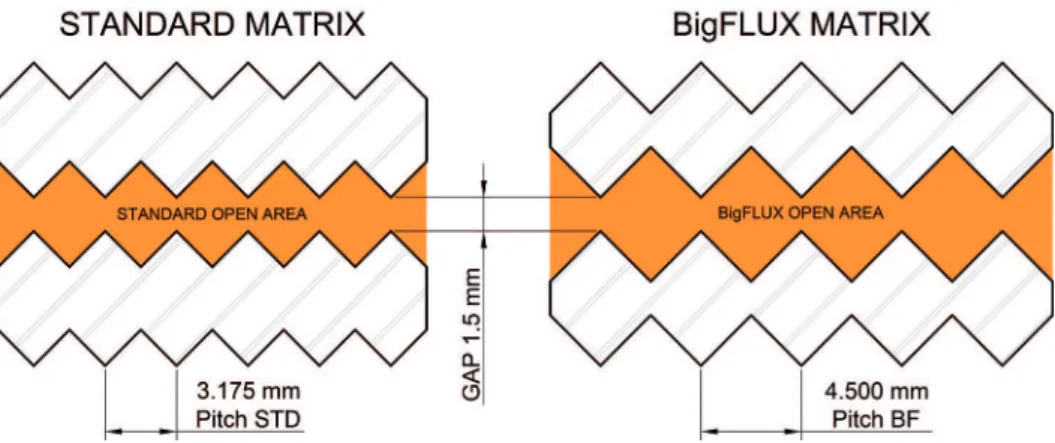
Figure 9 Open Area Comparison of Standard and BigFLUX Matrix @ Gap 1.5 mm.
The same calculations comparing the same gaps on both matrix, indicate an increase of 26 % @ gap 1.0 mm
and 32 % @ gap 0.5 mm. Of course, as already mentioned, the use of gaps smaller than 1.5 mm within the standard
matrixes, on industrial scale, has never been reported since in the long run it resulted in extensive clogging.
4.2 Further Features of the BigFLUX Matrix
Although the BigFLUX Matrixhas been designed primarily to increase the slurry lux throughput in the Super-WHIMS technology, it has additionally greatly improved the process and the operation of the magnetic separation in two very important issues. The first improvement is that the wider
dimensions of the open area turned the BigFLUX Matrix totally clogging free even at the 1.1 mm tested in the Mo-bile Super-WHIMS Plant. The second improvement is that the washing of this matrix became more eficient and effective to upgrade the quality thanks to the easier water low through the
groove space. These characteristics may open a new ield of applications in the gap below 1.5 mm which up to now could not be well explored due to the clogging problems. The success in us-ing this matrix will depend, as always, on the behavior of each type of ore to be processed.
5. The Super-WHIMS Mobile Plant Performance
5.1 The Process Flow Sheet
The process to scavenge iron from the tailings has been designed
to recover the slurry feed through three stages Rougher, Cleaner and
Re-Cleaner according to the low sheet of Figure 10.
Figure 10 The Mobile Plant Flow Sheet.
Of course the effective relationship between open areas will change as the gaps
between tips change. Figure 9 shows the open area for both matrixes at the same
gap opening @ 1.5 mm, and in this case the open area increase is approximately 22 %. The Total Open Area of the
Big-FLUX Matrix, with the square geometry above, is effectively increased by
approxi-mately 43 %, since the number of grooves per length of each standard steel plate is close to 93 grooves @ 3.175 mm pitch and
66 grooves @ 4.500 mm pitch.
In fact, the Total Open Area be-tween plates is:
Total STD area = 93 X 5.040 = 468.720 mm² and Total BiF Area = 66 x 10.125 =668.250 mm²
The slurry coming from the lotation plant is collected in a sump and then Pump BP-01 transports a controlled volume to the
motorized Filter NoBLOCK NB-01. The ilter removes oversized particles above 0.6 mm and the underlow – 0.6 mm is
feed boxes. The bottom rotor performs the Rougher stage with adjustable DC current from an AC/DC Converter inde-pendent from the top rotor. These coils induce in the matrixes a magnetic ield of 18,000 Gauss.
After passing in the Rougher stage, the Rougher Tailings RJ-RG are dis-charged by gravity to the tailings pond. The Rougher Concentrate CO-RG lows to a tank from where the pump BP-03 feeds two of the four feed boxes of the top rotor, and half of this rotor performs the cleaner stage. From the Cleaner stage the tailings low to the tailing pond and the
Cleaner Concentrate CO-CL is pumped by BP-04 to the two remaining feed boxes of the top rotor, and in this way the sec-ond half of the top rotor performs the Re-Cleaner stage producing the inal con-centrate CO-RC which is collected on a metal box for sampling purposes. The top rotor is equipped with standard matrixes set at a gap of 1.5 mm and the magnetic ield is adjusted at 12,000 Gauss. All the coils of the top rotor are supplied with DC Current from a separate AC/DC con-verter. Since there is an AC/DC converter for each rotor, the magnetic ield can be adjusted independently at each rotor. This
is a must for the process control, since the magnetic susceptibility of the Cleaner and Re-cleaner concentrates are much higher than that of the tailings. This possibility here described has been introduced after test number 12 to overcome the lack of in-dependent ield control for each rotor. The introduction of the BigFLUX Matrix was made at the same time of the installation of the second AC/DC converter, so after test 12, the process became fairly stable and provided conidence for an industrial scale operation. The results of these tests prepared by Vale Engineering Team are plotted in Figure 11.
Figure 11
Overall Test Results Prepared by VALE Engineering Team.
6. Conclusions
The various technologies here re-ported have been applied to scavenge iron from the tailings produced by lotation plants and have proved to be a viable solu-tion. Tested at an industrial feed rate of 40 tph, these results can be scaled up to larger scale production with no further concerns. Starting at an average of 20 % Fe in the tailings, a marketable product of above 60 % Fe can be produced with a mass re-covery of up to 14 %. According to VALE
igures, a yearly production of more than one million tons per year can be achieved. Important to mention that the feed rate and the results give support to state that the total volume of tailings from lotation in the order of 1800 m³/h can be processed by making use of 03 WHIMS GHX-1400 for the Rougher stage equipped with the BigFLUX Matrix with the 1.1 mm gap. The Cleaner and Re-Cleaner stages can be processed by three GX-500, each one
coupled with one GHX-1400 forming three independent production lines. Each line will be able to produce 50 tph, which when running 7000 hours per Year, will result in a total production of 350,000 tpy per line.
363
COLOMBO, A. F., HOPSTOCK, D. M. US Patent 4,192,738 - process to scavenge iron from tailings produced by lotation beneiciation and for increasing iron ore recovery. March, 11 1980.
PINTO, P. F. Teste industrial para concentração do rejeito de Vargem Grande II.
Resultados Status da Operação e Próximos Passos. May, 2017.
CHAVES, A. P. Teoria e prática do tratamento de minérios. (2nd ed.) São Paulo:
Signus Editora, 2001. v.1.
JONES, G. H. US Patent 3,326,374 – magnetic separator with washing and scouring means. 1963.
STONE, W. J. US Patent 3,380,367 – wet high intensity magnetic separator. 1972
RIBEIRO, J. P., RIBEIRO, C. H. T. The NoBLOCK technology. REM Rev. Esc. Minas. Ouro Preto, v. 68, Jul. /Sep. 2015.
RIBEIRO, J. P., RIBEIRO, C .H. T. New mega-sized WHIMS GHX-1400: a cost effective solution to reclaim iron ore ines from tailing ponds. REM - Rev. Esc. Minas. Ouro Preto, v. 66, Oct. /Dec. 2013.
References
Acknowledgments
The realization of this project count-ed with the precious support of many People and Institutions along more than one year of dedicated research work. The most decisive and rewarding was of course the total support of the VALE Engineering Team from Vargem Grande Mine which since the very beginning enthusiastically supported the challenge to apply new so-lutions to long lasting problems. The sup-port of Dragagem Paraopeba, Mr. Max and Junior, and to Itaminas Mineração, Mr. Bernardo Paz, Mr. Luis Almeida and
Mr. Alberto Alves, whose dedication, economical and manpower resources were a key and invaluable factor to reach this successful result. To Gaustec Engineering Team, especially the Project Leader Engi-neer Rafaella Bicalho and the Mobile Plant Operators Trainee Engineers Taiane Lopes and Custodio Borges who along six months succeeded to keeping the Plant continuous-ly running and granting its success. REM Magazine Board, Prof. Jorio and Engineer Luciano Borba who as always, opened valuable space in this traditional media to
support and spread worldwide our latest Technology. To Dannemann Institute, especially to Engineer Maria Moura, who has patiently and diligently managed our intellectual property system along the years. And inally to the INPI Institute, which in a very effective way to support technology developers, created the Green Patent System, granting in little more than one year the Patent BR 102015031762-0 protecting the core technology disclosed in this paper. To them all we would like to express our sincerest gratitude.