Manuel Luís Tender PhD Researcher
School of Engineering of University of Minho Guimarães – Portugal
João Pedro Couto Assistant Professor
School of Engineering of University of Minho Guimarães – Portugal
Luís Bragança Associate Professor
School of Engineering of University of Minho Guimarães - Portugal
The role of underground
construction for the mobility,
quality of life and economic and
social sustainability of urban regions
Abstract
Tunnelling has been used for several purposes for thousands of years. In the com-ing years the world's population will increase in the urban areas. So, the urban centres will have to adapt, in order to guarantee that their future population will have the necessary and sustainable growth. Due to the constraints for surface construction, also connected to environmental issues, this population growth will imply a greater use of the underground. With this optimal growth, the population of the cities will have better mobility, quality of life, and economic and social sustainability. In a irst phase, this report will present a historic approach to tunnelling and its foreseeable future. Afterwards, we will present some considerations on the three factors which tunnel-ling impacts: mobility, quality of life and social sustainability. As a case study, we will analyse the 2nd phase of the construction of the Marão Tunnel (TDM) – the longest ever built in the Iberian Peninsula– and describe the options made regarding each of those factors. In this case study, the options implemented made it possible to success-fully execute the works. For the industry, this work is important because it describes a successful management of the aspects under analysis.
Keywords: mobility, quality, sustainability, tunnel, Marão Tunnel. http://dx.doi.org/10.1590/0370-44672016700151
Civil Engineering
Engenharia Civil
1. Introduction
a. Sustainability
b. The present and the future of underground space
The construction sector began to recognize the impact of its ac-tivities on sustainable development in the 1990s (Mateus et al., 2013).
After that, a set of social, economic and environmental assumptions started to be implemented, in order to have works conducted to a
cer-tain level of quality, keeping to the deadlines,and ensuring a decrease in the amount of damagesdone to future generations.
The use of the underground space has been increasing (Bobylev, 2016) and gaining importance in the development of the central structure of cities and urban-ized areas (Delmastro et al., 2016b), and never before has it been this available (Bob-ylev, 2009). Several cities have decided to take advantage of the underground space and currently have in place several types of underground works, which are an integral part of the daily lives of the city dwellers. Some of them are even crucial for the nor-mal functioning of the city itself. Actually, it is safe to even say that cities like London or New York would not be able to keep operating functionally if they did not have underground infrastructures (Admiraal
& Cornaro, 2016). A lot of urban areas, besides being highly populated, present several other constraints, due to problems with trafic infrastructures and resources, goods and services distribution; problems with the protection against natural disas-ters; lack of space for work and leisure; and constraints to protect heritage and antique infrastructures (Burghignoli et al., 2013). The problem most widely recognized is probably the need to relieve trafic jams in the streets of cities (Broere, 2016). It is anticipated that the world population will increase 2.3 billion people between 2011 and 2050, from 7.0 to 9.3 billion people (Kaliampakos, 2015). It is also anticipated that the population living in urban areas
266
something that has been happening for quite some decades now. However, the costs involved when the height is substan-tial make it impossible to choose this way (Hunt et al., 2016). There is no denying that underground construction is increas-ing all over the world (Ritter et al., 2013) and there is an undeniable link between the population growth and the development of underground infrastructures. That can be
seen in the cities of Stockholm, Tokyo and Paris (Bobylev, 2009), to name but a few, which are betting on this kind of work due to its importance for economic develop-ment (Admiraal & Cornaro, 2016). So, it can be anticipatedthat the new infra-structures, due to the lack of space in our current cities, will be placed underground (Nelson, 2015).
Note that the evolution of the
un-derground space is always dependent on the inancial issues associated with the construction, operation and maintenance costs (Sterling, 1997), and there may even be some cases in which inancial limitations make it unfeasible to use un-derground space (Sterling, 1997);therefore, any infrastructure developments will always be dependent on a cost-beneit analysis carried out by the developer.
c. Building underground
Nowadays, the advantages offered by the use of the space below the surface are important for society (Bobylev, 2009) and in environmental, social and eco-nomic terms (Mateus et al., 2013).
Let's analyse in depth the several advantages of using underground works that have been identiied in literature. We will divide this analysis three fold: mobility, quality of life and economic and social sustainability.
Mobility
• They improve accesses and traf -ic low (Cui & Lin, 2016) decreasing journey times;
• They decrease the risk of trafic
collisions and road accidents.
Quality of life
• They increase the quality of life
level (Delmastro et al., 2016b);
• They make it possible for infra -structures to be available for everyone;
• They free space at the surface for
other uses, such as green areas (Admiraal & Cornaro, 2016).
Economic and social sustainability
• They provide a three-dimension -al freedom (Sterling, 1997) of design and planning (Sterling, 2013) with no set limits;
• They are surrounded by an excel -lent insulating material, namely when it comes to thermal action, both for low and high temperatures, to vibrations and noise (Sousa, 2000);
• Their maintenance costs are also
lower than with solutions above ground, due to more stable temperatures and pro-tection against outside inluences (Cui & Lin, 2016);
• They can add value to
real-estate and public spaces (Admiraal & Cornaro, 2016);
• They preserve historical centres
and save land for natural development (Cui & Lin, 2016);
• During construction, they cre -ate new jobs and improve the skills of those involved;
• They ight the isolation of popula -tions and reduce regional inequalities;
• They make possible an increasing
in population without having to extend urban borders (Cui & Lin, 2016);
• They allow protection from ter -rorist attacks (Delmastro et al., 2016b), floods, extreme wind events, heavy rains or erosion (Admiraal & Cornaro, 2016), earthquakes (a better protection than above ground infrastructures) (Ad-miraal, 2012), and industrial accidents (Sterling, 2013).
The use of the underground space has contributed to sustainable urban development (Nikolai Bobylev, 2010), useful in several areas (Bobylev, 2016), in particular for infrastructures that, due to the need for reliability, must be installed underground (Ronka et al., 1998).
Below you can ind some examples of these underground infrastructures.
Water supply and treatment – to supply the city with fresh water and drain the wastewater from the city, or to serve as a temporary storage place for rainwater when there is a lood.
Electrical infrastructures– The un-derground space is very important for the placement of energy systems (Delmastro
et al., 2016a), since the electric cables can pose a health risk, due to the magnetic ield they create, and, at the same time, they occupy the loor, due to servicing issues.
Transportation of goods or waste through a vacuum system – This option decreases the need for above ground con-tainers (Delmastro et al., 2016b) and the movement of trash trucks.
Road and rail connections – In many urban areas, growing trafic is a serious problem. However, it would be impossible to build more infrastructures for trafic at the surface, without unbearably com-promising the quality of the environment (Sousa, 2000).
Metropolitan systems – A metro system has the ability, when compared with conventional urban transport, to
carry more passengers at a higher speed. Some cities have wide centennial networks of lines, now being expanded while other cities are in the early stages of implemen-tation. The use of this kind of transport system reduces the trafic in peak hours, allowing to save a vast amount of man-hours per year (Godard, 2008).
Pedestrian circuits - for circulation in high-trafic areas such as high-volume stations (Sterling, 1997).
Areas dedicated to commerce, hous-ing, shelter and parking– an emerging phenomenon in several cities of the world (Admiraal & Cornaro, 2016): facilities, such as data centres, shopping centres, archives, libraries, art galleries, swimming pools, sports centres, water treatment centres and warehouses (Admiraal & Cornaro, 2016). In the case of wastewa-ter treatment centres, there is the added advantage of decreasing the foul smell.
Hydroelectric facilities – Hydroelec-tric facilities have several elements that can be underground, from the generation cen-tral to tunnels for different aims: access to the central and others. In the case of dams, the environmental impact is decreased if they are buried (Delmastro et al., 2016a). Carbon storage and transportation systems – as the use of natural resources, like gas and oil, increases, the need to have mining of gas and oil at ever greater depths (Sousa, 2000). Underground stor-age places for carbon are an alternative to tanks or deposits above ground.
Nuclear waste storage - The growing increase in the electric energy production capacity of nuclear plants has been fol-lowed by the growing production of these wastes (Sousa, 2000) that are usually not well accepted by populations. The buried solution is a successful solution, because it separates waste from humans and from the environment above ground, and also because it involves geological means with longer stability periods than the radioac-tive cycle of the waste itself(Sousa, 2000).
consists in the production of heat in a plant and its distribution through pipes, to urban area housesfor heatingand bath water, for example. This is already con-sidered one of the most environmentally
friendly solutions, allowing for substan-tial energy savings and lowering the cost of energy storage and distribution (Del-mastro et al., 2016a).
Support for other infrastructures
– an example is the micro-tunnel of Pescanova in Mira, built to connect the ishing transformation complex and the sea and to allow water to go in and out.
2. Research Method
In order to assess the real impact on the three factors under analysis of an un-derground construction, we have chosen to study the Marão Tunnel. This is because: a) one of the authors is amemberof the
survey-ing team of this tunnel, which allows him to follow all the developments; b) this is the longest tunnel in the Iberian Peninsula; and c) there are some good examples of manage-ment of the issues being analysed. We will
approach all three factors considering two of the phases of the lifecycle of a construc-tion: the design and the construction. This methodology will support the accuracy and reliability of the data obtained.
b. Case study presentation
The Marão Tunnel is located on Highway A4 (that links East Portugal to Spain), between Amarante and Vila
Real. It allows for the underground crossing of the Marão Mountain Range, in the East-West axis, between
Ansiães-Amarante and Campeã-Vila Real (East portal in Figure 1).
a. Methodology
Figure 1 Orographic framing of the East portal (author’s image).
The construction began in June 2009, but was suspended in September of the same year, due to a restraining order. The concessionaire was only able to resume works in September 2010; however, in June 2011, the works were suspended again, this time for inancial reasons. The Project Owner that carried out the 2nd stage of works was “Infraestruturas de Portugal”. The cost was estimated at 88.100.000 euros, and the constructor is the Joint Ven-ture “Teixeira Duarte/EPOS-Empresa Portuguesa de ObrasSubterrâneas”. On February 25 2014, European
Com-missiongives a favourable decision in terms of financing for the works to resume, which speaks of its importance for land cohesion, and makes it pos-sible to reduce the national cost, as the Project Owner has to support less than 50% of the value of investment. The excavation works were divided intofour fronts (two in the East and two in the West). When the works were resumed, in September 2014, there were 3,961 m left to excavate. The method used for excavation was the Conventional Excavation Method, which involves the following stages (Tender et al., 2015):
Topographic marking of the excavation face; sequential excavation of the rock mass; ventilation of the excavated area; removal of excavation products to the dumping site; scaling of excavation; application of the irst sprayed concrete layer and stabilizing devices.
It should be noted that Portugal, although a country with an old mining tradition, has no tradition in the execu-tion of tunnels as a construcexecu-tion work. Exceptions are the metro works of the cities of Lisbon and Oporto as well as underground works associated with hydroelectric generation projects.
3. Results and discussion
On the next page are the results of Marão Tunnel in the three factors being studied (mobility, quality of life, economic
and social sustainability).
The construction stage was espe-cially important for the goal set: to be
268
a. Influence on mobility
i. Project Stage
Creating a road between Amarante and Vila Real has the following advantages:
1. The existing track, 28.5km in length, is replaced by a new track with a length of 26km with estimated savings of 15% in fuel;
2. Improving local, regional, na-tional and internana-tional accesses namely between the coastal areas of Portugal and the border with Spain;
3. Average daily trafic increase be-tween Amarante and Vila Real from 8,000 vehicles / day to 10,500 vehicles / day;
4. It guarantees the crossing of the Marão Mountain Range in adverse weather, something otherwise impossible, due to the snow and the fog during the winter months. It should be noted that several times during the year, the existing road becomes very dangerous due to the deposition of ice and the lack of visibility. There are also frequent interruptions last-ing several hours, affectlast-ing all the trafic
between the cities of Amarante and Vila Real. The new road, since the tunnel entrances are located at a height approx. 200m below the old one, allows trafic to low unaffected by weather conditions;
5. Reduction in travel times. The goal is to make sure that the travel time between the main district capitals and a main or secondary road is un-der 30 minutes; therefore,reducing the travel time between Amarante and Vila real by 19%(currently, around 35min; afterwards,around 28min);
6. Reinforcement of road safety, re-ducing the high number of road accidents (average-18 fatalities a year), substantially improving the quality of movement of the lo-cal population.The goal is to achieve a 26% decrease, to a limit of 13 fatalities a year.
ii. Construction Stage
Impact on the roads surrounding the works construction site - the high volume of heavy transports between both portals, via Estrada Nacional 15, is damning to
the pavement. It is, therefore, necessary to maintain the roads in good condition, so that they will not present added risks to the users of the Estrada Nacional. Another preventive measure is the use of temporary road signalling system, with stoplights, as a means to reduce the impact on those using the N15.
Risks of road accident “in itinere” - Considering the bad weather conditions during winter, road risks are heightened during the construction stage, namely when it comes to the routes more prone to ice or snow, as can be seen in Figure 2, which shows the Highway A4, at the surface, between both faces of the excava-tion. The workers' skills and knowledge are of paramount importance for the decrease of road accidents. Thus, in the Marão Tunnel, the choice was made to train workers on road safety, especially focused on defensive driving, which en-abled the decrease of risks linked to the mobility of workers.
Figure 2
Highway A4 (author's photo).
b. Influence in the quality of life
i. Project Stage
Beyond the advantages linked to the improvement in quality of life con-nected to increase mobility, the Marão Tunnel enables:
1. Making cities more liveable; 2. Allowing the population a simpler access to leisure areas;
3. Enabling the landscaping of areas previously left unattended.
ii. Construction Stage
Fumes – The main sources of qual-ity of life impact when excavating are the explosives from blasting activities, the exhaust fumes from the trucks that carry the debris out, and the electricity
spent in ventilation (Huang et al., 2015). Excavating from both sides –usual in tunnels longer than 3000 m (Huang
et al., 2015) – not only decreases the time spent excavating and but it also decreases the length the trucks have to go through in order to remove the debris from the excavation front, reducing in this way those impact sources (Waris
et al., 2014).The gases produced by ire blasts (e.g., carbon monoxide and diox-ide, nitrogen, ammonia) were regularly analysedand monitored, to make sure they remained within the legal limits.
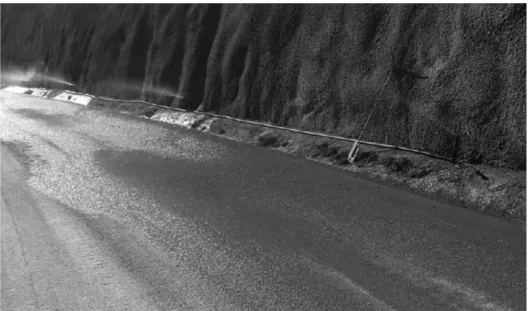
Dust and muds – The Marão Tun-nel had high impacts on the quality of
Figure 3 Humidifying system (author's photo).
Noise - To remove the contaminated air from the tunnel, high power 250 kW ventilators were used. This meant that it was necessary to install a special protec-tion on the ventilators onthe East side, so as to reduce the amount of noise produced.
Water courses - One of the known impacts of underground excavation is that water courses can be altered and, often, polluted (Sahu et al., 2015). In Marão
Tun-nel, the most signiicant impact was on the quality of the water resources of the Marão Mountain range, something that had been acknowledged from the stage of design, allowing for the setting up of preventive measures for the different construction stages. Considering the hydrogeological context, and in order to avoid contamina-tion of the Marão River, systems for water treatment were installed to treat the water
coming from the excavation of the tun-nel, so as to avoid signiicant changes in water quality that could compromise the resources present. Thus, two industrial wastewater treatment plants were built, one ateach of the portals of the Tunnel, to make sure that the physical and chemical treatment of the waters stemming from the excavation work was carried out before the water was released into the Marão River.
c. Influence on the economic and social sustainability
i. Project Stage
Taking into account the costsand beneits of a project has proven to be one of the most important factors in the evaluation process and it may even deine the project’s reliability (Bassan, 2006),since the beneits can be translated in terms of money (Kaliampakos et al., 2016). On the other hand, there are also cases when a tunnel proves to be the best solution regardless of its costs (Kaliam-pakos et al., 2016). In the case of the Marão Tunnel, the anticipated beneits greatly outweighedthe disadvantages.It is a fact that there is a great inter-regional inequality (the GDP per capita from Alto Trás os Montes is about 61% of the GDP per capita of Grande Porto). Therefore, the advantages of the Marão Tunnel were identiied as being:
1. To fight the inland situation and reinforce land cohesion. This enabled the population of Vila Real (around52,000people) and Bragança (around 35,000 people)to overcome the current situation of isolation that isan obstacle to their development; support and settle the population in that Region, namely working age population, revers-ing the human desertification trend that wasstarted many decades ago; and
reduce regional asymmetry and excessive polarization of the economic develop-ment in the coastal areas of Portugal and around big urban poles;
2. To develop the Trás os Montes region (improves accessibilities with an impact on the socio-economic con-ditions of the Region; promotes the Region's attractiveness and competitive-ness, enabling the presence of economic activities that generate wealth and local employment; facilitates commercial trade at a national and international level, by reinforcing the territorial con-nectivity; reinforcing the role of the Amarante and Vila Real cities, and also the link to Bragança, Mirandela and Macedo de Cavaleiros, in the urban regional system);
3. To strengthen territorial con-nectivity. This guarantees cross-border connections, allows the link to the Euro-pean transport networks, and promotes a greater connection of the inland to the coastal area and the Great Metropolitan Area of Porto).
ii. Construction Stage
Employment - The first impact of an enterprise like the Marão Tun-nel is the need to employ the workers to be used in the work itself. This job
creation was based on equal opportuni-ties between the locals and people from other places, which increased the social integration of the populations. In March 2015, 41% of the workers were locals.
Housing and restaurants - Both the newly hired personnel and those that already worked in the companies needed a place to live and eat. As for housing, the Marão Tunnel work has created a group of prefabricated bedrooms for 100 workers, and the meals were taken care off by the local restaurants.
For the rest of the workers, houses close to the working sites were rented. In fact, atthe peak of man-power on the job, there was a saturation of the local houses, which boosted the sustain-ability, albeit ephemeral, of the local entrepreneurs of this geographical area.
270
Resources use –In terms of the infrastructures needed to build the tunnel, there is usually some pressure to reduce water, electricity, ventilation and compressed air consumption. How-ever, the method used, given the high amount of explosives and machinery used, generates a cloud of toxic fumes after each blast. Also important are the exhaust fumes that are generated with the trafic of trucks to take the debris from the excavation face to the dump site. In order to expel the fumes from the galleries and to renovate the inside air, it is necessary to assure a certain venti-lation low, which uses a vast amount of electrical energy - electricity is the third highest source of environmental impact in excavation (36%) (Huang et al., 2015).
Re-use of excavation material –The construction sector is one of the major contributors to the depletion of natural resources (Mateus et al., 2013),while giving rise to millions of tons of waste (Oliveira et al., 2014) .Each blast in the tunnel generated a set amount of debris. These were removed from the tunnel to a dump site, so that other activities could be carried out (e.g., spaying of concrete or assembly of stabilization devices). In the most recent international projects, there is an effort to reuse the materials that come from the excavation of the tunnel (Ritter et al., 2013.). Reusing this material can save non-renewable resources, avoid the creation of deini-tive dumps, limit the negadeini-tive impact on neighbouring populations, and save energy by reducing the travel distance
of these materials (Ritter et al., 2013). So, this recycling process, by creating a closed life cycle for the products stem-ming from the excavation, can be con-sidered sustainable, and it takes the so-ciety, the economy and the environment into consideration at the same time (Rit-ter et al., 2013). In this case study, due to the vast amount of debris produced (400,000 m3), it proved necessary to provide two dumping sites, one on each side of the Marão Mountain Range, to temporarily store the material. Since the choice was to reuse the debris for land-illing of infrastructures, 155,000 m3 of debris were treated and, after crushing in an industrial unit outside of the site, were used for landilling of infrastruc-ture tubes (95,000m3) and for granular layers (60,000m3).
4. Conclusions
After analysing the current situation of underground works, the following con-clusions can be reached: the underground development is an important tool to develop cities; it links places separated by topography; and faces the challenges of the future.Gradually, new uses have been given to the underground space,
overstep-ping the usual uses of road and rail con-nections, as well as water and electricity infrastructures. Putting infrastructures underground brings about several advan-tages, from the optimization of spaces to environmental concerns, not forgetting heritage preservation issues. The under-ground presents a feasible opportunity
to install infrastructure systems which are more reasonable and sustainable. Concerning the case study we presented, and regarding the three factors under analysis, there is a huge impact depending on the choices made. In this case study, the choices guaranteed the success of the enterprise in all three aspects.
Acknowledgements
The student would like to thank: Infraestruturas de Portugal and Teixeira Duarte/EPOS Joint Venture, for their
support; the companies taking part in the R&D Project “SegOS”, associated to the Doctoral Programme, namely
MOTA-ENGIL, ORICA, SIKA and DST;Alexandra Valle Fernandes, for the translation.
References
ADMIRAAL, H. Underground space as invaluable asset for resilient cities. In: Proce-edings... 13th ACUUS World Conference 2012. Singapore.
ADMIRAAL, H., CORNARO, A. Why underground space should be included in urban planning policy - and how this will enhance an urban underground future.
Tunnelling and Underground Space Technology, v.55, p. 214-220, 2016. BASSAN, A. The economic feasibility of rebuilding Al-Isra university tunnel –
mecha-nical factors. American Journal of Applied Science, v.3, n.4, p. 1785-1789, 2006. BOBYLEV, N. Mainstreaming sustainable development into a city’s master
plan: a case of urban underground space use. Land Use Policy, v.26, n.4, p. 1128-1137, 2009.
BOBYLEV, N. Underground space as an urban indicator: measuring use of sub-surface. Tunnelling and Underground Space Technology, v.55, p. 40-51, 2016. BROERE, W. Urban underground space: solving the problems of today's cities.
Tun-nelling and Underground Space Technology, v.55, p. 245-248, 2016.
BURGHIGNOLI, A., CALLISTO, L., RAMPELLO, S., SOCCODATO, F., VIGGIA-NI, G. The crossing of the historical city centre of Rome by the new underground line C: a study of soil-structure interaction for historical buildings. In: BILOTTA et al, Geotechnics and Heritage. London: Taylor&Francis, 2013.
Tun-nelling and Underground Space Technology, v.55, p. 96-102, 2016a.
DELMASTRO, C., LAVAGNO, E., SCHRANZ, L. Underground urbanism: Master Plans and Sectorial Plans. Tunnelling and Underground Space Technology, v.55, p. 103-111, 2016b.
GODARD, J. Should we/can we avoid underground urban mass transit systems? In: ITA-AITES WORLD TUNNEL CONGRESS, 2008. Agra, India.
HUANG, L., BOHNE, R., BRULAND, A., JAKOBSEN, P. Environmental impact of drill and blast tunneling: life cycle assessment. Journal of Cleaner Production, v.86, p. 110-117, 2015.
HUNT, D., MAKANA, L., JEFFERSON, I., ROGERS, C. Liveable cities and ur-ban underground space. Tunnelling and Underground Space Technology, v.55, p. 8-20, 2016.
KALIAMPAKOS, D. New challenges in the use of underground space. In: WORLD TUNNELING CONGRESS. (2015 - Promoting tunneling in SSE Region, Dubrovnik).
KALIAMPAKOS, D., BENARDOS, A., MAVRIKOS, A. A review on the economics of underground space utilization. Tunnelling and Underground Space Technolo-gy, v.55, p. 236-244, 2016.
MATEUS, R., NEIVA, S., BRAGANÇA, L., MENDONÇA, P., MACIEIRA, M. Sustainability assessment of an innovative lightweight building technology for par-tition walls e Comparison with conventional technologies. Building and Environ-ment, v.67, p. 147-159, 2013.
NELSON, P. A framework for the future of urban underground engineering. Tun-nelling and Underground Space Technology, v.55, p. 32-39, 2016
OLIVEIRA, F., MENDONÇA, P., COUTO, J., CAMÕES, A., SILVA, E. Compa-rative environmental and economic analysis of South European building cons-tructive systems. WSEAS Transactions on Environment and Development,
v.10, p. 509-528, 2014.
RITTER, S., EINSTEIN, H., GALLER, R. Planning the handling of tunnel excava-tion material - A process of decision making under uncertainty. Tunnelling and Underground Space Technology, v.33, p. 193-201, 2013.
RONKA, K., RITOLA, J., RAUHALA, K. Underground Space in Land-Use Planning
Tunnelling and Underground Space Technology, v.13, n.1, p. 39-49, 1998. SAHU, H. B., PRAKASH, N., JAYANTHU, S. Underground mining for meeting
en-vironmental concerns – a strategic approach for sustainable mining in future. Pro-cedia Earth and Planetary Science, v.11, p. 232-241, 2015.
SOUSA, L. Innovative aspects in the design and construction of underground structu-res. In: PORTUGUESE GEOTECHNICAL CONGRESS, 2000. Porto, Portugal. STERLING, R. Tan Swan Beng Lecture - sustainability and resiliency issues for
urban underground space. 2013
TENDER, M., COUTO, J., FERREIRA, T. Prevention in underground construction with Sequential Excavation Method. In: AREZES et al. Occupation Safety and Hygiene III. London: Taylor & Francis. 2015. p. 421-424.
UNITED NATIONS. World Population Prospects:The 2007 Revision-Technical Re-port. 2007
WARIS, M., LIEW, S., KHAMIDI, F., IDRUS, A. Criteria for the selection of sustai-nable onsite construction equipment. International Journal of Sustainable Built Environment, v.3, p. 96-110, 2014.