Spin-ip Scattering Contribution to
Resonant-Tunneling Current in Semimagnetic
Semiconductor Heterostructures
V.A. Chitta, M. Z.Maialle,S.A. Le~ao, andM. H. Degani
Grupo de Simulac~ao Computacional de Sistemas Semicondutores Universidade S~ao Francisco, Faculdade de Engenharia,
13251-900 Itatiba, S~ao Paulo, Brazil Received February 6, 1999
We calculate the characteristic current-voltage curve of a tunneling device based on semimagnetic semiconductor materials. The device is a heterostructure with layers of Cd1,xMnxTe in which the
magnetic ions Mn2+ interact strongly with the conducting electrons via the
s-d exchange
interac-tion. Thermal uctuations of Mn2+ magnetic moments cause spin-dependent electron scattering
that modies the characteristic current-voltage curve. Our calculation shows how this electron-ion scattering is expected to aect the spin dynamics in transport measurements.
I Introduction
Recent advances in the growth of semimagnetic semi-conductor (SMS) quantum structures have renewed the interest in the long-standing study of carriers interact-ing with magnetic ions.[1] SMS quantum structures are versatile systems in which to conduct such study be-cause they make possible the adjust of the spatial over-lap between the carrier wave functions and the mag-netic ions.[2]
Optical spectroscopy with polarized light have con-tributed greatly to the understanding of the carrier spin dynamics in undoped SMS quantum structures.[3] That is because angular momentum conservation at the ab-sorption of a polarized photon allows creation of car-riers in denite spin states. Furthermore, detection of the polarization of the luminescence reveals the spin states of the carriers at the moment they recombine; from this it is possible to study the role of dierent spin relaxation mechanisms on the spin population initially photoexcited. On the other hand, most of the transport measurements do not give access to the spin state of the conducting carriers, which complicates the study of the spin dynamics. Also, such measurements usually re-quire doped SMS samples that only recently have been grown with reliable quality. Despite these diculties, preliminary investigations have shown interesting
be-haviors that are attributed to the spin polarization of the conducting carriers.[4]
In this work we investigate a tunneling device made out of layers of Cd1,xMnxTe materials, where the
mag-netic moments arise from the half-lled d shell of the
ions Mn2+. An external magnetic eld
B is applied
along the growth axis (z-axis) to align the localized
mo-ments and to create a magnetization proportional the average ion spin hS
z
i, which acts on the electrons via
the s-d exchange interaction. This eect can be seen,
in the mean-eld approximation, as a change in the po-tential proles; electrons with spins up see a dierent potential than electrons with spins down.[2] Several de-vices have been proposed[5] based on this dierence in potential proles to create tunneling current with some degree of spin polarization.
II Spin-dependent potential
proles
The coupling between electrons and the magnetic ions is given by thes-dexchange interaction term
P
i J
s,d b S
i
in the electron Hamiltonian, where b is the
electron-spin operator, S
i's are the ion spins, and J
s,d the
H 0 =
, ~
2
2m d
2
dz2+V (z)
gB
2 BN 0
xhSzi
2 +El; (1) with the signs corresponding to the electron spin
components jp=1=2i. m is the electron eective
mass and V (z) is the band-edge potential of the SMS heterostructure. The quantized motion in the xy-plane yields the Landau level ladder with El=~eB(l+
1
2)=m.
The Zeeman spin splitting is gBB and the average
spinhSzigives the so-called giant-Zeeman splitting that
cause the aforementioned change in the potential pro-le. Also, in Eq. (1), N0=1=0, with 0 as the volume
of the primitive cell, =hucjJs ,d
juci, where uc is the
periodic part of the conducton band Bloch function, and x is the Mn2+ molar fraction.[6]
The eigenstates of H
0 that we are concerned
with are those involved in the tunneling current. We use a short-handed notation for these eigenstates
jpi=
p
z;pk;p
,
hrjpi= p
pz(z)'pk( r
k)uc(
r)jpi; (2)
where pz(z), with pz=(Ep;kzp), gives the solution
of the z-direction problem for an electron with longi-tudinal energy Ep, propagating to the right (kzp>0)
or left (kzp<0). To obtain pz(z), we have used
open boundary conditions when solving numericallythe Schrodinger equation with the Hamiltonian H
0. The
solution of the xy-plane motion gives 'pk( r
k), with
pk=(lp;ky
p), as the lp-th Landau level state.
An electron in a statejpi, when tunneling potential
barriers of SMS material, has a transmission coecient T0
Ep;p, which can be easily calculated from the
eiges-tates pz(z) and depends on the longitudinal energy
Ep=~ 2k
zp 2
2m
and spin p. By considering the thermal
uctuations of the Mn2+ moments (see next section),
we allowfor transitions from the initialstatejpito other
states jqi with a probability rate per second that we
call Wpq. The resulting transmission TEp;p is then
ob-tained using a semi-classical Boltzmann equation[7] in
the rst Born approximation TEp;p = T
0
Ep;p+ Lm ~kzp
X
q Wpq(T
0
Eq;q ,T
0
Ep;p); (3)
where L is the system size, which includes the well and barrier regions, and
kzp=
q
2m[Ep,V (z)]=~
2 (4)
is the electron wave vector at the emitter, where z=,L=2.
The tunneling current emitter-to-collector is calcu-lated as the product of the electron change (e < 0) and the probability current, summed over the occupied states jpi at the emitter that are moving toward the
collector, yielding Je!c= e
2B
(2~) 2
X
lp;p Z
1
0
dEpfelp(Ep) e
TEp;p; (5)
where feis the emitter Fermi distribution function, and
e
TEp;p is given in Eq. (3) with the substitution T 0
Eq;q !
T0
Eq;q(1
,fc(Eq)) to account for the restriction due to
the exclusion principle on the occupation of the collec-tor states. A similar result is found for the colleccollec-tor- collector-to-emitter current Jc!e, and the net current is then
obtained as J=Je!c ,Jc
!e.
III Scattering by thermal
uc-tuations
An additional contribution of the s-d exchange inter-action to the electron motion comes from the thermal uctuations of the magnetic moments. Although the average magnetization components normal to B
van-ish, sincehSxi=hSyi=0, thermal uctuations allow a
-nite normal magnetization component proportional to
q
S2
x;y
that is varying in time. Fluctuations of the longitudinal component hSzi is also expected. The
time-dependent Hamiltonian accounting for these con-tributions is written as
c
H1(t) = ,
X
i J (
jr,Rij)[(Sz;i(t),hSz;ii)bz+ 12 (S +;i(t)
b
,+ S,;i(t) b
+)]; (6)
where the electron-spin raising and lowering operators b =
b
xiby have been used. Similarly, for the ion spins,
S;i(t)=Sx;i(t)
iSy;i(t), which are not operators. H
for the transition jpi!jq ibetween eigenstates of H
0 is proportional[8] to the Fourier transform of the correlation
function
G
pq(
)hh q jH 1(
t,)jpih pjH 1(
t)jq ii av
; (7)
where h i
av means an average over ensembles accounting for the random dependence of H
1(
t) on time, as well
as the average on the ion positions in the lattice sites. We assume an exponential decayG pq(
)/exp(,jj= c),
with
csetting the time scale of the ion-spin auto-correlations G pq( )/ P i;j hS ;i( )S 0 ;j(0)
ithat Eqs. (6) and (7)
imply. The transition rate is then
W
pq= 1 ~ 2 Z +1 ,1 G pq( )e ,i(Eq,Ep)=~
d =jhpjH 1
jq ij
2 2
c
~ 2+ (
E q ,E p) 2 2 c ; (8)
which is a Lorentzian function of the transferred energyE q
,E
p between the initial and nal scattering states of
the transition.
The matrix elementhpjH 1
jq iin Eq. (8) is then calculated as follows. The integral of the spatial parts can be
performed using the short-range nature ofJ(r) and the periodicity of the Bloch functions. Using the states Eq. (2),
, Z V q q z( z)'
q k( r k) u c( r)
J(jr,R i
j) p
p
z( z)'
p k( r k) u c( r)dr
= , q qz( Z i) ' q k( R ik) p pz( Z i) ' p k( R ik) ; (9)
where the magnetic ion positions are R i=(
R
ik ;Z
i). Calculating the spin-dependent part we obtain hpjH
1
jq i = , X i q q z( Z i) ' q k( R ik) p p z( Z i) ' p k( R ik) [ q;p p S
z ;i( t) + 12
q; 1 2 p; 1 2 S ;i(
t)]; (10)
where S z ;i(
t)=S z ;i(
t),hS z ;i
iand the upper (lower) signs holding for the spin-up to spin-down transitions
(vice-versa)
To proceed with the calculation of G pq( ) / P i;j hS ;i( )S 0 ;j(0)
i; we assume in this work no correlation
between spins of dierent ions, i.e.
hS ;i( )S 0 ;j(0) i= 0 ; i;j h S ( )S (0)
i; (11)
with =x;y ;z. This neglects the fact that pairing of spins in antiferromagnetic states is actually expected in the
systems investigated; which is however accounted for in an approximated manner in the eective concentrationx.[6]
The transition probability Eq. (8) then becomes
W pq= 2 4~ 2 X i q q z( Z i) 2 p p z( Z i) 2 ' q k( R ik) 2 ' p k( R ik) 2
F(! pq) ; (12) with! pq=( E q ,E p) =~ and F sf( !) = Z +1 ,1 hS ( )S (0) ie ,i! d; (13)
for the spin-ip (sf) scattering ( q=
,
p) and F sc( !) = Z +1 ,1 hS
z( )S z(0) ie ,i! d (14)
for the spin-conserving (sc) scattering ( q=
p).
The summation over the nal states, given in Eq. (3), allows us to perform the integration over the planar spin distribution f W pqz X
q =(lq;kyq) W
pq= ( =
0) 2
4~ 2
A(eB=h) 0 A 2 X lq;n N n q q z( Z n) 2 p p z( Z n) 2
F(! pq)
where Ais the system area andN
nis the number of ions in the n
th layer.
Finally, using the exponential decay of the spin correlationsG pq(
)/exp(,jj=
c), Eq. (13) gives F
sf( !
pq) = [
S(S+ 1),
S 2
z
hS
z i] 2
c
1 +! 2
pq
2
c
: (16)
d
For the spin-conserving scattering, a similar expres-sion is obtained by changing [S(S+1),
S 2
z
hS
z i]$
[ S
2
z
,hS
z i
2
]. Note that f W
pqz is proportional to the
product of probabilities of nding the electron in a primitive unit cell of the n
th layer, i.e.
0
A j
p( Z
n) j
2
, for the initial and nal states, times the number N
n
of such cells containing a magnetic ion in that layer. The sum over the Landau orbits gives the number of statesA(eB=h) in the degenerate levelsl
q. The thermal
equilibrium averages used above are hS z
i=,SB S(
y)
and S
2
z
=h S z
i 2
+S 2
d
dy B
S(
y), whereB S(
y) is the spin-S Brillouin function, with y=(g
Mn
B SB)=(k
B T) and S=5=2 for Mn
2+.
IV Results
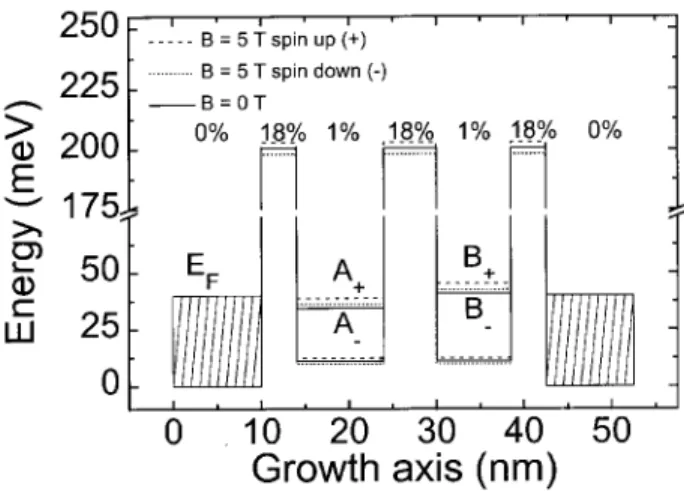
The tunneling device we investigate has the potential prole depicted in Fig. 1, where the material composi-tions are indicated and the percentages shown are the Mn2+ molar fraction
x. The levels drawn in the wells
A and B of the potential prole are the energies of the peaks of the transmission coecients corresponding to the quasi-bound spin-up (+) and spin-down (,) states
in these wells. For zero magnetic eldBthese levels are
degenerate (solid line in Fig. 1). They split for B 6=0
due to the s-dexchange term in the Hamiltonian. We
have chosen the system parameters in such a way that the resonant conditions for the tunneling through the levels of similar spins, A,-B, and A+-B+, occur at
the same gate voltage. In this way,when scatteringis neglected, only one peak is expected in the
characteris-tic current-voltage (I-V) curve of this device, exactly at
the voltage that align those levels. By including scatter-ing by the thermal uctuations, alignments of the levels of opposite spins, A+-B, and A+-B,, are also allowed
to contribute to the tunneling current. This is seen in Figs.2(a) and 2(b) for dierent values of magnetic eld, where the main peaks are due to spin-conserving tunneling and the smaller peaks at lower and higher voltages appear because of the spin-ip scattering.[9]
Experimental data [3] indicate long correlation times
c (
250 ps). Since the width of the transmission
co-ecient in Eq. (3) is much larger than the Lorentzian width ~=
c in the expression Eq. (8) for W
pq, in this
work the Lorentzian was used as a-function.
Figure 1. Eective potential prole. Solid line is the po-tential for electrons in zero magnetic eld. In nonzero eld the spin degeneracy is lifted, such that there are dierent potential proles for spin-up (dashed line) and spin-down (dotted line) electrons. Levels in the wells A and B indicate the energies of the quasi-bound states of spins up (+) and down (,). The materials in the layers of the heterostructure
are Cd1,xMnxTe, with
x being given by the percentages
shown. For this gure the bias voltage is zero and Fermi energy is set toE
F=30 meV in both emitter and collector,
corresponding to an In doping concentration 110
18cm,3.
It may be worthwhile mentioning that we had bet-ter resolved the spin-ip scatbet-tering contributions, as in Fig. 2, when the spin splitting was large (large values of B), otherwise the overlap with the main resonant
tunneling peak obscures the spin-ip peaks. The ef-fect of temperature is twofold on the results of Fig. 2. First, temperature enters the Fermi distribution func-tionsf(E) in Eq. (5) for the emitter and collector.[10]
Second, the alignment of the magnetic moments and their thermal uctuations depend onT; which aects
the observation of the spin-ip peaks in theI-V curve.
temper-atures the thermal uctuations are enhanced, but the spin splittings are smaller and theI-V peaks are
broad-ened. Some important contributions to the tunneling current, which are however beyond the scope of this paper, have not been treated in our model calculation, such as phonon-assisted and sequential tunneling, as well as charge accumulation eects and higher-order electron{magnetic-ion interactions.[1]
Figure 2. (a) Tunneling current density versus bias voltage for dierent values of magnetic eld (B=1 T up to 10 T,
for increasing values of current). (b) Same as above but in logarithmic scale. Scattering by Mn2+thermal uctuations
gives the small peaks at lower and higher voltages. For these results the Lorentzian in Eq. (8) is taken in the-limit, i.e. c!1. The increase of current with the magnitude of the
magnetic eld is due to the number of states in the Landau levels [factorA(eB=h) in Eq. (15)].
Acknowledgments
This work was supported by FAPESP and PROPEP-USF (Brazil).
References
[1] C.B. Duke,Tunneling in Solids, Suppl. 10, Solid State Physics, ed. by F. Seitz, D. Turnbull, and H. Ehrenre-ich (Academic Press, New York, 1969) p. 294. [2] J.K. Furdyna, J. Appl. Phys.64, R29 (1988).
[3] S.A. Crooker, D.D. Awschalom, J.J. Baumberg, F. Flack, and N. Samarth, Phys. Rev. B56, 7576 (1997).
[4] I.P. Smorchkova, N. Samarth, J.M. Kikkawa, and D.D. Awschalom, Phys. Rev. Lett.78, 3571 (1997).
[5] J.C. Egues, Phys. Rev. Lett.80, 4578 (1998). R.
Wes-sel and I.D. Vagner, Superlattices and Microstructures
8, 443 (1990). In the latter work the transverse
magne-tization was assumed nonzero and independent of time. This does not account properly for thermal uctuation eects.
[6] Actually, an eective Mn2+ molar fraction x
e= x(1, x)
12 is used to account for the antiferromagnetic pair
formation.
[7] B. Vinter and F. Chevoir,Resonant Tunneling in Semi-conductors, Edited by L.L. Changet al. (Plenum Press, New York, 1991) p. 201.
[8] C.P. Slichter, Principles of Magnetic Resonance (Harper & Row, New York, 1963) p. 190.
[9] As a conservative approximation that underestimates the spin-ip scattering we have takenxe=x(1,x)
12
as the molar fraction, assuming the antiferromagnetic pair states not taking part on the scatterings. See, e.g., G. Bastard and L. L. Chang, Phys. Rev. B 41, 7899
(1990).