Meta-Interpretation: Fifteen Years of Research with the Management
Report
Uajará Pessoa Araújo
Centro Federal de Educação Tecnológica de Minas Gerais, Departamento de Ciências Sociais Aplicadas, Programa de Pós-Graduação em Administração, Belo Horizonte, MG, Brazil
Mozar José de Brito
Universidade Federal de Lavras, Departamento de Administração e Economia, Lavras, MG, Brazil
Lívia Maria de Pádua Ribeiro
Centro Federal de Educação Tecnológica de Minas Gerais, Departamento de Ciências Sociais Aplicadas, Programa de Pós-Graduação em Administração, Belo Horizonte, MG, Brazil
Fernanda Tarabal Lopes
Universidade Federal do Rio Grande do Sul, Escola de Administração, Departamento de Ciências Administrativas, Porto Alegre, RS, Brazil
Received on 07.28.2015 – Desk Acceptance on 10.02.2015 – 4th version approved on 04.02.2016.
ABSTRACT
This paper deals with Brazilian empirical research published in journals between 2000 and mid-2015 that used, as a source of data, the Management Reports (MRs) released by publicly-traded companies together with their financial statements. MRs differ from each other, both in form as well as in substance, and due to this as well as to their other characteristics, they prove attractive for academic studies interested in official company discourse, more so because they involve documents that are public and retrievable over time, covering a substantial range of typically larger companies from different economic sectors. Driven by these characteristics, the goal of this study was to understand the way the academic world understands and uses the MR. The paper favored an interpretivist viewpoint, but used the triangulation allowed by the use of qualitative (content analysis) and quantitative (statistical, sociometric, and bibliometric analyses) methods. It was concluded that, for the core group of experts who dealt with the document, the MR is biased, incomplete, questionable, unclear, laborious, uncertain, but also useful - in the absence of another -, comprehensive, available, and retrievable over time. And it lends itself to the interest of company directors by increasing their value and at the same time legitimizing their companies, incorporating into discourse the use of contemporary management practices, consistent with the expectations of stakeholders. Finally, it suggests the possibility, unexplored in the articles analyzed, of employing the MR to study the dynamics of the institutionalization of administrative practices among companies in the country.
1 INTRODUCTION
opt to discuss the relative eiciency of the MR compared with alternative means and channels of communication (Social Report, Environmental Report, company websi-tes).
Finally, investigations focusing on those receiving the message are also important. hese are numerous, inclu-ding those listed by the CVM (1987) and prioritizing: shareholders, creditors, suppliers, and clients; as well as competitors, employees, unions, regulatory bodies, trade associations, investment analysts, and economic journa-lists – measuring how well the speciic needs of each ca-tegory are met or the impact of the MRs on the decisions of one or more groups; and consequently, on the equity market.
It was not diicult to ind 95 empirical investigations with varied theoretical frameworks and objectives, whi-ch used the MR as a source of data from 2000 onwards, each one borrowing from the document in its own way. hus, respecting the individuality of the investigations, it was envisaged that it would be feasible to extract a repre-sentation of the signiicance of the MR from the papers, exploring regularities and singularities, the institutional environment, and primarily, the researchers and their methodological options – at the same time responsible for the papers and almost exclusive “consumers” of the products created. herefore, the meta-interpretation re-ferred to in this article proposes to answer the following question: what does the Management Report mean to Brazilian researchers?
he relevance of the study would lie, answering the study question, in discovering and appreciating other possible meanings for the MR, indicating the potentials of analyzing it, which have not yet been explored satisfac-torily and therefore opening up other opportunities for understanding management and accounting practices in the country.
It is important to state straight away that a literature review regarding the MR was not proposed nor carried out, avoiding the risk of the product resulting in, as in-dicated by Wood (2000), pseudo synthesis, or rather, no-thing more than a commentated bibliography, a “tour” through what might appear important. he intention of ofering a meta-interpretation – understood here as an understanding that goes beyond content and the omis-sions from the articles taken individually, making pro-gress in the integration and in the metadata, such as authorship, journal, and year of publication, and other indications of collective production in the Brazilian scientiic environment – in the direction suggested by Weed (2005), which points to the urgency of this type of investigation in psychology and medicine, while there is relatively little meta-interpretation in social sciences, due to a lack of expertise in accumulating and reusing papers already published, primarily those of an interpre-tative nature. Nevertheless, Weed (2005) indicates dife-he Management Report (MR) is an obligatory
do-cument for publicly-traded companies, which must be released at the close of the inancial year together with Standardized Financial Statements (SFS) and Explana-tory Notes (EN). It complements these and contemplates the main administrative facts, including, optionally and among other things, a description of the businesses and products, an analysis of relevant exogenous factors regar-ding company performance, the state of research and de-velopment projects, questions relating to protecting the environment, and the application of administrative stre-amlining programs (Brasil, 1976; Brazilian Securities and Exchange Commission [Comissão de Valores Mobiliários - CVM], 1987).
It should be noted that the independent auditing of publicly-traded companies (obligatory auditing imposed by §3 of Article 177 of Act 6,404 of 1976 and conducted under the responsibility of auditors who, as well as being external to the organization, must also be registered at the CVM) does not analyze nor evaluate the content of MRs (Kos, Espejo, & Raifur, 2014), as can be observed in the Independent Auditing of Financial Statements Norm NBC T 11, in contrast with the thorough examination of content required of other parts of inancial statements. Because of this, and due to the narrative and lexible cha-racter of the MR, this document can make use of the cre-ativity of an entity’s Administration, which should redact it using simple language in order to make it accessible for the greatest number of readers possible, to the point of potentially transforming it into a powerful element for communicating useful and detailed information, allo-wing for understanding of the company, its objectives and policies (Brasil, 1976; CVM, 1987) and contributing to its legitimacy, as understood in Lindblom (1994) and Suchman (1995).
As a result, MRs difer from each other, both in form and in substance, thus proving attractive, because of this as well as their other characteristics, for academic studies interested in the oicial discourse of companies, prima-rily due to the documents being public and retrievable over time, covering a substantial range of typically larger companies from diferent economic sectors.
rent methodological options available to those interested; among which include: meta-analysis, meta-ethnography, cross comparison of cases, secondary analysis of prima-ry data, and phenomenological-interpretative analysis. Whichever the choice, the meta-interpretation needs to produce a new understanding, unlike merely compiling indings from original studies – a commitment of this study and which serves as a test of its relevance.
he layout of the article follows the traditional path:
immediately ater these introductory notes, a literatu-re literatu-review, limited to the most important, is pliteratu-resented. A presentation of the methodological procedures and an initial proiling of the Database (DB) are the subject of the third topic, which indicates the path followed to obtain the results indicated in the fourth, more detailed section, which also contains the appropriate analyses. Fi-nally, the ith section contains the overview and conclu-ding remarks.
2 THEORETICAL CONSIDERATIONS
his investigation deals with two ields: directly, the scientiic ield, and additionally, the business ield (via the corpus of the MR). As the concept of ‘ield’ is employed, it needs to be deined. In this study, between the six possi-ble interpretations regarding ield raised by Machado-da--Silva, Guarido Filho, and Rossoni (2006), it is suicient to simultaneously accept ield as a “set of organizations that share common meanings systems and that interact more frequently with each other than with authors from outsi-de the ield, thus constituting a recognized area of insti-tutional life” – following DiMaggio and Powel, according to Machado-da-Silva, Guarido Filho, and Rossoni, (2006, p.162); and as a “set formed of usually integrated and in-terlinked relationship networks, which emerge as struc-tured and structuring environments [...]”, as proposed by Powell, White & Owen-Smith, and also consistent with Machado-da-Silva, Guarido Filho, and Rossoni (2006, p. 162). Opting for these proposals, no important room is given to, for example, the proposal of Bourdieu (2004) as ield being an arena of power and conlict.
hus, the business ield has the Administrator as one of its agents, responsible for the release of the MRs meant for the internal consumption of entities in this ield, but borrowed from by Researchers, members of the scientiic ield, and self-appointed to analyze MRs in order to un-derstand the meanings behind, the production conditions, and the implications of the document.
It is accepted that both the Administrator and the Re-searcher, seeking that which is in their best interest – al-most always involving reputation, prestige, recognition, well-being, and more material rewards – are immersed in their ields, subject to the limitations and facilitations imposed by the corresponding institutional environment, which ultimately directs how ‘the game must be played’ and what is expected in terms of these agents’ conduct (Teixeira, Cappelle, Perdigão, & Antonialli, 2013, Araú-jo, Antonialli, Guerrini, & Oliveira, 2011, Rossoni & Machado-da-Silva, 2008). However, if the logics, resour-ces, preference between types of reward, and even the understanding of things can be conlicting within a ield (Greenwood, Raynard, Kodeihl, Micelotta, & Lounsbury, 2011), the greater the likelihood is of them being dife-rent between ields, and even opposing at times, such as the understanding of knowledge as a public good, in the case of the scientiic ield, and knowledge as a property
right, in that of companies; measured disclosure for com-panies and total disclosure for the researcher. It seems re-asonable, in the dynamic studied in this investigation, to demand transcendence from the Researcher, who should place themselves, at some point, in the position of the Ad-ministrator, and not the opposite. his initial point having been established, it seemed appropriate to use the institu-tional viewpoint to understand the studies regarding MRs, highlighting the coincidence of this also being the base for the majority of MR studies.
2.1 Institutionalization and Legitimization
Given the presence of P. Bourdieu in studies in the area, as discussed by Machado-da-Silva, Guarido, Filho, and Rossoni (2006), it is important to quickly acknowledge that, even though Bourdieu is mentioned in the previous section, he was not the reference supporting this paper (assuming that his connection with institutionalization derives from his habitus proposal, which does not play an important role in the analysis). More signiicant were Di-Maggio and Powell (1991, 2004) and the interpretations of Machado-da-Silva, Guarido Filho, and Rossoni (2006).
he literature presents diferent aspects of Institutio-nal heory. Hall and Taylor (1996) proposed these aspects being it into three schools: (i) economic or from the ra-tional school, through which, in the search for eiciency, organizations aim to adapt governance structure to insti-tutions and technology; (ii) historical, comparative, which understands institutions as the political legacy of histori-cal struggles, where the success of organizations would de-pend on coalitions between them; and (iii) sociological or neo-institutionalism, focused on understanding the how, the why, and the consequences of organizational behavior, dealing with organizational ields in the institutional con-text (Jacometti, Gonçalves, & Castro, 2014).
For neo-institutionalism theorists, institutions would be systems of symbols, cognitive frameworks, and mo-ral models that provide “patterns of meaning” that gui-de human action (Nee, 1998). It can be adgui-ded that some institutional procedures could be considered as cultural practices. hese practices would be incorporated into or-ganizations, not only because they increase their abstract eiciency (in terms of means and ends), but in consequen-ce of an acculturation proconsequen-cess, imposed by four mecha-nisms: (1) regulative, via rules, laws, and sanctions; (2) normative, via certiication and acceptance; (3) mimetric, through predominance and isomorphism; and (4) cogni-tive. he regulative mechanism has social control in its in-formal portions, monitoring, and control. Via the norma-tive mechanism, institutions lead individuals to perform speciic roles, internalizing the rules associated with these roles. In the mimetric mechanism, organizations imitate each other, reducing uncertainties (DiMaggio & Powell, 1991, 2004; DiMaggio, 1995; Scott, 2000). Via the cogni-tive mechanism, institutions inluence behavior in provi-ding frameworks and cognitive models, accepted as cru-cial for action, facilitating an interpretation of the world and agents’ behavior (DiMaggio, 1995).
hrough the joint action of these mechanisms, organi-zations would adopt certain practices because they have a recognized value in the environment in providing useful information; at the same time that they afect identity, self image and the preferences that guide the action of organi-zational agents – and thus the institutions would be sta-ble over time because they structure their own decisions concerning a possible reform that the individual may seek when subject to institutional models (Hall & Taylor, 1996).
Legitimization is presented as compensation for the conformity of institutions via mutual acceptance (DiMag-gio & Powell, 1991, 2004; DiMag(DiMag-gio, 1995; Scott, 2000). In this case, the deinition from Suchman (1995) is adopted, which is popular in DB texts and deines legitimacy as a perception or generalized assumption that the actions of an entity would be desirable or adequate or appropriate within the existing system and socially constructed from norms, values, beliefs, and deinitions – recognizing that companies would need to have legitimacy in the environ-ment in which they operate in order to achieve their goals.
Other legitimacy theorists include Wilmshurst and Frost (2000), O'Donovan (2002), and Lindblom (1994). From them, it would be reasonable to understand the pu-blication of MRs as an opportunity for organizations to demonstrate the congruence of their values (at least in the Administrator’s discourse) with their institutional envi-ronment in attempting to promote themselves or defend their image and their direction (Stanton, Stanton, & Pires, 1994). his acceptance is a very common denominator in the studies from the DB.
An interesting suggestion of the role of the institutio-nal environment regarding the content and form of annu-al reports is contained in the paper from Liberato and Pa-gliarussi (2008), who in studying reports from 4 countries via regression analysis and equality of means tests,
con-sidering the diferent cultural and corporate governance (legal protection and concentration of ownership) dimen-sions, indicate that the extent of voluntary disclosure of corporate strategies is greater in common law countries (in this case, the United States and United Kingdom) than in civil law countries (Brazil and France). his, in a way, is conirmed by Murcia, dos Santos, Salotti, and Nascimento (2010) in their presenting evidence of research indicating that voluntary disclosure varies in accordance with the country and activity sector.
here would be suicient evidence indicating that ac-tions are enmeshed in the institutional structures that they themselves produce, reproduce, and transform – with a greater or lesser degree of relexibility in accordance with the heory of Structuration from A. Giddens, since the institutional environment would favor the likelihood of adopting a given behavior to the detriment of others (Ja-cometti, Gonçalves, & Castro, 2014). However, it is ques-tioned how much real room there would be for Institutio-nal Work (IW), understood as the intentional, individual, or collective social action – physical or mental – of indi-viduals and organizations for, in their organizational ield, reconstructing, altering/adapting, or maintaining rules, ownership rights, access to resources, professional iden-tities, systems of meaning, education, and abilities – or even actions aimed to undermine the existing institutions undesired by that agent, who attempts to undo sanctions rules and undermine the moral foundations, beliefs, and values that support such institutions (Lawrence, Suddaby, & Leca, 2011; Jacometti, Gonçalves, & Castro, 2014). his discussion is beginning to gain terrain in Brazil and could be an interesting path for MR analysis.
2.2 Scientific Field and Institutional Environment
for Research in Brazil
For Silva (2015), the Capes journal evaluation crite-ria, together with support grants, have structuring power over Post-Graduation Programs, interfering in the strate-gic conduct of Program coordinators and researchers, led to work in networks (even when unnecessary) due to the valorization of inter-disciplinarity and of inter-institutio-nality, regarded as values.
Araújo (2008) developed a model based on the Institu-tional heory, considering that the formation of collabo-rative research networks requires researcher investment, in terms of time, attention, and even inancial, in order to create and maintain connections. Part of this investment comes in a conscious way (strategic); another, due to ha-bitus; and another still from mere isomorphic imitation (though this results in legitimacy among pears) or from pressure from the institutions present in the network; no-ting that the conscience investment would only be made because the agents imagine that they will receive pensation higher than the investments made. he com-pensation would come from diferent and interconnec-ted sources, in terms of valuable information, legitimacy, physical-emotional well-being, status, prestige, power, and even economic rewards (such as, for example, fun-ding for projects); compensation that would be obtained via the strategic mobilization of resources contained in the network (accessibility to information, to people in power, to prestigious people, to some other resource required by the study, such as laboratories). However, mobilization would depend on the agents’ perception of their position and place in the network, the resources available, and the
network dynamic itself; reinvestment would depend on the agents’ perception of obtained and achievable rewards.
he study of collaborative networks – usually using sociometric analysis of the links established through co--authorship or partnership in projects to trace the struc-ture of the arrangement, discuss its dynamic and reveal the logic and impact of the links – already has a certain tradition in Brazilian academia, including in papers focu-sed on controlling, accounting, and inance (areas that are customarily concerned with the MR) researcher networks, such as the studies from Cruz, Espejo, Costa, and Almei-da (2011), Mendes-Almei-da-Silva, Onusic, and Giglio (2013), Moraes Júnior, Vasconcelos, and Monte (2014), and Nas-cimento and Beuren (2011). But, obviously, networks’ concerns may also involve other areas of knowledge, such as, for example, the paper from Araújo, Antonialli, Guer-rini, and Oliveira (2011) on agricultural science and from Neiva and Corradi (2010) on psychology; even reaching speciic issues, such as the paper from Watanabe, Gomes, and Hofmann (2013), which studied cooperation among groups researching strategy in Brazil.
Based on these papers, it is proposed that researchers, within their networks and immersed in their institutio-nal environments, have two primary targets: funding of their research and publishing the results, which will award them with credentials for their acceptance in the academic community, in this case that of Brazil. With this aim, they follow a less risky model – such as that identiied here in the interpretation of MRs – and publish according to what is expected.
3 METHODOLOGICAL PROCEDURES AND DB CHARACTERIZATION
This is a documental (articles in journals were the primary source of data) and longitudinal (the articles selected to compose the sample were published from 2000 to mid 2015) study, with a descriptive purpose (in aiming to describe the way in which Brazilian academia deals with the MR), from a predominantly interpreti-vist viewpoint which made use of, when possible, the triangulation allowed by the use of qualitative (content analysis) and quantitative (statistical, sociometric, and biometric analyses) methods.
While most of the procedures applied in the stu-dy follow routes that are well established in biometric studies, it should be noted that the construction of the Synthetic and Generalist Description (SGD) of Brazilian articles that have used the MR, as laid out in detail in section 4.1, is a project with its own properties, inspired solely by the purpose – and not by the technique – of the Collective Subject Discourse from Levebre and Levebre (2003), which is: reconstituting a collective empirical entity, respecting qualitative and quantitative aspects of individual contributions. Any validity intended by SGD, derived from observation of its procedures, is restricted to the sample worked on and its extension beyond these limits gives rise to non quantifiable uncertainties.
3. 1 Constitution and Initial Characterization of
the Databank
The aim of the study was defined as that formed by papers available on the internet and published in Bra-zilian journals from 2000, including those that made explicit use of the Management Report as an empirical artifact, even when competing with other items, such as, for example, Explanatory Notes, Social Reports, and Environmental Reports. For practical purposes, it is as-sumed that the quantity (size of the population) of arti-cles that fits into this description is unknown.
By definition, theoretical essays did not take part in the selection, nor papers published in annals and in the form of theses and dissertations. This restriction is a way of avoiding the recurrence of the same study, in the expectation that it would be a natural for the researcher to carry out the work as a conclusion of post-gradua-tion, publishing some results in Congresses, and finally culminating in journal publication.
incorpo-ration of the second set of articles and from these for new papers, in a dynamic recognized in sociometry as the snow ball effect. The process was concluded when out of four recommendations; three already composed the Database (DB), which, in the end, included 95 ite-ms. This stage was concluded in February of 2015, whi-ch marked the end of the period examined.
The result, even though apparently objective, is not statistical: the Google Academic search engine revives papers via its own algorithm which, professedly, offers the results in order of relevance and impact. This, plus the snowball effect, limits the chances of choosing more recent papers and those that do not more emphatically mention the Management Report in their title and in the text. Therefore, an extrapolation of the findings ob-tained from the sample is subject to unquantifiable un-certainties and imprecision.
The distribution of papers over time favored the pe-riod from 2007 to 2012, with an average of twelve pa-pers per year, falling from then onwards, which may, at least in part, be debited to the sample bias. However, the lower average of two papers from 2000 to 2007 appears to be an indication that the Management Report was not very attractive to researchers at that time.
Of the 95 papers selected, only 40 mention the MR in their titles. The rest mention MR among the key wor-ds and/or in the abstract or in the text alone. This prac-tice made recovering the items difficult and may have prevented the participation of studies which would
otherwise be present in the DB.
The papers were published in 48 different journals. Of these, 29 served as a vehicle for only one article. In contrast, the journals Revista UnB Contábil/Contabili-dade, Gestão e Governança and Revista Universo Con-tábil, with nine and seven papers, respectively, were the most present journals in the DB. It should be re-ported that, despite the previous indication, there was no significant preference for journals typically focused on Accounting (52 papers were published in journals from the subarea, compared with 43 divulged in jour-nals with a wider scope). Additionally, using the Qualis classification and score from the Capes Foundation of the Ministry of Education for the Area of Administra-tion, Accounting, and Tourism, 9 papers were found in A2 (80 points each one), 29 in B1 (60), 31 in B2 (50), 22 in B3 (30), 3 in B4 (20), and one was not evaluated, thus giving a total of 4,730 points, averaging 49.8, equi-valent to B2 quality: the articles that worked with the Management Report mostly managed to get published in journals with a good reputation.
3.2 Theoretical and Methodological
Characterization of the Papers Selected
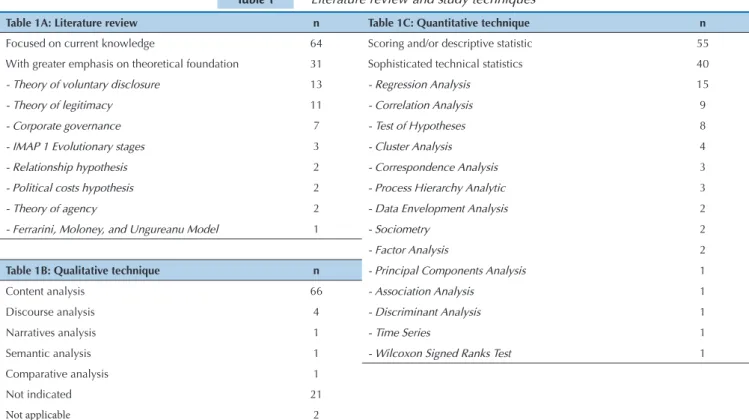
A quantiication of the studies from the DB was carried out in connection with the references presented in their literature review and the qualitative and statistical techni-ques applied in the development of these papers. Table 1 (divided into 1A, 1B, and 1C) presents the result obtained.
Table 1 Literature review and study techniques
Table 1A: Literature review n Table 1C: Quantitative technique n
Focused on current knowledge 64 Scoring and/or descriptive statistic 55 With greater emphasis on theoretical foundation 31 Sophisticated technical statistics 40
- Theory of voluntary disclosure 13 - Regression Analysis 15
- Theory of legitimacy 11 - Correlation Analysis 9
- Corporate governance 7 - Test of Hypotheses 8
- IMAP 1 Evolutionary stages 3 - Cluster Analysis 4
- Relationship hypothesis 2 - Correspondence Analysis 3
- Political costs hypothesis 2 - Process Hierarchy Analytic 3
- Theory of agency 2 - Data Envelopment Analysis 2
- Ferrarini, Moloney, and Ungureanu Model 1 - Sociometry 2
- Factor Analysis 2
Table 1B: Qualitative technique n - Principal Components Analysis 1
Content analysis 66 - Association Analysis 1 Discourse analysis 4 - Discriminant Analysis 1
Narratives analysis 1 - Time Series 1
Semantic analysis 1 - Wilcoxon Signed Ranks Test 1 Comparative analysis 1
Not indicated 21
Not applicable 2
Note. some studies used more than one theory and others more than one statistical technique. Source: Developed by the authors.
In the studies selected, there was a preference for the presentation of current knowledge – studies from other
invest-ment in theoretical foundation, notably the contribution from the theory of voluntary disclosure (in 13 studies) and from the theory of legitimacy or legitimization (11 studies).
As expected, the use of the Management Report im-plied the employment of qualitative techniques for analy-sis (except in two cases: one essay and one investigation regarding the use of graphics in MRs), with a strong preference for content analysis. Most of the time (55 out of 95 cases), the mathematical treatment came down to counting the occurrences of disclosure, or – when a lot – required the use of basic descriptive statistics, such as average and standard deviation. In 40 cases, however, more sophisticated methods were present, such as re-gression (15 papers) and correlation (9 papers) analyses and tests of hypotheses, such as the Student t, ANOVA, Kruskall-Wallis, and chi-squared tests (8 papers).
One point should be highlighted: the ontological de-sign of the studies from the DB. With only six exceptions, it is reasonable to conclude that the authors from the DB aimed to ensure the validity of their work, reinforcing aspects of objectivity, with the expectation that others would arrive at the same conclusions in following the method proposed (frequently, counting disclosures per categories) and working with the same MRs: the inherent subjectivity of qualitative analyses, when mentioned, is treated as a limitation, as discussed in section 4.4.
3.3 Authorship Characterization of Selected
Papers
A priori, it was decided that the scientiic work must be contextualized, both socially and historically: there would be no way of understanding the product – the MR studies – ignoring the factors and production and con-sumption conditions over time. With this in mind and motivated by observation of the Institutional heory, substantial investment was made, in this and the next subsection, focusing on authorship characterization of those who are inextricably responsible for the studies and the use of the results from other papers that proceeded them.
Firstly, it is noted that the 95 articles from the BD were of 155 diferent authorships, with a total of 283 participa-tions. here was therefore an average of 1.8 participations per researcher and 3.3 authors per article. hese authors were found to be linked to 47 institutions (almost all uni-versities and schools of higher education, with only three exceptions) at the period of the respective articles, which implies an average of 6 participations per institution.
However, the average reveals little of the distribution found, in that Researcher 55, the most frequent, appears in 28 articles (thus, in 30% of the papers, earning them 1,410 points according to Capes – this in only eight years since their irst article in 2006, which implies 176 points per year), while 116 authors (75% of the total) had only one participation. Similarly, with regards to the institu-tions: 24 of the 47 entities appear only once, while the University of São Paulo (USP), the Federal University
of Santa Catarina (UFSC), and the Regional Universi-ty of Blumenau (FURB) had 20, 39, and 104 participa-tions, respectively, through their researchers. hese dis-tributions, of many with little and few with a lot, are in line with other scientometric papers, which ofers some comfort regarding the representativeness of the sample.
For convenience, the current titles of the researchers from the BD (and not those from when their articles were published) were studied using the respective Lattes sys-tem curricula of 134 authors – thus, 86% of the sample. Of these, 70 are doctors (two with 1A productivity grants from CNPq, one of them, Researcher 55, being central to the authorship network; and 13 with level 2 grants, indi-cations of competency in research), while 56 have the hi-ghest title in master’s. Most of the authors obtained their master’s and/or doctorate titles in the subarea of Accoun-ting (or a variant, for example AccounAccoun-ting Science); 96 of the 126 have these title levels. As well as Accounting, Management also stands out, with 25 masters and/or doctors, and Production Engineering, with 16. It is also noted that USP awarded most of the titles: 57 of the 194 master’s and doctorate titles. Following that, UFSC appe-ars with 32 and FURB with 19 titles.
Joint-authorship was found to be a rule (only 6 papers had a single author, while the rule was 3 authors per arti-cle). However, the association of two or more entities was limited to 36 of the 95 papers, indicating the prevalence of intra-institutional work and thus some restriction on greater circulation of knowledge.
3.4 Sociometric Characterization of the
Arrangement of Researchers
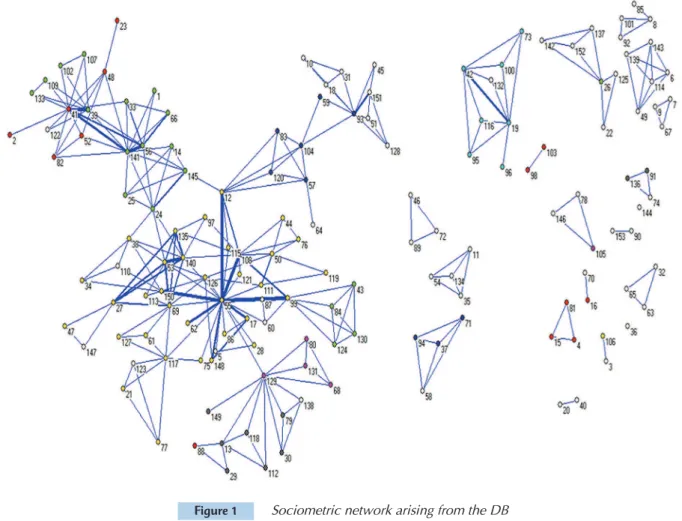
The 95 papers, with their 155 authors, involved 273 different didactic links, configuring a fragmented ar-rangement of 20 components, only one of them large, with a diameter of 8, the result of the connection of 93 nodes. It involves a low density (of 0.023) and low connectivity (of 0.368) arrangement and an average degree (= average number of partners) of 3.57 – no-ting the disparity, again of node 55, with 22 different partners.
Figure 1 represents the arrangement, where the node color serves to identify its entity, thus: yellow = Regional University of Blumenau (FURB); green = Federal University of Santa Catarina (UFSC); red = University of São Paulo (USP); dark blue = Federal University of Ceará (UFC); black = Federal University of Minas Gerais (UFMG); light blue = University of Brasilia (UnB); pink = Federal University of Paraná (UFPR), and finally, white = other entities.
clusters of researchers from UFSC, UFC, and UFPR are linked, and in these are connected clusters of re-searchers from USP and UFMG. In the arrangement, the role of node 129 should also be noted, which is important in linking FURB to its entity (UFPR) and to UFMG. The researchers from UnB do not form part of the largest component, but are connected to each other in a separate component.
As already observed, the researchers tended to seek
partners in their institution, with some exceptions (Researchers 12, 55, 99, and 129 stand out), thus ac-ting to avoid the constitution of more structural gaps, as is also the role of Researchers 41, 141, 126, and 117, who together with 55 and 129 have the lowest levels of aggregate constraint. However, it is Researcher 55 who stands out the most: with the largest number of partners (43 direct links with 22 different nodes) and who is most central in the arrangement.
Figure 1 Sociometric network arising from the DB
Note. Nodes = researcher; color of node = his/her organization. Source: Data from the study.
An important feature, obtained from the intersec-tion of authorship with the MR set examined in each paper, is the maximization of ‘efficiency’ in terms of research: 9 situations were found involving a total of 25 of the 95 papers from the DB in which exactly the same MR set was used more than once; some of them, using the same analysis techniques, in papers that could be taken as complementary, yielding publications in other journals. This phenomenon could be associated with the ‘proliferation of studies’, which was discussed in Castiel and Sanz-Valero (2007) in the public health field of science, explainable by the imperative to pu-blish and accumulate Capes points. This contributed, in some measure and in an artificial (and, it could be said, spurious) way, to the thickening of certain linking lines in the sociogram in Figure 1.
3.5 Implications for the Study
Enough indications were gathered to determine the property of the MR as a source of data in studies collectively conducted by qualified researchers who turned them into articles publishable in journals with good reputations. As a natural result of subarea ex-pertise and also confirmed by analysis of the DB, the prevalence of the Accounting viewpoint in the MR analyses is again acknowledged, a priori, with impli-cations that warrant reflection. Additionally, the DB is not depersonalized: some researchers are in structural positions, which gives them significantly wide powers of operation.
in Accounting became expert in the MR and may have been used as a reference for the researchers from the
largest component, shaping the papers to the study strategies of the nucleus.
4 RESULTS AND ANALYSIS
4.1 Design of the Studies from the DB
The first approach in the corpus of this investiga-tion per se was centered exclusively on title and key words. This resulted in 497 noun phrases (ignoring articles and prepositions, for example); of these, 190 were distinct. The terms were grouped considering their meaning into six groups plus the ‘Others’ group, which had terms taken without close association (111 of the 497 occurrences). The six other groups were cal-led: ‘Disclosure’, with 89 occurrences; ‘Type of disclo-sure’, with 88; ‘Framing of companies analyzed’, with 84 occurrences; ‘Source or origin of data’, with 63; ‘Me-thods for analysis’, with 34; and ‘Reference standard’, with 27 occurrences.
In the next step, with the aim of revealing the theo-retical support for the studies, the set of terms associa-ted in a relevant way with the ‘theor’ (from theory and theoretical) root was taken in the articles from the DB. The two findings were combined and gave rise to a Synthetic and Generalist Description (SGD) of the papers, with the following formulation:
“Study of the disclosure1, via the use of one and/or
more methods of analysis2, of data source3 from
au-thorship from a company or companies from a parti-cular or general sector of the economy4 compared to
reference standard(s)5; correlated or not with another
factor6, from the viewpoint of some theory or
theo-ries7, in the period….”.
Fictitiously, the SGD would cover in its scope, for example, the description of a “study of [environmen-tal] disclosure, via [content analysis] of [Management Report and Explanatory Notes], from [publicly-traded Brazilian companies from potentially polluting sec-tors] compared to [American disclosure practices], correlated with [the financial performance of those Brazilian companies], from the viewpoint of [the the-ory of voluntary disclosure], in the period [from 2006 to 2008]”. It is proposed that this standard (SGD), constructed over time, could be taken as an institutio-nal display from Brazilian academia of how to conduct studies on voluntary disclosure.
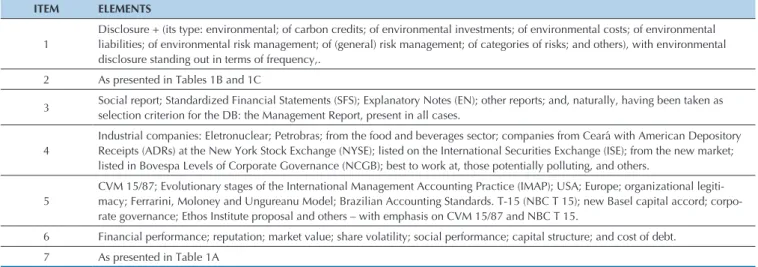
The elements from the superscript categories 1 to 7 of the SGD, mapped in the corpus, were found in ac-cordance with Table 2.
Table 2 Elements of the SGD categories
ITEM ELEMENTS
1
Disclosure + (its type: environmental; of carbon credits; of environmental investments; of environmental costs; of environmental liabilities; of environmental risk management; of (general) risk management; of categories of risks; and others), with environmental disclosure standing out in terms of frequency,.
2 As presented in Tables 1B and 1C
3 Social report; Standardized Financial Statements (SFS); Explanatory Notes (EN); other reports; and, naturally, having been taken as selection criterion for the DB: the Management Report, present in all cases.
4
Industrial companies: Eletronuclear; Petrobras; from the food and beverages sector; companies from Ceará with American Depository Receipts (ADRs) at the New York Stock Exchange (NYSE); listed on the International Securities Exchange (ISE); from the new market; listed in Bovespa Levels of Corporate Governance (NCGB); best to work at, those potentially polluting, and others.
5
CVM 15/87; Evolutionary stages of the International Management Accounting Practice (IMAP); USA; Europe; organizational legiti-macy; Ferrarini, Moloney and Ungureanu Model; Brazilian Accounting Standards. T-15 (NBC T 15); new Basel capital accord; corpo-rate governance; Ethos Institute proposal and others – with emphasis on CVM 15/87 and NBC T 15.
6 Financial performance; reputation; market value; share volatility; social performance; capital structure; and cost of debt. 7 As presented in Table 1A
Source: Data from the study.
It was found that the proposed SGD, well adjusted to the positive theory of accounting, encompasses 82 of the 95 studies from the DB, not necessarily implying that these use all of the SGD elements.
The 13 studies not met by the SGD tend to have a more interpretivist orientation, sometimes using dis-course analysis (instead of counting sentences per ca-tegory, typical of key content analysis), without being concerned with disclosure, but rather with the ter-ms theter-mselves, potentially revealing the figure of the
MR author, such as, for example, Grande and Beuren (2011):
Note. The total is lower than 95 due to lack of indication. Source: Data from the study.
identified in the management accounting practices of the companies studied. However, there is no guarantee that the MR effectively represents management dis-course and subjective analysis may reveal inaccuracies.
A significant portion of the studies from the DB considered a cross section appropriate (46 of the 95 ca-ses). When a longitudinal section is chosen, it was of two years in 6 papers; three years in 12 papers; four
years in four papers: five years in 10 papers; seven ye-ars in two papers; nine yeye-ars in two papers; 10 yeye-ars in nine papers; and 13 years in one paper. Considering the different cut-off periods and the juxtaposition of the years resulted in a representation as in Figure 2 (of year and frequency), providing evidence of a greater presen-ce of the years 2006 (42 studies); 2007 (36 studies); and 2008 (29 studies) in the DB and only one in the two extremities.
Table 3 Distribution of number of companies and number of MRs examined in the studies
From To From
(log)
To (log)
f Companies
f MRs
0 3 0.00 0.50 3 1
3 10 0.50 1.00 13 6
10 32 1.00 1.50 39 26
32 100 1.50 2.00 19 30
100 316 2.00 2.50 16 20
316 1,000 2.50 3.00 2 8
1,000 3,162 3.00 3.50 0 1
3,162 10,000 3.50 4.00 0 0
Figure 2 Number of papers in the DB per year
Note. Area under the curve is greater than 95 due to longitudinal sections. Source: Data from the study.
With regards to the number of companies and from this the number of MRs examined (that declared or obtained by multiplying the number of companies by the number of ye-ars from the chosen cut-of), a variation from 1 to 448 and
from 4 to 2,639 is found, respectively - in such an unequal distribution that it is better represented in logarithmic sca-le, as in Table 3, where f equals the frequency of each class, indicated between the columns ‘From’ and ‘To’.
According to Table 3, the greatest frequency was from studies that dealt with 10 to 32 companies, studying 32 to 100 MRs. he variety presented in Table 3 introduces a disturbing element into the evaluation of studies from the DB: that of how to deal with the reliability of results if for some 10 MRs were suicient, when others needed to study 1,000. It is evident that the answer lies in the
propo-sed goal and in the strategy for resolving the problem, but and if the indings were not consistent? In the quantitati-ve meta-analysis, the adjustment is made considering the sample size and the p-value, which should not be available in papers that did not carry out random sampling, as in the DB.
SGD, the number of companies and the cut-of period, there is quite a substantial range of research opportuni-ties, favoring the strategic researcher behavior referred to previously: he/she may feel ‘tempted’ to, for example, maintain the MR set and vary the type of disclosure, or maintain the type of disclosure and the MR set and vary the factor to be correlated, or even opt for another cut-of period, merely updating the research; he /she may also, ceteris paribus, use diferent criteria to create the list of categories for content analysis, implying diferent levels for the same type of disclosure, depending on the prefer-red theoretical viewpoint. here are so many possibilities that the designs of the studies from the DB would not ha-ppen to be identical: always something diferent, which prevents comparing their results.
To conclude, it is acceptable to stress the almost ine-vitable methodological bias of accountants, authors of the studies in the DB, perceived in converting/reducing a text (the MR) into a number (in this case, the ‘level of disclo-sure’) ignoring other considerations of a more interpreti-vist nature.
4.2 Reasons for Using the Management Report
he studies in the DB exhibit, explicitly or implicitly, one or more elements from the set listed below in order to warrant the use of MRs as a source of data.
Primarily, MRs would be relevant, since they perform the role of ofering, among other features, information not liable to be disclosed in standardized inancial state-ments, contributing to reducing information asymmetry, which would be desirable for a better working market. As MRs are compulsory for publicly-traded companies (while other narrative reports are optional), most Brazilian
stu-dies would use them to quantify disclosure, allowing for comparison of results.
MRs would have a wide range of legitimate parties in-terested in the information in them, just as the parts of the SFS. Additionally, they are presented together with the SFSs, which would communicate that the MRs hope to ofer: a lack of bias, veracity, transparency, ethics, timeli-ness, relevance, understandability, reliability, comparabili-ty, and materiality – which would, in turn, allow for better quality decision making on the part of those related to the entity.
Moreover, because it is less technical, less structured, more lexible, more descriptive (narrative) and not gover-ned by the general principles of accounting as SFSs are, MRs can ofer greater communicative quality, be clearer, and facilitate the understanding of a greater number of users, including laymen. Additionally, they would serve as a channel for voluntary disclosure of that which is con-sidered by the company as important, displaying the dis-cretionary power of the Administrator. As a result, they would help to sway the perceptions of interested parties, serving as an instrument for the legitimacy of the entity. In addition, even though this has not been mentioned in the studies in the DB, MRs are more accessible, possibly even the more outlying ones, made available by specialized media, Bovespa, and companies themselves.
4.3 Findings of the Studies from the DB
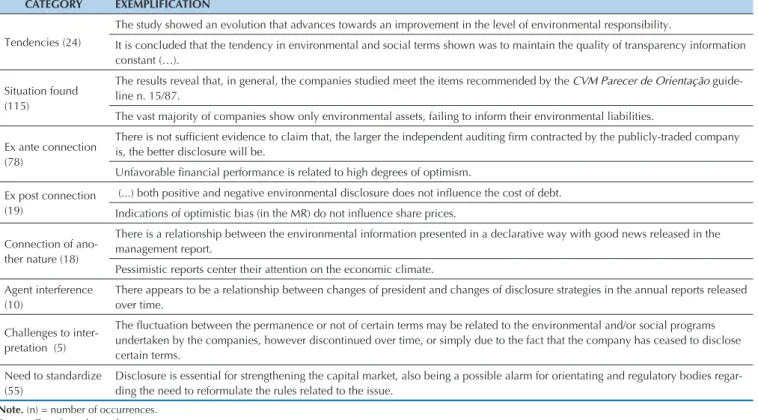
324 segments indicative of summaries of results, con-clusions and contributions were gathered. These seg-ments were grouped by topic, into eight categories. Table 4 presents the category, the respective frequency in bra-ckets, and some illustrative examples from the category.
Table 4 Findings of studies from the DB
CATEGORY EXEMPLIFICATION
Tendencies (24)
The study showed an evolution that advances towards an improvement in the level of environmental responsibility.
It is concluded that the tendency in environmental and social terms shown was to maintain the quality of transparency information constant (…).
Situation found (115)
The results reveal that, in general, the companies studied meet the items recommended by the CVM Parecer de Orientação guide-line n. 15/87.
The vast majority of companies show only environmental assets, failing to inform their environmental liabilities. Ex ante connection
(78)
There is not suficient evidence to claim that, the larger the independent auditing irm contracted by the publicly-traded company
is, the better disclosure will be.
Unfavorable inancial performance is related to high degrees of optimism.
Ex post connection (19)
(...) both positive and negative environmental disclosure does not inluence the cost of debt. Indications of optimistic bias (in the MR) do not inluence share prices.
Connection of ano-ther nature (18)
There is a relationship between the environmental information presented in a declarative way with good news released in the management report.
Pessimistic reports center their attention on the economic climate. Agent interference
(10)
There appears to be a relationship between changes of president and changes of disclosure strategies in the annual reports released over time.
Challenges to inter-pretation (5)
The luctuation between the permanence or not of certain terms may be related to the environmental and/or social programs
undertaken by the companies, however discontinued over time, or simply due to the fact that the company has ceased to disclose certain terms.
Need to standardize (55)
Disclosure is essential for strengthening the capital market, also being a possible alarm for orientating and regulatory bodies regar-ding the need to reformulate the rules related to the issue.
It is interesting to note that some conclusions appear contradictory, depending on the companies, period, and method chosen. Additionally, a third of the conclusions refer to a framework that no longer exists (but which has historical importance and can be updated).
However, taken in conjunction, the MR that emerges in Table 4 is an incomplete document (it would not be able to meet social, environmental, risk management, in-novation and other disclosure needs), biased, subjective (subject to Administrator discretion, motivated by his/her own interests); at the same time, it is conditioned by in-ternal (company size, its economic-inancial performan-ce, its capital structure, and the quality of its governance) and external (operating sector, incidence of regulatory power) elements, deprived of better quality monetary in-formation.
Given the current stage and positive, but insuicient, path of MR improvement, the alternative would be com-pulsory harmonization promoted by the regulatory body, bringing the document closer, as much as possible, to an accounting ideal.
4.4 Limitations Indicated in the Studies from the
DB
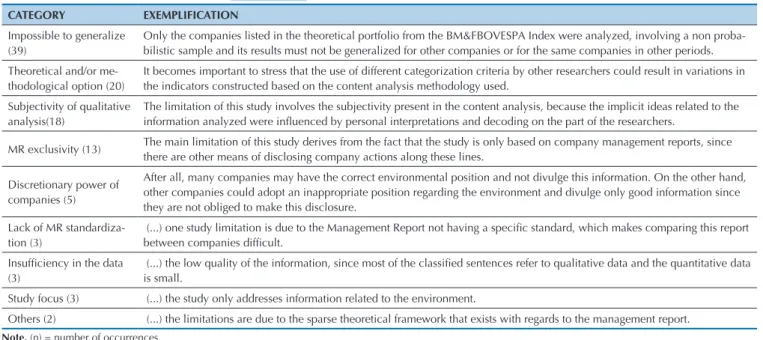
106 indications of study limitations were found in 48 of the 95 studies – implying that 47 papers did not explain the respective limitations, a mismatch with the reasonable conclusion that any study would have its own. he indi-cations were listed and semantically connected with each other and then grouped into 9 categories, as in Table 5, which includes an explanatory sample from the group, by way of example.
Table 5 Limitations indicated in the studies
CATEGORY EXEMPLIFICATION
Impossible to generalize (39)
Only the companies listed in the theoretical portfolio from the BM&FBOVESPA Index were analyzed, involving a non proba-bilistic sample and its results must not be generalized for other companies or for the same companies in other periods. Theoretical and/or
me-thodological option (20)
It becomes important to stress that the use of different categorization criteria by other researchers could result in variations in the indicators constructed based on the content analysis methodology used.
Subjectivity of qualitative analysis(18)
The limitation of this study involves the subjectivity present in the content analysis, because the implicit ideas related to the
information analyzed were inluenced by personal interpretations and decoding on the part of the researchers.
MR exclusivity (13) The main limitation of this study derives from the fact that the study is only based on company management reports, since there are other means of disclosing company actions along these lines.
Discretionary power of companies (5)
After all, many companies may have the correct environmental position and not divulge this information. On the other hand, other companies could adopt an inappropriate position regarding the environment and divulge only good information since they are not obliged to make this disclosure.
Lack of MR standardiza-tion (3)
(...) one study limitation is due to the Management Report not having a speciic standard, which makes comparing this report between companies dificult.
Insuficiency in the data
(3)
(...) the low quality of the information, since most of the classiied sentences refer to qualitative data and the quantitative data
is small.
Study focus (3) (...) the study only addresses information related to the environment.
Others (2) (...) the limitations are due to the sparse theoretical framework that exists with regards to the management report.
Note. (n) = number of occurrences. Source: Data from the study.
Table 5 appears to indicate that the initial liability of MRs in light of the study limitations would be having their content subject to the Company’s discretion (of its Administrator), which may choose what and how to ofer voluntary information, which in turn is easily pro-ne to produce insuicient (incomplete) MRs and their lack of standardization.
Nevertheless, a closer look captures how much the MR can add. Being a narrative element, it implied qua-litative analysis – whether of content or of discourse. From this, researcher subjectivity implications are no-ted, not only in the analysis process, but also from the initial choice of one or more theoretical frameworks (for example, corporate governance) or any other me-chanism (for example, CVM recommendation 15/1987), which provides the analysis categories and serves as a lens for them.
Not suicient, the most frequent restriction (it being
‘impossible to generalize’) is related to the intentional and non-probabilistic sampling, associated with the complexity of the qualitative analysis, laborious when trying to reduce the terms to a table of frequency.
4.5 Future Papers Suggested in the Studies
gestions); A2 – Adoption of another cut-of period (14 sug-gestions); A3 – Use of an alternative data source, other than the MR (10); A4 – Application of alternative theories to that employed in the paper (10); A5 – Widening of the sample (6); A6 – Adoption of another analytical model (4); and i-nally, A7 – Change of focus (with the remaining 3 category suggestions).
B – To study relationships, including those of cause-efect, with 38 suggestions, distributed into 3 groups: B1 – MR production conditions (28 suggestions); B2 – Impact of the MR (7); and B3 – Other relationships between variables as-sociated with the MR (3).
With regards to the irst category (‘test or widen the va-lidity of the indings’), it would be reasonable to indicate that there is some coherence among the study limitations, the proposals for new papers, and the predominantly des-criptive goal of the studies (mapping the frequency of oc-currence of certain elements suggested by the literature in the MRs), since having to choose an intentional and time speciic sample, any generalization of the description found would be taken as inappropriate, which would require more
tests, even of non-random samples as well, ‘consolidating’ or refuting the original study conclusion. However, this would require all the new studies to use the same metric as the irst study, not very likely in light of so many viewpoints liable to being activated, unless these new studies continue under the orientation of the original researchers – which results in a discussion of subjectivity, also indicated as being a limitation.
he other category (‘study relationships, including tho-se of cautho-se-efect’) includes the proposals for investigating the action of certain variables or features (for example, sec-tor regulation, size, location, and shareholder composition of the company) which act in the decision to disclose (or omit) and how to disclose; as well as testing the inluence of the level of disclosure over, for example, share volatili-ty. Regardless of how interesting this last proposal is, it has not attracted much attention from academia, perhaps due to the diiculty, or even impossibility, of keeping the other variables constant, together with the risk of having the study contested by the potential incidence of some ‘omitted varia-ble’ regarding the relationship found.
5 CONCLUSION
If the concept is accepted of institution being that more or less stable element of social life that afects the behavior and beliefs of individuals and collective actors, providing them with templates for action, cognition and emotion which, when implemented, reduce the risks associated with some type of cost (Lawrence, Suddabu, & Leca, 2011), it would be reasonable to accept the SGD referred to in sec-tion 4.1 as an institusec-tional display; follow the model, conso-lidated at least iteen years ago, and there will be less chance of having your paper, the fruit of hours of work, being rejec-ted by the scientiic ield – ignore it and you will sufer from sanctions. Now, this standard did not arise decontextualized in time and space; there is little risk in airming that it ari-ses from a diligent, deliberate efort or is the fruit of more fortuitous reproduction of accounting professors associated with FURB at the time of production.
Moreover, it can also be claimed that the evidence psented indicates roughly that management-accounting re-search in Brazil (or more suitably the dominant group of researchers identiied in this investigation) has embraced the Management Report, with reservations, since the docu-ment appears:
- Biased: the Administrator tends to value good news, at-tributing it to his/her competence, and to reserve little room (or none, if possible) for bad news, attributing it to external factors.
- Incomplete: it does not address all the elements for evaluating the quality of management regarding environ-mental, social, risk-related and strategic aspects.
- Questionable, if not suspicious: it allows margin for the false positive (it is mentioned, but does not exist) and the false negative (it is not mentioned, but exists), given that it
is not even audited.
- Unclear: it does not use precise terms, distancing itself from precise quantiication.
- Laborious and liable to subjectivity, given that it is nar-rative, which implies a qualitative analysis, with the parti-cular characteristics of this, and the use of non probability sampling in practice.
- Uncertain, since it results from agency mechanisms. - Useful, in the absence of another; comprehensive, and retrievable over time.
Because of this, the results of studies derived from the MR cannot be generalized and the variables studied, when found with statistical signiicance (which is arguable, since they are derived from samples for convenience), have a low explanatory power due to the practicing of discretionary power on the part of the Administrator.
A pattern was found; most of the papers adopted the model common to the group of researchers centered on the FURB team, practicing since 2005, which favors the accounting viewpoint: the MR narrative is converted into a level of disclosure and the connection of this variable to some conditioning factor or efect is tested. Observation of this pattern was possible via the construction of the SGD. his contribution is perhaps also a study diferentiator (and also, admittedly, a risk). While the majority of bibliometric papers are limited to treating the data analytically, the efort to derive an overview from this was crucial in the opinion of the authors of this study, in the uncovering of the under-lying pattern in the material analyzed.
standards of the Brazilian scientiic ield), without the au-thors putting themselves in the place of the potential priori-ty recipients (who belong to the business ield). If any doubt remains regarding who they are among those indicated by the CVM, it is not likely that the Administrator considers, even marginally, in the elaboration of his/her MR, the de-mands of a closed group of researchers, heard by the regula-tory bodies. Apparently, the authors in the DB highlight the fact that they are using interpretivist lenses from the scien-tiic ield in a document that belongs to the business ield, in which a good MR is that which provokes positive reactions (if possible, relected in a rise in share price), even if it is academically incomplete or biased.
On the other hand, there would be the possibility of ex-tracting new understandings based on MRs. his alternati-ve has already appeared periodically and may warrant more attention, perhaps from another group of researchers, who are closer to the theory of organizations.
If it is acceptable, as defended in the majority of the pa-pers in the DB, that Administrators aim to legitimize their companies, incorporating, at least in discourse, the use of contemporary management practices, it is no less accep-table that such practices are institutionalized also through Administrator discourse (and by other mechanisms), in a dualistic (legitimacy and institutionalization) path over time.
It would be interesting to discover, for example, how ‘pollution control’ and an ‘increase in eiciency’ was con-verted into ‘environmental management’, from there into ‘sustainable development’ and resulted in ‘sustainability’ and ‘eco-eiciency’, two fashionable terms, and from where it will go from there. In more general terms, how organiza-tions have accepted values or reacted to the pressures of
so-ciety, turning them into discursive resources – interesting, even and/or primarily if not applied.
Moreover, if it is possible to ind the current discourse of some managers via interviews (ater overcoming substantial obstacles), it is postulated that the MR would be the only capable, wide, historic, available, and inexpensive source for investigating the institutionalization of organizational practices – very similar to what is done in academia when the concern is the institutionalization of the same practices (and also theories and methods), when instead of the MR, the sources are scientiic texts themselves. Based on this, the proposed study would result in theory and not in descripti-ve generalizations – showing the duality set out in evidence to be valid.
Additionally, a question would remain open: would MRs be suitable documents for tracing some indication of Ins-titutional Work (IW), understood as an intentional action for changing the institutional environment in the organi-zational ield? Hypothetically, there is the challenge here, in not inding such indications, of showing whether this is due to omission in the MR or the inexistence of IW. In any event, another contribution to management science would remain.
Correspondence Address:
Uajará Pessoa Araújo
Centro Federal de Educação Tecnológica de Minas Gerais, Campus II, Departamento de Ciências Sociais Aplicadas Avenida Amazonas, 7675 - CEP: 30.421-169
Nova Gameleira – Belo Horizonte – MG Email: [email protected]
References
Araújo, U. P. (2008). Relação agência e estrutura em redes colaborativas
(doctorate thesis in management). Lavras: Ula.
Araújo, U. P., Antonialli, L. M., Guerrini, F. M. & Oliveira, R. F. de (2011). A percepção e as estratégias de ação do pesquisador de café em sua rede colaborativa. Revista de Administração Contemporânea, 15(4), 670-688. Bourdieu, P. (2004). Os usos sociais da ciência: por uma sociologia clínica
do campo cientíico. São Paulo: UNESP.
Brasil (1976). Lei nº 6.404, de 15 dezembro de 1976. Diário Oicial [da]
República Federativa do Brasil, Poder Executivo, Brasília, DF, 17 dez.
1976. Suplemento, 1.
Brasil (2015). Indicadores selecionados de ciência, tecnologia e inovação
Brasil 2015. Brasília: Ministério da Ciência, Tecnologia e Inovação.
Castiel, L. D. & Sanz-Valero, J. (2007) Entre fetichismo e sobrevivência: o artigo cientíico é uma mercadoria acadêmica? Caderno de Saúde
Pública, 23(12), 3041-3050.
Comissão de Valores Mobiliários – CVM (1987). Parecer de orientação CVM nº 15. Diário Oicial [da] República Federativa do Brasil, Poder Executivo, Brasília, DF, 08 jan.
Cruz, A. P. C. do, Espejo, M. M. dos S. B, Costa, F. & Almeida, L. B. Peril das redes de cooperação cientíica. Revista Contabilidade & Finanças, 22(55), 64-87.
DiMaggio, P. J. (1995). Culture and economy. In: Smelser, N. & Swedberg,
R. he handbook of economic sociology. New Jersey: Princeton
University, 1995.
DiMaggio, P. J. & Powell, W.W. (1991).he new institutionalism in
organizational analysis. Chicago: University of Chicago, 1991.
DiMaggio, P.J. & Powell, W.W. (2004). he iron cage revisited. In: Dobbin, F. (Ed.). he new economic sociology. Princeton: Princeton University, 111-134.
Grande, J. F. & Beuren, I. M. (2011) Mudanças de práticas de contabilidade gerencial identii-cadas nos RA de empresas familiares. Contabilidade,
Gestão e Governança, 14(3), 18-33.
Greenwood, R., Raynard, M., Kodeih, F., Micelotta, E. R. & Lounsbury, M. (2011). Institutional complexity and organizational responses. he
Academy of Management Annals, 5(1), 317-371.
Hall, P. A. & Taylor, R. C. R. (1996). Political science and the three new institutionalisms. Political Studies, 44(5), 936-957.
Jacometti, M., Gonçalves, S. A. & Castro, M. de. (2014). Institutional work e conhecimento em redes interorganizacionais. Revista de Administração
Mackenzie, 15(6), edição especial, 17-47.
Kos, S. R., Espejo, M. M. dos S. B. & Raifur, L. (2014). O conteúdo informacional do Relatório da Administração e o desempenho das empresas brasileiras do Ibovespa. Revista Universo Contábil, 10 (2), 43-62.
Lawrence, T., Suddaby, R. & Leca, B. (2011) Institutional work: refocusing institutional studies of organization. Journal of Management Inquiry, 20(10, 52-58.
Lefevre, F. & Lefevre, A. M. C. (2003). O discurso do sujeito coletivo: um novo enfoque em pesquisa qualitativa. Caxias do Sul: Educs. Liberato, G. B. & Pagliarussi (2008). Disclosure de estratégia em relatórios
anuais. Fucape Working Papers, 3, 28p.
Lindblom, C. K. (1994). he implications of organizational legitimacy for corporate social performance and disclosure. Anais Critical
Perspectives on Accounting Conference. New York.
Machado-da-Silva, C.L., Guarido Filho, E. R. & Rossoni, L. (2006). Campos organizacionais: seis diferentes leituras e a perspectiva de estruturação. Revista de Administração Contemporânea, Edição Especial, 159-196.
Moraes Júnior, V. F. de, Vasconcelos, A. F. & Monte, P. A. do. (2014). Peril dos trabalhos publicados de 2004 a 2010 na área educação e pesquisa do congresso USP de controladoria e contabilidade. Revista Ambiente
Contábil, 6(2), 36-54.
Murcia, F. D-R., dos Santos, A., Salotti, B. M. & Nascimento, A. (2010). Mapeamento da pesquisa sobre disclosure ambiental no cenário internacional. ConTexto, 10(17), 7-18
Nascimento, S. do & Beuren, I. M. Redes sociais na produção cientíica dos programas de pós-graduação de ciências contábeis. Revista de
Administração Contemporânea, 15(1), 47-66.
Nee, V. (1998). Source of new institutionalism. In: Briton, M., Nee, V. (Ed.). he new institutionalism in sociology. New York: Russell Sage Foundation, 1-17.
Neiva, E. R. & Corradi, A. (2010). A. A psicologia organizacional e do trabalho no Brasil. Revista Psicologia: Organizações e Trabalho, 10(2), 67-84.
O’Donovan, G. (2002). Environmental disclosures in annual report.
Accounting, Auditing & Accountability Journal, 15(3), 344-371.
Powell, W. W & Bromley, P. (2013). New institutionalism in the analysis of complex organizations. International Encyclopedia of Social and
Behavioral Sciences, 2nd Edition, 13 p.
Rossoni, L. & Machado-da-Silva, C. L. (2008). Análise institucional da construção do conhecimento cientíico em mundos pequenos. Faces
Journal, 7(1), 25-41.
Scott, W. R (2000). Institutions and organization. 2.ed. London: Sage, 2000. Silva, R. C. F. da (2015). Programa de ´pós-graduação em administração
da Ula (master’s in management dissertation). Lavras: Universidade
Federal de Lavras
Stanton, P., Stanton, J. & Pires, G. (2004). Impression of an annual report: an experimental study. Corporate Communications: an International
Journal, 9(1), 57-69.
Suchman, M. C. (1995) Managing legitimacy: strategic and institutional approaches. Academy of Management Journal, 20(3), 571-610. Teixeira, J. C., Cappelle, M. C. A., Perdigão, D. A. & Antonialli, L. M.
(2013). O campo cientíico na percepção de docentes de uma universidade: Revista GUAL, 6(3), 86-110.
Walsh, D. & Downe, S. (2005). Meta-synthesis method for qualitative research: a literature review. Methodological Issues in Nursing Research, 50(2), 204-211.
Watanabe, E. A., Gomes, A. O. & Hofmann (2013). Cooperação entre grupos de pesquisa em estratégia no Brasil. Revista Ibero-Americana
de Estratégia, 12(1), 84-106.
Weed, M. (2005). “Meta Interpretation”: a method for the interpretive synthesis of qualitative research. Forum: Qualitative Social Research, 6(1), art. 27.
Wilmshurst, T.D. & Frost, G.R. (2000). Corporate environmental reporting a test of legitimacy theory. Accounting Auditing and
Accountability Journal, 13(1), 10-26, 2000.