DOI: 10.1590/1808-057x201702750
Heterogeneity in earnings quality between diferent classes of
companies ater IFRS adoption: evidence from Brazil
Roberto Black
Universidade de São Paulo, Faculdade de Economia, Administração e Contabilidade de Ribeirão Preto, Departamento de Contabilidade, Ribeirão Preto, SP, Brazil
Sílvio Hiroshi Nakao
Universidade de São Paulo, Faculdade de Economia, Administração e Contabilidade de Ribeirão Preto, Departamento de Contabilidade, Ribeirão Preto, SP, Brazil
Received on 11.06.2015 – Desk acceptance on 01.19.2016 – 3rd version approved on 11.07.2016
ABSTRACT
his paper aims to investigate the existence of heterogeneity in earnings quality between diferent classes of companies ater the adoption of the International Financial Reporting Standards (IFRS). IFRS adoption is generally associated with an increase in the quality of inancial statements. However, companies within the same country are likely to have diferent economic incentives regarding the disclosure of information. hus, treating companies equally, without considering the related economic incentives, could contaminate earnings quality investigations. he case of Brazil is analyzed, which is a country classiied as code-law, in which tax laws determined accounting practice and in which IFRS adoption is mandatory. First, Brazilian companies listed on the São Paulo Stock, Commodities, and FuturesExchange (BM&FBOVESPA) were separated into two classes: companies issuing American Depositary Receipts (ADRs) before IFRS adoption and companies that did not issue ADRs until the adoption of IFRS. hen, this second class of companies was grouped, using cluster analysis, into two diferent subclasses according to economic incentives. Based on the groups identiied, the quality of accounting earnings is tested for each class of the companies before and ater IFRS adoption. his paper uses timely recognition of economic events, value relevance of net income, and earnings management as proxies for the quality of accounting earnings. he results indicate that a particular class of companies began showing conditional conservatism, value relevance of net income, and lower earnings management ater IFRS adoption. On the other hand, these results were not found for the two other classes of companies.
1. INTRODUCTION
h e adoption of the International Financial Reporting Standards (IFRS) is normally associated with an increase in the quality of disclosed accounting information (Barth, Landsman & Lang, 2008). Arguments suggesting that IFRS adoption produces signii cant benei ts for the capital market are based on the assumption that disclosure under IFRS increases the transparency and quality of i nancial statements. h is rel ects the fact that the IFRS framework is more capital market orientated and more comprehensive, especially with regards to disclosure, in relation to much of the national generally accepted accounting principles (GAAP).
However, there are also arguments suggesting that the ef ects of IFRS adoption on the capital market may be small or even insignii cant. In particular, there are reasons to be skeptical in relation to the assumption that IFRS adoption per se means i nancial statements have greater informational content (Daske, Hail, Leuz, & Verdi, 2008). h e evidence in various studies indicates a limited role for the accounting standards in determining the accounting quality observed; on the contrary, it emphasizes the importance of incentives in company accounting disclosure (Ball, Kothari & Robin, 2000; Ball, Robin & Wu, 2003; Burgstahler, Hail & Leuz, 2006).
h us, adopting the IFRS framework may not be seen as a suffi cient condition for companies from the same country to increase their quality. h e existence of heterogeneity is thus expected among gains in informational quality. In other words, it is possible that certain classes of companies achieve informational gains in accordance with economic incentives, while other classes of companies do not increase their quality even when IFRS is adopted.
h e case of Brazil is analyzed. Brazil is a country with a code-law tradition, mandatory IFRS adoption, and in which tax law determined accounting practice up until the rupture in accounting-tax compliance in 2007.
h e rupture of the formal link between the Brazilian accounting standards for disclosure purposes and the tax rules occurred with the publication of Act n. 11,638/2007 (Brazil, 2007). h is law aimed to update corporate legislation to enable the convergence process of the accounting practices adopted in Brazil. h ese two events were assumed to be relevant in reducing the dependency of the path of i nancial reporting in relation to the tax rules because companies began to be able to make changes that were not possible before.
Moreover, it bears mentioning that adoption of the IFRS framework in Brazil was carried out mandatorily.
Mandatory adoption of the international standards does not necessarily lead to higher quality accounting information, at least for those companies that do not have incentives to adopt. Viewed in another way, if IFRS adoption were voluntary, companies with fewer incentives to disclose would be less likely to adopt the IFRS framework in the i rst year of publication. As companies in the same country face dif erent reporting incentives it is natural to assume that the quality of accounting information is also heterogeneous.
h us, this paper aims to investigate the existence of heterogeneity in the quality of accounting earnings between dif erent classes of Brazilian companies at er the adoption of the international accounting standards. Conditional conservatism, value relevance, and earnings management were tested for the three classes of companies with different economic incentives for disclosing accounting information.
The first class of companies was called serious compliers. With the adoption of the international standards and decoupling from the tax laws, it is expected that one class of companies experienced an increase in quality at er IFRS adoption. h ese companies would have suffi cient economic incentives to abandon accounting-tax compliance and present greater quality in their disclosed set of accounting information.
Daske, Hail, Leuz, and Verdi (2013) indicate that bigger companies, with a greater need to obtain resources, greater growth opportunities, and lower levels of shareholder concentration, have more incentives to provide more transparent information. h ese variables were used, by means of cluster analysis, to identify companies with economic incentives to provide better quality accounting information.
h e second class was called American Depositary Receipt(ADR). It is expected that the Brazilian companies that issued ADRs had better quality before 2008. h e less developed Brazilian capital market led national companies with growth opportunities to seek external funding. Added to the fact that the US market is more demanding in relation to transparency and requires better quality accounting information, it is predicted that the class of Brazilian companies that issued ADRs would have better quality accounting information even before 2008, since these companies were already adopting accounting practices and policies that were closer to the international accounting standards.
of companies with lower quality that did not achieve increased informational quality even with IFRS adoption. h is class was called label compliers. It is argued that companies that receive little monitoring from the stock market may not exhibit improvements in terms of quality of information to be released in the periods following IFRS adoption, as a result of path dependence linked to taxation.
h e results obtained from the tests indicate that the serious compliers class went on to exhibit conditional conservatism, value relevance of net income, and less earnings management at er IFRS adoption. In contrast, the label compliers class did not exhibit conditional
conservatism, value relevance of net income, nor a reduction in earnings management at er IFRS adoption. As for the results for the ADR class, these indicate conditional conservatism and value relevance of net income both before and at er IFRS adoption.
h is paper aims to contribute to the literature on the IFRS adoption process, particularly in emerging countries. More specii cally, it aims to overcome the limitation in Brazilian empirical studies that tend to focus on the average ef ect of IFRS adoption. h us, verii cation and investigation of each one of the three classes and their particularities may be viewed as this paper’s main contribution.
2. THEORETICAL FRAMEWORK
2.1 IFRS Adoption and the Quality of a Firm’s Accounting Information
IFRS adoption is generally associated with increased quality of i nancial statements. Greater earnings quality is expected to be associated with timely recognition of economic events, value relevance of accounting variables, and less earnings management (Barth et al. 2008).
Earnings based on the International Accounting Standard Board (IASB) norms are expected to be less managed than if based on the Brazilian norms, since the IASB aims to limit managers’ discretionary power to report earnings that do not rel ect company economic performance. Using a sample of companies from 20 European countries, Aubert and Grudnitski (2012) verii ed that a fall in earnings management occurred at er the mandatory adoption of IFRS. Zéghal, Chtourou, and Sellami (2011) found evidence of a reduction in earnings management at er the mandatory adoption of IFRS in a sample composed of 353 French companies.
h e literature suggests that one characteristic of better quality accounting information is that large losses are recognized as they occur instead of being deferred to future periods (Leuz, Nanda & Wysocki, 2003). Ball and Shivakumar (2005) found that timely recognition of losses is less predominant in the United Kingdom in companies without market-traded securities than in companies that trade securities. Christensen, Lee, and Walker (2015) found that the voluntary adoption of IFRS in Germany is associated with a reduction in earnings management
than in British companies that traded securities. Similarly, Ball (2001) argues that convergence with international accounting standards is unlikely to be achieved simply by harmonizing accounting norms. h e author argues that uniform accounting norms were developed to satisfy the needs of common law countries (such as the United States of America and the United Kingdom), in which disclosure of information reduces information asymmetry between managers and accounting statement users; in places in which the spread of private information prevails, this model would be unlikely to succeed.
Generally, these studies reveal that the economic incentives to disclose strongly af ect the de facto application of the accounting standards, and thus dif erent incentives,
ceteris paribus, lead to dif erences in earnings quality.
2.2 Brazilian Institutional Environment and Adoption of the IFRS Framework
Up until Act n. 11,638/2007 (Brazil, 2007) was approved, the accounting system in Brazil was in a way tied to income tax (IR) calculations. h e Brazilian Federal Revenue Service, via Decree-Law n. 1,598/1977 (Brazil, 1977), tied tax legislation to corporate legislation by establishing that taxable income would be calculated based on accounting earnings, considering some adjustments dei ned by the tax legislation.
accounting practices that were considered more suitable from a corporate accounting point of view, in order not to have to pay tax earlier.
Moreover, Brazil had characteristics usually associated with low quality accounting disclosure – low legal enforcement, high government participation in accounting standards, high State participation in the economy, predominantly bank derived i nancing, a poorly developed securities market, and governance standards that let a lot to be desired (Ali & Hwang, 2000; Ball et al., 2000, 2003). h us, Brazil would be a typical code-law tradition country, in which i nancial statements would not be prepared to inform investors, but rather to adhere to tax and regulatory requirements.
However, even in an environment with low quality accounting information and a fragile governance regime like that of Brazil, some companies could be faced with strong incentives to distance themselves from the low quality setting of their country in order to fund future investment projects (Lopes & Walker, 2008). Thus, companies with investment opportunities wishing to obtain external funding had strong incentives to increase the quality of i nancial statements, given the greater demand in these markets for better quality information. h erefore, even before IFRS adoption, there may have been a class of companies that presented better quality accounting information.
Thus, before the adoption of the international standards, the existence of two classes of companies can be noted, dif ering in relation to the quality of accounting information released. h e class with the highest quality would be that composed of companies issuing securities in the international market. In contrast, the other companies did not have, up until IFRS adoption, suffi cient economic incentives to disclose better quality accounting information.
h e publication of Act n. 11,638/2007 (Brazil, 2007) and of Act n. 11.941/2009 (Brazil, 2009) legitimized the accounting convergence process, the decoupling of corporate and tax rules, the reduction in government interference in issuing corporate rules, and the powers of the Accounting Pronouncements Committee (CPC) for elaborating pronouncements aimed towards this convergence.
With the adoption of the international standards and decoupling from the tax rules, it is possible that one class of companies with lower quality information experiences increased quality with the adoption of the IFRS framework. Companies that are monitored by the stock market more could have suffi cient incentives to abandon accounting-tax compliance and present greater quality in their set of disclosed information.
It is argued that these companies did not have suffi cient economic incentives before IFRS adoption up until, for example, issuing securities on the international market. Moreover, the link itself between the norms for disclosure and tax purposes could be seen as an obstacle for these companies in adopting better quality information.
h is class of companies would be the only one that would face a signii cant variation in terms of accounting information quality. h e class with greater quality before IFRS adoption could continue to be engaged in disclosing greater quality accounting information, and would therefore not undergo signii cant changes in accounting information quality.
3. METHODOLOGICAL PROCEDURES
3.1 General Overview
h e tests are structured in two steps. In the i rst step, the companies listed on the São Paulo Stock, Commodities, and Futures Exchange (BM&FBOVESPA) were separated into three classes. h e companies were grouped in terms of economic incentives given by the equities market, as well as their respective qualities of accounting information prior to IFRS adoption.
Then, informational quality measurements were selected and tested for each one of the three classes of companies before and at er 2008. Value relevance, conditional conservatism, and earnings management were tested. h e regression models were estimated for the quality tests using the ordinary least squares model with heteroscedasticity-robust standard errors – variant HC1.
h e sample is composed of Brazilian companies listed on the BM&FBOVESPA during the period from 2003 to 2014. h e observations used in the tests only contemplate companies that have i nancial information for the whole period analyzed.
Companies from the i nancial sector were excluded, since they created comparison diffi culties, given the specificities both in tax legislation and in the rules determined by the Brazilian Central Bank. Moreover, observations classii ed as outliers were excluded, dei ned as observations above or below three standard deviations in relation to the standardized average for the variable of interest (Fávero, Beli ore, Silva & Chan, 2009).
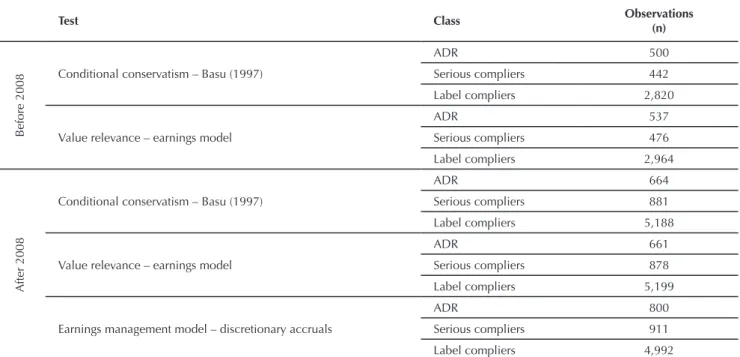
The data were collected from the Economatica®
database during the i rst quarter of 2015. Table 1 presents the number of observations for each test.
Table 1 Number of observations for each test
Test Class Observations
(n)
Before 2008
Conditional conservatism – Basu (1997)
ADR 500
Serious compliers 442
Label compliers 2,820
Value relevance – earnings model
ADR 537
Serious compliers 476
Label compliers 2,964
After 2008
Conditional conservatism – Basu (1997)
ADR 664
Serious compliers 881
Label compliers 5,188
Value relevance – earnings model
ADR 661
Serious compliers 878
Label compliers 5,199
Earnings management model – discretionary accruals
ADR 800
Serious compliers 911
Label compliers 4,992
ADR = American Depositary Receipt (class of companies with economic incentives to disclose both before and after 2008); label compliers = class with low economic incentives for improving accounting information quality after International Financial Reporting Standards (IFRS); serious compliers = class with economic incentives for improving accounting information quality after IFRS.
3.2 Separation of the Companies Before 2008
To validate the ADR variable as the proxy for greater quality, value relevance and conditional conservatism were tested for the companies that issued securities both on the BM&FBOVESPA and on the New York Stock Exchange (NYSE) during the period from 2003 to 2007. If these companies in fact had better quality, they would present conditional conservatism and value relevance of accounting numbers before the adoption of the IFRS framework.
Moreover, value relevance and conditional conservatism were tested for the sample of companies listed on the BM&FBOVESPA, but which did not have ADRs in 2007. It is predicted that this class did not exhibit value relevance and conditional conservatism before 2008.
3.3 Separation of the Companies After 2008
Daske et al. (2013) use economic incentive variables to separate the companies that adopt IFRS seriously from those that adopt it only as a label. h e authors assume that companies classii ed as serious adopters would improve their disclosure strategy with IFRS adoption. On the other hand, the other companies, the label adopters, would adopt the IFRS framework without any signii cant change in disclosure.
Daske et al. (2013) indicate that bigger companies, with a greater need for obtaining resources, greater growth opportunities, and a lower level of shareholder concentration, would be classii ed as serious adopters, and thus have incentives for providing more transparent information.
Beck, Demirgüç-Kunt, and Maksimovic (2005) argue that bigger companies are better able to absorb disclosure costs, are more sensitive to visibility in order to attract capital, and are normally subjected to higher disclosure requirements by multiple shareholders and institutional shareholders and by political and social stakeholders. Santos, Ponte, and Mapurunga (2014) i nd that company size causes a signii cant positive impact on the levels of Brazilian company compliance with the disclosure required by IFRS. In accordance with the paper from Daske et al. (2013), the size proxy used in this paper is the natural logarithm of market value.
h e more funding is needed, the more a company is liable to adopt convergence practices in a way that improves its funder evaluations (Francis Khurana, Martin & Pereira, 2008). According to the paper from Daske et al. (2013), the need for funding is measured by the liabilities/assets ratio.
Companies with strong growth opportunities are likely to need external i nancing to fund present and future investment projects. h ese companies need to voluntarily commit in some way to not depriving their investors by adopting more rigorous accounting practices. According to the paper from Daske et al. (2013), a company’s opportunity for growth is measured by the market-to-book (MTB) ratio.
Shareholder concentration is dei ned as the sum of the two biggest shareholders with voting rights. It is predicted that the greater the shareholder concentration, the lower the stock market monitoring would tend to be, and therefore the lower the demand for better quality i nancial statements.
h is paper used the four variables and proxies used in the paper from Daske et al. (2013) and added the variables volume traded and ef ective rate of income tax/ social security contribution (IR/CSSL) on net income to identify companies with economic incentives to improve the quality of disclosed accounting information.
With regards to the volume traded variable, the adverse selection hypothesis determines that when a group of shareholders has privileged information, there is an atmosphere of asymmetry of information that reduces liquidity (Glosten & Milgrom, 1985; Grossman & Stiglitz, 1980). It is predicted that the greater the volume traded, the greater a company’s incentive to disclose better quality information.
h e ef ective rate of income tax for legal entities (IRPJ)/ CSSL is dei ned as the ratio between current IRPJ/CSSL expenditure and income before IRPJ/CSSL (EBT). Scholes, Wolfson, Erickson, Maydew, and Shevlin (2002) argue that large shareholders that stay close to companies have an incentive to monitor managers’ tax planning activities and that these firms probably choose tax planning opportunities involving permanent accounting-tax dif erences, even if these opportunities reduce accounting earnings. It is predicted that the lower the stock market monitoring, the lower the ef ective rate of IRPJ/CSSL would tend to be.
It is assumed that the class of companies with lower informational quality before 2008 was divided into two subclasses at er IFRS adoption: companies that continued with the accounting-tax link (label compliers), and the second class that came to have higher quality accounting information (serious compliers).
h e information on the economic incentive variables relates to 2007, since if there were economic incentives for a company to disclose better quality information to investors, these incentives should already exist in 2007.
It is predicted that the companies from the serious compliers class are relatively bigger, trade greater volumes, have a relatively higher effective IR-social security contribution (CS), greater growth opportunities, greater funding needs, but in contrast, have lower shareholder concentration.
3.4 Quality Tests
3.4.1 Conditional conservatism.
h e conditional conservatism model is based on the assumption that, at the time of recognizing a future economic loss contained a particular entity’s income the capital market would timely recognize this loss in share returns (Brito, 2010). To test conditional conservatism, the Reverse Model of Associated Earnings to Returns from Basu (1997) is used:
EARN
it = α + β1DRit + β2Retit + β3DRit * Retit + εit
in which EARNit are the earnings per share in company i for year t, Retit is the return on the share price for company i in year t, andDRit is the dummy that is 1 when the return on shares is negative and 0 otherwise.
Under the conservatism hypothesis, earnings will be more strongly related with negative returns than with positive returns, which implies β2 + β3 > β2, or rather, β3 > 0. A positive and signii cant β3 coeffi cient reveals the presence of conditional conservatism (Silva, 2013).
3.4.2 Earnings management.
Earnings management is a tool used by managers so that accounting information is more optimistic in content than investors expect. h us, earnings management is an
intentional intervention in external i nancial reports with the intention that the reports do not represent the intrinsic reality of a business (Gioielli, Carvalho & Sampaio, 2013). In Brazil, the Modii ed Jones Model and KS Model are the most popular for detecting earnings management via accruals. Kothari, Leone, and Wasley (2005) are noted in proposing a model adjusted from the traditional Jones one, suggesting an analysis compared with performance, controlling discretionary accruals calculations with i rms from a same group and compared with performance (Martinez, 2013). Kothari et al. (2005) present another model, which is a new modii cation of the Jones Model, including return on assets (ROA):
in which TAit represents total accruals for company i in period t, Ait-1 represents total assets for company i in period t-1, ΔREVit represents the variation in sales revenue of company i in period t-1, ΔARit represents the variation in the accounts receivable of company i in period t-1,
PPEit represents the value of the assets of company i in period t, and ROAit represents the return on the assets of company i in period t.
As the data for accrual calculations are only available at er 2005, 2003 and 2004 were not used for the earnings management model.
To investigate the level of company earnings management at er the adoption of the IFRS framework, the following equation was used (Silva, 2013; Tendeloo & Vanstraelen, 2005):
1
2
in which [DA]it represents the discretionary accruals of company i in period t and IFRSit is a dummy that takes the value 1 for the years at er the adoption of the international standards and 0 otherwise. If a particular company reduces its degree of earnings management at er IFRS adoption, the β1 coeffi cient is expected to be negative and statistically signii cant.
3.4.3 Value relevance.
According to Barth, Beaver, and Landsman (2001), the informational content of accounting can be evaluated via value relevance studies, the aim of which is to analyze the
relevance of accounting information for investors. Value relevance tests aim to calculate whether an accounting value will be able to present a signii cant relationship with a market’s prices. If this is the case, this value would be considered relevant by the investor for evaluating the economic-i nancial performance of an entity and would be rel ected in market prices (Silva; 2013; Suzart, 2013).
h e specii cation of the returns model or Earnings Response Coeffi cient (ERC) considered in this paper is similar to that adopted in the studies from Easton and Harris (1991) and Francis and Schipper (1999):
RET
it+1 = α + β1EBTit + εit
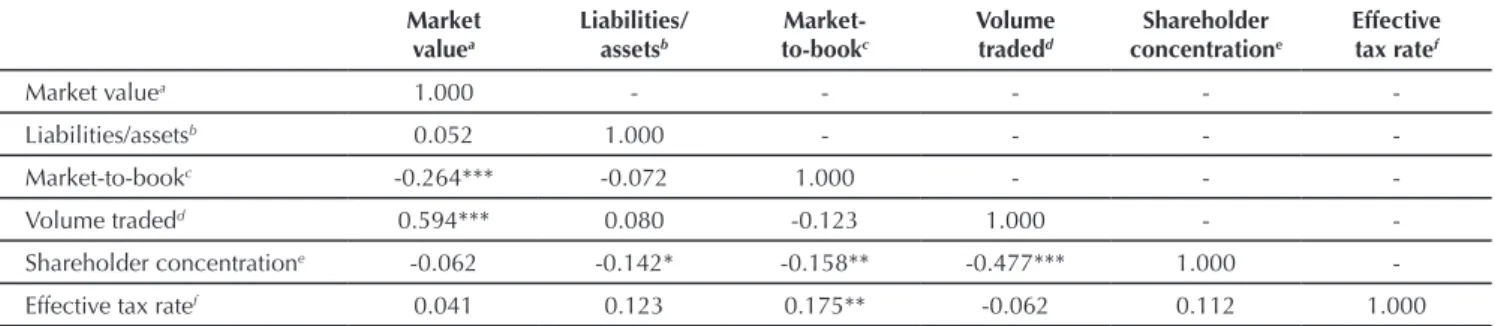
Table 2 Table of correlations between grouping variables
Market valuea
Liabilities/ assetsb
Market-to-bookc
Volume tradedd
Shareholder concentratione
Effective tax ratef
Market valuea 1.000 - - - -
-Liabilities/assetsb 0.052 1.000 - - -
-Market-to-bookc -0.264*** -0.072 1.000 - -
-Volume tradedd 0.594*** 0.080 -0.123 1.000 -
-Shareholder concentratione -0.062 -0.142* -0.158** -0.477*** 1.000
-Effective tax ratef 0.041 0.123 0.175** -0.062 0.112 1.000
*, **, ***: two-tailed statistical signifi cance to 10%, 5%, and 1%, respectively; a: natural logarithm of average company market value in 2007; b: ratio between total company liabilities and assets in 2007; c: company book-to-market ratio in 2007; d: natural logarithm of average volume traded for companies in 2007; e: sum of two biggest shareholders with voting rights; f: ratio between current income tax on legal entity/social security contribution expenses on net earnings (IRPJ/CSSL) and earnings before IRPJ/CSSL.
Source: Elaborated by the authors.
in which RETit is the return on share i three months at er the date of closing the accounting statements and EBTit
is the value of earnings before income taxdivided by total assets.
4. RESULTS
4.1 Cluster Analysis
First, a correlation was carried out between the variables that indicate more or less stock market monitoring. h en, a cluster analysis was conducted of the companies listed on the BM&FBOVESPA and not classii ed in the ADR class.
4.1.1 Correlation table.
h e correlations between the variables that show
economic incentives (Table 2) have the signs predicted
in the previous section. More specii cally, all of the
variables were negatively correlated with the shareholder
concentration variable. For example, volume traded has
a negative and statistically signii cant relationship with
degree of shareholder concentration (-0.477***).
Table 3 Averages of variables for each subclass
Market value Liabilities/assets
(%) Market-to-book
Valume traded
Shareholder concentration (%)
Effective tax rate (%)
Average subclass A 14.39* 55.66 0.66 8.84*** 33.69*** 34.5***
Average subclass B 13.84* 53.61 0.65 7.26*** 80.41*** 18.6***
*, **, ***: two-tailed statistical signifi cance to 10%, 5%, and 1%, respectively.
Source: Elaborated by the authors.
h e results found are consistent with the results from other studies. For example, Rubin (2007) i nds that the level of shareholder concentration is negatively related with the degree of liquidity of companies listed on the NYSE. Moreover, Zeng (2011) verii ed that Chinese companies with shareholder concentration present lower ef ective income tax rates.
The negative relationship between market value and shareholder concentration is consistent with the arguments from Demsetz and Lehn (1985): the bigger the company, ceteris paribus, the greater the market value of
a given fraction of the company. h e higher price of the given fraction of the company should, in itself, reduce the degree of shareholder concentration.
4.1.2 Cluster analysis.
In the cluster analysis the hierarchical grouping process was used with the link between groups method involving the squared Euclidian distance. At er identifying two subclasses of companies from the result of the cluster analysis, the average was calculated for each variable for each one of the subclasses (Table 3).
h e variables in Table 3 signal more or less stock market monitoring of the companies. More monitoring is associated with a greater demand for quality accounting information, the aim of which is to ultimately help with decision making. As the IFRS framework is orientated towards the capital market and more comprehensive in relation to the Brazilian GAAP, companies with more market monitoring would have the incentive to increase the quality of their accounting information at er IFRS adoption to signal commitment and transparency to the market.
Viewed in another way, companies with low stock market monitoring could be concerned, for example, with economizing on tax without leading to substantial changes in the disclosure of accounting information. If the i nancial information disclosed in fact stands apart from the accounting for tax purposes, it must be useful for decision making, with signii cant value relevance. Similarly, the information is timelier in character and must present conditional conservatism towards economic
events. h ese characteristics are not expected to be present in accounting information that is strongly inl uenced by tax aspects, since tax accounting does not focus on decision making.
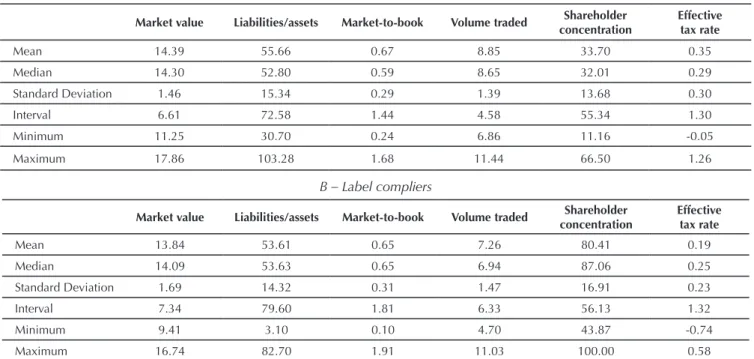
Given the characteristics of subclass B – high shareholder concentration, low effective IRPJ/CSSL rate, and lower volume traded – it is assumed that these companies would not be engaged in providing higher quality accounting information, even at er adopting the IFRS framework. A low ef ective IR rate would be indicative of emphasis on the use of dif erent parameters to economize on tax payments. h us, this class was called label compliers.
In general, the means and medians of the variables of interest are consistent with the predictions. More specii cally, the means and medians of the market value, volume traded, and ef ective IR/CS rate are greater for the
serious compliers class in relation to the label compliers class. Moreover, the mean and median of the shareholder concentration variable are lower for the serious compliers class in relation to the label compliers class.
Table 4 Descriptive statistic for the grouping variables for serious compliers and label compliers classes
A – Serious compliers
Market value Liabilities/assets Market-to-book Volume traded Shareholder concentration
Effective tax rate
Mean 14.39 55.66 0.67 8.85 33.70 0.35
Median 14.30 52.80 0.59 8.65 32.01 0.29
Standard Deviation 1.46 15.34 0.29 1.39 13.68 0.30
Interval 6.61 72.58 1.44 4.58 55.34 1.30
Minimum 11.25 30.70 0.24 6.86 11.16 -0.05
Maximum 17.86 103.28 1.68 11.44 66.50 1.26
B – Label compliers
Market value Liabilities/assets Market-to-book Volume traded Shareholder concentration
Effective tax rate
Mean 13.84 53.61 0.65 7.26 80.41 0.19
Median 14.09 53.63 0.65 6.94 87.06 0.25
Standard Deviation 1.69 14.32 0.31 1.47 16.91 0.23
Interval 7.34 79.60 1.81 6.33 56.13 1.32
Minimum 9.41 3.10 0.10 4.70 43.87 -0.74
Maximum 16.74 82.70 1.91 11.03 100.00 0.58
label compliers = subclass of companies with lower stock market monitoring; serious compliers = subclass of companies with greater stock market monitoring.
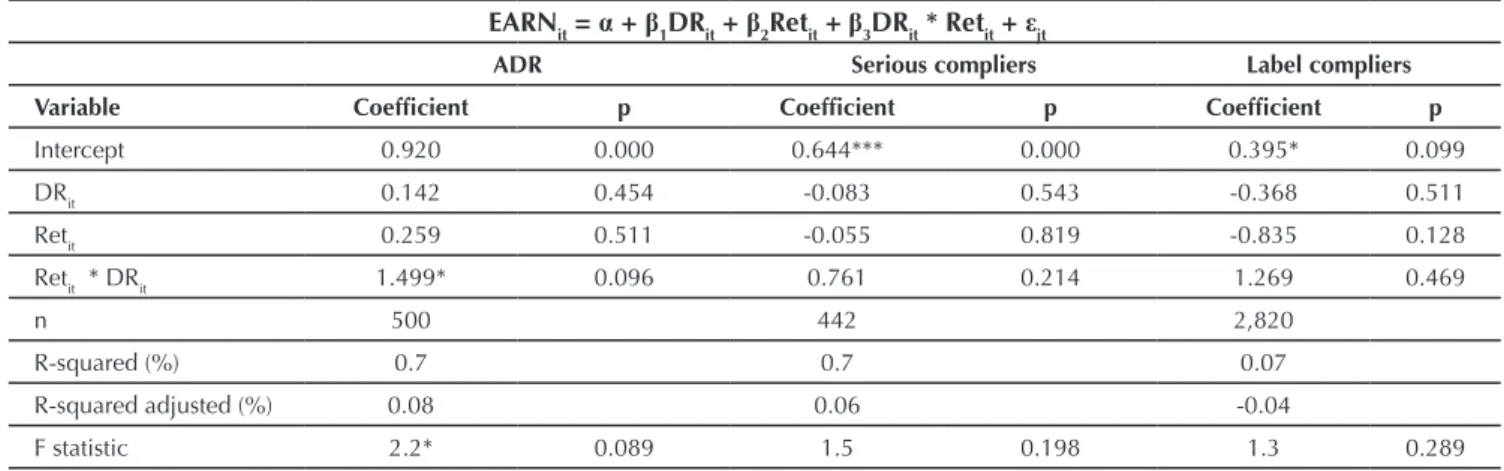
Table 5 Regression for the Reverse Model of Profi t Associated to Returns for the three classes of companies in the period from 2003 to 2007.
EARNit = α + β1DRit + β2Retit + β3DRit * Retit + εjt
ADR Serious compliers Label compliers
Variable Coefi cient p Coefi cient p Coefi cient p
Intercept 0.920 0.000 0.644*** 0.000 0.395* 0.099
DRit 0.142 0.454 -0.083 0.543 -0.368 0.511
Retit 0.259 0.511 -0.055 0.819 -0.835 0.128
Retit * DRit 1.499* 0.096 0.761 0.214 1.269 0.469
n 500 442 2,820
R-squared (%) 0.7 0.7 0.07
R-squared adjusted (%) 0.08 0.06 -0.04
F statistic 2.2* 0.089 1.5 0.198 1.3 0.289
*, **, ***: two-tailed statistical signifi cance to 10%, 5%, and 1%, respectively.
ADR = American Depositary Receipt (class of companies with economic incentives to disclose both before and after 2008); DRit
= dummy that is 1 when the return on a share is negative and 0 otherwise; EARNit = earnings per share for company i in year t; label compliers = class with low economic incentives for improving the quality of accounting information after International Financial Reporting Standards (IFRS); Retit = return on the share price of company i in year t ; serious compliers = class with economic incentives for improving the quality of accounting information after IFRS.
Source: Elaborated by the authors.
4.2 Results for the Quality of Accounting Earnings Tests
4.2.1 Results for the Reverse Model of Proi t Associated to Returns for the three classes of companies before IFRS adoption.
Table 5 presents the results from the conditional conservatism evaluation for the three classes of companies in the period from 2003 to 2007.
h e results from the conditional conservatism test before IFRS adoption are consistent with the predictions made previously. h e β3 coeffi cient is not statistically signii cant, whether for the serious compliers class, or for the label compliers class. h us, it cannot be affi rmed that these two sets of companies adopted mechanisms for timely recognition of economic losses before IFRS adoption. It is argued that these two classes of companies did not have, up until then, suffi cient economic incentives for adopting mechanisms of conditional conservatism.
h ese results are consistent with the Brazilian empirical studies that have sought to investigate conservatism before 2008. Using a sample of Brazilian companies in the period from 1995 to 1999, Lopes (2001) identii es that economic losses are not timely recognized, measuring this recognition using the market model from Basu (1997). Costa, Lopes and Costa (2006) apply the same model from Basu (1997) to a sample of Latin American publicly-held companies covering the period from 1995 to 2001 and
economic return.
On the other hand, the β3 coeffi cient for the companies from the ADR class is positive and statistically signii cant, revealing that these companies adopted mechanisms for the timely recognition of economic losses before IFRS adoption.
4.2.2 Results from the value relevance model for the three classes of companies before IFRS adoption.
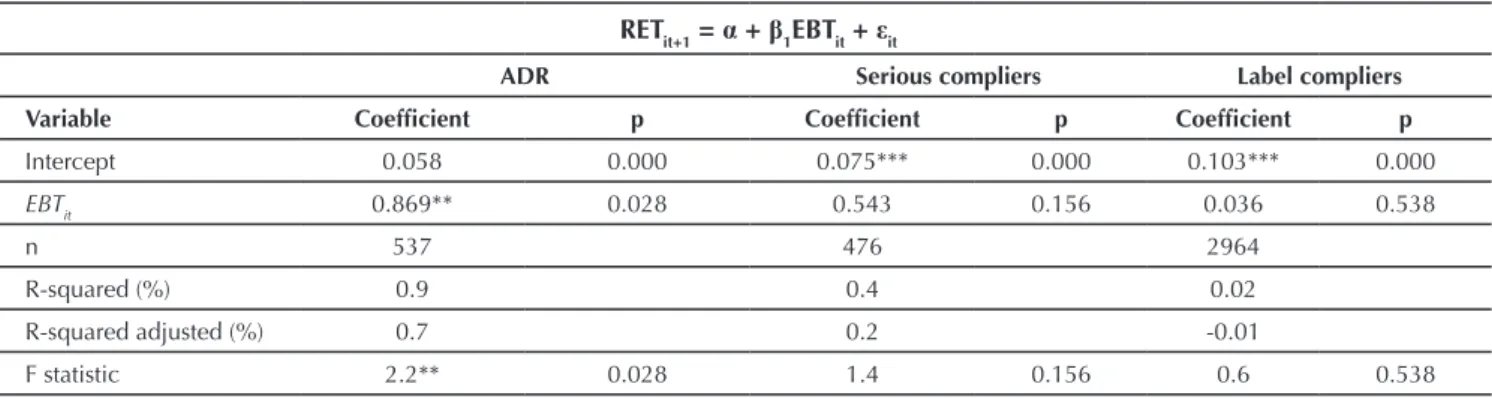
Table 6 presents the results from the value relevance evaluation for the three classes of companies from 2003 to 2007.
Due to the non-signii cance of the β1 coeffi cient, the existence of value relevance cannot be verii ed, whether for the serious compliers class, or for the label compliers class, before 2008. h us, these companies would not have suffi cient incentives to disclose accounting information that helped investors to form expectations in relation to the creation of future cash l ows. Similarly, Nakao (2012) does not i nd value relevance of EBT before 2008, neither for companies belonging to the Ibovespa, or for companies not belonging to the Ibovespa.
On the other hand, the β1 coeffi cient for the ADR class companies is positive and statistically signii cant, providing evidence that the earnings disclosed by a company would be considered as relevant by investors for evaluating the economic-i nancial performance of the entity and would be rel ected in market prices.
h e conclusions reached with the results from the value relevance test are similar to those obtained with the conditional conservatism test. Validation of the ADR variable stands out as a proxy for greater quality before 2008, as well as the non-verii cation of value relevance of accounting earnings for the serous compliers class before 2008. h us, to identify whether an increase in quality occurred for the serious compliers class, the value relevance of this class at er 2008 needs to be tested.
4.2.3 Results from the Reverse Model of Profit Associated to Returns for the three classes of companies at er IFRS adoption.
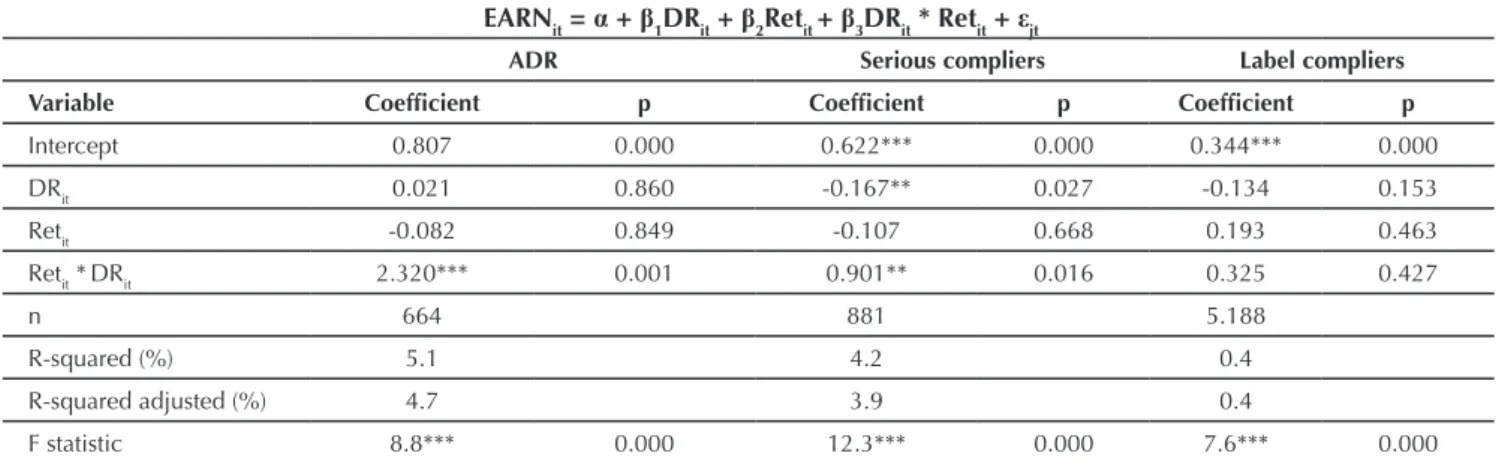
Table 7 presents the results from the evaluation of conditional conservatism for the three classes of companies from 2008 to 2014.
Table 6 Regressions for the value relevance model for the three classes of companies from 2003 to 2007
RETit+1 = α + β1EBTit + εit
ADR Serious compliers Label compliers
Variable Coefi cient p Coefi cient p Coefi cient p
Intercept 0.058 0.000 0.075*** 0.000 0.103*** 0.000
EBTit 0.869** 0.028 0.543 0.156 0.036 0.538
n 537 476 2964
R-squared (%) 0.9 0.4 0.02
R-squared adjusted (%) 0.7 0.2 -0.01
F statistic 2.2** 0.028 1.4 0.156 0.6 0.538
*, **, ***: two-tailed statistical signifi cance to 10%, 5%, and 1%, respectively.
ADR = American Depositary Receipt (class of companies with economic incentives to disclose both before and after 2008); label compliers = class with low economic incentives for improving the quality of accounting information after International Financial Reporting Standards (IFRS); EBTit = value of earnings before income tax divided by total assets; RETit+1 = return on share i three months after releasing the fi nancial statements; serious compliers = class with economic incentives for improving the quality of accounting information after IFRS.
Table 7 Regressions for the Reverse Model of Profi t Associated to Returns for the three classes of companies from 2008 to 2014
EARNit = α + β1DRit + β2Retit + β3DRit * Retit + εjt
ADR Serious compliers Label compliers
Variable Coefi cient p Coefi cient p Coefi cient p
Intercept 0.807 0.000 0.622*** 0.000 0.344*** 0.000
DRit 0.021 0.860 -0.167** 0.027 -0.134 0.153
Retit -0.082 0.849 -0.107 0.668 0.193 0.463
Retit *DRit 2.320*** 0.001 0.901** 0.016 0.325 0.427
n 664 881 5.188
R-squared (%) 5.1 4.2 0.4
R-squared adjusted (%) 4.7 3.9 0.4
F statistic 8.8*** 0.000 12.3*** 0.000 7.6*** 0.000
*, **, ***: two-tailed statistical signifi cance to 10%, 5%, and 1%, respectively.
ADR = American Depositary Receipt (class of companies with economic incentives to disclose both before and after 2008); DRit = dummy that takes the value 1 when the return on a share is negative and 0 otherwise; EARNit = earnings per share for company i in year t; label compliers = class with low economic incentives for improving the quality of accounting information after International Financial Reporting Standards (IFRS); Retit = return on the share price of company i in year t; serious compliers = class with economic incentives for improving the quality of accounting information after IFRS.
Source: Elaborated by the authors.
h e companies that issued ADRs present conditional conservatism at er the adoption of the international standards (positive and statistically significant β3 coefficient), indicating that the accounting brought forward recorded losses already incorporated in the share prices. When the results from Table 6 are taken together with the results from Table 4, it is concluded that the ADR class of companies continues using conditional conservatism mechanisms in their i nancial statements at er IFRS adoption.
At er the adoption of the IFRS framework, the serious compliers class of companies comes to present timely recognition of economic losses. h e β3 coeffi cient is statistically signii cant and positive, consistent with more timely recognition of losses than economic gains. h ese results suggest that these companies experienced an increase in quality, probably as a result of the stock market demand for information.
For the label compliers class of companies, no change in conditional conservatism was verii ed at er the adoption
of the IFRS framework, since the β3 coeffi cient is not statistically signii cant. h e low economic incentives for disclosing better quality accounting information implies a lack of conditional conservatism, even with the adoption of the norms aimed towards protecting investors.
In investigating the ef ect of Act n. 11,638/2007 (Brazil, 2007) over the conditional conservatism of companies listed on the BM&FBOVESPA, Santos, Lima, Lima, and Freitas (2011) did not i nd any ef ect of the new rules over the degree of asymmetric recognition of losses and gains. In contrast to the study cited, the results obtained in this paper provide evidence of conditional conservatism at least for a particular set of companies.
4.2.4 Results for the discretionary accruals model from Kothari et al. (2005) for the three classes of companies.
A reduction in earnings management is identii ed both for the serious compliers class and for the ADR class at er the adoption of the IFRS framework. h e β1 coeffi cient is statistically signii cant and negative, and consistent with the reduction in earnings management, thus showing these companies’ concern with providing investors with more trustworthy information. However, no reduction in earnings management was identii ed for the class with low incentives for disclosing better quality information.
Convergence of the results found in the Brazilian literature on earnings management at er IFRS adoption cannot be verii ed. h e results from Joia and Nakao (2014) do not allow it to be affi rmed that there was a fall in the level of earnings management with the introduction of the IFRS framework. Klann (2011), on the other hand, records that in Brazil, in the post-convergence period, there was an increase in the level of earnings management, unlike the behavior the author identii ed for England, where it
appears there was a decrease in earnings management. As for Silva (2013), he i nds that discretionary accruals, a proxy for earnings management, decreased in the period of complete adoption.
The results involving no reduction in earnings management for the label compliers class and the evidence of the reduction in earnings management for the serious compliers and ADR classes at er 2008 may help to explain the conl icting results in the Brazilian literature. It is concluded that segregation of the companies into classes helps to overcome the limitation of treating the companies in a homogenous way.
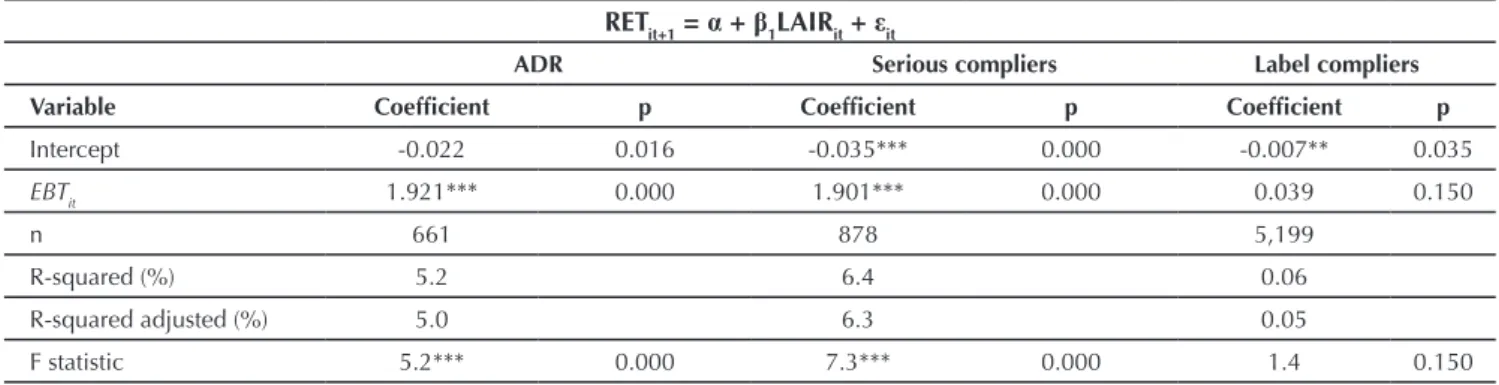
4.2.5 Results for the value relevance model for the three classes of companies at er IFRS adoption Table 9 presents the results from the value relevance evaluation for the three classes of companies from 2008 to 2014.
Table 8 Regressions for the discretionary accruals model for the three classes of companies after 2008
[DA]it = α + β1IFRSit + εit
ADR Serious compliers Label compliers
Variable Coefi cient p Coefi cient p Coefi cient p
Intercept 0.008 0.008 0.021 0.000 -0.005 0.332
IFRSit -0.013*** 0.001 -0.029*** 0.000 0.002 0.745
n 800 911 4,992
R-squared (%) 1.1 7.6 0.00
R-squared adjusted (%) 0.9 2.1 -0.00
F statistic -3.3*** 0.001 -4.9*** 0.000 0.3 0.745
*, **, ***: two-tailed statistical signifi cance to 10%, 5%, and 1%, respectively.
ADR = American Depositary Receipt (class of companies with economic incentives to disclose both before and after 2008); |DA|it = discretionary accruals of company i in period t; IFRSit = dummy that takes the value 1 for the years after the adoption of the international standards and 0 otherwise; label compliers = class with low economic incentives for improving the quality of accounting information after International Financial Reporting Standards (IFRS); serious compliers = class with economic incentives for improving the quality of accounting information after IFRS.
Table 9 Regressions for the value relevance models for the three classes of companies from 2008 to 2014
RETit+1 = α + β1LAIRit + εit
ADR Serious compliers Label compliers
Variable Coefi cient p Coefi cient p Coefi cient p
Intercept -0.022 0.016 -0.035*** 0.000 -0.007** 0.035
EBTit 1.921*** 0.000 1.901*** 0.000 0.039 0.150
n 661 878 5,199
R-squared (%) 5.2 6.4 0.06
R-squared adjusted (%) 5.0 6.3 0.05
F statistic 5.2*** 0.000 7.3*** 0.000 1.4 0.150
*, **, ***: two-tailed statistical signifi cance to 10%, 5%, and 1%, respectively.
ADR = American Depositary Receipt (class of companies with economic incentives to disclose both before and after 2008); label compliers = class with low economic incentives for improving the quality of accounting information after International Financial Reporting Standards (IFRS); EBTit = value of earnings before income tax, divided by total assets; RETit+1 = return on share i three months after the release of fi nancial statements; serious compliers = class with economic incentives for improving the quality of accounting information after IFRS.
Source: Elaborated by the authors.
First, due to the β1 coeffi cient being positive and statistically signii cant, the ADR class presents value relevance of net income at er IFRS adoption.
Second, the class with economic incentives for disclosing better quality accounting information presents value relevance of earnings before IRPJ/CSSL at er 2008. Adding the non-verii cation of value relevance at er 2008, it is concluded that the serious compliers class experienced an increase in quality, this time measured via the value relevance test.
h e results found support the results from the Brazilian literature on value relevance and IFRS adoption. Using data from 2010 and 2011, Silva (2013) i nds value relevance of accounting information during the period of complete
adoption of the IFRS framework. Similarly, the results from Gonçalves, Batista, Macedo, and Marques (2014) reveal that accounting information became more relevant. Comparison between the R2 of the relevance regressions
reveals that there was an increase in the explanatory power of share price via net earnings per share and net equity per share.
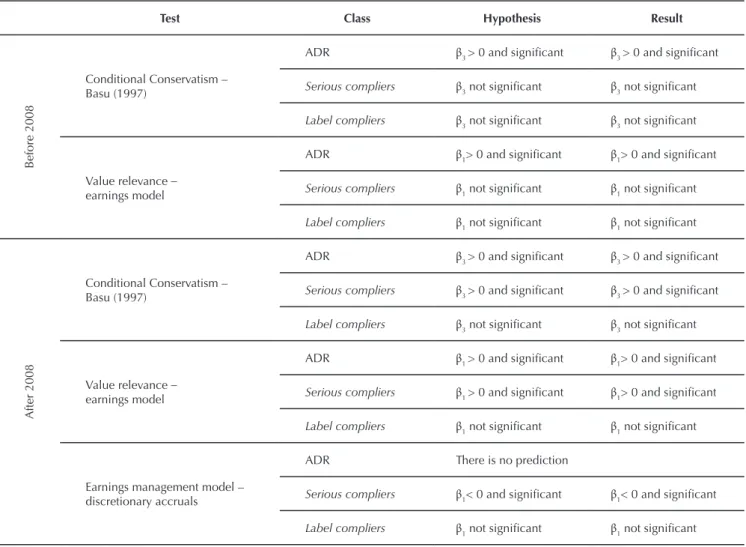
h e results obtained with the tests are consistent with the predictions. h e serious compliers class came to exhibit conditional conservatism, value relevance of net income, and lower earnings management at er IFRS adoption. h e results for the ADR class indicate conditional conservatism
and value relevance of net income both before and at er IFRS adoption. As for the label compliers class, the results do not indicate conditional conservatism, value relevance of net income, and reduced earnings management at er IFRS adoption.
5. SUMMARY OF THE HYPOTHESES, TESTS, AND RESULTS
Table 10 presents the hypotheses, tests, and results from the paper.
Table 10 Summary of hypotheses, tests, and results
Test Class Hypothesis Result
Before 2008
Conditional Conservatism – Basu (1997)
ADR β3 > 0 and signii cant β3 > 0 and signii cant
Serious compliers β3 not signii cant β3 not signii cant
Label compliers β3 not signii cant β3 not signii cant
Value relevance – earnings model
ADR β1> 0 and signii cant β1> 0 and signii cant
Serious compliers β1 not signii cant β1 not signii cant
Label compliers β1 not signii cant β1 not signii cant
After 2008
Conditional Conservatism – Basu (1997)
ADR β3 > 0 and signii cant β3 > 0 and signii cant
Serious compliers β3 > 0 and signii cant β3 > 0 and signii cant
Label compliers β3 not signii cant β3 not signii cant
Value relevance – earnings model
ADR β1 > 0 and signii cant β1> 0 and signii cant
Serious compliers β1 > 0 and signii cant β1> 0 and signii cant
Label compliers β1 not signii cant β1 not signii cant
Earnings management model – discretionary accruals
ADR There is no prediction
Serious compliers β1< 0 and signii cant β1< 0 and signii cant
Label compliers β1 not signii cant β1 not signii cant
ADR = American Depositary Receipt (class of companies with economic incentives to disclose both before and after 2008).
6. CONCLUSION
h is paper verii ed that adoption of the IFRS framework cannot be seen as the only guide to accounting information quality. At er all, if adoption of the IFRS framework was enough to increase the quality of accounting earnings, convergence would naturally be expected in Brazilian empirical papers that seek to verify quality gains since 2008. On the contrary, when the papers are analyzed together, the results appear conl ictive. h us, this paper aims to overcome the limitation found in the Brazilian literature from treating the companies in a homogenous way, the results for which generally capture the average ef ect for companies around IFRS adoption.
In general, the results from the tests are consistent with the predictions. h e companies with economic incentives given by the stock market really achieve increased quality at er adopting the IFRS framework. h is set of companies starts to more timely recognize losses in relation to economic gains, disclosed earnings become value relevant, and they show evidence of reduced earnings management.
Moreover, evidence was found of accounting information quality for the ADR class. h e companies from this class show conditional conservatism and value relevance of net income both before and at er 2008. h e identii cation of a class of companies with greater quality beforehand may be seen as a contribution from this paper. At er all, international empirical papers have identii ed the existence of only two classes of companies (Daske et al., 2013). h erefore, verii cation of a third class, the dif erentiating characteristic of which is its quality before IFRS adoption, may be seen as an additional contribution from this paper.
Finally, conditional conservatism, value relevance, and lower earnings management were not identii ed for the set of companies with low economic incentives, whether before or at er 2008. Quite probably, the path of these companies tends to depend on the previous accounting practices inl uenced by taxation.
One alternative study design to that used in this paper would be to separate the companies, taking only the level of accounting information quality into consideration. h is way, increases in quality could be identii ed directly, rather than using variables, in order to verify higher or lower incentives for better accounting disclosure. However, the quality metrics used (conditional conservatism, earnings management, and value relevance) are not able to capture a measure of quality for each company, but do capture the existence or not of a measure of quality for a particular number of observations.
h e results contribute to a line of research in the accounting literature that aims to understand the real motivations and incentives for elaborating accounting information (Ball et al., 2000, 2003; Ball & Shivakumar, 2005; Bushman & Piotroski, 2006), by showing that company variables play a key role in this process.
Moreover, Brazilian and international regulatory bodies may be interested in these results, since they show that the properties of i nancial statements depend on company incentives. h is imposes a challenge for recent ef orts by these bodies to consolidate convergence with the international accounting standards. h e results suggest that a global and uniform set of accounting standards may not have the power de facto to make the properties of accounting numbers converge to the same level.
REFERENCES
Ali, A., & Hwang, L. (2000). Country specii c factors related to i nancial reporting and the value relevance of accounting data.
Journal of Accounting Research, 38(1), 1-21.
Aubert, F., & Grudnitski, G. (2012). Analysts’ estimates: what they could be telling us about the impact of IFRS on earnings manipulation in Europe. Review of Accounting and Finance,
11(1), 53-72.
Ball, R. (2001). Infrastructure requirements for an economically effi cient system of public i nancial reporting and disclosure.
Ball, R., & Shivakumar, L. (2005). Earnings quality in UK private i rms: comparative loss recognition timeliness. Journal of
Accounting & Economics, 39(1), 83-128.
Ball, R., Kothari, S. P., & Robin, A. (2000). h e ef ect of
international institutional factors on properties of accounting earnings. Journal of Accounting and Economics, 29(1), 1-51. Ball, R., Robin, A., & WU, J. (2003). Incentives versus standards:
properties of accounting income in four East Asian countries.
accounting standard setting: another view. Journal of
Accounting & Economics, 31(1-3), 77-104.
Barth, M. E., Landsman, W. R., & Lang, M. H. (2008).
International accounting standards and accounting quality.
Journal of Accounting Research, 46(3), 467-498.
Basu, S. (1997). h e conservatism principle and the asymmetric timeliness of earnings. Journal of Accounting and Economics,
24(1), 3-37.
Beck, T., Demirgüç-Kunt, A., & Maksimovic, V. (2005). Financial and legal constraints to i rm growth: does i rm size matter?
Journal of Finance, 60(1), 137-177.
Brasil (1976). Lei nº 6.404, de 15 de dezembro de 1976. Dispõe sobre as sociedades por ações. Brasília, DF: Diário Oi cial da União.
Brasil (1977). Decreto-Lei nº 1.598, de 26 de dezembro de 1977. Altera a legislação do imposto sobre a renda. Brasília, DF: Diário Oi cial da União.
Brasil (2007). Lei nº 11.638, de 28 de dezembro de 2007. Altera e revoga dispositivos da Lei nº 6.404, de 15 de dezembro de 1976, e da Lei nº 6.385, de 7 de dezembro de 1976. Brasília, DF: Diário Oi cial da União.
Brasil (2009). Lei nº 11.941, de 27 de maio de 2009. Altera a legislação tributária federal relativa ao parcelamento ordinário de débitos tributários e dá outras providências. Brasília, DF: Diário Oi cial da União.
Brito, G. A. S. (2010). Conservadorismo contábil e o custo do
crédito bancário no Brasil (Doctoral h esis). Universidade de
São Paulo, São Paulo, SP.
Burgstahler, D., Hail, L., & Leuz, C. (2006). h e importance of reporting incentives: earnings management in European private and public i rms. h e Accounting Review, 81(5), 983-1016.
Bushman, R. M., & Piotroski, J. D. (2006). Financial reporting incentives for conservative accounting: the inl uence of legal and political institutions. Journal of Accounting and Economics,
42(1-2) 107-148.
Christensen, H. B., Lee, E, & Walker, M. (2015). Incentives or standards: what determines accounting quality changes around IFRS adoption? European Accounting Review, 24(1), 31-61.
Costa, F. M., Lopes, A. B., & Costa, A. C. (2006). O
conservadorismo em cinco países da América do Sul. Revista
Contabilidade & Finanças, 17(41) 7-20.
Daske, H., Hail, L., Leuz, C., & Verdi, R. (2008). Mandatory IFRS reporting around the world: early evidence on the economic consequences. Journal of Accounting Research, 46(5), 1085-1142.
Daske, H., Hail, L., Leuz, C., & Verdi, R. (2013). Adopting a label: heterogeneity in the economic consequences around IAS/IFRS adoptions. Journal of Accounting Research, 51(3), 495-47. Demsetz, H., & Lehn, K. (1985). h e structure of corporate
ownership: causes and consequences. Journal of Political
Economy, 93(6), 1155-1177.
Easton, P., & Harris, T. S. (1991). Earnings as an explanatory variable for returns. Journal of Accounting Research, 29(1), 19 36.
Fávero, L. P. L., Beli ore, P. P., Silva, F. L., & Chan, B. L. (2009).
Análise de dados: modelagem multivariada para tomada de
decisões. Rio de Janeiro, RJ: Elsevier.
Francis, J. R., Khurana, I. K., Martin, X., & Pereira, R. (2008). h e role of i rm-specii c incentives and country factors in explaining voluntary IAS adoptions: evidence from private i rms. European Accounting Review, 17(2), 331-360. Francis, J., & Schipper, K. (1999). Have i nancial statement lost
their relevance? Journal of Accounting Research, 37(2), 319-352.
Gioielli, S. P. O., Carvalho, A. G., & Sampaio, J. O. (2013). Capital de risco e gerenciamento de resultados em IPOs. Brazilian
Business Review, 10(4), 32-68.
Glosten, L., & Milgrom, P. (1985). Bid, ask, and transaction prices in a specialist market with heterogeneously informed traders.
Journal of Financial Economics, 14(1), 71-100.
Gonçalves, J. C., Batista, B. L. L., Macedo, M. A. S., & Marques, J. A. V. C. (2014). Análise do impacto do processo de convergência às normas internacionais de contabilidade no Brasil: um estudo com base na relevância da informação contábil. Revista Universo Contábil, 10(3), 25-43. Grossman, S., & Stiglitz, J. (1980). On the impossibility of
informationally effi cient markets. American Economic Review,
70(3), 393-408.
Joia, R. M., & Nakao, S. H. (2014). Adoção de IFRS e gerenciamento de resultados nas empresas brasileiras de capital aberto. Revista de Educação e Pesquisa em
Contabilidade, 8(1), 22-38.
Klann, R. C. (2011). Gerenciamento de resultados: análise comparativa de empresas brasileiras e inglesas antes e após a
adoção das IFRS (Doctoral h esis). Universidade Regional de
Blumenau, Blumenau, SC.
Kothari, S. P., Leone, A., & Wasley, C. (2005). Performance matched discretionary accrual measures. Journal of Accounting
and Economics, 39(1), 163-197.
Lang, M., Lins, K. V., & Maf ett, M. (2012). Transparency, liquidity, and valuation: international evidence on when transparency matters most. Journal of Accounting Research, 50, 729-774.
Leuz, C., Nanda, D., & Wysocki, P. D. (2003). Earnings management and investor protection: an international comparison. Journal of Financial Economics, 69, 505-527. Lopes, A. B, & Walker, M. (2008). Firm-level incentives and the
informativeness of accounting reports: an experiment in Brazil [Working Paper]. Social Science Research Network. Retrieved from http://ssrn.com/abstract=1095781.
Lopes, A. B. (2001). A relevância da informação contábil para o mercado de capitais: o modelo de Ohlson aplicado à BOVESPA
(Doctoral h esis). Universidade de São Paulo, São Paulo, SP. Martinez, A. L. (2013). Gerenciamento de resultados no Brasil:
um survey da literatura. Brazilian Business Review, 10(4), 1-31.
Nakao, S. H. (2012). A adoção de IFRS e o legado da conformidade
contábil-i scal mandatória (Habilitation h esis). Universidade
de São Paulo, Ribeirão Preto, SP.
Rubin, A. (2007). Ownership level, ownership concentration and liquidity. Journal of Financial Markets, 10(3), 219-248. Santos, E. S., Ponte, V. M. R., & Mapurunga, P. V. R. (2014).
Address for correspondence:
Roberto Black
conformidade das empresas com a divulgação requerida e alguns fatores explicativos. Revista Contabilidade &
Finanças, 25(65), 161-176.
Santos, L. P. G., Lima, I. S., Lima, G. A. S. F., & Freitas, S. C. de F. (2011). Efeito da Lei 11.638/07 sobre o conservadorismo condicional das empresas listadas BM&FBOVESPA. Revista
Contabilidade & Finanças, 22(56), 174-188.
Scholes, M. S., Wolfson, M. A., Erickson, M., Maydew, E. L., & Shevlin, T. (2002). Taxes and business strategy: a planning
approach (2nd ed.). Upper Saddle River, NJ: Prentice Hall.
Silva, R. L. M. (2013). Adoção completa das IFRS no Brasil: qualidade das demonstrações contábeis e o custo de capital
próprio (Doctoral h esis). Universidade de São Paulo, São
Paulo, SP.
Suzart, J. A. S. (2013). Informações contábeis governamentais e o mercado secundário de títulos públicos: um estudo sob a ótica
da value relevance no Brasil (Doctoral h esis). Universidade de
São Paulo, São Paulo, SP.
Tendeloo, B. V., & Vanstraelen, A. (2005). Earnings management under German GAAP versus IFRS. European Accounting
Review, 14(1), 155-180.
Zéghal, D., Chtourou, S., & Sellami, Y. M. (2011). An analysis of the ef ect of mandatory adoption of IAS/IFRS on earnings management. Journal of International Accounting, Auditing
and Taxation, 20(2), 61-72.
Zeng, T. (2011). Ownership concentration, state ownership, and ef ective tax rates: evidence from China’s listed i rms.

![Table 8 Regressions for the discretionary accruals model for the three classes of companies after 2008 [DA] it = α + β 1 IFRS it + ε it](https://thumb-eu.123doks.com/thumbv2/123dok_br/18914321.432974/14.892.78.827.104.297/table-regressions-discretionary-accruals-model-classes-companies-ifrs.webp)