Abstract—The TRT model, developed to accurately reproduce the tire thermal dynamics in all the vehicle working conditions, has to be physically characterized [1][2]. An appropriate non-destructive procedure, that allows to obtain the thermal diffusivity of completely different tire layers, is described. The heat is directly supplied on the tire tread surface trough a specifically powered laser, while two thermal cameras acquire temperatures reached on both the outer and the inner layers. Using the above instrumentation layout to acquire the tire radial and circumferential temperature gradients and a specifically developed mathematical TRTLab model based on the use of Fourier’s equation of diffusion applied to a three dimensional domain, allows to estimate the tire thermal diffusivity.
Index Terms—Tire thermal diffusivity estimation, tire conductivity, tire specific heat, tire density, TRTLab, tire thermal characterization, tire thermal behavior, tire test procedure
I. INTRODUCTION
proper tire characterization is the key for a correct modelling of the entire vehicle dynamics, since tires are involved in the interaction with the road that generates the tangential force distributions within the handling limits. Tire is an extremely integrated system. The contact patch extension and the pressure distribution are connected to its internal structure, as the specific carcass composition and the peculiar disposition of belt cords and nylon plies. The tangential interaction forces, fulfilling the functions of sufficient braking or traction and adequate steering control and stability, deeply depend on the compound characteristics of the tread layer. Since the tire compound is a visco-elastic material, composed of vulcanized SBR polymeric chains, its behavior can be described according the Williams-Landel-Ferry equation, where the viscoelastic behavior of polymer material at a reference temperature T0
can be related to the viscoelastic to the behavior at another temperature T by changing the frequency scale [3].
In order to optimize the compound characteristics in all the vehicle-working conditions and therefore the grip, two
Manuscript received March 21, 2016; revised April 4, 2016.
Christophe Allouis is with Institute of Research on Combustion of the CNR, Napoli Italy (e-mail: [email protected]).
Flavio Farroni is with Dipartimento di Ingegneria Industriale, Università degli Studi di Napoli Federico II, via Claudio n. 21 80125 Napoli Italy (e-mail: [email protected]).
Aleksandr Sakhnevych is with Dipartimento di Ingegneria Industriale, Università degli Studi di Napoli Federico II, via Claudio n. 21 80125 Napoli Italy (e-mail: [email protected]).
Francesco Timpone is with Dipartimento di Ingegneria Industriale, Università degli Studi di Napoli Federico II, via Claudio n. 21 80125 Napoli Italy (corresponding author: phone: +39 081 76 83263; fax: +39 081 2394165; e-mail: [email protected])
directly opposing influences should be taken into account: the frequency of contact with the track road, corollary of the car‟s speed, and the prevailing working tire temperature. The tuning of completely heterogeneous parameters set, as tire pressure, tire internal structure, suspension geometry and the vehicle characteristics, is achievable only if all the above component subsystems are properly modelled within the simulation environment.
A crucial parameter for tire structure thermodynamic characterization is the thermal diffusivity, defined as the ratio between the thermal conductivity and the product of the specific heat and density. This parameter is a function of temperature and it varies with different compound compositions, especially exalted in the competition tires.
A technique for the determination of the thermal diffusivity of a tire compound was previously proposed including a destructive procedure, where the tyre was cut in samples and then heated up by laser [4]. An original non-destructive technique, to evaluate the thermal diffusivity within a specifically developed TRTLab model, is illustrated. Another huge benefit of using this innovative procedure is the fact that TRTLab and the already existing TRT [1][2] models share the same tire structure module, differentiating only in the boundary conditions package, as the natural convection and laser power impact phenomena.
II. EXPERIMENTAL TEST SETUP
A. Instrumentation Layout
The non-destructive test procedure is performed on the entire tire to acquire the temperature distributions in all the directions of heat propagation towards the point of the heat supply on the tread surface.
In Fig. 1, a 2D plant of the experimental test rig layout, specifically designed for this purpose, is described:
a specific powered laser emitter, pointing on the tire tread layer;
two IR cameras, directly facing the interior and the exterior tire surfaces, to measure the both tread and innerliner circumferential temperature gradients; a K type thermocouple, inserted at a particular
depth within the tire thickness which corresponds to the interface between the tread layers and the carcass structure, to acquire a point of the radial temperature gradient;
a convergent lens, placed between the laser emitter and the tire, to obtain a constant laser beam diameter of 10 mm upon the tread surface.
The laser emitter used for the test procedure is an argon ion Stabilite 2017, in Fig. 2, produced by Spectra-Physics.
Tire Thermal Characterization:
Test Procedure and Model Parameters Evaluation
C. Allouis, F. Farroni, A. Sakhnevych and F. Timpone, Member, IAENG
The tread surface is heated via the laser beam, expanded and collimated with the lens, with a specifically developed power values sequence, ranged between 0.5-2 W.
The IR thermocameras adopted are FLIR SC6800 MWIR Series, in Fig. 2, whose sensor sensitivity is ranged from 1 to 5 micron. In addition to the temperature trend acquisition of the inner and outer tire surfaces, their specific purpose is the detecting the area of the circumferential temperature gradient extension to correctly choose the value of the tire portion to mesh within the TRTLab model afterwards.
A thermocouple K, placed radially towards the laser beam direction, monitors the tire bulk temperature and thus
provides the radial temperature gradient to be compared with the simulated one. The thermocouple is particularly useful for the qualitative evaluation of the thermal conductivity for the principal tire layers: all the other things being equal, higher is the temperature of the bulk layer, greater is the part of heat flux conducted, and thus the tire tread thermal diffusivity value is lower.
Before performing the tests, all the tire surfaces, interest of IR measure, are properly cleaned and an accurate value of the laser power emitted is measured using a power meter with an accuracy ±0.1%.
B. Data Acquisition and Processing
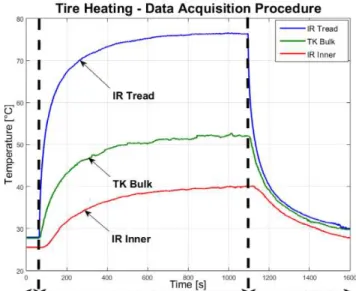
A standard test consists of three principal steps, in Fig. 3: idle phase: laser is switched off; a correct
functioning of all the instrumentation is monitored; heating phase: laser emitter is turned on; the heat
propagation in all directions is acquired. During this step, transient temperature trends are particularly relevant to evaluate the node inertia values [5] within the TRTLab model and to estimate the thermal diffusivity as a function of temperature. The heating phase finishes when all the temperature gradients are stable with no more significant heat exchanges in time between the different tire n;
cooling phase: laser is switched off; the natural convection remains the only heat transport mechanism within the tire thermal system.
The data acquired with IR cameras have been processed
using the “FLIR IR Research software” with an accuracy ±0.1°C. Being appropriately factory calibrated, thermocameras provide the instantaneous temperature in all the pixels per frame instant-by-instant, allowing studying the thermal heat propagation along the circumferential directions especially during the transient phase of heating. Since TRTLab is a discrete model, where a three-dimensional grid of nodes reproduces the volume of the tire
Fig. 1. The tire tread surface is warmed-up with different power values in steady state conditions by a continuous Argon laser. The infrared cameras acquire frames with a windows size of 640x512 pixels at a 20 Hz rate to be
further analyzed by the „FLIR IR Research software‟ and the „Matlab Image Processing Toolbox‟ software.
Fig. 2. Laser emitter (see left) consists of a controller, power supply and laser head, where the last two components have to be fluid-cooled, needing a supplemental water tube connection. IR thermocamera (see right) is air cooled to dissipate the heat produced its functioning.
Fig. 3. The typical test duration is 1600 seconds, with three triggers applied in the following way: 60 seconds of idle phase, 1050 seconds of heating phase and 550 seconds of cooling phase. It becomes immediately evident that the thermal dynamics of the three layers in analysis is completely different: tread temperature has an almost vertical slope trend, meanwhile bulk and innerliner are affected by the inertial mass contribute so that their dynamics is more gradual in the both heating and cooling phases.
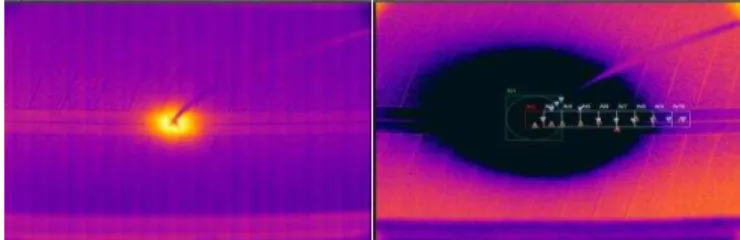
to be analyzed, the acquired images have been square-meshed obtaining a grid of mean temperature values per node to be compared with the simulated ones, in Fig. 4.
III. TRTLAB MODEL
The evaluation of the thermal diffusivity is complicated and delicate, since the whole tire thickness is expected to be thermally analyzed where different layers with disparate characteristics interact with each other throughout the heat propagation. Additionally, it has to be highlighted that the intrinsic temperature dependence and the variability due to different purpose tire structures also represent complicating matters. Moreover, this is precisely why the TRTLab model needs the greatest possible number of tests at different laser powers to have more data in transient and steady state conditions to evaluate both the physical diffusivity of different tire layers and the tire thermal inertias to embed in the Thermo Racing Tire model, where the transient thermal dynamics is dominant [6][7][8][9].
A. Thermodynamic Model
Thermo Racing Tire Laboratory model version is based on the Fourier‟s law according to the equation 1, applied to a three-dimensional discrete domain [6]:
= − ∙ ∇ (1)
where k is the material thermal conductivity, expressing how fast heat flows through the solid in analysis. In heat transfer theory, starting from the Fourier‟s law, it is possible to derive a second order differential equation able to describe the thermal phenomenon dynamics, particularly
suitable to be integrated numerically.
Applying the first thermodynamics law to an infinitesimal volume dV, in Fig. 5, the expression of the Fourier‟s diffusion equation can be obtained.
Assuming the infinitesimal volume non-deformable, so that it cannot perform any work, its internal energy dU is equal to the infinitesimal flow of incoming energy dQ:
= (2)
where dQ takes into account the heat exchanged dQex
through the entire outer volume surface and the internal generation term dQg:
= + � (3)
Considering the equation adopted to a discrete infinitesimal volume and applying the Gauss theorem, so that a surface integral governing the heat exchange term
dQex becomes a volume integral, the Fourier‟s diffusion
equation expression can be finally carried out:
�∙ ∙ ∙ = �∙ ∙ + ∙ ( ∙∇ ) ∙ (4)
To be numerically integrated, the above equation is rewritten in a state-space representation matrix form, as follows:
� � =
�
� ∙ +
( ∙ � )
� ∙ (5)
The heat generation term qg in (5) is related to the laser thermal flux at the tread nodes.
B. Boundary Conditions
The tire heat exchanges with the external environment, supposing negligible the radiation mechanism, are the following:
Natural convection modelling
Natural convection is a heat transport mechanism, in which the fluid motion is not externally generated since it is the consequence of the density differences due to the temperature gradient within the fluid [10]. A dimensionless Grashof number governs the flow regime in natural convection, representing the ratio of buoyant forces to viscous ones, so that it provides the main criterion to discriminate laminar and turbulent flows:
� =��( − ∞)�
3
3 (6)
where:
�
2 is gravity acceleration.
�
1 is the cubic expansion coefficient of the fluid.
�
is the characteristic length of the problem in exam.
[ ] is the surface temperature. ∞ [ ] is the fluid temperature. 2 is kinematic viscosity.
The natural convection thermal exchange term between the tire tread and innerliner surfaces and the surrounding fluid is equal to:
= ℎ �( − ∞) (7)
where:
ℎ
is the mean coefficient of thermal exchange of the surface for natural convectionFig. 4. IR frames of the innerliner layer in two completely different experiment phases are presented. During the heating transient phase (see left), the radial thermal flux is dominant, so that the only warmed up innerliner area is the corresponding one to the laser spot upon the tread surface. It has to be highlighted that a precise centering of TK thermocouple towards the radial heat propagation is a necessary condition. During the steady-state phase (see right), an appropriate modelling of the tangential heat propagation within the three-dimensional TRTLab domain is a prerequisite to obtain a correct thermal diffusivity estimation of different tire layers.
�
is the heat exchange surface area. is the node temperature. ∞ is ambient temperature.
It has to be highlighted that there are not any analytical general purpose equations, available in literature, governing the phenomenon of natural convection, since in addition to the fluid motion complexity only a very limited number of simple geometries has been analyzed under strict simplified assumptions. With the exception of a few simple cases, the relations of the heat exchange within the natural convection are therefore based on experimental studies.
Natural convection coefficient h is obtained by the dimensionless analysis, as follows:
ℎ = �
� (8)
The simplest empirical relation to express the Nusselt dimensionless number Nu takes into account the geometry characteristics, the Rayleigh number Ra and the Pradtl number Pr:
� = 0.825 + 0.387
1 6
1 + 0.492 )916 8/27
2
(9)
Laser beam modelling
Thermal flux quantity qg concerning the laser beam power affecting the tread surface is supposed to be equal to the
power measured with the energy meter during the tests. This heat generation term is assigned only to the tread nodes located within the laser spot area, as shown Fig. 6.
C. Tire Structure
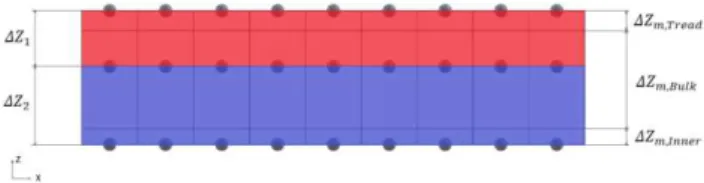
The tire extreme non-homogeneity has made it necessary to consider almost two sets of mechanical and thermodynamic parameters along the tire thickness. The easiest and least computationally expensive solution is to adopt only two homogeneous material zones along the radial direction, separated at the tread/carcass interface. Thus, the tread properties concern only the compound characteristics, particularly useful to discern different compound dynamics within Thermo Racing Tire model, the carcass properties embrace the belt and plies reinforcements and the innerliner thin film, as shown in Fig. 7.
Therefore, two different set of the following physical parameters have been assigned to the above zones:
� - density [ �/ 3]
cv - specific heat [ � ∙ ]
K - thermal conductivity [ ∙ ]
Additionally, the variability with temperature of the last two parameters has been also taken into account.
In summation, the tire patch is schematized as a parallelepiped constituted by three layers discretized by
means of a grid, whose node physical characteristics depend on their position in one of two material zones above described, as shown in Fig. 8.
D. Constitutive Equations
The Thermo Racing Tire Laboratory model requires the following input data to operate properly: the laser emitter power for laser beam modelling, the external air temperature for natural convection modelling and the pre-heating temperatures of the external tire layers as initial conditions necessary for the integration of the heat balance equations.
Finally, the TRTLab model is written in the matrix form:
�1
�
� 2
� � 3
� … … �
�
=
1 2
…
…
…
+ 1
� ∙
11 ⋯ 1
21
… 2
…
…
…
…
1
…
…
…
… ∙
1 2
…
…
…
(10)
in which is the generic coefficient, relative to the energy balance equation of the node , that multiplies the -th node temperature, while is the generic coefficient not multiplying nodes temperatures.
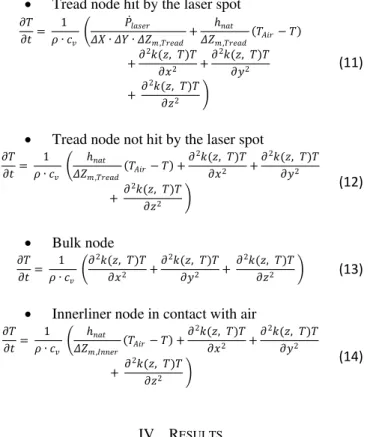
Heat balance equations for the most significant node configurations, taking into account the thermal exchanges along the all directions, are further reported.
Fig. 6. Being the Thermo Racing Tire a discrete model, the entire heating flux power is subdivided to singular nodes in relation to laser spot area quantity (in yellow) directly impacting upon the singular node extent within the xy plane. Therefore, only a part of the total laser power is assigned to each tread node in the heat balance equation. Three tire inertia layers are represented: tread in blue, bulk in green and innerliner in red.
Fig. 7. The whole tire thickness is divided in two zones of homogeneous material: ΔZ1 equal to the tread effective thickness (in red) and ΔZ2 equal to
the rest of the tire radial dimension (in blue).
Fig. 8. The tread and the innerliner nodes, whose radial dimensions are respectively ΔZm,Tread and ΔZm,Inner, are completely arranged in the zones ΔZ1
and ΔZ2, so that the physical parameters of the above masses are uniquely
Tread node hit by the laser spot
� � =
1
� ∙ � ∙ � ∙ � ,
+ ℎ
� , � − )
+� ( , )
2
� 2 +
�2 ( , )
� 2
+ � ( , )
2
� 2
(11)
Tread node not hit by the laser spot
� � =
1
� ∙ ℎ
� , � − )
+� ( , )
2
� 2 +
�2 ( , )
� 2
+ � ( , )
2
� 2
(12)
Bulk node
� � =
1
� ∙
�2 ( , )
� 2 +
�2 ( , )
� 2 +
�2 ( , )
� 2 (13)
Innerliner node in contact with air
� � =
1
� ∙ ℎ
� , � − )
+� ( , )
2
� 2 +
�2 ( , )
� 2
+ � ( , )
2
� 2
(14)
IV. RESULTS
The comparison between the theoretical and the experimental results, provided respectively by the Thermo Racing Tire Laboratory model and by the non-intrusive thermal diffusivity characterization procedure developed, is
represented in Fig. 9.
The results show a good agreement especially in steady state conditions, since the thermal diffusivity is supposed constant in this phase. It is worthwhile to note that a more detailed discretization of the tire total thickness should decrease the thermal inertia influence, enhancing the response of the inner layers during the transient heating and cooling phases too.
The adoption of a more detailed tire structure, diversifying the biggest possible number of layers along the radial direction, will improve the response of the model even in the transient phase. In this case, a considerable computational cost has to be taken into account due a more vast number of layers and then of nodes constituting the tire structure.
V. CONCLUSION
A non-intrusive test procedure to evaluate the tire thermal diffusivity has been described. The first results of the thermal tire characteristics supposed constant concern mainly the steady state conditions, which are therefore properly reproduced, as shown in Fig. 9.
The adoption of the simplest possible tire structure configuration within the TRTLab model, reproducing the simplest version of the TRT one, provides the optimum trade-off between two clear needs: a detailed and physical representation of the entire tire composite structure and a simplified performance oriented model. The two zoned TRTLab version model is therefore able to reproduce the principle thermal phenomena and to provide a suitable set of thermal parameters for the Thermo Racing Tire model [11].
A further Thermo Racing Tire Laboratory model could take into account both radial and circumferential thermal fluxes and therefore the consequential temperature distribution, distinct per structure and compound [12] of each tire, to evaluate the thermal diffusivity without using the thermocouple.
ACKNOWLEDGMENT
The authors thank Eng. Marco Di Pilla, Mr. Gennaro Stingo and Mr. Giuseppe Iovino for their fundamental technical support during the testing and bench development stages within the Laboratory of Engineering Department Laboratory of “Università degli Studi di Napoli Federico II”.
REFERENCES
[1] F. Farroni, D. Giordano, M. Russo and F. Timpone, “TRT: thermo racing tyre a physical model to predict the tyre temperature
distribution”, Meccanica, vol. 49, issue 3, pp. 707-723, 2014. [2] F. Farroni, A. Sakhnevych, and F. Timpone, "An Evolved Version of
Thermo Racing Tyre for Real Time Applications", Lecture Notes in Engineering and Computer Science: Proceedings of The World Congress on Engineering 2015, 1-3 July, 2015, London, U.K., pp 1159-1164
[3] Ferry, J. D., Viscoelastic Properties of Polymers, 3rd ed., John Wiley and Sons (New York, 1980).
[4] C. Allouis, A. Amoresano, D. Giordano, M. Russo, F. Timpone,
“Measurement of the Thermal Diffusivity of a Tire Compound by Mean of Infrared Optical Technique,” International Review of Mechanical Engineering, vol. 6, n. 6, Praise Worthy Prize, September 2012.
[5] G. Carbone, BN. Persson, “Crack motion in viscoelastic solids: the
role of the flash temperature”, The European Physical Journal E, vol. 17, issue 3, pp. 261-281, July 2005.
[6] Yeow, S.H., Ei-Sherbiny, M., Newcomb, T.P., “Thermal Analysis of
a Tire During Rolling or Sliding,” Wear, 48: 157-171, (1978) [7] Yavari, B., Tworzydlo, W.W., and Bass, J. M., “A Thermomechanical
Model to Predict the Temperature Distribution of Steady State Rolling
Tires,” Tire Science and Technology, 21(3): 163-178, (1993) [8] Ebbott, T.G., Hohman, R.L., Jeusette, J-P., and Kerchman, V., “Tire
Temperature and Rolling Resistance Prediction with Finite Element Analysis, Tire Science and Technology, 27(1): 2-21, (1999)
[9] Yokota, K., Higuchi, E., and Kitagawa, M., "Estimation of Tire Temperature Distribution and Rolling Resistance under Running Conditions Including Environmental Factors," Proceedings of SAE Congress,Technical Paper #2012-01-0796, (2012)
[10] F. Kreith, R. M. Manglik and M. S. Bohn, “Principles of Heat
Transfer”. 6th ed. Brooks/Cole USA, 2010.
[11] F. Farroni, A. Sakhnevych, F. Timpone, “Development of a Grip and Thermodynamics Sensitive Procedure for the Determination of
Tyre/Road Interaction Curves based on Outdoor Test Sessions,”
Proceedings of the 4th International Tyre Colloquium, 20-21 April 2015, University of Surrey, Guildford, United Kingdom.