1 INTRODUCTION
Nonnative origin wood charcoal plays an important part in Brazilian economy, in particular the economy of
Minas Gerais state, the main producing and consuming state in Brazil. Most Eucalyptus stands there are intended for charcoal production for use in metallurgy. According to Minas Gerais Silviculture Association-AMS (2009), EUCALYPTUS STANDS VM01 AND MN463
Erica Moraes de Souza1, José Reinaldo Moreira da Silva2, José Tarcísio Lima3, Alfredo Napoli4, Túlio Jardim Raad5, Thiago Gomes Gontijo6
(received: November 4, 2009; accepted: November 30, 2010)
ABSTRACT: Modern technologies for continuous carbonization of Eucalyptus sp. require special care in wood cutting procedures. Choosing the right tool, cutting speeds and feed rates is important to manage time and energy consumption, both of which being critical factors in optimizing production. The objective of this work is to examine the infl uence of machining parameters on the specifi c cutting energy consumption of Eucalyptus sp. stands MN 463 and VM 01, owned by V&M Florestal. Tests were performed at the Wood Machining Laboratory of the Federal University of Lavras (DCF/UFLA). Moist logs 1.70m in length were used. The experiment was set up using a 3 x 3 x 4 x 2 factorial design (cutting speed x feed rate x number of teeth x tree stand). Results were subjected to analysis of variance and means were compared by the Tukey test at the 5% signifi cance level. Greater cutting speeds, lower feed rates and the 40 teeth circular saw consumed more specifi c energy. Stand MN 463 consumed more specifi c energy. The combination of cutting speed 46 m.s-1, feed rate 17 m.min-1 and 24 teeth circular saw produced better specifi c energy consumption results for stand MN 463. As for stand VM 01, the combination of cutting speed 46 m.s-1, feed rate 17 m.min-1 and 20 teeth circular saw resulted in lower specifi c energy consumption.
Key words: Eucalyptus sp., specifi c energy, transverse cutting, circular saw, machining.
ENERGIA ESPECÍFICA DE CORTE EM SERRA CIRCULAR PARA OS CLONES DE EUCALYPTUS VM01 E MN463
RESUMO: Novas tecnologias de carbonização contínua do Eucalyptus sp. requerem cuidados no corte da madeira. A escolha
da ferramenta e das velocidades de corte e de avanço infl uenciam no tempo e no consumo de energia, fatores importantes para otimizar a produção. Objetivou-se, com o presente estudo, verifi car a infl uência dos parâmetros de usinagem no consumo de energia específi ca de corte da madeira dos clones de Eucalyptus sp., MN 463 e VM 01, da Empresa V&M Florestal. Os ensaios foram desenvolvidos no Laboratório de Usinagem da Madeira (DCF/UFLA). Foram utilizadas toras úmidas de 1,70 m de comprimento. O delineamento experimental utilizado foi fatorial 3 x 3 x 4 x 2 (velocidade de corte x velocidade de avanço x número de dentes x clone). Os resultados obtidos foram submetidos à análise de variância e as médias comparadas pelo teste de Tukey a 5% de signifi cância. Maiores velocidades de corte, menores velocidades de avanço e serra circular de 40 dentes consumiram mais energia específi ca de corte. O clone MN 463 consumiu maior quantidade de energia específi ca. A interação entre a velocidade de corte de 46 m.s-1, a velocidade de avanço de 17 m.min-1 e a serra circular com 24 dentes apresentou melhores resultados de consumo
de energia específi ca de corte para o clone MN 463. Para o clone VM 01, a interação entre a velocidade de corte de 46 m.s-1, a
velocidade de avanço de 17 m.min-1 e a serra circular com 20 dentes apresentou menor consumo de energia específi ca de corte.
Palavras-chave: Eucalyptus sp., energia específi ca, corte transversal, serra circular, usinagem.
1Forest Engineer, Professor M.Sc. in Wood Science and Technology – Departamento de Ciências Florestais/DCF – Universidade Federal de Lavras/UFLA –
Cx.P. 3037 – 37200-000 – Lavras, MG, Brasil – ericafl [email protected]
2Forest Engineer, Professor Ph.D. in Forest Engineering – Departamento de Ciências Florestais/DCF – Universidade Federal de Lavras/UFLA – Cx.P. 3037 –
37200-000 – Lavras, MG, Brasil – [email protected] a.br
3Forest Engineer, Ph.D. in Forest Sciences – Departamento de Ciências Florestais/DCF – Universidade Federal de Lavras/UFLA – Cx.P. 3037 –
37200-000 – Lavras, MG, Brasil – [email protected] a.br
4Materials Scientist, Ph.D. in Energetic Systems - CIRAD – BIOS Department – TA A-39 – Genetic diversity and breeding of forest species –
73 rue Jean-François Breton – 34398 – Montpellier, France – [email protected]
5Mechanical Engineer, Ph.D. in Mechanical Engineering – V&M Florestal LTDA – Fazenda Itapoã, s/n. Zona Rural – 35774-000 – Paraopeba, MG,
Brasil – [email protected]
6Forest Engineer – Departamento de Ciências Florestais/DCF – Universidade Federal de Lavras/UFLA – Cx.P. 3037 – 37200-000 – Lavras, MG,
in 2008 the total area covered by Eucapyptus stands in the state intended for pig iron production was 65,587 ha, and the total consumption of wood charcoal by the steel industry was 20.9 million meters. Other than the steel industry, charcoal is also a substitute for fuel oil in boilers and combustion furnaces in the cement and other primary material industry (TRUGILHO et al., 2001).
Where charcoal is produced in traditional ovens, wood is cut to approximately 3.60 m in length and tools include chainsaws or other forest equipment. Where continuous carbonization is used, log pieces are approximately 30cm in length and sections are processed using circular saws. Wood processing operations should be done so as to spare equipment of excessive wear and tear, damage or destruction, ultimately seeking to reduce maintenance and replacement costs (BROWN; BETHEL, 1975).
Néri et al. (1999) argued that cutting force requirements have considerable importance in the design of cutting tool geometry and also in the power demanded from equipment. Cutting forces may vary depending on the sharpness and type of tool being used, on the species and also on grain orientation and cut direction.
Specifi c cutting energy consumption is defi ned as the relationship between net cutting energy consumption and volume of removed material. Meyer (1926), as cited by Kollmann and Cotê Júnior (1968), found that higher cutting speeds are associated with reduced cutting energy effi ciency. Specifi c energy along with specifi c force allows comparison and assessment of cutting tool effi ciency (LUBKIN, 1957, as cited by KOLLMANN; COTÊ JÚNIOR, 1968).
Ersoy and Atici (2004) argued that from specifi c cutting energy data one can estimate the power required, noting however that motor effi ciency as well as friction and inertia effects are also factors to be considered.
Given the need to boost production and reduce costs, the charcoal industry is proposing to use variable frequency drives, operated at different speeds (SIMÃO; ALMEIDA NETO, 2002). Campana et al. (2000) argued that variable frequency drives are effective tools to correct load indices, performance and power factors found lower than nominal, and to prevent unnecessary burden on electric motors, ultimately translating as reduced energy consumption. The use of variable frequency drives in irrigation has provided satisfactory results, helping reduce power consumption and allowing energy savings (HANSON et al., 1996).
Through combined efforts of UFLA, CIRAD/ France and V&M Florestal, the objective of this study is to optimize both production and quality of Eucalyptus
charcoal for the steel industry, by studying the infl uence of cutting speeds, feed rates, number and geometry of circular saw teeth on specifi c cutting energy consumption regarding Eucalyptus sp. stands MN 463 and VM 01.
2 MATERIAL AND METHODS
Logs 1.70m in length and 7 to 11 cm in diameter were used from stands MN 463 (a natural Eucalyptus urophylla hybrid) and VM 01 (Eucalyptus camaldulensis x Eucalyptus urophylla), at age 8 years, located in the municipality of Paraopeba/MG and owned by V&M Florestal. Newly felled logs were selected (unseasoned wood). The average basic wood density was 0.514 and 0.574 g.cm-³, for stands MN 463 and VM 01 respectively. Tests were performed at the Wood Machining Laboratory of the Department of Forest Sciences, Federal University of Lavras (DCF/UFLA).
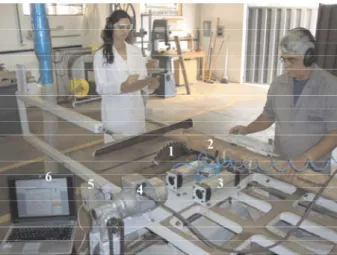
Measurements were taken of feed rates and rotation frequency of the circular saw used by the production unit of V&M Florestal, and cutting speed was then calculated. With these data at hand, an automatic table motion system was devised for the moving circular saw, at the Wood Machining Laboratory (DCF/UFLA) (Figure 1), controlled by a variable frequency drive that stored electrical parameters. The variable frequency drive used was a CFW08 (WEG) model, equipped with a serial communication interface (KSD CFW08), SuperDrive® software.
Figure 1 – Feed rate and cutting speed controlled moving circular saw (DCF/UFLA). 1) circular saw, 2) log section, 3) pneumatic pistons, 4) feed motor, 5) variable frequency drive and 6) computer.
Figura 1 – Serra circular de carrinho (DCF/UFLA), com
Four parameters were acquired simultaneously during the cutting operation, namely: value proportional to rotation frequency (min-1 = RPM), motor output current (Amperes), motor output voltage (Volts) and motor torque (%). Parameter acquisition time was 250 milliseconds, according to the work of Oliveira et al. (2008). To determine specifi c energy, rotation frequency and torque were used.
Once data was collected by the software, log cutting intervals were identifi ed by selecting abruptly ascending/descending torque values alternating with reduced, relatively constant torque ranges, the latter being discarded.
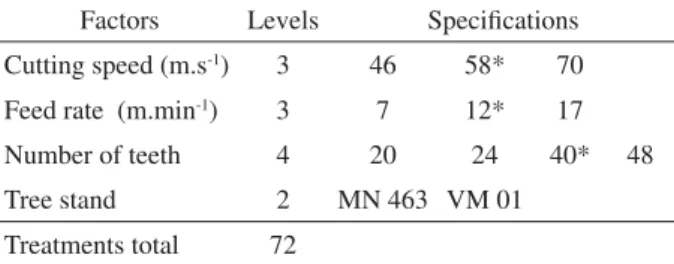
Machining parameters being assessed are described in Table 1. The teeth geometry used was alternate cutting edges. However, for the 40 teeth saw, which is similar to the saw used by V&M Florestal, two successive alternating teeth were used, one trapezoidal and one fl at.
Table 1 – Levels and specifi cations of machining parameters used.
Tabela 1 – Níveis e especifi cações dos parâmetros de usinagem
adotados.
Factors Levels Specifi cations Cutting speed (m.s-1) 3 46 58* 70 Feed rate (m.min-1) 3 7 12* 17
Number of teeth 4 20 24 40* 48
Tree stand 2 MN 463 VM 01
Treatments total 72
*Machining conditions at V&M Florestal
To calculate the specifi c energy consumption of each treatment, Equations 1, 2 and 3 were used.
(1)
Power = cutting power (kW); T = torque (kgf.m);
n = rotation (min-1 = rpm).
(2) E = energy (kJ);
Power = cutting power (kW); D = log diameter (m); Vf = feed rate (m.min-1).
1000 736 0014 . 0 × × × =T n
Power 60 Power D E Vf ⎛ × ⎞ =⎜ ⎟× ⎝ ⎠ (3)
Es = specifi c energy (kJ.cm-3); E = energy (kJ);
D = average log diameter (cm); k = tooth thickness (cm).
The experiment was set up using a completely randomized design with a 3 x 3 x 4 x 2 factorial arrangement (cutting speed x feed rate x number of teeth x tree stand), with 20 replicates. Data were subjected to analysis of variance and means were compared by the Tukey test at the 5% signifi cance level.
3 RESULTS AND DISCUSSION
Results showed that a cutting speed of 70 m.s-1 produced a higher overall mean (4.84 x 10⁻² kJ.cm-3) of specifi c energy consumption whereas a cutting speed of 58 m.s-1 produced a lower mean (4.16 x 10⁻² kJ.cm-3). In both stands there was a tendency for the specifi c cutting energy consumption to decrease with increasing feed rates. With increasing cutting speeds, on the other hand, there was a tendency for specifi c energy consumption to increase. High cutting speeds are associated with higher rotation frequency values, consequently increasing the cutting power requirements (Equations 1, 2 and 3). In a study on specifi c energy consumption at different cutting speeds for aluminum and steel, Rodrigues and Coelho (2007) found that specifi c energy consumption decreased with increasing cutting speeds. The authors reported that facilitated metal ductility and chip formation was due to the temperature rise during the cutting procedure. Owing to its insulating properties, wood does not favor substantial temperature rises.
The analysis of variance (Table 2) showed that main effects and their relevant interactions were signifi cant, and factors are interdependent. The breakdown of cutting speed at each level of feed rate, number of teeth and tree stand was done by multiple comparisons at the 5% signifi cance level, by the Tukey test.
Table 2 – Analysis of variance summary for specifi c cutting energy consumption concerning Eucalyptus sp. stands MN 463 and VM 01, as a function of cutting speed, feed rate, number of teeth, stand and respective double, triple and quadruple interactions.
Tabela 2 – Resumo da análise de variância para o consumo da
energia específi ca de corte da madeira dos clones de Eucalyptus sp. MN 463 e VM 01, em função das velocidades de corte, velocidade de avanço, número de dente, clone e suas respectivas interações duplas, triplas e quádruplas.
Source Degree of Freedom Mean Square
Cutting speed (Vc) 2 0.006320*
Feed rate (Vf) 2 0.163665*
Number of teeth (Z) 3 0.024844*
Tree stand 1 0.003921*
Vc x Vf 4 0.006710*
Vc x Z 6 0.004246*
Vc x Tree stand 2 0.016456*
Vf x Z 6 0.002986*
Vf x Tree stand 2 0.000153*
Z x Tree stand 3 0.006511*
Vc x Vf x Z 12 0.002190*
Vc x Vf x Tree stand 4 0.008087*
Vf x Z x Tree stand 6 0.001025*
Vc x Vf x Z x Tree stand 12 0.002823*
Error 1374 0.000038
Corrected Total 1799
* – signifi cant at the 5% signifi cance level; overall mean = 0.044238; coeffi cient of variation = 13.98%.
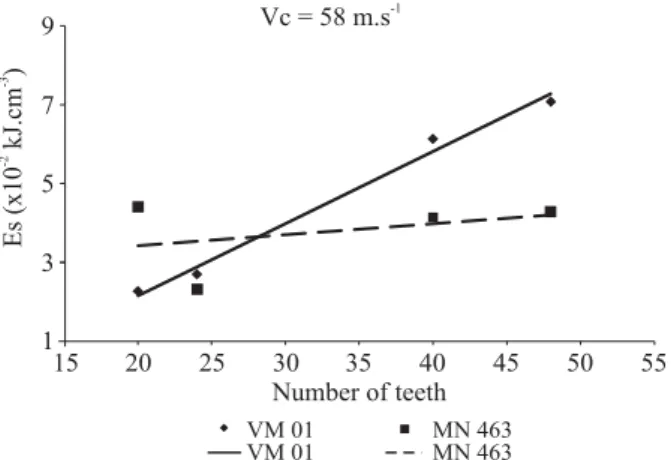
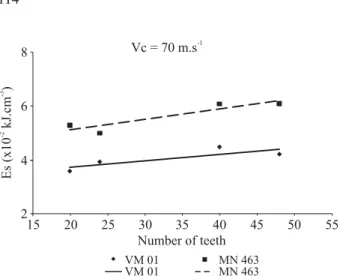
There was a tendency for specifi c cutting energy consumption to increase as a function of increasing number of teeth, in both stands (Figures 2, 3 and 4). Overall, the 40 teeth and 48 teeth circular saws produced higher values of specifi c cutting energy consumption (5.11 and 5.16 x 10⁻² kJ.cm-3 respectively), not differing statistically. On average, the 24 teeth circular saw produced lower values
of specifi c energy consumption (3.57 x 10⁻² kJ.cm-3). A larger number of teeth could infer wood scraping rather than cutting when interacting with the cutting speeds and feed rates being studied, consequently causing more energy consumption.
Figure 2 – Specifi c energy consumption tendency for Eucalyptus sp. stands MN 463 and VM 01 as a function of number of teeth, with a feed rate of 7 m.min-1.
Figura 2 – Tendência do consumo de energia específi ca de
corte para os clones de Eucalyptus sp. MN 463 e VM 01 em função do número de dentes para a velocidade de avanço de 7 m.min-1.
Figure 3 – Specifi c energy consumption tendency for Eucalyptus sp. stands MN 463 and VM 01 as a function of number of teeth, with a feed rate of 12 m.min-1.
Figura 3 – Tendência do consumo de energia específi ca de
Figure 4 – Specifi c energy consumption tendency for Eucalyptus sp. stands MN 463 and VM 01 as a function of number of teeth, with a feed rate of 17 m.min-1.
Figura 4 – Tendência do consumo de energia específi ca de corte
para os clones de Eucalyptus sp. MN 463 e VM 01 em função do número de dentes para a velocidade de avanço de 17 m.min-1.
When cutting the wood from stand MN 463, the 40 teeth and the 48 teeth circular saws produced overall higher mean values of specifi c energy consumption, 5.04 and 4.95 x 10⁻² kJ.cm-3 respectively, though these values did not differ statistically. The 24 alternate teeth circular saw produced the lowest mean value of specifi c cutting energy consumption, 3.76 x 10⁻² kJ.cm-3.
With wood from stand MN 463, using a feed rate of 7 m.min-1, a 40 teeth circular saw (alternate fl at and trapezoidal teeth) and a cutting speed of 70 m.s-1 resulted in the highest value of specifi c cutting energy consumption, 9.02 x 10⁻² kJ. cm-3. The lowest value of specifi c energy consumption (1.88 x 10⁻² kJ.cm-3) was produced when using a feed rate of 17 m.min-1, a 24 alternate teeth circular saw and a cutting speed of 46 m.s-1.
With wood from stand VM 01, the 48 teeth saw produced a higher mean value of specifi c cutting energy consumption (5.38 x 10⁻¹ kJ.cm-3). The 20 alternate teeth saw produced a lower mean value of energy consumption (3.11 x 10⁻² kJ.cm-3).
The highest value of specific cutting energy consumption (11.52 x 10⁻² kJ.cm-3) for stand VM 01 was observed when using a feed rate of 7 m.min-1, a 48 alternate teeth circular saw and a cutting speed of 58 m.s-1. The use of a feed rate of 17 m.min-1, a 20 alternate teeth saw and a speed of 46 m.s-1 produced the lowest value of specifi c energy consumption, 1.10 x 10⁻² kJ.cm-3.
It was noted that, regardless of stand density, cutting speed and feed rate, there was an increase in specifi c cutting energy consumption with increasing number of teeth being used. Overall analysis of data (Figures 5, 6 and 7) revealed
that stand MN 463 (0.514 g.cm-3) showed more specifi c energy consumption in comparison to stand VM 01 (0.574 g.cm-3), with mean values of specifi c energy consumption at 4.59 and 4.26 x 10⁻² kJ.cm-3 respectively. The stand with higher numerical value of density showed less specifi c cutting energy consumption, disputing literature in general. However, analyses of variance of moisture (Table 3) and basic density (Table 4) of logs from stands MN 463 and VM 01 reveal statistical similarity for these variables, ruling out the possibility of inferring that the wood from stand VM 01 is denser.
Figure 5 – Specifi c energy consumption tendency for Eucalyptus sp. stands MN 463 and VM 01 as a function of number of teeth, for a cutting speed of 46 m.s-1.
Figura 5 – Tendência do consumo de energia específi ca de corte
para os clones de Eucalyptus sp. MN 463 e VM 01 em função do número de dentes para a velocidade de corte de 46 m.s-1.
Figure 6 – Specifi c energy consumption tendency for Eucalyptus sp. stands MN 463 and VM 01 as a function of number of teeth, for a cutting speed of 58 m.s-1.
Figura 6 – Tendência do consumo de energia específi ca de corte
Figure 7 – Specifi c cutting energy consumption tendency for Eucalyptus sp. stands MN 463 and VM 01 as a function of number of teeth, for a cutting speed of 70 m.s-1.
Figura 7 – Tendência do consumo de energia específi ca de corte
para os clones de Eucalyptus sp. MN 463 e VM 01 em função do número de dentes para a velocidade de corte de 70 m.s-1.
Table 3 – Analysis of variance summary for unseasoned woods from Eucalyptus sp. stands MN 463 and VM 01, as a function of moisture.
Tabela 3 – Resumo da análise de variância das madeiras
denominadas verdes, para os clones de Eucalyptus sp. MN 463 e VM 01, em função da umidade.
Source Degree of Freedom Mean Square
Tree stands 1 229.336806n.s
Error 70 141.709853
Corrected Total 71
Overall mean = 73.0930556; Coeffi cient of variation = 16.29%. ns – nonsignifi cant at the 5% signifi cance level.
Table 4 – Analysis of variance summary for wood from Eucalyptus sp. stands MN 463 and VM 01, as a function of basic density.
Tabela 4 – Resumo da análise de variância da madeira dos clones
de Eucalyptus sp. MN 463 e VM 01, em função da densidade básica.
Source Degree of Freedom Mean Square
Tree stands 1 0.375000ns
Error 4 0.125000
Corrected Total 5
Overall mean = 0.7500000; Coeffi cient of variation = 47.14%. ns – nonsignifi cant at the 5% signifi cance level.
These values correspond to an average increase of 7.7% in energy consumption to cut wood from stand MN 463.
4 CONCLUSIONS
From analyses performed on stands MN 463 and VM 01, including cutting speeds, feed rates, number of teeth and teeth geometry of circular saws, the following conclusions were drawn:
- higher cutting speeds and lower feed rates demanded more specifi c cutting energy consumption;
- the 40 teeth circular saw with alternate trapezoidal and fl at teeth demanded more specifi c cutting energy consumption, thus being unsuitable for the cut in question;
- the interaction of a cutting speed of 46 m.s-1, a feed rate of 17 m.min-1 and a 24 alternate teeth circular saw showed better results of specific cutting energy consumption for unseasoned wood from stand MN 463;
- the interaction of a cutting speed of 46 m.s-1, a feed rate of 17 m.min-1 and a 20 alternate teeth circular saw demanded less specifi c cutting energy consumption for unseasoned wood from stand VM 01;
- unseasoned wood from stand MN463 demanded more specifi c cutting energy in comparison to unseasoned wood from stand VM 01, despite them being statistically similar.
5 ACKNOWLEDGMENTS
The authors wish to thank V&M Florestal, Kampmann do Brasil Ltda. and CIRAD/France.
6 REFERENCES
ASSOCIAÇÃO MINEIRA DE SILVICULTURA. Anuário estatístico 2009. Disponível em <http://www.silviminas.com. br/>. Acesso em: 9 jul. 2009.
BROWN, N. C.; BETHEL, J. S. La industria maderera. México: Limusa, 1975. 388 p.
CAMPANA, S. Racionalização do uso da energia elétrica em sistemas de irrigação tipos pivô central e aspersão convencional. 2000. 108 p. Dissertação (Mestrado em Engenharia Agrícola) – Universidade Federal de Viçosa, Viçosa, 2000.
ERSOY, A.; ATICI, U. Performance characteristics of circular diamond saws in cutting of different type of rocks. Diamond and Related Materials, v. 13, p. 22-37, Jan. 2004.
HANSON, B.; WEIGAND, C.; ORLOFF, S. Performance of electric irrigation pumping plants using variable frequency drives. Journal of Irrigation and Drainage Engineering, New York, v. 122, n. 3, p. 179-82, May/June 1996.
KOLLMANN, F. F. P.; CÔTE JÚNIOR, W. A. Principles of wood science and technology. New York: [s.n.], 1968. v. 1, 592 p.
NÉRI, A. C.; GONÇALVES, R.; HERNANDEZ, R. E. Forças de corte ortogonal 90-0 em três espécies de madeira de eucalipto. Revista Brasileira de Engenharia Agrícola e Ambiental, Campina Grande, v. 3, n. 2, p. 239-244, 1999.
OLIVEIRA, G. M. V.; SILVA, J. R. M.; MARTINS, M. Medição de ângulos básicos de corte em serras de disco de processamento da madeira e derivados. In: ENCONTRO BRASILEIRO EM MADEIRA E ESTRUTURAS DE MADEIRA-EBRAMEM, 11., 2008, Londrina. Anais... Londrina, 2008. CD-ROM.
RODRIGUES, A. R.; COELHO, R. T. Infl uence of the tool edge geometry on specifi c cutting energy at high-speed cutting. Journal of the Brazilian Society of Mechanical Sciences and Engineering, v. 29, p. 279-283, 2007.
SIMÃO, E. B.; ALMEIDA NETO, M. F. Rendimento do conjunto inversor/motor de indução sob diferentes condições de carga. Goiânia: UFG, 2002. Projeto fi nal de curso.