AMTD
8, 3571–3603, 2015Refraction angles from inversion of
dilution
D. Fussen et al.
Title Page
Abstract Introduction
Conclusions References
Tables Figures
◭ ◮
◭ ◮
Back Close
Full Screen / Esc
Printer-friendly Version Interactive Discussion
Discussion
P
a
per
|
Discussion
P
a
per
|
Discussion
P
a
per
|
Discussion
P
a
per
|
Atmos. Meas. Tech. Discuss., 8, 3571–3603, 2015 www.atmos-meas-tech-discuss.net/8/3571/2015/ doi:10.5194/amtd-8-3571-2015
© Author(s) 2015. CC Attribution 3.0 License.
This discussion paper is/has been under review for the journal Atmospheric Measurement Techniques (AMT). Please refer to the corresponding final paper in AMT if available.
Retrieval of vertical profiles of
atmospheric refraction angles by
inversion of optical dilution
measurements
D. Fussen, C. Tétard, E. Dekemper, D. Pieroux, N. Mateshvili, F. Vanhellemont, G. Franssens, and P. Demoulin
Belgian Institute for Space Aeronomy, 3, Avenue Circulaire, 1180 Brussels, Belgium
Received: 22 January 2015 – Accepted: 4 March 2015 – Published: 2 April 2015
Correspondence to: D. Fussen ([email protected])
AMTD
8, 3571–3603, 2015Refraction angles from inversion of
dilution
D. Fussen et al.
Title Page
Abstract Introduction
Conclusions References
Tables Figures
◭ ◮
◭ ◮
Back Close
Full Screen / Esc
Printer-friendly Version Interactive Discussion
Discussion
P
a
per
|
Discussion
P
a
per
|
Discussion
P
a
per
|
Discussion
P
a
per
|
Abstract
In this paper, we show how the usual change of tangent altitude associated with at-mospheric refraction is inseparably connected to a variation of the observed apparent intensity, for extended and pointlike sources. We demonstrate, in the regime of weak refraction angles, that atmospheric optical dilution and image deformation are strictly
5
concomitant. The approach leads to the integration of a simple differential equation re-lated to the observed transmittance in the absence of other absorbing molecules along the optical path. We successfully applied the proposed method to the measurements performed by two past occultation experiments: GOMOS for stellar and ORA for solar occultations. The developed algorithm (named ARID) will be applied to the imaging of
10
solar occultations in a forthcoming pico-satellite mission.
1 Introduction
In the terrestrial and planetary atmospheres, electromagnetic waves generally do not propagate along straight lines due to refractivity gradients caused by the vertical vari-ation of the molecular concentrvari-ation. In solar, stellar, planetary and GPS radio
occul-15
tations, an orbiting spectroradiometer in a low Earth orbit (LEO) measures the atmo-spheric transmittance as a function of the tangent altitude of the line-of-sight. Such measurement techniques offer a precious advantage: they are self-calibrating because the observed signal is normalized with respect to the exo-atmospheric signal.
The effect of refraction of stellar light has been used in the past for probing
plane-20
tary atmospheres (see Elliot and Olkin, 1996 and reference therein). Inversion of radio occultation amplitude data were proposed by Sokolovskiy (2000) as a complemen-tary technique to the classical phase inversion. The subject of stellar scintillations is very broad and directly related to the study of atmospheric turbulence (Wheelon, 2001, 2003). Star occultations have been the main technique used by the GOMOS
AMTD
8, 3571–3603, 2015Refraction angles from inversion of
dilution
D. Fussen et al.
Title Page
Abstract Introduction
Conclusions References
Tables Figures
◭ ◮
◭ ◮
Back Close
Full Screen / Esc
Printer-friendly Version Interactive Discussion
Discussion
P
a
per
|
Discussion
P
a
per
|
Discussion
P
a
per
|
Discussion
P
a
per
|
ment and allowed the reconstruction of atmospheric irregularities in air density and temperature profiles (see Kan et al., 2014, and reference therein).
The refractive optical dilution (i.e. light extinction caused by atmospheric refraction) observed during Sun occultations has been considered by Miller (1967) for a rocket flight operated by the Meteorological Office, however without presenting a solution to
5
invert the angular integration across the solar disk. More recently, high precision refrac-tion measurements obtained by solar imaging were recorded by the SOFIE instrument (Gordley et al., 2009) onboard the AIM satellite. They proposed an elegant method to relate the apparent Sun image flattening to the refraction angles characterizing the tangent rays emitted from the solar disk edges.
10
In this paper, we focus on the exploitation of the global radiative dilution experienced by light when crossing the Earth’s atmospheric layers. We present an original method to retrieve the refraction angle profile from the integration of a simple differential equation, defining the ARID algorithm (Atmospheric Refraction by Inversion of Dilution). In a re-cent past, our team (Dekemper et al., 2013) published a method dedicated to pressure
15
profile retrievals by analysis of Sun refraction based on the use of Zernike polynomials. In the same sense, the ARID method relies only on the first Zernike moment (i.e. the total intensity) thus it can also be used for pointlike sources as stars or GPS satellites. Furthermore, the refraction profile is integrated downward from the highest considered altitude, allowing the sounding of the upper atmospheric layers where refraction is very
20
weak.
In the first section, we recall the elementary principles of atmospheric refraction and we simplify the geometrical problem by defining the useful phase screen approximation. In the second section, we derive several interrelated effects of atmospheric refraction and we show the concomitance of image flattening, shift of the apparent tangent
al-25
AMTD
8, 3571–3603, 2015Refraction angles from inversion of
dilution
D. Fussen et al.
Title Page
Abstract Introduction
Conclusions References
Tables Figures
◭ ◮
◭ ◮
Back Close
Full Screen / Esc
Printer-friendly Version Interactive Discussion
Discussion
P
a
per
|
Discussion
P
a
per
|
Discussion
P
a
per
|
Discussion
P
a
per
|
recorded by the ORA instrument and we demonstrate the possibility of directly using the Sun transmittance to retrieve the refraction angle profile, although the problem is more complicated due to the angular extension of the solar disk. In the last section we draw conclusions on the capacity of the proposed algorithm and the associated requirements.
5
We deliberately don’t consider electromagnetic scintillation and fast amplitude fluc-tuations superimposed on signals that travel through a turbulent atmosphere and that can be measured by using fast photometers (Wheelon, 2001). Instead we will concen-trate on the low frequency signal extinction caused by refractive dilution. In order to limit the scope of this study, we focus on the retrieval of the profiles of refracted angles.
10
The vertical inversion techniques coupled to the use of the hydrostatic hypothesis have been extensively studied elsewhere (Hajj et al., 2002).
2 Atmospheric refraction and phase screen approximation
Assuming that the Fermat’s principle can be used to describe the atmospheric prop-agation of electromagnetic radiation in the optical domain (Born and Wolf, 1950), it
15
can be shown that the position vectorr of a light ray obeys the following equation with respect to the infinitesimal length element ds:
d ds
n(r)dr ds
=∇n(r) (1)
where the Cartesian reference frame is located at the center of a sphere that locally approximates the Earth geoid. Furthermore, the refraction index n(r) possesses the
20
AMTD
8, 3571–3603, 2015Refraction angles from inversion of
dilution
D. Fussen et al.
Title Page
Abstract Introduction
Conclusions References
Tables Figures
◭ ◮
◭ ◮
Back Close
Full Screen / Esc
Printer-friendly Version Interactive Discussion
Discussion
P
a
per
|
Discussion
P
a
per
|
Discussion
P
a
per
|
Discussion
P
a
per
|
a central force:
n(rt)rt=b (2)
wherert is the radial distance to the point of closest approach or turning point andbis the impact parameter of the emitted light ray. The ray trajectory is clearly symmetrical with respect to the turning point and the total refraction angleα, defined with respect
5
to the incident direction, can be calculated as:
α=2
∞
Z
rt dα
drdr =2
∞
Z
rt 1
n(r) dn(r)
dr
b
p
n(r)2r2−b2
dr (3)
It is important to realize that the most important contribution to α comes from the region around the turning point rt, i.e. at low grazing altitudes. Notice that rays are bent toward the higher density regions implying thatα≤0. If we defineu=n(r)r and
10
f(b)=−α/2πb, we can identify the inverse Abel transform (Bracewell, 1965) of the refractive index:
f(b)=−1
π
∞
Z
b
ln′(n(u))
p
u2−b2
du (4)
It is therefore possible to retrieve a vertical profile of refractive index by using the inverse transform:
15
n(u)=exp
−
1
π
∞
Z
u
α(b)
p
b2−u2 db
(5)
The refractive indexn(r) is in good approximation related to the refractivityν(r) by
n(r)=1+ν(r)=1+C(λ)ρ(r)
ρ0
AMTD
8, 3571–3603, 2015Refraction angles from inversion of
dilution
D. Fussen et al.
Title Page
Abstract Introduction
Conclusions References
Tables Figures
◭ ◮
◭ ◮
Back Close
Full Screen / Esc
Printer-friendly Version Interactive Discussion
Discussion
P
a
per
|
Discussion
P
a
per
|
Discussion
P
a
per
|
Discussion
P
a
per
|
whereρ0 is the reference atmospheric density in standard conditions. A slight wave-length dependence exists forC(λ) according to the following parameterization (Edlen, 1966):
C(λ)=10−88342.13+(2 406 030./(130−(1./λ2)))
+15 997./(38.9−(1./λ2)) (7)
whereλis expressed in micrometers. It is a good approximation to consider a locally
5
isothermal exponential atmosphere. WithHtthe atmospheric scale height at the turning point, the refractivity is given by:
ν(r)≃νtexp
−r−rt
Ht
(8)
Keeping in mind that the refractivityνtis a small quantity and that the ratiort/Htis large, we obtain the simple analytical approximation forα:
10
α≃ −νt
s
2πrt
Ht
(9)
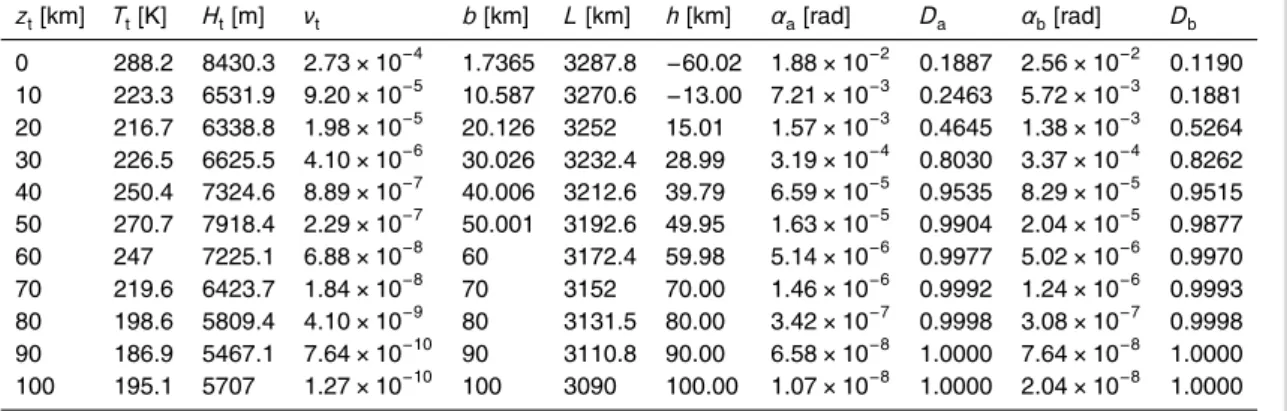
and we give in Table 1 the values computed for a standard atmosphere.
It is worth noting that the effective distanceseover which most of the refraction takes place can be estimated as the path length necessary to experience a characteristic change ofHt in the local altitude. We get:
15
se≃
q
2rtHt≃300 km (10)
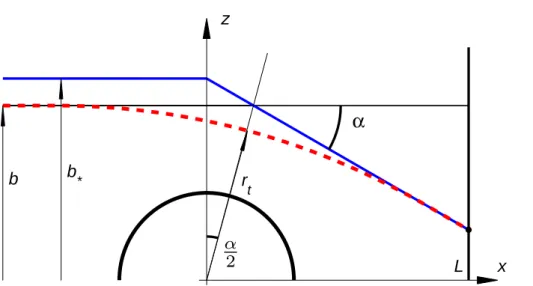
Considering that Eq. (3) leads to solutions with two asymptotes (straight lines be-fore entering and after exiting the atmosphere) and that we are working in a regime of weak refraction (|α| ≪1), it is legitimate to introduce the so-called “phase screen” approximation (Wheelon, 2003) that is illustrated in Fig. 1.
AMTD
8, 3571–3603, 2015Refraction angles from inversion of
dilution
D. Fussen et al.
Title Page
Abstract Introduction
Conclusions References
Tables Figures
◭ ◮
◭ ◮
Back Close
Full Screen / Esc
Printer-friendly Version Interactive Discussion
Discussion
P
a
per
|
Discussion
P
a
per
|
Discussion
P
a
per
|
Discussion
P
a
per
|
In the phase screen approximation, the refraction occurs through an equivalent in-finitesimal atmosphere reduced to a vertical plane at the considered geolocation. The turning point position is moved horizontally byrttan α/2
≃bα/2, in the backward di-rection, a negligible quantity with respect to se. Along the vertical, the turning point is displaced upward by about bα2/2 (a value smaller than the Fresnel length for
5
b≥30 km), and the impact parameter b∗ can in the phase screen approximation be considered as virtually identical tob. Furthermore, the small magnitude of the refrac-tion angle allows for the usual trigonometric approximarefrac-tion:
tan (α)≃α (11)
3 From refraction to dilution
10
Atmospheric refraction is usually considered in the context of ray tracing because the most apparent effect is a shift in the apparent tangent height of any ray emitted by a distant light source. Furthermore, in this section we are going to demonstrate that this change in position must correspond to an equivalent change in the measured spectral irradiance at the receiver.
15
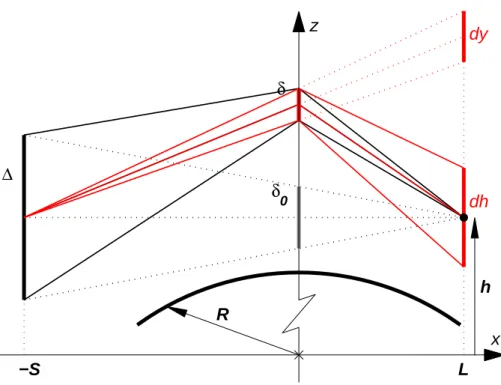
In Fig. 2, we consider a bi-dimensional approach of the problem for an extended light source like the Sun. We also assume the following approximations: the horizontal gradients of the refractive index (i.e. of the atmospheric air density) can be neglected around the turning point and the distance from a LEO satellite to the limb is about
L≃3000 km, much closer than the distance at which some refracted rays will cross
20
the optical axis containing the center of the Earth of radius R. Indeed, the maximal refraction angleαm(for a grazing ray) is about 0.02 radians and leads to a focal length ofLm≃R/αm≃3×10
5 km.
The angular extension of the solar disk (≃0.0093 rad) is spanned by its diameter∆
located at a distance (L+S) from the satellite. Without refraction, the tangent heighth
25
AMTD
8, 3571–3603, 2015Refraction angles from inversion of
dilution
D. Fussen et al.
Title Page
Abstract Introduction
Conclusions References
Tables Figures
◭ ◮
◭ ◮
Back Close
Full Screen / Esc
Printer-friendly Version Interactive Discussion
Discussion
P
a
per
|
Discussion
P
a
per
|
Discussion
P
a
per
|
Discussion
P
a
per
|
Any ray emitted from the Sun at altitudezpropagates as a straight line with slopeβ
until it is refracted inx=0 at altitudez′. The exiting ray, with slopeβ′, is detected at
Lby the satellite sensor. Notice thatβ′ is a priori unknown: it is necessary to use an imager with a high vertical resolution compatible with the small refraction angle but the satellite pointing and stability knowledges have to meet the same requirements. We
5
have the simple relations:
β′(z)=β(z)+α(z′) (12)
z′=z+Sβ (13)
h=z′+Lβ′ (14)
Depending on the true altitude dependence of the refractivity profile ν(z′), the
sys-10
tem of Eqs. (12)–(14) does not possess a general analytical solution and must be solved iteratively (an “exact” ray tracing solution would lead to the numerical solution of a boundary value problem for the differential Eq. 1). However, it is reasonable to linearize the profile of refracted angles aroundz′as:
α(z′)≃α0+α1z′ (15)
15
whereα0≤0 andα1≥0 for an exponentially decreasing density profile. By elementary algebra, one gets the correct slopeβ(z) under which the Sun ray is emitted to hit the sensor:
β=h−(1+α1L)z−Lα0
L+S+LSα1
(16)
If there was no refraction, the solar disk would span a vertical domainδ0 (of about
20
28 km) atx=0:
δ0=
L∆
AMTD
8, 3571–3603, 2015Refraction angles from inversion of
dilution
D. Fussen et al.
Title Page
Abstract Introduction
Conclusions References
Tables Figures
◭ ◮
◭ ◮
Back Close
Full Screen / Esc
Printer-friendly Version Interactive Discussion
Discussion
P
a
per
|
Discussion
P
a
per
|
Discussion
P
a
per
|
Discussion
P
a
per
|
whereas we obtain the angular size of the refracted Sun by using Eqs. (13) and (16):
δ= L∆
L+S+LSα1
(18)
We conclude that atmospheric refraction leads to two effects:
– The image of the light source is displaced by a a positive elevation with respect to the unrefracted tangent altitude, leading to a non-negligible bias for the retrieval of
5
the vertical concentration profile of any remotely sensed trace gas. In particular, the center of the Sun is shifted upward by:
z′(h)−h=−LS(α0+α1h)
L+S+LSα1
(19)
– The atmosphere acts as a diverging lens and produces a smaller and real image of the Sun. The compression factorDis obtained from Eqs. (17) and (18):
10
D= δ
δ0
= L+S
L+S+LSα1
(20)
As observed from the sensor side and assuming for the moment a constant brightness of the source and the image, the radiometric signal will be proportional to the solid angle subtending the Sun image and hence reduced by the same factor D. This is a third effect of refraction, a decrease of the reference signal, that must be taken into account
15
for the computation of atmospheric transmittance in occultation experiments. We call this effect “dilution” of the incoming irradiance according to the formalism presented in the following paragraph.
In some circumstances (typically when observing stars or planets), the angular size of the light source object is below the optical resolution and the concept of image
20
AMTD
8, 3571–3603, 2015Refraction angles from inversion of
dilution
D. Fussen et al.
Title Page
Abstract Introduction
Conclusions References
Tables Figures
◭ ◮
◭ ◮
Back Close
Full Screen / Esc
Printer-friendly Version Interactive Discussion
Discussion
P
a
per
|
Discussion
P
a
per
|
Discussion
P
a
per
|
Discussion
P
a
per
|
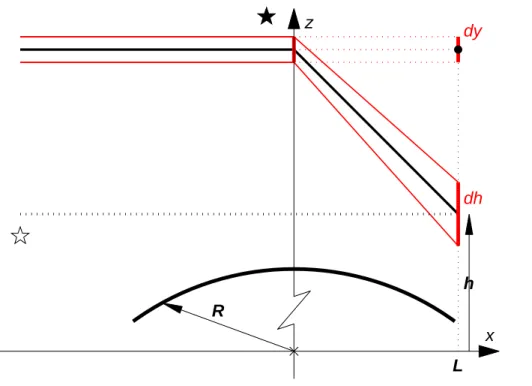
understand the dilution effect by reasoning on the refraction of a pencil of rays emitted from the Sun’s surface and passing through the position of the refracted image atx=0 (see Fig. 2). In the absence of atmosphere, the radiative energy contained in this pencil would have hit the phase screen aty, illuminating an infinitesimal element dy. Clearly, we get:
5
z′−h S =
y−h
L+S (21)
and
dy=L+S
S dz
′ (22)
When atmospheric refraction is “switched on”, the same pencil (hence the same amount of energy) will reach the detector at altitudeh. When differentiating Eq. (14) for
10
zfixed (dz=0), we get:
dh=(L+S+LSα1)
S dz
′ (23)
By conservation of energy, the observed irradiance is inversely proportional to the ratio of the infinitesimal elements on which the light is spread. It follows that
dy
dh =
1
1+LSα1
L+S
=D (24)
15
AMTD
8, 3571–3603, 2015Refraction angles from inversion of
dilution
D. Fussen et al.
Title Page
Abstract Introduction
Conclusions References
Tables Figures
◭ ◮
◭ ◮
Back Close
Full Screen / Esc
Printer-friendly Version Interactive Discussion
Discussion
P
a
per
|
Discussion
P
a
per
|
Discussion
P
a
per
|
Discussion
P
a
per
|
altitude change (b≥h) and the radiative dilution (D≤1). For star, planetary and GSS occultations in the phase screen approximation, we simply get:
h=b+α(b)L (25)
D= 1
1+Lα1
(26)
Even if the quantityα1is small, one has to notice the amplification effect by the distance
5
to the limbLand there is no difficulty to alter the last equation for the general cases of
α1=α1(b) andD=D(b):
D(b)= 1
1+Lddαb (27)
We want to emphasize here that the usual measurement of refraction by measur-ing the angular displacement fromh to b (for pointlike source) or the image
flatten-10
ing (Gordley et al., 2009) can be EQUIVALENTLY replaced by a transmittance mea-surement, i.e.D(b), taking into account other potential extinction mechanisms. Indeed, Eq. (27) may be re-written to obtain the following differential equation:
dα
db =
1
L
1
D(b)−1
(28)
It is therefore possible to integrate Eq. (28) with boundary condition α(∞)=0 to
re-15
trieve the profile of refracted angles. A small difficulty subsists because b is a priori unknown as it is determined byα itself. However, Eq. (25) is easily invertible and we also get:
D(h)=db
dh=1−L
dα
AMTD
8, 3571–3603, 2015Refraction angles from inversion of
dilution
D. Fussen et al.
Title Page
Abstract Introduction
Conclusions References
Tables Figures
◭ ◮
◭ ◮
Back Close
Full Screen / Esc
Printer-friendly Version Interactive Discussion
Discussion
P
a
per
|
Discussion
P
a
per
|
Discussion
P
a
per
|
Discussion
P
a
per
|
and the corresponding differential equation with the unrefracted tangent altitude as the independent variable:
dα
dh =
1
L(1−D(h)) (30)
4 Application to star occultations by the GOMOS instrument
4.1 GOMOS intruments
5
The GOMOS stellar occultation instrument has been extensively described elsewhere (e.g., Bertaux et al., 2010). Shortly, GOMOS was embarked on board the ENVISAT platform launched in 2002 in a heliosynchronous circular orbit at an altitude of 800 km. After 10 years of operation, more than 860 000 measurements have been carried out. GOMOS is a UV-visible-NIR spectrometer aimed at monitoring the vertical
concentra-10
tion profiles of minor atmospheric constituents such as O3or NO2. Each spectral trans-mittance is obtained by dividing the measurements made through the atmosphere by the reference one performed outside the atmosphere. It is also equipped with an accu-rate pointing system required to track efficiently the setting star during the occultation. This mechanism consists of a plane mirror controlled by a steering front assembly
15
(SFA) and driven by a fast Star Acquisition and Tracking Unit (SATU).
The GOMOS measurements are sensitive to atmospheric scintillations caused by atmospheric turbulence. To demodulate the amplitude fluctuations, two fast photome-ters have been added to measure simultaneously the star intensities in two spectral channels centered in the blue (500 nm) and in the red (672 nm). It turned out that this
20
correction is almost perfect when the star sets along the orbital plane but does not work properly for very oblique occultations due to the presence of residual scintilla-tion caused by horizontal turbulent structures. Photometer data have also been used to investigate atmospheric turbulence (Kan et al., 2014) and to derive high resolution temperature profiles (Dalaudier et al., 2006) from the time delay induced by chromatic
AMTD
8, 3571–3603, 2015Refraction angles from inversion of
dilution
D. Fussen et al.
Title Page
Abstract Introduction
Conclusions References
Tables Figures
◭ ◮
◭ ◮
Back Close
Full Screen / Esc
Printer-friendly Version Interactive Discussion
Discussion
P
a
per
|
Discussion
P
a
per
|
Discussion
P
a
per
|
Discussion
P
a
per
|
refraction. Here we focus on the low frequency part of the refractive effects by showing how to apply the ARID algorithm to the photometer data for the retrieval of refractive angle profiles.
4.2 Processing of GOMOS photometers data
During GOMOS occultations, a part of the incoming star light is routed toward the
5
fast photometers. They measure the stellar intensities with a high sampling frequency (1 kHz) in limited wavelength bandwidths (50 nm). During one spectrometer acquisi-tion (0.5 s), the photometers record 500 stellar intensity values, from which we extract a transmittance profileT(h) as:
T(h)=Is(h)
Ir
(31)
10
whereIs(h) is the signal of the photometer smoothed with a Hanning filter to remove the fluctuations due to atmospheric scintillation and Ir is the exo-atmospheric refer-ence signal of the star computed from the median of all measurements with a tangent altitude greater than 105 km. The left panel of Fig. 4 shows a typical intensity signal measured by the red photometer, together with its smoothed version. One can notice
15
some oscillations observed at higher tangent altitudes (above 50 km) that are strongly correlated with the measurements of the SATU angle needed to keep the image of the setting star in the center of the CCD detectors.
In the following example, we have used only the measurements of the red photome-ters to minimize the impact of optical extinction due to Rayleigh scattering, and ozone
20
and nitrogen dioxide absorptions. The NO2absorption slant path optical thicknessδNO2 at 30 km in the red channel is aboutδNO2(672 nm)≃1.2×10−
3
AMTD
8, 3571–3603, 2015Refraction angles from inversion of
dilution
D. Fussen et al.
Title Page
Abstract Introduction
Conclusions References
Tables Figures
◭ ◮
◭ ◮
Back Close
Full Screen / Esc
Printer-friendly Version Interactive Discussion
Discussion
P
a
per
|
Discussion
P
a
per
|
Discussion
P
a
per
|
Discussion
P
a
per
|
Therefore, the transmittanceTm(h) deduced from the red photometer measurement at each tangent altitudehcan be expressed simply as:
Tm(h)=D(h)TR(h)TO3(h) (32)
whereDrepresents the contribution of the refractive dilutionTR, the Rayleigh scattering andTO3 the ozone absorption. From Eq. (30) we obtain the following expression:
5
dα
dh =
1
L 1−
Tm(h)
TR(h)TO3(h)
!
(33)
The transmittance TR can be expressed as a function of the air scattering cross-sectionσR, the effective slant path length through the atmosphereLRand the air num-ber densityρ:
TR(h)=exp (−σRρ(h)LR) (34)
10
The following expression forσR(Bodhaine et al., 1999) has been used in this study:
σR= 24π3 λ4ρ2 0
n(λ)2−1
n(λ)2+2
!2
FK (35)
in whichλis the wavelength,ρ0=2.547×10 19
cm−3is the air number density at stan-dard temperature and pressure (T0=288.15 K,P0=1013.25 mb), FK the King factor with a constant value of 1.06 (Lenoble, 1993) andnthe air refractive index. The number
15
densityρ(h) that appears in Eq. (34), can be expressed as a function of the refractivity using Eq. (6) and hence as a function of the refraction angleα(Eq. 9). Finally, we get:
ρ(h)= ρ0
C(λ)|α(h)|
s
Ht 2π(Rt+h)
AMTD
8, 3571–3603, 2015Refraction angles from inversion of
dilution
D. Fussen et al.
Title Page
Abstract Introduction
Conclusions References
Tables Figures
◭ ◮
◭ ◮
Back Close
Full Screen / Esc
Printer-friendly Version Interactive Discussion
Discussion
P
a
per
|
Discussion
P
a
per
|
Discussion
P
a
per
|
Discussion
P
a
per
|
The effective lengthLR of an exponentially decreasing atmosphere can be well ap-proximated by:
LR≃
q
2πRtHt (37)
Finally, using Eqs. (34), (36) and (37) in Eq. (33), we get:
dα
dh =
1
L
1−
Tm(h)
TO3(h) exp
σRρ0
C(λ) α(h)Ht
s
Rt
Rt+h
(38)
5
By numerically integrating this equation, we obtain α(h). One can notice that the scale height Ht is depending on the temperature. In a first iteration, we have used climatological profiles of the scale height to obtain a first evaluation of the refraction angleα0 and of the associated number density and scale height. Then, an additional iteration was performed from these values to verify the convergence of the solution of
10
Eq. (38). In all performed test cases, we observed that the method used is stable and provides profiles of refraction angles that are not dependent on the first guess scale height.
4.3 Results and comparisons
Figure 5 shows the refractive angle derived by the ARID method from the GOMOS
15
red photometer (in red) using measurements from one single occultation observed in July 2002. This vertical occultation (close to the orbital plane) was performed in full dark illumination condition (night). We have also compared the ARID numerical results obtained with the analytical approximation of Eq. (9), showing a fair agreement in the upper atmosphere. Typically, the relative differences decrease with the altitude from
20
almost 20 % at 20 km to a few percents at 90 km.
AMTD
8, 3571–3603, 2015Refraction angles from inversion of
dilution
D. Fussen et al.
Title Page
Abstract Introduction
Conclusions References
Tables Figures
◭ ◮
◭ ◮
Back Close
Full Screen / Esc
Printer-friendly Version Interactive Discussion
Discussion
P
a
per
|
Discussion
P
a
per
|
Discussion
P
a
per
|
Discussion
P
a
per
|
the main mirror is oriented in elevation and in azimuth toward the target star. Then, during the occultation, this orientation is modified to keep the star image in the centers of the detectors. In the GOMOS data, the elevation and azimuth angles are provided as a function of time. For a vertical occultation, the changes in elevation angle are due to the movement of the satellite on its orbit and to the refractive effects. Thus,
5
the refraction angle is simply deduced by subtracting the geometric contribution from the sum of the elevation and SATU angles. Figure 5 also shows the refraction angle deduced from the pointing system, in satisfactory agreement with the values retrieved by using the ARID method and the analytical approximation.
5 Application to solar occultations by the ORA instrument
10
5.1 Refractive dilution of the Sun
In solar occultations from a LEO satellite without any imaging system, the observed transmittance is integrated over the angular size of the Sun, resulting in an apparent loss of vertical resolution for the retrieved vertical refractivity profile. However, this loss is apparent because the sampling rate of measurements is usually large with a strong
15
overlap of the observed solar disks between two successive acquisitions that causes redundance. This redundance does not lead to an ill-conditioned inverse problem be-cause the very large S/N ratio is not limited by the brightness of the source but only by the dynamical scale of the sensor. Still, the inverse problem consists of retrieving a profile of refracted angles from a signal produced by a double integration: one along
20
the optical path and one along the angular range under which the Sun is observed. Assuming the spherical homogeneity of the atmosphere around the geolocation of the measurement (this should be checked with respect to Eq. 10), we can make use of the symmetry of the problem (see Fig. 6). Hereafter we will consider the near-infrared do-main where contributions of O3absorption and Rayleigh scattering may be neglected.
AMTD
8, 3571–3603, 2015Refraction angles from inversion of
dilution
D. Fussen et al.
Title Page
Abstract Introduction
Conclusions References
Tables Figures
◭ ◮
◭ ◮
Back Close
Full Screen / Esc
Printer-friendly Version Interactive Discussion
Discussion
P
a
per
|
Discussion
P
a
per
|
Discussion
P
a
per
|
Discussion
P
a
per
|
We consider that the Sun consists of horizontal slices spanning an angular domain described by the angleθ∈
θb,θt
whereθb=−arctan 2∆S
andθt=−θbrespectively refer to the bottom and top edges of the Sun (Fig. 6). Each slice can be considered with the same refraction geometry if it is associated with the satellite-limb distanceLθ and the unrefracted tangent altitudehθ, whereasLandhrefer to the Sun center.
5
The relation between these quantities is obtained by a rotation matrix as:
Lθ=Lcosθ+hsinθ hθ=−Lsinθ+hcosθ (39)
We can express the total measured transmittanceT(h) as:
T(h)=
θt
Z
θb
G(θ)
1−Lθ dαθ
dhθ
dθ (40)
whereG(θ) is a normalized brightness distribution related to the solar limb darkening
10
and
θt
Z
θb
G(θ) dθ=1 (41)
In this article, we will use the limb darkening parameterization of Neckel, as done by Dekemper et al. (2013). The relative intensity of a slice subtended by angle θ (with respect to the intensity of the same slice if it would have a constant brightness of 1)
15
can be obtained by integrating the solar limb darkening curve along the slice of constant
θ.
The limb darkening parameterization sld(β) is expressed as a function of the cosine of the emission angleβfrom the Sun surface by:
sld(β)=a0+a1cos (β)+a2cos (β)2+a3cos (β)3+a4cos (β)4+a5cos (β)5 (42)
AMTD
8, 3571–3603, 2015Refraction angles from inversion of
dilution
D. Fussen et al.
Title Page
Abstract Introduction
Conclusions References
Tables Figures
◭ ◮
◭ ◮
Back Close
Full Screen / Esc
Printer-friendly Version Interactive Discussion
Discussion
P
a
per
|
Discussion
P
a
per
|
Discussion
P
a
per
|
Discussion
P
a
per
|
where theai and their wavelength dependence are given in Table 2. After integration across the solar disk along the horizontal direction, the brightness distribution is ob-tained as:
G(θ)=8ζ
a0+
πa1 2∆ζ+
8a2 3∆2ζ
2
+3πa3
2∆3 ζ 3
+128a4
15∆4 ζ 4
+5πa5 ∆5 ζ
5
/π∆2Gλ
(43)
with
5
ζ(θ)=
s
∆2
4 −S
2tan2(θ) (44)
and
Gλ=a0+ 2 3a1+
1 2a2+
2 5a3+
1 3a4+
2
7a5 (45)
For the inversion, it is useful to work with the complementary transmittanceTc(h) := 1−T(h). The retrieval of f(θ;h) :=dαθ
dhθ is obtained from a set of m complementary
10
transmittance measurementsTc(hi), recorded at successive nominal tangent altitudes
hi:
Tc(hi)= θt
Z
θb
G(θ)L(θ;hi)f(θ;hi) dθ{i=1. . .m} (46)
5.2 Application to ORA data
The ORA instrument, launched onboard the EUropean REtrievable CArrier (EURECA)
15
AMTD
8, 3571–3603, 2015Refraction angles from inversion of
dilution
D. Fussen et al.
Title Page
Abstract Introduction
Conclusions References
Tables Figures
◭ ◮
◭ ◮
Back Close
Full Screen / Esc
Printer-friendly Version Interactive Discussion
Discussion
P
a
per
|
Discussion
P
a
per
|
Discussion
P
a
per
|
Discussion
P
a
per
|
aerosol extinction vertical profiles in the UV to near IR range by using independent radiometric modules (Arijs et al., 1995).
ORA consisted of eight radiometers of similar design with broadband filters cen-tered at 259, 340, 385, 435, 442, 600, 943, 1013 nm, each containing a quartz window, an interference filter, and a simple optics followed by a photodiode detector. From
Au-5
gust 1992 to May 1993 the instrument measured about 7000 sunrises and sunsets from its quasi-circular orbit at an altitude of 508 km. The near-infrared channel at 1013 nm was mainly dedicated to stratospheric aerosol observations as it is very weakly affected by Rayleigh scattering (see Fig. 7).
The ORA data set has been unfortunately archived with a restricted altitude range
10
and sampling, sufficient for an accurate retrieval of vertical profiles of ozone concentra-tion and of stratospheric aerosol extincconcentra-tion. However, above 50–60 km, a contaminaconcentra-tion by straylight was clearly caused by the very large field of view of the instrument (±2◦). The unavailability of high-altitude measurements to correctly assess the straylight con-tribution forced us to use an empirical straylight removal algorithm above 50 km. This
15
was possible because the smooth signal is produced by a photodiode current mea-surement and virtually free of shotnoise.
The large vertical extension of the solar disk at the geolocation of the occultation caused a strong overlap between successive transmittance measurements. Each ac-quisition combines different Sun slices (corresponding to paraxial rays at different
tan-20
gent altitudes with respect to the Sun center). Therefore a first step was to build a La-grange interpolation matrix to map the set of paraxial rays into a 1 km regular altitude grid. The discretization allows us to re-write Eq. (46) under matrix form:
y=Kf (47)
where the forward model operatorK combines the brightness angular weights G(θ),
25
AMTD
8, 3571–3603, 2015Refraction angles from inversion of
dilution
D. Fussen et al.
Title Page
Abstract Introduction
Conclusions References
Tables Figures
◭ ◮
◭ ◮
Back Close
Full Screen / Esc
Printer-friendly Version Interactive Discussion
Discussion
P
a
per
|
Discussion
P
a
per
|
Discussion
P
a
per
|
Discussion
P
a
per
|
case. Instead, after an appropriate scaling of all factors of Eq. (47), we implemented two numerical methods (Hansen, 1998): a classical Tikhonov regularization TIK (depend-ing on a regularization parameterµ) and a pre-conditioned conjugated gradient method PCG (iterated up to a maximal number of iterationsni). Two selection methods were also inter-compared to select µ or ni: the classical L-corner (LC) method searching
5
for the accuracy/smoothing boundary (Hansen, 1998), and the Durbin–Watson (DW) method (Fussen, 1999; Durbin and Watson, 1950) that tries to minimize the correla-tion between the residuals. After several test cases and although both methods and regularization parameters give close results, the combination PCG/DW was selected because it turned out to be slightly more robust in perturbed cases.
10
Eventually, the retrievedf(h)=ddαh was numerically integrated to obtain the vertical profile of refraction angles.
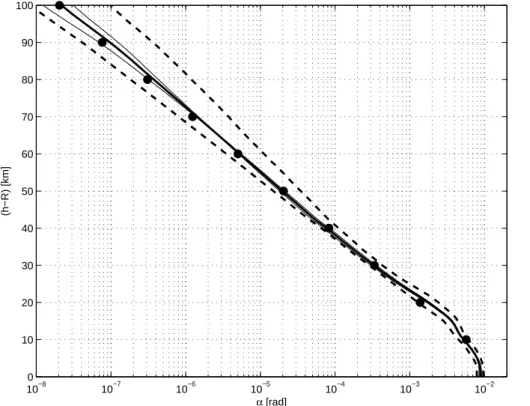
We have processed the full ORA data set (6821 occultations) from which we screened 2836 transmittance profiles that showed the least straylight contamination. The statistical results are presented in Fig. 8. The median vertical profile of refraction
15
angles is in good agreement with values obtained by ray tracing for a US76 atmosphere although the contamination by residual straylight is responsible for an important spread above 40–50 km. The median agreement is about 5 % in the 30–60 km range and 15 % in the 60–100 km range. Below 20–30 km, the absence of cloud screening prevents an accurate assessment. With only 16 bits to code the signal, the digitization error was
20
taken into account and is visible in the upper atmosphere.
It has to be underlined that the ARID method used in solar occultations can produce useful data over 6 orders of magnitude. The quality of the data is strongly related to the possibility of the straylight removal, to the level of pointing stability during the acquisition of the reference radiance and during the occultation (typically 1 min) and to
25
AMTD
8, 3571–3603, 2015Refraction angles from inversion of
dilution
D. Fussen et al.
Title Page
Abstract Introduction
Conclusions References
Tables Figures
◭ ◮
◭ ◮
Back Close
Full Screen / Esc
Printer-friendly Version Interactive Discussion
Discussion
P
a
per
|
Discussion
P
a
per
|
Discussion
P
a
per
|
Discussion
P
a
per
|
6 Conclusions
Geometrical optics is extensively used to describe the propagation of electromagnetic waves through an atmospheric medium. Many studies have been focused on the com-putation and the measurement of amplitude and phase fluctuations induced by a ran-dom medium, reflecting important properties of atmospheric turbulence. However, in
5
this paper, we concentrated on the exploitation of the average refractive bending that is relevant to a ray tracing approach (neglecting diffraction). We demonstrate how at-mospheric refraction is equivalently responsible for a change of the tangent altitude in limb remote sensing geometry and for a change (mostly an attenuation) of the ap-parent radiance of the light source. As occultation measurements are self-calibrating,
10
it is then possible to process the refractive dilution curve to obtain the vertical profile of refraction angles. This is the basis of the ARID method that can be implemented in a very direct way for punctual sources like stars or planets by integration of a sim-ple differential equation. As the numerical integration proceeds downward from the exo-atmospheric domain, the method is particularly well suited for upper atmospheric
15
measurements to the limit of the radiometric sensitivity and the pointing stability. For extended sources like the Sun, a complementary angular inversion is necessary but it leads to a well-conditioned problem due to the very high signal-to-noise ratio.
We have applied ARID to GOMOS stellar and ORA solar occultation data with encouraging results. Our Institute is presently designing a triple CubeSat PICASSO
20
(PICo-satellite for Atmospheric and Space Science Observations) that will host the spectral imager VISION (VIsible Spectral Imager for Occultation and Nightglow). This prototype instrument for atmospheric remote sensing from pico-satellites will be able to observe solar occultations in inertial mode thanks to its imaging capacity of the full solar disk. It should be able to measure refraction angles of about 0.5 micro-radians at
25
AMTD
8, 3571–3603, 2015Refraction angles from inversion of
dilution
D. Fussen et al.
Title Page
Abstract Introduction
Conclusions References
Tables Figures
◭ ◮
◭ ◮
Back Close
Full Screen / Esc
Printer-friendly Version Interactive Discussion
Discussion
P
a
per
|
Discussion
P
a
per
|
Discussion
P
a
per
|
Discussion
P
a
per
|
Acknowledgements. This work has been partially funded by the PRODEX program of the
Bel-gian Scientific Policy Office (BELSPO) in support to the ORA and GOMOS experiences. PI-CASSO is presently funded by ESA under GSTP program “PIPI-CASSO Mission and VISION Miniaturized Hyperspectral Imager”.
References 5
Arijs, E., Nevejans, D., Fussen, D., Frederick, P., Ransbeek, E. V., Taylor, F. W., Calcutt, S. B., Werrett, S. T., Heppelwhite, C. L., Pritchard, T. M., Burchell, I., and Rodgers, C. D.: The ORA Occultation Radiometer on EURECA, Adv. Space Res., 16, 833–836, 1995. 3589
Bertaux, J. L., Kyrölä, E., Fussen, D., Hauchecorne, A., Dalaudier, F., Sofieva, V., Tamminen, J., Vanhellemont, F., Fanton d’Andon, O., Barrot, G., Mangin, A., Blanot, L., Lebrun, J. C.,
10
Pérot, K., Fehr, T., Saavedra, L., Leppelmeier, G. W., and Fraisse, R.: Global ozone mon-itoring by occultation of stars: an overview of GOMOS measurements on ENVISAT, Atmos. Chem. Phys., 10, 12091–12148, doi:10.5194/acp-10-12091-2010, 2010. 3582
Bodhaine, B. A., Wood, N. B., Dutton, E. G., and Slusser, J. R.: On rayleigh optical depth calculations, J. Atmos. Ocean. Tech., 16, 1854–1861, 1999.
15
Born, M. and Wolf, E.: Principles of Optics, 6th edn., Imprint, Oxford Pergamon Press, New York, 1975. 3574
Bracewell, R.: The Fourier Transform and its Apllications, McGraw-Hill, New York, 1965. 3575 Chaves, J.: Introduction to Nonimaging Optics, CRC Press, 2008. 3580
Dalaudier, F., Sofieva, V., Hauchecorne, A., Kyrölä, E., Laurent, L., Marielle, G. Retscher, C.,
20
and Zehner, C.: High resolution density and temperature profiling in the stratosphere us-ing bi-chromatic scintillation measurements by GOMOS, in: Proceedus-ings of the First Atmo-spheric Science Conference, European Space Agency, 2006, edited by: Lacoste, H. and Ouwehand, L., ESA SP-628, published on CDROM, pp. 34.1., 2006.
Dekemper, E., Vanhellemont, F., Mateshvili, N., Franssens, G., Pieroux, D., Bingen, C.,
25
Robert, C., and Fussen, D.: Zernike polynomials applied to apparent solar disk flattening for pressure profile retrievals, Atmos. Meas. Tech., 6, 823–835, doi:10.5194/amt-6-823-2013, 2013. 3573, 3587
Durbin, J. and Watson, G.: Testing for serial correlation in least-squares regression, Biometrika, 37, 409–428, 1950. 3590
AMTD
8, 3571–3603, 2015Refraction angles from inversion of
dilution
D. Fussen et al.
Title Page
Abstract Introduction
Conclusions References
Tables Figures
◭ ◮
◭ ◮
Back Close
Full Screen / Esc
Printer-friendly Version Interactive Discussion
Discussion
P
a
per
|
Discussion
P
a
per
|
Discussion
P
a
per
|
Discussion
P
a
per
|
Edlen, B.: The refractive index of air, Metrologia, 2, 71–80, 1966. 3576
Elliot, J. L. and Olkin, C. B.: Probing planetary atmospheres with stellar occultations, Annu. Rev. Earth Pl. Sc., 24, 89–123, 1996. 3572
Fussen, D.: An efficient algorithm for the large-scale smoothing of scattered data retrieved from remote sounding experiments, Ann. Geophys., 21, 1645–1652,
doi:10.5194/angeo-21-1645-5
2003, 2003. 3590
Gordley, L., Burton, J., Marshall, B. T., McHugh, M., Deaver, L., Nelsen, J., Russell, J. M., and Bailey, S.: High precision refraction measurements by solar imaging during occultation: results from SOFIE, Appl. Optics, 48, 4814–25, doi:10.1364/AO.48.004814, 2009. 3573, 3581
10
Hajj, G. A., Kursinski, E. R., Romans, L. J., Bertiger, W. I., and Leroy, S. S.: A technical descrip-tion of atmospheric sounding by GPS occultadescrip-tion, J. Atmos. Sol.-Terr. Phy., 64, 451–469, 2002. 3574
Hansen, P. C.: Rank-deficient and discrete ill-posed problems: numerical aspects of linear in-version, Siam, 4, ISBN 0-89871-403-6, 141–154, 1998. 3590
15
Kan, V., Sofieva, V. F., and Dalaudier, F.: Variable anisotropy of small-scale stratospheric irreg-ularities retrieved from stellar scintillation measurements by GOMOS/Envisat, Atmos. Meas. Tech., 7, 1861–1872, doi:10.5194/amt-7-1861-2014, 2014. 3573
Lenoble, J.: Atmospheric Radiative Transfer, A. Deepak Pub., 1993.
Miller, D., E.: Stratospheric attenuation in the near ultraviolet, P. R. Soc. A, 301, 57–75, 1967.
20
3573
Peck, E. R. and Reeder, K.: Dispersion of air, J. Opt. Soc. Am., 62, 958–962, 1972.
Sokolovskiy, S.: Inversions of radio occultation amplitude data, Radio Sci., 35, 97–105, 2000. 3572
Wheelon, A. D.: Electromagnetic Scintillation, I. Geometrical Optics, Cambridge University
25
Press, 2001. 3572, 3574
AMTD
8, 3571–3603, 2015Refraction angles from inversion of
dilution
D. Fussen et al.
Title Page
Abstract Introduction
Conclusions References
Tables Figures
◭ ◮
◭ ◮
Back Close
Full Screen / Esc
Printer-friendly Version Interactive Discussion
Discussion
P
a
per
|
Discussion
P
a
per
|
Discussion
P
a
per
|
Discussion
P
a
per
|
Table 1.Refraction parameters for a standard atmosphere:zt,Tt,Htandνtrespectively refer to local tangent altitude, temperature, scale height and refractivity;b is the impact parameter,L
the distance to the limb (satellite to phase screen),his the unrefracted impact parameter;αa,
Da,αbandDbare the refraction angles and the dilution factors computed by means of formula Eq. (9) (a) or by numerical ray tracing (b).
zt[km] Tt[K] Ht[m] νt b[km] L[km] h[km] αa[rad] Da αb[rad] Db
AMTD
8, 3571–3603, 2015Refraction angles from inversion of
dilution
D. Fussen et al.
Title Page
Abstract Introduction
Conclusions References
Tables Figures
◭ ◮
◭ ◮
Back Close
Full Screen / Esc
Printer-friendly Version Interactive Discussion
Discussion
P
a
per
|
Discussion
P
a
per
|
Discussion
P
a
per
|
Discussion
P
a
per
|
Table 2.Table of solar limb darkening parameters valid for 0.422< λ[µm]<1.1.
a0 0.75267−0.265577λ
a1 0.93874+0.265577λ −0.004095 λ5
a2 −1.89287+0.012582λ5
a3 2.4223−0.017117λ5
a4 −1.71150+0.011977λ5
AMTD
8, 3571–3603, 2015Refraction angles from inversion of
dilution
D. Fussen et al.
Title Page
Abstract Introduction
Conclusions References
Tables Figures
◭ ◮
◭ ◮
Back Close
Full Screen / Esc
Printer-friendly Version Interactive Discussion
Discussion
P
a
per
|
Discussion
P
a
per
|
Discussion
P
a
per
|
Discussion
P
a
per
|
r
t
b b*
α
α
2 L x
z
AMTD
8, 3571–3603, 2015Refraction angles from inversion of
dilution
D. Fussen et al.
Title Page
Abstract Introduction
Conclusions References
Tables Figures
◭ ◮
◭ ◮
Back Close
Full Screen / Esc
Printer-friendly Version Interactive Discussion
Discussion
P
a
per
|
Discussion
P
a
per
|
Discussion
P
a
per
|
Discussion
P
a
per
|
x z
−S L
∆
δ
δ
0
dy
dh
R
h
AMTD
8, 3571–3603, 2015Refraction angles from inversion of
dilution
D. Fussen et al.
Title Page
Abstract Introduction
Conclusions References
Tables Figures
◭ ◮
◭ ◮
Back Close
Full Screen / Esc
Printer-friendly Version Interactive Discussion
Discussion
P
a
per
|
Discussion
P
a
per
|
Discussion
P
a
per
|
Discussion
P
a
per
|
x z
L
dy
dh
R
h
AMTD
8, 3571–3603, 2015Refraction angles from inversion of
dilution
D. Fussen et al.
Title Page
Abstract Introduction
Conclusions References
Tables Figures
◭ ◮
◭ ◮
Back Close
Full Screen / Esc
Printer-friendly Version Interactive Discussion
Discussion
P
a
per
|
Discussion
P
a
per
|
Discussion
P
a
per
|
Discussion
P
a
per
|
0 20 40 60 80 100 120 140 −1000
0 1000 2000 3000 4000 5000 6000 7000 8000 9000 10000
Altitude [km]
FP intensity [electrons]
0 20 40 60 80 100 120 140 0.2
0.4 0.6 0.8 1
Altitude [km]
T
60 80 100 120 −8
−6 −4 −2 0 2 4 6
Altitude [km]
SATU angle [µrad]
SATU angle re−scaled transmittance photometer signal
smoothed signal
AMTD
8, 3571–3603, 2015Refraction angles from inversion of
dilution
D. Fussen et al.
Title Page
Abstract Introduction
Conclusions References
Tables Figures
◭ ◮
◭ ◮
Back Close
Full Screen / Esc
Printer-friendly Version Interactive Discussion
Discussion
P
a
per
|
Discussion
P
a
per
|
Discussion
P
a
per
|
Discussion
P
a
per
|
10−8 10−7 10−6 10−5 10−4 10−3 10−2 0
10 20 30 40 50 60 70 80 90
Refractive angle [rad]
Altitude [km]
AMTD
8, 3571–3603, 2015Refraction angles from inversion of
dilution
D. Fussen et al.
Title Page
Abstract Introduction
Conclusions References
Tables Figures
◭ ◮
◭ ◮
Back Close
Full Screen / Esc
Printer-friendly Version Interactive Discussion
Discussion
P
a
per
|
Discussion
P
a
per
|
Discussion
P
a
per
|
Discussion
P
a
per
|
L h
h
θ
L
θ
b
θ
AMTD
8, 3571–3603, 2015Refraction angles from inversion of
dilution
D. Fussen et al.
Title Page
Abstract Introduction
Conclusions References
Tables Figures
◭ ◮
◭ ◮
Back Close
Full Screen / Esc
Printer-friendly Version Interactive Discussion
Discussion
P
a
per
|
Discussion
P
a
per
|
Discussion
P
a
per
|
Discussion
P
a
per
|
0 0.2 0.4 0.6 0.8 1 −50
0 50 100
T
h−R [km]
10−4 10−2 100 0
10 20 30 40 50 60 70 80 90 100
1−T
h−R [km]
AMTD
8, 3571–3603, 2015Refraction angles from inversion of
dilution
D. Fussen et al.
Title Page
Abstract Introduction
Conclusions References
Tables Figures
◭ ◮
◭ ◮
Back Close
Full Screen / Esc
Printer-friendly Version Interactive Discussion
Discussion
P
a
per
|
Discussion
P
a
per
|
Discussion
P
a
per
|
Discussion
P
a
per
|
10−8 10−7 10−6 10−5 10−4 10−3 10−2 0
10 20 30 40 50 60 70 80 90 100
α [rad]
(h−R) [km]
![Table 2. Table of solar limb darkening parameters valid for 0.422 < λ[µm] < 1.1.](https://thumb-eu.123doks.com/thumbv2/123dok_br/16449702.197434/25.918.243.465.266.429/table-table-solar-limb-darkening-parameters-valid-µm.webp)