BGD
7, 351–385, 2010A calibration of benthic foraminiferal
paleotemperature proxies
H. L. Filipsson et al.
Title Page
Abstract Introduction
Conclusions References
Tables Figures
◭ ◮
◭ ◮
Back Close
Full Screen / Esc
Printer-friendly Version
Interactive Discussion Biogeosciences Discuss., 7, 351–385, 2010
www.biogeosciences-discuss.net/7/351/2010/ © Author(s) 2010. This work is distributed under the Creative Commons Attribution 3.0 License.
Biogeosciences Discussions
This discussion paper is/has been under review for the journal Biogeosciences (BG). Please refer to the corresponding final paper in BG if available.
A culture-based calibration of benthic
foraminiferal paleotemperature proxies:
δ
18
O and Mg/Ca results
H. L. Filipsson1, J. M. Bernhard2, S. A. Lincoln3, and D. C. McCorkle2
1
Dept. of Earth and Ecosystem Sciences, Division of Geology, Lund University, S ¨olvegatan 12, 22362 Lund, Sweden
2
Geology and Geophysics Department, Woods Hole Oceanographic Institution, Woods Hole, MA 02543, USA
3
Dept. of Earth, Atmospheric and Planetary Sciences, Massachusetts Institute of Technology, Cambridge, MA 02139, USA
Received: 16 December 2009 – Accepted: 17 December 2009 – Published: 18 January 2010
Correspondence to: H. L. Filipsson ([email protected])
BGD
7, 351–385, 2010A calibration of benthic foraminiferal
paleotemperature proxies
H. L. Filipsson et al.
Title Page
Abstract Introduction
Conclusions References
Tables Figures
◭ ◮
◭ ◮
Back Close
Full Screen / Esc
Printer-friendly Version
Interactive Discussion Abstract
Benthic foraminifera were cultured for five months at four temperatures (4, 7, 14 and 21◦C) to establish the temperature dependence of foraminiferalδ18O and Mg/Ca. Two
Buliminaspecies (B. aculeataandB. marginata) were most successful, adding cham-bers at all four temperatures and reproducing at 7 and 14◦C. Foraminiferalδ18O val-5
ues displayed ontogenetic variations, with lower values in younger individuals. The
δ18O values of adult specimens decreased with increasing temperature in all but the 4◦C treatment, exhibiting a relationship consistent with previous δ18O paleotemper-ature calibration studies. Foraminiferal Mg/Ca values, determined by laser ablation inductively coupled plasma mass spectrometry, were broadly consistent with previous 10
Mg/Ca calibration studies, but extremely high values in the 4◦C treatment and higher than expected values at two of the other three temperatures make it challenging to interpret these results.
1 Introduction
Quantitative paleoceanographic reconstructions are an essential component of efforts 15
to understand the oceans’ role in climate, to document natural climate variability on a range of time scales, and to predict the impact of future climate change. The isotopic and elemental compositions of the calcium carbonate tests (shells) of fossil foraminifera are widely used to estimate ocean chemistry and temperature at the time of calcifica-tion. Most foraminiferal paleochemical and paleotemperature reconstructions rely on 20
modern-ocean empirical calibrations, which are based on core-top sediments, but the inherent environmental variability in the ocean, and the co-variation of many important environmental, ecological, and physiological factors in the ocean, can complicate inter-pretation of these empirical calibrations. An alternative way to investigate the controls on foraminiferal geochemical proxies is to grow the foraminifers in the laboratory under 25
BGD
7, 351–385, 2010A calibration of benthic foraminiferal
paleotemperature proxies
H. L. Filipsson et al.
Title Page
Abstract Introduction
Conclusions References
Tables Figures
◭ ◮
◭ ◮
Back Close
Full Screen / Esc
Printer-friendly Version
Interactive Discussion Culturing studies using planktonic foraminifera provide the best examples of this
ap-proach (e.g., Erez and Luz, 1982; Bijma et al., 1990; N ¨urnberg et al., 1996; Lea and Spero, 1992; Spero et al., 1997; Bemis et al., 1998; Bijma et al., 1999). Culturing studies also have been used to investigate the stable oxygen and carbon isotopic com-position (Chandler et al., 1996; Wilson-Finelli et al., 1998; McCorkle et al., 2008; Barras 5
et al., 2010) and trace metal content (Russell et al., 1994; Toyofuku et al., 2000; Toy-ofuku and Kitazato, 2005; Havach et al., 2001; Segev and Erez, 2006; Hintz et al., 2006a,b) of benthic foraminifera. Here, we use a single seawater reservoir to culture benthic foraminifera at four different temperatures. Because microhabitat effects were minimized and the water chemistry kept constant across the range of temperatures, our 10
culture experiment addresses key uncertainties in the existing, field-based calibrations of benthic foraminiferalδ18O and Mg/Ca.
2 Methods
2.1 Collection and maintenance
Foraminifera were obtained by coring the seafloor at various locations and transport-15
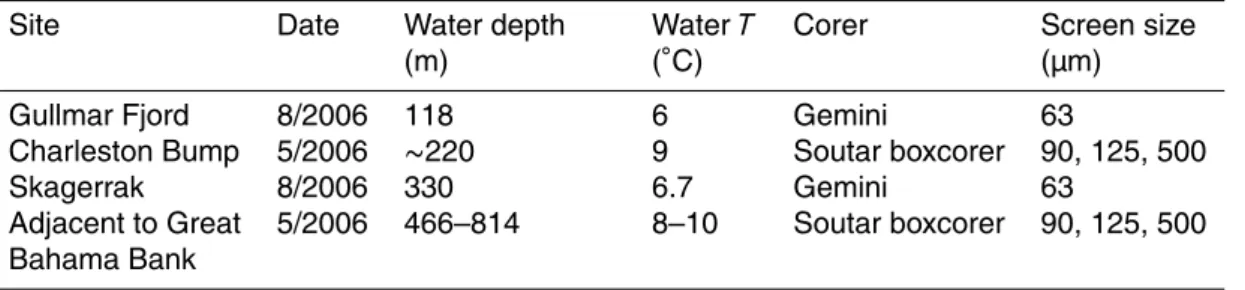
ing surface sediments (top ∼2 cm) to the laboratory at Woods Hole Oceanographic Institution (WHOI), USA. Samples were collected from the northeastern Skagerrak (330 m), Gullmar Fjord, Sweden (118 m), the Charleston Bump off South Carolina, USA (∼220 m), and at three sites near the Great Bahama Bank (466–814 m) (Fig. 1, Table 1). Bottom water was collected at each site using a CTD-Niskin rosette, main-20
tained near bottom-water temperatures, and used for sieving to remove fine material and concentrate the benthic foraminifera. Immediately after sieving, the samples were transferred to a plastic container and stored at 5–7◦C until the samples were trans-ported in coolers to WHOI after the cruise.
In our shore-based 7◦C environmental room, the sample containers were plumbed 25
mix-BGD
7, 351–385, 2010A calibration of benthic foraminiferal
paleotemperature proxies
H. L. Filipsson et al.
Title Page
Abstract Introduction
Conclusions References
Tables Figures
◭ ◮
◭ ◮
Back Close
Full Screen / Esc
Printer-friendly Version
Interactive Discussion ture ofDunaliella tertiolectaand Isochrysis galbana(Hintz et al., 2004). Subsamples
were taken from the stock cultures and sieved, using chilled artificial sea water, over a 63-µm screen. Specimens showing signs of activity, by containing algae or having colored cytoplasm, were picked from the>63-µm fraction and incubated at 7◦C in Petri dishes with artificial sea water and calcein (10 mg/l) solution for two to four weeks, 5
following Bernhard et al. (2004). The samples were fed every week and the calcein solution was changed every 3–4 days.
Just before initiation of the experiment, specimens were examined using epifluores-cence microscopy at 480-nm excitation and 520-nm emission, and fluorescent speci-mens, which had precipitated calcite during the calcein incubation, were picked using 10
a fine brush or pipette. All examination, sorting, and picking were carried out on ice. Fluorescent specimens were transferred to cell tissue culture cups (8-ml volume; 8-µm nominal pore diameter) and placed in acrylic culture chambers (Hintz et al., 2004). Each culture cup contained a 2–3 mm thick layer of HPLC-grade silt-sized silica to pro-vide a substrate for the foraminifera.
15
Most culture chambers were inoculated with a mix of species, with all inoculates in any given culture chamber from the same sampling site. The exceptions were three “monoculture” chambers that contained a mix ofBulimina aculeata and B. marginata
from Charleston Bump and adjacent to the Great Bahama Bank (see below). Skager-rak species included Bolivina skagerrakensis, Bolivinellina pseudopunctata, Bulimina
20
marginata, Cassidulina laevigata, Globobulimina turgida, Hyalinea balthica, Melonis barleeanum, Pullenia bulloides, Quinqueloculina seminulum, Stainforthia fusiformis, and Uvigerina spp.; Gullmar Fjord species included Bolivina skagerrakensis, Bo-livinellina pseudopunctata, Bulimina marginata, C. laevigata, Elphidium excavatum, G. turgida, H. balthica, Nonionella turgida, Nonionellina labradorica, Pyrgo williamsoni, Q.
25
BGD
7, 351–385, 2010A calibration of benthic foraminiferal
paleotemperature proxies
H. L. Filipsson et al.
Title Page
Abstract Introduction
Conclusions References
Tables Figures
◭ ◮
◭ ◮
Back Close
Full Screen / Esc
Printer-friendly Version
Interactive Discussion spp.,Globobulimina sp.,Lenticulina sp.,Melonis barleeanum, andUvigerina spp. As
noted, three culture chambers contained “monocultures” of the Bulimina aculeata/B. marginatacomplex. These two species were not separated, as juveniles of these two species were indistinguishable, and even the adult populations exhibited a spectrum of morphologies – some specimens appeared as typical B. marginata orB aculeata
5
while others exhibited traits of both species. Thus, we refer to our results on these species from the Charleston Bump and Great Bahama Bank to be from theBulimina aculeata/B. marginataspecies complex.
The experiment was initiated on 19 December 2006, and was terminated between 15 and 23 May 2007. Five culture chambers were placed in each of three refrigerators (4, 10
7, 14◦C) and, in addition, two were placed at room temperature (∼21◦C). Temperatures were monitored using Onset Tidbit T loggers. The culture chambers were individually plumbed, each with two outlets and two inlets at the top and at the bottom, to avoid geochemical gradients in the culture chambers, following Hintz et al. (2004). All culture chambers were connected to one single reservoir (200 l) of filtered surface seawater 15
from the Gulf Stream, which was diluted with 8.4 l of MilliQ water to achieve a salinity of 35; this dilution also lowered the alkalinity from 2390 µeq/kg to 2258 µeq/kg. The water from the large reservoir was pumped to a header tank and both tanks were continuously bubbled with air from the building air intake. The air was first bubbled through a carboy of distilled water to increase its relative humidity. From the header 20
tank, the water flowed to culture chambers by gravity; flow rates averaged 4 ml/min. The residence time of water in culture chambers was approximately 2 min.
Every 10 days, flow was stopped and a mixture ofD. tertiolectaandI. galbanawas introduced into each culture chamber to allow the foraminifera to feed. After an hour, the flow was reinstated after the algae settled to the silica surface. After experiment 25
BGD
7, 351–385, 2010A calibration of benthic foraminiferal
paleotemperature proxies
H. L. Filipsson et al.
Title Page
Abstract Introduction
Conclusions References
Tables Figures
◭ ◮
◭ ◮
Back Close
Full Screen / Esc
Printer-friendly Version
Interactive Discussion Sampling for salinity, alkalinity, dissolved inorganic carbon (DIC), and δ18Ow from
the reservoir tank occurred approximately every third week. Salinity samples were measured by the WHOI Hydrographic Analysis Facility using an Autosal salinometer. The alkalinity and DIC data were analyzed by closed-vessel titration of large-volume (∼100 ml) samples using an automated titration system (Bradshaw et al., 1981; Brewer 5
et al., 1986), and the alkalinity and DIC concentrations were determined using a nonlin-ear curve fitting approach (Department of Energy, 1994), and standardized using certi-fied reference materials obtained from Dr. A. Dickson (Scripps Institution of Oceanog-raphy). The standard deviation of replicate analyses of culture water was 0.4 µeq/kg for alkalinity and 1.3 µmol/kg for DIC (n=6 pairs). The carbonate ion concentration [CO23−] 10
and the pH (total scale, “pH(t)”) were calculated from the alkalinity and DIC data us-ing the “CO2SYS” program (Lewis and Wallace, 1998), with the carbonate dissociation constants of Roy et al. (1993), the calcite solubility of Mucci (1983), and the assump-tion that the boron/salinity ratio of the culture system water was equal to the seawater value.
15
Theδ18O of water was analyzed in the laboratory of D. Schrag (Harvard Univ.) using a VG Optima mass spectrometer with a VG Isoprep 18 automated shaker/equilibrator (Schrag et al., 2002). The standard deviation of replicateδ18O analyses was 0.04‰ (n=6);δ18Owvalues are reported relative to Standard Mean Ocean Water (SMOW). 2.2 Stable oxygen isotopes of foraminiferal calcite
20
The stable oxygen isotopic composition of foraminiferal calcite was determined using a Kiel III Carbonate Device connected to a Finnigan MAT 253 mass spectrometer. Procedures and precision for this instrument can be found at: http://www.whoi.edu/ paleo/mass-spec/. Depending on available calcite mass, samples consisted of pooled individuals ranging from 3 to 80 individuals or portions of individuals (see below). 25
BGD
7, 351–385, 2010A calibration of benthic foraminiferal
paleotemperature proxies
H. L. Filipsson et al.
Title Page
Abstract Introduction
Conclusions References
Tables Figures
◭ ◮
◭ ◮
Back Close
Full Screen / Esc
Printer-friendly Version
Interactive Discussion equation
(T=16.5−4.80∗(δ18Oc,VPDB−(δ18Ow,SMOW−0.27))
was used to calculate δ18O equilibrium values (δ18Oeq), the δ18O values of calcite (δ18Oc,VPDB) in equilibrium with water (δ18Ow,SMOW) at the given temperature (Bemis et al., 1998).
5
2.3 Microdissection using laser ablation
In cases where an inoculate specimen added chambers during the experiment, the pre-existing (fluorescent) calcite was removed from the non-fluorescent calcite formed during the experiment using laser ablation microdissection (Hintz et al., 2006b). A con-servative approach was used when microdissecting, we preferred to lose some of the 10
newly added calcite rather than risk inclusion of pre-existing calcite in the subsequent analyses.
2.4 Mg/Ca analysis
Benthic foraminifera from deep-sea sediments are typically cleaned before solution ICP-MS Mg/Ca analysis, and several protocols (e.g., Martin and Lea, 2002) have been 15
designed to remove clay and adhering contaminants that may be high in Mg relative to foraminiferal calcite, as well as high-Mg phases of calcite known to occur in some planktonic foraminifera (e.g., Brown and Elderfield, 1996; Dekens et al., 2002). The specimens in this study were not cleaned because the cultured foraminifera were lightly calcified and fragile, and rigorous chemical cleaning would likely have precluded ana-20
lysis at 4◦C and reduced the number of analyses possible at 7, 14 and 21◦C. This ap-proach seemed justified because the culture substrate (HPLC-grade silica) was clean, minimizing the risk of contamination.
BGD
7, 351–385, 2010A calibration of benthic foraminiferal
paleotemperature proxies
H. L. Filipsson et al.
Title Page
Abstract Introduction
Conclusions References
Tables Figures
◭ ◮
◭ ◮
Back Close
Full Screen / Esc
Printer-friendly Version
Interactive Discussion light and epifluorescence microscopy before analysis. Several mm-sized crystals of the
OKA carbonatite standard (Bice et al., 2005) were also affixed to each slide. Mg/Ca analyses were made using the Thermo Element HR-ICP-MS equipped with a New Wave UP213 laser ablation sampling device. Raster patterns were defined in the NewWave software, using each specimen’s micrographs to guide selection of a suit-5
able sampling region. Raster paths were typically spaced 30 µm from one another but on several specimens with few experimentally precipitated chambers the paths were condensed to 20 µm spacing. Scan speed was 5 µm/s, repetition rate 10 Hz, scan depth 0 µm, spot size 40 µm and laser power 50%. Ablated material was removed from the chamber by helium carrier gas (0.42–0.5 l/min) which was combined with argon 10
(0.8 l/min) to form the final sample gas. Mass spectrometer settings closely followed those outlined in Hathorne et al. (2003). Isotope masses monitored were25Mg, 43Ca,
48
Ca, 86Sr, and 88Sr, with each analysis consisting of 70 to 90 cycles through these five masses.
Blanks (run without laser input) and the OKA carbonatite standard were analyzed 15
after every 3–6 samples, and25Mg and 43Ca curves were constructed for blanks and standards analyzed over the course of each day’s analyses. These blank values were subtracted from both samples and standards, and the sample 25Mg/43Ca ratio was normalized to an OKA Mg/Ca of 4.55 mmol/mol, as determined by (Bice et al., 2005). In some cases, Mg and Ca intensities varied significantly over the course of an ana-20
lysis. When Mg and Ca intensities peaked simultaneously this was interpreted as the result of rapid introduction of calcite to the mass spectrometer, perhaps when a larger-than-typical amount of calcite was ablated. Other, less regular fluctuations in signal intensity, including the anticorrelation of Mg and Ca, may reflect instrument tuning problems, though we cannot rule out the possibility of extremely heterogeneous 25
BGD
7, 351–385, 2010A calibration of benthic foraminiferal
paleotemperature proxies
H. L. Filipsson et al.
Title Page
Abstract Introduction
Conclusions References
Tables Figures
◭ ◮
◭ ◮
Back Close
Full Screen / Esc
Printer-friendly Version
Interactive Discussion carbonatite standard provide one estimate of the reproducibility of LA-ICP-MS Mg/Ca
measurements: the relative standard deviation for 12 OKA measurements made over two months was 1.7%. However, no direct test of the reproducibility of LA-ICP-MS Mg/Ca measurements of foraminiferal calcite was possible because specimens are likely to exhibit intratest and intertest heterogeneity (Pena et al., 2008).
5
3 Results
3.1 Water chemistry
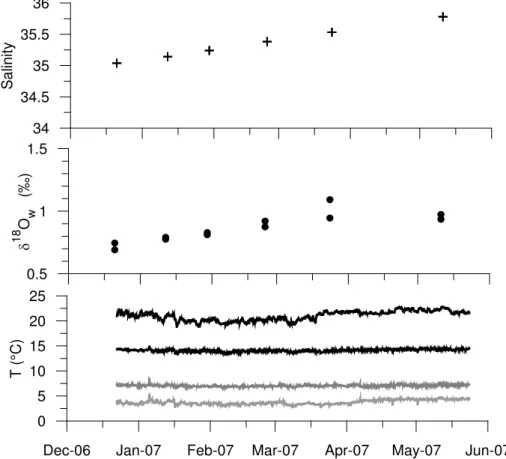
We assume that most calcification occurred in the final months of the experiment (Mc-Corkle et al., 2008), and focus on water chemistry between February and May 2007. The salinity increased from 35.0 to∼35.8 during the entire experiment (Fig. 2a), and 10
δ18Ow increased from 0.7‰ to 0.95‰ (Fig. 2b). The average δ18Ow value between February and May was 0.9‰ (range 0.1‰) and the average temperatures for the same period were 3.8◦C (range ∼1◦C), 7.0◦C (range 0.5–1◦C), 14.1◦C (range 0.5–1◦C), 21.0 ˚ C (range 1–2 ◦C) (Fig. 2c), abbreviated to 4, 17, 14, and 21◦C. The coldest and warmest treatments showed the most temperature variation. Temperature did not sys-15
tematically increase or decrease over the experiment, although long-term trends were noted in the 21◦C treatment, which was not thermostatted.
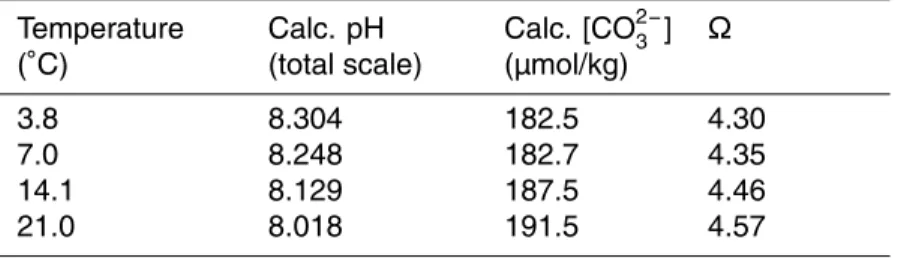
Alkalinity increased by 0.7% during the course of the experiment, from 2258 µeq/kg to 2273 µeq/kg (Fig. 3a, Table 2). This increase is smaller than would be predicted from the observed salinity increase, suggesting a modest consumption of alkalinity, 20
either due to the release of metabolites, or to leaching of trace acidity from the sys-tem components (tubing, culture chambers, etc.) during the experiment. Dissolved inorganic carbon (DIC) showed a similar increase through most of the experiment, but decreased in April and May 2007 (Fig. 3a). Because alkalinity and DIC covaried, the carbonate ion concentration [CO23−] remained relatively constant at values between 25
BGD
7, 351–385, 2010A calibration of benthic foraminiferal
paleotemperature proxies
H. L. Filipsson et al.
Title Page
Abstract Introduction
Conclusions References
Tables Figures
◭ ◮
◭ ◮
Back Close
Full Screen / Esc
Printer-friendly Version
Interactive Discussion 3.2 Calcification at different temperatures
Bulimina aculeataandB. marginatawere the most successful taxa in the experiment, in terms of calcification, so we focus on these two species. In addition,Cassidulina lae-vigataalso reproduced at 7◦C. The reproductive yield ofC. laevigatawas sparse, and the mass produced was insufficient for proxy analyses. Specimens ofHyalinea balthica
5
andMelonis barleanum, originally from the Skagerrak, also added a few new chambers at all temperatures except at 21◦C. The specimens originating from the Gullmar Fjord grew little and did not reproduce at any of the temperatures; we omit further discussion of the fjord material. A few specimens ofRosalinasp. occurred in all culture chambers except those at room temperature, despite not being observed in the initial inoculate. 10
At the lowest temperature (4◦C), several specimens of B. aculeata/B. marginata
added one to three chambers to their tests, but little growth occurred in the remaining 4◦C specimens, and no reproduction took place at 4◦C (Table 3). At 7◦C,B. marginata
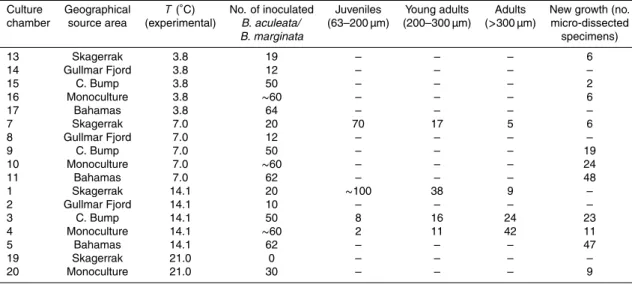
from the Skagerrak reproduced abundantly, yielding approximately 90 new specimens, which had reached the 63 to 200 µm size fraction (the smallest fraction collected) by 15
the end of the experiment (Table 3). Considerable growth ofB. aculeata/B. marginata
occurred in the three remaining 7◦C culture chambers, enabling microdissection of new (experimental) calcite from many specimens (Table 3). Reproduction also occurred at 14◦C, producing hundreds of offspring that had reached the 63–200 µm size fraction by the end of the experiment (Table 3). Some specimens of theB. aculeata/B. marginata
20
complex also reproduced at 14◦C, and a large proportion of those offspring grew to the>300 µm size fraction (Table 3). It is likely that more than one reproduction event occurred at this temperature because there were specimens ranging from juveniles to adult that were all born in culture (Table 3). Dozens of inoculate specimens displayed substantial new growth, adding at least three chambers and increasing in test volume 25
BGD
7, 351–385, 2010A calibration of benthic foraminiferal
paleotemperature proxies
H. L. Filipsson et al.
Title Page
Abstract Introduction
Conclusions References
Tables Figures
◭ ◮
◭ ◮
Back Close
Full Screen / Esc
Printer-friendly Version
Interactive Discussion 3.3 Stable oxygen isotopes
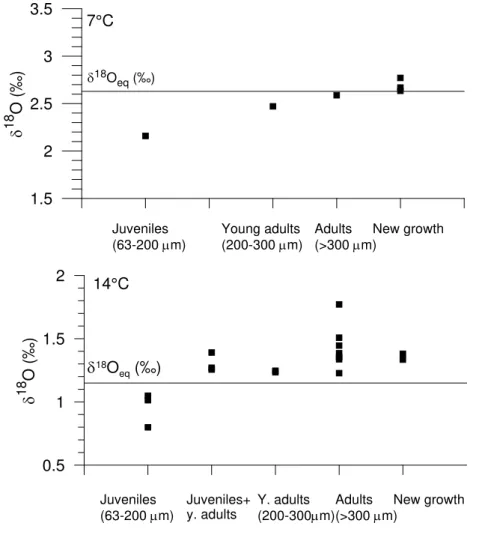
The amount and type of test material available for B. aculeata/B. marginata stable isotope analyses (microdissected new growth vs. offspring born in culture) varied be-tween the different temperatures (Table 4). In general, larger specimens (>300 µm) at 7◦C were closer to δ18Oeq than smaller specimens (Fig. 4a). At 14◦C the oxygen 5
isotope data from all size classes were similar, and slightly higher than the predicted
δ18Oeq, except for the 14◦C juveniles which had lowerδ18O values (Fig. 4b). For com-parison with the cultured specimens, stable isotopic analyses were also performed on pre-existing calcite from samples originating from the Skagerrak, Charleston Bump, and Great Bahamas Bank (Table 4); theδ18O values from the pre-existing calcite var-10
ied depending on source region where the largest scatter came from the monocultures ofB. aculeata/marginatacomplex.
3.4 Mg/Ca ratios
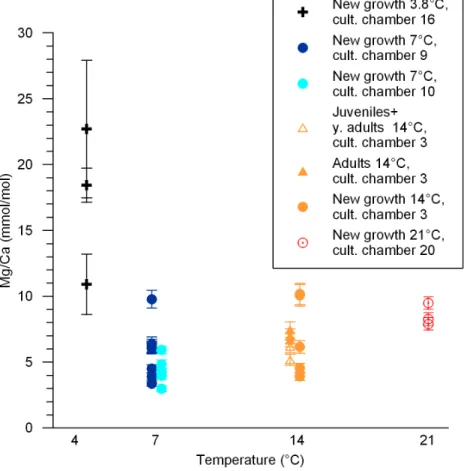
Mg/Ca analyses were performed on microdissected, new growth from all four tem-peratures, and on young adults and adult specimens born in culture from the 14◦C 15
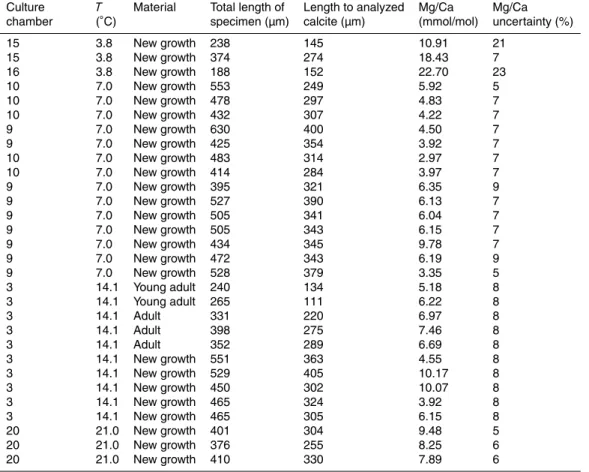
treatment. The foraminiferal Mg/Ca values ranged from 3.4 to 22.7 mmol/mol (Table 5, Fig. 5). No significant difference in Mg/Ca was observed between specimens from dif-ferent culture chambers maintained at a single temperature (e.g., culture chambers 3 and 10 at 7◦C; culture chambers 15 and 16 at 4◦C), and the Mg/Ca of specimens born in culture at 14◦C did not differ significantly from that of chambers added during the 20
BGD
7, 351–385, 2010A calibration of benthic foraminiferal
paleotemperature proxies
H. L. Filipsson et al.
Title Page
Abstract Introduction
Conclusions References
Tables Figures
◭ ◮
◭ ◮
Back Close
Full Screen / Esc
Printer-friendly Version
Interactive Discussion 4 Discussion
4.1 Growth and reproduction with respect to temperature
Bulimina aculeataandB. marginataoccur widely, ranging latitudinally as well as by wa-ter depth, occurring from deltas to the deep sea (Murray, 2006). In the South Atlantic Ocean,B. aculeatais present at sites with temperatures as low as 0.5◦C (Mackensen 5
et al., 1993) demonstrating that this species can grow and reproduce below 4◦C. Here, however, the cultured specimens grew at 4◦C, but they did not reproduce. The cultured specimens may not have been adapted to this lowest temperature; the temperatures at the coring sites ranged from∼7◦C (Skagerrak) to∼8–10◦C on the Charleston Bump and the Great Bahama Bank (Bernhard et al., 2006, SMHI database SHARK). At the 10
lowest culture temperature, growth is likely to be slow, so a longer experiment may have been required to produce similar mass as at higher experimental temperatures. The specimens from the Charleston Bump and the Bahamas grew at 7◦C, but only the Bulimina marginata specimens from the Skagerrak reproduced at this tempera-ture. This temperature is similar to the average temperature at the sampling site in 15
NE Skagerrak, and is slightly warmer than the reported lower temperature limit forB. marginata(Husum and Hald, 2004). The highest yield reproduction events took place at 14◦C, and were observed in specimens from all collection sites. This temperature is considerably higher than the temperature at any of the sampling sites. However, we note that both species (B. aculeataand B. marginata) have been reported from areas 20
with relatively high temperatures; B. marginata for instance from the South Brazilian Shelf (13–20◦C) (Eichler et al., 2008) and the Red Sea (Edelman-Furstenberg et al., 2001), and B. aculeata from the Ebro Delta (14–19◦C) (Murray, 2006; Cartes et al., 2007).
We do not know whether successful reproduction in culture implies that the slightly 25
BGD
7, 351–385, 2010A calibration of benthic foraminiferal
paleotemperature proxies
H. L. Filipsson et al.
Title Page
Abstract Introduction
Conclusions References
Tables Figures
◭ ◮
◭ ◮
Back Close
Full Screen / Esc
Printer-friendly Version
Interactive Discussion not consistently promote reproduction. These results – elevated reproduction at
inter-mediate temperatures – are consistent with the observations of Barras et al. (2009).
4.2 Ontogenetic trends in isotopic values
A substantial fraction of the observed oxygen isotopic variability is related to test size, suggesting age-related (ontogenetic) effects on test chemistry (Fig. 4). Several studies 5
have suggested that younger (smaller) individuals precipitate CaCO3 with lowerδ18O values than older (larger) specimens (e.g., Dunbar and Wefer, 1984; Schmiedl et al., 2004; McCorkle et al., 2008), though this pattern does not always exist (e.g., Wefer and Berger, 1991; Corliss et al., 2002). A size-linked (ontogenetic) trend is seen in the 7◦C δ18O data, with the most pronounced depletions in the smallest specimens 10
(Fig. 4a). This pattern is less clear in the 14◦C data, where all groups>200 µm show similarδ18O values (Fig. 4b). Ontogenetic isotopic depletions were most pronounced in the smallest size fractions analyzed by McCorkle et al. (2008), who suggested that adult specimens approach an asymptotic isotopic composition.
4.3 Oxygen isotopic composition as a function of temperature 15
Variability in foraminiferalδ18Oc, including the impact of ontogenetic effects, can be as-sessed by considering the offsets (∆δ18O values) between the observed foraminiferal
δ18Oc and the predicted foraminiferal δ18Oeq for each experimental temperature (Fig. 6). These∆δ18O values were calculated using the paleotemperature equation from Bemis et al. (1998). Where there are sufficient data (7◦C and 14◦C), similarδ18Oc 20
values (Table 4) and∆δ18O values (Fig. 6) are seen in both new growth and born-in-culture specimens. The range in ∆δ18O for new growth and adult specimens at the three warmest temperatures (roughly 0.6‰) was only slightly larger than the range of ∆δ18O values previously observed in single-temperature culturing experiments, which ranged between 0.2 and 0.5‰ (McCorkle et al., 2008). The observed∆δ18O range 25
BGD
7, 351–385, 2010A calibration of benthic foraminiferal
paleotemperature proxies
H. L. Filipsson et al.
Title Page
Abstract Introduction
Conclusions References
Tables Figures
◭ ◮
◭ ◮
Back Close
Full Screen / Esc
Printer-friendly Version
Interactive Discussion The foraminiferal δ18Oc values decreased with increasing temperature from 7◦C
to 21◦C (Fig. 7). However, the single, unreplicated value at 4◦C (0.62‰) is roughly 2‰ lower than we would expect from the paleotemperature equation estimates dis-cussed below, and instead is similar to the δ18Oc−δ18Ow values of the 14◦C spec-imens (Fig. 7). This 4◦C isotopic analysis used microdissected, new growth calcite 5
from multiple specimens, raising the possibility that the sample inadvertently included some pre-existing calcite, precipitated at a higher temperature in the field. We do not think that this occurred, but while we have no reason simply to reject the data point at 4◦C, we will not use it in the following assessment of the temperature dependence of
Buliminaδ18O. 10
Theδ18Oc−δ18Owvalues provide a culture-based assessment of published oxygen isotope paleotemperature equations (Fig. 7) (Shackleton, 1974; Kim and O’Neil, 1997; McCorkle et al., 1997; Bemis et al., 1998). Although the 14◦C culture data are most consistent with the “warmer” paleotemperature equations (Shackleton, 1974; McCorkle et al., 1997), the best overall agreement, over the 21◦C to 7◦C temperature range, is 15
with the paleotemperature equation of Bemis et al. (1998) (Fig. 7).
A previous culture study reported small depletions from predicted equilibrium calcite
δ18O values (McCorkle et al., 2008) and proposed that these isotopic offsets could re-flect the elevated carbonate ion concentration of the culture system, relative to typical bottom-water values, following the results of Spero and co-workers (Lea and Spero, 20
1992; Spero et al., 1997; Bijma et al., 1999). However, the Bemis et al. (1998) pale-otemperature expression, which provides the best match to the multiple temperature results of this study, would have been in better agreement with the δ18O data of Mc-Corkle et al. (2008), obviating the need to invoke a carbonate ion effect. The higher-than-predictedδ18O values in the 14◦C cultures cannot be explained by elevated car-25
BGD
7, 351–385, 2010A calibration of benthic foraminiferal
paleotemperature proxies
H. L. Filipsson et al.
Title Page
Abstract Introduction
Conclusions References
Tables Figures
◭ ◮
◭ ◮
Back Close
Full Screen / Esc
Printer-friendly Version
Interactive Discussion 4.4 Mg/Ca ratios with respect to temperature
The foraminiferal Mg/Ca values from the 21◦C treatment vary by roughly±10% about a mean of 8.5 mmol/mol, but the Mg/Ca values from the other three temperatures show much more scatter, varying by factors of 2 to 3. In addition to this variability, the absolute values of the foraminiferal Mg/Ca ratios in the 4, 7, and 14◦C treatments 5
are much higher than the values predicted by studies of core-top field specimens. To illustrate this offset, we plot our culture data with the benthic foraminiferal (Cibicidoides) Mg/Ca temperature calibration curve of Lear et al. (2002) (Fig. 8). The Mg/Ca values from the 21◦C cultures span the Lear et al. calibration curve, but the remainder of our Mg/Ca data are substantially higher than predicted by the Lear et al. (2002) re-10
lationship, and other published calibrations (Martin et al., 2002; Healey et al., 2008). While deep-water Mg/Ca paleothermometry continues to be a topic of active study and debate, none of the field-based data sets report low-temperature values approaching those we observed (Lear et al., 2002; Martin et al., 2002; Marchitto et al., 2007; Healey et al., 2008).
15
We do not believe that the high Mg/Ca values reflect species-dependent variation in Mg incorporation. We know of two sets of Mg/Ca analyses of field collectedBulimina, including∼4.5◦C deep-sea data from Lear et al. (2002), and shallow water data (∼7◦C) from the Skagerrak and Gullmar Fjord (Groeneveld and Filipsson, personal communi-cation). TheseBulimina field data agree well with the Lear et al. (2002)Cibicidoides
20
calibration curve, and include no values higher than∼2.5 mmol/mol.
Strongly elevated Bulimina Mg/Ca values were, however, observed in a previous culturing study (Hintz et al., 2006b). Single-individual whole-specimen Mg/Ca values, cultured at 7◦C and measured by solution ICP-MS, reached values equal to the highest LA-ICP-MS values observed in this study, and included several specimens with Mg/Ca 25
BGD
7, 351–385, 2010A calibration of benthic foraminiferal
paleotemperature proxies
H. L. Filipsson et al.
Title Page
Abstract Introduction
Conclusions References
Tables Figures
◭ ◮
◭ ◮
Back Close
Full Screen / Esc
Printer-friendly Version
Interactive Discussion (Fig. 9). Ontogenetic effects, and their underlying variations in calcification
mecha-nisms, may explain the elevated Mg/Ca values in our study. However until these trends have been observed again over a temperature range, and cleaning and analytical arti-facts have been further tested and ruled out, we are unwilling to take these first multiple temperature culture-based Mg/Ca data at face value.
5
5 Conclusions
We cultured benthic foraminifera at 4, 7, 14, and 21◦C, and observed reproduction and copious calcification of Bulimina aculeata/marginata at temperatures close to or slightly higher than in situ temperatures (7 and 14◦C treatments), with no reproduction and less calcification at either substantially lower (4◦C) or higher (21◦C) temperatures. 10
The absence of reproduction at higher and lower temperatures suggests that temper-ature stress does not consistently promote reproduction; instead there appears to be a temperature window where environmental conditions are most beneficial for these species’ reproduction and growth.
Observed ontogenetic variations in foraminiferal stable oxygen isotope values are 15
consistent with patterns observed in culturing studies by McCorkle et al. (2008) and Barras et al. (2010). Further, the observedδ18O data are more consistent with the pa-leotemperature equation proposed by Bemis et al. (1998) than with those proposed by e.g., Shackleton (1974), and McCorkle et al. (1997). In contrast, the high observed foraminiferal Mg/Ca values in this study are not consistent with published benthic 20
foraminiferal Mg/Ca: temperature relationships. This discrepancy may reflect onto-genetic variations in foraminiferal elemental compositions, but at present we cannot rule out sample cleaning or analytical explanations for these high values.
Acknowledgements. We thank the captains, crews, and scientific parties of the RV Arne Tiseliusand RV Oceanus during our collection cruises, D. R. Ostermann, M. Jeglsinki, and 25
BGD
7, 351–385, 2010A calibration of benthic foraminiferal
paleotemperature proxies
H. L. Filipsson et al.
Title Page
Abstract Introduction
Conclusions References
Tables Figures
◭ ◮
◭ ◮
Back Close
Full Screen / Esc
Printer-friendly Version
Interactive Discussion to HLF. A Fulbright fellowship to HLF together with traveling grants from G ¨oteborg University,
the Crafoord Foundation, and the Royal Physiographic Society in Lund enabled HLF’s Postdoc stay and subsequent visits to WHOI.
References
Barras, C., Geslin, E., Duplessy, J. C., and Jorissen, F. J.: Reproduction and growth of the 5
deep-sea benthic foraminiferaBulimina marginata under different laboratory conditions, J. Foramin. Res., 39, 155–165, 2009.
Barras, C., Duplessy, J. C., Geslin, E., Michel, E., and Jorissen, F.: Calibration of δ18O of laboratory-cultured deep-sea benthic foraminiferal shells in function of temperature, Biogeo-sciences Discuss., 7, 335–350, 2010, http://www.biogeoBiogeo-sciences-discuss.net/7/335/2010/. 10
Bemis, B. E., Spero, H. J., Bijma, J., and Lea, D. W.: Reevaluation of the oxygen isotopic composition of planktonic foraminifera: Experimental results and revised paleotemperature equations, Paleoceanography, 13, 150–160, 1998.
Bernhard, J. M., Blanks, J. K., Hintz, C. J., and Chandler, G. T.: Use of the fluorescent calcite marker calcein to label foraminiferal tests, J. Foramin. Res., 34, 96–101, 2004.
15
Bernhard, J. M., Ostermann, D. R., Williams, D. S., and Blanks, J. K.: Comparison of two meth-ods to identify live benthic foraminifera: A test between rose bengal and celltracker green with implications for stable isotope paleoreconstructions, Paleoceanography, 21, PA4210, doi:10.1029/2006PA001290, 2006.
Bice, K. L., Layne, G. D., and Dahl, K.: Application of secondary ion mass spectrometry 20
to the determination of Mg/Ca in rare, delicate, or altered planktonic foraminifera: Ex-amples from the Holocene, Paleogene, and Cretaceous, Geochem. Geophy. Geosy., 6, Q12p0710.1029/2005gc000974, 2005.
Bijma, J., Faber, W. W., and Hemleben, C.: Temperature and salinity limits for growth and survival of some planktonic foraminifers in laboratory cultures., J. Foramin. Res., 20, 95– 25
116, 1990.
Bijma, J., Spero, H. J., and Lea, D.: Reassessing foraminiferal stable isotope geochem-istry: Impact of the oceanic carbonate system (experimental results), in: Use of Proxies in Paleoceanography: Examples from the South Atlantic, edited by: Fischer, G. and Wefer, G., Springer Verlag, Berlin Heidelberg, 489–512, 1999.
BGD
7, 351–385, 2010A calibration of benthic foraminiferal
paleotemperature proxies
H. L. Filipsson et al.
Title Page
Abstract Introduction
Conclusions References
Tables Figures
◭ ◮
◭ ◮
Back Close
Full Screen / Esc
Printer-friendly Version
Interactive Discussion Bradshaw, A. L., Brewer, P. G., Shafer, D. K., and Williams, R. T.: Measurements of total
carbon-dioxide and alkalinity by potentiometric titration in the geosecs program, Earth Planet. Sc. Lett., 55, 99–115, 1981.
Brewer, P. G., Bradshaw, A. L., and Williams, R. T.: Measurements of total carbon dioxide and alkalinty in the North Atlantic ocean in 1981, in: The Global Carbon Cycle: Analysis of the 5
Natural Cycle and Implications of Anthropogenic Alterations for the Next Century, edited by: Reichle, D., Springer-Verlag, Berlin, 358–381, 1986.
Brown, S. J. and Elderfield, H.: Variations in Mg/Ca and Sr/Ca ratios of planktonic foraminifera caused by postdepositional dissolution: Evidence of shallow Mg-dependent dissolution, Pa-leoceanography, 11, 543–551, 1996.
10
Cartes, J. E., Papiol, V., Palanques, A., Guill ´en, J., and Demestre, M.: Dynamics of supraben-thos offthe Ebro Delta (Catalan Sea: Western Mediterranean): Spatial and temporal pat-terns and relationships with environmental factors, Estuarine, Coast. Shelf Sci., 75, 501–515, 2007.
Chandler, G. T. and Green, A. S.: A 14-day harpacticoid copepod reproduction bioassay for lab-15
oratory and field contaminated muddy sediments, in: New Techniques in Aquatic Toxicology, edited by: Ostrander, G., Lewis Publ. Inc., 23–39, 1996.
Chandler, G. T., Williams, D. F., Spero, H. J., and Gao, X. D.: Sediment microhabitat effects on carbon stable isotopic signatures of microcosm-cultured benthic foraminifera, Limnol. Oceanogr., 41, 680–688, 1996.
20
Corliss, B. H., McCorkle, D. C., and Higdon, D. M.: A time series study of the carbon isotopic composition of deep-sea benthic foraminifera, Paleoceanography, 17, p. 1036, 2002. Dekens, P. S., Lea, D. W., Pak, D. K., and Spero, H. J.: Core top calibration of Mg/Ca in tropical
foraminifera: Refining paleotemperature estimation, Geochem. Geophy. Geosy., 3(4), 1022, doi:10.1029/2001gc000200, 2002.
25
Department of Energy: Handbook of methods for the analysis of various parameters of the carbon dioxide system in seawater; version 2, in: Ornl/cdiac-74, edited by: Dickson, A. G. and Goyet, C., 1994.
Dunbar, R. B. and Wefer, G.: Stable isotope fractionation in benthic foraminifera from the Peru-vian continental margin, Mar. Geol., 59, 215–225, 1984.
30
Edelman-Furstenberg, Y., Scherbacher, M., Hemleben, C., and Almogi-Labin, A.: Deep-sea benthic foraminifera from the central Red Sea, J. Foramin. Res., 31, 48–59, 2001.
BGD
7, 351–385, 2010A calibration of benthic foraminiferal
paleotemperature proxies
H. L. Filipsson et al.
Title Page
Abstract Introduction
Conclusions References
Tables Figures
◭ ◮
◭ ◮
Back Close
Full Screen / Esc
Printer-friendly Version
Interactive Discussion foraminiferal assemblages of the South Brazil: Relationship to water masses and nutrient
distributions, Cont. Shelf Res., 28, 1674–1686, 2008.
Erez, J. and Luz, B.: Temperature control of oxygen-isotope fractionation of cultured planktonic foraminifera, Nature, 297, 220–222, 1982.
Hathorne, E. C., Alard, O., James, R. H., and Rogers, N. W.: Determination of intratest vari-5
ability of trace elements in foraminifera by laser ablation inductively coupled plasma-mass spectrometry, Geochem. Geophy. Geosy., 4(12), 8408, doi:10.1029/2003gc000539, 2003. Havach, S. M., Chandler, G. T., Wilson-Finelli, A., and Shaw, T. J.: Experimental determination
of trace element partition coefficients in cultured benthic foraminifera, Geochim. Cosmochim. Ac., 65, 1277–1283, 2001.
10
Healey, S. L., Thunell, R. C., and Corliss, B. H.: The Mg/Ca-temperature relationship of benthic foraminiferal calcite: New core-top calibrations in the<4◦C temperature range, Earth Planet. Sc. Lett., 272, 523–530, doi:10.1016/j.epsl.2008.05.023, 2008.
Hintz, C. J., Chandler, G. T., Bernhard, J. M., McCorkle, D. C., Havach, S. M., Blanks, J. K., and Shaw, T. J.: A physicochemically constrained seawater culturing system for production 15
of benthic foraminifera, Limnol. Oceanogr.-Meth., 2, 160–170, 2004.
Hintz, C. J., Shaw, T. J., Chandler, G. T., Bernhard, J. M., McCorkle, D. C., and Blanks, J. K.: Trace/minor element : Calcium ratios in cultured benthic foraminifera. Part I: Inter-species and inter-individual variability, Geochim. Cosmochim. Ac., 70, 1952–1963, 2006a.
Hintz, C. J., Shaw, T. J., Bernhard, J. M., Chandler, G. T., McCorkle, D. C., and Blanks, J. K.: 20
Trace/minor element: Calcium ratios in cultured benthic foraminifera. Part II: Ontogenetic variation, Geochim. Cosmochim. Ac., 70, 1964–1976, 2006b.
Husum, K. and Hald, M.: Modern foraminiferal distribution in the subarctic Malangen Fjord and adjoining shelf, Northern Norway, J. Foramin. Res., 34, 34–48, 2004.
Kim, S. T. and O’Neil, J. R.: Equilibrium and nonequilibrium oxygen isotope effects in synthetic 25
carbonates, Geochim. Cosmochim. Ac., 61, 3461–3475, 1997.
Lea, D. W. and Spero, H. J.: Experimental determination of barium uptake in shells of the planktonic foraminiferaOrbulina universaat 22◦C., Geochim. Cosmochim. Ac., 56, 2673– 2680, 1992.
Lear, C. H., Rosenthal, Y., and Slowey, N.: Benthic foraminiferal Mg/Ca-paleothermometry: 30
A revised core-top calibration, Geochim. Cosmochim. Ac., 66, 3375–3387, 2002.
Lewis, E. and Wallace, D. W. R.: Program Developed for CO2 System Calculations.
Lab-BGD
7, 351–385, 2010A calibration of benthic foraminiferal
paleotemperature proxies
H. L. Filipsson et al.
Title Page
Abstract Introduction
Conclusions References
Tables Figures
◭ ◮
◭ ◮
Back Close
Full Screen / Esc
Printer-friendly Version
Interactive Discussion oratory, US Department of Energy, Oak Ridge, Tennessee, 1998.
Mackensen, A., Futterer, D. K., Grobe, H., and Schmiedl, G.: Benthic foraminiferal assemblages from the eastern South Atlantic polar front region between 35-degrees and 57-degrees dis-tribution, ecology and fossilization potential, Mar. Micropaleontol., 22, 33–69, 1993.
Mackensen, A., Schumacher, S., Radke, J., and Schmidt, D. N.: Microhabitat preferences and 5
stable carbon isotopes of endobenthic foraminifera: Clue to quantitative reconstruction of oceanic new production? Mar. Micropaleontol., 40, 233–258, 2000.
Marchitto, T. M., Bryan, S. P., Curry, W. B., and McCorkle, D. C.: Mg/Ca temperature calibra-tion for the benthic foraminifer Cibicidoides pachyderma, Paleoceanography, 22, PA1203, doi:10.1029/2006PA001287, 2007.
10
Martin, P. A. and Lea, D. W.: A simple evaluation of cleaning procedures on fossil ben-thic foraminiferal Mg/Ca, Geochem. Geophy. Geosy., 3, 8401, doi:10.1029/2001gc000280, 2002.
Martin, P. A., Lea, D. W., Rosenthal, Y., Shackleton, N. J., Sarnthein, M., and Papenfuss, T.: Quaternary deep sea temperature histories derived from benthic foraminiferal Mg/Ca, Earth 15
Planet. Sc. Lett., 198, 193–209, 2002.
McCorkle, D. C., Corliss, B. H., and Farnham, C. A.: Vertical distributions and stable isotopic compositions of live (stained) benthic foraminifera from the North Carolina and California continental margins, Deep-Sea Res. Pt. I, 44, 983–1024, 1997.
McCorkle, D. C., Bernhard, J. M., Hintz, C. J., Blanks, J. K., Chandler, G. T., and Shaw, T. J.: The 20
carbon and oxygen stable isotopic composition of cultured benthic foraminifera, in: Biogeo-chemical Controls on Palaeoceanographic Environmental Proxies, edited by: Austin, W. E. N. and James, R. H., Geological Society, London, Special Publications, 135–154, 2008. Mucci, A.: The solubility of calcite and aragonite in seawater at various salinities, temperatures,
and one atmosphere total pressure, Am. J. Sci., 283, 780–799, 1983. 25
Murray, J. W.: Ecology and Applications of Benthic Foraminifera, Cambridge University Press, Cambridge, 426 pp., 2006.
N ¨urnberg, D., Bijma, J., and Hemleben, C.: Assessing the reliability of magnesium in foraminiferal calcite as a proxy for water mass temperatures, Geochim. Cosmochim. Ac., 60, 803–814, 1996
30
BGD
7, 351–385, 2010A calibration of benthic foraminiferal
paleotemperature proxies
H. L. Filipsson et al.
Title Page
Abstract Introduction
Conclusions References
Tables Figures
◭ ◮
◭ ◮
Back Close
Full Screen / Esc
Printer-friendly Version
Interactive Discussion Roy, R. N., Roy, L. N., Vogel, K. M., Portermoore, C., Pearson, T., Good, C. E., Millero, F. J.,
and Campbell, D. M.: The dissociation-constants of carbonic-acid in seawater at salinities 5 to 45 and temperatures 0◦C to 45◦C, Mar. Chem., 44, 249–267, 1993.
Russell, A. D., Emerson, S., Nelson, B. K., Erez, J., and Lea, D. W.: Uranium in foraminiferal calcite as a recorder of seawater uranium concentrations, Geochim. Cosmochim. Ac., 58, 5
671–681, 1994.
Schmiedl, G., Pfeilsticker, M., Hemleben, C., and Mackensen, A.: Environmental and biological effects on the stable isotope composition of recent deep-sea benthic foraminifera from the western Mediterranean Sea, Mar. Micropaleontol., 51, 129–152, 2004.
Schrag, D. P., Adkins, J. F., McIntyre, K., Alexander, J. L., Hodell, D. A., Charles, C. D., and Mc-10
Manus, J. F.: The oxygen isotopic composition of seawater during the last glacial maximum, Quaternary Sci. Rev., 21, 331–342, 2002.
Segev, E. and Erez, J.: Effect of Mg/Ca ratio in seawater on shell composition in shallow benthic foraminifera, Geochem. Geophy. Geosy., 7, Q02P09, doi:10.1029/2005GC000969, 2006. Shackleton, N. J.: Attainment of isotopic equilibrium between ocean water and the benthonic 15
foraminifera genusUvigerina; isotopic changes in the ocean during the last glacial, in: Colloq. CNRS, edited by: Labeyrie, L., 203–209, 1974.
SMHI hydrographic data base SHARK http://www.smhi.se/klimatdata/oceanografi/ marin-fysik-kemi-och-biologi/oceanografiskt-datacenter-1.3798.
Spero, H. J., Bijma, J., Lea, D. W., and Bemis, B. E.: Effect of seawater carbonate concentration 20
on foraminiferal carbon and oxygen isotopes, Nature, 390, 497–500, 1997.
Toyofuku, T., Kitazato, H., Kawahata, H., Tsuchiya, M., and Nohara, M.: Evaluation of Mg/Ca thermometry in foraminifera: Comparison of experimental results and measurements in na-ture, Paleoceanography, 15, 456–464, 2000.
Toyofuku, T. and Kitazato, H.: Micromapping of Mg/Ca values in cultured specimens 25
of the high-magnesium benthic foraminifera, Geochem. Geophy. Geosy., 6, Q11P05, doi:10.1029/2005GC000961, 2005.
Wefer, G. and Berger, W. H.: Isotope paleontology: Growth and composition of extant calcare-ous species, Mar. Geol., 100, 207–248, 1991.
Weiss, N. A.: Introductory Statistics, Addison-Wesley, New York, 2004. 30
BGD
7, 351–385, 2010A calibration of benthic foraminiferal
paleotemperature proxies
H. L. Filipsson et al.
Title Page
Abstract Introduction
Conclusions References
Tables Figures
◭ ◮
◭ ◮
Back Close
Full Screen / Esc
Printer-friendly Version
Interactive Discussion Table 1.Sampling details from the sites in the North Atlantic.
Site Date Water depth WaterT Corer Screen size
(m) (◦C) (µm)
Gullmar Fjord 8/2006 118 6 Gemini 63
Charleston Bump 5/2006 ∼220 9 Soutar boxcorer 90, 125, 500
Skagerrak 8/2006 330 6.7 Gemini 63
BGD
7, 351–385, 2010A calibration of benthic foraminiferal
paleotemperature proxies
H. L. Filipsson et al.
Title Page
Abstract Introduction
Conclusions References
Tables Figures
◭ ◮
◭ ◮
Back Close
Full Screen / Esc
Printer-friendly Version
Interactive Discussion Table 2. Water chemistry measured during the course of the experiment together with
calcu-lated values of pH(total scale), CO23−andΩ. The average measured salinity, alkalinity, and DIC of the 200 l reservoir (35.35; 2264.0 µeq/kg, and 2001.0 µmol/kg) were used for calculations at all four temperatures.
Temperature Calc. pH Calc. [CO23−] Ω
(◦C) (total scale) (µmol/kg)
3.8 8.304 182.5 4.30
7.0 8.248 182.7 4.35
14.1 8.129 187.5 4.46
BGD
7, 351–385, 2010A calibration of benthic foraminiferal
paleotemperature proxies
H. L. Filipsson et al.
Title Page
Abstract Introduction
Conclusions References
Tables Figures
◭ ◮
◭ ◮
Back Close
Full Screen / Esc
Printer-friendly Version
Interactive Discussion Table 3. Number of inoculated specimens from the different source regions together with the
results from the culturing experiment, organized according to temperature and size classes. “Monoculture” refers to monocultures of Bulimina aculeata/marginata, originating from the Charleston Bump and near the Great Bahama Bank. Juveniles, young adults, and adults were born in culture; “new growth” is material precipitated during the experiment.
Culture Geographical T(◦C) No. of inoculated Juveniles Young adults Adults New growth (no.
chamber source area (experimental) B. aculeata/ (63–200 µm) (200–300 µm) (>300 µm) micro-dissected
B. marginata specimens)
13 Skagerrak 3.8 19 – – – 6
14 Gullmar Fjord 3.8 12 – – – –
15 C. Bump 3.8 50 – – – 2
16 Monoculture 3.8 ∼60 – – – 6
17 Bahamas 3.8 64 – – – –
7 Skagerrak 7.0 20 70 17 5 6
8 Gullmar Fjord 7.0 12 – – – –
9 C. Bump 7.0 50 – – – 19
10 Monoculture 7.0 ∼60 – – – 24
11 Bahamas 7.0 62 – – – 48
1 Skagerrak 14.1 20 ∼100 38 9 –
2 Gullmar Fjord 14.1 10 – – – –
3 C. Bump 14.1 50 8 16 24 23
4 Monoculture 14.1 ∼60 2 11 42 11
5 Bahamas 14.1 62 – – – 47
19 Skagerrak 21.0 0 – – – –
BGD
7, 351–385, 2010A calibration of benthic foraminiferal
paleotemperature proxies
H. L. Filipsson et al.
Title Page
Abstract Introduction
Conclusions References
Tables Figures
◭ ◮
◭ ◮
Back Close
Full Screen / Esc
Printer-friendly Version
Interactive Discussion Table 4. Stable oxygen isotopic data for the cultured foraminifera presented for each
tempera-ture and size class, together with isotope data for pre-existing calcite. The standard deviations refer the analytical precision of the mass spectrometer. “Monoculture” refers to monocultures ofBulimina aculeata/marginata, originating from the Charleston Bump and near the Great Ba-hama Bank.N refers to number of specimens or microdissected parts of specimens analyzed.
Culture Source area T Material δ18O δ18O N
chamber (◦C) mean (‰) SD (‰)
13+15+16 Skagerrak+C. Bump+Monoculture
3.8 New Growth 1.27 0.06 13
7 Skagerrak 7.0 Juveniles 2.16 0.03 74
7 Skagerrak 7.0 Young adults 2.47 0.04 15
7 Skagerrak 7.0 Adults 2.59 0.03 5
9 C. Bump 7.0 New growth 2.67 0.04 6
10 Monoculture 7.0 New growth 2.63 0.02 10
11 Bahamas 7.0 New Growth 2.77 0.03 10
1 Skagerrak 14.1 Juveniles 0.80 0.04 80
1 Skagerrak 14.1 Juveniles 1.01 0.04 42
1 Skagerrak 14.1 Young adults 1.25 0.02 20 1 Skagerrak 14.1 Young adults 1.23 0.01 24
1 Skagerrak 14.1 Adults 1.23 0.04 5
1 Skagerrak 14.1 Adults 1.77 0.05 4
3 C. Bump 14.1 Juv.+young adults 1.27 0.03 13 3 C. Bump 14.1 Juv.+young adults 1.26 0.03 14
3 C. Bump 14.1 Adults 1.34 0.03 5
3 C. Bump 14.1 Adults 1.44 0.04 5
4 Monoculture 14.1 Juv.+young adults 1.39 0.04 13
4 Monoculture 14.1 Adults 1.35 0.02 8
4 Monoculture 14.1 Adults 1.38 0.02 8
4 Monoculture 14.1 Adults 1.51 0.04 8
5 Bahamas 14.1 New growth 1.33 0.02 6
5 Bahamas 14.1 New growth 1.38 0.05 6
20 Monoculture 21.0 New growth –0.20† 0.17
3 C. Bump NA Pre-existing –0.79 0.04 8
4 Monoculture NA Pre-existing 0.14 0.05 8
5 Bahamas NA Pre-existing –0.64 0.02 20
9 C. Bump NA Pre-existing –0.11 0.05 10
10 Monoculture NA Pre-existing 0.13 0.04 13
11 Bahamas NA Pre-existing 0.16 0.02 16
13 Skagerrak NA Pre-existing 2.69 0.05 5 15 C. Bump NA Pre-existing –1.55† 0.05 3 20 Monoculture NA Pre-existing –0.76 0.09 9
BGD
7, 351–385, 2010A calibration of benthic foraminiferal
paleotemperature proxies
H. L. Filipsson et al.
Title Page
Abstract Introduction
Conclusions References
Tables Figures
◭ ◮
◭ ◮
Back Close
Full Screen / Esc
Printer-friendly Version
Interactive Discussion Table 5.Mg/Ca data for the calcite precipitated during the experiment presented for each
tem-perature and analyzed material (new growth; young adults and adults) together with specimen length and length to LA raster.
Culture T Material Total length of Length to analyzed Mg/Ca Mg/Ca chamber (◦C) specimen (µm) calcite (µm) (mmol/mol) uncertainty (%)
15 3.8 New growth 238 145 10.91 21
15 3.8 New growth 374 274 18.43 7
16 3.8 New growth 188 152 22.70 23
10 7.0 New growth 553 249 5.92 5
10 7.0 New growth 478 297 4.83 7
10 7.0 New growth 432 307 4.22 7
9 7.0 New growth 630 400 4.50 7
9 7.0 New growth 425 354 3.92 7
10 7.0 New growth 483 314 2.97 7
10 7.0 New growth 414 284 3.97 7
9 7.0 New growth 395 321 6.35 9
9 7.0 New growth 527 390 6.13 7
9 7.0 New growth 505 341 6.04 7
9 7.0 New growth 505 343 6.15 7
9 7.0 New growth 434 345 9.78 7
9 7.0 New growth 472 343 6.19 9
9 7.0 New growth 528 379 3.35 5
3 14.1 Young adult 240 134 5.18 8
3 14.1 Young adult 265 111 6.22 8
3 14.1 Adult 331 220 6.97 8
3 14.1 Adult 398 275 7.46 8
3 14.1 Adult 352 289 6.69 8
3 14.1 New growth 551 363 4.55 8
3 14.1 New growth 529 405 10.17 8
3 14.1 New growth 450 302 10.07 8
3 14.1 New growth 465 324 3.92 8
3 14.1 New growth 465 305 6.15 8
20 21.0 New growth 401 304 9.48 5
20 21.0 New growth 376 255 8.25 6
BGD
7, 351–385, 2010A calibration of benthic foraminiferal
paleotemperature proxies
H. L. Filipsson et al.
Title Page
Abstract Introduction
Conclusions References
Tables Figures
◭ ◮
◭ ◮
Back Close
Full Screen / Esc
Printer-friendly Version
Interactive Discussion
A B
BGD
7, 351–385, 2010A calibration of benthic foraminiferal
paleotemperature proxies
H. L. Filipsson et al.
Title Page
Abstract Introduction
Conclusions References
Tables Figures
◭ ◮
◭ ◮
Back Close
Full Screen / Esc
Printer-friendly Version
Interactive Discussion
34 34.5 35 35.5 36
S
a
lin
it
y
0.5 1 1.5
δ
1
8 O
w
(
‰
)
Dec-06 Jan-07 Feb-07 Mar-07 Apr-07 May-07 Jun-07
0 5 10 15 20 25
T
(°
C)
Fig. 2.Salinity,δ18Ow, and temperature measured during the experiment. Two water samples
BGD
7, 351–385, 2010A calibration of benthic foraminiferal
paleotemperature proxies
H. L. Filipsson et al.
Title Page
Abstract Introduction
Conclusions References
Tables Figures
◭ ◮
◭ ◮
Back Close
Full Screen / Esc
Printer-friendly Version
Interactive Discussion Fig. 3. Water chemistry data during the course of the experiment. Alkalinity and DIC were
BGD
7, 351–385, 2010A calibration of benthic foraminiferal
paleotemperature proxies
H. L. Filipsson et al.
Title Page
Abstract Introduction
Conclusions References
Tables Figures
◭ ◮
◭ ◮
Back Close
Full Screen / Esc
Printer-friendly Version
Interactive Discussion 1.5
2 2.5 3 3.5
δ
18
O
(
‰
)
7°C
δ18O eq (‰)
Juveniles
(63-200 µm)
Young adults
(200-300 µm)
Adults
(>300 µm)
New growth
0.5 1 1.5 2
δ
18
O
(
‰
)
14°C
δ18O
eq (‰)
Juveniles
(63-200 µm)
Juveniles+ y. adults
Y. adults
(200-300µm)
Adults
(>300 µm)
New growth
BGD
7, 351–385, 2010A calibration of benthic foraminiferal
paleotemperature proxies
H. L. Filipsson et al.
Title Page
Abstract Introduction
Conclusions References
Tables Figures
◭ ◮
◭ ◮
Back Close
Full Screen / Esc
Printer-friendly Version
Interactive Discussion Fig. 5. Mg/Ca (mmol/mol) over the experimental temperature gradient, presented by sample
BGD
7, 351–385, 2010A calibration of benthic foraminiferal
paleotemperature proxies
H. L. Filipsson et al.
Title Page
Abstract Introduction
Conclusions References
Tables Figures
◭ ◮
◭ ◮
Back Close
Full Screen / Esc
Printer-friendly Version
Interactive Discussion Fig. 6.The difference betweenδ18Ocand theδ
18
O(eq)vs. experimental temperature. δ 18
O(eq)
is indicated with a dotted line and calculated using the Bemis et al. (1998) paleotemperature equation, together with aδ18Ow of 0.92‰ (average between February and May). All calcite
BGD
7, 351–385, 2010A calibration of benthic foraminiferal
paleotemperature proxies
H. L. Filipsson et al.
Title Page
Abstract Introduction
Conclusions References
Tables Figures
◭ ◮
◭ ◮
Back Close
Full Screen / Esc
Printer-friendly Version
Interactive Discussion Fig. 7. Temperature vs. δ18Oc−δ
18
Ow, together with the paleotemperature equations from
BGD
7, 351–385, 2010A calibration of benthic foraminiferal
paleotemperature proxies
H. L. Filipsson et al.
Title Page
Abstract Introduction
Conclusions References
Tables Figures
◭ ◮
◭ ◮
Back Close
Full Screen / Esc
Printer-friendly Version
Interactive Discussion Fig. 8. Mg/Ca vs. temperature includingCibicidoidescore top calibration of Lear et al. (2002),
BGD
7, 351–385, 2010A calibration of benthic foraminiferal
paleotemperature proxies
H. L. Filipsson et al.
Title Page
Abstract Introduction
Conclusions References
Tables Figures
◭ ◮
◭ ◮
Back Close
Full Screen / Esc
Printer-friendly Version
Interactive Discussion Fig. 9. Mg distribution coefficients plotted versus length from the proloculus to LA raster,
pre-sented together with the data from Hintz et al. (2006a) study of ontogenetic effects on Mg/Ca of B. aculeata. DMgfor the cultured foraminifera from the present study was calculated assuming


![Fig. 3. Water chemistry data during the course of the experiment. Alkalinity and DIC were analyzed from water samples from the reservoir tank, and used to calculate [CO 2− 3 ] and pH(t).](https://thumb-eu.123doks.com/thumbv2/123dok_br/17074098.235581/29.918.98.605.143.461/chemistry-course-experiment-alkalinity-analyzed-samples-reservoir-calculate.webp)