Verification of the Pressure Equalisation Inside the Satellite Compartment of the …
J. of the Braz. Soc. of Mech. Sci. & Eng. Copyright 2005 by ABCM October-December 2005, Vol. XXVII, No. 4 / 469
P. Moraes Jr.
and A. L. Pereira
CTA/ Instituto de Aeronáutica e Espaço Space Systems Division Pça Mal-Ar Eduardo Gomes, 50 12228-904 São José dos Campos, SP. Brazil [email protected] [email protected]
Verification of the Pressure
Equalisation Inside the Satellite
Compartment of the Brazilian Satellite
Launch Vehicle
During the atmospheric flight of the Brazilian satellite launch vehicle the pressure inside the satellite compartment should be equalised with the atmospheric pressure. This becomes necessary due to the high pressure differences which result when the vehicle reaches high altitudes with decreasing atmospheric pressures, generating high loads acting on the internal surface of the fairing. The equalisation is achieved through venting holes placed around the fairing of the satellite compartment. The design of the venting orifices should be constrained to the restriction of constant evacuation of the compartment, so that, at any time of the trajectory, the pressure difference is minimal. Meeting this constraint becomes complex due to the flight environment of the vehicle which is characterised by very high acceleration levels. So, the flow around the fairing undergoes constant variation of the velocity field going from subsonic to hypersonic velocities. The position, size and number of venting orifices were determined using gas dynamic analysis and calculations and later validated through flight tests. The article describes the mean features of the design process, discusses the venting criterion, and shows the flight results.
Keywords: compartment venting, pressure equalisation, launch vehicle, VLS
Introduction
The Brazilian satellite launch vehicle, known under the acronym VLS, is composed by four propulsive stages and a satellite compartment covered by a fairing (Boscov at all, 1990). The fairing should protect the satellite against aerodynamic loads and heating that are established during the atmospheric flight of the VLS (Moraes Jr., 1992), Figure 1.1
Figure 1. Configuration and Fairing of the Brazilian Satellite Launch Vehicle (VLS).
The propulsive stages use solid propellant motors and so the vehicle presents high level of acceleration during all the flight phases. Due to this fact the vehicle reaches high velocities in low altitudes and dense atmosphere, which results in high dynamic pressures and fast decreasing surface pressure along the fairing. Thus, the flow around the fairing of the payload compartment
Paper accepted July, 2005. Technical Editor: Atila P. Silva Freire.
suffers constant variation with local velocities varying from low subsonic to hypersonic, as illustrated in figure 2.
When the vehicle reaches high altitudes and consequently low atmospheric pressures, a significantforce acts on the internal surface of the satellite compartment. This force results from the increasing difference between internal and external pressures during the ascent flight. Thus the internal pressure should be equalised with the external pressure in order to avoid damage of the structure or a previous opening of the fairing.
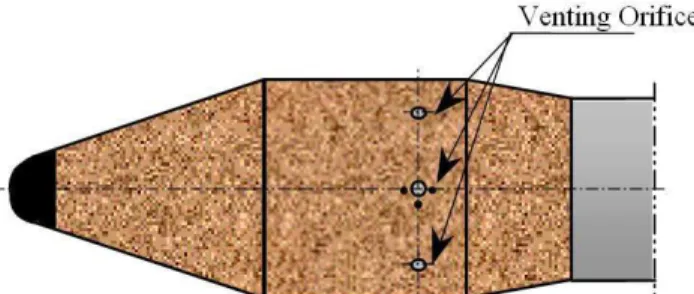
The pressure equalisation is carried out through small orifices placed in a plane normal to the longitudinal axis of the vehicle, radially distributed in that plane, which is located in the cylindrical section of the fairing.
Figure 2. VLS trajectory during the atmospheric flight.
P. Moraes Jr. and A. L. Pereira
/ Vol. XXVII, No. 4, October-December 2005 ABCM
470
constant evacuation of the satellite compartment so that, in any time and flight phase, the difference between internal and external pressures should be minimal. This requirement makes the problem quite complex due to the flight environment of the VLS.
The location, the size, and the number of orifices were determined making use of gas dynamic analysis and specific calculation procedures, and also results from high speed wind tunnel tests. Later those results have been confirmed with measurements carried out during the flight of the vehicle.
The article describes design features of the pressure equalisation device, discusses the established criteria for sizing and placement of the equalising orifices, and finally presents the results from measurements made during the flight of VLS second prototype. Furthermore some recommendations are presented with respect to location and dimensions of the orifices with the aim to optimize the dynamic of the pressure equalisation procedure.
Venting Orifices
In order to solve the problem of equalising the internal pressure of the satellite compartment of the VLS against the external (atmospheric) pressure, a simple and affordable concept has been chosen. This concept concerns the use of several small orifices placed in a plane normal to the longitudinal axis of the vehicle over the cylindrical portion of the faring surface, as illustrated in figure 3.
Figure 3. Venting orifices on the VLS fairing.
The orifices have so the function to allow a fast and efficient equalisation between internal and atmospheric pressures.
Location of the Venting Orifices
To find the most adequate position for the venting orifices a criterion was established which considers that the difference between the static pressure at the orifice location over the fairing surface and the undisturbed atmospheric pressure should be close to zero. This lead to the fact that the internal pressure of the satellite compartment is equalised against the atmospheric pressure when both parts of the fairing are ejected. This event occurs at 127 s after the launch of the vehicle.
The pressure coefficient Cp that brings a relationship between both pressures is defined as shown in Equation (1):
∞ ∞ − =
q P P
C x
p (1)
where, : Px is the static pressure acting on a station x over the fairing surface, P∞ is the undisturbed atmospheric pressure, and q∞
is the dynamic pressure as defined in Equation (2)
q∞ = ½ ρ∞ (V∞) 2 (2)
where, ρ∞ is the local atmospheric density, and V∞ the vehicle velocity.
The established pressure equalisation criterion specifies now that the pressure coefficient Cp should be equal or very close to zero for any flight time.
This certainly is a very hard requirement to be attended when distributions of the pressure coefficient Cp along the fairing surface are observed for different flight times, e.g. Mach numbers, as presented in figures 4 and 5 (Moraes Jr. & Neto, 1990).
Figure 4. Pressure coefficient along the VLS fairing, 0.7 ≤≤≤≤ Mach ≤≤≤≤ 1.25.
Figure 5. Pressure coefficient along the VLS fairing, 1.50 ≤≤≤≤ Mach ≤≤≤≤ 3.75.
Firstly the option was to place the venting orifices in the boat tail region of the fairing due to the fact that the Cp curves cross the zero line for all Mach numbers in that region. Nevertheless this crossing was characterised by high gradients dCp/dx of the Cp distribution. This behaviour of the Cp distributions could lead to a critical situation if small deviations in the manufacturing of the venting orifices, angles of attack higher than the prescribed values, or separation of the local boundary layer, and so on, should occur. Due to that, the equalisation criterion was slightly changed, so that a small pressure difference could be taken account of, and the venting orifices were located in the rear part of the cylindrical segment of the fairing, where the Cp gradients are not so high.
Verification of the Pressure Equalisation Inside the Satellite Compartment of the …
J. of the Braz. Soc. of Mech. Sci. & Eng. Copyright 2005 by ABCM October-December 2005, Vol. XXVII, No. 4 / 471
the local pressure difference, between surface and atmospheric pressures, should be for any flight time, equal or less than 5 kPa.
Sizing the Venting Orifices.
The pressure equalisation process should allow that the retained air mass inside the satellite compartment, by a pressure differential of 5 kPa (Eleutheriadis, 1994), evacuates through a number of orifices of a determined area in a very short time interval.
To attend this requirement and realise the equalisation process, 16 orifices with a diameter of 25 mm each should be needed (Eleutheriadis, 1994). It is important to note here that aspects concerning the structural integrity of the fairing, which has an aeronautical concept and is manufactured in aluminium, limited the size of the orifice.
So, the final arrangement of the venting orifices are summarised below:
16 venting orifices, 25 mm diameter,
located in section x = 2.512,7 mm, which corresponds to x/L = 0,12914 from the fairing nose,
equally distributed in that plane by 22.5 degrees.
The section x/L = 0,12914 shows local surface pressures quite similar to atmospheric ones during all the atmospheric flight phase of VLS as already shown in figures 4 and 5.
Instrumentation for Verification of the Venting Orifices
To evaluate the performance of the equalisation process during the atmospheric flight of the VLS, several pressure transducers have been installed inside and outside the satellite compartment. While a total pressure sensor was installed inside the satellite compartment, three differential pressure sensors were installed at the external surface of the fairing, around the venting orifices, as illustrated in figure 6 and with the pressure ranges shown in table 1.
To carry out the measurements Endevco piezoresistive pressure sensors were used. For the measurement of the total pressure inside the fairing, the sensor model 8530C was installed, and for measurement of the differential pressure, microphones of type 8510B-2. In both cases, transducer and microphone, signal amplifiers have been utilised with adjusted gains for an 0 to 5 V output. The amplified signals were transmitted by radio frequency (S band; 2275.5 MHz) to ground.
Table 1. Ranges of data acquisition.
Sensor No. Type Position Measurement range
36 absolute Inside the fairing 101.325 kPa
37 differential - 2.5 kPa to + 2.5 kPa
38 differential x = 2,512.7 mm - 2.5 kPa to + 2.5 kPa
39 differential - 2.5 kPa to + 2.5 kPa
Figure 6. VLS fairing with venting orifices.
Results of the Flight Measurements
By occasion of the launch operation ALMENARA, in which the second prototype of VLS was started in November 1999, pressures were measured from vehicle launch up to 55 s of the first stage flight. The in flight acquired data were then compiled and analysed, and are presented and discussed in the following figures.
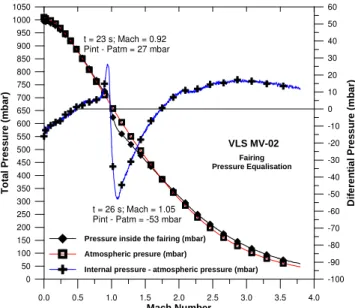
Figure 7 shows, for the time interval between launch and 55s, expressed as function of the flight Mach number, the pressure measured inside the fairing compared with the atmospheric pressure in the corresponding flight altitude
0.0 0.5 1.0 1.5 2.0 2.5 3.0 3.5 4.0 Mach Number
0 50 100 150 200 250 300 350 400 450 500 550 600 650 700 750 800 850 900 950 1000 1050
T
o
ta
l
P
re
s
s
u
re
(
m
b
a
r)
-100 -90 -80 -70 -60 -50 -40 -30 -20 -10 0 10 20 30 40 50 60
D
if
e
re
n
ti
a
l
P
re
s
s
u
re
(
m
b
a
r)
Pressure inside the fairing (mbar)
Atmospheric presure (mbar)
Internal pressure - atmospheric pressure (mbar) VLS MV-02
Fairing Pressure Equalisation
t = 23 s; Mach = 0.92 Pint - Patm = 27 mbar
t = 26 s; Mach = 1.05 Pint - Patm = -53 mbar
Figure 7. Pressure inside the fairing and atmospheric pressure as function of flight Mach number.
The atmospheric pressure was obtained from real trajectory reconstitution (Gomes & Costa e Silva, 1997) using the Standard Atmosphere (NASA-NOAA-USAF, 1976).
The pressure inside the fairing follows the variation of the atmospheric pressure with the altitude, being slightly higher up to approximately 22 s flight time, when it increases rapidly and reaches a difference of 2.7 kPa, compared with the atmospheric pressure. This difference is due to “an inertia” of the equalisation process. Later, the internal pressure drops more rapidly than the atmospheric pressure, showing now a difference of – 5.3 kPa. At this moment the fairing is fully evacuated. From this point the internal pressure becomes similar to the values presented by the standard atmosphere pressures.
By the determination of the size and location of the venting orifices it was established that the satellite compartment should have its internal pressure equalised so far as the difference between internal and atmospheric pressures would amount not more then ± 5.0 kPa, although the simulation of the equalisation process indicated a differential up to – 12.0 kPa in the transonic velocity regime (Eleutheriadis, 1994). This maximal value was not reached, and this is of advantage, due to a slightly different real flight trajectory compared with that used for estimations. The real flight trajectory presented lower velocities than the nominal.
Figure 8 shows the pressure values obtained with sensors
P. Moraes Jr. and A. L. Pereira
/ Vol. XXVII, No. 4, October-December 2005 ABCM
472
0
.0
0
0
.2
5
0
.5
0
0
.7
5
1
.0
0
1
.2
5
1
.5
0
1
.7
5
2
.0
0
2
.2
5
2
.5
0
2
.7
5
3
.0
0
3
.2
5
3
.5
0
3
.7
5
4
.0
0
Mach -4.0
-3.5 -3.0 -2.5 -2.0 -1.5 -1.0 -0.5 0.0 0.5 1.0 1.5 2.0
D
if
fe
re
n
ti
a
l
P
re
s
s
u
re
(
k
P
a
)
Pressure Tap 1
Pressure Tap 2
Pressure Tap 3
Figure 8. Pressures inside and outside the fairing. Pressure taps close to the venting orifice.
The variation of the internal pressure related to the atmospheric pressure is more evident during the flight phase corresponding to the transonic velocity regime. In the velocity regime, and already from Mach number close to 0.8, a flow region with supersonic velocities takes place over the cylindrical portion of the fairing, which is later closed by a shock wave near to the location of the venting orifices. This fact has been most probably the reason for the increase of the pressure inside the fairing as shown in figure 7 for the flight time equal to 23 s.
By increasing flight velocity and reaching the supersonic velocity regime a detached bow shock wave will appear upward of the fairing. The flow over the fairing cylindrical segment is completely supersonic and local shock waves will only be present in the boat-tail region of the fairing. Figure 9 illustrates these phenomena whose effects were shown in figure 7.
Figure 9. Schlieren pictures of the flow over the VLS fairing for Mach = 0.90 and Mach = 1.05.
Figure 9. (Continued).
Conclusions
Venting orifices were designed and placed over the fairing of the satellite compartment of the VLS with the aim to provide a equalisation of the internal pressure against the atmospheric pressure along the atmospheric flight of the vehicle. Results obtained through analysis and calculations as also high speed wind tunnel tests have allowed to design a system composed by 16 orifices of 25 mm diameter located in a section at the cylindrical segment of the fairing. This arrangement made possible the attendance of the equalisation criterion and design requirement, and has been later validated during the launch of the VLS second prototype, when pressure measurements inside and outside the satellite compartment were carried out. The flight measurements indicate that the venting orifices were right positioned and the equalisation process has been performed adequately.
References
Boscov, J., et all., 1990, “Development Status of the Brazilian VLS Satellite Launcher Program”, 17th International Symposium on Space Technology and Science, Tóquio, Japão, Mai 90
Eleutheriadis, André, 1994, Posicionamento e Dimensionamento de
Orifícios Equalizadores de Pressão para a Coifado VLS, CTA/IAE,
AED-590/51, Doc No. 590-600000/B7001, São José dos Campos-SP,Mar 1994
Gomes, R. M., Costa e Silva, E. C., 1997, “VLS-1 V02 – Operação Almenara. Relatório de Segurança de Vôo”, CTA/IAE, Rel No. 590-000000/F4017, São José dos Campos-SP, 27 Abr 2000
Johns, A. L., Jones, M. L., 1975, “Wind Tunnel Investigation of a Centaur Standard Shroud Compartment Vent from Mach Number of 0.70 to 1.96", NASA TM X-71759, Cleveland, USA, Aug
Moraes Jr., P., 1992, “Aerodynamic Design of the Brazilian Satellite
Launch Vehicle VLS", 18th ISTS - International Symposium on Space
Technology and Science, Kagoshima, Japan, 17-23 Mai 92
Moraes Jr., P., Neto, A. A., 1990, “Obtenção das Características
Aerodinâmicas do VLS via Ensaios em Túnel de Vento", 1° Simpósio
Brasileiro de Tecnologia Aeroespacial, São José dos Campos-SP, 27-31 Ago 90
Moraes Jr., P., Neto, A. A., 1990, "Aerodynamic Experimental Investigation of the Brazilian Satellite Launch Vehicle (VLS)", Anais do III Encontro Nacional de Ciências Térmicas - ENCIT 90, Itapema-SC, Dez 90
Moraes Jr., P., Pereira, A. L., 2000, “VLS/V02. Análise Pós-Vôo: Orifícios Equalizadores de Pressão da Coifa Principal”, MemoTec 026/ASE/2000, CTA/IAE, São José dos Campos-SP, 26 Mai 2000