Article
0103 - 5053 $6.00+0.00*e-mail: [email protected]
Pre-Concentration and Determination of Trace Uranium (VI) in Environments
using Ion-imprinted Chitosan Resin
via
Solid Phase Extraction
Yunhai Liu,*,a,b Xiaohong Cao,b Zhanggao Le,a,b Mingbiao Luo,a,b Wenyuan Xub and
Guolin Huangb
aKey Laboratory of Nuclear Resources and Environment (ECIT), Ministry of Education,
Nanchang 330013, P. R. China
bDepartment of Applied Chemistry, East China Institute of Technology, 56 Xuefu Road,
Fuzhou 344000, P. R. China
Foram preparadas resinas quitosana de ligação cruzada com impressão molecular de uranil e sem impressão, possuindo grupamentos quinolin-8-ol. Em todos os casos um efeito de impressão signiicativo foi observado na comparação do percentual de extração de urânio (VI). A resina com impressão molecular foi usada para pré-concentração extrativa de urânio (VI) em fase sólida antes de determinação espectrofotométrica. Variáveis experimentais que inluenciam a extração quantitativa de urânio (VI) foram otimizadas em método estático e em extração com coluna. A capacidade de retenção de urânio (VI) foi de 218 mg por g de resina, que é maior que a resina sem impressão molecular correspondente ou outra fase sólida adsorvente que possua grupamento quinolin-8-ol. O intervalo de pH ótimo encontrado foi 4,5-7,0. O urânio adsorvido foi fácil e quantitativamente eluido com HCl 1 mol L-1 (10 mL) sob uma vazão de 2 mL min-1. Estudos de
interferentes mostraram uma alta tolerância para diversos íons e espécies eletrolíticas. O limite de detecção foi de 2 µL L-1 e o intervalo de concentração linear de 5-100 µg L-1. A exatidão do
método foi testada com material padrão de referência de rocha de urânio. Além disso, o método foi aplicado para a determinação de urânio em amostras de solo contaminado e sedimento.
The uranyl-ion-imprinted and non-imprinted cross-linked chitosan resins possessing quinoline-8-ol moiety have been prepared. In all the cases, a signiicant imprinting effect was noticed on comparing percent extraction of uranium (VI). The resulting ion-imprinted resin was used for solid phase extractive preconcentration of uranium (VI) prior to its determination by spectrophotometry. Experimental variables that inluence the quantitative extraction of uranium (VI) were optimized by both static and column methods. The retention capacity found for uranium (VI) was 218 mg g-1 of
resin which is higher than the corresponding non-imprinted resins and other solid phase extraction sorbents possessing quinoline-8-ol moiety. The optimum pH range was 4.5-7.0. Uranium adsorbed was easily and quantitatively eluted with 1 mol L-1 HCl (10 mL) at a low rate of 2 mL min-1.
Interference studies showed a high tolerance of diverse ions and electrolyte species. The limit of detection was 2 µg L-1 and the dynamic linear range was 5-100 µg L-1. The accuracy of the
developed method was tested with one uranium ore standard reference material. Furthermore, the proposed method was successfully applied for the determination of uranium in contaminated soil and sediment samples.
Keywords: chitosan, quinoline-8-ol, ion-imprinted resin, solid phase extraction, uranium (VI)
Introduction
Uranium finds extensive applications as nuclear fuel in power plants and is widely distributed in the environment and occurs at low levels in water, soil, rocks,
plants and animals. Similar to lead, uranium and its compounds are highly toxic and cause acute cytotoxicity and phenotypic effects on rat and human osteoblasts, the
cells responsible for bone formation.1 According to World
15 and 30 ng mL-1, respectively.2 Uranium concentrations
in natural environment are usually very low. Thus, the pre-concentration technique is prerequisite for the accurate determination of uranium at low concentration level. Many methods have been developed for an effective separation and pre-concentration of uranium. Procedures based on
ion exchanges,3 solvent extractions,4 and solid phase
extractions (SPEs)5 are among them. Recently, SPE has
come to the forefront due to its several merits over other pre-concentration techniques: high enrichment factors; low intrinsic costs; low solvent consumption; shorter processing times; simpler processing procedures; ease of automation and most signiicantly environmentally friendlier.
Commercially available solid phase sorbents with metal-retaining functional group, such as iminodiacetate and dipentylpentylphosphonate have been developed for
the collection/pre-concentration of uranium.6-8 Moreover,
some researchers synthesized several kinds of sorbents containing such functional groups, as amidoxime, salicylic acid, dihydroxyazobenzene and maleic acid and used for
the pre-concentration of uranium.9 However, these sorbents
were found to have some serious problems such as a low adsorbing ability and a large amount of acidic waste water. Chitosan, obtained through partial chitin deacetylation, is one of excellent base substances for novel sorbents synthesis, provided by the presence of the numerous functional amino groups for chemical modiications. Compared with the synthetic polymer materials, such as poly(styrene-divinylbenzene), polyethylene and polyurethane, the
chitosan has several advantages:10 (i) high hydrophilicity
due to hydroxyl groups of glucose units; (ii) presence of
a large number of primary amino and hydroxyl groups;
(iii) lexible structure of the polymer chain. Inoue and
Baba11 synthesized various types of chelating resins with
cross-linked chitosan, which contain such group as oxine, pyridine, thiophene, thioether, carboxylate, iminodiacetate
and EDTA. Recently, Oshita and co-workers12 synthesized
several novel chitosan resins derivatized with serine moiety,
phenylarsonic acid moiety,13 iminodi(methylphosphonic
acid) moiety14 and 3,4-dihydroxybenzoic acid15 for
collection/pre-concentration of uranium, which offered excellent uranium retention capacities of 49.4, 83, 117.5
and 330 mg g-1 resin, respectively.
Quinoline-8-ol moiety has been immobilized in
amberlite XAD-416 and anchored in chloromethylated
polymeric resin beads,17 which offered uranium retention
capacities of 2.74 and 120.3 mg g-1, respectively. Inoue
and co-workers have prepared Ga templated quinoline-8-ol chitosan and investigated its adsorption of Mo(IV),
V(IV), In(III), Al(III), Zn(II), Fe(II), Cd(II), and Ga(III).18
However, there is no reports on the chitosan resin possessing
quinoline-8-ol moiety, which is used as solid phase sorbents for the pre-concentration of uranium.
In this work, to improve the pre-concentration of trace uranium in environmental samples before the spectrophotometric measurement, an ion-imprinted
technology19 was employed. We have synthesized the
uranyl-ion-imprinted and non-imprinted cross-linked chitosan resins possessing quinoline-8-ol moiety. The ion-imprinted chitosan resin shows higher retention capacities of uranium than non-ion-imprinted chitosan resin and other polymeric resins modiied with quinoline-8-ol. The pre-concentration of uranium (VI) using the ion-imprinted cross-linked chitosan resin via solid phase extraction was investigated. The validity of the developed pre-concentration method was tested by analyzing one uranium ore standard reference material for uranium. Further, the possible use of the proposed method for the determination of uranium in soil and sediment samples was investigated.
Experimental
Reagents and chemicals
Chitosan was supplied by Zhejiang Yuhuan Chemical Engineer Co., the deacetylated degree of which was about 90%. 5-Chloromethyl-8-quinolinol was obtained from Aldrich. All other reagents and solvents were of analytical grade and used without further puriication.
Figure 1. Scheme for preparation of uranyl IIC-HQ-CTS resin.
O OH CH2 NH2 OH n HQ-MeCl
Et3N, H2O
O OH CH2 NH OH O n N OH CH2
HQ-type Chitosan (HQ-CTS) Chitosan
UO22+ N O CH2 N O CH2 O H H O H H epichlorohydrin N O CH2 N O CH2 O H H O H H Leaching N OH CH2 N OH CH2
Ion-imprinted Cross-linked HQ-type Chitosan (IIC-HQ-CTS)
UO22+
Apparatus
Fourier transform infrared (FT-IR) spectra were obtained using a Nicolet 670 FT-IR spectrometer (USA) and the samples were ground and pressed into KBr pellets for analysis. The BET surface area was measured by nitrogen adsorption/desorption at 77 K using a QuadraSorb SI surface area after degassing the samples at 100 °C for 10 h. Carbon and nitrogen were determined using vario EL III Elemental analyzer (GER). A 721 model UV-Vis spectrophotometer (Shanghai Precision Instruments Co) was used to determine UVI as UVI-arsenazo III complex.
A PHS-25 model digital pH meter (Shanghai Precision Instruments Co.) was used to determine the pH values of solutions.
Synthesis of ion-imprinted and non-imprinted and cross-linked HQ-type chitosan resins
The quinoline-8-ol type chitosan was synthesized in
a similar manner to the previous work.18,20 Briely, a mass
of 5 g of chitosan particles was dissolved in 500 mL of
15% v v-1 acetic acid solution with stirring. Then, a mass
of10 g of 5-chloromethyl-8-quinolinol hydrochloride and 30 mL of dry triethylamine were added. The reaction mixture was reluxed at 75 °C for 36 h. After the reaction, the HQ-type chitosan resin was iltered and washed each three times with ethanol and ether to remove unreacted 5-chloromethyl-8-quinolinol. The IR adsorption frequency
assignment to the THQ-type chitosan was 1595 cm-1
(corresponding to C=N of the quinoline ring), whose frequency depicted the additional bands compared with chitosan itself. The IR spectra of HQ-type chitosan showed
N−H and O−H stretching in 3415 cm-1 (corresponding to
3432 cm-1 of chitosan), which indicated that new bonds
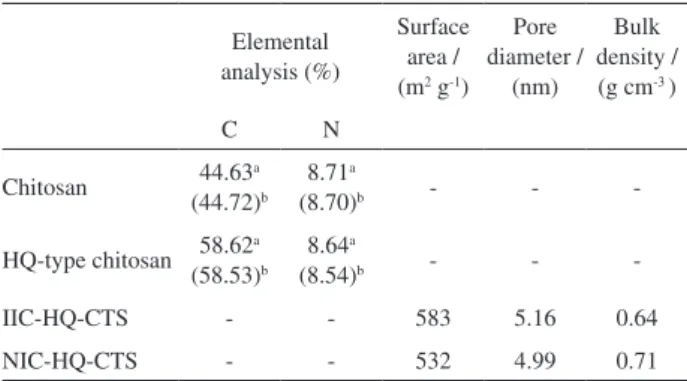
between N and quinoline ring were developed. These bands are due to the ring of quinoline introduced into the chitosan as a base material. Furthermore, the results of elemental analysis (Table 1) conirm the IR spectral data described above, which demonstrate the successful preparation of THQ-type chitosan.
About 2 g of HQ-type chitosan resin was dissolved in
100 mL of 5 % v v-1 acetic acid and 4 g of UO
2(NO3)3·6H2O
was added slowly with stirring at room temperature. The solution above described was poured into the dispersion medium, which was composed of toluene, petroleum
ether (1:1, v v-1) and an emulsifier Tween-80®. The
dispersion medium was stirred with a mechanical stirrer at 1000 rpm at room temperature. Then, 30 min later, 2 mL epichlorohydrin was added to the reaction mixture. The reaction mixture was stirred for further 5 h. After the
reaction, the ion-imprinted cross-linked HQ-type chitosan resin (IIC-HQ-CTS) was collected by iltering and washed consecutively with ether and acetone three times. The
imprint ion, UO22+ was leached out from 2 g of chitosan
resin obtained above by stirring with 100 mL of 5.0 mol L-1
HCl for 6 h. The obtained product was then dried in an oven at 40 °C for 24 h.
The synthesis of the corresponding non-imprinted cross-linked HQ-type chitosan resin (NIC-HQ-CTS) was carried out using the same procedures as those described above, except imprinted ion. These NIC-HQ-CTS resins were also subjected to the same pretreatment as that of IIC-HQ-CTS.
Procedure of batch “static” method
A sample solution containing 2-200 µg of uranium (VI) in a volume of 10-1000 mL was taken and its pH was
adjusted to ca. 5.0 by adding sodium acetate-acetic acid
buffer. The resins (0.1 g) were added to the above solution and stirred for 1 h at room temperature. Then, they were iltered before the pre-concentrated metal ions were eluted
with 10 mL of 1.0 mol L-1 HCl for 10 min and determined
spectrophotometrically using Arsenazo III method.21
The eluent was taken and 5 mL of 1:1 HCl and 1.0 mL
0.1% m v-1 arsenazo III were added and diluted to 25 mL.
The absorbance of uranium (VI)-arsenazo III complex was measured at 656 nm.
Procedure of column “dynamic” method
Around 0.1 g of resins was wetted in 5 mL ethanol and 5 mL deionized water was added. The wetted resin was packed into the glass column (size: 4.0 mm diameter and 10 cm length) and washed three times with 50 mL deionized water. A volume of 500 mL of sample solution of uranium (VI) was taken and the pH adjusted to 5.0 and passed through the above column at a low rate Table 1. Elemental analysis and properties of chitosan resins
Elemental analysis (%)
Surface area / (m2 g-1)
Pore diameter /
(nm)
Bulk density / (g cm-3 )
C N
Chitosan 44.63 a (44.72)b
8.71a
(8.70)b - -
-HQ-type chitosan 58.62 a (58.53)b
8.64a
(8.54)b - -
-IIC-HQ-CTS - - 583 5.16 0.64
NIC-HQ-CTS - - 532 4.99 0.71
of 2.0 mL min-1 using a peristaltic pump. The metal
ions were eluted with 10 mL of 1.0 mol L-1 HCl and
determined spectrophotometrically using the method as mentioned above.
Procedure for the analysis of standard, soil and sediment samples
About 0.10-0.50 g of sample was treated with 5 mL
concentrated HF and 1.0 mL concentrated HNO3 at 160 °C
on sand bath till the mixture became dry. The mixture was cooled and treated with 10 mL nitrohydrochloric acid (aqua regia) on sand bath till the mixture was dry. The residue was then cooled, dissolved in 50 mL of deionized water. The amount of uranium in the sample was determined using the procedure of column “dynamic” method.
Results and Discussion
Properties of chitosan resins
The IIC-HQ-CTS and NIC-HQ-CTS resins were successfully prepared applying the procedure described in experimental section. As listed in Table 1, the Brunauer-Emmett-Teller (BET) analyses indicate that the largest surface areas for IIC-HQ-CTS and
NIC-HQ-CTS are 583 and 532 m2 g-1, respectively. The obtained
resins have large speciic surface areas and low bulk density which demonstrate the mesoporous structures of these resins.
Inluence of solution pH on uranium (VI) extraction
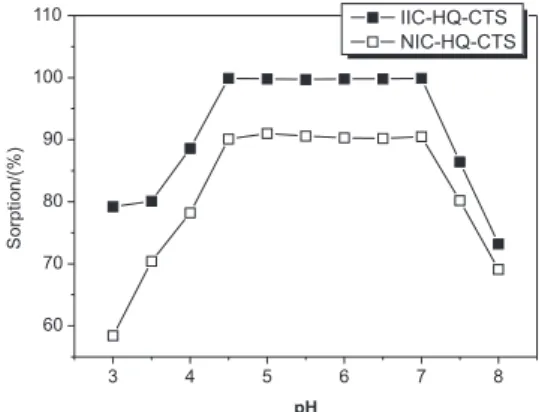
The inluence of solution pH on uranium (VI) extraction was investigated by the batch “static” method. A series of solution containing 100 µg of uranium (VI) ion in a volume of 1000 mL was taken and the pH of these solutions was adjusted between 3.0 and 8.0. The results indicated that the pre-concentration of uranium (VI) is constant and
maximum in the pH range 4.5-7.0 (Figure 2). At pH ≤ 4.5,
the =N– and –OH functionalities in quinoline-8-ol which may participate in chelation were protonated leading to the depression in the percent pre-concentration due to the electrostatic repulsion with the positively charged uranyl
species.22 At pH > 5, various species of uranium (VI) were
detected which are not responsible for uranium uptake by
resins.23 Hence the pH was adjusted to 5.0 in all subsequent
studies. Furthermore, as seen in Figure 2, the percent pre-concentration of IIC-HQ-CTS is slightly higher than that of NIC-HQ-CTS in all pH conditions, which can be attributed to the imprinting effect.
Retention or sorption capacity for uranium (VI)
The retention capacities of the chitosan resins were investigated within a wide range of initial metal ion
concentration (10-200 mg L-1). As it can be seen in
Figure 3, the quantity of uranium (VI)retained augment
with increasing amount of uranium (VI) taken initially and
reaches a plateau in the range 180-200 mg L-1. Moreover,
compared to the non-imprinted resin, the ion-imprinted HQ-type chitosan resins offer higher retention capacities. The maximum retention capacities of IIC-HQ-CTS and
NIC-HQ-CTS resin were found to be 218 and 136 mg g-1,
respectively. Again, as in the case of above section, it can be explained by an imprinting effect. More signiicantly, these results indicated that the improvement of uranium (VI) extraction is achievable by an imprinting procedure for the functionalized chitosan. Furthermore, the retention capacities of ion-imprinted or non-imprinted HQ-type chitosan resins in the present study are higher than other
quinoline-8-ol impregnated16 and anchored17 polystyrene
divinylbenzene resins, suggesting the advantages of chitosan over other synthetic base materials.
Kinetics of uranium (VI) extraction
To determine the rate of loading of UVI on the resin,
batch “static” experiments were carried out in pH 5.0 solutions using 0.1 g resins stirred with 250 mL of metal ion solution. At predetermined intervals, aliquots of 5 mL solution were collected for analysis. The loading
half-time (t1/2) is deined as the time in which resins attain 50%
saturation with UVI. From the kinetics of IIC-HQ-CTS and
NIC-HQ-CTS, it was observed that an equilibrium time of about 5 min was required for the maximum sorption. The loading half-times (t1/2) of the chitosan resins were
both about 1.5 min. The faster adsorption rate of UVI on
better accessibility of the metal ions to the chelating sites in the chitosan, which is due to the good hydrophilicity of chitosan itself .24
Optimization of experimental variables in column methods
In order to optimize the parameters that inluence the enrichment of uranium (VI) from dilute aqueous solution, the column “dynamic” method was carried out in view of the quantitative recovery. A series of solution containing
100 µg UVI ion in 500 mL were taken and the pH of these
solutions was adjusted to ca. 5.0 and the recommended
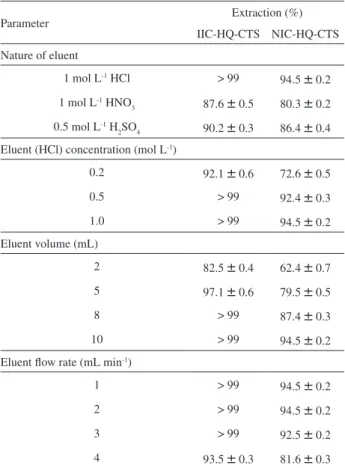
column procedure was followed. The results obtained using IIC-HQ-CTS and NIC-HQ-CTS resins under different eluents, eluent concentrations, eluent volumes and eluent low rates are summarized in Table 2. As it can be seen in Table 2, hydrochloric acid alone promotes quantitative elution of previously pre-concentrated uranium (VI) for
IIC-HQ-CTS resin in a concentration of 0.5 mol L-1.
Hence, 1 mol L-1 HCl was employed in subsequent studies
in order to ensure complete elution even at higher amount of metal ion. Also seen from Table 2, an eluent volume as low as 8 mL was enough to offer quantitative recovery using IIC-HQ-CTS resin. Therefore, 10 mL eluent volume was employed in subsequent studies. The optimum eluent
low rates obtained ranged from 1.0 to 3.0 mL min-1, and
an increase in low rate resulted in a decrease in extraction due to insuficient contact time between the resin and the
metal ion solution. A low rate of 2 mL min-1 was employed
in subsequent studies so as to ensure quantitative recovery even at higher amount of metal ion and avoid extended analysis times. Once again, imprinting effect was evident in all the instances. Under these optimum conditions, quantitative pre-concentration and elution of uranium (VI) was obtained for aqueous phase volumes varying in the range 10-500 mL, which shows that enrichment or
pre-concentration factor was ca. 50.
Resins stability and reusability
The regeneration of resins may be important for keeping the process costs down and offering the possibility of recovering the metal ion extracted from the solution. For this purpose, it is desirable to desorb the sorbed metal ions
and to regenerate the resin for another cycle of application.10
For chitosan resins solubilizing in acid aqueous solution, cross-linking opens the possibility of developing stability and reproducibility.25 Here, to evaluate resin stability and
res-usability, the uranium (VI) was loaded and eluted several Figure 3. Retention capacities of IIC-HQ-CTS and NIC-HQ-CTS resin
(pH 5.0, 500 mL aqueous solution).
Figure 4. Effect of equilibration time on the adsorption of uranium (VI) (pH 5.0, uranium (VI) concentration: 50 mg L-1, 250 mL).
Table 2. Effect of various parameters on the percent of extraction of uranium with IIC-HQ-CTS and NIC-HQ-CTS by column method
Parameter Extraction (%)
IIC-HQ-CTS NIC-HQ-CTS
Nature of eluent
1 mol L-1 HCl > 99 94.5 ± 0.2
1 mol L-1 HNO
3 87.6 ± 0.5 80.3 ± 0.2 0.5 mol L-1 H
2SO4 90.2 ± 0.3 86.4 ± 0.4 Eluent (HCl) concentration (mol L-1)
0.2 92.1 ± 0.6 72.6 ± 0.5
0.5 > 99 92.4 ± 0.3
1.0 > 99 94.5 ± 0.2
Eluent volume (mL)
2 82.5 ± 0.4 62.4 ± 0.7
5 97.1 ± 0.6 79.5 ± 0.5
8 > 99 87.4 ± 0.3
10 > 99 94.5 ± 0.2
Eluent low rate (mL min-1)
1 > 99 94.5 ± 0.2
2 > 99 94.5 ± 0.2
3 > 99 92.5 ± 0.2
times. The retention capacities of the IIC-HQ-CTS and NIC-HQ-CTS resins decreased less than 2% over 20 loading-elution cycles, indicating the possible reuse of resins for practical applications. Furthermore, it was observed that the retention capacities of the resins under ambient conditions remained practically unchanged after storing for 60 days.
Breakthrough studies
Breakthrough capacity is signiicant and applied in SPE applications as it offers actual working capacity of the resin in the column. The pre-concentrating abilities of the obtained resins were assessed by using a series of sample volumes
containing 10 µg mL-1 uranium (VI) ion passed through the
preconditioned column at the optimum conditions described above. Salient breakthrough curves for uranium (VI) are shown in Figure 5. As seen, breakthrough capacities of the IIC-HQ-CTS and NIC-HQ-CTS resins for uranium (VI)
were 62,400 and 44,800 µg mL-1, respectively. Considering
the relation of breakthrough points of these two chitosan resins, it is suggested that an appealing feature of greater afinity for uranium (VI) was attainable by the ion imprinting.
Statistical and calibration parameters for column method
The calibration parameters for the enrichment of uranium (VI) in the proposed IIC-HQ-CTS method using the column technique were investigated under the optimum conditions described above. The calibration curve was
linear over the concentration range 5-100 µg L-1 of uranium.
The limit of detection (LOD) deined as the metal ion concentration giving a signal equal to three times the standard deviation of the blank signal divided by the slope of the
analytical calibration curve was found to be 2.0 µg L-1. The
precision of the proposed method was investigated using a 20 µg metal ion present in 1.0 L of solution, which gave a mean absorbance of 0.039 and expressed as RSD: 1.96 %. The linear equation with regression is:
A = 0.00206C - 0.0021 R2 = 0.9996
where A is the peak height absorbance, C is the concentration
in µg L-1 , and R is the regression coeficient.
Tolerance of electrolytes and diverse ions
Considering the feasibility of complexes formation between chloride, sulfate, phosphate anions and several metal ions including uranium (VI), the eficiency of the IIC-HQ-CTS resin in binding metal ions must be checked for possible reduction in extraction. Under the conditions of optimum pre-concentration of uranium (VI), the effects
of NaCl, NaNO3, Na2SO4, CaCl2, NaSCN, KCl, EDTA,
NH4Cl, Na3PO4, and Na2CO3 on the IIC-HQ-CTS resin were studied using the recommended column method for 1 µg mL-1 U (VI) solution in a volume of 100 mL.
The tolerance of electrolytes was summarized in Table 3. Analogously, the effects of several cations (which are likely to co-exist with uranium (VI) in its minerals ores) were also investigated, and the results are summarized in Table 3. Clearly, the high tolerance of electrolytes and diverse ions is due to the speciic binding to the uranium (VI) ions in the imprinted resin.
Table 3. Tolerance limits of electrolytes and cations on the pre-concentration of UVI on the IIC-HQ-CTS resin
Electrolytes/Cations Compound Tolerance limits / (mg L-1)
NaCl NaCl 11,688
NaNO3 NaNO3 16,998
Na2SO4 Na2SO4 21,306
CaCl2 CaCl2 11,098
NaSCN NaSCN 8,107
KCl KCl 14,910
EDTA EDTA 29,225
NH4Cl NH4Cl 8,024
Na3PO4 Na3PO4 4,918
Na2CO3 Na2CO3 5,299
Fe(III) FeCl3 15
Co(II) CoSO4•7H
2O 60
Ni(II) NiCl2•H2O 50
Al(III) Al(No3)3•9H2O 75
Cu(II) CuSO4•5H2O 50
Mn(II) MnSO4•H2O 75
Pb(II) Pb(NO3)2 60
Zn(II) ZnSO4•7H2O 70
Th(IV) Th(NO3)4•6H2O 40
Analysis of soil samples and standard uranium ore samples
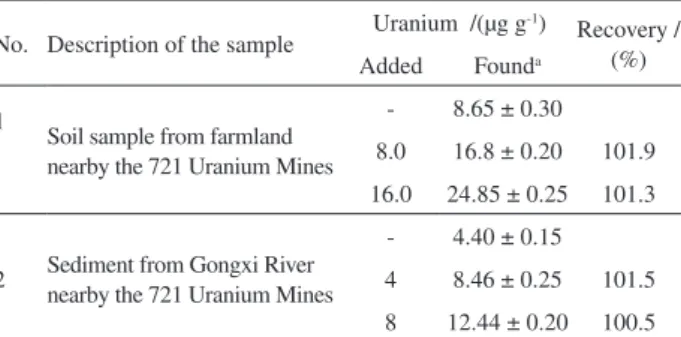
To verify applications and validations of the proposed method, one standard reference material, soil collected from farmland and sediment collected from the Gongxi River were subjected to dissolution, pre-concentration and determination. The results obtained for the standard reference material are shown in Table 4, and those for the soil sample and the sediment sample are shown in Table 5. The results obtained are in good agreement with the certiied values and the recoveries of spiked uranium were quantitative. Thus, these results indicated that the SPE pre-concentration method with IIC-HQ-CTS resin developed in the present work is accurate, simple and low cost for analyzing ore, soil and sediment samples containing traces of uranium.
Conclusions
Solid phase extraction with an ion-imprinted cross-linked HQ-type chitosan resin provides an effective pre-concentration of uranium (VI). In all cases, a signiicant imprinting effect was noticed when comparing the eficiency of extractions of uranium (VI) with ion-imprinted and corresponding non-imprinted chitosan resins. The ion-non-imprinted cross-linked chitosan resins, IIC-HQ-CTS gave higher retention capacity
( 218 mg g-1), quantitative recoveries in the pH range 4.5 to
7.0, and elevated tolerance to electrolytes and diverse ions. The Table 4. Analysis of uranium ore standard reference material (GBW04108)
No.
Uranium added / (µg g-1)
Uranium found / (µg g-1)
Recovery / (%) Present
methoda
Certiiedb
1 None 82 ± 0.50 79
-2 60 140 ± 0.30 101.7
3 120 202 ± 0.30 102.5
a Average and standard deviation from triplicate runs carried out with a single column; b Certiied values reported by Centre of China Reference Materials.
Table 5. Determination of uranium(VI) in soil and sediment samples
No. Description of the sample Uranium /(µg g -1)
Recovery / (%) Added Founda
1
Soil sample from farmland nearby the 721 Uranium Mines
- 8.65 ± 0.30
8.0 16.8 ± 0.20 101.9
16.0 24.85 ± 0.25 101.3
2 Sediment from Gongxi River nearby the 721 Uranium Mines
- 4.40 ± 0.15
4 8.46 ± 0.25 101.5
8 12.44 ± 0.20 100.5
a Average and standard deviation from triplicate run carried out with a single column.
IIC-HQ-CTS resins can be reused as they are unaffected even after 20 cycles demonstrating a high mechanical and chemical strength. The proposed column method offers low detection limits and is more precise (as RSD is 1.96 %). Furthermore, the accuracy of the developed SPE method was veriied by analyzing one uranium ore standard reference material for uranium (VI), and the proposed SPE method was applied to the determination of uranium in soil and sediment samples. Hence, the SPE preconcentration method with an ion-imprinted cross-linked HQ-type chitosan resin provides a simple, accurate and low cost procedure for the determination of trace amounts of uranium(VI) in soil , ore and sediment samples.
Acknowledgments
This work was financially supported by National Natural Science Foundation of China (Grant No. 20862001), National Defense Basic Research Foundation of China (Grant No. A3420060146), Provincial Natural Science Foundation of Jiangxi (Grant No. 2008GQH0051) and Sci. & Tech. Project of Jiangxi Provincial Department of Education (Grant No. GJJ09528).
References
1. Milgram, S.; Carrière, M.; Thiebault, C.; Malaval, L.; Gouget, B.; Toxicology2008, 250, 62.
2. WHO: Guidelines for Drinking Water Quality, 2nd ed.,
Addendum to vol. 2, Health Criteria and Other Supporting Information, WHO/EOS/98-1, Geneva, 1998.
3. Elnaggar, I. M.; Shabana, E. I.; Eldessouky, M. I.; Talanta1992,
396, 53.
4. Kannan, S.; Deb, S. B.; Gamare, J. S.; Drew, M. G. B.;
Polyhedron2008, 272, 557.
5. Rao, T. P.; Preetha, C. R.; Sep. Purif. Rev.2003, 32, 1. 6. Miura, T.; Morimoto, T.; Hayano, K.; Kishimoto, T.; Bunseki
Kagaku2000, 49, 245.
7. Perma, L.; Betti, M.; Moreno, J. M. B.; Fuoco, R.; J. Anal. At. Spectrom.2001, 16, 26.
8. Carter, H. E.; Warwick, P.; Cobb, J.; Longworth, G.; Analyst 1999, 124, 271.
9. Preetha, C. R.; Rao, T. P.; J. Radioanal. Nucl. Chem.2006, 267, 265.
10. Crini, G.; Prog. Polym. Sci.2005, 30, 38.
11. Inoue, T. T. K.; Baba, Y.; Chitosan: A Versatile Biopolymer for Separation, Puriication and Concentration of Metal Ions, CRC Press: New York, 2007.
12. Oshita, K.; Oshima, M.; Gao,Y.; Lee, K. H.; Motomizu, S.;
Anal. Chim. Acta2003, 480, 239.
14. Yamakawa, S.; Oshita, K.; Sabarudin, A.; Oshima, M.; Motomizu, S.; Bunseki Kagaku2004, 53, 1039.
15. Sabarudin, A.; Oshima, M.; Takayanagi, T.; Hakima, L.; Gao, Y. H.; Motomizu, S.; Anal. Chim. Acta2007, 581, 214. 16. Gladis, J. M.; Rao, T. P.; Anal. Bioanal. Chem.2002, 373, 867. 17. Praveen, R. S.; Metilda, P.; Daniel, S.; Rao, T. P.; Talanta2005,
67, 960.
18. Inoue, K.; Hirakawa, Y. H.; Ishikawa, Y.; Sep. Sci. Technol. 1996, 312, 273.
19. Metilda, P.; Gladis, J. M.; Rao, T. P.; Anal. Chim. Acta2004,
512, 63.
20. Lang, H. Y.; Zhang, X. J.; Wei, Y. F.; Chem. J. Chinese Universities2004, 25, 770.
21. Song, J. R.; The Chemical Analysis of Uranium Ore; Atomic Energy Press: Beijing, 2006.
22. Atia, A. A.; Hydrometallurgy2005, 80, 13.
23. Brynda, M.; Wesolowski, T. A.; Wojcichowski, K.; J. Phys. Chem. A2004, 108, 5091.
24. Gao,Y.; Oshita, K.; Lee, K. H.; Oshima, M.; Motomizu, S.;
Analyst2002, 127, 1713.
25. Wan Ngah, W. S.; Endud, C. S.; Mayanar, R.; React. Funct. Polym.2002, 50, 181.
Received: April 7, 2009