Article
*e-mail: [email protected]
Electron Energy-Loss Cross Sections for the Chemical Bond Overlap Plasmon
of the Hydrogen Molecule
Oscar L. Malta, Renaldo T. Moura Jr.* and Ricardo L. Longo
Departamento de Química Fundamental - CCEN, Universidade Federal de Pernambuco, Cidade Universitária, 50740-540 Recife-PE, Brazil
Examinamos a possibilidade de detectar o plásmon da região de recobrimento da ligação química (CBOP) da molécula de hidrogênio através do espalhamento inelástico de elétrons. Foi previsto que o CBOP absorve e espalha eicientemente a radiação eletromagnética acima do limiar de ionização molecular para o caso dos halogenetos de metais alcalinos. Para a molécula de hidrogênio, a natureza quadrupolar da seção de choque do CBOP fornece valores de seção de choque para perda de energia que dependem da energia do feixe de elétrons incidente e um comportamento angular que é totalmente distinto da ionização usual, das transições inter-bandas e dos processos dissociativos. Algumas relações obtidas anteriormente entre o CBOP e a polarizabilidade da região de recobrimento sugerem ser essa grandeza uma ferramenta teórica promissora na quantiicação da covalência em ligações químicas.
We examine the possibility of detecting the chemical bond overlap plasmon (CBOP) of the hydrogen molecule by electron inelastic scattering. The CBOP has been predicted to eficiently absorb and scatter electromagnetic radiation above the molecular ionization threshold in the cases of alkali halides. For the hydrogen molecule the quadrupole nature of the CBOP energy-loss cross section leads to cross section values with impacting electron energy dependence and an angular behavior which are totally distinguishable from the usual ionization, inter-band transitions and dissociation processes. Previously established relationships between the CBOP and the polarizability of the overlap region suggest this an a promising theoretical tool for quantifying covalency in the chemical bond.
Keywords: energy loss, bond overlap plasmon, H2, electron scattering, covalency
Introduction
In a relatively recent attempt to obtain a deeper insight on covalency in lanthanide compounds, the concepts of chemical bond overlap polarizability (OP) and ionic speciic valence (ISV) have been introduced.1 This has allowed the
deinition of a covalency scale and a description of ligand ields in coordination compounds in terms of a potential that may be treated non phenomenologically when charge factors, appearing in the simple overlap model,2 are
identiied with the ligating atoms ISV’s. As far as each pair lanthanide ion-ligating atom is considered as a diatomic-like molecule, these charge factors are a simple function of the chemical bond force constant, internuclear distance and LUMO-HOMO energy difference.
The OP and ISV concepts have also been explored in a more general context outside the scope of ligand ield theory. They have proven to be useful in the case of diatomic molecules, allowing to establish a new covalency scale in excellent agreement with Pauling’s scale3,4 and analytically
quantiiable in terms of the OP. Relevant questions could be raised on possible relationships between macroscopic properties of materials and these concepts. Thus, for example, a good correlation has been found between the non-linear index of refraction (n2) and the OP.4 More
recently, a proposal in which the overlap region is regarded as a localized plasmon-like charge distribution (chemical bond overlap plasmon–CBOP), characterized by the OP, has raised the question on the possibility of absorption and inelastic scattering of radiation by the overlap region, above the irst ionization threshold.5 Predicted oscillator strengths
soft-X-rays spectral regions. An interesting aspect is that, formally, oscillation modes corresponding to σ and π bonds can be distinguished by these processes, on the grounds of their quite distinct electronic clouds as, for instance, in the carbon monoxide molecule.
In the present work we calculate, within a Born-type approximation, the electron energy-loss cross section for the CBOP of the H2 molecule as a function of the incident electron energy and scattering angle. The aim is to examine how this inelastic scattering cross section compares with the cross section values for processes involving bound-to-bound (inter-band) transitions, ionization and dissociation. An interesting feature of the present model and calculations is that no molecular continuum wave functions are involved.
Results and Discussion
Electron energy-loss cross sections for the CBOP
Chemical bond overlap plasmon
The CBOP theory has been developed in reference 1 as a consequence of the concepts of overlap polarizability and ionic speciic valence introduced in reference 1. In this subsection we briely present the main points of the theory and their application to the case of the H2 molecule.
The overlap polarizability, αOP, is given by1
(1)
where
(2)
with Sξ,ζ being the overlap integral between orbitals |ξ〉 and |ζ〉 involved in the formation of a given chemical bond. Distinguishing between σ and π bonds is a matter of taking the appropriate sum over valence shell orbitals in equation 2 for each case. R is the internuclear distance, ∆E is the energy difference between the LUMO and HOMO associated with the chemical bond, and e is the elementary charge.
The overlap charge, q, is postulated to satisfy the following relations:
(3)
and
(4)
where k is the force constant of the chemical bond and the ionic speciic valence, v, is given by
(5)
The theory also postulates that the CBOP excitation frequency, ω0, is given by the harmonic oscillator behavior according to
(6)
where
(7)
and me being the electron mass. Thus, the CBOP may act as an open scattering channel.
Electron energy-loss cross sections
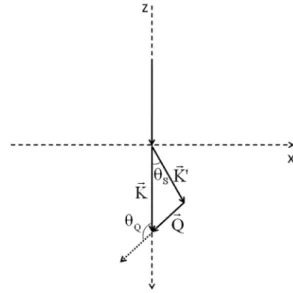
The inelastic scattering process by the CBOP is schematized in Figure 1. An incident electron on the z axis, with wave vector K→, hits a target molecule, considered as a spherical system located at the origin of the reference frame, and is scattered with a wave vector K→’. From the addition theorem for spherical harmonics the interaction Hamiltonian between an incident electron and the CBOP is given by
(8)
where the position vector r→’ stands for the overlap region
and r→ stands for the impacting electron. It is assumed that
r’ < r.
The scattering cross section, in a unitary interaction volume, per scattering solid angle is given by6
(9)
where the total initial and inal wave functions are expressed as
(10)
and
(11)
where |0〉 and |1〉 indicate the initial and inal state of the CBOP. Conservation of energy requires that
(12)
ħω0 being the CBOP energy.
Since the dipole moment of the excited CBOP vanishes for A2-type molecules, the relevant term in the expansion in equation 8 corresponds to t = 2 (the quadrupole term). The matrix element in equation 9 reduces to
(13)
where Q→ = K→ – K→’ . Using the partial waves expansion
(14)
where j(Qr)is a spherical Bessel’s function, equation 13 becomes
(15)
The orthonormality relation for the spherical harmonics has been used in the above equation. An interesting feature is that the radial integral involving the spherical Bessel’s function in this equation is independent of Q, having a value equal to 1/3. Evaluation of the matrix element given by equation 15 is not an easy task due to the dificulty in evaluating the p-spherical component of the quadrupole transition moment of the CBOP. This dificulty can be considerably facilitated if this p-dependent quadrupole transition moment is replaced by an average quadrupole moment of the CBOP, M(2). This approximation is
better justiied on the basis of the rotational degrees of freedom of the target molecule. Thus, equation 15 may be approximated as
(16)
The quadrupole contribution to the differential cross section in equation 9 is then given by
(17)
where E is the kinetic energy of the incident electron. The angular dependence of the r.h.s. of equation 17 is better analyzed if the following relation is used:7
(18)
where ( ) is a 3-j symbol. The cross section is totally symmetric with respect to the azimuthal angle φQ. Therefore, the r.h.s. of equation 17 may be replaced by an average over φQ and, from equation 18, it is not dificult to see that the summation over the product of spherical harmonics reduces to 5/4π, giving
(19)
The total cross section in a scattering solid angle speciied by the position and characteristics of the detection instrument is then given by
(20)
The distance from the target molecule to the detection instrument and its aperture deine the angles ∆φ = φ2 – φ1 , θ1 and θ2. This cross section has a maximum for a scattering angle, θs (between θ1 and θ2), equal to π/2.
Numerical estimates
In order to discuss the important features of the cross section given by equation 20 an estimate of the CBOP average quadrupole moment is needed. The quadrupole moment of the H2 molecule has been estimated to be 0.22 Å2.8 Thus, it is reasonable to assume (in cm2) that
(21)
The overlap integral between the two 1s orbitals is
(22)
for R in a0 and with ζ being the orbital exponent in a0–1.
Using R = 0.74 Å = 1.40 a0 and ζ = 1.0 a0–1 we ind ρ = 0.753.
Considering the force constant, k = 5.1 × 10⁵ dyne cm–1,10
and v = 1, the CBOP excitation energy, from equations 6 and 7, is found to be 18 eV, which is ca. 2.5 eV above
the ionization threshold of the H2 molecule. This result should be considered as a lower bound value, since if the orbital exponent is optimized,11 at the equilibrium distance,
1.42 a0, it is equal to 1.17 a0–1, so that ρ = 0.680 and the CBOP excitation energy becomes 19 eV. In addition, the valence bond treatment can be improved by including the ionic contribution (ψI) to the Heitler-London covalent function (ψC). Indeed, if the covalent and ionic functions are non-orthogonal, the optimized wavefunction at the energy minimum (optimum ζ) is9
(23)
If the ionic contribution is orthogonalized to the covalent function, this wavefunction becomes
(24)
In any case, there is an ionic contribution to the wavefunction when localized (optimum) atomic orbitals are used. Thus, the ionic speciic valence, v, should be smaller than 1.0, which leads to an increase of the CBOP excitation energy. For instance, for non-orthogonal functions the ionic contribution is nearly 5% so that v ca.
0.95 which yields a CBOP excitation energy ca. 19.5 eV.
Ascribing ∆E in equation 5 as the irst excitation energy of H2, namely ∆E ca.12.7 eV yields a value of 0.82 for the
ionic speciic valence, according to equation 5, and thus a value of ca. 21 eV for the CBOP excitation energy. As
a result, a good estimate of the CBOP excitation energy would be 20 ± 1 eV. We performed TDHF/aug-ccpVQZ calculations12 for H
2 at 0.736 Å and found some highly
excited states at 18.9, 20.2 and 24.0 eV. All these states have a Rydberg character, thus having a very distinct electronic density from the CBPO charge density. It is thus expected that, in despite of the CBOP excitation energy being in the energy range of highly excited discrete states they should have very distinct angular dependence in the differential cross section electron energy loss spectra.
The cross section in equation 20 presents interesting and distinguishable features in comparison with electron energy-loss cross sections for usual processes like inter-band transitions, ionization and dissociation. The irst aspect to be noted is that the differential cross section
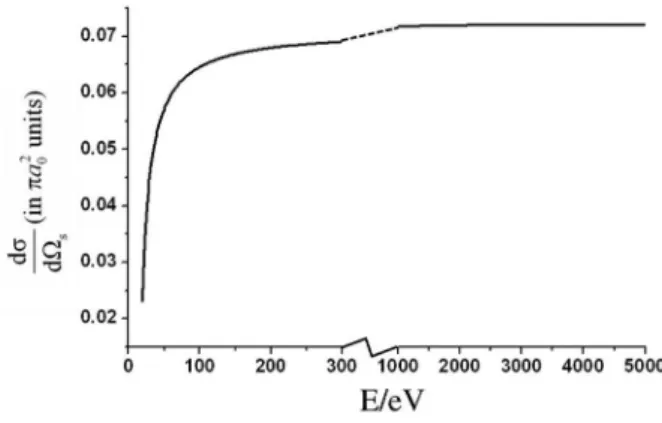
(dσ/dΩs) in equation 19 assumes values between 0.023 and 0.071, in units of πa2
0, for incident electron energies
between 20 eV and 1000 eV, respectively. These values are basically of the same order as the ones estimated, both experimentally and theoretically, for the usual processes mentioned above.13,14 They are only a factor of three smaller
then the values for ionization at these two energies.14
The irst distinguishable aspect to be noted is the energy dependence presented by equation 19. In contrast to the cases of inter-band, ionization and dissociation processes, the CBOP differential cross section presents no maximum; it increases with increasing incident energy and goes asymptotically to a value around 0.07 (in units of πa02 ), as
shown in Figure 2. This behavior is a consequence of the quadrupole nature of the electron scattering process by the CBOP in A2-type molecules.
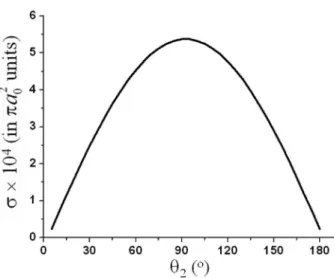
The second aspect is the angular dependence presented by the total cross section given by equation 20. The sinusoidal angular dependence is predicted to be independent of the incident energy, also in contrast to the inter-band, ionization and dissociation cases. In these cases, both the differential and total cross sections have a maximum between 15 eV and 100 eV, and decrease as the incident energy increases, with angular dependence peaked between 30° and 40°,13
while in the CBOP case it is peaked at 90°. The angular dependence of the total cross section is depicted in Figure 3 for an incident energy equals to 1000 eV, aperture angular resolutions ∆φ = 5° (ixed) and ∆θ = 5° with θ varying from 0° to 180° and plotted as a function of the inal angle θ2.
Conclusions
Once the CBOP is directly related to the polarizability of the overlap region, which in turn is directly associated to the degree of covalency, its assessment by means of spectroscopic techniques may constitute a tool for
quantifying the sharing of electrons in a chemical bond. In addition to the previously analyzed oscillator strengths and Raman cross sections by the CBOP in heteropolar diatomic molecules, the results obtained in the present work, though for the particular case of the hydrogen molecule, indicate that electron energy-loss spectra may also provide useful information on the CBOP.
The hydrogen molecule, as a case study, has been particularly illustrative due to the quadrupole nature of the CBOP electron energy-loss cross section, which presents an impacting electron energy dependence and angular behavior distinguishable from the scattering cross sections for inter-band transitions, ionization and dissociation.
Acknowledgements
The authors are grateful for the inancial support from the CNPq (Brazilian Agency) and from RENAMI and IMMC (Brazilian Scientiic Programs).
Figure 3. Angular (θ2) dependence of the energy loss total cross section (σ) for an incident energy (E) of 1000 eV with aperture angular resolutions of ∆φ = 5° (ixed) and ∆θ = 5° with θ varying from 0° to 180°.
References
1. Malta, O. L.; Batista, H. J.; Carlos, L. D.; Chem. Phys. 2002, 282, 21.
2. Malta, O. L.; Chem. Phys. Lett. 1982, 87, 27; 1982, 88, 353. 3. Albuquerque, R. Q.; Malta, O. L.; In Nato Science Series II:
Math. Phys. Chem., vol. 126, Krupa, J. C.; Kulagin N. A. eds.; Kluwer Academic Publishers: Dordrecht, 2003, p. 141. 4. Albuquerque, R. Q.; PhD Thesis, Universidade Federal
de Pernambuco, Brazil, 2004. (http://www.bdtd.ufpe.br/ tedeSimpliicado//tde_busca/arquivo.php?codArquivo=2539) 5. Malta, O. L.; Chem. Phys. Lett. 2005, 406, 192.
6. Davydov, A. S.; Quantum Mechanics, 2nd ed., Pergamon Press:
Oxford, 1976.
7. Edmonds, A. R.; Angular Momentum in Quantum Mechanics, 2nd ed., Princeton University Press: New Jersey, 1960.
8. Carter, C.; March, N. H.; Vincent, D.; Proc. Phys. Soc. (London)
1958, 71, 2.
9. Gallup, G. A.; Valence Bond Methods - Theory and Application, Cambridge University Press: New York, 2002.
10. McQuarrie, D. A.; Simon, J. D.; Physical Chemistry - A Molecular Approach, University Science Books: Sausalito, CA, 1997.
11. Magnasco, V.; J. Chem. Educ. 2008, 85, 1686.
12. Helgaker, T.; Jorgensen, P.; Olsen, J.; Molecular Electronic-Structure Theory, John Wiley & Sons: New York, 2000. 13. Rescigno, T. N.; McCurdy Jr., C. W.; McKoy, V.; Phys. Rev. A:
At., Mol., Opt. Phys. 1976, 13, 216.
14. Straube, H. C.; Renault, P.; Lindsay, B. G.; Smith, K. A.; Stebbings, R. F.; Phys. Rev. A: At., Mol., Opt. Phys. 1995, 54,
2146.
Received: September 11, 2009