Ar
ti
cle
0103 - 5053 $6.00+0.00
*e-mail: [email protected]
Selective Sorbent Enrichment of Nickel Ions from Aqueous Solutions
using a Hierarchically Hybrid Organic-Inorganic Polymer
Based on Double Imprinting Concept
Letícia Ramos Nacano,a Mariana Gava Segatellia and César Ricardo Teixeira Tarley*,a,b
aDepartamento de Ciências Exatas, Universidade Federal de Alfenas (Unifal-MG),
Rua Gabriel Monteiro da Silva, 700, 37130-000 Alfenas-MG, Brazil
bDepartamento de Química Analítica, Instituto Nacional de Ciência e Tecnologia (INCT)
de Bioanalítica, Instituto de Química, Universidade Estadual de Campinas (Unicamp), Cidade Universitária Zeferino Vaz s/n, 13083-970 Campinas-SP, Brazil
Este estudo envolve a preparação de um polímero orgânico-inorgânico impresso com íon (IIP)
para o enriquecimento seletivo de Ni2+ em soluções aquosas com posterior determinação por GF
AAS. A rede polimérica híbrida foi preparada a partir de uma mistura do monômero funcional, 2-aminoetil-3-aminobutilmetildimetoxissilano e tetraetoxissilano como agente de ligação cruzada,
contendo Ni2+ e brometo de cetiltrimetilamônio como moldes. Os polímeros foram caracterizados
por IV, TG e MEV. A capacidade máxima adsortiva do IIP para os íons Ni2+, determinada pelo
modelo linear de Langmuir, foi de 5,44 mg g-1.Quando o coeiciente de seletividade iônica do
IIP foi comparado com os coeicientes de seletividade do NIP (non imprinted polymer) e IIP2
(ion imprinted polymer na ausência do surfactante), a partir das misturas binárias de Ni2+/Cu2+,
Ni2+/Co2+, Ni2+/Cd2+ e Ni2+/Zn2+, os respectivos valores do coeiciente de seletividade relativo (k’)
foram 36,54 e 3,55, 1,22 e 2,03, 4,43 e 1,42, 28,60 e 1,74, demonstrando maior seletividade do IIP
para os íons Ni2+. O método proposto forneceu um limite de detecção de 0,16 µg L-1 e foi aplicado
com sucesso na determinação de Ni2+ em amostras de águas enriquecidas e itoterápico (Gingko
Biloba) com valores satisfatórios de recuperação.
This study involves the preparation of an ion imprinted organic-inorganic polymer (IIP)
for selective sorbent enrichment of Ni2+ from aqueous solutions with further determination
by GF AAS. The hybrid polymeric network was prepared from a mixture of 2-aminoethyl-3-aminobutylmethyldimethoxysilane as functional monomer, and tetraethoxysilane as crosslinking
agent, containing Ni2+ and cetyltrimethylammonium bromide as templates. The polymers were
characterized by IR, TG and SEM. The maximum adsorptive capacity of IIP towards Ni2+ ions,
determined by linear Langmuir model, was found to be 5.44 mg g-1. When the selectivity coeficient
of IIP was compared with the selectivity coeficient of NIP (non imprinted polymer) and IIP2 (ion
imprinted polymerin the absence of surfactant), from the binary mixtures of Ni2+/Cu2+, Ni2+/Co2+,
Ni2+/Cd2+ and Ni2+/Zn2+, values of relative selectivity coeficient (k’) were 36.54 and 3.55, 1.22
and 2.03, 4.43 and 1.42, 28.60 and 1.74, respectively, demonstrating higher selectivity of IIP for
Ni2+ ions. The proposed method provided a limit of detection of 0.16 µg L-1 and was successfully
applied for Ni2+ determination in spiked water samples and in a phytoterapic product (Gingko
Biloba) with satisfactory recovery values.
Keywords: nickel, Hierarchically Imprinted Polymer, GF AAS, enrichment
Introduction
Recent years have seen remarkable progress in the development of separation/preconcentration methodologies
on the literature shows that the primary requirements to attain good performance of the SPE include quantitative sorption and elution, kinetically faster sorption and desorption, accessibility of analyte towards sites of sorbents and, mainly, selectivity.2 The selective analyte
separation has not been properly achieved from analysis of real samples by using conventional solid sorbents, such as modiied silica (C18), chelating resins, unloaded polyurethane foam and activated carbon, thus being the main disadvantage of the SPE.3 Nevertheless, this
drawback can successfully be overcome by using selective sorbents, which present speciic recognition sites formed in synthetic materials by binding analyte with high speciic sites of sorbent.4 These materials make use of chemical
imprinting technology that provides selective recognition at molecular level of an analyte over closely related structural analogues. Molecularly imprinted polymers have been the most common approach of chemical imprinting technology and have found application in several analytical methods such as, chromatographic separation, sensors, solid phase extraction for sample clean-up and luorescence spectroscopy.5 Based on simple speciic memory effect
created as a consequence of the shape and the position of functional group of the template molecules with those functional groups of sorbent, Nishide et al.,4 in a similar
way, proposed, for the irst time, sorbent materials capable of recognizing metallic ions. The selectivity of these ion imprinted materials depends on the speciicity of the ligand, coordination geometry, coordination number charges and sizes of the ions.6,7 Thus, it is of paramount importance
the preparation of these materials for the development of selective sorbent enrichment methods for metallic ions. In fact, similarly to molecularly imprinting materials, ion imprinted materials ind interesting applications in SPE, metal ion sensors and membranes separation of inorganics, but their use is significantly less exploited. Different approaches in synthesis of these sorbents can be adopted and mainly categorized as organic or hybrid organic-inorganic sorbents. In organic polymeric sorbents, the “memorized cavity” by means binding metal ion templates with those sites of organic monomers, can be achieved from different methods, such as crosslinking of bifunctional reagents with linear polymeric chains, chemical immobilization, surface imprinting and trapping. In order to get more information, the reader can refer to a review described by Rao et al.2
Regarding organic-inorganic polymeric sorbents, the conventional sol-gel process has widely been employed for the incorporation of the metal ion templates into rigid networks8, using tetraethoxisylane (TEOS) as the inorganic
precursor and organic molecules as functional monomers. In addition, ion imprinted sorbents can also be prepared
by surface imprinting technique, in which the silica gel surface is modiied with organic molecules as functional monomers.9 Although these two conventional methods
provide sorbents with attractive features, including high selectivity and absence of welling effect,9,10 both do not
present a precise control of pore sizes and surface area.11
Moreover, especially for sol-gel process, the resulting materials exhibit reduced accessibility of the analyte towards linkage sites, promoting unfavorable adsorption/ dessorption kinetics. Therefore, improved hybrid organic-inorganic sorbents with a precise control of not only adsorption sites but also with mesoporous structures have been developed by using surfactants during the synthesis.12
These sorbents are known as hierarchically imprinted organic–inorganic sorbents because they utilize the imprinting effect twice (metal ion template and surfactant). Their application as selective materials are still in early stages and have been limited only for copper,12 cadmium
and mercury,13,14 whose functional employed groups have
been (3-(2-aminoethylamino)-propyltrimethoxysilane) and
N-[3-(trimethoxy-silyl)propyl]ethylenediamine (TPED). Thus, in the present study, a hybrid organic–inorganic sorbent based on double imprinting concept was evaluated for selective retention of nickel ions from aqueous solution using 2-aminoethyl-3-aminobutylmethyldimethoxysilane (AAMDMS), as functional monomer. The sorbent was characterized by infrared spectroscopy, thermogravimetry (TG), scanning electron microscopy (SEM) and adsorption isotherms. In addition, it was compared with control polymers taking into account the relative selectivity coeficient (k’). Finally, by using the selective sorbent a reliable preconcentration method for nickel determination by GF AAS was developed and its feasibility was assessed by its application for analysis of water samples. The whole optimization procedure was performed by using factorial design and Doehlert matrix owing to its intrinsic advantages over univariate method.15
Experimental
Instrumentation
99.99% (White Martins, São Paulo, Brazil) was used as purge gas. A Shimadzu AA-6800 lame atomic absorption spectrometer (FAAS) (Shimadzu, Tokyo, Japan) was also used in this study. The pH values of samples were measured using a pH-meter (Scott, Cambridge UK), equipped with a glass-combination electrode. A peristaltic pump (Ismatec IPC-08, Glattzbrugg, Switzerland), furnished with Tygon®
tubes, was used to propel all samples and reagent solutions. The morphology of all polymers was evaluated by scanning electron microscopy (SEM), using a JEOL JSM-6360 LV scanning electron microscope (Tokyo, Japan) with an electron acceleration voltage of 20 kV. The samples were previously coated by a thin layer of carbon followed by the Au/Pd alloy in a Bal-Tec MED 020 equipment. Thermal analyses were performed in a TA Instruments TGA 2950 thermogravimetric analyzer (California, USA), where the polymers (ca. 10 mg) were heated from 30 up to 980 oC,
at a heating rate of 10 oC min-1, under argon atmosphere.
Infrared (IR) spectra were obtained in a Bomem Michelson MB-102 spectrometer. The experiments were carried out using KBr discs to prepare the polymer samples and the spectral range varied from 4000 to 400 cm-1. Sample
decomposition was performed in a microwave oven (Milestone Microwave Laboratory System).
Reagents and solutions
The solutions were prepared with analytical grade chemical reagents as well as with water obtained from a Milli-Q puriication system (Millipore, Bedford, MA, USA). In order to prevent metal contamination from laboratory glassware, it was kept 24 h in a 10% v/v HNO3 solution. Tetraethoxysilane (TEOS) and 2-aminoethyl-3-aminobutylmethyldimethoxysilane (AAMDMS) from Alfa Products were used in this study. Cetyltrimethylammonium bromide (CTAB) (Vetec, Brazil) was used without further puriication. Nickel standard solutions were prepared daily by appropriate dilution of 1000 mg L-1 nickel solution
(Merck, Darmstadt, Germany). Acetate, borate, amoniacal and phosphate buffers were prepared from their respective salts (Merck) without further purification. Ethanol of analytical grade was purchased from Merck. All solutions used in interference study containing the Cu2+, Cd2+, Co2+,
Sb3+, Pb2+, Mn2+, Zn2+ foreign ions were prepared by dilution
from Merck standard solutions at 1000 mg L-1.
Preparation of hierarchically hybrid organic-inorganic polymer
The synthetic route and the recognition mechanism of Ni2+ ions were based on literature with minor modiication.13
In the irst step, the complex formation was performed between Ni2+ ions and those binding sites (-NH- and -NH
2)
present in AAMDMS in the presence of CTAB. For this task, 0.550 g of NiCl2.5H2O and 1.46 g of CTAB were dissolved in 40 mL of deionized water. To this mixture, 1.1 g of AAMDMS was added and magnetically stirred for 1 h. Next, TEOS (4.0 g of TEOS was dissolved in 4 mL of methanol and stirred for 20 min) and NaOH (1.0 mol L-1,
7.6 mL) were added to the mixture, which was stirred for 2 days at room temperature and, then, reluxed at 90 °C for 1 day. In this procedure, TEOS and AAMDMS were independently self-hydrolyzed and self-condensed to form the hybrid organic-inorganic polymer. The hydrolysis of TEOS and the copolymerization occur due to the presence of NaOH. After the end of the synthesis, Ni2+ ion conined
in the selective cavity and the surfactant incorporated in the sorbent were removed from successive washings with 2.0 mol L-1 HNO
3 and ethanol, respectively. The resulting
polymer was exhaustively washed with deionized water, and dried at 100 °C for 4 h until use. In order to evaluate the selective features of the polymer as well as the effect of CTAB in the synthesis, the Ni2+- imprinted polymer, deined
here as IIP2, was also prepared using the same synthesis procedure, except by addition of CTAB. In addition, the control blank polymer, known as NIP (non imprinted polymer) was prepared in parallel without addition of Ni2+,
however containing CTAB. These polymers (IIP, NIP and IIP2) were further characterized by SEM, thermogravimetry (TG) and IR.
General procedure for enrichment of nickel ions from water samples
The ion imprinted polymer (IIP) (100 mg) was packed into a minicolumn (6.0 x 1.0 cm i.d.), made of poly(vinyl chlorine) (PVC). Small amounts of glass wool were placed at both sides in order to prevent loss of the polymer during sample loading. Afterwards, the minicolumn was successively conditioned with 3.0 mol L-1 HNO
3
and deionized water. The method was based on off-line enrichment of 20.0 mL of sample previously buffered (pH 8.4) with 0.43 mol L-1 borate buffer onto polymer
at a low rate of 5.0 mL min-1. After preconcentration
procedure, the elution step was carried out with 2.0 mL of 3.3 mol L-1 HNO
3 solution at a low rate of 2.0 mL min
-1.
Batch adsorption experiments
Adsorption experiments were carried out in closed polyethylene lasks at room temperature, by putting 30 mg of IIP in 20.0 mL of Ni2+ ions solutions with increasing
concentration ranging from 3.0 up to 11.0 mg L-1. The
value of optimum pH (pH 8.4 in 0.43 mol L-1 borate
buffer) adopted in these experiments was that previously optimized from minicolumn preconcentration procedure, while shaking time employed was 10 min. After the shaking time, the concentration of Ni2+ in the supernatant
was determined by FAAS. The amount of Ni2+ adsorption
on the IIP was determined as the difference between the initial concentration and the equilibrium concentration (supernatant). In order to achieve the maximum adsorption capacity (MAC), all batch experimental data were itted to the linear Langmuir isotherm model.16
Optimization of enrichment method
The selective sorbent enrichment procedure of nickel ions was optimized by using a 25-1 fractional factorial design
associated with Doehlert matrix. These techniques were adopted in this study because they enable the selection of optimal experimental procedures, helping to avoid trivial mistakes during the optimization. The possibilities of simultaneous study of several factors also facilitate the evaluation of interaction effects between the factors as well as allow us to attain the best sensitivity of the method. Those factors commonly studied, which play important role in the sorbent enrichment system were: sample pH, eluent concentration (EC), buffer sample concentration (BC), enrichment low rate (EFR) and mass of IIP. All assays were performed by enrichment of 20.0 mL of 10.0 µg L-1
nickel solution. The analyses of experimental assays were processed using the STATISTICA software package (StatSoft, Tulsa, USA).
The eluent low rate was ixed at 2.0 mL min-1. It must
be emphasized that higher amounts than 200 mg of polymer were avoided throughout the study, once this condition leads to leakage in the minicolumn, due to resulting overpressure.
Evaluation of imprinting effect on the IIP
In order to measure the speciicity of the IIP towards Ni2+ions, adsorption studies under competitive conditions
in the presence of Cu2+, Co2+, Cd2+ and Zn2+ ions were
performed. As it is predictable that in the presence of foreign ions a competition might start for those sites of IIP, the imprinting effect of IIP towards Ni2+ ions was
investigated from competitive adsorption of binary mixtures of Ni2+/Cu2+, Ni2+/Co2+, Ni2+/Cd2+, Ni2+/Zn2+ onto IIP, IIP2
and NIP. For this task, batch experiments were carried out at room temperature, where 100 mg of polymers were taken and stirred for 30 min in closed polyethylene lasks with 50 mL of binary mixtures, containing 5 mg L-1 of each
metallic ion, buffered (pH 8.4) with 0.43 mol L-1 borate
buffer (pH was adopted here according to the optimization procedure). After this step, the supernatant was collected and the metallic ion amounts were determined by FAAS. Based on these assays, parameters related to the selective performance of sorbents, such as distribution coeficient (Kd), selectivity coeficient (k) and relative selectivity coeficient (k’) were determined. Distribution coeficients of Ni2+, Cu2+, Co2+, Cd2+ and Zn2+ were calculated according
to equation (1):
(1)
where Ci, Cf and Vs represent the initial, inal solution concentrations and the volume of the solution, respectively. The selectivity coeficient is deined as the ratio between the distribution coeficient for Ni2+ ions and the distribution
coeficient for foreign ions. In order to make a comparison between k values of the imprinted polymer with those control polymers, i.e. the relative selectivity coeficient (k’), the following equation (2) was employed. This equation allows an estimation of the effect of imprinting on selectivity.
(2)
Results and Discussion
Characterization of hierarchically hybrid organic-inorganic polymer
IR spectra of IIP, NIP and IIP2 are illustrated in Figure 1. As it can be seen from the spectra, the vibrations of OH relative to adsorbed water were observed around 3440 and 1627 cm-1. The absorption around 1380 cm-1 is
assigned to CH2-N vibrations and a stronger and broader peak can be observed from IIP and IIP2 spectra, in which this phenomenon may be explained by coordination between -CH2-N- and Ni2+ ions, still retained into the
of Si–O–Si and Si–O–H bonds, respectively, and the peaks around 827 and 449 cm-1 correspond to the Si–O vibrations.
The presence of two peaks of very low intensity around 3030 and 2969 cm-1 from IIP spectrum is attributed to
the symmetry and asymmetry stretch vibration of CH2 of CTAB molecule.17
The morphology of the polymers is shown in Figures 2a-c. The images clearly shown the presence of pores in the IIP network and signiicant changes in the morphology of the IIP and NIP samples were observed. The IIP (Figure 2a) was found to have a larger surface area and particles with more uniform sizes than IIP2 (Figure 2c). This behavior demonstrates that the presence of surfactant in the synthesis may promote a better access of Ni2+ ions towards the selective cavity. On the
other hand, NIP presented completely lat morphology, thus indicating that the presence of Ni2+ ions during the
synthesis is fundamental and play a more important role than the surfactant for the formation of cavities and pores in the inal product.
Thermogravimetric curves for the three polymers are shown in Figure 3. The polymers studied here are classiied as polysilsesquioxane and their thermal degradation take place via scission and redistribution of Si-C and Si-O bonds, where high decomposition temperatures are observed, commonly accompanied by formation of silicon oxycarbide glasses.18 According to Figure 3, the initial
weight loss from 25 up to around 180 oC was attributed
to the physisorbed residual water and loss of volatile segments retained in the hybrid on account of incomplete polycondensation reactions of the residual silanol groups. For the IIP, a pronounced weight loss from 214 up to 223 oC
(ca. 49%) was veriied due to the thermal decomposition of the polymer and the subsequent weight loss (about 11%) was detected in the range of 224-950 oC, in which
it was associated to the formation of silicon oxycarbide
Figure 1. FT-IR spectra of polymers IIP, NIP and IIP2
Figure 2. Scanning electron micrographs of (a) IIP, (b) NIP and (c) IIP2. The images were 10,000 ampliied.
glasses, which are stable at higher temperatures. A similar behavior was observed for the IIP2; however the polymer degradation was veriied from 189 up to 201 oC, with a
weight loss of 81%. Hence, the higher thermal stability and ceramic yield of IIP in relation to IIP2 indicated that there is a synergic effect between Ni2+ ions and the surfactant in
the thermal stability of the IIP, in which it promoted a high crosslinking degree of the polymer. The thermal behavior of NIP showed a different degradation pattern when compared with IIP and IIP2. From 25 up to 248 oC, the weight loss
(ca. 9 %) is attributed to physisorbed residual water and loss of volatile segments. Afterwards, the pyrolysis was obtained when the temperature varied from 248 up to 315 oC. In this step, the weight loss occurred by degradation
of Si-C bonds and redistribution of Si-O. Finally, the inal step carried out up to 950 oC is assigned to the stable
silicon oxycarbide glasses. A plausible explanation of the expressive difference of thermal stability and ceramic yield of NIP when compared with IIP and IIP2 is related to the porosity of the material. As already demonstrated,
micrographs showed that NIP network do not exhibit porosity. Therefore, it is proposed that to the formation of densely packed crosslinked networks favors the increase of the initial temperature of polymer decomposition.
Optimization of enrichment procedure
Table 1 shows the factors, their levels and the analytical response for the 25-1 fractional factorial design. For this
design, the generator matrix Mass = pH.EC.BC.EFR was adopted. The main effects and their interactions can be graphically represented from the Pareto chart (Figure 4). Based on main effect, the illustration shows that only the sample pH is statistically significant. Both buffer concentration and the eluent concentration are signiicant factors when analyzed from their interaction effects. On the other hand, the mass of IIP and the enrichment low rate did not show to be signiicant for the proposed method. A mass of IIP of 100 mg was, therefore, employed in this study for all other optimization steps. Even working with
Table 1. 25-1 fractional factorial design and responses for the nickel enrichment on IIP
Factors Levels
Minimum (−) Maximum (+)
pH 5.0 8.0
Eluent concentration (EC) (mol L-1) 2.0 4.0
Buffer concentration* (BC) (mol L-1) 0.05 0.1
Enrichment low rate (EFR) (mL min-1) 5.0 10.0
Mass of IIP (mg) 100 200
Runs pH EC BC EFR Mass Response (peak area)
1 - - - - + 0.252/0.261
2 + - - - - 0.593/0.591
3 - + - - - 0.125/0.121
4 + + - - + 0.517/0.572
5 - - + - - 0.081/0.083
6 + - + - + 0.864/0.884
7 - + + - + 0.153/0.140
8 + + + - - 0.718/0.682
9 - - - + - 0.122/0.113
10 + - - + + 0.812/0.847
11 - + - + + 0.210/0.202
12 + + - + - 0.723/0.698
13 - - + + + 0.169/0.165
14 + - + + - 0.749/0.774
15 - + + + - 0.047/0.044
16 + + + + + 0.924/0.941
high enrichment low rate (10 mL min-1), the analytical
signal was satisfactory, indicating that the kinetic of mass transfer of Ni2+ towards selective sites of IIP is fast and
independent of low rate. Therefore, 10 mL min-1 was
chosen for subsequent studies.
An enhancement of Ni2+ adsorption at the IIP was
noted by increasing the sample pH within the experimental domain (5.0 to 8.0). At lower pH values, the nitrogen atoms of the functional precursor are positively charged and, as a consequence, an electrostatic repulsion occurs with Ni2+ ions. In addition, it is interesting to note that the
analytical response is increased when the sample pH and the buffer concentration are simultaneously increased. This observation can be evidenced by signiicant positive interaction effect (3.60). So, a higher analytical signal will be achieved by simultaneous increase in the sample pH and the buffer concentration levels and such conditions could never be achieved if a univariated optimization was used. In order to evaluate the effect of the eluent concentration, we can take into account the interaction between pH and EC, which is positive and statistically signiicant (2.51). This result suggests the necessity of using acid concentrations higher than 2.0 mol L-1 to enhance the analytical signal
as well as to avoid memory effect during the enrichment/ elution steps.
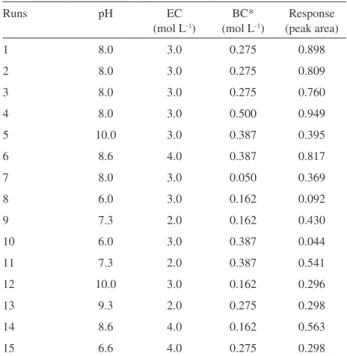
In order to ind the optimum values for pH, EC and BC, a Doehlert matrix was used. Each factor has now a new minimum, maximum and central level that was chosen bearing in mind the results from 25-1 fractional factorial
design. The results obtained are shown in Table 2. From the analysis of these results by using analysis of variance (ANOVA) (Table 3), it can be concluded that the quadratic regression model is signiicant, once there is no lack of it with a conidence interval of 95% [MSlof/MSpe (3.1224) is lower than critical F3,2 (19.16)]. An observation of the response surfaces in Figure 5 allows us to obtain optimum values of the studied factors. Hence, based on these results, the following experimental conditions were optimized:
8.4 for pH, 0.43 mol L-1 for borate buffer concentration
and 3.3 mol L-1 for eluent concentration.
Batch adsorption experiments
It is well established that to build adsorption isotherms, two important parameters must be optimized: sample pH and equilibrium time. Thus, as previously optimized, the
Figure 4. Pareto chart used for assessing the effect of factors on pre-concentration procedure. EC = eluent concentration; BC= buffer concentration; EFR = enrichment low rate; Mass = mass of IIP.
Table 2. Doehlert matrix employed for inal optimization of pH, eluent concentration and buffer concentration
Runs pH EC
(mol L-1)
BC* (mol L-1)
Response (peak area)
1 8.0 3.0 0.275 0.898
2 8.0 3.0 0.275 0.809
3 8.0 3.0 0.275 0.760
4 8.0 3.0 0.500 0.949
5 10.0 3.0 0.387 0.395
6 8.6 4.0 0.387 0.817
7 8.0 3.0 0.050 0.369
8 6.0 3.0 0.162 0.092
9 7.3 2.0 0.162 0.430
10 6.0 3.0 0.387 0.044
11 7.3 2.0 0.387 0.541
12 10.0 3.0 0.162 0.296
13 9.3 2.0 0.275 0.298
14 8.6 4.0 0.162 0.563
15 6.6 4.0 0.275 0.298
* Acetate/acetic acid buffer for pH 6.0, phosphate for pH ranging from 6.6 up to 7.3, borate for pH 8.6 and amoniacal pH ranging from 9.3 up to 10.0
Table 3. Analysis of variance obtained from the Doehlert design shown in Table 2
Effects SS df MS F p
BC 0.152447 1 0.152447 30.8300 0.030939
BC2 0.032070 1 0.032070 6.4857 0.125752
pH 0.098972 1 0.098972 20.0156 0.046504
pH2 0.697517 1 0.697517 141.0618 0.007015
EC 0.024471 1 0.024471 4.9488 0.156093
EC2 0.100422 1 0.100422 20.3088 0.045878
BC.pH 0.006072 1 0.006072 1.2279 0.383226
BC.EC 0.001931 1 0.001931 0.3906 0.595790
pH.EC 0.027032 1 0.027032 5.4668 0.144344
Lack of it (lof) 0.046318 3 0.015439 3.1224 0.251945
Pure error (pe) 0.009890 2 0.004945
Total SS 1.159225 14
optimum sample pH value of Ni2+ adsorption onto IIP
was 8.4, while 10 min of shaking time were suficient for attaining the equilibrium time of Ni2+ between the solid
and liquid phases (data not shown). By using these values, the adsorption isotherm of Ni2+ is illustrated in Figure 6(a).
The experimental isotherm data were successfully itted to the linear Langmuir isotherm model (Figure 6b), with coeficient of determination of 0.9962. The maximum adsorbed amount of Ni2+ on the IIP was 5.44 mg g-1. This
result shows that the adsorption capacity of the hybrid organic-inorganic polymer towards Ni2+ ions is higher
than others organic ion imprinted polymers previously published.19-21
Evaluation of imprinting effect on the IIP
Tables 4 and 5, show Kd, k and k’ values of Cu2+ (ionic
radius 87.0 pm), Co2+ (ionic radius 83.8 pm), Cd2+ (ionic
radius 109.0 pm) and Zn2+ (ionic radius 88.0 pm) with
respect to Ni2+ (ionic radius 83.0 pm). A brief comparison
of Kd values for the Ni2+ ions clearly demonstrates high
adsorption in IIP and IIP2 in relation to NIP. Such results can be explained due to more porous surface of the IIP and IIP2 in detriment of NIP (Figure 2), which plays an important role in adsorption processes. Similar behavior can be observed for Cu2+, Co2+, Cd2+ and Zn2+ ions, where low K
d
values were observed in NIP. The selectivity coeficient (k) is of paramount importance to express the imprinting effect created in the imprinted polymers. As the stability of Cu2+-
diamine complex is higher than Ni2+- diamine complex,13
Figure 5. Surface response obtained from Doehlert matrix (a) EC x pH (b) BC x EC (c) pH x BC.
it would be expected that larger k values could be obtained for Cu2+/Ni2+ system in IIP and IIP2, if no imprinting effect
was achieved. Nevertheless, as it can be seen in Table 4, the k value for the Ni2+/Cu2+ system of IIP (4.02) is higher
than IIP2 (1.13) and NIP (0.11). Such results conirm that higher recognition sites exist in IIP than IIP2, while no recognition sites are present in NIP. The imprinting effect, quantitatively determined by relative selectivity coeficient, showed that the IIP for Ni2+/Cu2+ was 36.54 and 3.55 times
more selective than NIP and IIP2, respectively. For the Ni2+/Co2+ system the imprinting effect observed was
somewhat reduced, showing relative selectivity coeficient of 1.22 and 2.03 times greater than NIP and IIP2 (Table 4). The competition between Ni2+ and Co2+ for
those selective sites of IIP can be explained due to very similar ionic radius of these metallic ions. Regarding to the Ni2+/Cd2+ and Ni2+/Zn2+ binary mixtures, the high adsorption
afinity of recognition sites to the imprinted Ni2+ ions was
once again conirmed from the great relative selectivity coeficient (Table 5).
As demonstrated, IIP presents good imprinting effect when compared with NIP and IIP2. However, in order to apply the enrichment method in real samples, the selective performance of the IIP towards Ni2+ ions in the presence of
foreign ions [Cu2+, Cd2+, Co2+, Sb3+, Pb2+, Mn2+ and Zn2+] at
different proportions, was evaluated. For this task, 20 mL of Ni2+ ions solutions at 10 µg L-1 were preconcentrated under
optimized conditions. The studied analyte:interferent ratios were 1:1, 1:10 and 1:100. The tolerance limit is deined
as the foreign ion concentration causing an relative error smaller than 10% in the Ni2+ determination. Interferences
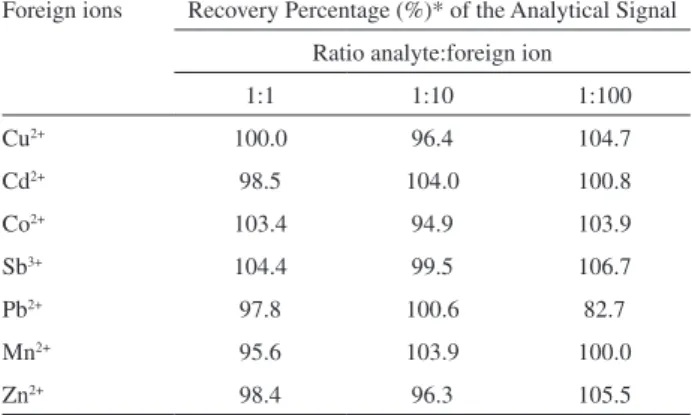
may be caused by the competitive adsorption of ions onto IIP surface, however only Pb2+ interfered at level 100 fold
to that Ni2+, leading to a decrease of analytical signal of
17.3%, probably due to Pb2+ retention onto those non
selective sites of the IIP (Table 6).
Analytical characteristics
The characteristic performance data for the IIP in the enrichment method under the optimum conditions were obtained by preconcentrating 20 mL of aqueous standard solution of Ni2+ ions. The calibration curve for Ni2+ ions
Table 4. Parameters related to imprinting effect (Kd, k, k’) of Cu2+and Co2+ with respect to Ni2+
Sorbent Kd (mL g -1)
k k’ Kd (mL g
-1)
k k’
Ni2+ Cu2+ IIP/NIP IIP/IIP2 Ni2+ Co2+ IIP/NIP IIP/IIP2
IIP 10938 2720 4.02
36.54 3.55
60795 20678 2.94
1.22 2.03
NIP 118 1055 0.11 60 25 2.40
IIP2 8074 7138 1.13 17365 11975 1.45
IIP = ion imprinted polymer synthesized in the presence of Ni2+ and surfactant; NIP = non imprinted polymer synthesized in the absence of Ni2+ and in the presence of surfactant; IIP2 = ion imprinted polymer synthesized in the presence of Ni2+ and in the absence of surfactant. The initial concentration of metallic ions was 5.0 mg L-1.
Table 5. Parameters related to imprinting effect (Kd, k, k’) of Cd2+and Zn2+ with respect to Ni2+
Sorbent Kd (mL g -1)
k k’ Kd (mL g
-1)
k k’
Ni2+ Cd2+ IIP/NIP IIP/IIP2 Ni2+ Zn2+ IIP/NIP IIP/IIP2
IIP 93600 20466 4.57
4.43 1.42
46700 32820 1.43
28.60 1.74
NIP 31 30 1.03 96 1864 0.05
IIP2 68550 21421 3.20 47093 58139 0.82
IIP = ion imprinted polymer synthesized in the presence of Ni2+ and surfactant; NIP = non imprinted polymer synthesized in the absence of Ni2+ and in the presence of surfactant; IIP2 = ion imprinted polymer synthesized in the presence of Ni2+ and in the absence of surfactant. The initial concentration of metallic ions was 5.0 mg L-1.
Table 6. Effect of foreign ions on the analytical signal recovery of 10 µg L-1 Ni2+ submitted to preconcentration method
Foreign ions Recovery Percentage (%)* of the Analytical Signal
Ratio analyte:foreign ion
1:1 1:10 1:100
Cu2+ 100.0 96.4 104.7
Cd2+ 98.5 104.0 100.8
Co2+ 103.4 94.9 103.9
Sb3+ 104.4 99.5 106.7
Pb2+ 97.8 100.6 82.7
Mn2+ 95.6 103.9 100.0
Zn2+ 98.4 96.3 105.5
was obtained in the range 0.5 up to 15.0 µg L−1 with
satisfactory coeficient of correlation (r > 0.994). A limit of detection (LOD =3 Std/m, where Std is the standard deviation for ten replicates determination of the blank signal and mis the slope of the calibration curve) of 0.16 µg L-1
for Ni2+ was obtained, while the limit of quantiication
(LOQ = 10Std/m) was found to be 0.55 µg L-1.22 Eight
replicates determinations of both 2.0 and 13.0 µg L-1 gave
the respective relative standard deviation of 2.67 e 3.37%, respectively. By preconcentrating 20 mL of sample, the experimental enrichment factor of the proposed IIP sorbent, calculated as the ratio between the slopes of analytical curves with and without the enrichment procedure,23 was
found to be 11 fold. Other important analytical parameters for sorbent enrichment were also calculated, such as consumptive index (CI = sample volume/EF) of 1.81 mL and enrichment eficiency (EE), which establishes the sensitivity enhancement using a preconcentration time of 1 min. Thus, the EE was found to be 2.75 min-1. These
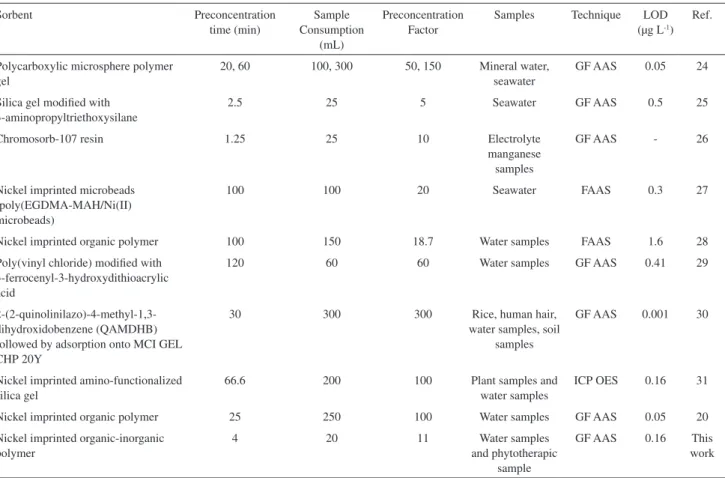
satisfactory results related to the performance of solid sorbent enrichment relect the outstanding application of
hybrid organic-inorganic polymer in the development of sorbent preconcentration methodologies. Table 7 shows comparative data obtained by proposed method with other off-line sorbent preconcentration for nickel determination. Substantial improvements in sorbent preconcentration performance with the proposed method, such as low sample consumption, absence of chelating agent on the preconcentration procedure, high sample throughput and, mainly, selectivity are shown. It must be emphasized that improvements in the detectability of the method can be achieved by using higher sample volume.
Real sample application
The proposed enrichment method was applied to the determination of Ni2+ in water samples. In order to evaluate
the feasibility of the method even in samples with high salt content, a synthetic seawater sample was prepared as follows: 27.9 g L-1 NaCl, 1.4 g L-1 KCl, 2.8 g L-1 MgCl
2,
0.5 g L-1 NaBr, 2.0 g L-1 MgSO
4.
32 Lake water samples
from Furnas Dam, Minas Gerais - Brazil, were collected
Table 7. Characteristic data obtained by selective sorbent preconcentration method using hierarchically hybrid organic-inorganic polymer and other off-line sorbent preconcentration for nickel determination
Sorbent Preconcentration
time (min)
Sample Consumption
(mL)
Preconcentration Factor
Samples Technique LOD (µg L-1)
Ref.
Polycarboxylic microsphere polymer gel
20, 60 100, 300 50, 150 Mineral water, seawater
GF AAS 0.05 24
Silica gel modiied with 3-aminopropyltriethoxysilane
2.5 25 5 Seawater GF AAS 0.5 25
Chromosorb-107 resin 1.25 25 10 Electrolyte
manganese samples
GF AAS - 26
Nickel imprinted microbeads (poly(EGDMA-MAH/Ni(II) microbeads)
100 100 20 Seawater FAAS 0.3 27
Nickel imprinted organic polymer 100 150 18.7 Water samples FAAS 1.6 28
Poly(vinyl chloride) modiied with 3-ferrocenyl-3-hydroxydithioacrylic acid
120 60 60 Water samples GF AAS 0.41 29
2-(2-quinolinilazo)-4-methyl-1,3-dihydroxidobenzene (QAMDHB) followed by adsorption onto MCI GEL CHP 20Y
30 300 300 Rice, human hair,
water samples, soil samples
GF AAS 0.001 30
Nickel imprinted amino-functionalized silica gel
66.6 200 100 Plant samples and
water samples
ICP OES 0.16 31
Nickel imprinted organic polymer 25 250 100 Water samples GF AAS 0.05 20
Nickel imprinted organic-inorganic polymer
4 20 11 Water samples
and phytotherapic sample
GF AAS 0.16 This work
in polypropylene bottles, to which 3 drops of concentrated HNO3 for each 100 mL of samples were added in order to avoid growth of microorganisms. Afterwards, the samples were iltrated under vacuum using 0.45 µm cellulose acetate membranes and buffered with 0.43 mol L-1 borate buffer
(pH 8.4). Recovery experiments were carried out using sample solutions to which known amounts of Ni2+ ions
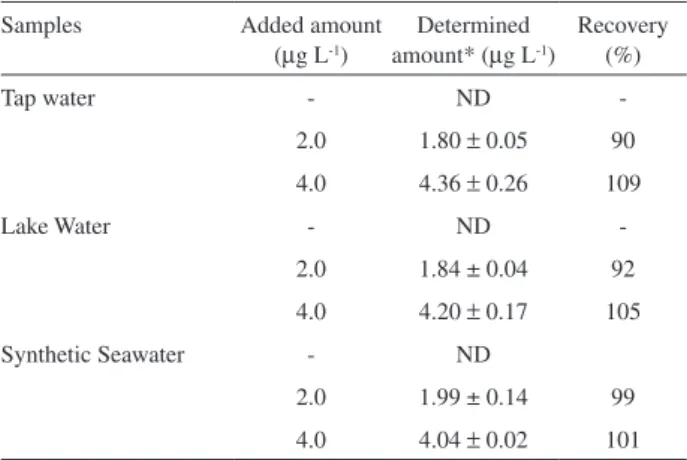
solution had been added. Each recovery was calculated by comparing the results obtained before and after addition. As shown in Table 8 the data obtained for spiked samples showed good recoveries, thus attesting that the sorbent solid phase enrichment associated to GF AAS determination is a reliable way for enrichment of Ni2+ in various natural water samples
as well as for sample clean-up. The direct analysis of Ni2+ in
water samples containing high salt content, such as seawater could not be performed by GF AAS, because it generates high background signals, scattering, and a strong matrix effect that lead to a worsening on sensitivity and even loss of accuracy. Apart from the water samples, the method also was applied for Ni2+ determination in a phytotherapic product
(Ginkgo Biloba) submitted to acid decomposition according to the literature.1 The amount of Ni2+ ions determined
in Ginkgo Biloba was found to be 1.05 ± 0.08 µg g-1,
while the addition of 3.0 µg g-1 to sample gave rise to a
recovery of 92.4% (3.74 ± 0.09 µg g-1).
Conclusion
Porous hybrid organic–inorganic polymer based on double imprinting concept for selective retention of nickel ions using 2-aminoethyl-3-aminobutylmethyldimethoxysilane (AAMDMS) as functional monomer was prepared, characterized against control blank polymers and successfully applied for nickel ions enrichment from
aqueous solution. The chemometric tools based on factorial design and Doehlert matrix was successfully applied in the selection of optimal experimental conditions, helping to avoid trivial mistakes during optimization as well as leading to reduction of experiments. The results obtained in this study, based on relative selectivity coeficient, showed that IIP had imprinting effect for the Ni2+ in aqueous
solution in comparison to IIP2 and NIP. The most selective performance of IIP is attributed to the double imprinting by Ni2+ ions and surfactant CTAB during predetermined
orientation of those specific binding sites containing functional groups in selective cavities, which it is easily feasible in sol-gel process. It is worth to emphasize that the use of surfactant leads to the formation of polymers with more porous surface only in the presence of template Ni2+,
as can be observed from smoother morphology of NIP. It indicates that there is a synergic effect between Ni2+ ions
and surfactant in the pores formation.
Finally, it could be shown that with the present study, a more expanded application of hierarchically hybrid organic-inorganic polymer based on double imprinting concept in solid phase preconcentration is described, contributing for new investigations of these imprinted polymers in the ield of analytical sciences.
Acknowledgments
The authors would like to thank CNPq (Conselho Nacional de Desenvolvimento Cientíico e Tecnológico), FAPEMIG (Fundação de Amparo à Pesquisa do Estado de Minas Gerais), CAPES (Coordenação de Aperfeiçoamento de Pessoal de Nível Superior) and INCT of Bioanalytical (Instituto Nacional de Ciência e Tecnologia de Bioanalítica) for the inancial support and fellowships.
References
1. Barbosa, A. F.; Segatelli, M. G.; Pereira, A.C.; Santana Santos, A.; Kubota, L. T.; Luccas, P. O.; Tarley, C. R. T.; Talanta2007, 71, 1512.
2. Rao, T. P.; Kala, R.; Daniel, S.; Anal. Chim. Acta 2006, 578, 105.
3. Tarley, C. R. T.; Arruda, M. A. Z.; Anal. Lett. 2005, 38, 1427. 4. Nishide, H.; Deguchi, J.; Chem. Lett. 1976, 5, 169.
5. Tarley, C. R. T.; Sotomayor, M. D. T.; Kubota, L. T.; Quim. Nova2005, 28, 1087.
6. Andaç, M.; Ozyapi, E.; Senel, S.; Say, R.; Denizli A.; Ind. Eng. Chem. Res.2006, 45, 1780.
7. Birlik, E.; Ersöz, A.; Denizli, A.; Say, R.; Anal. Chim. Acta
2006, 565, 145.
8. Makote, R. D.; Dai, S.; Anal. Chim. Acta 2001, 435, 169.
Table 8. Recovery percentage for nickel ions determination in different kinds of water samples
Samples Added amount (µg L-1)
Determined amount* (µg L-1)
Recovery (%)
Tap water - ND
-2.0 1.80 ± 0.05 90
4.0 4.36 ± 0.26 109
Lake Water - ND
-2.0 1.84 ± 0.04 92
4.0 4.20 ± 0.17 105
Synthetic Seawater - ND
2.0 1.99 ± 0.14 99
4.0 4.04 ± 0.02 101
9. Na, J.; Chang, X. J.; Hong, Z.; Qun, H.; Zheng, H.; Anal. Chim. Acta2006, 577, 225.
10. Han, D. M.; Fang, G. Z.; Yan, X. P.; J. Chromatogr., A2005, 1100, 131.
11. Burleigh, M. C.; Dai, S.; Hagaman, E. W.; Lin, J. S.; Chem. Mater. 2001, 13, 2537
12. Dai, S.; Burleig, M. C.; Ju, Y. H.; Gao, H.J.; Lin, J. S.; Pennycook, S. J.; Barnes, C. E.; Xue, Z. L.; J. Am. Chem. Soc.
2000,122, 992.
13. Lu, Y.; Yan, X.; Anal. Chem. 2004, 76, 453.
14. Wu, G.; Wang, Z.; Wang, J.; He, C.; Anal. Chim. Acta 2007, 582, 304.
15. Tarley, C. R. T.; Silveira, G.; Dos Santos, W. N. L.; Matos, G. D.; Da Silva, E. G. P.; Bezerra, M. A. B.; Miro, M.; Ferreira, S. L. C.; Microchem. J. 2009, 92, 58.
16. Tarley, C. R. T.; Ferreira, S. L. C.; Arruda, M. A. Z.; Microchem. J.
2004, 77, 163.
17. Jun, Z.; Zhi-Iiang, L.; Gang, X.; Xing, Z.; Trans. Nonferrous Met. Soc. China2007, 17, 1367.
18. Canto, C. F.; Prado, L. A. S. de A.; Radovanovic, E.; Yoshida, I. V. P. Polym. Eng. Sci.2008, 48, 141.
19. Hart, B. R.; Shea, K. J.; J. Am. Chem. Soc. 2001, 123, 2072. 20. Otero-Romaní, J.; Moreda-Pineiro, A.; Bermejo-Barrera, P.;
Martin-Esteban, A.; Anal. Chim. Acta.2008, 630, 1.
21. Jacob, R.; Tate, M.; Banti, Y.; Rix, C.; Mainwaring, D. E.; J. Phys. Chem. A, 2008, 112, 322.
22. Long, G. L.; Winefordner, J. D. Anal. Chem. 1983, 55, 712. 23. Tarley, C. R. T.; Arruda, M. A. Z.; Anal. Sci. 2004, 20, 961. 24. Dakova, I. G.; Karadjova, I. B.; Georgieva, V. T.; Georgiev, G.
S.; Microchim. Acta.2009, 164, 55.
25. Tokman, N.; Akman, S.; Ozcan, M.; Talanta2003, 59, 201. 26. Yao, J.; Liu, Y.; Tuo, Y.; Zhou, F.; Zhang, J.; Xiao, Y.; Can.
J. Anal. Sci. Spectrosc. 2004, 49, 267.
27. Ersöz, A.; Say, R.; Denizli, A. Anal. Chim. Acta.2004, 502, 91. 28. Saraji, M.; Yousei, H.; J. Hazard. Mater.2009, 15, 1152. 29. Kiptoo, J. K.; Ngila, J. C.; Silavwe, N. D.; Microchim. Acta.
2008, 160, 211.
30. Yanga, G.; Fena, W.; Lei, C.; Xiao, W.; Sun, H.; J. Hazard. Mater.2009, 162, 44.
31. Jiang, N.; Chang, X.; Zheng, H.; He, Q.; Hu, Z.; Anal. Chim. Acta. 2006, 577, 225.
32. Zougagh, M.; Rudner, P. C.; Torres, A. G.; Pavon, J. M. C.; J. Anal. At. Spectrom. 2000, 15, 1589.
Received: February 21, 2009
Web Release Date: December 3, 2009