INTRODUCTION
Ceramics represent the most abundant indings among the archaeological artefacts [1]. They are made from clay as raw material and transformed into a durable material by the action of heat. Nowadays, physical and chemical characterization is a powerful tool to investigate ancient ceramics in order to understand their nature, their change in time, their technology and their provenance. Therefore,
several analytical methods are currently applied to provide these information for the archaeology and the cultural heritage.
Chemical analysis by using X-ray luorescence (XRF) spectroscopy is a well-established technique for the provenance studies, as it can be used to determine major and minor elements and a selected number of trace elements of ancient pottery [2]. The determination of these elements is related to the raw material and can be successfully used
Characterization of some archaeological ceramics and clay samples from
Zamala - Far-northern part of Cameroon (West Central Africa)
(Caracterização de algumas cerâmicas arqueológicas e amostras de argila
de Zamala - Extremo-Norte de Camarões, África Central Ocidental)
Z. L. Epossi Ntah*1,4, R. Sobott2,4, B. Fabbri3, K. Bente4
1Department of Arts and Archaeology, University of Yaounde 1, PO box 755, Yaounde, Cameroon 2GeoCentre North Bavaria, Friedrich-Alexander University Erlangen-Nuremberg, Germany 3Institute of Science and Technology for Ceramics, National Research Council (CNR) of Italy, Faenza, Italy 4Institute of Mineralogy, Crystallography and Materials Science, University of Leipzig, Scharnhorststraße 20,
04275 Leipzig, Germany *[email protected]
Abstract
Seventeen ceramics samples (515±95 BP, about 580 years old) and two clay raw materials from Zamala (Far-northern, Cameroon) were characterized by X-ray diffraction (XRD), thermal analysis (DTA/TG) and X-ray luorescence spectroscopy. The aim of the work was the deduction of the production technology and provenance of these ceramics. With the exception of one sample the analysed ceramics formed a homogeneous chemical and mineralogical group. The observed mineralogical phases were quartz, mica (biotite), potassium feldspar (microcline) and plagioclase (albite and oligoclase). The XRD study of two local clays yielded the presence of quartz, kaolinite, mica, feldspar and plagioclase. The presence of the broad endothermic peak in the DTA/TG curves of the clays and its absence in the curves of the ceramics indicated that the iring temperature of the ceramics was above 550-600 °C,
which is the temperature of the kaolinite-metakaolinite transformation. The iring experiments of the clay between 400-1200 °C in oxidizing atmosphere showed that mica disappeared above 900 °C. Therefore, the iring temperature of the sherds should have been between 600-900 °C. The chemical correlation between ceramics and local clay materials pointed out to a local production of these ceramics.
Keywords: Zamala, Cameroon, archaeological ceramics, clays, characterization, production technology, provenance.
Resumo
Dezessete amostras de cerâmica (515±95 AP, cerca de 1435 d.C.) e duas argilas de Zamala (Extremo Norte, Camarões) foram
caracterizadas por difração de raios X (DRX), análise térmica (DTA/TG) e espectroscopia de luorescência de raios X. O objetivo
do trabalho foi a dedução da tecnologia de produção e proveniência dessas cerâmicas. Com exceção de uma amostra, as cerâmicas analisadas formaram um grupo químico e mineralógico homogêneo. As fases mineralógicas observadas foram quartzo, mica (biotita), feldspato de potássio (microclínio) e plagioclásio (albita e oligoclásio). O estudo de DRX de duas argilas locais revelou a presença de quartzo, caulinita, mica, feldspato e plagioclásio. A presença do pico endotérmico largo nas curvas de DTA/TG das argilas e a sua ausência nas curvas das cerâmicas indicaram que a temperatura de queima da cerâmica foi acima de 550-600 °C, que é a temperatura de transformação caulinita-metacaulinita. As experiências de queima da argila entre 400-1200 °C em atmosfera oxidante mostraram que a mica desapareceu acima de 900 °C. Portanto, a temperatura de queima dos fragmentos deve ter sido entre 600-900 °C. A correlação química entre as peças cerâmicas e as argilas locais indicaram produção local dessas cerâmicas.
for the classiication of the ceramics into groups of similar compositions [3]. The mineralogical analysis of the ceramics gives information about their iring conditions. X-ray diffraction (XRD) is one of the most popular technique for determining mineral phases of ancient ceramics. During iring, the changes of the mineralogical composition of the clay are indicative for the estimation of the iring temperature. Thermal analysis (DTA/TG - differential thermal analysis/thermogravimetry) is used to determine the thermal behaviour and the iring temperature in conjunction with the X-ray diffraction.
Apart some results reported on modern ceramics [4-7] and ancient ceramics [8-10], the characterization of ancient ceramics from an analytical point of view is still novel in Cameroon and rare in West Central Africa. This paper presents the irst contribution on this type of investigation of ancient ceramics from Zamala (Far North Cameroon). The choice of the northern region of Cameroon is due to their long tradition in pottery making and their archaeological background. The aim of this work was to characterize some ancient ceramics from Zamala by their mineralogical and chemical compositions in order to estimate their iring temperature and to suggest their provenance. Therefore, seventeen ceramic sherds and two local raw materials were analysed by X-ray diffraction, thermal analysis DTA/TG and X-ray luorescence.
EXPERIMENTAL
Samples: the ceramic samples investigated (515±95 BP, about 580 years old) were collected at the archaeological site of the village Zamala in the far north region of Cameroon, Diamaré Division (Fig. 1) at different depths. According
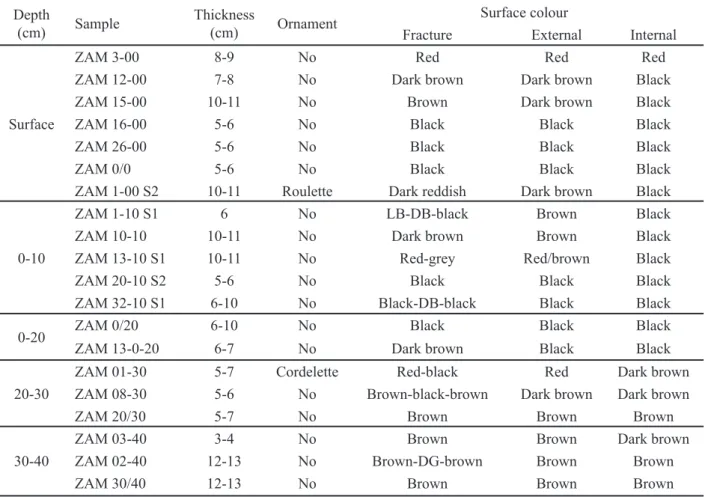
to their differences and appearance regarding the colour, thickness, ornament and function, seventeen samples were selected for this study. These samples were dried, cleaned with distilled water, cut off and powered for the analyses. In the vicinity of the excavated area, two clay pits were found; these clays are still used nowadays for the production of pottery. Here samples were collected, which were labelled clay ZAM 1 and ZAM 2. In case of the clay ZAM 1, some clay samples were collected at different depth and they were named ZAM 1-50 cm, ZAM 1-130 cm, ZAM 1-140 cm, while ZAM 2 was collected at a depth of 190 cm. The characteristics of the ceramic samples are presented in Table I and the photos of some ceramic sherds are viewed in Fig. 2.
Experimental methods: X-ray diffraction analyses of bulk ceramics and clay raw materials were carried out by the Seifert X-ray Diffraction (XRD 7). The operating conditions were: CuKα radiation (1.5406 Ǻ), voltage of 40 kV, Ni-ilter, current 40 mA, 2θ range from 5° to 65°, at a speed of 2 °/min. Firing experiments on clays under oxidizing conditions were carried out. For that, 2 g of crushed raw material were ired in a furnace (Nabertherm) from 200 to 1200 °C by steps of 200 °C (heating rate 150 °C/h). The desired maximum temperature was maintained for 24 h and XRD analyses of the iring products were carried out. Thermal analyses on ceramics and clays were carried out by a Netzsch apparatus, calibrated by using In, Sn, Bi, Zn, Al as standard materials. The samples were placed in Al2O3
crucibles and the measurements carried out in air from 20 to 1200 °C with a heating rate of 15 °C/min. Chemical analyses of the ceramics and the clays by XRF were carried out using 1 g of powdered sherd mixed with 6 g of Merck Spectromelt A14 (mixture of lithium tetraborate and La2O3) and melted
at 1000 °C for 15 min. After cooling the homogeneous glass disc were analysed. The apparatus used for the analyses was the Siemens SRS 303 AS equipped with an X-ray tube with Rh-anode. The analyser-crystals were: LiF (100) for Ca, K, Ti, Fe; LiF (110) for Mn; PET for Si, Al; OVO 55 for Mg, Na; C for P. The measurement time was 20 to 40 min.
The colour of the cross section of the ceramic sherds was used to develop a hypothesis/model for the deduction of iring atmosphere [11]: red and brown colour caused by Fe3+ indicated the oxidizing atmosphere; black and grey
colour caused by Fe2+ indicated the reducing atmosphere;
combination of black/grey and brown/red indicated the change from a reducing atmosphere to an oxidizing atmosphere. The modal composition of the ceramics was calculated on the basis of the X-ray luorescence data and taking the data from X-ray diffraction and optical microscopy (if available) into consideration [10]. Therefore, the modal composition is some sort of synopsis of data available for a particular ceramic and the modal components agree with actually occurring minerals. The analysed oxides were attributed to minerals in the following way: Na2O: plagioclase (albite, oligoclase); K2O: K-feldspar
(microcline), mica (biotite); CaO: plagioclase, apatite; MgO: mica (biotite); FeO/Fe2O3: biotite, goethite/hematite;
Al2O3: feldspar, metakaolinite, mica (biotite); SiO2: quartz, Figure 1: Localization maps of Zamala: (a) map of Cameroon
showing the Diamaré Division in the far north region; (b) Diamaré Division showing the excavated area and the clay pits.
aluminosilicates; TiO2: biotite, rutile. The program for the
calculation was the Excel software.
RESULTS AND DISCUSSION Ceramics
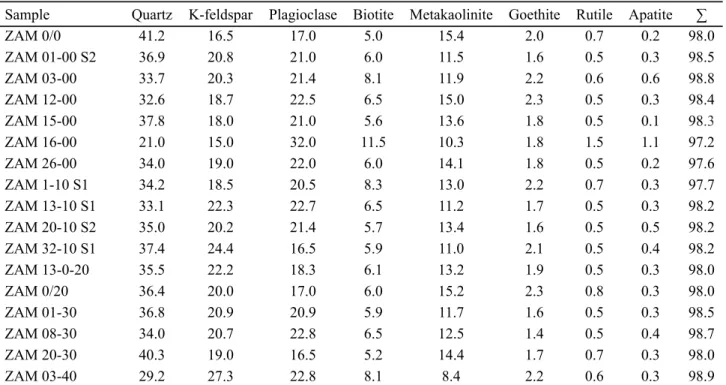
X-ray diffraction analysis: the mineralogical composition
of the sherds from Zamala is presented in Table II. It was noticed that the analysed ceramics formed a homogeneous mineralogical group. The observed mineralogical phases were quartz, mica (biotite), potassium feldspar (microcline) and plagioclase (mainly albite). The results of semi-quantitative analysis (modal composition, Table III) showed a very homogeneous group of ceramic sherds, which includes 16 samples out of 17, with the following average composition and standard deviation: quartz 35.4% (2.9%); K-feldspar 20.4% (2.6%); plagioclase 20.1% (2.5%); metakaolinite 12.7% (1.9%). The modal composition was completed by about 6% of biotite, 2% of goethite and minor amounts of rutile and apatite. The isolated sherd ZAM 16-00 was characterized by a lower content of quartz (about 21%) and higher contents of plagioclase (32%) and biotite (about 11%). Metakaolinite was chosen as one of the modal components because kaolinite was not present in any of the Figure 2: View of some sherds: (a) ZAM 1-00 S2, (b) ZAM 01-30,
(c) ZAM 03-40.
[Figura 2: Imagens dos fragmentos cerâmicos: (a) ZAM 1-00 S2, (b) ZAM 01-30, (c) ZAM 03-40.]
Depth
(cm) Sample Thickness (cm) Ornament Fracture Surface colourExternal Internal
Surface
ZAM 3-00 8-9 No Red Red Red
ZAM 12-00 7-8 No Dark brown Dark brown Black
ZAM 15-00 10-11 No Brown Dark brown Black
ZAM 16-00 5-6 No Black Black Black
ZAM 26-00 5-6 No Black Black Black
ZAM 0/0 5-6 No Black Black Black
ZAM 1-00 S2 10-11 Roulette Dark reddish Dark brown Black
0-10
ZAM 1-10 S1 6 No LB-DB-black Brown Black
ZAM 10-10 10-11 No Dark brown Brown Black
ZAM 13-10 S1 10-11 No Red-grey Red/brown Black
ZAM 20-10 S2 5-6 No Black Black Black
ZAM 32-10 S1 6-10 No Black-DB-black Black Black
0-20 ZAM 0/20 6-10 No Black Black Black
ZAM 13-0-20 6-7 No Dark brown Black Black
20-30
ZAM 01-30 5-7 Cordelette Red-black Red Dark brown
ZAM 08-30 5-6 No Brown-black-brown Dark brown Dark brown
ZAM 20/30 5-7 No Brown Brown Brown
30-40
ZAM 03-40 3-4 No Brown Brown Dark brown
ZAM 02-40 12-13 No Brown-DG-brown Brown Brown
ZAM 30/40 12-13 No Brown Brown Brown
Notes: LB - light brown; DB - dark brown; DG - dark grey.
Table I - General characteristics of selected sherds.
investigated sherds. The contents of the modal components apatite and rutile were very low so that they could not be detected by X-ray diffraction. The absence of hematite
and magnetite in the XRD patterns of brown and black coloured sherds can be explained by a quantity lower than the detection limit of XRD [10]. Hematite is one of the most Sherd Firing atmosphere Biotite Quartz Microcline Plagioclase
ZAM 3-00 Oxidizing xx xxxx xx xx
ZAM 12-00 Oxidizing xxx xxxx xxx xx
ZAM 15-00 Oxidizing x xxxx xx xx
ZAM 16-00 Reducing xx xxxx xx xxxx
ZAM 26-00 Reducing x xxxx xx xx
ZAM 0/0 Reducing x xxxx xx xx
ZAM 1-00 S2 Oxidizing x xxxx xx xx
ZAM 1-10 S1 Reducing then oxidizing xxxx xxxx xxx x
ZAM 10-10 Oxidizing x xxxx xxx x
ZAM 13-10 S1 Reducing then oxidizing xxxx xxxx xxx x
ZAM 20-10 S2 Reducing x xxxx xx xxx
ZAM 32-10 S1 Reducing then oxidizing x xxxx xxx x
ZAM 0/20 Reducing then oxidizing x xxxx xxx xx
ZAM 13-0-20 Reducing x xxxx xx xx
ZAM 01-30 Reducing then oxidizing x xxxx xx xx
ZAM 08-30 Reducing then oxidizing x xxxx xx xx
ZAM 20/30 Oxidizing x xxxx xxx xxx
ZAM 03-40 Oxidizing x xxxx xxx xx
ZAM 02-40 Reducing then oxidizing x xxxx xxx xxxx
ZAM 30/40 Oxidizing x xxxx xxxx xx
Sample Quartz K-feldspar Plagioclase Biotite Metakaolinite Goethite Rutile Apatite ∑
ZAM 0/0 41.2 16.5 17.0 5.0 15.4 2.0 0.7 0.2 98.0
ZAM 01-00 S2 36.9 20.8 21.0 6.0 11.5 1.6 0.5 0.3 98.5
ZAM 03-00 33.7 20.3 21.4 8.1 11.9 2.2 0.6 0.6 98.8
ZAM 12-00 32.6 18.7 22.5 6.5 15.0 2.3 0.5 0.3 98.4
ZAM 15-00 37.8 18.0 21.0 5.6 13.6 1.8 0.5 0.1 98.3
ZAM 16-00 21.0 15.0 32.0 11.5 10.3 1.8 1.5 1.1 97.2
ZAM 26-00 34.0 19.0 22.0 6.0 14.1 1.8 0.5 0.2 97.6
ZAM 1-10 S1 34.2 18.5 20.5 8.3 13.0 2.2 0.7 0.3 97.7
ZAM 13-10 S1 33.1 22.3 22.7 6.5 11.2 1.7 0.5 0.3 98.2
ZAM 20-10 S2 35.0 20.2 21.4 5.7 13.4 1.6 0.5 0.5 98.2
ZAM 32-10 S1 37.4 24.4 16.5 5.9 11.0 2.1 0.5 0.4 98.2
ZAM 13-0-20 35.5 22.2 18.3 6.1 13.2 1.9 0.5 0.3 98.0
ZAM 0/20 36.4 20.0 17.0 6.0 15.2 2.3 0.8 0.3 98.0
ZAM 01-30 36.8 20.9 20.9 5.9 11.7 1.6 0.5 0.3 98.5
ZAM 08-30 34.0 20.7 22.8 6.5 12.5 1.4 0.5 0.4 98.7
ZAM 20-30 40.3 19.0 16.5 5.2 14.4 1.7 0.7 0.3 98.0
ZAM 03-40 29.2 27.3 22.8 8.1 8.4 2.2 0.6 0.3 98.9
Table II - Mineralogical composition of the ceramics studied (xxxx: very abundant, xxx: abundant, xx: medium, x: weak or trace). [Tabela II - Composição mineralógica das cerâmicas estudadas (xxxx: muito abundante, xxx: abundante, xx: médio, x: fraco ou traço).]
intense colouring materials and only 1-1.5% of hematite is suficient to give the pottery a reddish colour [1].
Thermal analysis: the thermal analysis of the 17 selected
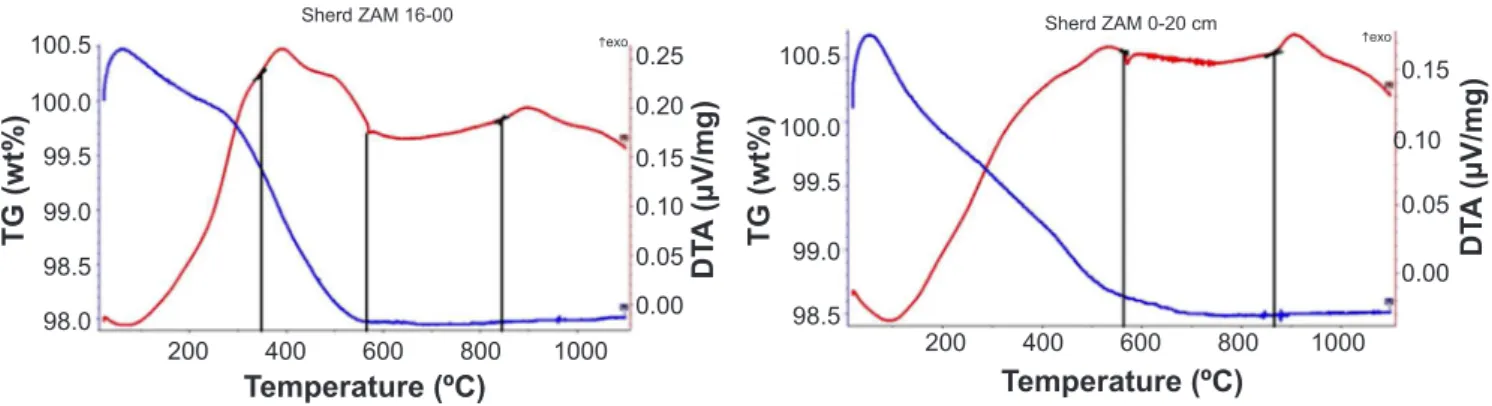
ceramics yielded almost similar results, which showed two thermal behaviours or two thermal groups of ceramics, according to the presence or absence of an exothermic peak between 250-450 °C. Thermograms of two ceramic sherds which revealed the existence of the two thermal groups are presented in Fig. 3. Most of the samples do not show the exothermic peak, which characterized the samples ZAM 16-00, ZAM 26-00 and ZAM 20-10 S2 only. The presence of the exothermic peak between 250-500 °C (DTA) can be explained by the combustion of organic material contained in these samples [12, 13]. According to Palanivel et al. [1] the exothermic effect observed within the range 200-650 °C is attributed to the combustion of organic materials, not completely burnt
during iring in reducing condition and transformed into carbonaceous particles, which are thought to have been deliberately added into ceramic paste to increase its plasticity, or were contained in the clay utilized in the manufacture. It has been suggested that the organic materials might have been added as a binder in the preparation of the pottery or in manufacturing external surface coating, for example albuminous [14]. Apart from this difference of behaviour at the range of 250-450 °C (DTA), the two thermal groups of ceramics presented similar characteristics. The thermal curves of all the sherds showed a small endothermic peak starting at around 573 °C which corresponded to the allotropic transformation of quartz. The broad exothermic peak which started at around 850 °C corresponded to the transformation of metakaolinite. The presence of this reaction showed that kaolinite was present in the clay but it was destroyed during
Figure 3: DTA/TG curves for ceramics of: (a) thermal group 1 (sample ZAM 16-00); and (b) thermal group 2 (sample ZAM 0/20).
[Figura 3: Curvas de DTA/TG de cerâmicas do: (a) grupo térmico 1 (amostra ZAM 16-00); e (b) grupo térmico 2 (amostra ZAM 0/20).]
100.5 exo exo
Sherd ZAM 16-00 Sherd ZAM 0-20 cm
100.5 100.0
100.0 99.5
99.5 99.0
99.0 98.5
98.5 98.0
0.25
0.15
0.05
0.15
0.05 0.20
0.10
0.00
0.10
0.00
200 200
Temperature (ºC)
DT
A (µV/mg) DTA (µV/mg)
TG (wt%) TG (wt%)
Temperature (ºC)
600 600
400 800 1000 400 800 1000
Table IV - Chemical composition of the selected ceramics (wt%).
[Tabela IV - Composição química de cerâmicas selecionadas (% em massa).]
Sherd SiO2 Al2O3 Fe2O3 MnO MgO CaO Na2O K2O TiO2 P2O5 LOI ∑ ZAM 0/0 72.92 14.54 3.01 0.08 0.66 1.16 1.59 3.30 0.69 0.06 1.92 99.93 ZAM 01-00 S2 72.20 14.60 2.86 0.02 0.82 1.24 1.96 4.14 0.45 0.12 1.47 99.88 ZAM 03-00 70.20 15.00 3.95 0.04 1.13 1.26 2.00 4.30 0.57 0.24 1.25 99.94 ZAM 12-00 69.60 16.20 3.65 0.05 0.89 1.23 2.10 3.84 0.53 0.13 1.79 100.01
ZAM 15-00 72.30 15.00 2.93 0.02 0.78 1.30 1.96 3.62 0.48 0.04 1.43 99.86
ZAM 16-00 61.00 16.10 7.41 0.02 1.62 3.46 2.98 3.71 1.50 0.44 1.45 99.69
ZAM 26-00 70.20 15.70 3.04 0.03 0.81 1.29 2.04 3.82 0.50 0.11 2.38 99.92
ZAM 01-10 S1 69.40 15.10 4.00 0.04 1.15 1.58 1.91 3.96 0.65 0.13 1.70 99.62
ZAM 13-10 S1 70.50 15.20 3.07 0.03 0.91 1.31 2.13 4.44 0.50 0.11 1.63 99.83
ZAM 20-10 S2 71.10 15.40 2.81 0.03 0.79 1.22 2.00 4.00 0.48 0.19 1.85 99.87
ZAM 32-10 S1 71.90 13.90 3.31 0.03 0.83 1.04 1.53 4.73 0.51 0.15 2.00 99.93
iring with the subsequent formation of metakaolinite.
Chemical composition: the chemical composition of
ceramics from Zamala is presented in Table IV. The results suggested that these ceramics formed a homogeneous group characterized by the following contents (wt%): SiO2
69-73, Al2O3 14-16, Fe2O3 2.8-4.0, MgO 0.6-1.2, CaO 1-1.6,
Na2O 1.5-2.1, K2O 3.3-5.4 and TiO2 0.4-0.7. Only one
sample did not belong to this homogeneous group: the ceramic sherd ZAM 16-00 characterized by a low content of SiO2 (61.00 wt%), and particularly high contents of
Fe2O3 (7.41 wt%), CaO (3.46 wt%) and TiO2 (1.50 wt%).
The binary correlation diagrams SiO2-Fe2O3, CaO-MgO
and Na2O-TiO2 illustrate the chemical homogeneity of the
analysed ceramics from Zamala (Fig. 4). The chemical homogeneity of the analysed sherds suggests that all these sherds were probably produced from the same clay raw material or they belong to the same production group. Sherd ZAM 16-00 should be another group of ceramic production in this region or a production from a different clay raw material. The P2O5 content was very low in all
the sherds; only sherd ZAM 16-00 presents a value of 0.44 wt%. According to the literature, this means no phosphorus
contamination [15-17]. This result suggested that these sherds were not buried long enough to absorb phosphorus coming from eventual bones in the soil. The LOI (loss on ignition) values were very low, in the range of 0.9-2.4 wt%. These values indicated a high iring temperature according to the mineralogical composition of the ceramics which does not include clay minerals. In addition, these ceramics did not signiicantly absorb water during the burial stage, according to the climate in the far northern dry region of Cameroon, which is characterized by a low annual precipitation value.
Clays
X-ray diffraction analysis: the XRD results of the two
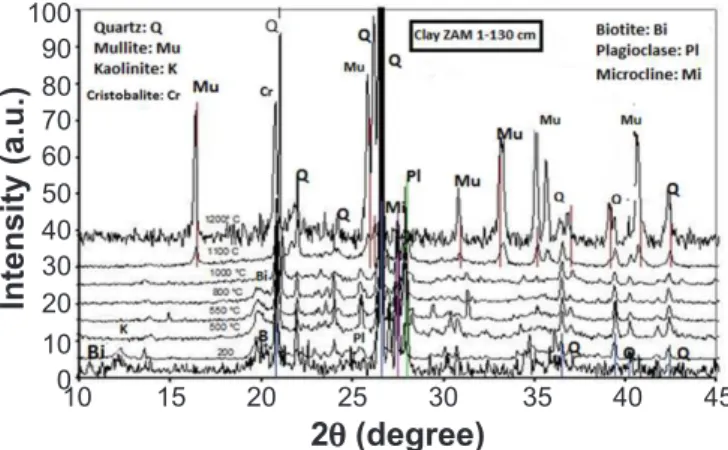
clays (ZAM 1 and ZAM 2) showed the same phases: quartz, microcline, oligoclase and kaolinite. The iring experiments of the two clays in the range of 200-1200 °C under oxidizing conditions present similar results. Therefore, only the XRD patterns of the clay ZAM 1-130 cm are presented in Fig. 5. The patterns showed the decay of kaolinite below 500 °C, in accordance with the literature. Kaolinite transforms, losing the hydroxyl groups between 350-500 °C, to an amorphous Figure 4: Chemical correlation diagram of oxides by wt%: (a) CaO/MgO, (b) SiO2/Fe2O3, (c) Na2O/TiO2.
[Figura 4: Diagrama de correlação química de óxidos em % em massa: (a) CaO/MgO, (b) SiO2/Fe2O3, (c) Na2O/TiO2.]
1.75 8.00
6.00
4.00 7.00
5.00
3.00
2.00 1.50
1.50 1.25
1.25 1.00
1.00 0.75
1.00 1.50 2.00 2.50 3.00 3.50 60.00 62.50 65.00 67.50 70.00 72.50
0.75
0.50
1.60 1.80 2.00 2.20 2.40 2.60 2.80 3.00
MgO (wt%)
CaO (wt%) SiO2 (wt%)
Na2O (wt%)
Fe
2
O3
(wt%)
Ti
O 2
(wt%)
a) b)
compound called metakaolinite [18, 19]. Biotite was still present at 800 °C and absent at 1000°C. Its decay appeared between 900-1000 °C. This result was conirmed in the literature [20-25]. Quartz and plagioclase were present at all the temperatures because they are resistant even at highest temperatures. Microcline (potassium feldspar) was still present at 1000 °C but the peaks were weak (25-26° 2θ). This result was in agreement with the data from the literature [26, 27]. The decrease of microcline started at 900 °C. Between 1000-1100°C, microcline disappeared in agreement with the
results of Cultrone et al. [28]. Mullite appeared between 1000-1100 °C, in accordance with the literature [25, 27, 29-34]. At 1200 °C, the mullite peaks at 16°, 26.5° and 27° 2θ were very intense. These observations showed that the quantity of mullite was increasing with the increase of temperature [32-36]. Cristobalite started to appear at 1100 °C, but its peak was weak, in accordance with the results of Xu and Hofmeister [25] which showed the formation of cristobalite at 1050 °C. At 1200°C, the peak at 21-22° 2θ became strong. The absence of iron oxide minerals (hematite and magnetite) was noted in the two clays. It could be explained by a concentration below 1.5-2 wt% which was not detected by XRD.
Thermal analysis: the DTA/TG curves of the clays showed
similar phenomena; therefore, only the clay ZAM 1-130 cm is presented (Fig. 6). Endothermic peak between RT-200 °C corresponded to the loss of hygroscopic water in the clay [37, 38]. The DTA curve showed a distinct endothermic peak starting around 450 °C accompanied by a loss of mass of 2.45%; it corresponded to the dehydroxylation of kaolinite to metakaolinite [39]. This result was in agreement with the X-ray diffraction of the ired clays. A weak thermal effect at 573 °C corresponded to the allotropic transformation of quartz. A broad endothermic peak starting at around 620 °C accompanied by a loss of weight of 0.43% corresponded to the decomposition of carbonate, mainly calcite [28, 40-42]. An exothermic peak starting at around 850 °C corresponded to the transformation of metakaolinite probably to gamma alumina or mullite according to the literature [32, 43, 44]. The absence of the exothermic peak observed at 250-300 °C in the DTA curves of the clays suggested that these clay materials did not contain organic materials. Therefore, the presence of this peak in some DTA curves of sherds could suggest that the potter added the organic materials in the paste during manufacture. Of course, if it is assumed that the local clays here studied were used to produce these ceramics.
Chemical analysis: the chemical composition of the clay
raw materials found during the excavation is presented in Table V. The results showed that the clay ZAM 2 was richer in SiO2 than ZAM 1, while the contents of aluminium and
iron oxides were higher in the clay ZAM 1. The contents of alkali oxides were similar in the two clays whereas the content of titanium oxide was higher in the ZAM 1 clay. The two clays presented low contents of manganese and phosphorus oxides. The LOI was slightly higher in the ZAM 1 clay, suggesting that this clay contained more clay minerals, according to the higher content of aluminium
Figure 6: DTA/TG curves of the clay ZAM 1-130 cm.
[Figura 6: Curvas de DTA/TG da argila ZAM 1-130 cm).]
Figure 5: X-ray diffraction patterns of the clay ZAM 1-130 cm at different temperatures: RT (room temperature) to 1200 ºC.
[Figura 5: Difratogramas de raios X da argila ZAM 1-130 cm em diferentes temperaturas: temperatura ambiente a 1200 °C.]
Clay SiO2 Al2O3 Fe2O3 MnO MgO CaO Na2O K2O TiO2 P2O5 LOI ∑
ZAM 1-50 cm 70.38 13.20 2.31 0.08 0.56 2.78 1.53 3.17 0.65 0.05 5.24 99.95 ZAM 1-130 cm 70.72 14.88 2.72 0.08 0.68 1.47 1.65 3.10 0.72 0.05 3.86 99.93 ZAM 1-140 cm 67.01 15.69 4.33 0.11 1.05 1.09 1.47 3.12 0.96 0.06 5.04 99.93 ZAM 2-190 cm 76.79 11.38 1.68 0.06 0.41 1.36 1.42 2.92 1.68 0.04 3.40 99.93 Table V - Chemical composition of the clays collected (wt%).
[Tabela V - Composição química das argilas coletadas (% em massa).] 100
70
40
10 90
60
30
0
10 15 20 25 30 35 40 45
80
50
Intensity (a.u.)
2q (degree)
20
exo
ZAM 1-130 cm
100
99
98
97
96
0.15 0.20
0.05 0.10
0.00
-0.05 200
Temperature (ºC)
TG (wt%)
DT
A (µV/mg)
600
oxide. The variations observed for the ZAM 1 clay at the different depths of extraction (50, 130 and 140 cm) were limited and they seemed due to geochemical processes in the clay bed.
Provenance of the ceramics
The comparison between the chemical data for ceramics and clays is presented in Table VI. The results showed that the average chemical composition of the homogeneous group of ceramics its very well with the chemistry of the clays ZAM 1 in particular those collected at the depth of 130 and 140 cm. According to the potter present during the excavation, the clay from this depth is the most suitable for the ceramic production. This clay, which is still used nowadays, was most probably the raw material for the ancient ceramics produced in the excavated area, so that a local production of the ceramics could be inferred. In addition, it can be suggested that potters did not modify the clay paste during pottery manufacture.
The isolated sherd ZAM 16-00 was not produced from the local clay studied. The lower content of silicon oxide and the higher contents of iron, magnesium, calcium and sodium oxides in this ceramic clearly revealed its different origin. Probably this ceramic came from another place and could indicate a cultural exchange with near localities. Table VI also shows that the chemical composition of the clay ZAM 2 was different from the chemical composition of the sherds analysed, even though it had the same minerals of clay ZAM 1. However, it seemed that this type of clay was not used to produce the excavated ceramics. This material was very rich in aplastic inclusions and poor in clay minerals. Therefore, the puriication of this clay would be required to diminish the percentage of quartz and to increase the percentage of kaolinite. In such a case, theoretically the analysed ceramics could also have been produced from the clay ZAM 2.
Estimation of the iring conditions
The presence or the absence of speciic mineral assemblages in ceramics is often used for the estimation of the iring temperature [45]. The behaviour of these speciic minerals under temperature is variable according to the nature of the clay and the iring atmosphere. The
mineralogical phases observed in all the ceramics studied were quartz, potassium feldspar, mica (biotite) and plagioclase. The minerals present in the clay material were quartz, kaolinite, biotite, potassium feldspar, and plagioclase.
Quartz, potassium feldspar and plagioclase are stable even at high temperatures, so that they cannot be considered for the estimation of the iring temperature [24, 26]. The XRD patterns of the ired clays showed the decay of kaolinite between 400-500 °C. This range of temperature is the same for the clay ired in reducing, or reducing then oxidizing and oxidizing atmosphere [24]. As kaolinite was present in the local clays, its absence in the ceramics can only be explained by a iring temperature higher than 500-550 °C [10, 19, 29, 46] or above 600-650 °C when the crystalline structure collapses and metakaolinite forms [47].
The XRD patterns of the ired clays under oxidizing atmosphere showed the decay of biotite below 1000 °C (Fig. 5). Mica decays between 900-1000 °C in the silicate rich clays during oxidizing atmosphere [23, 29] and below 700-750 °C in silicate rich clays during reducing atmosphere [48]. Due to the presence of biotite in the XRD patterns of all ceramics, it can be assumed that those presenting brown/ red colour or a combination of brown and black colours on the cross section were ired below 1000 °C. In accordance with the DTA/TG results, the exothermic peak in the range of 850-1000 °C indicated that the samples were ired at 900 °C or even below this temperature [41]. For the sherds, which present black colour on the cross section (reducing atmosphere), the estimated iring temperature could be less than 750 °C. The different colour observed on the cross section of the ceramics suggests that bonire and pit-iring were used in this locality [11]. The prevalence of bonires is deduced due to the high percentage of the ceramics which present brown/red colour or a combination of brown and black colours on the cross section. The sherds with the black colour on the cross section were probably pit-ired.
CONCLUSIONS
The characterization of the selected ceramics and clay samples from an excavated area in Zamala (Cameroon) showed that these ceramics formed a homogeneous group in agreement with all the analytical methods. Only one sherd was chemically different from the others. The comparison Sample SiO2 Al2O3 Fe2O3 MnO MgO CaO Na2O K2O TiO2 P2O5 ∑
Average ceramics 72.24 15.34 3.33 0.04 0.90 1.28 1.96 4.23 0.55 0.13 100.00
Sherd ZAM 16-00 62.09 16.39 7.54 1.65 3.52 3.03 3.78 1.53 0.45 0.02 100.00
ZAM 1-50 cm 74.31 13.94 2.44 0.08 0.59 2.93 1.62 3.35 0.69 0.05 100.00
ZAM 1-130 cm 73.61 15.49 2.83 0.08 0,71 1.53 1.72 3.23 0.75 0.05 100.00 ZAM 1-140 cm 70.62 16.53 4.56 0.12 1.11 1.15 1.55 3.29 1.01 0.06 100.00 ZAM 2-190 cm 76.79 11.38 1.68 0.06 0.41 1.36 1.42 2.92 0.47 0.04 99.93
Table VI - Comparison of the chemical composition for clay and ceramics.
between clays and ceramics indicated that their chemical compositions were very close. Two possibilities were discussed: the ceramics were either produced from the local clay without pre-treatment or they were produced from the local clay with a preliminary treatment to diminish the quartz content and to increase the kaolinite content. The thermal behaviour of some ceramics suggested that the potters probably added organic materials in the paste to improve the quality of the local clays. The estimation of the iring temperature of the ceramics was based on the presence and absence of some speciic mineral assemblages in the clay, ired clays and sherds. Due to the presence of biotite and the absence of kaolinite in all the sherds, the estimated range of the iring temperature of the sherds produced in oxidizing atmosphere was between 600-900 °C whereas the sherds produced in reducing atmosphere were ired in the range of 600-750 °C.
ACKNOWLEDGMENTS
This work presents some results of PhD Dissertation of Epossi Ntah. She is very thankful to Schlumberger Foundation for their inancial support during her PhD studies at the Institute for Mineralogy, Crystallography and Materials Science in Leipzig. A special thanks to the Department of Arts and Archaeology of the University of Yaounde I for their help during the collection of samples. Her thanks go also to the members of the University of Leipzig for their assistance in the laboratory analyses.
REFERENCES
[1] R. Palanivel, U.R. Kumar, Rom. J. Phys. 56 (2011) 195-208.
[2] L. Damjanovi, U.Č. Mio, N.Ć. Cerovi, M.Ć.Ć. Mari, V.Ć. Andri, Archaeometry 58 (2016) 380-400.
[3] D.N. Papadopoulou, M. Lalia-Kantouri, N. Kantiranis, J.A. Stratis, J. Therm. Anal. Calorim. 84 (2006) 39-45. [4] O.P. Gosselain, J. Archaeol. Sci.19 (1992) 243-259. [5] O.P. Gosselain, J. Mater. Cult. 4 (1999) 205-230. [6] O.P. Gosselain, Poteries du Cameroun meridional: styles
techniques et rapports à l’identité, Editions CNRS Paris
(2002) p. 254.
[7] A.L. Smith, Archaeometry 42 (2000) 21-42.
[8] J. Mercader, M. Garcia-Heras, I. Gonzalez-Alvarez, J. Archaeol. Sci. 27 (2000) 163-82.
[9] M. Elouga, “Archéologie du Cameroun méridional: étude de la céramique des sites du sud de la boucle de la Sanaga”, Univ. Yaoundé I (2001) p. 534.
[10] Z.L. Epossi Ntah, “Archaeometrical studies: petrography, mineralogy and chemistry of selected ceramic sherds and clay samples from Cameroon-Regions of Mombal, Mfomakap and Zamala”, Univ. Leipzig (2012) 135.
[11] R. Martineau, P. Petrequin, in Arts du feu et productions
artisanales, P. Pétrequin, P. Fluzin, J. Thiriot, P. Benoit
(Eds.), (2000) 337-358.
[12] S.J. Sousa, J.N.F. Holanda, J. Therm. Anal. Calorim. 87 (2007) 423-428.
[13] G. Clerk, B. Leach, S. O’Conner, Islands of inquiry: colonization, seafaring and archaeology of maritime
landscape, Terra Aust., Aust. Natl. Univ. Press. (2008)
435-452.
[14] A. Moropoulou, A. Bakolas, K. Bisbikou, Thermochim. Acta 2570 (1995) 743-753.
[15] C. Lemoine, M. Picon, Rev. d’Archéométrie 6 (1982) 101-112.
[16] P. Collomb, M. Maggetti, Rev. d’Archéometrie 20 (1996) 69-75.
[17] B. Fabbri, S. Gualtieri, Reasons of phosphorus pollution in archaeological pottery and its consequences: a
reassessment, Dev. Archaeol. Res. M. Adalslteinn T. Olander
(Eds.), Nov. Sci. Publ., New York (2013) 41-66.
[18] R.B. Heimann, M. Maggetti, H.C. Einfalt, Ber. Dt. Keram. Ges. 57, 6-8 (1980) 145-152.
[19] E. Murad, U. Wagner, Hyperine Interact. 45 (1989) 161-177.
[20] R.W. Grimshaw, The chemistry and physics of clays, Techbooks, India (1971) 727.
[21] M. Maggetti, in Archaeol. Ceram. Smithson., J.S. Olin, A.D. Franklin (Eds.), Inst. Press. (1982) 121-133.
[22] H. Béarat, Archäologische Monogr. 12 (1992) 64-99. [23] U. Hertli, M. Maggetti, A. Jornet, G. Galetti, in Proc. 4th Eur. Meet. Anc. Ceram. Archaeol. Archaeom. Stud.,
Andorra 1999 (1997) 168-174.
[24] J. Bonzon, “Archaeometrical study (petrography, mineralogy and chemistry) of Neolithic ceramics from Arbon Bleiche 3 (Canton of Thurgan, Switzerland)”, Univ. Fribourg, Suisse (2005) 187.
[25] W. Xu, W. Hofmeister, Met. Proc. Archäometrie und Denkmalplege, Bochum (2010) 126-128.
[26] A. İssi, A. Kara, A.O. Alp, Ceram. Int. 37 (2011) 2575-2582.
[27] A. Jornet, “Analyse minéralogique et chimique de la céramique romaine suisse à enduit brillant”, Univ. Fribourg (1982) 266.
[28] G. Cultrone, C. Rodriguez-Navarro, E. Sebastien, O. Cazalla, M.J. De La Torre, Eur. J. Mineral. 13 (2001) 621-634.
[29] M. Maggetti, H. Westley, J.S. Olin, “Provenance and technical studies of Mexican majolica using elemental and phase analysis”, J.B. Lambert (Ed.), ACS Adv. Chem. Ser. 205, Archaeol. Chem. III, Am. Chem. Soc. (1984) 151-191. [30] G.W. Brindley, S. Udagawa, J. Am. Ceram. Soc. 43 (1960) 59-65.
[31] M. Maggetti, Fortschr. Miner. 64, 1 (1986) 87-103. [32] S. Lee, Y.J. Kim, H.S. Moon, J. Am. Ceram. Soc. 10 (1999) 2841-2848.
[33] M. Gonon, G. Fantozzi, H. Osmani, M. Hamidou, M.A. Madjoubi, K. Loucif, N. Bouaouadja, Silic. Ind. 65 (2000) 257-259.
[34] A. Elimbi, S. Founyapte, D. Njopwouo, Ann. Chim. des Matériaux. 29 (2004) 67-77.
LIX 300 (1994).
[36] P. Pialy, “Effets de la température de cuisson (1000-1400 °C) sur la composition minéralogique et les propriétés physiques de deux matériaux argileux kaolinitiques de Calabar (Nigeria) rencontrés sur le marché camerounais”, Univ. Yaoundé I Fac. Sci. (2002) 53.
[37] L. Maritan, L. Nodari, C. Mazzoli, A. Milano, U. Russo, Appl. Clay Sci. 31 (2006) 1-15.
[38] L. Paama, I. Pitkanen, P. Peramaki, Talanta 51 (2000) 349-57.
[39] M. Hajjaji, S. Kacim, M. Boulmane, Appl. Clay Sci. 21 (2002) 203-212.
[40] V.A. Drebuschchak, L.N. Mylnikova, T.N. Drebuschchak, V.V. Boldyrev, J. Therm. Anal. Calorim. 82 (2005) 617-626.
[41] S. Meyvel, P. Satha, G. Velraj, Cerâmica 58 (2012)
338-341.
[42] B. Fabbri, S. Gualtieri, S. Shoval, J. Eur. Ceram. Soc. 34 (2014) 1899-1911.
[43] A. Bengheza, Cahier d’Archeol. Jurassienne 8 (1999) 132-134.
[44] P. Ricciardi, L. Nodari, B. Fabbri, S. Gualtieri, U. Russo, in Proc. 8th EMAC, Lyon 2005, BAR Int. Ser. 1691
(2007) 13-18.
[45] A. Iordanidis, J. Garcia-Guinea, G. Karamitrou-Mentessidi, Mater. Charact. 60 (2009) 292-302.
[46] M. Colak, T. Anderson, M. Maggetti, G. Galetti, in Proc. 6th Eur. Meet. Anc. Ceram., Fribourg (2001) 75-86.
[47] C. Ionescu, L. Ghergari, M. Horga, G. Rădulescu, Studia Univ. Babeş-Bolyai, Geologia 52 (2007) 29-35. [48] Y. Maniatis, A. Simopoulos, A. Kostikas, V. Perdikatsis, J. Am. Ceram. Soc. 66 (1983) 773-781.